Weed money
pp. 42-43 · Read in the full issue
Developments
Weed money Pacifica’s underground industry
By Usa Wiliams
IN the Cook Islands, the shock of marijuana use amongst locals is still being felt amongst those who take the high moral ground and insist the drug is still the domain of tourists.
But cases coming into court and recent street polls surveying public opinion on marijuana use have shown that times are changing. Are we looking at a day when marijuana will be as freely available to consenting adults as alcohol and cigarettes? Not if the Police, the churches and the general public have their say. Now
and again cases come up in the Rarotonga High Court and the public goes into shock dismay that it’s happening in Paradise. But what the cases and their sentences hide is the green growth of an underground tax free industry here, smack in the capital of idyllic Cook Islands.
But just how big is the local dope industry? Is the Raro Special going to be
as well known in the export circles as the Fiji variety which often ends up on the market here?
Police have no idea.
One source claims a good sup ply could keep a dealer mak ing up to $5,000 a day easily, tossing in the example of the latest police haul with a $250,000 street value.
Officials haven’t confirmed what they think the value is.
What they do know is that marijuana is flying into the country from a variety of sources - many point the fin ger at Fiji - and they don’t have the drug dogs or the man power to stop it. “A (drug) dog costs more than an officer and then you’ve got to feed it and keep it trained,” says Police Commissioner Tevai Matapo. Numbers of those dealing or selling are harder to come by, mostly because the industry is so new and there are more new faces all the time. Police say the numbers are tiny and the talk of an industry is exaggerated. They base that stance on the few cases they’ve handled.
What is a fact is that cannabis is here, and it can be bought.
Costs vary, according to demand and supply. Four years ago, when there were few sup pliers, it cost up to $l,OOO for a gram. During a glut, it could
go as low as $2OO an ounce, just over 28 grams. Comparing the marijuana market to the price of gold, smokers are paying much more for weed than they would for the pre cious metal. “Put it this way,” says one insider, “from one plant you could make yourself $3,000. There’s no set-up costs and a very high return. It’s sort of the busi
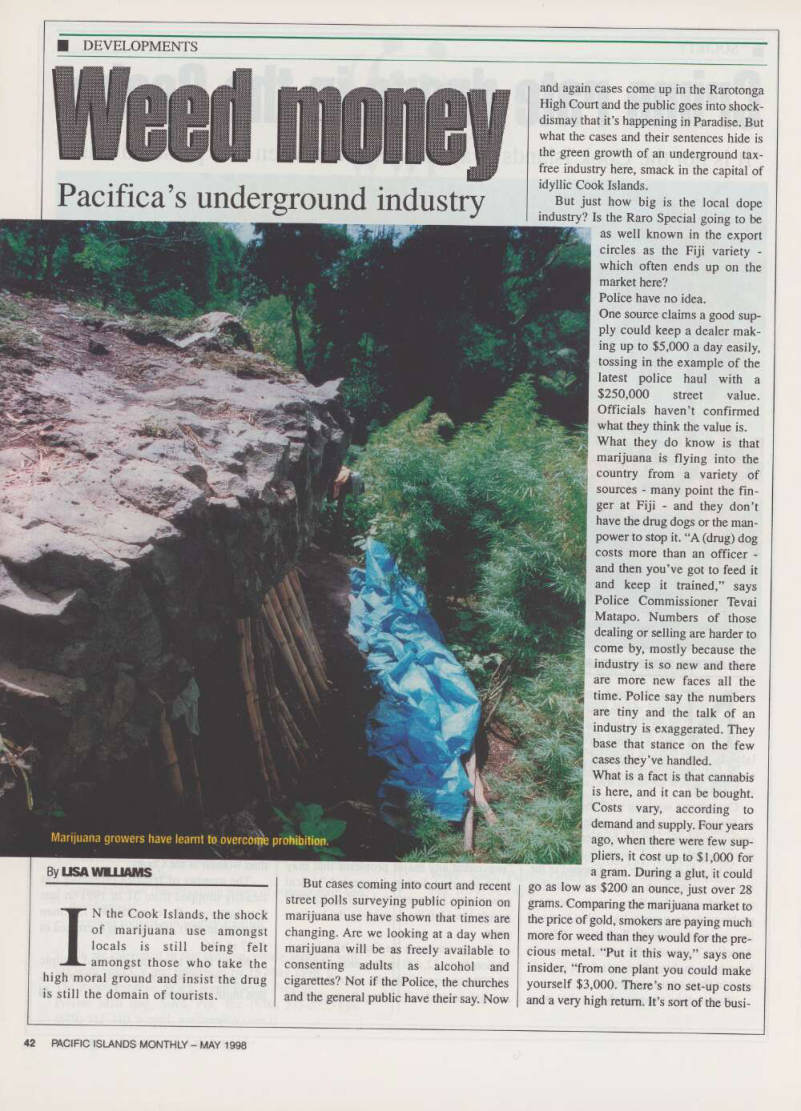
Marijuana growers have learnt to overcome prohibition.
ness everybody would like to have. It’s illegal but it’s out there.” A family man is currently facing charges in one of the biggest cannabis busts in the country - the 40-odd plants were much more than the one or two grown “for personal use”.
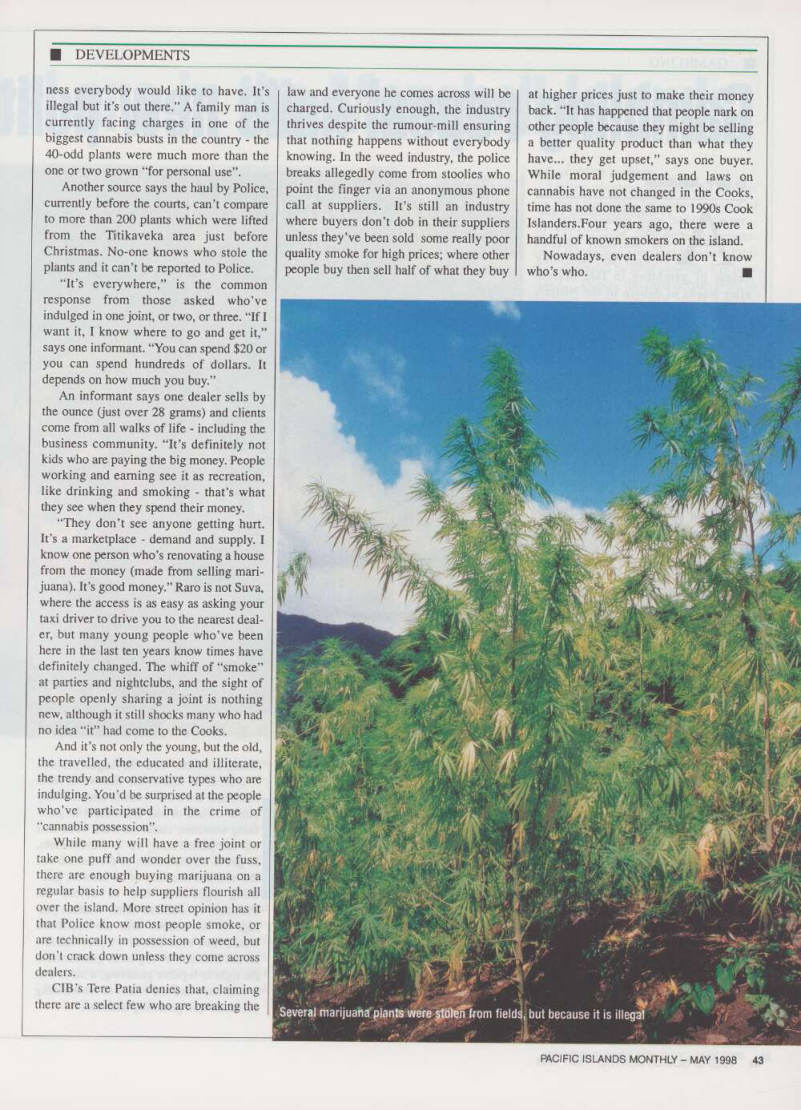
Another source says the haul by Police, currently before the courts, can’t compare to more than 200 plants which were lifted from the Titikaveka area just before Christmas. No-one knows who stole the plants and it can’t be reported to Police.
“It’s everywhere,” is the common response from those asked who’ve indulged in one joint, or two, or three. “If I want it, I know where to go and get it,” says one informant. “You can spend $2O or you can spend hundreds of dollars. It depends on how much you buy.”
An informant says one dealer sells by the ounce (just over 28 grams) and clients come from all walks of life - including the business community. “It’s definitely not kids who are paying the big money. People working and earning see it as recreation, like drinking and smoking - that’s what they see when they spend their money.
“They don’t see anyone getting hurt.
It’s a marketplace - demand and supply. I know one person who’s renovating a house from the money (made from selling mari juana). It’s good money.” Raro is not Suva, where the access is as easy as asking your taxi driver to drive you to the nearest deal er, but many young people who’ve been here in the last ten years know times have definitely changed. The whiff of “smoke” at parties and nightclubs, and the sight of people openly sharing a joint is nothing new, although it still shocks many who had no idea “it” had come to the Cooks.
And it’s not only the young, but the old, the travelled, the educated and illiterate, the trendy and conservative types who are indulging. You’d be surprised at the people who’ve participated in the crime of “cannabis possession”.
While many will have a free joint or take one puff and wonder over the fuss, there are enough buying marijuana on a regular basis to help suppliers flourish all over the island. More street opinion has it that Police know most people smoke, or are technically in possession of weed, but don't crack down unless they come across dealers.
ClB’s Tere Patia denies that, claiming there are a select few who are breaking the
law and everyone he comes across will be charged. Curiously enough, the industry thrives despite the rumour-mill ensuring that nothing happens without everybody knowing. In the weed industry, the police breaks allegedly come from stoolies who point the finger via an anonymous phone call at suppliers. It’s still an industry where buyers don’t dob in their suppliers unless they’ve been sold some really poor quality smoke for high prices; where other people buy then sell half of what they buy
at higher prices just to make their money back. “It has happened that people nark on other people because they might be selling a better quality product than what they have... they get upset,” says one buyer.
While moral judgement and laws on cannabis have not changed in the Cooks, time has not done the same to 1990 s Cook Islanders. Four years ago, there were a handful of known smokers on the island.
Nowadays, even dealers don’t know who’s who. ■
Several marijuana plants were stolen from fields, but because it is illegal