Has Bari burned his bridges?
pp. 36-37 · Read in the full issue
By Atama Ragan Ivatu
THE future in professional rugby of Manasa Bari, one of Fijian sport’s few superstars, is now very much in doubt after Otago high landers ditched him from the current Super Twelve Series. He breached his contract by playing in a rela tively meaningless sevens competition, and seriously injuring a shoulder, while holidaying at home. Bari also has a contract with Otago for the New Zealand National Provincial Championship, which extends through to 1999, and this too is in jeopardy.
“We will review Manasa’s situation closer to the time the NPC
commences (August),” John Hombrook, the Otago Rugby Union secretary was quoted as saying immediately after the Highlanders made their announcement.
Should Bari be banished from the professional rugby circuit, it will be a severe setback for a player who had seemed destined to suc ceed Waisale Serevi as the great shining light for the game in Fiji.
Ironically though, Bari preferred soccer until well into his mid teens. His birthplace, Tavua, is a hptbed of the round-ball code and his school, Tavua College, offered little encouragement to budding young rugby players.
It was after leaving school that Bari, realising he did not have the gifts to become a second Diego Maradona, turned to rugby and joined the Tavua Old Boys club.
Originally a halfback, he rapidly earned a reputation for himself as a player of immense promise fol lowing a switch to the wing.
However, it was a huge surprise when the selectors of Fiji’s national sevens side picked him for their squad to contest the 1994 International Sevens at Suva. Although his team were surprisingly beaten by Eastern Fiji in the final, Bari impressed sufficiently to be given a ticket to the prestigious Hong Kong Sevens.
Still two months short of his
twentieth birthday, the inexperi
enced Bari let nerves get the better of him at the Son Kon Po Stadium. Nonetheless, he scored two tries in both the games in which he appeared - against Portugal and South Korea in prelimi nary round encounters.
Amidst the fumbles and weak tackles, Bari’s immense poten tial was obvious enough for the Australian club Warringah to recruit him. Professional rugby had not been legalised then and the promise of a job and accommodation was all that Warringah could use to lure the Levuka teenager to Sydney’s North Shore.
For the unemployed Bari, who had been raised in the village of Tavualevu by his grandparents, that was enough and he set off for
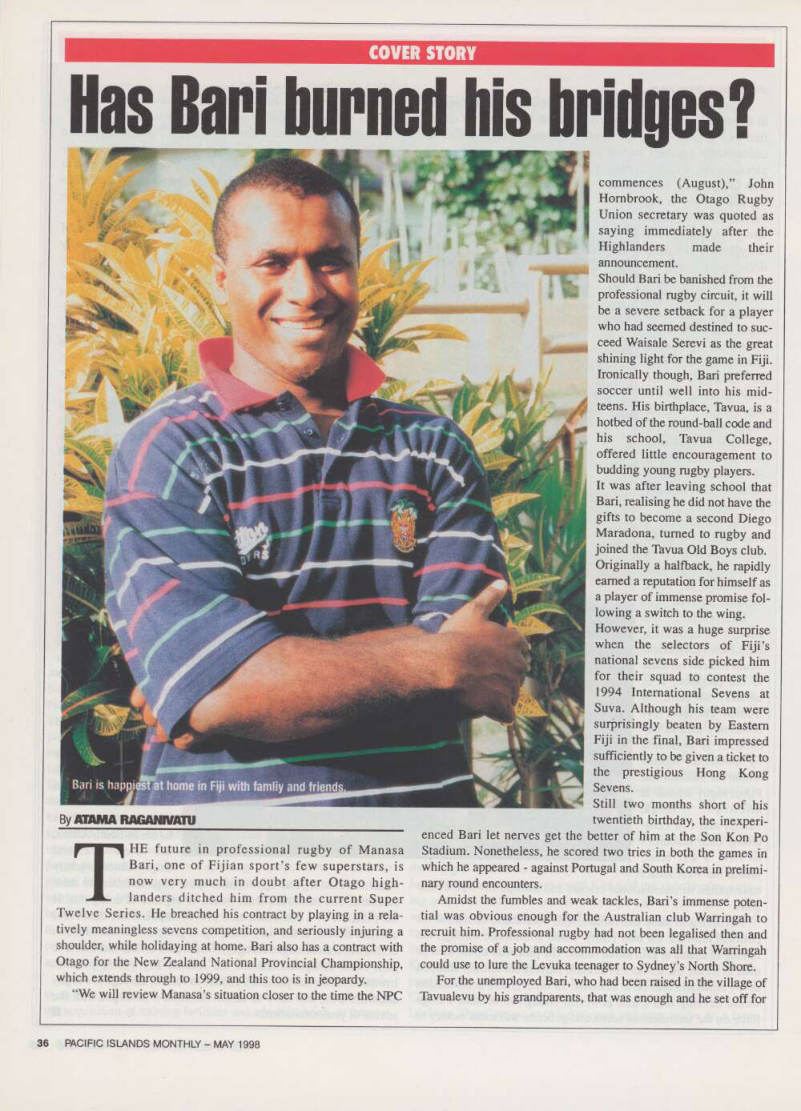
Bari is happiest at home In Fiji with family and friends.
an adventure in the “Big Smoke”. With Bari notching some cru cial tries, Warringah reached the Sydney competition final and his performances for them earned him a call up for the Australian Barbarians. Even so, Warringah decided against offering terms generous enough to tempt him into staying for the 1995 season and he returned to Fiji in time to win selection for his country’s Hong Kong Sevens expedition that year.
On this occasion he did himself full justice in the British terri tory then known as The Crown Colony. However, his enduring memory is of a refereeing error which robbed him of the chance to score what may well have been a crucial try in the final against New Zealand. Fiji lost 17-35. A star of the victorious New Zealand side was compatriot Joeli Vidiri. The Nausori Highlander’s defec tion to Kiwi rugby meant that a vacancy existed in Fiji’s 15-a-side selection and Bari filled it.
Bari claimed the most tries during Fiji’s tour to Wales and Ireland late in 1995, but abbreviated forms of rugby provided him with greater glory. He received the Player of the Tournament acco lades at the Japan Sevens, Air France Sevens in Paris and Brisbane’s Ballymore Tens. It was after the latter competition that Queensland rugby officials approached Bari and offered him the opportunity to show his wares in the Sunshine State.
Encouraged by Fiji team-mate Jacob Rauluni, already a Brisbane resident, and intent upon emulating another countryman.
Hie Tabua, who had gained considerable fame in Australia, Bari enthusiastically signed a contract with the Brothers club.
Reports initially coming out of Brisbane suggested that Bari was taking to Australian life and Australian rugby like the prover bial duck to water. He even talked about rejecting Fiji and setting his sights upon being with the Wallabies at the 1999 World Cup.
But complications soon arose. It transpired that Bari had also signed a contract with the Waikato Rugby Union in New Zealand and made a verbal commitment to Otago.
The Waikato offer was, potentially, the most lucrative of the
three and, suddenly, a career with them was the scenario he favoured. But, it became apparent only Brothers’ document was binding. In spite of that, it required a great deal of persuasion from Bari’s elders back in Tavualevu before he reluctantly agreed to take the field for Brothers.
Bari gritted his teeth and ably fulfilled his obligations to Brothers. However, any thoughts of wearing the green and gold of Australia were quickly forgotten and all hopes of a full appease ment between Brothers and Bari ended when they declined to release him for Fiji’s tour of New Zealand. Waikato, their attitude soured by the acrimonious tug-of-war with Brothers, lost interest in Bari and the Otago Rugby Football Union won his signature by default for 1997.
Bari’s form both with the Highlanders in the Super Twelve and Otago’s National Provincial Championship fluctuated. He had great difficulty in adjusting to the harsh cold of a lower south Island winter and an environment very different to Tavua.
His late return after playing a major role in Fiji’s World Sevens Cup win at Hong Kong, as well as the celebrations afterwards, did not endear him to Otago officials either. Nevertheless, Bari was, showing glimpses of his best towards the end of 1997 and the prospect of him and All Black Jeff Wilson sharing the wings at Carisbrook, this season, had Otago fans drooling with anticipa tion. Fiji desperately needs “The Black Pearl”, as he is affection ately known, honing his skills in the world’s toughest competi tions and, at 23 years of age, Bari still has plenty of time to prove his true worth, if given the scope to do so.
Short and stocky, he is a speedy and nippy opportunist who has been compared with the most venerated winger ever produced by Fiji - Senivalati Laulau. Despite Bari’s undeniable gifts, it is doubtful if he, given his track record, will readily find another Super Twelve or NPC team willing to provide a lifeline if Otago discard him. For the good of Fiji, Bari, and, in all probability, Otago, let us hope reconciliation is achieved. ■
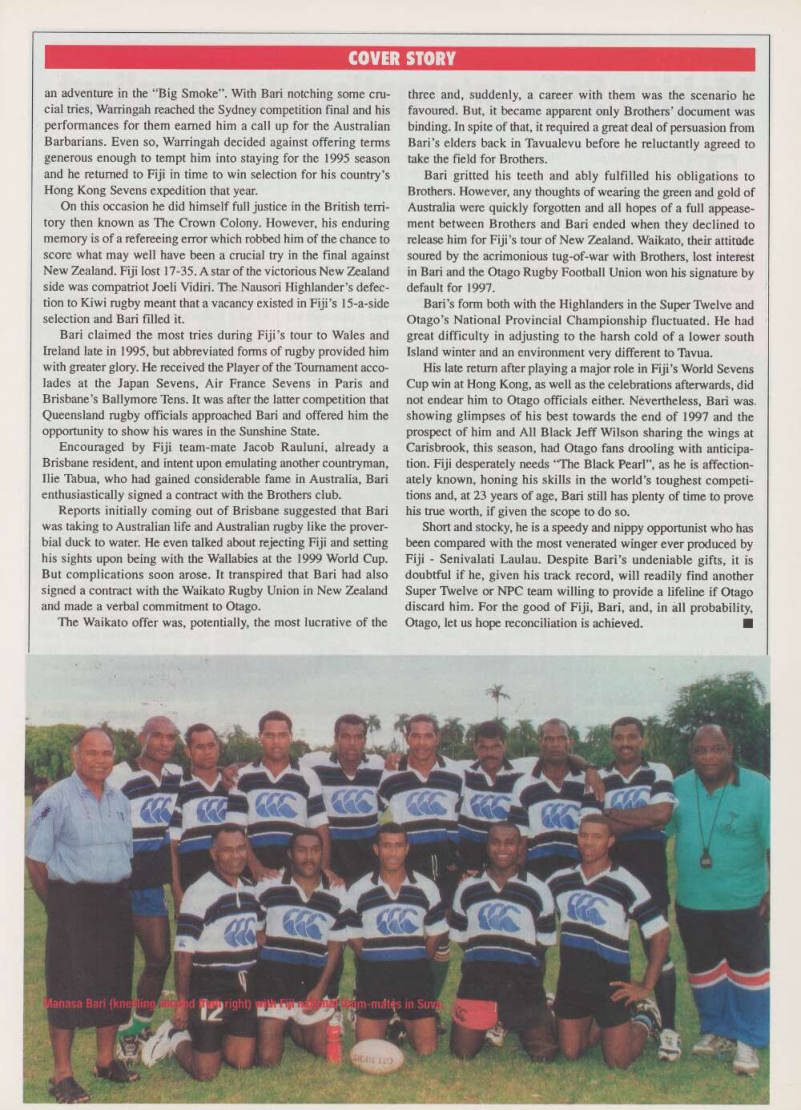
Manasa Bari (knecling second from right) with Fiji national team-mates in Suva.