Rugby becomes big business
pp. 32-35 · Read in the full issue
Cover Story
Professionalism creates new challenges for Pacific Rugby
By Atama Raganivatu
Most encyclopaedias
claim the chief exports of Fiji, Tonga and Samoa to be, respectively, sugar, coconut products and timber. However, if current trends continue, these commodities may soon be superseded in all three coun tries by professional rugby players.
Nobody has actually sat down and cal culated how much the economies of the trio benefit from “The Brawn Drain” mainly in the form of remittances sent to family back home - or even the number of Fijians, Tongans and Samoans currently playing overseas. Statistics revealed by such an exercise would, many people believe, be startling.
Although there are those who found that places like New Zealand were not paved with gold and returned home bitter ly disillusioned, nonetheless, the stream of players constantly travelling between the Pacific Islands and New Zealand has, gen erally speaking, been beneficial for both the individuals concerned and their Kiwi clubs.
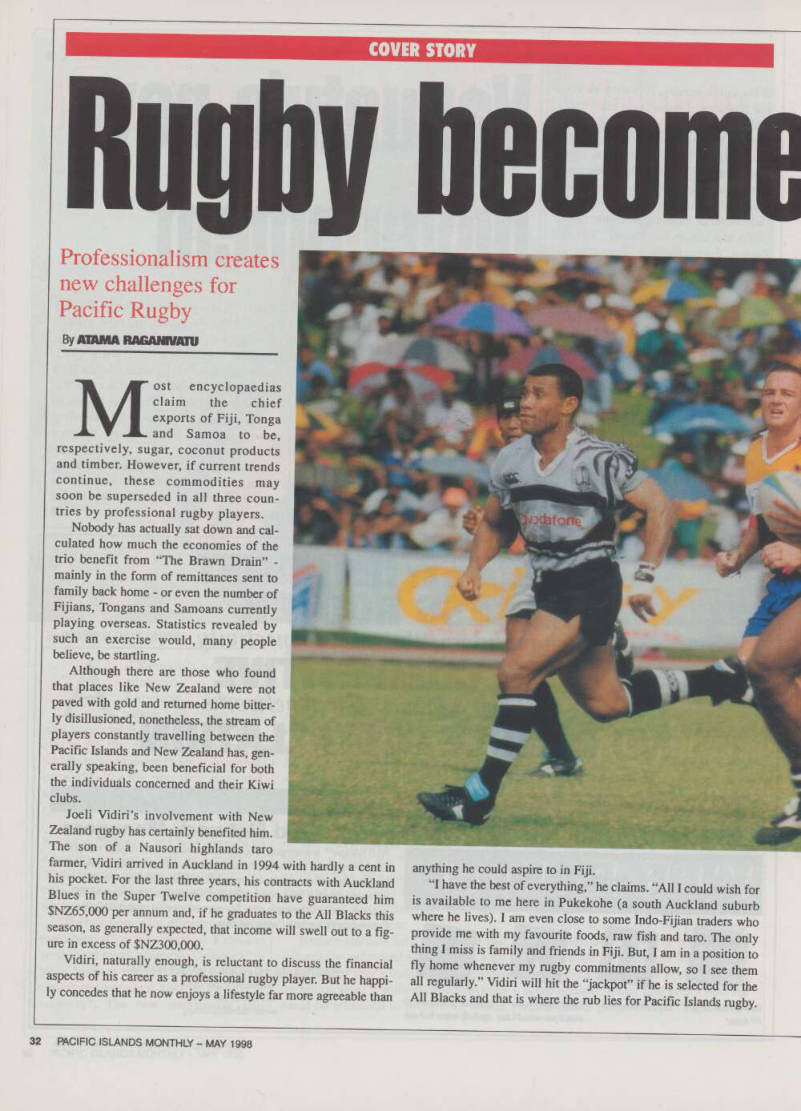
Joeli Vidiri’s involvement with New Zealand rugby has certainly benefited him.
The son of a Nausori highlands taro
farmer, Vidiri arrived in Auckland in 1994 with hardly a cent in his pocket. For the last three years, his contracts with Auckland Blues in the Super Twelve competition have guaranteed him $NZ65,000 per annum and, if he graduates to the All Blacks this season, as generally expected, that income will swell out to a fig ure in excess of SNZ3OO,OOO.
Vidiri, naturally enough, is reluctant to discuss the financial aspects of his career as a professional rugby player. But he happi ly concedes that he now enjoys a lifestyle far more agreeable than
anything he could aspire to in Fiji.
“I have the best of everything,” he claims. “All I could wish for is available to me here in Pukekohe (a south Auckland suburb where he lives). I am even close to some Indo-Fijian traders who provide me with my favourite foods, raw fish and taro. The only thing I miss is family and friends in Fiji. But, I am in a position to fly home whenever my rugby commitments allow, so I see them all regularly.” Vidiri will hit the “jackpot” if he is selected for the All Blacks and that is where the rub lies for Pacific Islands rugby.
To make really substantial amounts from their limited years of participation in the game, our players must make themselves avail able to other nations (most obviously Australia and New Zealand, though do not discount the British teams recruiting Pacific Islanders in the not too distant future). As a consequence, fewer and fewer gifted Tongan, Fijian and Samoan players are making themselves available for island combinations.
At the time of writing, 43 players of Pacific islands heritage were attached to Super Twelve squads. Just 13 of those have declared themselves accessible to the selectors of Fiji, Tonga and
Samoa. Only the most devout of national ists would blame the 30 who have reluc tantly (and make no mistake, the majority do it with great reluctant) forsaken their spiritual homes for the one chance they are likely to be given in life to secure the finan cial futures of both themselves and their families. Fiji, Tonga and Samoa have long had to be content playing cameo roles on the international rugby scene. It was British' soldiers who introduced the game to Fiji in 1880, however 33 years were to pass before the Fiji Rugby Union came into being.
The Marist Brothers religious order claims the honour of bringing rugby to Samoa at the beginning of this century, but the earli est recorded match in Tonga did not take place until 1923 - only a year before the Fiji and Western Samoa representative teams met each other for the first time. The Friendly Islands’ original club was not formed until 1939.
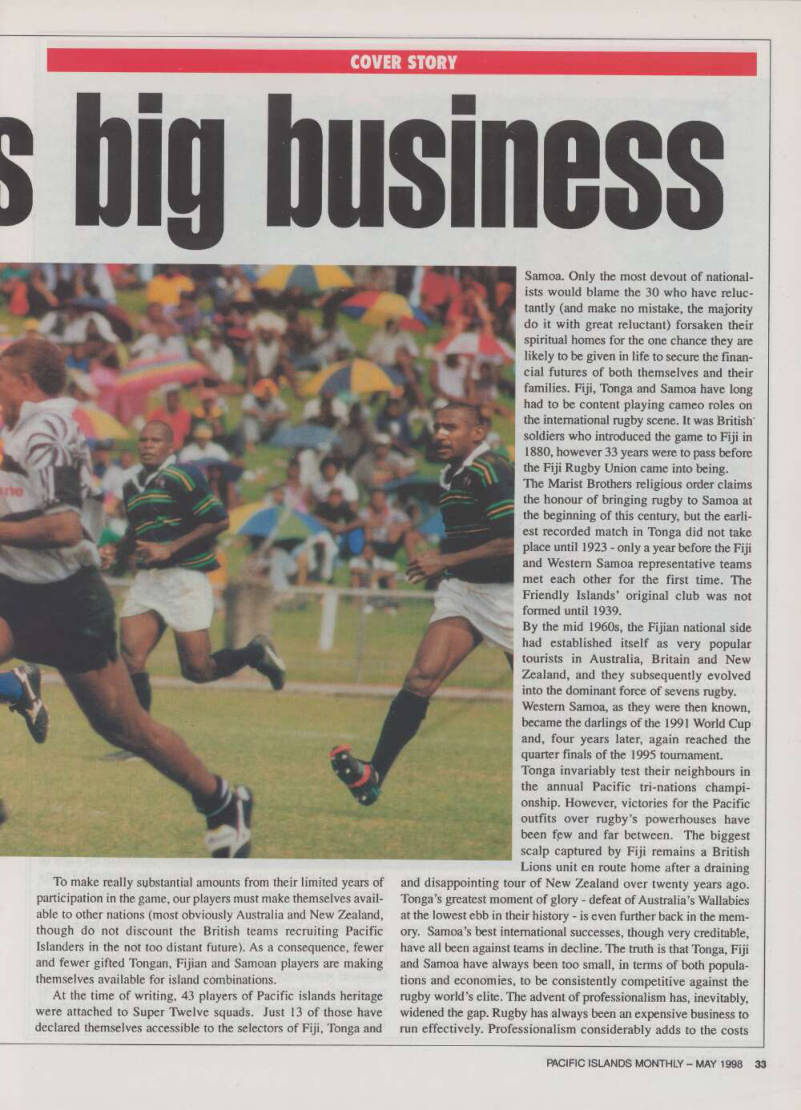
By the mid 19605, the Fijian national side had established itself as very popular tourists in Australia, Britain and New Zealand, and they subsequently evolved into the dominant force of sevens rugby.
Western Samoa, as they were then known, became the darlings of the 1991 World Cup and, four years later, again reached the quarter finals of the 1995 tournament.
Tonga invariably test their neighbours in the annual Pacific tri-nations champi onship. However, victories for the Pacific outfits over rugby’s powerhouses have been few and far between. The biggest scalp captured by Fiji remains a British Lions unit en route home after a draining
and disappointing tour of New Zealand over twenty years ago.
Tonga’s greatest moment of glory - defeat of Australia’s Wallabies at the lowest ebb in their history - is even further back in the mem ory. Samoa’s best international successes, though very creditable, have all been against teams in decline. The truth is that Tonga, Fiji and Samoa have always been too small, in terms of both popula tions and economies, to be consistently competitive against the rugby world’s elite. The advent of professionalism has, inevitably, widened the gap. Rugby has always been an expensive business to run effectively. Professionalism considerably adds to the costs
involved in the administration of the sport in Tonga, Fiji and Samoa, as those countries strive to avoid being left further behind New Zealand, Australia, South Africa, France and England.
Traditionally, the Pacific trio have relied heavily upon wealthy private benefactors’ generosity for funding. However, this is inad equate to meet today’s needs and corporate sponsorship is abso lutely essential for the development of rugby in the region.
Unfortunately, Fiji, Samoa, and Tonga do not offer value for money to any major would-be international sponsor wishing to adopt a team to provide world-wide exposure. Competition for the sponsors’ dollars has never been more intense, and sadly, the region’s teams have little to offer potential backers when com pared to thousands of other sporting organisations around the globe. Fay Richwhite’s sponsorship of Manu Samoa is, though neither party will disclose the actual amount involved, believed to be so large one is tempted to call the merchant bankers philan thropists rather than sponsors. However, it has been insufficient to prevent the majority of gifted Samoan players, eligible to repre sent both countries, opting for New Zealand rather than Samoa.
Lack of funding affects all facets of rugby, from junior match es at village level, through coaching, schools rugby, refereeing, the acquisition of training facilities and administration, to interna
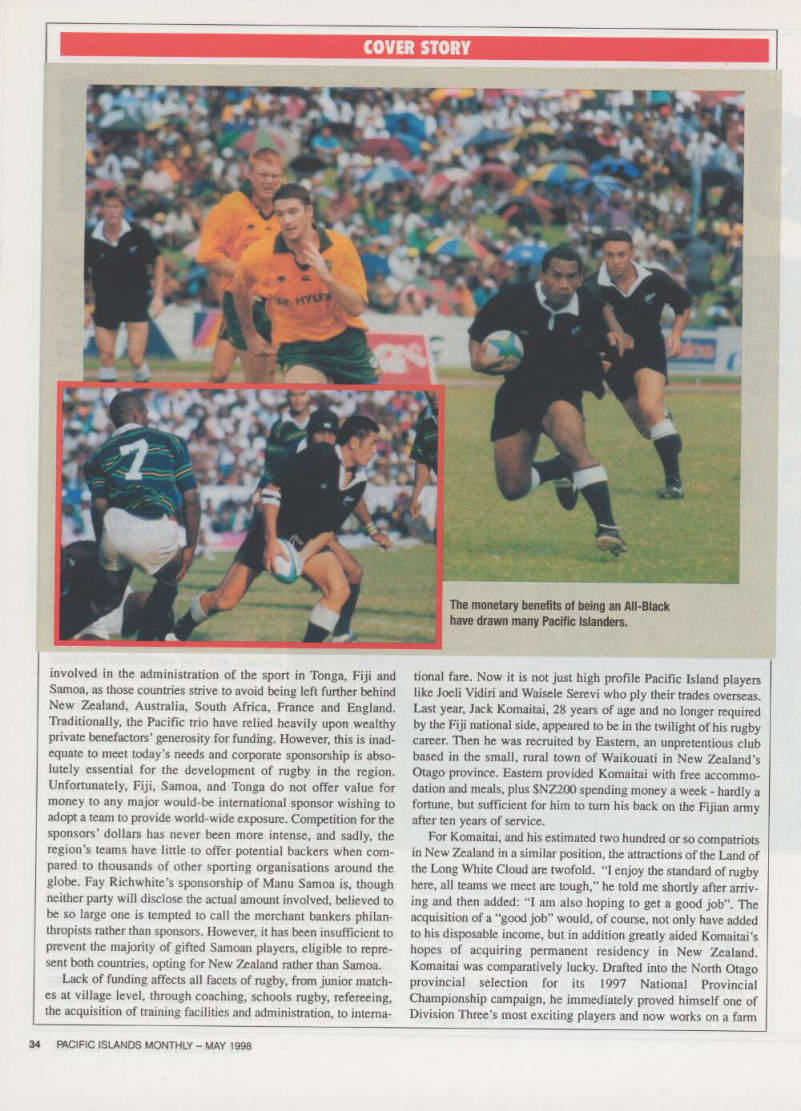
tional fare. Now it is not just high profile Pacific Island players like Joeli Vidiri and Waisele Serevi who ply their trades overseas.
Last year. Jack Komaitai, 28 years of age and no longer required by the Fiji national side, appeared to be in the twilight of his rugby career. Then he was recruited by Eastern, an unpretentious club based in the small, rural town of Waikouati in New Zealand’s Otago province. Eastern provided Komaitai with free accommo dation and meals, plus SNZ2OO spending money a week - hardly a fortune, but sufficient for him to turn his back on the Fijian army after ten years of service.
For Komaitai, and his estimated two hundred or so compatriots in New Zealand in a similar position, the attractions of the Land of the Long White Cloud are twofold. “I enjoy the standard of rugby here, all teams we meet are tough,” he told me shortly after arriv ing and then added: “I am also hoping to get a good job”. The acquisition of a “good job” would, of course, not only have added to his disposable income, but in addition greatly aided Komaitai’s hopes of acquiring permanent residency in New Zealand.
Komaitai was comparatively lucky. Drafted into the North Otago provincial selection for its 1997 National Provincial Championship campaign, he immediately proved himself one of Division Three’s most exciting players and now works on a farm
The monetary benefits of being an All-Black have drawn many Pacific Islanders.
owned by a team-mate.
Although some would question whether being a farm labourer in a remote and desolate nook of the South Island can be classi fied as “a good job”, the former Lebanon peace-keeper is undoubtedly satisfied with his current lot in life. “I am very pleased to have come to New Zealand,” he recently confirmed with a huge smile. Unless radical changes are made over the com
ing years, rugby in the Pacific will almost cer tainly continue to struggle, with our sides decimated not only by the poaching of Super Twelve teams but resurgent Australian rugby league clubs too.
Even the proposed introduction next year of a Pan Pacific
Championship, involv
ing Fiji, Samoa, Tonga, Canada, Japan, USA and Hong Kong, will not fill the coffers of our national admin istrative bodies to any great degree.
The fielding of a combined team in the Super Twelve is a more exciting and, potentially, far more lucrative concept.
But, such is the strength of opposition from New Zealand and South African officials to the proposal, it is unlikely to come to fruition. The most rev olutionary idea in cir culation is promoted by ambitious figures within the Samoan and Fijian rugby unions. It involves Tonga, Samoa and Fiji com bining their resources to form a test team, just as the West Indie's
have united in international cricket and Europe for Ryder Cup golf.
According to these individuals, who declined to be named for political reasons, the new entity would commence through the issuing of shares to gain initial funds. The proceeds would then be used to secure the services of suitable players not already snapped up by Australia and New Zealand. In theory, this combination would develop into a unit powerful enough to become a huge force on the international scene and generate sufficient money to
enhance all aspects of local rugby.
Although the young Turks rely a great deal upon sheer specu lation for their claims, the idea does have much merit.
Conservative elements within the Tongan, Fijian, and Samoan administrative bodies are much less enthusiastic, believing a unit ed team will diminish the standing of their individual countries in the international sporting arena. New Zealand Rugby Union office
bearers are even more vehement in opposi tion, because most of the players initially targeted are currently attached to their teams. But the Kiwi view is short-sighted.
Once a combined team starts producing significant revenue, money will be pumped into junior development and eventually all its members will be locally produced and locally based.
Anybody viewing col lege rugby in Fiji, Samoa, and Tonga could not fail to be impressed by the extraordinary poten tial of young players in the Pacific Islands.
It is a sign of the times that most of those stars of the future aspire to play for Australia or New Zealand.
This is another nega tive aspect a combined team might well elim inate. In view of the colossal cost of main taining professional teams and the uncer tainty of rugby’s future in South Africa, the New Zealand Rugby Union urgently
needs another regular opponent to draw huge numbers to their stadiums. The combined team would be capable of doing this. If the prospect of a combined side proves unpalatable, then local officials should, at the very least, try to promote the introduction of transfer fees throughout rugby. This would enable our teams to gain some compensation for the loss of key young players.
Irrespective of what path they choose to follow, the region’s rugby administrators will have to tackle immense challenges with the advent of professionalism. ■
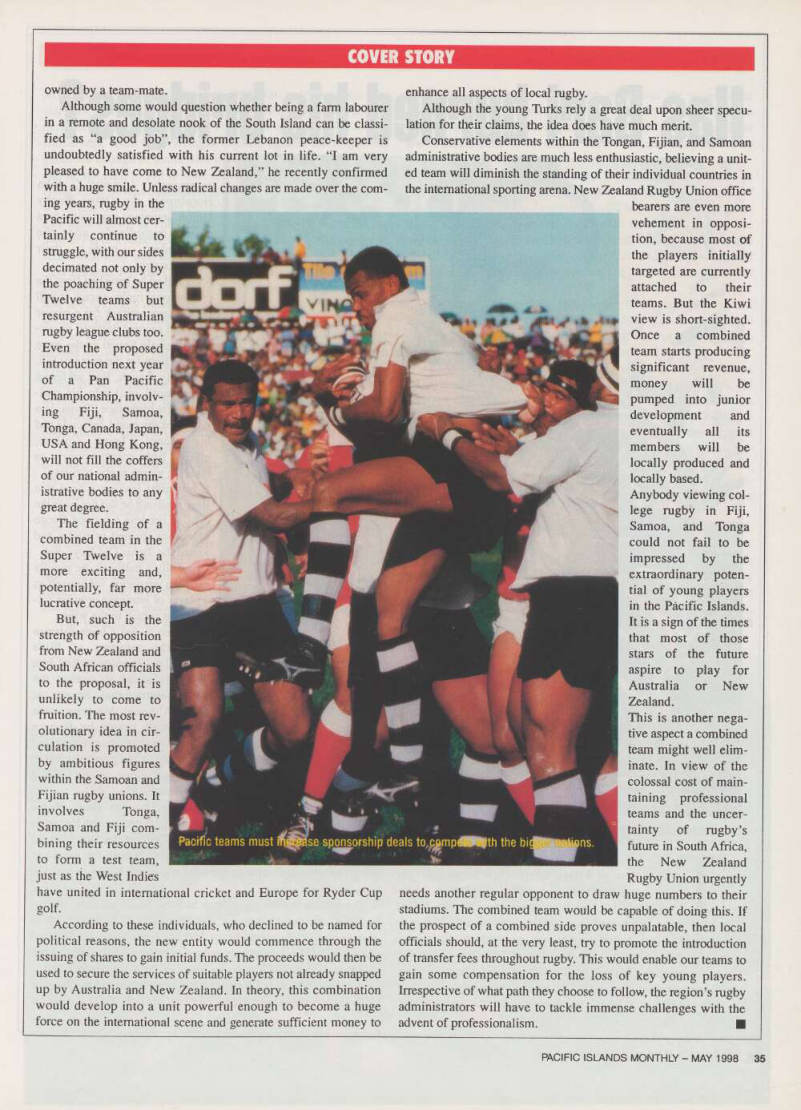
Pacific teams must increase sponsorship deals to compe[?]e with the biger nations.