Making SSEX internationally compliant
p. 38 · Read in the full issue
Stock Market
The smallest stock exchange in the world - in Suva, Fiji - is undergoing a review by a United Nations Development Project Mission to make sure it is internationally com pliant. The Suva Stock Exchange (SSEx) call market has been up and running for the past two years and the review comes as trading is starting to pick up.
The review will include a look at the operational, supervisory and regulatory framework within the Fiji stock market
and whether they are in compli ance with Capital Markets Development Authority requirements.
SSEx initially had four com panies listed on the big board but this has increased to eight this year. There are no restric tions on buying and selling of stock within the exchange other than Fijian Holdings Ltd, which allows for only indigenous Fijian stock ownership.
Other companies listed are bums Philp Toyota, Flour Mills of Fiji, Fiji Sugar Corporation, South Pacific Distilleries, Rewa Rice Ltd, Fiji Television, Carlton Brewery Fiji Ltd and Fijian Holdings. Buying and selling of listed stock must be done within the exchange as required by the CMDA.
With Fiji’s proposed tax on
all interest earned on deposits in banks, analysts predict that more people will be looking for alternative sources of invest ment.
The exchange was initially trading once a week but was forced to increase call times, and may continue to do so because of increasing demand.
“It all depends on the demand we get on the market for listed stock,” said the manager of the Suva Stock Exchange Mesake Nawari. SSEx had initially operat ed as a trading post.
At the moment, he said, the exchange was experiencing an average of 10 orders for each call session. And two more com panies, Vanua Levu-based Pacific Islands Gold and Emperor Gold Mining Ltd have
shown interest in getting listed.
“Since we opened the call market there has been an increased interest, not only from institutions but by private people as well,” Mr Nawari said.
“Business confidence is building in the people. There is a definite rise in investor confidence, which is a good indicator of an economy.” The local interest in buying and selling of stock piqued after a lot of pub licity was generated around a take-over bid recently. Rumours of a take-over bid fuelled interest and, when the order was
made, trading on the exchange was sus pended to give shareholders time to make up their minds. The take-over bid was suc cessful and this intrigued a lot of people in the capital because it was so public.
The idea of a Wall street in Suva City may be hard for some to grasp but SSEx has the works - brokers to take individual orders to buy or to sell (at a price), set trad ing times twice a week, links to interna
tional exchanges and just about everything
you can expect to get anywhere else. The exchange has available the latest financial reports and dividend amounts of listed
companies.
It deals with registered bonds including FDL (long-term), FDB (medium term) and the Credit Corporation tradeable term
deposit.
The recent demutualisation of Colonial Mutual Life saw more possibilities open up for local stockholders. They had the option to deal with the Suva exchange or directly with the Corporate Registry Service based in Melbourne. SSEx set up a scheme called the Suva Stock Exchange Colonial Small Shareholder Exit Scheme which negotiated stock selling for interest ed local Colonial stockholders.
The lowest stock holder for Colonial in Fiji stood at $1,500 in stock with shares
selling at a cost of 6.48 each.
“This scheme significantly min imised difficulties that Fiji resi dents wishing to buy or sell Colonial shares may have faced and also minimised transaction costs especially sales fees,”
Nawari said.
The same sort of dealing holds true for anyone holding stock in a foreign owned company who wants to trade from Fiji.
Shareholders of companies list ed on the Melbourne Exchange can buy and sell through the Suva exchange which is
equipped with overseas trading
facilities. Interested people can buy shares into companies like Goodman Fielder, ANZ, Cable and wireless, which are not list ed on the Suva exchange.
To get through a stock exchange, an order has to be
placed with the brokers. These are then brought to the market, although there is no actual trading between call market ses sions.
Trading occurs at 10.30 am every Monday and Thursday. Once an order is recorded during a call session, a market officer will issue the contract note number
(usually prepared by the appointed bro
ker). There is a note for both buyers and sellers.
Afterwards individual notes are sent to the exchange for clearance. Everyone is charged a selling cost of, at the most, 2.5 percent of stock traded on the day. This cost is shared between the Suva Stock exchange, the overseas brokers and the corporate registry in Melbourne. ■
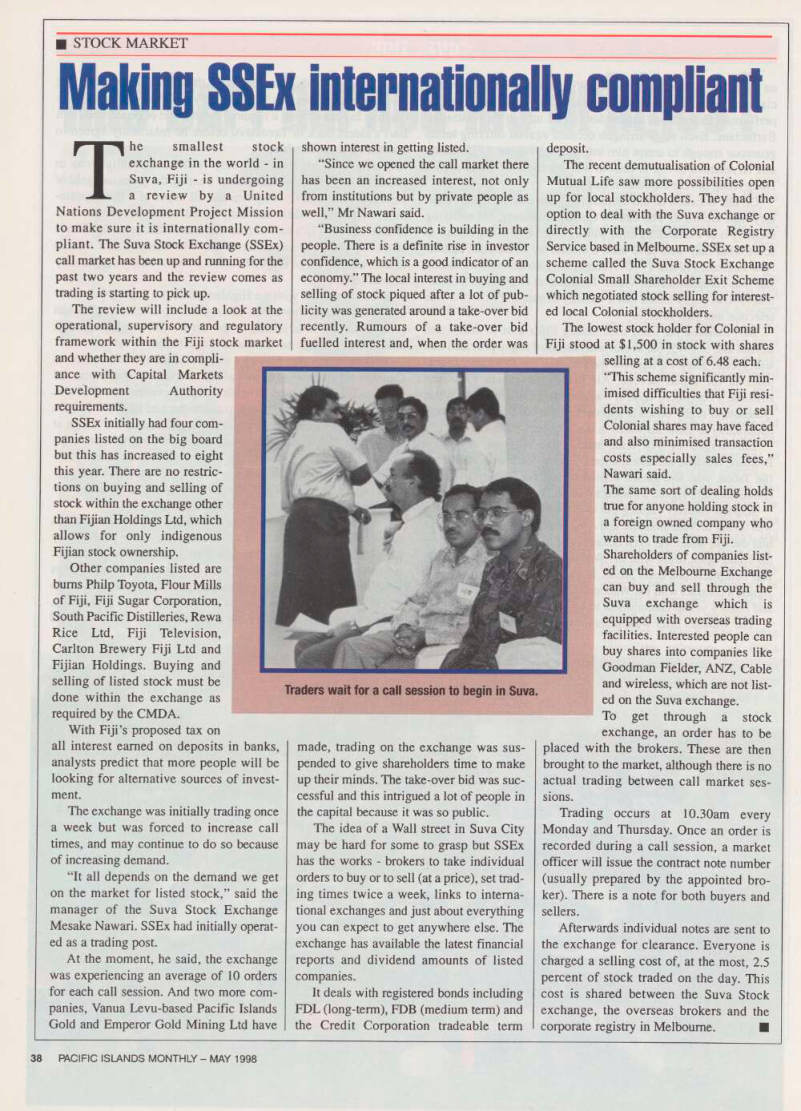
Traders wait for a call session to begin in Suva.