Disaster relief promises improve
pp. 16-17 · Read in the full issue
Majuro’s weather sta tion reports that the capital city received slightly over two inches of rain from January to March, or just eight percent of the norm.
But, as lines at three Japanese-donated water-making units grow and people wait half a day or more just to get five gallons of fresh water, even these rain figures seem exaggerated.
More than four months into the El Nino-caused drought, Marshall Islanders will tell you that when weather officials said this would be the worst El Nino drought ever, they weren’t kidding.
In early March, the Marshall Islands government declared the country a disaster area, appealing to the United States for emergency aid. President Clinton respond ed quickly with a disaster declaration, paving the way for Federal Emergency Management Agency aid.
Huge water makers arrived in April for Majuro and Ebeye, the two main urban centres, and smaller ones that can be car
ried on ships to provide fresh water to the outer islands most desperate for water.
While the emergency U.S. water aid will relieve some of the drought problem, by any account it has been a rough four months for many islanders.
It isn’t expected to improve significant ly until June and beyond, when the rains are predicted to return to about 70 percent of normal. As residents focus on the imme diate need to find a few gallons of water every day, no-one is talking about the long term consequences to crops and lens wells from the drought.
On April 3 in Majuro, it rained for sev eral minutes at a time throughout the after noon. Though this wasn’t what one would in normal times call a ‘real rain’, it prompt ed one local resident to exclaim exuberant ly: “It’s a miracle.” That’s how it felt, and that’s how long it’d been.
“We haven’t caught any rain since December 17,” said Majuro Water and Sewer Company general manager Bill Roberts. The water cuts which used to last for hours are now almost two weeks long
because there is no water in the govern ment reservoir. Majuro depends on rain for 90 percent of its fresh water, though a fresh lens on the atoll provides close to a million gallons of water each week.
With about 30,000 people living in the capital, and without rain to fill residents’ home catchments, residents consume at least two million gallons in one day. In early March, the Japanese government pro vided three small 2,000 gallon per day reverse-osmosis water-making machines for Majuro that convert ground water into drinkable water. They have provided many residents on Majuro with their only source of fresh water and people wait for hours to get their supply.
“We took our bottles down at 4 a.m. and we didn’t get them filled up until 2 in the afternoon,” said Tarkine Lavin. He got about 10 gallons for that 10 hour wait. The arrival at the end of March of a 16,000-gal lon-a-day water-maker from Japan speed ed up water availability.
The drought has made island residents extremely resourceful when it comes to
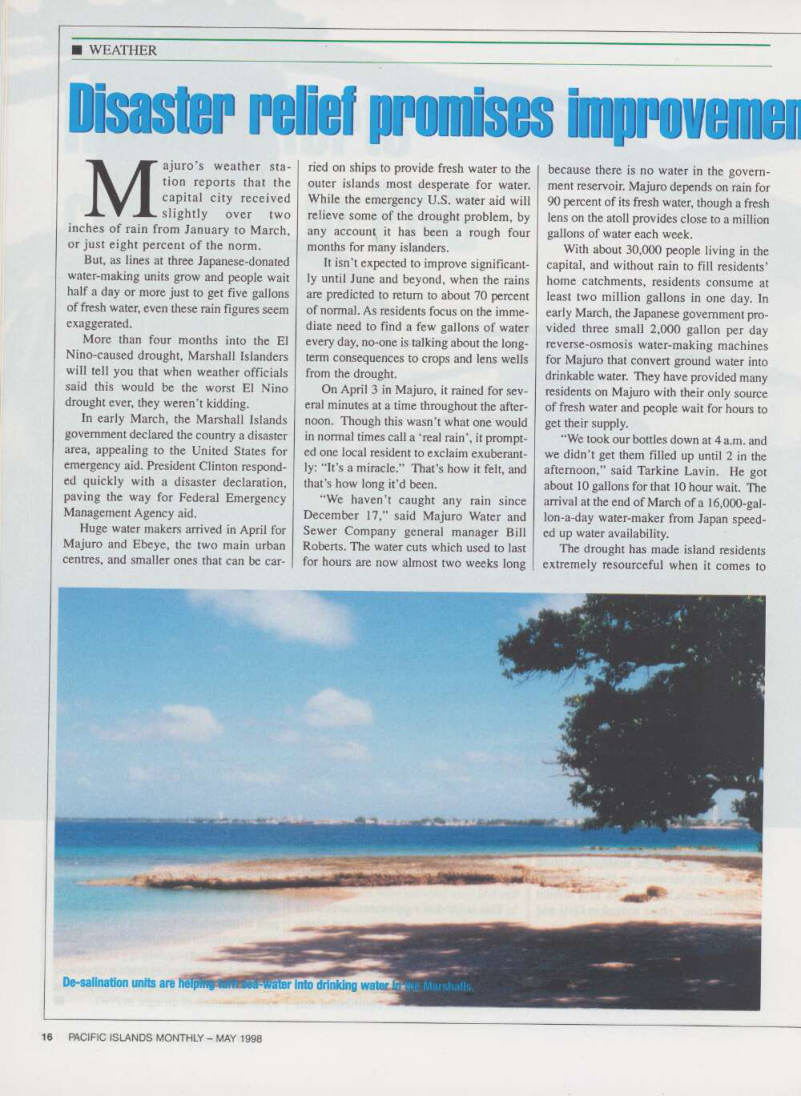
De-salination units are hilping wurn sea-water into drinking water in the Marshalls.
finding water. Air conditioners produce several gallons of clean run-off water a day. “It’s good for washing dishes or tak ing a bath,” said local resident Jeffrey Wase, adding that his family carefully col lects every drop from their household air conditioner.
A lot of people have dug their own ground wells, bucketing water by hand to get water for bathing and cooking. For the most part, though, everyone takes fewer showers.
As problematic as finding water is in Majuro, home to half the country’s 60,000 people, it’s nothing like Ebeye, the urban centre next to the U.S. Army’s Kwajalein missile testing range. At least Majuro has a massive underground lens that provides water, even though the amount is small.
Ebeye, on the other hand, has no fresh water resources.
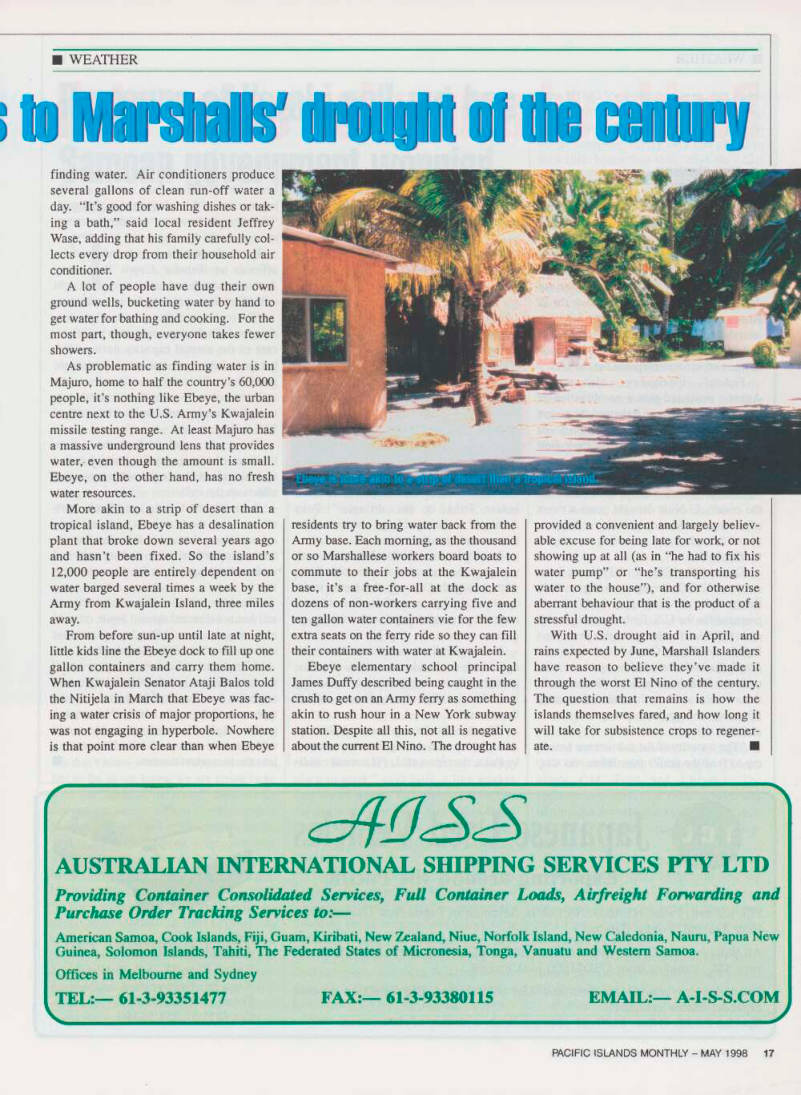
More akin to a strip of desert than a tropical island, Ebeye has a desalination plant that broke down several years ago and hasn’t been fixed. So the island’s
12,000 people are entirely dependent on
water barged several times a week by the Army from Kwajalein Island, three miles away.
From before sun-up until late at night, little kids line the Ebeye dock to fill up one gallon containers and carry them home.
When Kwajalein Senator Ataji Balos told the Nitijela in March that Ebeye was fac ing a water crisis of major proportions, he was not engaging in hyperbole. Nowhere is that point more clear than when Ebeye
residents try to bring water back from the Army base. Each morning, as the thousand or so Marshallese workers board boats to commute to their jobs at the Kwajalein base, it’s a free-for-all at the dock as dozens of non-workers carrying five and ten gallon water containers vie for the few extra seats on the ferry ride so they can fill their containers with water at Kwajalein.
Ebeye elementary school principal James Duffy described being caught in the crush to get on an Army ferry as something akin to rush hour in a New York subway station. Despite all this, not all is negative about the current El Nino. The drought has
provided a convenient and largely believ able excuse for being late for work, or not showing up at all (as in “he had to fix his water pump” or “he’s transporting his water to the house”), and for otherwise aberrant behaviour that is the product of a
stressful drought.
With U.S. drought aid in April, and rains expected by June, Marshall Islanders have reason to believe they’ve made it through the worst El Nino of the century.
The question that remains is how the islands themselves fared, and how long it will take for subsistence crops to regener ate. ■
Ebeye is more akin to a st[?]p of desert than a tropical Island.