Relief efforts
pp. 14-15 · Read in the full issue

Weather
Relief efforts continue in PNG
By Sam Vulum
Old Puso forced herself out of bed to make sure the local nurse returned from town with bags of rice from her daughter.
This would support the family while waiting for the gardens to produce again following the recent devastation of the El Nino drought.
The nurse, from the village aid post, had to set out early on foot from the moun tain village to be in time to catch a coastal ship several kilometres down the coast.
The nurse was visiting town for medi cal supplies to cater for the increasing number of people suffering from diseases in the aftermath of the drought. In normal circumstances she would collect the sup plies from the district health centre.
However that, too, ran out of stock.
Puso received her supply but there are thousands of others in her area and in other parts of the country who are not so fortu nate. Some are still living off wild foods while others are heavily dependent on
relief supplies.
The Australian aid agency AusAID which is leading the relief efforts, placed the figure at about 54,000 down from 60,000 at the height of the crisis.
Although gardens have started produc ing since the first rain in December last year, it will be May before they can start living off them. AusAID head in PNG Annmaree O’Keeffe said the concern now was to supply food aid until the gardens were sustainable.
But Kiriwina drought committee chair man Anthony Douwa, from the Milne Bay province, reported affected people were not receiving supplies. He called on the provincial authorities and disaster commit tees to physically assess the drought situa
tion in the province.
Douwa said the situation in the districts was worsening yet the teams had not been visiting them. In the Kaiapit district in the Morobe Province, 10 villages had not received any relief supplies since relief operations began last year.
The Churches of Christ disaster relief coordinator Dr Tobey Huff said people there did not receive any supplies because most of it had been used by villages in the valley.
When approached by village elders, authorities said there was a lack of funds. Dr Huff said. He then contacted the national disaster office which put him to the provin cial disaster office, which promised to supply food. But, in the end,
nothing happened.
“They assured me the supplies were going out that week to the whole area... They lied,” he said. Dr Huff said while the church had organised to fly in tonnes of rice to the area, their work was hindered after the only airstrip in the area was closed due to heavy rainfall.
In another worrying report from the Western Highlands province, the increased fertility of the soil and the heavy rains in recent months, affected the formation of kaukau tubers.
Kaukau, or sweet potato, is the staple diet of the people in the Highlands. The vines, shoots and leaves of kaukau plants in new gardens were growing very fast and that this was retarding the development of tubers.
Provincial authorities fear the drought relief operations may have to be extended in the region because of this development.
Reports from Southern Highlands, Chimbu
and Enga also indicated that kaukau gar dens, made soon after the drought and frost, yielded none or underdeveloped tubers. This means the food shortage is going to continue.
In the Oro province, caterpillars have been destroying the gardens in the worst affected areas of Tufi, Safia, Asimba and Kira. Oro’s executive officer to the admin istrator Titus Hatagen said some of these
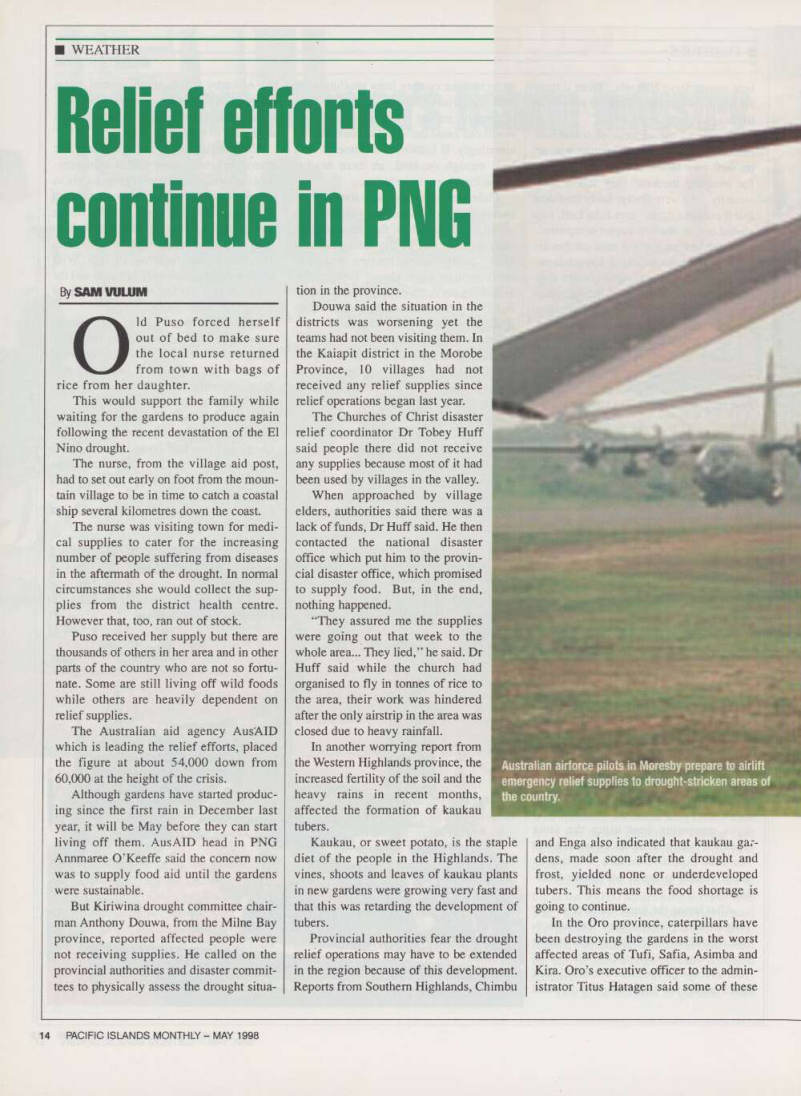
Australian airforce pilots in Moresby prepare to airlift emergency relief supplies to drought-stricken areas of the country.
areas had not improved as expected and it will take longer for the situation to return to normal. Meanwhile 45 of the 400 tonnes of seeds in AusAlD’s $ 1.2 million “rehabilitation” phase arrived in PNG and have being distributed.
Forty-two tonnes of potato seedlings arrived in Port Moresby and 3.5 tonnes in Lae and 14 tonnes to areas in central province. The next phase of AusAlD’s relief efforts is to help crop production.
With the Department of Agriculture and Livestock, it has distributed seeds of quick-growing crops throughout the coun try.
This is for diet supplements until main crops such as sweet potatoes can yield.
Since October last year, the Australian government has committed some $3O mil lion to the drought relief effort.
These funds are in addition to the $3OO million which Australia contributed this
financial year under the PNG-Australia Development Co-operation Treaty. The $3O million has gone towards purchasing food in PNG, the Australian Defence Force air operation, technical assistance and sup port of other relief activities by Australian non-govemment aid organisations.
With the on-going delivery of vegetable seeds and quick growing crops to revitalise gardens quickly, an end may yet be in sight to the aftermath of drought in PNG. ■