Fine-tunin g Samoa's fisti ng industry
pp. 12-13 · Read in the full issue
Fisheries
By Chris Peieru
again in November. Earnings for 1997 topped SUS7.S million, over half of the island state’s entire export revenues. In 1995 the Central Bank figure for fish sales abroad was zero.
Small wonder then why Samoans with no previous interest in the fishing industry are falling over each other to hook some of the action out on the waves.
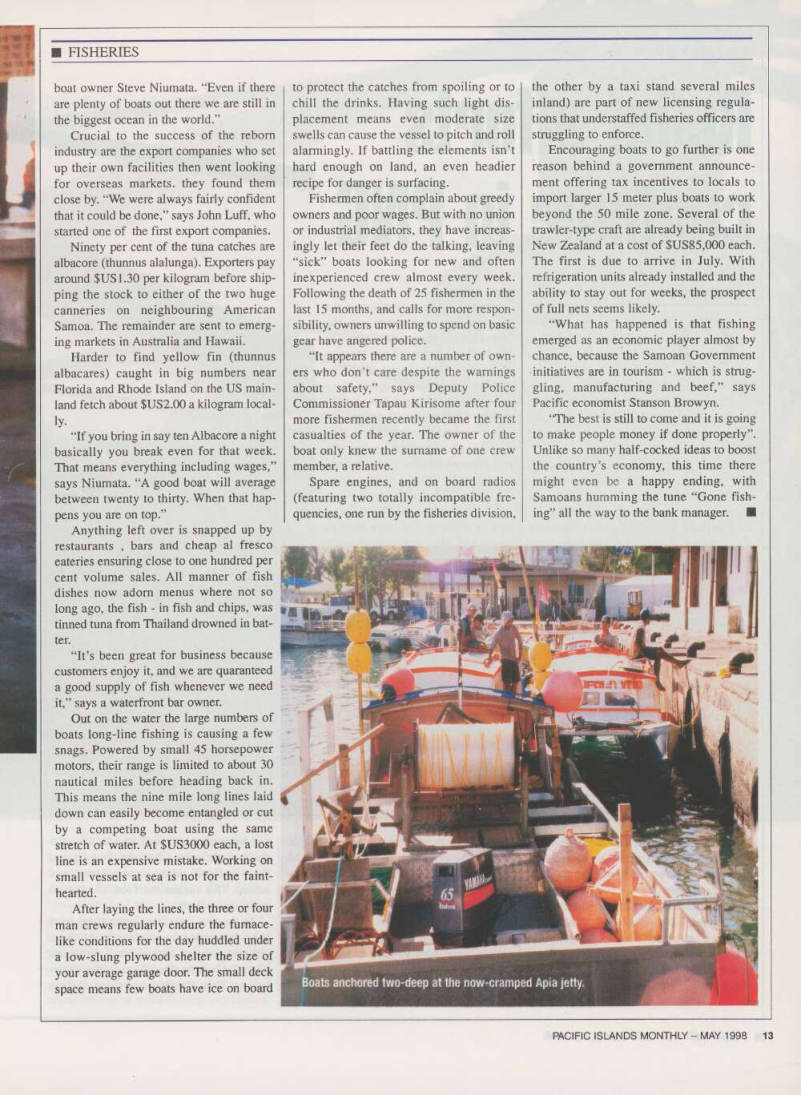
Boat builders have struggled to keep up with demand. From just a handful of boats plying the shallow harbour reef 18 months ago, the Fisheries Department has issued licences to 135 boats moored two abreast
along a now jammed Apia jetty. The huge increase testified to the score of people who splashed out about SUS 13,000 each for a ten meter aluminium fishing boat broadly based on a traditional outrigger design.
Potentially the financial rewards are as big as the 95,800 square kilometres of blue water that marks out the boundaries around the islands. Compared to other Pacific islands, that amount of ocean is quite small but still remains a huge virtually untapped resource.
“This is the business to get into,” says
IN Samoa commercial tuna fishing is now the country’s number one export earner.
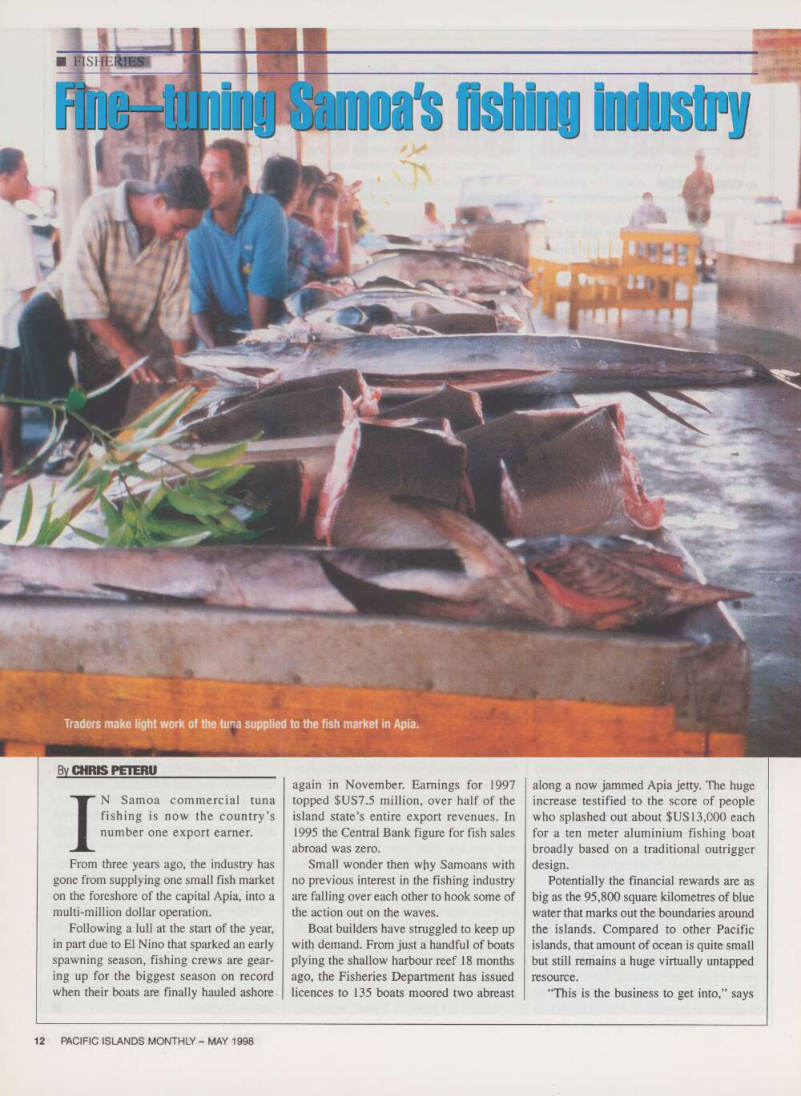
From three years ago, the industry has gone from supplying one small fish market on the foreshore of the capital Apia, into a multi-million dollar operation.
Following a lull at the start of the year, in part due to El Nino that sparked an early spawning season, fishing crews are gear ing up for the biggest season on record when their boats are finally hauled ashore
Traders make light work of the tuna supplied to the fish market in Apia.
boat owner Steve Niumata. “Even if there are plenty of boats out there we are still in the biggest ocean in the world.”
Crucial to the success of the reborn industry are the export companies who set up their own facilities then went looking for overseas markets, they found them close by. “We were always fairly confident that it could be done,” says John Luff, who started one of the first export companies.
Ninety per cent of the tuna catches are albacore (thunnus alalunga). Exporters pay around SUSI.3O per kilogram before ship ping the stock to either of the two huge canneries on neighbouring American Samoa. The remainder are sent to emerg ing markets in Australia and Hawaii.
Harder to find yellow fin (thunnus albacares) caught in big numbers near Florida and Rhode Island on the US main land fetch about SUS2.OO a kilogram local ly- “If you bring in say ten Albacore a night basically you break even for that week.
That means everything including wages,” says Niumata. “A good boat will average between twenty to thirty. When that hap pens you are on top.”
Anything left over is snapped up by restaurants , bars and cheap al fresco eateries ensuring close to one hundred per cent volume sales. All manner of fish dishes now adorn menus where not so long ago, the fish - in fish and chips, was tinned tuna from Thailand drowned in bat ter.
“It’s been great for business because customers enjoy it, and we are quaranteed a good supply of fish whenever we need it,” says a waterfront bar owner.
Out on the water the large numbers of boats long-line fishing is causing a few snags. Powered by small 45 horsepower motors, their range is limited to about 30 nautical miles before heading back in.
This means the nine mile long lines laid down can easily become entangled or cut by a competing boat using the same stretch of water. At SUS3OOO each, a lost line is an expensive mistake. Working on small vessels at sea is not for the faint hearted.
After laying the lines, the three or four man crews regularly endure the furnace like conditions for the day huddled under a low-slung plywood shelter the size of your average garage door. The small deck space means few boats have ice on board
to protect the catches from spoiling or to chill the drinks. Having such light dis placement means even moderate size swells can cause the vessel to pitch and roll alarmingly. If battling the elements isn’t hard enough on land, an even headier recipe for danger is surfacing.
Fishermen often complain about greedy owners and poor wages. But with no union or industrial mediators, they have increas ingly let their feet do the talking, leaving “sick” boats looking for new and often inexperienced crew almost every week.
Following the death of 25 fishermen in the last 15 months, and calls for more respon sibility, owners unwilling to spend on basic gear have angered police.
“It appears there are a number of own ers who don’t care despite the warnings about safety,” says Deputy Police Commissioner Tapau Kirisome after four more fishermen recently became the first casualties of the year. The owner of the boat only knew the surname of one crew member, a relative.
Spare engines, and on board radios (featuring two totally incompatible fre quencies, one run by the fisheries division.
the other by a taxi stand several miles inland) are part of new licensing regula tions that understaffed fisheries officers are struggling to enforce.
Encouraging boats to go further is one reason behind a government announce ment offering tax incentives to locals to import larger 15 meter plus boats to work beyond the 50 mile zone. Several of the trawler-type craft are already being built in New Zealand at a cost of SUSBS,OOO each.
The first is due to arrive in July. With refrigeration units already installed and the ability to stay out for weeks, the prospect of full nets seems likely.
“What has happened is that fishing emerged as an economic player almost by chance, because the Samoan Government initiatives are in tourism - which is strug gling, manufacturing and beef,” says Pacific economist Stanson Browyn.
“The best is still to come and it is going to make people money if done properly”.
Unlike so many half-cocked ideas to boost the country’s economy, this time there might even be a happy ending, with Samoans humming the tune “Gone fish ing” all the way to the bank manager. ■
Boats anchored two-deep at the now-cramped Apia jetty.