A cattle thief for a PM?
p. 11 · Read in the full issue
Politics
By Chris Peteru
Forgetting today what you
said yesterday has always been important for surviv
ing in politics.
But finding out that Samoa’s Prime Minister Tofilau Eti Alesana was convicted of cattle theft following months of govern ment denials is alarmingly unforgettable.
Nine months ago MPs from the islands 49 seat parliament were reaching for the tissues as angry words were hurled between the ruling Human Rights Protection Party and the Samoa National Development Party.
The reason was SNDP leader Tupua Tamasese had tabled a police file stating that in 1966 a 41-year-old high chief, Vaaelua Eti a.k.a. Alesana was convicted of cattle theft.
“Samoa, I have never stolen anything in my life, because I am the son of a church minister,” he responded to the allegation.
The government claimed that the oppo sition was trying to destabilise the country by making outrageous statements that could not be justified.
Speaker of the House Toleafoa Faafisi refused to accept the police file saying it was not authentic.
Taking the floor Deputy PM Tuilaepa Malielegaoi added, “this cannot be an offi cial police card, the government coat of arms is missing... and there is no signature from any police officer.”
As government diatribe turned misty eyed condemning Tamasese, Tuilaepa moved for him to be suspended from the House for the rest of the parliamentary term. The mood turned soggier still as MP Fuimaono Mimio begged for Tamasese to
be forgiven.
An emotional Prime Minister accepted the apology. However, Tamasese refused to withdraw his statement.
To clear the good name of the Prime Minister, Police Commissioner Asi Blakelock and Justice Secretary Pierre Meredith were requested by the govern ment to confirm whether Alesana had a criminal record. “I wish to inform you that there are no documents or other records to
show that the leader of government was ever charged with theft,” wrote Meredith to parliament days later.
“I refer to your request and indicate that I have no knowledge of the existence of any records,” said the police commission er.
Just lately the picture changed dramati cally, when a subdued Malielegaoi announced during a weekly press confer ence that police had found Alesana’s file confirming the theft convictions. For his part, he was fined along with 27 other men from Lalomalava village over the slaughter of several cattle.
“The Prime Minister has agreed to these charges, but remember these things he was accused of made it appear that the PM him self went and stole something. No, now it is very clear, it was a decision done by the village.”
He said there was a big difference between what the PM was accused of and what was now known. If the file had not been found, he said, the PM too would not have understood because the decision was so old. The PM, Malielegaoi said, just for got.
Even if his memory lapsed, what gov
emment found out wasn’t exactly a revela tion. They were probably the last people in the world to suspect their leader may have, indeed, misunderstood something.
In a small community of 167,400 peo ple, in the end there are no secrets. And now everyone knows that the PM has a colourful past.
Opposition leader Tamasese believes the discovery of the file was connected to a defamatory libel court case between Alesana and the national Samoa Observer newspaper.
“One assumes that the police would not have discovered the Prime Minister’s crim inal file if it wasn’t for the fact that the file was cited and produced in the Observers defence statement in the pending court case,” he claimed.
For its part, the Observer said in an edi torial that the whole affair “smelt of a cover-up”.
Under the constitution, any member of parliament with a criminal record has to give up his seat and a by-election held. A Supreme Court challenge by the Opposition against Tofilau could now be on the cards and would have huge ramifi cations if upheld. ■
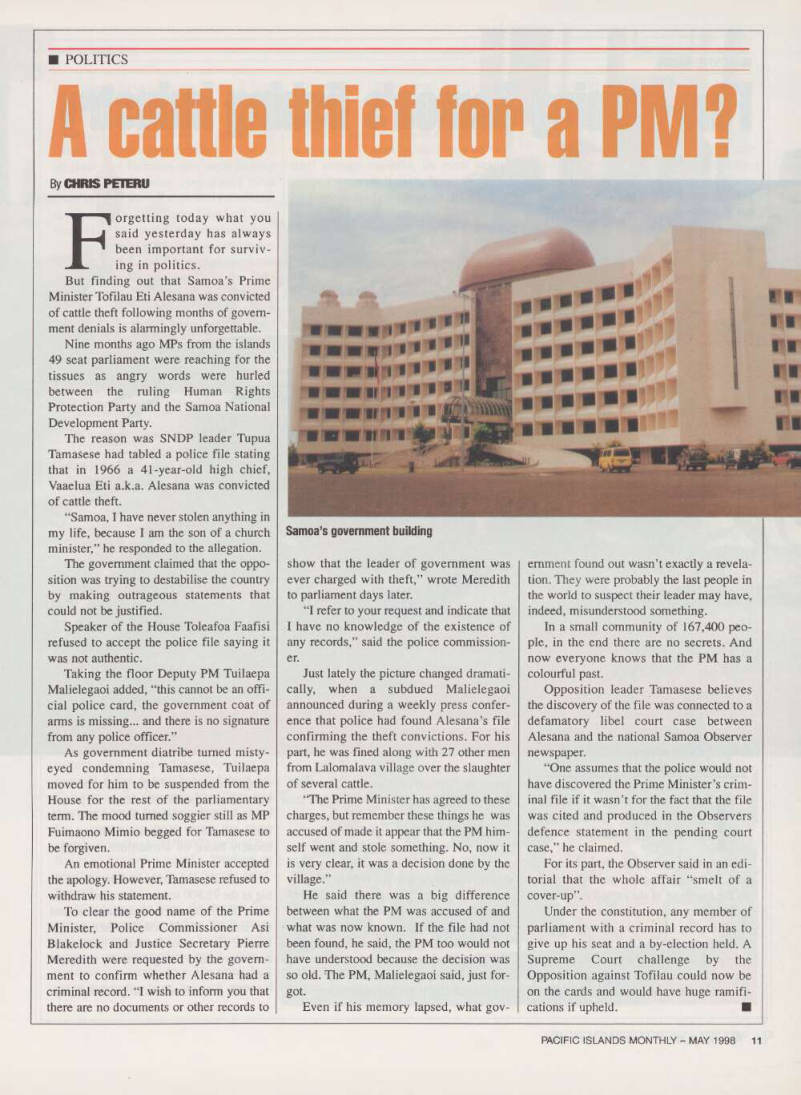
Samoa’s government building