Double whammy for outer atoll
p. 18 · Read in the full issue
By Giff Johnson
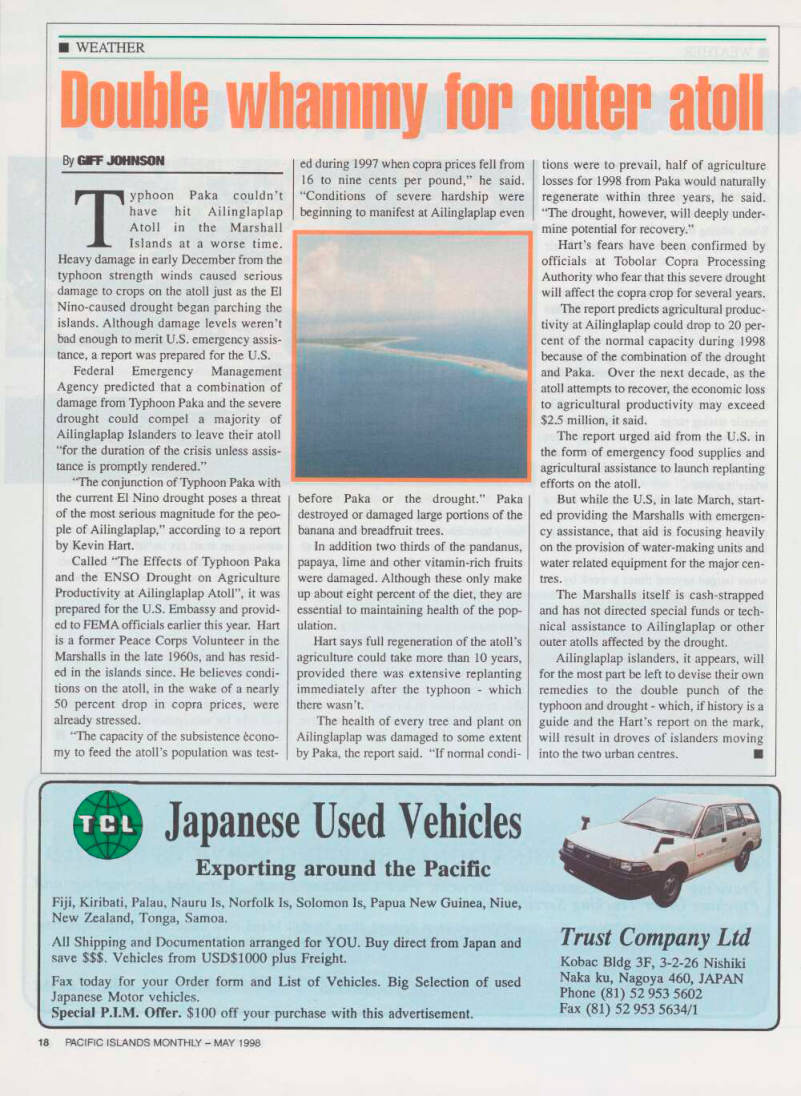
Typhoon Paka couldn’t have hit Ailinglaplap Atoll in the Marshall Islands at a worse time.
Heavy damage in early December from the typhoon strength winds caused serious damage to crops on the atoll just as the El Nino-caused drought began parching the islands. Although damage levels weren’t bad enough to merit U.S. emergency assis tance, a report was prepared for the U.S.
Federal Emergency Management Agency predicted that a combination of damage from Typhoon Paka and the severe drought could compel a majority of Ailinglaplap Islanders to leave their atoll “for the duration of the crisis unless assis tance is promptly rendered.”
“The conjunction of Typhoon Paka with the current El Nino drought poses a threat of the most serious magnitude for the peo ple of Ailinglaplap,” according to a report by Kevin Hart.
Called “The Effects of Typhoon Paka and the ENSO Drought on Agriculture Productivity at Ailinglaplap Atoll”, it was prepared for the U.S. Embassy and provid ed to FEMA officials earlier this year. Hart is a former Peace Corps Volunteer in the Marshalls in the late 19605, and has resid ed in the islands since. He believes condi tions on the atoll, in the wake of a nearly 50 percent drop in copra prices, were already stressed.
“The capacity of the subsistence econo my to feed the atoll’s population was test
ed during 1997 when copra prices fell from 16 to nine cents per pound,” he said, “Conditions of severe hardship were beginning to manifest at Ailinglaplap even
before Paka or the drought.” Paka destroyed or damaged large portions of the banana and breadfruit trees.
In addition two thirds of the pandanus, papaya, lime and other vitamin-rich fruits were damaged. Although these only make up about eight percent of the diet, they are essential to maintaining health of the pop ulation.
Hart says full regeneration of the atoll’s agriculture could take more than 10 years, provided there was extensive replanting immediately after the typhoon - which there wasn’t.
The health of every tree and plant on Ailinglaplap was damaged to some extent by Paka, the report said. “If normal condi
tions were to prevail, half of agriculture losses for 1998 from Paka would naturally regenerate within three years, he said.
“The drought, however, will deeply under mine potential for recovery.”
Hart’s fears have been confirmed by officials at Tobolar Copra Processing Authority who fear that this severe drought will affect the copra crop for several years.
The report predicts agricultural produc tivity at Ailinglaplap could drop to 20 per cent of the normal capacity during 1998 because of the combination of the drought and Paka. Over the next decade, as the atoll attempts to recover, the economic loss to agricultural productivity may exceed $2.5 million, it said.
The report urged aid from the U.S. in the form of emergency food supplies and agricultural assistance to launch replanting efforts on the atoll.
But while the U.S, in late March, start ed providing the Marshalls with emergen cy assistance, that aid is focusing heavily on the provision of water-making units and water related equipment for the major cen tres.
The Marshalls itself is cash-strapped and has not directed special funds or tech nical assistance to Ailinglaplap or other outer atolls affected by the drought.
Ailinglaplap islanders, it appears, will for the most part be left to devise their own remedies to the double punch of the typhoon and drought - which, if history is a guide and the Hart’s report on the mark, will result in droves of islanders moving into the two urban centres. ■