Academy to help develop soccer in the region
p. 44 · Read in the full issue
By Atama Raganivatu
The recent announcement that a youth soccer acade my would be built to accommodate young play ers from throughout the Oceania region was greeted with elation, as it is recognised as the most constructive step yet taken to improve the standard of the world’s most popular sport in the Pacific Islands.
Although Australians and New Zealanders will be in residence as well, the Pacific Island nations are likely to be the main beneficiaries, due to the acade my giving their most promising junior players sustained access to the highest quality of coaching for the first time.
The SUS9OO,OOO academy, to be based in Auckland, New Zealand, is scheduled to open in May this year. The initial costs are to be met with a loan from international soccer’s ruling body, FIFA, which will be interest and collater al free. Into the bargain (and the transac tion must be regarded as an extraordinary bargain), repayment can be financed in full from only a portion of the cash FIFA will inject into the area through receipts acquired from the 1998 World Cup finals.
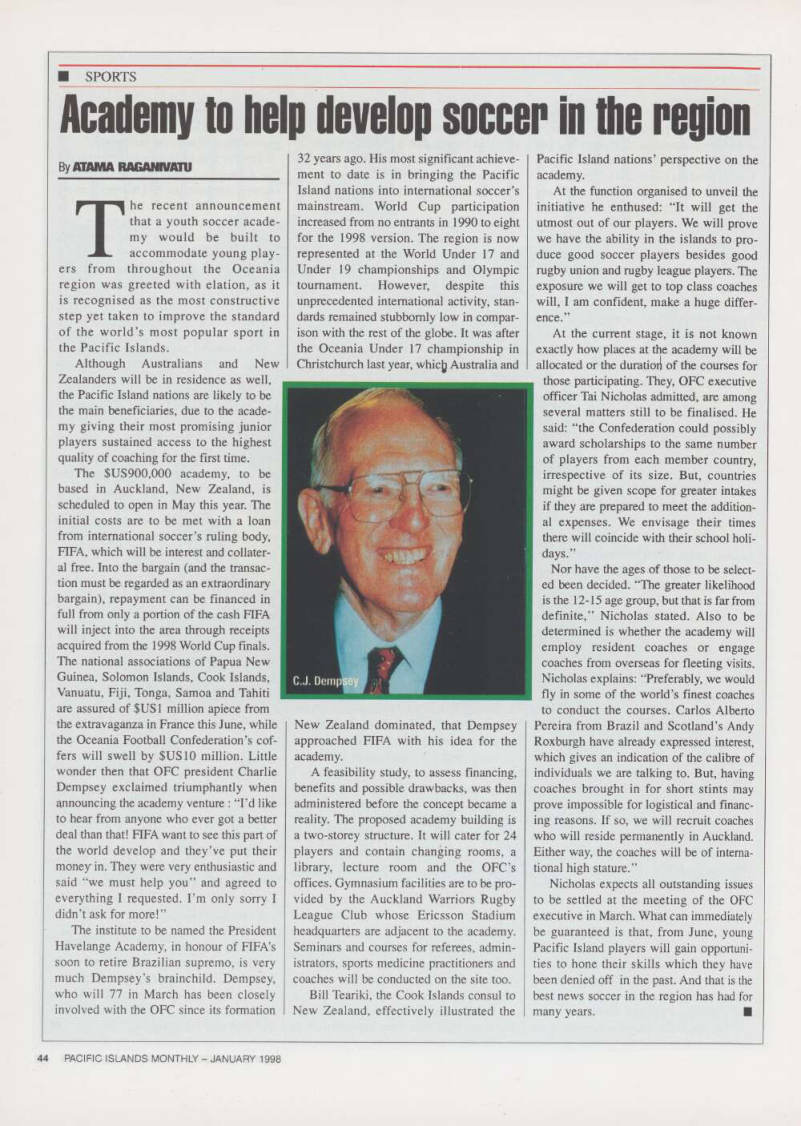
The national associations of Papua New Guinea, Solomon Islands, Cook Islands, Vanuatu, Fiji, Tonga, Samoa and Tahiti are assured of SUSI million apiece from the extravaganza in France this June, while the Oceania Football Confederation’s cof fers will swell by SUSIO million. Little wonder then that OFC president Charlie
Dempsey exclaimed triumphantly when
announcing the academy venture : “I’d like to hear from anyone who ever got a better deal than that! FIFA want to see this part of the world develop and they’ve put their money in. They were very enthusiastic and said “we must help you” and agreed to everything I requested. I’m only sorry I didn’t ask for more!”
The institute to be named the President Havelange Academy, in honour of FIFA’s soon to retire Brazilian supremo, is very
much Dempsey’s brainchild. Dempsey,
who will 77 in March has been closely involved with the OFC since its formation
32 years ago. His most significant achieve ment to date is in bringing the Pacific Island nations into international soccer’s mainstream. World Cup participation increased from no entrants in 1990 to eight for the 1998 version. The region is now represented at the World Under 17 and Under 19 championships and Olympic tournament. However, despite this unprecedented international activity, stan dards remained stubbornly low in compar ison with the rest of the globe. It was after the Oceania Under 17 championship in Christchurch last year, whicjj Australia and
New Zealand dominated, that Dempsey approached FIFA with his idea for the academy.
A feasibility study, to assess financing, benefits and possible drawbacks, was then administered before the concept became a reality. The proposed academy building is a two-storey structure. It will cater for 24 players and contain changing rooms, a library, lecture room and the OFC’s offices. Gymnasium facilities are to be pro vided by the Auckland Warriors Rugby League Club whose Ericsson Stadium headquarters are adjacent to the academy.
Seminars and courses for referees, admin istrators, sports medicine practitioners and coaches will be conducted on the site too.
Bill Teariki, the Cook Islands consul to New Zealand, effectively illustrated the
Pacific Island nations’ perspective on the academy.
At the function organised to unveil the initiative he enthused: “It will get the utmost out of our players. We will prove we have the ability in the islands to pro duce good soccer players besides good rugby union and rugby league players. The exposure we will get to top class coaches will, I am confident, make a huge differ ence.”
At the current stage, it is not known exactly how places at the academy will be allocated or the duratioii of the courses for those participating. They, OFC executive officer Tai Nicholas admitted, are among several matters still to be finalised. He said; “the Confederation could possibly award scholarships to the same number of players from each member country, irrespective of its size. But, countries might be given scope for greater intakes if they are prepared to meet the addition al expenses. We envisage their times there will coincide with their school holi days.”
Nor have the ages of those to be select ed been decided. “The greater likelihood is the 12-15 age group, but that is far from definite,” Nicholas stated. Also to be determined is whether the academy will employ resident coaches or engage coaches from overseas for fleeting visits.
Nicholas explains: “Preferably, we would fly in some of the world’s finest coaches to conduct the courses. Carlos Alberto Pereira from Brazil and Scotland’s Andy Roxburgh have already expressed interest, which gives an indication of the calibre of individuals we are talking to. But, having coaches brought in for short stints may prove impossible for logistical and financ ing reasons. If so, we will recruit coaches who will reside permanently in Auckland.
Either way, the coaches will be of interna tional high stature.”
Nicholas expects all outstanding issues to be settled at the meeting of the OFC executive in March. What can immediately be guaranteed is that, from June, young Pacific Island players will gain opportuni ties to hone their skills which they have been denied off in the past. And that is the best news soccer in the region has had for many years. ■
C. J. Dempsey