Pacific Islands

Monthly
INSIDE: SHIPLEY - THE REGION’S FIRST FEMALE LEADER
sďśdsdsds
Corruption!
The Pacific drag
American Samoa US$2.5O; Australia A 53.50; Cook Islands NZ$3; Fiji F 52.50 Vat incl; FS Micronesia US$3; Kiribati A 52.50; Nauru A 52.50; Niue NZ$3; Norfolk As 3: New Caledonia cpf2so; New Zealand NZ53.45 incl GST; Northern Marianas US$3; Papua New Guinea K 3; Palau US$3: Marshall Islands US$3; Solomon Islands As 3; French Polynesia cpf3oo; Tonga P 3; USA US$3; Vanuatu VT22O; Western Samoa T 5.50. These are recommended prices only.
Advertisements & other items, p. 2 (1 item)
|{T)} Telikom
you don’t have to travel to Papua New Guinea to experience the glamour and the uniqueness of the culture and environment. JUST dail 675 Part of this nature-gifted country remains mysterious and untouched.
With over 700 languages, diverse cultures, towering mountains, tropical rain forests, wild life, superb marine life and has abundance in natural resources. As a young country, Papua New Guinea has a promising Tourism Manger Marketing Tourism Promotion Authority PO Box 1291 Port Moresby NCD Papua New Guinea.
Tel: 1675) 320 0211 Fax: t*7 5 > 320 0223 investment future and has in store unique tourism potential. No wonder this young country boasts a tropical paradise for adventures and discoveries.
Telikom has the only state-of-the-art telecommunications network links within Papua New Guinea and to anywhere around the world. Now, use 675 to call to a country you’ve never heard of for a unique opportunity.
Investment Director Marketing Investment Poromotion PO Box 5053 Boroko NCD Paoua New Guinea Tel: (675) 321 7311 Fax: (67s) 321 2819 1
|{t)} TELIKOM
|V| / ***' 4Uki*r
Telecommunication Assistant General Manager Telikom Marketing Department PO Box 291 Waigani NCD Papua New Guinea Tel: (675! 300 5564 Fax: (675) 300 5540/5541
Pacifjcklands
Vol 67 No. 13
The News Magazine
January 1998
PUBLISHER: Alan Robinson ACTING EDITOR: Bernadette Hussain SENIOR WRITER; Bernadette Hussain
Correspondents:
Sally Andrew. Patrick Decloitre, Giff Johnson, Chris Peteru, Susan Prokop, Atama Raganivatu, Michael Field. Liz Thompson, Lili Tuwai, Sam Vulum, lan Williams COLUMNISTS: David Barber (Wellington), Jemima Garrett (Sydney), Debbie Singh (South Pacific Commission).
GRAPHIC ARTISTS: James Ranuku, Josefa Bola, Andrew Williams
Advertising Sales
Senior Regional Sales (South Pacific) Shabana Naaz Tel (679) 304111,303244, Fax (679) 303809.
Sydney, Canberra: Bob Hill Media Representation, Tel (61-2) 4164245, Fax (61-2) 4165064.
Brisbane: Jane Fewings Media and Advertising Associates Tel (61-7) 3378 4522, Fax (61-7)3878 1071.
Adelaide: Hastwell Williamsons Representatives, Tel (61-8) 3799522, Fax (61-8) 3799735.
Melbourne: Brown Orr Fletcher Burrows (Aust) Pty Ltd.
Tel (61-3) 98265188, Fax (61-3) 98265644.
Auckland: McKay & Bowman, International Media Representatives Limited, Tel (64-9)4190561, Fax (64-9) 4192243.
Japan: Universal Media Corporation, Tokyo, Tel (3) 3266626741, Cable; UNI-MEDIA Tokyo, Fax (3) 32626742.
Pacific Islands Monthly was founded in 1930
(Usps 9522480).
A Fiji Times Limited production.
Cover prices are recommended retail only. Registered by Australia Post, Publication No. NBPI2IO. © Copyright Fiji Times Limited, 177 Victoria Parade, Suva, Fiji.
Tel (679) 304111, fax (679) 303809.
Email: [email protected] PIM Website: http://www.pim.com.fj Pacific Islands Monthly is published monthly by Fiji Times Limited, a division of Nationwide News, 2 Holt Street, Surry Hills, Sydney, NSW 2010.
Send Address Changes To:
Pacific Islands Monthly POBox 1167 Suva, Fiji.
Typeset and printed by The Fiji Times Limited, 177 Victoria Parade, Suva, Fiji.
Layout and cover design by Andrew Williams
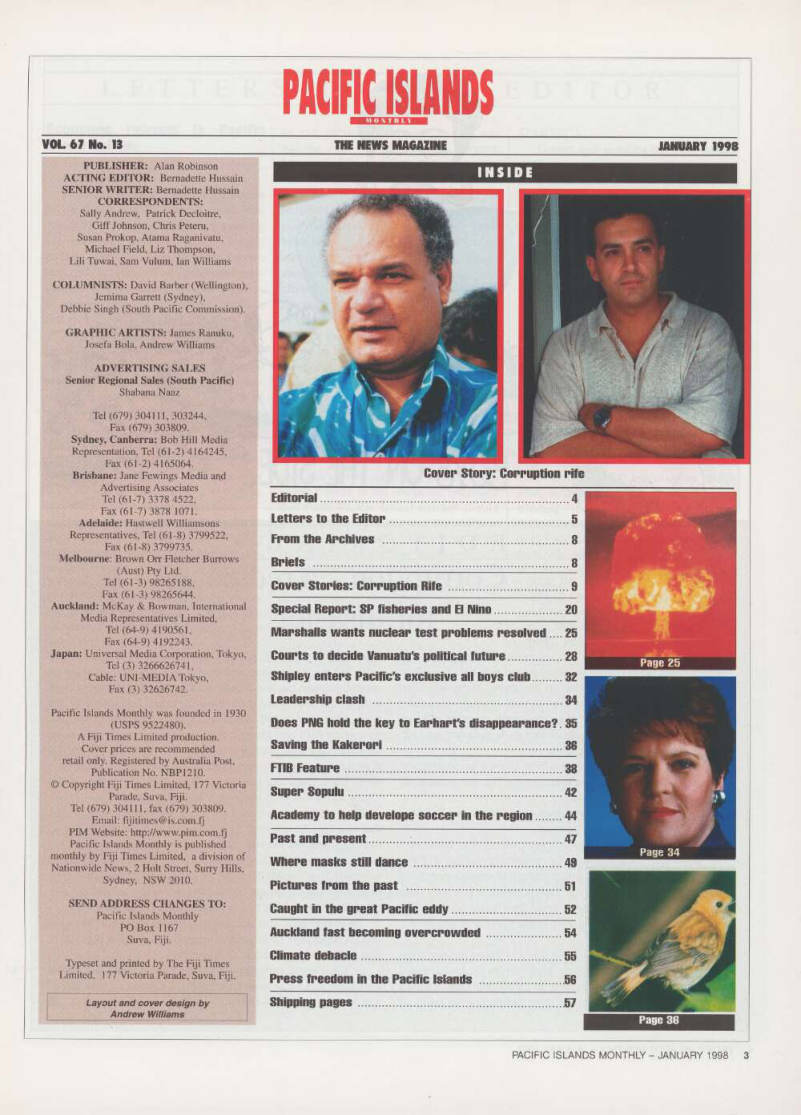
Inside
Editorial 4 Letters to the Editor 5 From the Archives 8 Briefs 8 Cover Stories: Corruption Rife 8 Special Report: SP fisheries and El Nino 20 Marshalls wants nuclear test problems resolved. .. . 25 Courts to decide Vanuatu's political future 28 Shipley enters Pacific's exclusive all boys club 32 Leadership clash 34 Does PNG hold the key to Earhart's disappearance?. 35 Saving the Kakerori 36 FTIB Feature 38 Super Sopulu 42 Academy to help develope soccer in the region 44 Past and present 47 Where masks still dance 49 Pictures from the past 51 Caught in the great Pacific eddy 52 Auckland fast becoming overcrowded 54 Climate debacle 55 Press freedom in the Pacific Islands 56 Shipping pages 57
Page 25
Page 34
Page 3G
Cover Story: Corruption rife
Boys On The Side..

Editorial
Corruption - a recipe for disaster
Corruption is an ugly word. But, sad to say, it is a word increasing ly used around the region. Of course, it’s not new. There
have been rumblings before and no doubt will be again but in recent months we have seen shocking evidence of how bad things have become. Corruption is a cancer that gnaws at the very heart of good governance. It wrecks lives as well as whole economies by depriving people of essential services such as health and edu cation while the material wealth of nations is siphoned into off shore real estate and bank accounts.
From the shenanigans in Papua New Guinea to the ombuds man’s battle in Vanuatu to the rumblings in Fiji, the accusations echo around the southern ocean.
And that’s not to forget the goings-on in Samoa, the Solomon Islands, Tonga and the Cook Islands.
None of the island nations is free of corruption. None ever will be. For the cancer can never be completely eradicated. But it can be treated and brought under control if enough people of honour are prepared to stand up. That, it seems, is precisely what we lack. And while the majority wring their hands on the politi cal and commercial sidelines, trust in our systems of democratic government erodes.
A recent opinion carried out for The Fiji Times measured the esteem in which the community held various professions and occupations ranging from teachers to churchmen to journalists and politicians. Those surveyed rated politicians, in terms of
trustworthiness, only marginally better than car salesmen, the lowest in the league table. It’s a shock ing indictment of the
behaviour of people in public office. Once seen as a source of hope for the future, our leaders are increasingly regarded as greedy, self-serving and dishonest. The people are punch-drunk with politicians. Many now expect corrupt behaviour as the norm, accepting it with a resigned shrug. No matter, it seems, how many MPs and senior public servants are removed, others appear to take their place and carry on as before. It’s a recipe for disaster. For as people lose faith in the institutions of govern ment, it’s a short step from there to ignoring them completely.
Chaos and lawlessness is the only logical outcome.
It’s time for honesty and transparency in government. And that will only be achieved by honest people banding together to ruthlessly root out the self-servers and the cheats.
The argument that leaders have cultural and traditional rights to wealth won’t wash. None of the cultures of the South Pacific have traditions of corruption and theft. There are, however, a host of traditions of sharing that are in danger of being lost.
There is already very real anger in many of our communities.
It is an anger bom of frustration at people’s apparent inability to find leaders who will act in their interests.
So far it’s still bubbling away under the surface but unless something is done to relieve the pressure there is a future risk of a series of very violent eruptions. ®
Boys On The Side..
Letters To The Editor
Economic reforms in Pacific Island nations
Dear Madam, Reported from the South Pacific Forum in the Cook Islands was the news that Australia and New Zealand were pressing for economic reforms in the Pacific nations. The plan calls for civil service cuts, privatisation of non profitable gov ernment businesses and services, adoption of new government accounting practices and greater public service efficiency.
This is set against a background of financial difficulties, in 11 of the 14 island nations, caused by their isolation, narrow
production bases, subsistence lifestyles,
small business communities and lack of natural resources. The proposed economic reforms are similar to those that New Zealand has undertaken.
It sold off assets such as Telecom and Railways, (both of which now make very large profits) and is proposing to dispose of reading and electricity generation.
There is increasing privatisation of both education and health, the civil service has been drastically reduced in size and many have had no pay increases for several years to name just a very few of the areas affect ed by the policy. There has been no tax reduction as a result of these policies and the number of people dependent on bene fits has risen.
The reforms have worked in some areas and for some people but it has left behind many economic and social problems. What will the proposed reforms mean to island nations? No doubt tourism will be seen as something of a saviour. The Theeexperience of Niue might show the opposite. The airport was upgraded and a 24 room resort built, all from aid funds which means that the proposals were sub ject to close scrutiny by the aid donors.
Except for official visitors both are unused.
The Cook Islands debt ridden hotel, (also built from aid funds) incomplete for six years is up for sale with the government company set up to build and run it, in receivership. As part of a financial restruc turing the Cook Islands dismissed 18,000 civil servants, two thirds of the public ser vants. What was the salary savings - $3OOO per person? What was the social cost to the country? What savings can other island nations make? What government business
es and services, profitable or not, can nations like Tuvalu, Kiribati, Nauru, Marshall Islands, Federated States of Micronesia sell to some overseas organisa tion? What resources do they have that can be turned into successful business ventures and should they sell their fishing rights?
What happened when the Solomon Islands sold logging rights? There was an outcry about cutting of the rain forests but no one offered an alternative to replacing the lost revenue. What benefits will the adoption of new government accounting practices have on the economy? The island nations would be better advised to place reforms on “hold” and press strongly for the aid agencies to fund a study that identifies indigenous sustainable development for each of the islands in each of the nations.
The answer for many islands will be “noth ing can be done in the foreseeable future”.
The other factor, and a most important one, that comes out of this push for eco nomic reform, is the continued insistence that these Pacific Island nations should strive for economic growth comparable to that of western nations - as if that is the only indicator of a healthy society.
Western nations are still grappling with the high economic and social costs of unemployment resulting from their reforms. Pacific Island nations have suc cessfully absorbed the economic and social implications of unemployment into their lifestyles for over 100 years. With a detailed study of all factors leading to a plan for indigenous sustainable develop ment, with a phasing of implementation that incorporates the social factors involved in the reforms, island nations could look forward with confidence to achieving some greater degree of econom ic self sufficiency.
Stuart Keene Levin
New Zealand
Fiji and SPARTECA

Dear Madam, Jemima Garrett’s opinion piece “Aussie Rules: SPARTECA’s death sentence for region” (PIM, October 1997) was basical ly a plea to support Fiji’s garment industry through relaxing the Rules of Origin under
Sparteca.
Garrett sees reducing the local content of Fiji garments exported to Australia and New Zealand as a way of providing the Fijian industry with a “breathing space”, to become competitive as Australian and New Zealand tariff protection is reduced.
She sees this as similar to the “breath ing space” that the Australian government has given the Australian clothing and tex tile industry by agreeing not to reduce its tariffs for five years after the Year 2000.
But SPARTECA countries will auto matically receive the same breathing space as Australian firms frorp the freeze on tar iffs.
Will relaxation of the Rules of Origin really lead to the Fijian industry becoming more internationally competitive? By the time Australia and New Zealand, and other high-income APEC countries, reduce their protection levels to zero (by 2010, and lower-income APEC countries by 2020), along with the World Trade Organisation winding down of the Multi-fibre Agreement, all garment making industries, in Fiji and elsewhere, which expect to be profitable will have to produce in the most efficient way for those markets to which their output is best suited.
Relaxing the Rules of Origin under SPARTECA will mean that the Fijian industry will find it more profitable to do less value adding.
But this applies only so long as Fiji has lower rates of protection than Australia and New Zealand. Once Australia and New Zealand have reduced their tariffs to levels near those of Fiji, the Fijian industry will have to compete with all other countries on an equal footing and the Rules of Origin will be immaterial. At this point, Fiji’s industry will have to have found its market niches and be efficient in producing those
particular products.
Will these market niches be in garments to which Fiji adds little value to mainly
imported material? With Fiji’s relatively
high wage levels compared to the low wage/low productivity countries of South and East Asia, it is highly unlikely. Fiji’s garment industry needs policies which push it in the direction of becoming glob ally efficient. Some would argue that this is not possible - that Fiji’s garment indus try only exists because of the special favours granted under SPARTECA and the
export credit scheme. Favours, I should add, which are condoned by the Australian and New Zealand garment industries only because of the existence of the Rules of Origin and because Fiji’s imports come at the expense of imports from non-SPARTE CA countries.
I believe that the manner in which the Fijian garment industry has grown in the years since the devaluation and other post coup reforms points to the influences being internal policy changes rather than external policy such as SPARTECA.
Therefore, I am optimistic about its prospects in a free-trade situation. One way to push the Fijian industry in this pre ferred direction is for Fiji to adopt the same tariff regime as Australia and New Zealand (which does away with the need for Rules of Origin) and, in the future, lower its tar iffs in line with Australia and New Zealand.
Essentially, this would mean that Fiji would join the Closer Economic Relationship (CER) of Australia and New Zealand which is committed to free trade under APEC by 2010.
Moving to free trade in this way would
be a much better adjustment path for Fiji to follow to find out which activities are real ly in its best interest than that suggested by Garrett.
(Prof) Ron Duncan
Executive Director
Naming religions

Dear Madam I fully agree with your opening editori al remark to “In the name of God” (PIM Aug. 1997) - to label Fiji a “Christian state” does not guarantee a better state.
We all know the cliche, “Do not judge a book by its cover!” and are once again reminded of the Shakespearean question, “What’s in the name?” Granted, I am a native Tongan and an outsider to the cur rent situation in Fiji. But I am an ordained elder of the Methodist Church, begging permission to interject in the name of reli gions.
I add one further challenge to your already critical analysis: Christianity needs to own up to what it has done, in Fiji and in
the Pacific as a whole.
Until Christianity accounts for her political and oftentimes violent involve ment in native cultures, we cannot fully appreciate her religiosity. In a contribution to the Pacific Journal of Theology in 1993, I closed with the same plea; let’s stop shift ing the blame, and own up to our mess-ups, past and present.
Let’s name Christianity! We must own up to the fact, also, that mixing religion with politics may not be legislated at the state level but religious ideologies cannot be tamed at the personal level.
Each legislator, each parliamentarian, comes as a religious person, openly or in the closet, whether Muslim, Hindu, Jewish, Buddhist, Christian, or otherwise.We must own up to the fact, therefore, that religion is political and diverse.
And those are strengths, not weakness es, realistically speaking. We must own up to the fact, also, that we operate in the interpretative level most, if not all, of the time.
Surely no religion is an empirical sci ence. On the other hand, what science does not involve imagination and interpretation?
Data need to be interpreted if they are to be useful. The weaknesses you see in reli gions then, in my opinion, are strengths.
They at least disclose our naivete. So despite my agreement with your critique, I beg to differ, and for responsibleness.
Jione Havea
Southern Methodist University Dallas, Texas,
Usa.
Advertisements & other items, pp. 6-7 (2 items)
Letters To The Editor
Round Tea Bags
Specially selected teas from the highlands of PNG,blended to give a smooth and satisfying cup of tea. f* W\ w 'I t' 5 :
WARREN PLANTATION
(MT. HAGEN) PTY LTD
P.O. Box 95, Mt Hagen Papua New Guinea Telephone: 545 1335 Fax: 545 1239
Ti
Electnca
Business
ELECT
For Sale
nr m I i Sale is offered on a Walk-in, Walk-out basis of a well established
Company which
offers General Electrical Works
and Contracting
Services United Electric Co. Ltd has been in existence for over twenty eight years and enjoys a Clientele that provides a steady and attractive level of turn-over with excellent potential for growth.
Sale includes Property, Stock in Trade, Furniture, Fittings, Equipment and 5 Motor Vehicles.
Enquiries are to be directed to:- United Electric Co. Ltd. Lots 9-10 Toti Street, Wailada Sub-Division, Lami.
Phones: 361 244 & 361-493, Fax: 361-269, GPO Box 769, Suva, Fiji.
A question of public [?]
Dear Madam, Chris Peteru’s article of November 1997 makes it abundantly clear that all is not well in Samoa’s Public Trust Office
ever since the resignation of former public trustee Anae Tony Pereira who headed the office from 1982-91.
Peteru reported that the latest public trustee, Toleafoa Solomona Toailoa appointed in 1993 and office accountant Mulitalo Penaia have been suspended
pending investigations on charges of mis
appropriating trust funds.
Toleafoa was stood down for down loading SUS 16,000 to his personal account but Mulitalo’s action is unstated.
Peteru rightly suggests that Toleafoa’s action is not without precedent. But his excellent report is tarnished somewhat by concealing the identity of Toleafoa’s pre decessor who was responsible for the mess he inherited and thus perhaps the major source of his behaviour.
Quoting from former Chief Auditor Su’a Rimoni Ah Chong’s 1993-1994 Report (p. 82-84), Toleafoa’s pre-decessor gave $368,871 of trust money to office staff as loans and $50,000 to himself.
Mulitalo’s share was an estimated $34,000 in terms of “allowances”.
Despite the auditor’s report, Mulitalo remained employed until his current sus
pension with Toleafoa. Su’a’s report stated that while Toleafoa’s predecessor divided the funds between himself and his office staff, $3.7 million in mortgage accounts, most of it arrears, were uncollected.
Some mortgage loans and advances from the common fund in arrears were for given by the public trustee or with, in some cases, the minister responsible for the office.
Apart from the anonymous identity of Toleafoa’s predecessor, other points remains.
For example, why was Toleafoa singled out if no action was taken against his pre decessor? Why should Toleafoa be treated differently from his predecessor?
As Su’a observed, are such behaviour explained away in terms of aganu’u ma agaifanua fa’a Samoa and Christian chari ty, of loving one another when keeping other people’s money and forgiving each other when re-investing it for them?
Morgan Tuimaleali’ fano,
P O Box 2377, Government Buildings, Suva.
Advertisements & other items, p. 7 (1 item)
Letters To The Editor
7
PACIFIC ISLANDS MONTHLY - JANUARY 1998
From The Archives
November, 1930
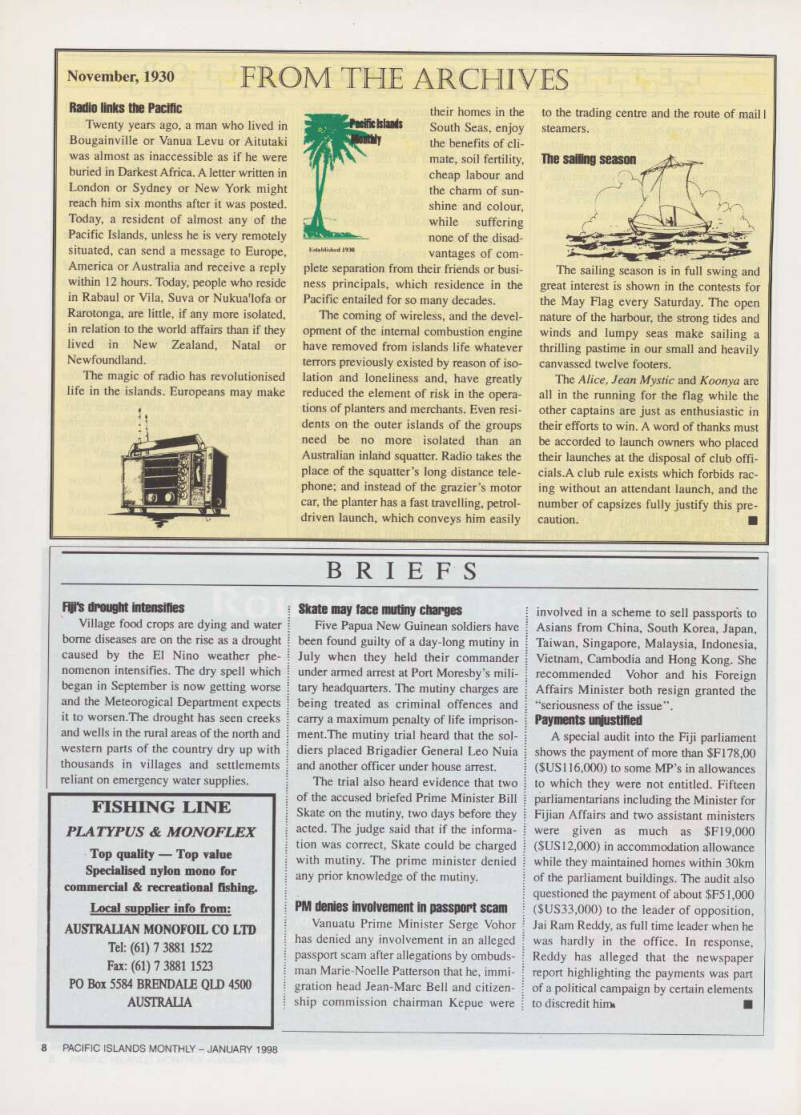
Radio links the Pacific Twenty years ago, a man who lived in Bougainville or Vanua Levu or Aitutaki was almost as inaccessible as if he were buried in Darkest Africa. A letter written in London or Sydney or New York might reach him six months after it was posted.
Today, a resident of almost any of the Pacific Islands, unless he is very remotely situated, can send a message to Europe, America or Australia and receive a reply within 12 hours. Today, people who reside in Rabaul or Vila, Suva or Nukualofa or Rarotonga, are little, if any more isolated, in relation to the world affairs than if they lived in New Zealand, Natal or Newfoundland.
The magic of radio has revolutionised life in the islands. Europeans may make
their homes in the South Seas, enjoy the benefits of cli mate, soil fertility, cheap labour and the charm of sun shine and colour, while suffering none of the disad vantages of com
plete separation from their friends or busi ness principals, which residence in the Pacific entailed for so many decades.
The coming of wireless, and the devel opment of the internal combustion engine have removed from islands life whatever terrors previously existed by reason of iso lation and loneliness and, have greatly reduced the element of risk in the opera tions of planters and merchants. Even resi dents on the outer islands of the groups need be no more isolated than an Australian inland squatter. Radio takes the place of the squatter’s long distance tele phone; and instead of the grazier’s motor car, the planter has a fast travelling, petrol driven launch, which conveys him easily
to the trading centre and the route of mail 1 steamers.
The sailing season is in full swing and great interest is shown in the contests for the May Flag every Saturday. The open nature of the harbour, the strong tides and winds and lumpy seas make sailing a thrilling pastime in our small and heavily canvassed twelve footers.
The Alice, Jean Mystic and Koonya are all in the running for the flag while the other captains are just as enthusiastic in their efforts to win. A word of thanks must be accorded to launch owners who placed their launches at the disposal of club offi cials.A club rule exists which forbids rac ing without an attendant launch, and the number of capsizes fully justify this pre caution. ■
Established 1930
Briefs
Hjft drought intensifies
Village food crops are dying and water borne diseases are on the rise as a drought caused by the El Nino weather phe nomenon intensifies. The dry spell which began in September is now getting worse and the Meteorogical Department expects it to worsen. The drought has seen creeks and wells in the rural areas of the north and western parts of the country dry up with thousands in villages and settlememts reliant on emergency water supplies.
Skate may face mutiny charges Five Papua New Guinean soldiers have been found guilty of a day-long mutiny in July when they held their commander under armed arrest at Port Moresby’s mili
tary headquarters. The mutiny charges are
being treated as criminal offences and carry a maximum penalty of life imprison ment. The mutiny trial heard that the sol diers placed Brigadier General Leo Nuia and another officer under house arrest.
The trial also heard evidence that two of the accused briefed Prime Minister Bill Skate on the mutiny, two days before they acted. The judge said that if the informa tion was correct, Skate could be charged with mutiny. The prime minister denied any prior knowledge of the mutiny.
PM denies involvement in passport scam Vanuatu Prime Minister Serge Vohor has denied any involvement in an alleged passport scam after allegations by ombuds man Marie-Noelle Patterson that he, immi gration head Jean-Marc Bell and citizen ship commission chairman Kepue were
involved in a scheme to sell passports to Asians from China, South Korea, Japan,
Taiwan, Singapore, Malaysia, Indonesia,
Vietnam, Cambodia and Hong Kong. She recommended Vohor and his Foreign Affairs Minister both resign granted the “seriousness of the issue”.
Payments unjustified
A special audit into the Fiji parliament shows the payment of more than $F178,00 ($US116,000) to some MP’s in allowances to which they were not entitled. Fifteen parliamentarians including the Minister for Fijian Affairs and two assistant ministers were given as much as $F 19,000 (SUS 12,000) in accommodation allowance while they maintained homes within 30km of the parliament buildings. The audit also questioned the payment of about $F51,000 ($U533,000) to the leader of opposition, Jai Ram Reddy, as full time leader when he was hardly in the office. In response, Reddy has alleged that the newspaper report highlighting the payments was part of a political campaign by certain elements to discredit him* ■
Advertisements & other items, p. 8 (1 item)
Fishing Line
PLATYPUS & MONOFLEX
Top quality Top value Specialised nylon mono for commercial & recreational fishing.
Local supplier info from:
AUSTRALIAN MONOFOIL CO LTD
Tel: (61) 7 3881 1522 Fax: (61) 7 3881 1523
PO Box 5584 BRENDALE QLD 4500
AUSTRALIA
Corruption rife
Cover Stories
What is
happen ing in the region?
At a time when it is fac
ing economic downturn and focus should be on ways to reverse this, governments seems to be involved in ways of trying to stop corruption or fraud in the island nations. Corruption has become a major worry in the Pacific with most if not all countries having their share of it. This white collar crime seems to have taken a hold of the Pacific and gov ernments will have to find a way to rid this problem before it gets out of hand. Name the scam and one will find it here - pass port, customs fraud, police are just a few.
The biggest one in the past couple of months has to be undoubtedly in Papua New Guinea where Prime Minister Bill Skate is shown on video allegedly offering bribe to the media through his Internal Affairs Minister, Thomas Pelika.
The footage which was aired on the ABC in November last year, shook the political roots of the nation. Of course.
Skate denied it all calling it a set-up and branding the former government advisor Mujo Sefa, who secretly filmed the alleged deal, a blackmailer. There were calls by former prime ministers, members of par liament and political leaders for Skate to resign but he refused. He maintained his innocence and even brushed aside calls for an inquiry saying it was a waste of public funds.
He has now referred the matter to the police and the ombudsman. Fiji has also had its share in this field. The major one also in the past couple of months has been in its Customs Department. There were allegations of duty evasion and customs officers being offered bribes to speed up the work. There was always talk about this but nothing was done as there was no proof - this was until a senior officer came for ward and admitted to receiving bribe from a well known businessman to speed up his customs clearance.
This revelation send the department into panic and in the next couple of days the then acting finance minister called for an inquiry. The report was released later
last year with the inquiry commission pointing out that corruption was rife at all levels of the department. A few months after the release of the report, Finance Minister Jim Ah Koy invited new Zealand lawyer and former head of NZ’s Special Fraud Office, Charles Sturt, to look into the Fiji situation. Speaking in general on cor ruption to The Sunday Times, Sturt said it was a problem that surpassed national bor ders. To a greater or lesser degree, this affects everyone, regardless of geographic position or degree of"development. Sturt said the dynamics, complexity and trends of worldwide fraudulent networks have on many occasions overwhelmed the ability of many governments to foresee and react.
He said that without doubt serious fraud - which includes corruption driven frauds shatters social cohesion and coherence.
“It is essential to prevent the progres sion of this phenomenon and to ensure that its negative effects will not endanger the rule of law. Th Samoa scandal is to do with the illegal sale of Samoan passports. The first person to be arrested in this scam was a Chinese businessman in April last year.
He flew into the country carrying a local passport as identification. Police arrested him for holding fraudulent documents and unlocked the scandal of the year.
Since his arrest, a number of immigra tion officers have been suspended in con nection with a racket involving the sale of passports for upto $26,000 each in Hong Kong and possible Apia head office.
Suspicions that something was amiss should have been raised earlier. Despite meagre salaries - the 1995 budget had the chief officer earning about $19,000 a year - flash lifestyles that included the late model cars, trips abroad, rental houses and investments that went way beyond the offi cers' earning were never investigated.
Many blame the poor economic situa tion while others just put it down to plain greed. Corruption exists around the world, but for a region the size of the South Pacific, it seems to be quite dominant. As government and other bodies try to look for ways to combat this white collar crimes, all the ordinary person can do is raise the alarm and watch what happens next. ■
Conservatory
building controversy
Controversy came to Papua New Guinea all at once.
Before the Skate allega tions were brought to public attention, another scandal caught the interest of the people.
But this time it was to do with the for mer prime minister, Sjr Julius Chan and his role in the purchase of the Cairns Conservatory building. According to the auditor general’s report the building was bought with PNG Public Officers’
Superannuation Fund (POSF) for $A 18.72 million (approximately SUS 11.69 m) in November 1994 - this was three times its true market value.
Private valuations obtained by the audi tor-general showed that at the time of sale, the market value of the property was between $A5.75 million (SUS3.Sm to SAB million (SUS4.Sm).
The report also referred to the relation ship between Sir Julius and Australian property developer Warren Anderson in the lead-up to the sale. Anderson’s company, Tipperary Developments Pty Ltd, had pur chased the building for $A9.75 million (SUS6m) a short time before it disposed of it to the POSF for nearly twice the price.
The then Consul in Cairns, Jacob Lemeki said Sir Julius introduced him to Anderson and asked the consul to “involve them in finding a property in Cairns on behalf of the PNG government”.
Lemeki said he believed Anderson was “very well known” to the former prime minister and another former prime minis ter, Pias Wingti, and that he and his com pany might have been involved in other deals in PNG. During the investigations.
Sir Julius said he had not met Anderson in Cairns, however, he admitted that he told Lemeki to consult with Anderson to find a property for the PNG government because of his experience in the field.
POSF’s managing director Ereman Ragi told the investigations that there was political pressure to expedite the sale from former minister Sir Albert Kipalan and Nick Violaris - whom he described as an
What next Mr
Prime Minister?
associate of Sir Julius. Ragi said he had lunch with Sir Julius on October 11, 1994 and gained the impression that the then prime minister had “some interest in the proposal”. Sir Julius had denied that Violaris was a business associate of his.
The auditor general said that almost all public officers who were interviewed by him under oath, claimed that political pres sure was exerted on them to expedite the purchase of the building. He said that a discernible nexus between public servants and politicians could be established from the evidence before him.
The report said that Sir Julius played a pivotal role in the building purchase, to the powers vested in him by virtue of the influ ential positions he held and indirectly through associates. His deputy, Chris Haeveta was also criticised for approving a refinancing package to allow the POSFB to purchase the building through its sub sidiary company, Moki No 1 Pty Limited.
The report said Haiveta’s immediate approval of the refinancing package and his involvement in obtaining a valuation report long after the investment, which was flawed, raised questions about his covert involvement in the purchase of the
conservatory building.
It also said that the pressure was placed on PNG government departments to rent office space in the building for $7OO per square metre, double the rent that they were paying in other Caims premises.
The report recommended that Ragi be dismissed form office and charged with negligence, the sacking of the entire POSFB and a review and possible termi nation of contracts relating to the manage ment of the building. ■
ill Skate ... corrupt, loud mouthed
R J drunk politi
cian or godfather of
Papua New Guinea’s murderous ras cals?
What is he? This is the question which people not only in PNG but around the region were asking as allegations of cor ruption against the prime minister came to light.
It started when the prime minister was in Canada attending the APEC summit in November last year. Skate allegedly autho rised the payments of SAI9OO (SUSI2OO) in bribes through a senior minister. This was according to video tapes which were secretly filmed by a former government advisor Mujo Sefa and leaked to the ABC.
In a revelation that rocked the already shaky government coalition, Skate was shown talking to Sefa about a payment to Internal Affairs Minister, Thomas Pelika, in October last year.
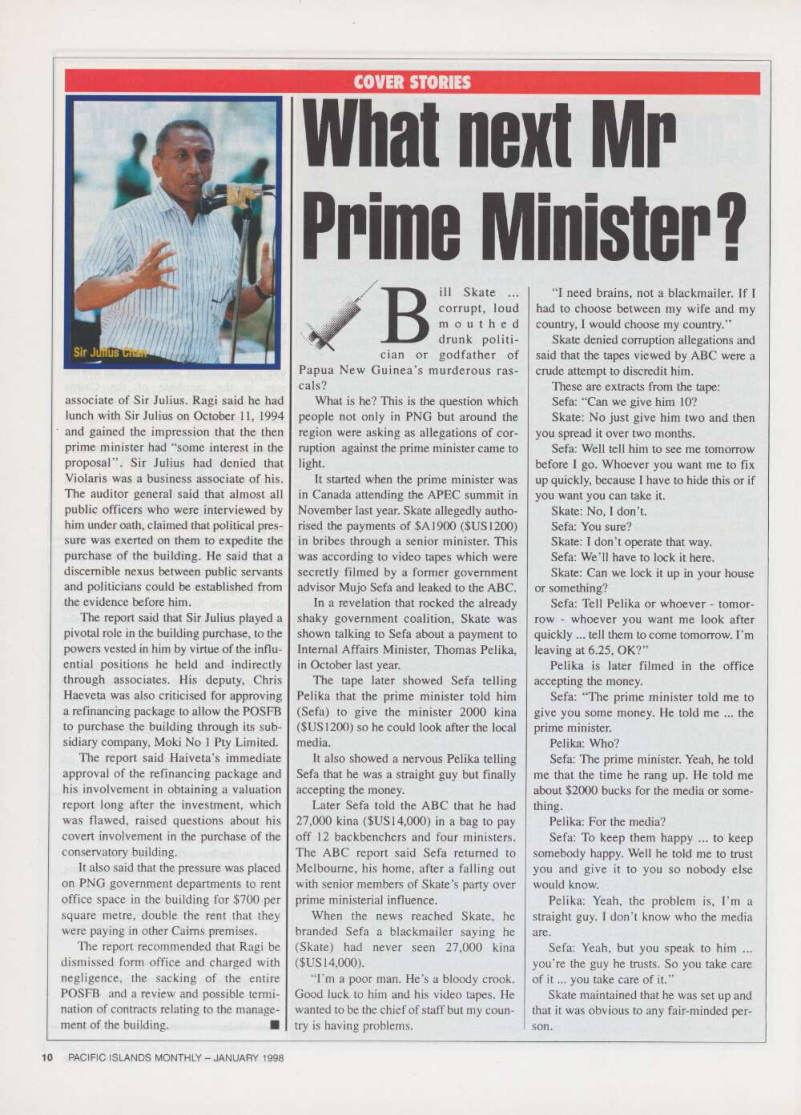
The tape later showed Sefa telling Pelika that the prime minister told him (Sefa) to give the minister 2000 kina (SUSI2OO) so he could look after the local media.
It also showed a nervous Pelika telling Sefa that he was a straight guy but finally accepting the money.
Later Sefa told the ABC that he had 27,000 kina (SUS 14,000) in a bag to pay off 12 backbenchers and four ministers.
The ABC report said Sefa returned to Melbourne, his home, after a falling out with senior members of Skate’s party over prime ministerial influence.
When the news reached Skate, he branded Sefa a blackmailer saying he (Skate) had never seen 27,000 kina
(Sus 14,000).
“I’m a poor man. He’s a bloody crook.
Good luck to him and his video tapes. He wanted to be the chief of staff but my coun try is having problems.
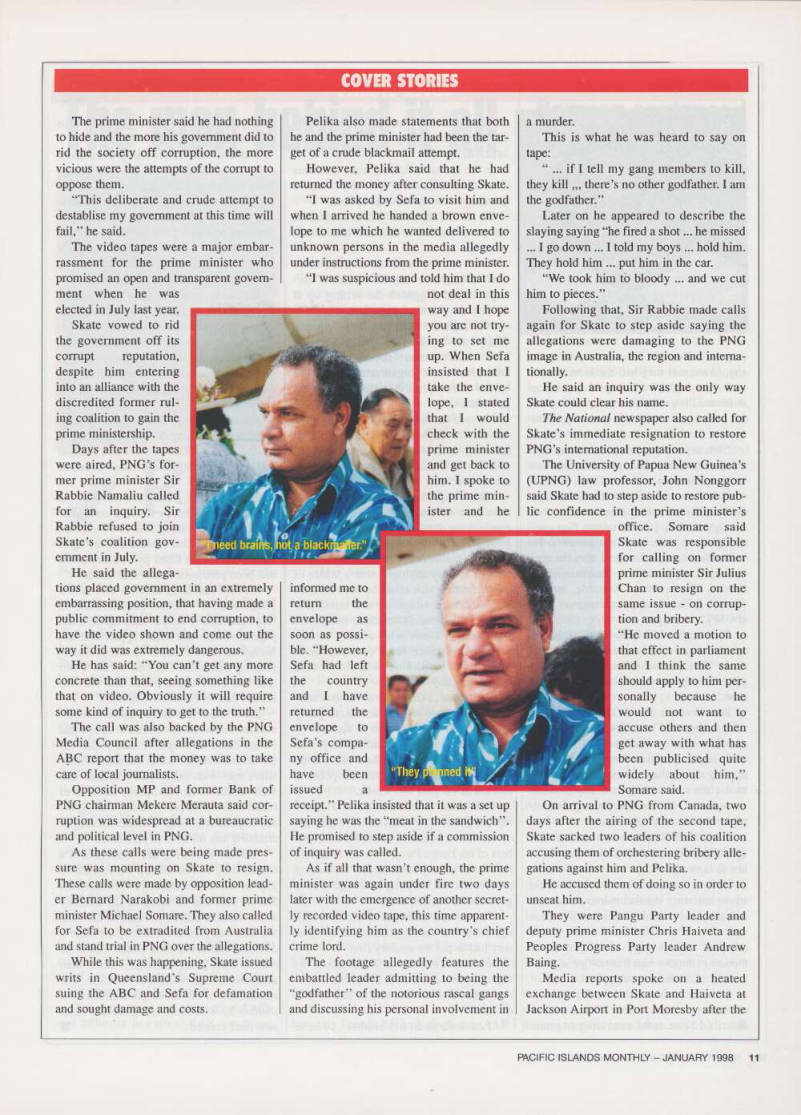
“I need brains, not a blackmailer. If I had to choose between my wife and my country, I would choose my country.”
Skate denied corruption allegations and said that the tapes viewed by ABC were a crude attempt to discredit him.
These are extracts from the tape: Sefa: “Can we give him 10?
Skate: No just give him two and then you spread it over two months.
Sefa: Well tell him to see me tomorrow before I go. Whoever you want me to fix up quickly, because I have to hide this or if you want you can take it.
Skate; No, I don’t.
Sefa; You sure?
Skate; I don’t operate that way.
Sefa; We’ll have to lock it here.
Skate: Can we lock it up in your house or something?
Sefa: Tell Pelika or whoever - tomor row - whoever you want me look after quickly ... tell them to come tomorrow. I’m leaving at 6.25, OK?”
Pelika is later filmed in the office accepting the money.
Sefa: “The prime minister told me to give you some money. He told me ... the prime minister.
Pelika; Who?
Sefa: The prime minister. Yeah, he told me that the time he rang up. He told me about $2OOO bucks for the media or some thing.
Pelika: For the media?
Sefa: To keep them happy ... to keep somebody happy. Well he told me to trust you and give it to you so nobody else would know.
Pelika: Yeah, the problem is, I’m a straight guy. I don’t know who the media are.
Sefa: Yeah, but you speak to him ... you’re the guy he trusts. So you take care of it... you take care of it.”
Skate maintained that he was set up and that it was obvious to any fair-minded per son.
The prime minister said he had nothing to hide and the more his government did to rid the society off corruption, the more vicious were the attempts of the corrupt to oppose them.
“This deliberate and crude attempt to destablise my government at this time will fail,” he said.
The video tapes were a major embar rassment for the prime minister who promised an open and transparent govern ment when he was
elected in July last year.
Skate vowed to rid the government off its corrupt reputation, despite him entering into an alliance with the discredited former rul ing coalition to gain the prime ministership.
Days after the tapes were aired, PNG’s for mer prime minister Sir Rabbie Namaliu called for an inquiry. Sir Rabbie refused to join Skate’s coalition gov ernment in July.
He said the allega
tions placed government in an extremely embarrassing position, that having made a public commitment to end corruption, to have the video shown and come out the way it did was extremely dangerous.
He has said: “You can’t get any more concrete than that, seeing something like that on video. Obviously it will require some kind of inquiry to get to the truth.”
The call was also backed by the PNG Media Council after allegations in the ABC report that the money was to take care of local journalists.
Opposition MP and former Bank of PNG chairman Mekere Merauta said cor ruption was widespread at a bureaucratic and political level in PNG.
As these calls were being made pres sure was mounting on Skate to resign.
These calls were made by opposition lead er Bernard Narakobi and former prime minister Michael Somare. They also called for Sefa to be extradited from Australia and stand trial in PNG over the allegations.
While this was happening, Skate issued writs in Queensland’s Supreme Court suing the ABC and Sefa for defamation and sought damage and costs.
Pelika also made statements that both he and the prime minister had been the tar get of a crude blackmail attempt.
However, Pelika said that he had returned the money after consulting Skate.
“I was asked by Sefa to visit him and when I arrived he handed a brown enve lope to me which he wanted delivered to unknown persons in the media allegedly under instructions from the prime minister.
“I was suspicious and told him that I do not deal in this
way and I hope you are not try ing to set me up. When Sefa insisted that I take the enve lope, I stated that I would check with the prime minister and get back to him. I spoke to the prime min ister and he
informed me to return the envelope as soon as possi ble. “However, Sefa had left the country and I have returned the envelope to Sefa’s compa ny office and have been issued a
receipt.” Pelika insisted that it was a set up saying he was the “meat in the sandwich”.
He promised to step aside if a commission of inquiry was called.
As if all that wasn’t enough, the prime minister was again under fire two days later with the emergence of another secret ly recorded video tape, this time apparent ly identifying him as the country’s chief crime lord.
The footage allegedly features the embattled leader admitting to being the “godfather” of the notorious rascal gangs and discussing his personal involvement in
a murder.
This is what he was heard to say on tape: “ ... if I tell my gang members to kill, they kill ,„ there’s no other godfather. I am
the godfather.”
Later on he appeared to describe the slaying saying “he fired a shot... he missed ... I go down ... I told my boys ... hold him.
They hold him ... put him in the car.
“We took him to bloody ... and we cut him to pieces.”
Following that, Sir Rabbie made calls again for Skate to step aside saying the allegations were damaging to the PNG image in Australia, the region and interna
tionally.
He said an inquiry was the only way Skate could clear his name.
The National newspaper also called for Skate’s immediate resignation to restore PNG’s international reputation.
The University of Papua New Guinea’s (UPNG) law professor, John Nonggorr said Skate had to step aside to restore pub lic confidence in the prime minister’s
office. Somare said Skate was responsible for calling on former prime minister Sir Julius Chan to resign on the same issue - on corrup tion and bribery.
“He moved a motion to that effect in parliament and I think the same should apply to him per sonally because he would not want to accuse others and then get away with what has
been publicised quite
widely about him,”
Somare said.
On arrival to PNG from Canada, two days after the airing of the second tape, Skate sacked two leaders of his coalition accusing them of orchestering bribery alle gations against him and Pelika.
He accused them of doing so in order to unseat him.
They were Pangu Party leader and deputy prime minister Chris Haiveta and Peoples Progress Party leader Andrew Baing.
Media reports spoke on a heated exchange between Skate and Haiveta at Jackson Airport in Port Moresby after the
prime minister told his deputy of his sack ing. Skate said they had made him drunk and talk bullshit. The prime minister defended the godfather tape by saying that his comments were made under the influ ence of alcohol.
“When people get drunk they say any thing they like. I’m surprised Australians are very interested,” he said.
At the time Skate said that the Pangu- PPP, the former ruling administration, had a long-standing plan to unseat him even though they were coalition partners. He said it was brought forward after the con troversial report into the purchase of the Caims Conservatory Building by the Public Officers Superannuation Fund
(Pose).
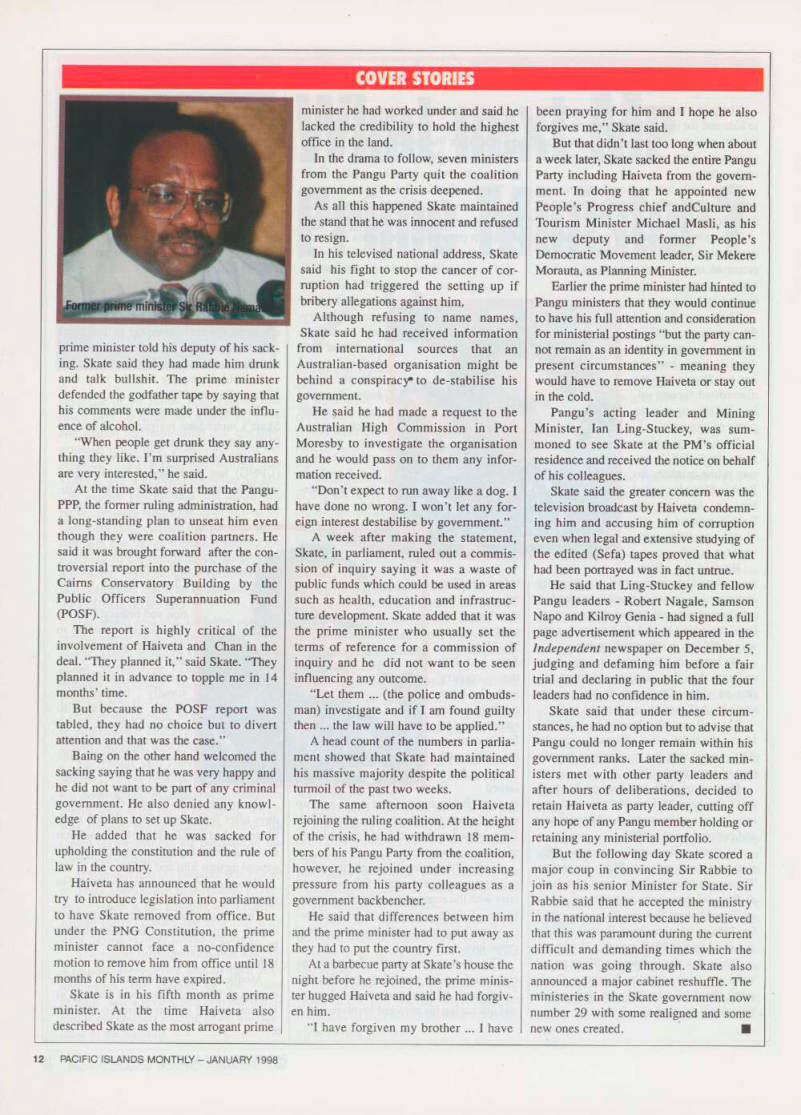
The report is highly critical of the involvement of Haiveta and Chan in the deal. “They planned it,” said Skate. “They planned it in advance to topple me in 14 months’ time.
But because the POSE report was tabled, they had no choice but to divert attention and that was the case.”
Baing on the other hand welcomed the sacking saying that he was very happy and he did not want to be part of any criminal government. He also denied any knowl edge of plans to set up Skate.
He added that he was sacked for upholding the constitution and the rule of law in the country.
Haiveta has announced that he would try to introduce legislation into parliament to have Skate removed from office. But under the PNG Constitution, the prime minister cannot face a no-confidence motion to remove him from office until 18 months of his term have expired.
Skate is in his fifth month as prime minister. At the time Haiveta also described Skate as the most arrogant prime
I minister he had worked under and said he lacked the credibility to hold the highest office in the land.
In the drama to follow, seven ministers from the Pangu Party quit the coalition government as the crisis deepened.
As all this happened Skate maintained the stand that he was innocent and refused to resign.
In his televised national address. Skate said his fight to stop the cancer of cor ruption had triggered the setting up if
bribery allegations against him.
Although refusing to name names.
Skate said he had received information from international sources that an Australian-based organisation might be behind a conspiracy* to de-stabilise his government.
He said he had made a request to the Australian High Commission in Port Moresby to investigate the organisation and he would pass on to them any infor mation received.
“Don’t expect to run away like a dog. I have done no wrong. I won’t let any for eign interest destabilise by government.”
A week after making the statement.
Skate, in parliament, ruled out a commis sion of inquiry saying it was a waste of public funds which could be used in areas such as health, education and infrastruc ture development. Skate added that it was the prime minister who usually set the terms of reference for a commission of inquiry and he did not want to be seen influencing any outcome.
“Let them ... (the police and ombuds man) investigate and if I am found guilty then ... the law will have to be applied.”
A head count of the numbers in parlia ment showed that Skate had maintained
his massive majority despite the political
turmoil of the past two weeks.
The same afternoon soon Haiveta rejoining the ruling coalition. At the height of the crisis, he had withdrawn 18 mem bers of his Pangu Party from the coalition, however, he rejoined under increasing pressure from his party colleagues as a government backbencher.
He said that differences between him and the prime minister had to put away as they had to put the country first.
At a barbecue party at Skate’s house the night before he rejoined, the prime minis ter hugged Haiveta and said he had forgiv en him.
“I have forgiven my brother ... I have
been praying for him and I hope he also forgives me,” Skate said.
But that didn’t last too long when about a week later, Skate sacked the entire Pangu Party including Haiveta from the govern ment. In doing that he appointed new People’s Progress chief and Culture and Tourism Minister Michael Masli, as his new deputy and former People’s Democratic Movement leader. Sir Mekere Morauta, as Planning Minister.
Earlier the prime minister had hinted to Pangu ministers that they would continue to have his full attention and consideration for ministerial postings “but the party can not remain as an identity in government in present circumstances” - meaning they would have to remove Haiveta or stay out in the cold.
Pangu’s acting leader and Mining Minister, lan Ling-Stuckey, was sum moned to see Skate at the PM’s official residence and received the notice on behalf of his colleagues.
Skate said the greater concern was the television broadcast by Haiveta condemn ing him and accusing him of corruption even when legal and extensive studying of the edited (Sefa) tapes proved that what had been portrayed was in fact untrue.
He said that Ling-Stuckey and fellow Pangu leaders - Robert Nagale, Samson Napo and Kilroy Genia - had signed a full page advertisement which appeared in the Independent newspaper on December 5, judging and defaming him before a fair trial and declaring in public that the four leaders had no confidence in him.
Skate said that under these circum stances, he had no option but to advise that Pangu could no longer remain within his government ranks. Later the sacked min isters met with other party leaders and after hours of deliberations, decided to retain Haiveta as party leader, cutting off any hope of any Pangu member holding or
retaining any ministerial portfolio.
But the following day Skate scored a major coup in convincing Sir Rabbie to join as his senior Minister for State. Sir Rabbie said that he accepted the ministry in the national interest because he believed that this was paramount during the current difficult and demanding times which the nation was going through. Skate also announced a major cabinet reshuffle. The ministeries in the Skate government now number 29 with some realigned and some new ones created. ■
The man behind it all
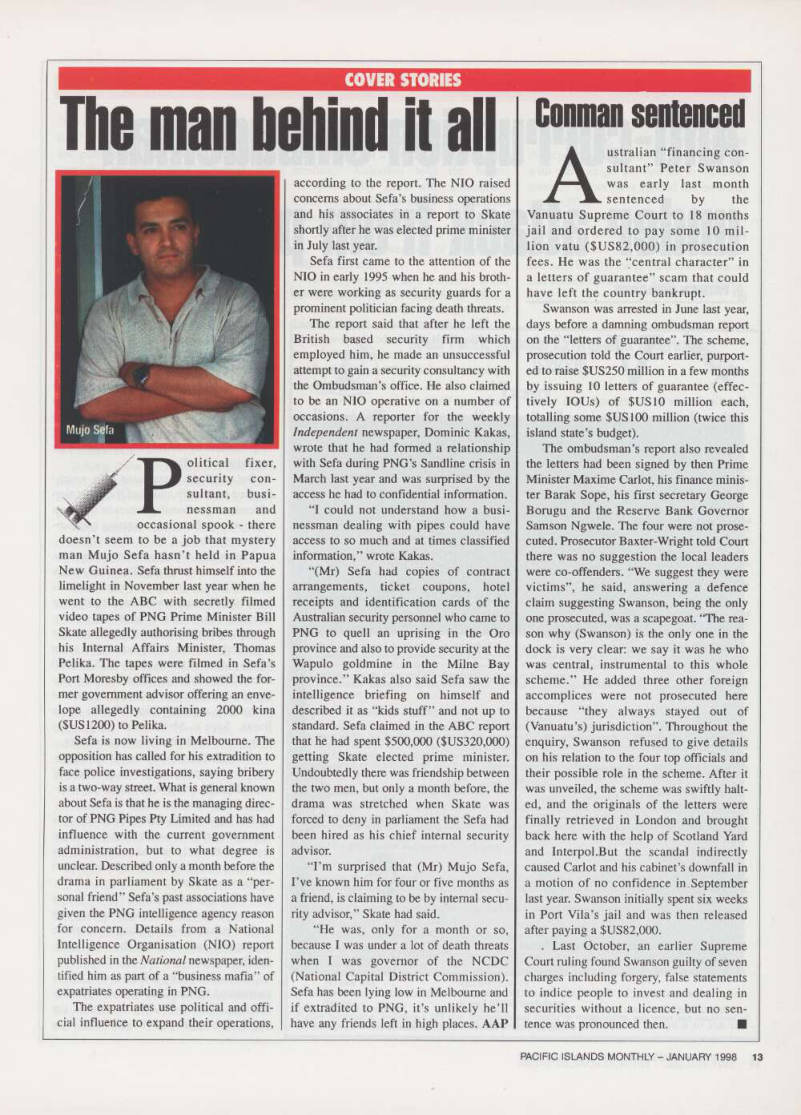
✓ Political fixer,
security con
sultant, busi nessman and occasional spook - there doesn’t seem to be a job that mystery man Mujo Sefa hasn’t held in Papua New Guinea. Sefa thrust himself into the limelight in November last year when he went to the ABC with secretly filmed video tapes of PNG Prime Minister Bill Skate allegedly authorising bribes through his Internal Affairs Minister, Thomas Pelika. The tapes were filmed in Sefa’s Port Moresby offices and showed the for met government advisor offering an enve
lope allegedly containing 2000 kina
(SUS1200) to Pelika.
Sefa is now living in Melbourne. The opposition has called for his extradition to
face police investigations, saying bribery
is a two-way street. What is general known about Sefa is that he is the managing direc tor of PNG Pipes Pty Limited and has had influence with the current government administration, but to what degree is unclear. Described only a month before the drama in parliament by Skate as a “per sonal friend” Sefa’s past associations have given the PNG intelligence agency reason for concern. Details from a National Intelligence Organisation (NIO) report published in the National newspaper, iden tified him as part of a “business mafia” of expatriates operating in PNG.
The expatriates use political and offi cial influence to expand their operations,
according to the report. The NIO raised concerns about Sefa’s business operations and his associates in a report to Skate shortly after he was elected prime minister in July last year.
Sefa first came to the attention of the NIO in early 1995 when he and his broth er were working as security guards for a prominent politician facing death threats.
The report said that after he left the British based security firm which employed him, he made an unsuccessful attempt to gain a security consultancy with the Ombudsman’s office. He also claimed to be an NIO operative on a number of occasions. A reporter for the weekly Independent newspaper, Dominic Kakas, wrote that he had formed a relationship with Sefa during PNG’s Sandline crisis in March last year and was surprised by the access he had to confidential information.
“I could not understand how a busi nessman dealing with pipes could have access to so much and at times classified information,” wrote Kakas.
“(Mr) Sefa had copies of contract arrangements, ticket coupons, hotel receipts and identification cards of the Australian security personnel who came to PNG to quell an uprising in the Oro province and also to provide security at the Wapulo goldmine in the Milne Bay province.” Kakas also said Sefa saw the intelligence briefing on himself and described it as “kids stuff” and not up to standard. Sefa claimed in the ABC report that he had spent $500,000 ($U5320,000) getting Skate elected prime minister.
Undoubtedly there was friendship between the two men, but only a month before, the drama was stretched when Skate was forced to deny in parliament the Sefa had been hired as his chief internal security advisor.
“I’m surprised that (Mr) Mujo Sefa, I’ve known him for four or five months as a friend, is claiming to be by internal secu rity advisor,” Skate had said.
“He was, only for a month or so, because I was under a lot of death threats when I was governor of the NCDC (National Capital District Commission).
Sefa has been lying low in Melbourne and if extradited to PNG, it’s unlikely he’ll have any friends left in high places. AAP
Connai sentenced
Australian “financing con
sultant” Peter Swanson was early last month sentenced by the Vanuatu Supreme Court to 18 months jail and ordered to pay some 10 mil lion vatu (SUSB2,GOO) in prosecution fees. He was the “central character” in a letters of guarantee” scam that could have left the country bankrupt.
Swanson was arrested in June last year, days before a damning ombudsman report on the “letters of guarantee”. The scheme, prosecution told the Court earlier, purport ed to raise SUS2SO million in a few months by issuing 10 letters of guarantee (effec tively lOUs) of SUSIO million each, totalling some SUSIOO million (twice this island state’s budget).
The ombudsman’s report also revealed the letters had been signed by then Prime Minister Maxime Carlot, his finance minis ter Barak Sope, his first secretary George Borugu and the Reserve Bank Governor Samson Ngwele. The four were not prose cuted. Prosecutor Baxter-Wright told Court there was no suggestion the local leaders were co-offenders. “We suggest they were victims”, he said, answering a defence claim suggesting Swanson, being the only one prosecuted, was a scapegoat. “The rea son why (Swanson) is the only one in the dock is very clear: we say it was he who was central, instrumental to this whole scheme.” He added three other foreign accomplices were not prosecuted here because “they always stayed out of (Vanuatu’s) jurisdiction”. Throughout the enquiry, Swanson refused to give details on his relation to the four top officials and their possible role in the scheme. After it was unveiled, the scheme was swiftly halt ed, and the originals of the letters were finally retrieved in London and brought back here with the help of Scotland Yard and Interpol. But the scandal indirectly caused Carlot and his cabinet’s downfall in a motion of no confidence in September last year. Swanson initially spent six weeks in Port Vila’s jail and was then released after paying a SUSB2,OOO. . Last October, an earlier Supreme Court ruling found Swanson guilty of seven charges including forgery, false statements to indice people to invest and dealing in securities without a licence, but no sen tence was pronounced then. ■
Anti-coprnpOon ombudsman
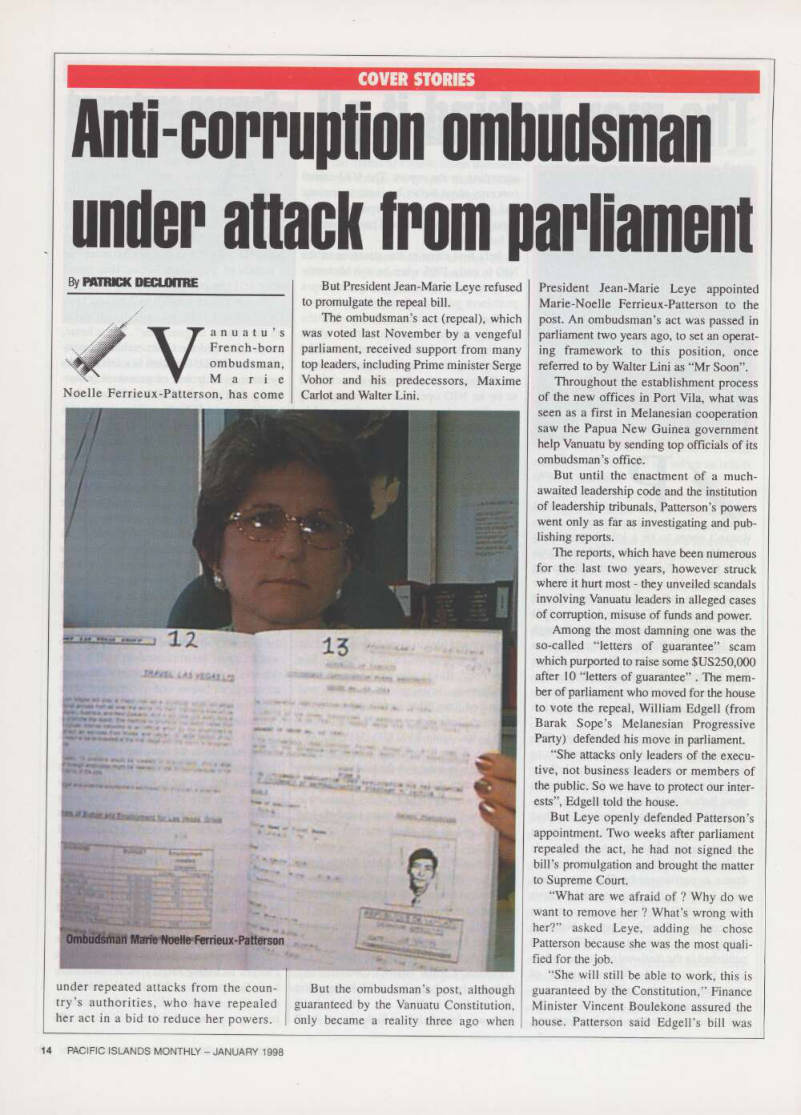

under attack from parliament
By Patrick Decumtre
anu a t u s / French-born ombudsman, Marie
Noelle Ferrieux-Patterson, has come
under repeated attacks from the coun try’s authorities, who have repealed her act in a bid to reduce her powers.
But President Jean-Marie Leye refused to promulgate the repeal bill.
The ombudsman’s act (repeal), which was voted last November by a vengeful parliament, received support from many top leaders, including Prime minister Serge Vohor and his predecessors, Maxime Carlot and Walter Lini.
But the ombudsman’s post, although guaranteed by the Vanuatu Constitution, only became a reality three ago when
President Jean-Marie Leye appointed Marie-Noelle Ferrieux-Patterson to the post. An ombudsman’s act was passed in parliament two years ago, to set an operat ing framework to this position, once referred to by Walter Lini as “Mr Soon”.
Throughout the establishment process of the new offices in Port Vila, what was seen as a first in Melanesian cooperation saw the Papua New Guinea government help Vanuatu by sending top officials of its ombudsman’s office.
But until the enactment of a much awaited leadership code and the institution of leadership tribunals, Patterson’s powers went only as far as investigating and pub lishing reports.
The reports, which have been numerous for the last two years, however struck where it hurt most- they unveiled scandals involving Vanuatu leaders in alleged cases of corruption, misuse of funds and power.
Among the most damning one was the so-called “letters of guarantee” scam which purported to raise some $U5250,000 after 10 “letters of guarantee” . The mem ber of parliament who moved for the house to vote the repeal, William Edgell (from Barak Sope’s Melanesian Progressive Party) defended his move in parliament.
“She attacks only leaders of the execu tive, not business leaders or members of the public. So we have to protect our inter ests”, Edgell told the house.
But Leye openly defended Patterson’s appointment. Two weeks after parliament repealed the act, he had not signed the bill’s promulgation and brought the matter to Supreme Court.
“What are we afraid of ? Why do we want to remove her ? What’s wrong with her?” asked Leye, adding he chose Patterson because she was the most quali fied for the job.
“She will still be able to work, this is guaranteed by the Constitution,” Finance Minister Vincent Boulekone assured the house. Patterson said Edgell’s bill was
“talking nonsense” and “in total contradic tion” not only with the economic, social and political reforms the Vanuatu govern ment had embarked upon since early this year, but also with the government’s decla rations of the last two years.
“It is a very sad day for Vanuatu”, she said. “It’s not a sad day, this is a day of vic tory and progress for Vanuatu,” Carlot said in parliament. Edgell’s private bill came just before Patterson released more embar rassing reports on the government and some politicians.
Some of them contained results of her investigation in the alleged illegal sale of Vanuatu passports to Asians from Hong Kong, Macao, Taiwan and South Korea.
Another report touched on politicians’ malpractises to obtain housing loans through the Vanuatu National Provident Fund. The matter generated heated debates in parliament.
Among those often cited in Patterson’s report on malpractice, former finance min ister Willie Jimmy says “she has too many powers.
“She defames leaders who are demo cratically elected, she creates instability in the investment climate in Vanuatu and she causes us financial loss”.
Trade Minister Barak Sope was once sacked by Vohor (in September last year) for his involvement in the letters scam. He has since returned to office and told parlia ment Patterson could not criticise leaders in Vanuatu, because Melanesian culture did not allow women to criticise men.
Vohor said the ombudsman’s act should be repealed to be replaced with a “more appropriate” version. Even Lini, who is currently in charge of a reform program fostering better governance and trans parency, spoke in favour of the repeal.
“I don’t know the true purpose of the Ombudsman. She’s here to judge other leaders. Why do we need to publish (all these reports)? If we need to hide (things), then we hide.”
There’s no secrecy, no security, no integrity in this nation. We must restore stability”, he said. Carlot, was indirectly toppled by Patterson’s “letters” report.
“She judges us, and in her eyes we’re already criminals,” he said, supporting the principle of secrecy. “I think she’s popular because of her reports, but I believe people don’t believe the wrong recommendations they contain.” Out of the 50 members of the house, only 13 in Donald Kalpokas’s
opposition disapproved of the repeal.
“This repeal is not so much with the pre sent act, it’s got a lot to do with personal reasons,” Kalpokas told the house.
“Responsibility goes with democracy,
always. Adolf Hitler was a very popular leader, but he was not good.
Constitution puts limits to what we can do,” opposition member of parliament Sela Molisa added.
He suggested all MPs currently under an ombudsman investigation should
abstain from taking part to vote.
Another MP, Daniel Bangtor, warned
the repeal would certainly raise questions
with the foreign aid donors to Vanuatu, some of whom have funded the ombuds man’s office.
“They have the right to worry and question us on the true intentions of this bill. This comes as a private member’s bill and surprisingly, the government stands up and comes up with all kinds of justifica tions.” ■
Advertisements & other items, p. 15 (1 item)
Vacancy
• f
(SPREP)
Project Officer, Avifauna Conservation/Invasive Species, Biodiversity
and Natural Resource Conservation Division
Applications are invited for the position of Project Officer Avifauna Conservation/Invasive Species within the Biodiversity and Natural Resource Conservation Division of the South Pacific Regional Environment Programme (SPREP) in Apia, Samoa.
Background SPRBP’s Biodiversity and Natural Resource Conservation Division (BNRCD) objective is to protect the natural heritage of the Pacific Islands region through the conservation and sustainable use of biodiversity. Outputs identified within the BNRCD include development and implementation of a Regional Avifauna Conservation Programme and a Regional Invasive Species Programme to ensure: • wise management of bird and bat species and their habitats in order to facilitate recovery of endangered species and conservation of other indigenous avifauna; and • prevention, eradication or control of non-indigenous species which threaten ecosystems, habitats and species.
Post Description The Project Officer (Avifauna Conservation/Invasive Species) will be responsible to the Director, through the Head of Division of the Biodiversity and Natural Resource Conservation Division, under the direction of the Biodiversity (Species) Programme Officer. She/he is expected to perform the following principal duties: • Plan, oversee and facilitate the activities of the Regional Avifauna Conservation Programme (RACP); • Coordinate the development and implementation of the new Regional Invasive Species Programme (RISP); • Assist the South Pacific Biodiversity Conservation Programme Conservation Area Programme in addressing avifauna conservation and invasive species issues in these areas; • Assist with initiatives as required within SPREP’s Biodiversity and Natural Resource Conservation Programme.
Required Qualifications and Experience Candidates must have appropriate tertiary qualifications with at least 5 years’ work experience in this field, preferably within the Pacific islands region. Other essential requirements arc: sound coordination, communication and facilitation skills and relevant technical knowledge in the field of avifauna conservation and/or invasive species. An appreciation of conservation issues in Pacific Island countries is also essential. Candidates must also have the ability to undertake work programme planning (including budgeting), deliver on agreed work programme outputs, and the ability to work as part of an inter-disciplinary and/or multi-cultural team.
Appointment Appointment will be at the Project Officer Level of SPREP’s authorised salary scales for contract staff, depending on the successful applicant’s qualifications and experience. The package will include annual return airfares for appointee and dependents, a housing subsidy and other benefits. SPREP remuneration may be tax-free depending upon circumstances. The appointment will be for 3 years initially, with renewal for a further term depending upon the officer’s performance and availability of funds.
Applications Applications should be accompanied by a detailed curriculum vitae containing full personal details, information on qualifications and experience for the position, previous appointments, current position and salary, names, addresses and telephone and fax contact numbers of three persons associated with the applicant professionally and who would be prepared to provide testimonials. An indication of how soon the applicant would Ire available should be indicated.
Closing Date: 20 February 1998. Late applications will not be considered.
Applications should be addressed to The Director South Pacific Regional Environment Programme (SPREP) PO Box 240 Tel: (685) 21929 Apia Fax: (685) 20231 Samoa E-mail [email protected] Further information, including a full post description and details of remuneration and terms and conditions of appointment, is available from the Administration Officer, SPREP.
Corruption in Fiji's
customs department
By Bernadettte Hussain
Early last year, a senior cus toms official
in Fiji’s
x' Customs Department claimed that corruption and bribery were rife and were the cause of a multi-million-dollar loss in govern ment revenue. These allegations perhaps caused more impact because the officer admitted to taking the bribe in December 1996. He alleged he was offered SFSOOO (SUS34BO) bribe by a businessman in return for not pursing a case of evasion of duty.
He said this was normal practice in the department where majority of officers were on low salaries. Officers were earning between SFSOOO and SFBOOO (SUS34BO and $1185575) per year.
The officer claimed that there were more cases of evasion than those with cor rect paper work; in most cases of evasion of duty, businessmen offered cash to “kill” the issue and bribery was most common and most cases were not highlighted because the department itself decided on what action to take.
The officer’s allegations saw an inquiry into the department and the committee dis covered that not only was there truth in the allegations and there were a lot of other problems as well and concerns were raised over the accountability of the department.
A police investigation into the depart ment showed that many senior and junior civil servants abused office. Police Commissioner Isikia Savua also confirmed at the time that containers of goods had been smuggled out of the Suva Wharf through the use of forged documents.
He said that investigations showed a high level of abuse of office, bribery and corruption and there was no doubt that con tainers filled with valuable items were taken out after cheating the proper system.
In August last year, the inquiry team made its report official and rumours and allegations were confirmed.
The report revealed that corruption was
rife at all levels of the department and there were recommenda tions of a major over haul with early retire ment of senior staff who were found to be ineffective.
However, the report said that not all customs officers were corrupt. It said cor ruption varied from collusion with traders and the acceptance of money to carry out illegal acts or not to carry out their duties in a proper manner. This included cases where officers demanded money from pas sengers for lunch or yaqona (kava).
While the committee actively sought and obtained information on corruption, the majority of the submissions tended to concentrate on poor management practices, outdated procedures, the inability of senior management to recognise the changes required and their inability to consider industry needs in regards to facilitation.
The report said that senior management had lost the respect of those they were sup posed to lead and morale of junior officers was low while members of the public had a poor opinion of the department as a whole.
But the report also said that not all the problems at customs arose from the actions of the department. It said police were not familiar with commercial documentation and had their own set of priorities.
It recommended that these matters should normally be addressed by experi enced well trained customs investigation officers. The report said that matters of dis cipline were being dealt with by the depart ment but they had not necessarily been dealt with in a consistent manner.
“Cultural ties and lack of managerial experience by some of the officers have led to a lack of action,” it said.
The report said that a major concern over the last five years had been the sys tematic fraud attempts by importers of used cars. It said misdescription, under valua
tion, split consignment, surplus and unen
tered goods in full container loads and cars dissembled to take on the appearance of parts, had all been used at some time to evade the payment of duty.
The report said in cases where Customs had held inquiries the investigation officers received anonymous threats against them and their families. They were abused and one officer had been assaulted. It said that since the rate of import duty on new and
used cars were high compared to those on parts. “This encouraged some traders to attempt to evade payment of the appropri ate duty.” The huge fiscal advantage that can be obtained has led and will continue to lead to associated crimes of bribery of officers and abuse of powers,” it said.
The report added that government would agree to the loss of large amounts of revenue received from duty on imported vehicles. In 1996,' Fiji’s Public Service Commission (PSC) ordered an investiga tion into an alleged abuse of office by a high-ranking customs officer. The investi gation followed a complaint by the Fiji Public Service Association (FPSA).
The official allegedly helped some sec ond-hand car dealers and failed to lay charged against an airline executive who imported pornographic tapes into Fiji. The executive was caught with the pornograph ic tapes by customs officers at the Nadi International Airport.
The Customs Department is not the only government department where there are allegations of corruption. The Prisons Department is also included.
A letter dated April 4, 1997 and signed simply “Prison Intelligence Unit” was sent to Fiji’s permanent secretary for home affairs, Apisolome Tudreu.
The letter made serious allegations against the department and stopped short at naming names. It claimed that bribery was rife, there was a lack of discipline among prison officers and prisoners moved freely around the security bay with not control over their movements to the visiting area.
Apart from laxity in supervision of pris oners, the letter claimed that a prisoner who presented a superintendent with a Tabua (whale’s tooth - highly valued in the indigenous Fijian culture) and a bundle of fish, was soon after released on extra mural duties.
The superintendent was also accused of nepotism, which the letter said was a major problem in the department. The letter claimed that relatives of the superintendent were considered for promotions over deserving officers. There were also allega tions of the superintendent being bribed with cartons of beer to help in promotions.
Efforts are being made to curb these problems as soon as possible and as the public demands accountability, the pres sure is on all these departments to make sure that they provide this and at the same time cleanup the mess. ■
Fiji faces a gnawing
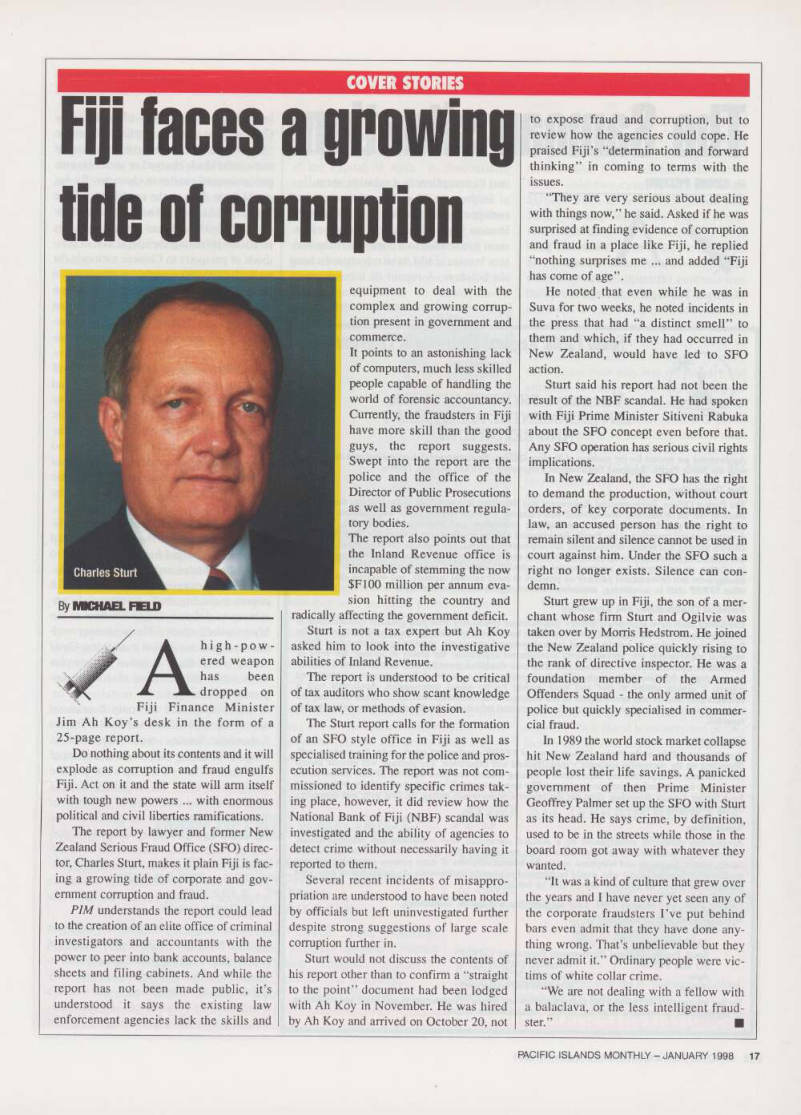
tide af corruption
By Michael Field
Ahigh - p o w - ✓ ered weapon has been
X XL dropped on
Fiji Finance Minister Jim Ah Koy’s desk in the form of a
25-page report.
Do nothing about its contents and it will explode as corruption and fraud engulfs Fiji. Act on it and the state will arm itself with tough new powers ... with enormous political and civil liberties ramifications.
The report by lawyer and former New Zealand Serious Fraud Office (SFO) direc tor, Charles Sturt, makes it plain Fiji is fac ing a growing tide of corporate and gov ernment corruption and fraud.
PIM understands the report could lead to the creation of an elite office of criminal investigators and accountants with the power to peer into bank accounts, balance sheets and filing cabinets. And while the report has not been made public, it’s understood it says the existing law enforcement agencies lack the skills and
equipment to deal with the
complex and growing corrup
tion present in government and commerce.
It points to an astonishing lack of computers, much less skilled people capable of handling the world of forensic accountancy.
Currently, the fraudsters in Fiji have more skill than the good guys, the report suggests.
Swept into the report are the police and the office of the Director of Public Prosecutions as well as government regula tory bodies.
The report also points out that the Inland Revenue office is incapable of stemming the now SFIOO million per annum eva sion hitting the country and
radically affecting the government deficit.
Sturt is not a tax expert but Ah Koy asked him to look into the investigative abilities of Inland Revenue.
The report is understood to be critical of tax auditors who show scant knowledge of tax law, or methods of evasion.
The Sturt report calls for the formation of an SFO style office in Fiji as well as specialised training for the police and pros ecution services. The report was not com missioned to identify specific crimes tak ing place, however, it did review how the National Bank of Fiji (NBF) scandal was investigated and the ability of agencies to detect crime without necessarily having it reported to them.
Several recent incidents of misappro priation are understood to have been noted by officials but left uninvestigated further despite strong suggestions of large scale corruption further in.
Sturt would not discuss the contents of his report other than to confirm a “straight to the point” document had been lodged with Ah Koy in November. He was hired by Ah Koy and arrived on October 20, not
to expose fraud and corruption, but to review how the agencies could cope. He praised Fiji’s “determination and forward thinking” in coming to terms with the issues.
“They are very serious about dealing with things now,” he said. Asked if he was
surprised at finding evidence of corruption
and fraud in a place like Fiji, he replied “nothing surprises me ... and added “Fiji has come of age”.
He noted that even while he was in Suva for two weeks, he noted incidents in the press that had “a distinct smell” to them and which, if they had occurred in New Zealand, would have led to SFO action.
Sturt said his report had not been the result of the NBF scandal. He had spoken with Fiji Prime Minister Sitiveni Rabuka about the SFO concept even before that.
Any SFO operation has serious civil rights
implications.
In New Zealand, the SFO has the right to demand the production, without court orders, of key corporate documents. In law, an accused person has the right to remain silent and silence cannot be used in court against him. Under the SFO such a right no longer exists. Silence can con demn.
Sturt grew up in Fiji, the son of a mer chant whose firm Sturt and Ogilvie was taken over by Morris Hedstrom. He joined the New Zealand police quickly rising to the rank of directive inspector. He was a foundation member of the Armed Offenders Squad - the only armed unit of police but quickly specialised in commer cial fraud.
In 1989 the world stock market collapse hit New Zealand hard and thousands of people lost their life savings. A panicked government of then Prime Minister Geoffrey Palmer set up the SFO with Sturt as its head. He says crime, by definition, used to be in the streets while those in the board room got away with whatever they wanted.
“It was a kind of culture that grew over the years and I have never yet seen any of the corporate fraudsters I’ve put behind bars even admit that they have done any thing wrong. That’s unbelievable but they never admit it.” Ordinary people were vic tims of white collar crime.
“We are not dealing with a fellow with a balaclava, or the less intelligent fraud ster.” ■
The Samoan situation
By Chris Peteru
./ A sked once ✓ /% whether the Samoan gov- X. .m. ernment was corrupt, Deputy Prime Minister Tuilaepa Malielegaoi replied
that “corruption is a relative term.”
In the past 12 months the volume of corrupt episodes that fell at the door of the Human Rights Protection Party govern ment snowballed to a point where the visi tors bureau could have advertised cheap ski holidays. A record of infrastructural development of embarrassing events
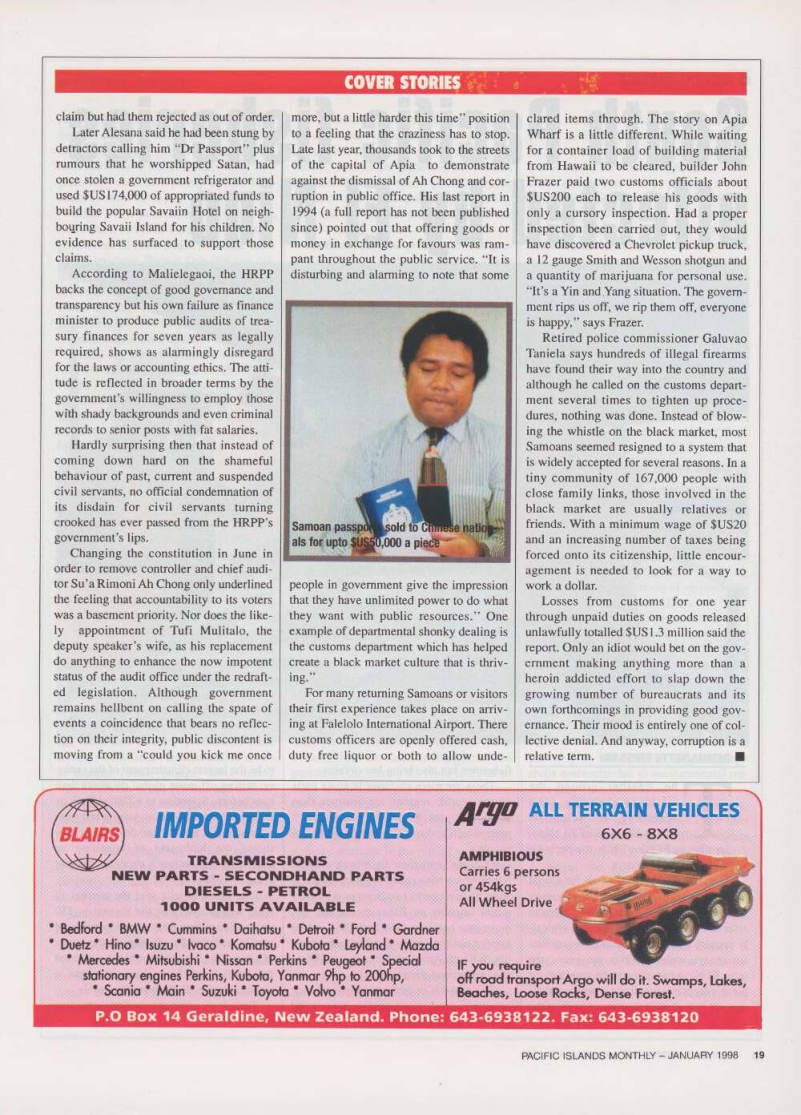
involving government officials. The Chinese lunar calendar marked 1997 as the “Year of the Boar” and the behaviour of some individuals charged or under investi gation seemed similar in character. By far, the biggest dent to the credibility of the Tofilau Eti Alesana led administration hap pened in April last year when revelations of a scam involving the illegal sale of hun dreds of passports to Chinese nationals for up to SUSSO,OOO a piece by immigration
department officers. Although speculation
that some of the deals may have taken place through Samoa’s Hong Kong con sulate, so far nothing has been substantiat ed.
Despite ramifications internationally of Chinese nationals travelling on dud
Samoan documents, police investigations
have stayed firmly in Apia. All the while Alesana who held the immigration portfo lio for 12 years repeatedly stated he had no knowledge of the scam. Malilegaoi believes a Chinese crime syndicate is at the heart of the operation but few support the theory.
Government assertions that no top offi cials were involved in the scam evaporated when police charged former ambassador to the United States and member of parlia ment Dr Tuaopepe Felix Wendt with 28 counts including theft, forgery and con spiracy to defraud during his time at the Washington Embassy. The prominent com munity figure has denied everything. Chief immigration officer Tuipoloa Suisala plus three other officers have also been sus
pended and charged.
But Wendt isn’t the only bureaucrat now being called to answer. Public Trustee Solomona Toialoa was suspended in August for taking thousands of dollars of trust funds. Allowed to keep a law practice going even while investigation, Toialoa says the money was owed to him by four government members of parliament he defended against bribery allegations dur ing the last elections. Meanwhile, an inves tigation into a huge fraud at the consul gen eral’s office in Wellington by a Samoan employee is being carried out by New Zealand police.
Even the prime minister has not been spared from accusations of corruption.
Opposition leader Tuitua Tamsese said in parliament that Alesana was “the only prime minister in the whole world who is a confirmed (in court) thief.” He later pre sented police documents supporting that
claim but had them rejected as out of order.
Later Alesana said he had been stung by detractors calling him “Dr Passport” plus rumours that he worshipped Satan, had once stolen a government refrigerator and used SUS 174,000 of appropriated funds to build the popular Savaiin Hotel on neigh bouring Savaii Island for his children. No evidence has surfaced to support those claims.
According to Malielegaoi, the HRPP backs the concept of good governance and transparency but his own failure as finance minister to produce public audits of trea sury finances for seven years as legally required, shows as alarmingly disregard for the laws or accounting ethics. The atti tude is reflected in broader terms by the government’s willingness to employ those with shady backgrounds and even criminal records to senior posts with fat salaries.
Hardly surprising then that instead of coming down hard on the shameful behaviour of past, current and suspended civil servants, no official condemnation of its disdain for civil servants turning crooked has ever passed from the HRPP’s
government’s lips.
Changing the constitution in June in order to remove controller and chief audi tor Su’a Rimoni Ah Chong only underlined the feeling that accountability to its voters was a basement priority. Nor does the like ly appointment of Tufi Mulitalo, the deputy speaker’s wife, as his replacement do anything to enhance the now impotent status of the audit office under the redraft ed legislation. Although government remains hellbent on calling the spate of events a coincidence that bears no reflec tion on their integrity, public discontent is moving from a “could you kick me once
more, but a little harder this time” position to a feeling that the craziness has to stop.
Late last year, thousands took to the streets of the capital of Apia to demonstrate against the dismissal of Ah Chong and cor ruption in public office. His last report in 1994 (a full report has not been published since) pointed out that offering goods or money in exchange for favours was ram pant throughout the public service. “It is disturbing and alarming to note that some
people in government give the impression that they have unlimited power to do what they want with public resources.” One example of departmental shonky dealing is the customs department which has helped create a black market culture that is thriv
ing.”
For many returning Samoans or visitors their first experience takes place on arriv ing at Falelolo International Airport. There customs officers are openly offered cash, duty free liquor or both to allow unde
dared items through. The story on Apia Wharf is a little different. While waiting for a container load of building material from Hawaii to be cleared, builder John Frazer paid two customs officials about SUS2OO each to release his goods with only a cursory inspection. Had a proper inspection been carried out, they would have discovered a Chevrolet pickup truck, a 12 gauge Smith and Wesson shotgun and a quantity of marijuana for personal use.
“It’s a Yin and Yang situation. The govern ment rips us off, we rip them off, everyone is happy,” says Frazer.
Retired police commissioner Galuvao Taniela says hundreds of illegal firearms have found their way into the country and although he called on the customs depart ment several times to tighten up proce dures, nothing was done. Instead of blow ing the whistle on the black market, most Samoans seemed resigned to a system that is widely accepted for several reasons. In a tiny community of 167,000 people with close family links, those involved in the black market are usually relatives or friends. With a minimum wage of SUS2O and an increasing number of taxes being forced onto its citizenship, little encour agement is needed to look for a way to work a dollar.
Losses from customs for one year through unpaid duties on goods released unlawfully totalled SUS 1.3 million said the report. Only an idiot would bet on the gov ernment making anything more than a heroin addicted effort to slap down the growing number of bureaucrats and its own forthcomings in providing good gov ernance. Their mood is entirely one of col lective denial. And anyway, corruption is a relative term. ■
Advertisements & other items, pp. 18-19 (1 item)
(Sprep)
South Pacific Regional Environment Programme
Vacancy: PROJECT OFFICER,
ENVIRONMENTAL ASSESSMENT
AM) REPORTING
Applications are invited for the position of Project Officer, Environmental Assessment and Reporting with the South Pacific Regional Environment Programme (SPREP) in Apia, Samoa.
Post Description:
The Project Officer, Environmental Assessment and Reporting is responsible to the Director through the Head of the Environmental Management and Planning Division to coordinate and facilitate capacity building activities for environmental monitoring, assessment and reporting, in particular, effective development and operation of the Pacific Environment and Natural Resource Information Centre, selected GIS/RS training and system development; development of national and regional environmental databases and systems of reporting; provide technical advice to member governments and collaborating organisations in relation to techniques for environmental monitoring; assessment and reporting, regular report to management and development partners on progress to build national capacity, and working closely with other SPREP staff in monitoring, assessment and storage of environmental data.
Required Qualifications and Experience Candidates' must have appropriate tertiary qualifications (preferably with post-graduate qualifications in a relevant field) from a recognised institution and at least 5 year’s work experience, preferably within the Pacific islands region, in a field related to environmental assesment, monitoring and reporting. Other essential requirements are; proven project management experience; the ability to manage the work of consultants; a proven ability to work as a part of an inter-disciplinary and/or multi-cultural team; the ability to meet project deadlines (often under difficult circumstances); a proven ability to prepare proposals and reports; a proven ability to live and work within Pacific island communities. Applicants with a demonstrated interest and involvement in the environmental, economic and social issues affecting the region, particularly through the provision of environmental information for decision makers, will be highly regarded.
Conditions Appointment will be at the Project Officer Level of SPREP’s authorised salary scales for contract staff, depending on the successful applicant’s qualifications and experience. The package will include annual return airfares for appointee and dependents, a housing subsidy and other benefits. SPREP remuneration may be tax-free depending upon circumstances. The appointment will be for 3 years initially, with renewal for a further 3 years depending upon the the officer’s performance during the first term and depending on the availability of funds.
Applications
Applications should be accompanied by a detailed curriculum vitae containing full personal details, information on qualifications and experience for the position, previous appointments, current position and salary, names, addresses and telephone and/or fax contact numbers of three persons associated with the applicant professionally and who would be prepared to provide testimonials. An indication of how soon the applicant would be available should also be indicated.
Closing Date: 15 February 1998. Late applications will not be considered.
Applications should be addressed to: The Director
South Pacific Regional Environment Programme (SPREP)
PO Box 240 Telephone (685) 21 929 Apia Fax: (685) 20 231 Samoa E-mail [email protected] Further information, including a full post description and details of remuneration and toms and conditions of appointment, is available from this SPREP Administration Officer.
BLAIRS
IMPORTED ENGINES
TRANSMISSIONS
NEW PARTS - SECONDHAND PARTS
DIESELS - PETROL
1000 UNITS AVAILABLE
Bedford * BMW * Cummins * Daihatsu * Detroit * Ford * Gardner Duetz* Hino* Isuzu* Ivaco* Komatsu* Kubota* Leyland* Mazda * Mercedes * Mitsubishi * Nissan * Perkins * Peugeot ’ Special stationary engines Perkins, Kubota, Yanmar 9hp to 200np, * Scania * Main * Suzuki * Toyota * Volvo * Yanmar
yji rga all terrain vehicles
6X6 - BXB
AMPHIBIOUS
Carries 6 persons or 454kgs All Wheel Drive IF you require off road transport Argo will do it. Swamps, Lakes, Beaches, Loose Rocks, Dense Forest.
P.O Box 14 Geraldine, New Zealand. Phone: 643-6938122. Fax: 643-6938120
affected by EI Nino
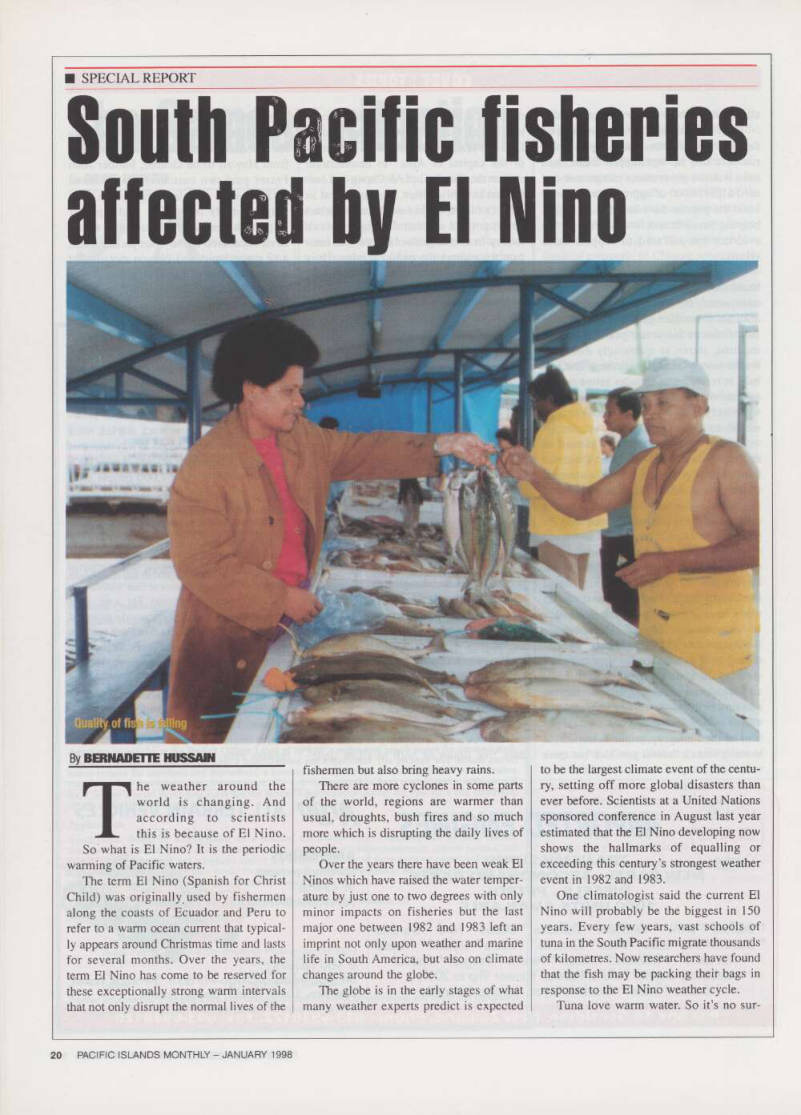

Special Report
South Pacific fisheries affected by EI Nino
By Bernadette Hussain
fishermen but also bring heavy rains.
There are more cyclones in some parts of the world, regions are warmer than usual, droughts, bush fires and so much more which is disrupting the daily lives of people.
Over the years there have been weak El Ninos which have raised the water temper ature by just one to two degrees with only minor impacts on fisheries but the last major one between 1982 and 1983 left an imprint not only upon weather and marine life in South America, but also on climate changes around the globe.
The globe is in the early stages of what many weather experts predict is expected
to be the largest climate event of the centu ry, setting off more global disasters than ever before. Scientists at a United Nations sponsored conference in August last year estimated that the El Nino developing now shows the hallmarks of equalling or exceeding this century’s strongest weather event in 1982 and 1983.
One climatologist said the current El Nino will probably be the biggest in 150 years. Every few years, vast schools of tuna in the South Pacific migrate thousands of kilometres. Now researchers have found that the fish may be packing their bags in response to the El Nino weather cycle.
Tuna love warm water. So it’s no sur-
The weather around the world is changing. And according to scientists this is because of El Nino.
So what is El Nino? It is the periodic warming of Pacific waters.
The term El Nino (Spanish for Christ Child) was originally used by fishermen along the coasts of Ecuador and Peru to refer to a warm ocean current that typical ly appears around Christmas time and lasts for several months. Over the years, the term El Nino has come to be reserved for these exceptionally strong warm intervals that not only disrupt the normal lives of the
prise that huge numbers congregate just north of Papua New Guinea, in what tends to be the balmiest part of the Pacific. But fishermen have noticed that every few years they can catch plenty of fish thou sands of miles far east.
After a few months, however, the fish •swim back to PNG, Scientists have sug gested that El Nino might influence these tuna migrations. Patrick Lehodey and col leagues at the Oceanic Fisheries Program at South Pacific Commission, an interna tional agency based in Noumea, New Caledonia, set out to see if the two phe nomena were indeed linked.
They dug out catch records from 1988 to 1995 for skipjack tuna in the South Pacific, as well as records for temperature and the Southern Oscillation Index (SOI), which is a measure of the barometric pres sures that drive El Nino. Lehodey’s team found that two months after the SOI dropped, indicating El Nino conditions, the Pacific’s warm water would extend thou sands of kilometres to the east as would the most productive fishing area.
Lehodey says they are effectively con cerned about the influence of El Nino on the tuna fisheries in the Pacific. He says the distribution of tuna is largely influ enced by environmental conditions such as temperature, dissolved oxygen, but mainly by the presence of available food.
“The tuna food consists of small crus taceans, squids and fish. The production of these tuna prey depends on the oceanic pri mary (algae) production which can be evaluated and located from satellites that measure ocean colour,” he said.
“However, the development of tuna for age from this primary production takes several weeks (small crustaceans) to sever al months (small pelagic fish) during which both the ocean currents and the ran dom movements of the organisms generate the final distribution of the prey chased by tuna.
“So favourable zones for tuna general ly are close to areas with high primary pro ductivity or/and fronts between water masses known to aggregate the small prey organisms.” According to an article titled ENSO And Tuna In the Western Pacific which was published earlier this year, near ly 70 percent of the world’s annual tuna harvest, currently 3.2 million tonnes, comes from the Pacific Ocean. Skipjack tuna dominate the catch.
The article says that although skipjack are distributed in the surface mixed layer throughout the equatorial and subtropical Pacific, catches are highest in the western equatorial Pacific warm pool, a region characterised by low primary productivity rates and the warmest surface waters of the world’s ocean.
Lehodey says the presence of this pro ductive fishery in the region is in a first view surprising since the primary produc tion is low particularly in comparison with the eastern and central equatorial Pacific.
“The main oceanic zones with high prima ry productivity in the western Pacific are close to the islands, particularly the large ones that enrich the surrounded waters with terrestrial inputs due to run off mech anisms, said Lehodey.
“This is particularly clear around PNG.
A second major source of high primary productivity, at the boundary of the west ern equatorial region (usually around 160 degrees east), is the central equatorial region (equatorial upwelling).
“However, the boundary (front) between these two regions is moving in longitude according to the climatic oscilla tion ENSO.” He explains that during El Nino events, the front moves eastward, so enriching the fishing grounds of Kiribati, Nauru and Tuvalu.
During the converse La Nina event is a cooling of the equatorial ocean and the front moves westward, so drawing more fish into such major fishing zones as those of PNG and the Federated States of Micronesia.
“Regarding the fishing ground close to PNG, the influence of El Nino on the pri mary productivity around the island is not evident from the satellite images for the period of the strong El Nino if 1982 to 1983 to which the present El Nino event can be compared.
However, since the El Nino generates severe droughts in the region we should expect a decrease in the run off and conse quently in primary productivity/available fish food around the islands.
“In summary, we can describe the west ern equatorial region with two major attractive poles for surface tuna which are skipjack and young yellowfin which are caught by purse seine which are the sur rounding waters of PNG/Irian Jaya Island and the mobile front between the western and the central water masses.”
He further explains that in La Nina phase, the front is moving westward, close to PNG, the runoff is maximum and the warm waters are concentrated in the west; these effects combine to produce a very attractive region between PNG, FSM and the Solomon Islands.
In El Nino phase, the front is moving eastward, the runoff is low and the surface layer of warm water is expanding east ward; consequently the tuna resource is much more dispersed throughout the whole western equatorial region with one part of the stock following the eastward move ment of the front and the other dispersing between spot prey aggregation such as local fronts, islands, seamounts, logs and so on. He added that from a fishing per spective an El Nino event may cause reduced catch rates (measured in tonnes per day) in Irian Jaya due to a lack of float ing objects or fish aggregating devices (FAD). Examples of FAD are floating logs or payaos. “For some reason which we do not completely understand, fish such as skipjack and juvenile yellowfin and big eye often associate and concentrate under
Fad’S.
“In the last decade, purse seining tech niques have gradually shifted from fishing on free-swimming schools of skipjack and yellowfin to fishing on FAD’s “In summary, for purse seine fishermen who fish on FAD’s, there will probably be less natural FAD’s during an El Nino.
Thus, vessels may spend more time search ing for decent size fish schools and catch rates maybe lower. Conversely, if purse seiners fish on free swimming schools the number of schools in the PNG, Irian Jaya, FSM and the Solomon Islands area will probably be reduced because the stock shifts eastwards due to environmental rea sons previously mentioned.”
He adds that if there are less natural floating objects in a fishing area, the fleet could always set its own artificial objects such as drifting FAD’s or anchored FAD’s to offset the lack of natural objects.
Lehodey says that during El Nino, most of the commercial fleets from distant water nations such as Japan, the United States and Korea move eastward.
“While there is less fishing activity in PNG, Irian Jaya, FSM and the Solomon Islands during El Nino, we do not want to sound entirely pessimistic about fishing opportunities in these areas. In the extend
ed El Nino from 1991 to 1995 a lot of fish were still caught in FSM, PNG, the Philippines and Indonesia. The fishing fleets within these countries continue to remain economically viable even under the poorer environmental conditions.”
He says that while they (SPC) under stand the regional picture fairly well, it is difficult to predict what may happen in a localised area.
“With advances in more comprehensive fishing data and better satellite products, our understanding of the fisheries and ocean is improving each year.
“More specifically for the area around Fiji, two pelagic fisheries have historically operated in the Fijian FEZ, a surface pole and line fishery and offshore longline fish ery. The domestic Fijian pole-and-line fish ery has operated over a number of ENSO events (1975-92), but neither total catch nor catch rates (catch per unit effort, measured as tonnes per day fished) appear to have any correlation with ENSO events.
“Catch and catch rates in a pole and line fishery often are determined by other fac tors, most importantly, the availability of baitfish” He explains further saying that the
fishery is also seasonal, with most of the catch produced from January to March. In December, the oceanography of the Fiji FEZ changes abruptly from winter to sum mer conditions. The arrival of summer usu ally marks the onset of the surface fishery.
“In contrast to the pole and line fishery, there appears to be a marked change in the catchability or migration of tunas in the subsurface longline fishery.”
While the SPC looks at the change from the scientific perspective, the Solomon Islands based Forum Fisheries Agency’s duty is to develop fisheries management in the region. They are working closely with the SPC to understand the movement of fish in the region. lan Cartwright of FFA said at present it was too early to exactly say what they were going to do.
“We are in the beginning of this El Nino and anything could happen. We know what the scientists are telling us and will react on the stock situation once we know for defi nite what is happening,” he said. He said they were alive to the situation and were watching carefully and collecting all the information they could for future manage ment. ■
EI Nino hits the North Pacific

North Pacific
By Off Johnson
As the El Nino-caused drought sweeps through the western part of Micronesia heading for the Marshall Islands, the islands are taking unprecedented action in response to the dire predictions of meteorologists. In the Federated States of Micronesia, legislation has been introduced into the national congress calling for SUS 2 million to be spent to build water storage tanks, neighborhood catchments and wells, and desalination facilities. In response to predictions of an impending drastic drought in Majuro, the Marshall Islands capital, the development bank is offering loans to help families buy and install rainwater catchment tanks, while city water company officials are
improving pumping capa bility to tap a large under ground fresh water lens well to reduce the atoll’s dependence on rainfall which is now virtually total. A national disaster
preparedness committee
in the Marshalls has kicked into gear, launch ing visits to schools and church groups to promote water conservation.
When virtually all the fresh water comes from rain, talk of a drought is serious business. And thanks to the region-wide weather net work monitoring El Nino progress, which developed after the severe 1983 El Nino drought, these islands are the best informed that they’ve ever been.
“This will be one of the strongest El Nino’s we’ve ever seen,” Guam-based meteorologist Charles “Chip” Guard told Majuro’s Chamber of Commerce, church
groups and government officials during an awareness raising visit in November.
Majuro, which normally gets more than 12 inches of rain in November to help
stock up water supplies as it heads into the January-April dry season, was well below normal, and Guard said that all signs “point to a severe drought.” City water, which is always rationed in Majuro, was further cut back on only every third day in November as reservoir levels plummet edto “danger” levels.
Earlier in the summer, weath er forecasters had predicted increased typhoon and tropi cal storm activity starting in the vicini|ty of the Marshalls in the October/November period.
“The last three super typhoons all started between Majuro and Kwajalein and moved west (causing major damage in Saipan and Guam),” Guard said, empha
sizing the point that the predictions by meteorologists tracking El Nino have been on the mark so far this year.
The peak of the expected drought, he
Fishing in the Marshalls than usual
said, will be in the January to March period, when forecasters predict there will be less than one inch of rain per month. For the January to June period, Guard predicts that Majuro’s rainfall will be 40 inches below normal or only about 20 percent of the usual rainfall.
Because El Nino changes the water tem perature, it affects both fisheries and reefs.
As a massive area of warm water has moved to the east, aside from weather patterns this has changed the sea level in the western Pacific. In the Guam/Yap area, the sea water is 15 inches lower than normal, while off the coast of South America, water levels are 20 inches above normal. Guard said. In Western Pacific Islands, coral reefs are bleaching from their exposure to the sun because of the lowered sea level from El Nino, he said. Guard, however, does not expect sea level to change dramatically in the Marshalls.
He said sea level difference in Majuro is likely to be in the range of six inches, not enough to cause reef problems.
But Guard predicts the drought will be tougher on Majuro residents than a similar El Nino in 1983, because the population has doubled to 30,000 since then, placing greater strain on limited water resources.
On the positive side, Marshalls Energy Company general manager Billy Roberts who doubles as a board member for the City Water Company, says that Majuro’s water situation is actually greatly improved since 1983, putting the capital in a better position to survive the long drought.
Roberts pointed out that in 1983, there was no salt water sewer system for the downtown area (where more than half the population lives), the fresh water lens wells were not being tapped for fresh water, and few residents had water catchments at their homes.
“Majuro is much better off now than ever before,” Roberts said. Guard warned that a particular problem with an extended drought is that the underground lens wells in Majuro (and other islands) will turn brackish (salty) because there is no rainfall to refill them.
“Fresh water lens wells will be depleted when nothing is there to replenish the sup ply,” he said. In 1983, large agriculture tracts in the Marshalls literally dried up, killing everything from coconut and bread fruit to banana and papaya trees.
As mitigation efforts proceed, all most Marshall Islanders can do is brace for a long, long dry season. ■
Advertisements & other items, pp. 22-23 (1 item)
Trade Mark Cautionary
NOTICE IN PALAU
Notice is hereby given that SAMSUNG MOTORS INC, a joint stock company organised and existing under the laws of the Republic of Korea, of 25-17, Shinho-dong, Kangso-gu, Pusan, Republic of Korea (South Korea) is the sole proprietor in Palau and elsewhere of the following trade mark. used in respect of:— Automobiles, trucks, station wagons, vans, buses, and parts for all the aforementioned; engines for land vehicles; tires for vehicle wheels International Class 12.
Motor vehicle maintenance and repair; car washing; automobile lubrication; installation and repair of gasoline pumps for gas station; ship maintenance and repair; airplane maintenance and repair; engine and turbine maintenance and repair; electric appliance installation and repair International Class 37.
The said proprietor claims all rights in respect of the above trade mark and will take all necessary legal steps against any person or company infringing their said rights.
Davies Collison Cave
Patent Attorneys
One Little Collins Street
Melbourne, Victoria, 3000
AUSTRALIA
TRADE MARK CAUTIONARY
NOTICE IN MICRONESIA
Notice is hereby given that SAMSUNG MOTORS INC, a joint stock company organised and existing under the laws of the Republic of Korea, of 25-17, Shinho-dong, Kangso-gu, Pusan, Republic of Korea (South Korea) is the sole proprietor in Micronesia and elsewhere of the following trade mark. used in respect of:— Automobiles, trucks, station wagons, vans, buses, and parts for all the aforementioned; engines for land vehicles; tires for vehicle wheels International Class 12.
Motor vehicle maintenance and repair; car washing; automobile lubrication; installation and repair of gasoline pumps for gas station; ship maintenance and repair; airplane maintenance and repair; engine and turbine maintenance and repair; electric appliance installation and repair International Class 37.
The said proprietor claims all rights in respect of the above trade mark and will take all necessary legal steps against any person or company infringing their said rights.
Davies Collison Cave
Patent Attorneys
One Little Collins Street
Melbourne, Victoria, 3000
AUSTRALIA
move further to fish
Fishermen farced Is move further to fish
By Bernadette Hussain
As the El Nino climate change sets in, fisher men around the region are concerned over what may or may not happen.
Not all understand the scientific expla nation behind the condition and may find it hard to understand exactly what is going on.
Those who know, or it would be better to say, have some idea, are also concerned because they are not sure what the conse quences might be. Captain David Lucas of Solander Pacific, a shipping company based in Suva, Fiji, is one such person.
“I have spoken to various people in the South Pacific Commission and New Zealand MIF and they say we are going have to look at it retrospectively,” he says.
“My understanding of it is basically what’s happening is that there is a large passage of hot water coming out from South America which is up to five to six degrees warmer than normal and of course the winds instead of flowing from the south east in the southern hemisphere and the north east in the northern hemisphere are reversed and going back towards the hot spot near South America.
“I don’t really know what it means for us. I know that fish are a lot harder to catch at the moment and the season is different than it has been in the past. We are on the edge of the hot spot and do not know what the effect will be because we do not have a crystal ball but we do know that the effect right now is that fishing is a lot different and the quality of the fish is low.”
He says now they have to go further north to find the fish but the effort really is a waste of time because the quality is not good, meaning the fat content is not there.
“The amount of fat content is very important because in the Japanese market, where most of our fish go, it is the primary consideration when it comes to price.”
On El Nino he says that this is very complex situation which not many under stand.
“All the scientists that I have spoken to are not too sure of what is going to happen either. In 1982-1983 when there was the
last big El Nino, they realised what was happening too late in the period to under stand what the build-up would be.”
He says some boats are travelling north for two days before they put their gear in the water which is about 400 to 500 miles.
“In 1994, we were able to fish very close to port, we could travel out about 12 hours and start fishing. With the cost of fuel of course, it is quite expansive to move too far, then when we catch the fish we find that it is not the same quality and of course the price is down, whereas our costs are up.
“We are also affected by the strength of the Yen, so really what the effect of El Nino is very difficult to say. “What we have to do is put our heads down and work hard and get through whatever it has in store us. In some parts of the Pacific the fishing is very good, in fact better than nor mal such as around the Marshall Islands but if fishing gets any worse around here then I suppose everybody will have to stop fishing till the situation gets better.”
Compared to the same period last year, he says that in the winter months from June to August fishing was very good but in the same months this year that just didn’t hap pen.
“We did not get that peak. If you look at it on a graph there was hardly any rise at all, very disappointing. That was most unusual because every year no matter how bad the fishing was in the summer months, it always peaked in my experience since 1992, in those months.”
So if things get worse will the need to move to other EEZ’s arise in order to make up for the loss?
“It’s a question that I haven’t really given much thought to basically because of the costs involved. Also if you’re going to move out of the Fiji EEZ then you have to start talking to other governments and other EEZ’s requiring licences and what have you there and I think it may be a very complicated process. “But I suppose the only option for us is if we weren’t able to sustain ourselves in Fiji’s EEZ that we may have to move into international EEZ and try our luck there. But that would probably be the last alternative. “We prefer to catch as close as we can. That seems to be the right economical thing to do.”
So what is he going to do?
“Well it looks like it is going to be a large event and we’ll just have to wait around and see what is going to happen as we can’t do anything about it.” ■
Advertisements & other items, p. 24 (1 item)
24
■ SPECIAL REPORT
PACIFIC ISLANDS MONTHLY - JANUARY 1998
■ SPECIAL REPORT
Marshalls wants nuclear

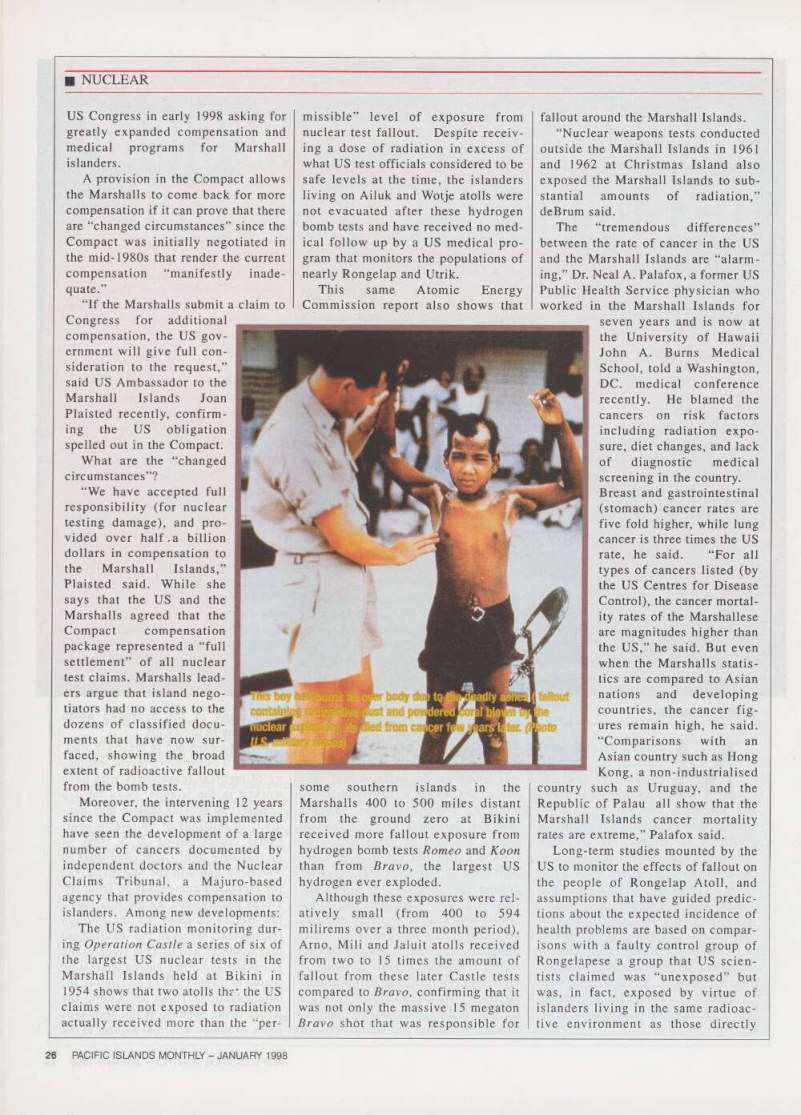
Nuclear
Marshalls wants nuclear test problems resolved
By Off Johnson
All compensation, consideration about illnesses and environmental damage, says Marshall Islands Ambassador to the US Banny deßrum, was based on the premise that only one of the 67 tests, the 1954 Bravo
hydrogen bomb explosion, exposed
Marshall Islanders or their land to unsafe amounts of radiation. The Compact provides the bulk of com pensation to islanders from the two ground zero test sites at Bikini and Enewetak, and Rongelap and Utrik atolls, which were severely affected by fallout from the Bravo test. The Marshalls case is buttressed by the recent release of numerous formerly top-secret US studies and reports from the testing period which confirm that nuclear test fallout was spread far beyond these four atolls and resulted
Marshall Islands offi
cials say that the lega cy of the 67 American nuclear tests at Bikini and Enewetak has yet to be fully addressed by the United States and are preparing to trigger the so-called
“changed circumstance” provisions of
the Compact of Free Association that allow the Marshalls to seek additional compensation. Through the Compact and related programs, the US has pro vided more than half a billion dollars to the Marshall Islands in nuclear test compensation, medical and other ser vices since 1986. But that is far from adequate, given multiplying health problems, say Marshall Islands lead ers.
from many of the hydrogen bomb explosions in the 19505.
Will the evidence in these US stud ies as well as the more recent testimo ny of medical researchers who have worked in the islands, sway the US Congress to provide tens or may hun dreds of millions of dollars in addi tional compensation at a time of increasingly tight fiscal conditions in America? And will the Marshalls’ bid for increased compensation from the US be undermined by the fact that a law passed in 1994 by the Nitijela
(parliament) removed the requirement
that islanders had to have lived in the Marshalls sometime during the testing period of 1946-1958 to be eligible for compensation? These are among the issues being debated as the Marshalls gears to submit a formal request to the
Hydrogen bomb test at Bikini Atoll in 1954 as part of Operation Castle
US Congress in early 1998 asking for greatly expanded compensation and medical programs for Marshall islanders.
A provision in the Compact allows the Marshalls to come back for more compensation if it can prove that there are “changed circumstances” since the
Compact was initially negotiated in
the mid-1980s that render the current
compensation “manifestly inade
quate.”
“If the Marshalls submit a claim to
Congress for additional compensation, the US gov ernment will give full con sideration to the request,” said US Ambassador to the Marshall Islands Joan Plaisted recently, confirm ing the US obligation spelled out in the Compact.
What are the “changed circumstances”?
“We have accepted full responsibility (for nuclear testing damage), and pro vided over half.a billion dollars in compensation to the Marshall Islands,”
Plaisted said. While she says that the US and the Marshalls agreed that the Compact compensation package represented a “full settlement” of all nuclear test claims. Marshalls lead ers argue that island nego tiators had no access to the dozens of classified docu ments that have now sur faced, showing the broad extent of radioactive fallout from the bomb tests.
Moreover, the intervening 12 years since the Compact was implemented have seen the development of a large number of cancers documented by independent doctors and the Nuclear Claims Tribunal, a Majuro-based agency that provides compensation to islanders. Among new developments: The US radiation monitoring dur ing Operation Castle a series of six of the largest US nuclear tests in the Marshall Islands held at Bikini in 1954 shows that two atolls thft the US claims were not exposed to radiation actually received more than the “per
missible” level of exposure from nuclear test fallout. Despite receiv ing a dose of radiation in excess of what US test officials considered to be safe levels at the time, the islanders living on Ailuk and Wotje atolls were not evacuated after these hydrogen bomb tests and have received no med ical follow up by a US medical pro gram that monitors the populations of nearly Rongelap and Utrik.
This same Atomic Energy Commission report also shows that
some southern islands in the Marshalls 400 to 500 miles distant from the ground zero at Bikini received more fallout exposure from hydrogen bomb tests Romeo and Koon than from Bravo, the largest US hydrogen ever exploded.
Although these exposures were rel atively small (from 400 to 594 milirems over a three month period), Arno, Mili and Jaluit atolls received from two to 15 times the amount of fallout from these later Castle tests compared to Bravo, confirming that it was not only the massive 15 megaton Bravo shot that was responsible for
fallout around the Marshall Islands.
“Nuclear weapons tests conducted outside the Marshall Islands in 1961 and 1962 at Christmas Island also exposed the Marshall Islands to sub stantial amounts of radiation,” deßrum said.
The “tremendous differences” between the rate of cancer in the US and the Marshall Islands are “alarm ing,” Dr. Neal A. Palafox, a former US Public Health Service physician who worked in the Marshall Islands for
seven years and is now at the University of Hawaii John A. Burns Medical School, told a Washington, DC. medical conference recently. He blamed the cancers on risk factors including radiation expo sure, diet changes, and lack of diagnostic medical screening in the country.
Breast and gastrointestinal (stomach) cancer rates are five fold higher, while lung cancer is three times the US rate, he said. “For all types of cancers listed (by the US Centres for Disease Control), the cancer mortal ity rates of the Marshallese are magnitudes higher than the US,” he said. But even when the Marshalls statis tics are compared to Asian nations and developing countries, the cancer fig ures remain high, he said.
“Comparisons with an Asian country such as Hong Kong, a non-industrialised
country such as Uruguay, and the Republic of Palau all show that the Marshall Islands cancer mortality rates are extreme,” Palafox said.
Long-term studies mounted by the US to monitor the effects of fallout on the people of Rongelap Atoll, and assumptions that have guided predic tions about the expected incidence of health problems are based on compar isons with a faulty control group of Rongelapese a group that US scien tists claimed was “unexposed” but was, in fact, exposed by virtue of islanders living in the same radioac tive environment as those directly
This boy hao burns all over boby due to the deadly ashes (fallout contining radioastive dust and powdered coral blewn by the nuclear axp[?]sio[?] He dked trom cancer few tew years later. (Photo
U.S. miitiar [?]ces)
exposed to fallout.
Japanese doctors conducting nation-wide surveys in the mid-1990s discovered a high incidence of thyroid tumours, with about 10 percent of the several thousand islanders surveyed found to have tumours.
But can the Marshalls sell the US Congress on more compensation? “As partners, as friends, as historical allies, the Marshall Islands govern ment looks forward to working with the US to define the full extent of human and environmental damage caused by the US nuclear weapons testing program,” deßrum said recently.
“I am thankful to the US govern ment for its willingness to work with the Marshall Islands to address these
lingering problems.”
But it may prove difficult to get the US to dig into its Congressional cof fers and come up with more money and expanded medical programs. Dr Palafox expressed concern that, with the Compact between the US and the Marshalls nearing its end, there will be resistance from the US government to continue health care funding to the Marshalls to deal with the serious can cer problems in the islands.
His fears were not erased by the US Department of Energy which, despite a recommendation from a US Presidential panel that a US medical program for Marshall Islanders •exposed to nuclear test fallout should be expanded, said there is no justifica tion for increasing the number of islanders included in the medical
monitoring.
Despite a number of key US Congressmen who are sympathetic to
the Marshalls nuclear test concerns, it is likely to be an uphill campaign for the islands.
The Marshalls is planning to sub mit a formal request for more compen sation early in 1998, well ahead of the planned renegotiations of the Compact that will start in 1999. Additional compensation and expanded medical care for Marshall islanders is an issue that should be handled separately
from the Compact renegotiations,
Foreign Minister Phillip Muller said.
“We want to get this issue out of the way (before we start negotiations with the US),” Muller said. “It’s an issue under the current arrangement.
It shouldn’t be left to cloud future dis cussions and arrangements.”
It may possibly be dealt with before the 1999 talks take up broader US-Marshall Islands relations and
budget issues for the post-2001 peri
od.
But a Nitijela amendment to the original regulations establishing eligi bility for Nuclear Claims Tribunal compensation could be one point of contention that complicates an other wise strong case for additional fund ing. The Tribunal is receiving SUS4S million from the US to compensate Marshall islanders but, because of an increasingly large number of claims, has already awarded over SUS6O mil lion.
This has forced it to limit actual payments to islanders to less than 60 percent of their actual awards for lack of funds. The Tribunal has repeatedly said that the SUS4S million compen sation funds are grossly inadequate to fully satisfy all compensation awards.
The original policy of the Tribunal
was to compensate islanders who were physically present in the islands dur ing the 1946-1958 testing period according to a list of conditions, pri marily cancers, presumed to be caused by radiation.
That was amended by the Nitijela to delete the cut-off year of 1958 and make eligible anyone who had a phys ical presence in the Marshall Islands or who is the biological child of a mother who had a physical presence in the islands anytime since 1946. This makes eligible for compensation islanders who weren’t born during the testing, providing compensation to second and third generations who have illnesses on the tribunal’s list of compensable conditions.
Tribunal scientific advisors who have otherwise supported expansion of the list of illnesses that receive compensation say that there is little scientific evidence to confirm a link between exposure to radiation and genetic effects in offspring of exposed individuals.
Since Clinton administration offi cials have already indicated they are not warmly disposed to the Marshalls claims for additional compensation and medical care, US officials will undoubtedly attempt to use this expansion of the Tribunal’s compen sation program against the govern ment in its campaign for additional compensation. Nevertheless, this is a minor skirmish in the battle for more compensation.
As deßrum remarked: “From a pub lic health perspective, we need to con sider why the Marshalls has among the world’s highest cancer mortality and incidence rates” ■
Advertisements & other items, p. 27 (1 item)
Japanese Used Vehicles
Exporting around the Pacific
Fiji, Kiribati, Palau, Nauru Is, Norfolk Is, Solomon Is, Papua New Guinea, Niue, New Zealand, Tonga, Samoa.
All Shipping and Documentation arranged for YOU. Buy direct from Japan and save sss. Vehicles from USDSIOOO plus Freight.
Fax today for your Order form and List of Vehicles. Big Selection of used Japanese Motor vehicles.
Special P.I.M. Offer. $lOO off your purchase with this advertisement. r
Trust Company Ltd
Kobac Bldg 3F, 3-2-26 Nishiki Naka ku, Nagoya 460, JAPAN Phone (81) 52 953 5602 Fax (81) 52 953 5634/1
Politics
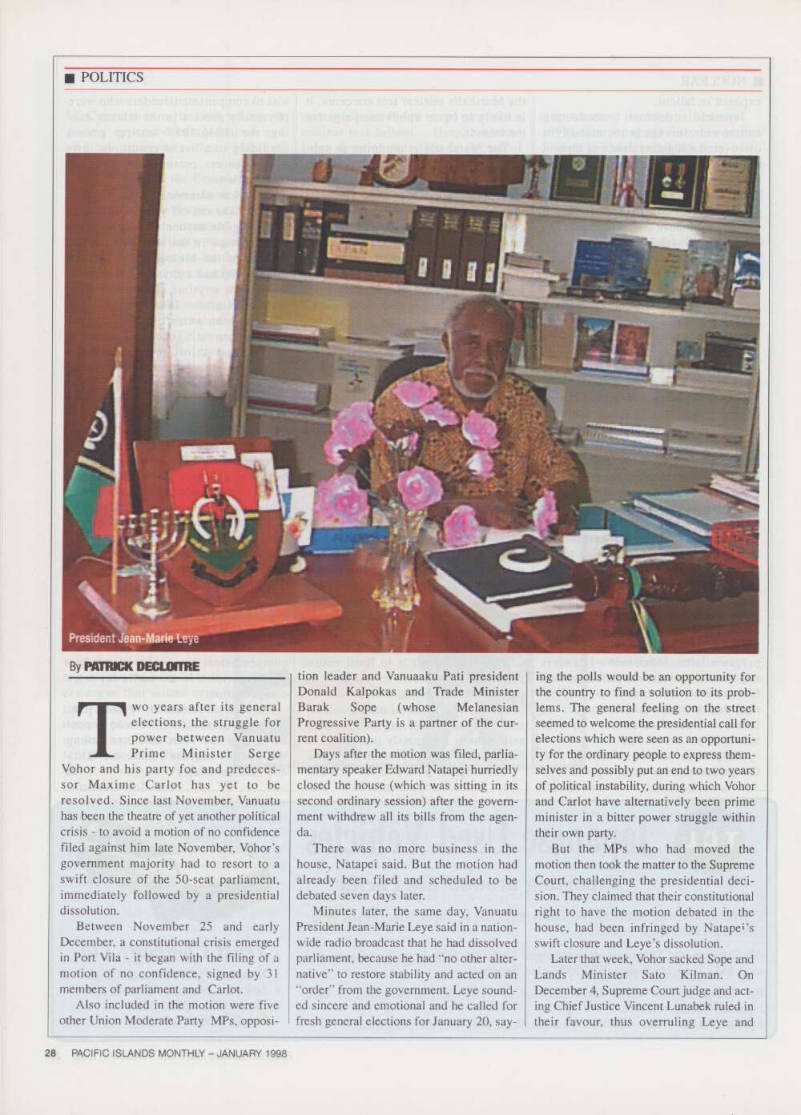

By Patrick Decloitre
tion leader and Vanuaaku Pati president Donald Kalpokas and Trade Minister Barak Sope (whose Melanesian Progressive Party is a partner of the cur rent coalition).
Days after the motion was filed, parlia
mentary speaker Edward Natapei hurriedly
closed the house (which was sitting in its second ordinary session) after the govern ment withdrew all its bills from the agen da.
There was no more business in the house, Natapei said. But the motion had already been filed and scheduled to be debated seven days later.
Minutes later, the same day, Vanuatu President Jean-Marie Leye said in a nation wide radio broadcast that he had dissolved parliament, because he had '‘no other alter native” to restore stability and acted on an “order” from the government. Leye sound ed sincere and emotional and he called for fresh general elections for January 20, say
ing the polls would be an opportunity for the country to find a solution to its prob lems. The general feeling on the street seemed to welcome the presidential call for elections which were seen as an opportuni ty for the ordinary people to express them selves and possibly put an end to two years of political instability, during which Vohor and Carlot have alternatively been prime minister in a bitter power struggle within their own party.
But the MPs who had moved the motion then took the matter to the Supreme Court, challenging the presidential deci sion. They claimed that their constitutional right to have the motion debated in the house, had been infringed by Natape«’s swift closure and Leye’s dissolution.
Later that week, Vohor sacked Sope and Lands Minister Sato Kilman. On December 4, Supreme Court judge and act ing Chief Justice Vincent Lunabek ruled in their favour, thus overruling Leye and
Two years after its general elections, the struggle for power between Vanuatu Prime Minister Serge Vohor and his party foe and predeces sor Maxime Carlot has yet to be resolved. Since last November, Vanuatu has been the theatre of yet another political crisis - to avoid a motion of no confidence filed against him late November, Vohor’s government majority had to resort to a swift closure of the 50-seat parliament, immediately followed by a presidential dissolution.
Between November 25 and early December, a constitutional crisis emerged in Port Vila - it began with the filing of a motion of no confidence, signed by 31 members of parliament and Carlot.
Also included in the motion were five other Union Moderate Party MPs, opposi-
Natapei’s decisions. Lunabek said there was a “link” between the parliament's clo sure and the presidential dissolution and that “even if (Leye) had the constitutional discretion to dissolve parliament, he “failed to take into account that there was an outstanding business before the house”.
The ruling nullified Leye’s dissolution, his call for elections, as well as the parlia ment’s closing.
The parliament was therefore immedi ately brought back to life and summoned to resume debates the same day to debate the only item left on the agenda - the defi ance motion. At that stage, either Carlot or Kalpokas were expected to be close to becoming prime minister.
Things took another twist later that day, when Vohor’s government made a last minute application to the Supreme Court
to obtain that the ruling’s execution be frozen pending an appeal. Before it could debate the motion, parliament was sus
pended.
In a late-night Supreme court session later that ended one of the most volatile days in the country’s history, both parties settled on a status quo until a Court of Appeal was convened to confirm or infirm Lunabek’s ruling. The truce effectively put a hold on the motion, but also went back in time to set the clocks back to November 25, before the situation had begun to dete riorate.
The agreement said in substance until a Court of Appeal convened here (which had not happened when this edition went to press), the President was no longer to men tion January 20 as the date for general elections and not even mention any other possible date, neither side is to take steps to dissolve parliament (which cannot be convened either), and the government restored as it was before November 25.
Sope and Kilman were therefore reinstated in Vohor’s government.
“This agreement preserves all the bene fits (the motion’s supporters) got from the Supreme Court decision while at the same time recognising the right of the unsuc cessful parties to appeal,” John Ridgway, the motion supporters’ lawyer said.
“We’ll just have to wait and see what the Court of Appeal decides.”
In Vanuatu, the Court of Appeal sits on an ad hoc basis and consists of local, but also foreign judges flown in for the occa sion.
It was expected to once but possibly not for all, rule on Vanuatu’s shaky political future. ■
Former prime minister Maxime Carlot
Trade Minister Barak Sope
Advertisements & other items, pp. 29-31 (1 item)
Variety, style and value
FOR YOUR NEW HOME
■ i New Zealand is recognised world-wide as a leading manufacturer of kitset homes. As one of the pioneers in this field, Maddren Homes have been supplying quality homes throughout the Pacific for over a decade.
We know the demands of your unique environment and have developed a range of designs for all conditions.
From our low cost, cyclone resistant, Pacific Panel System to our luxurious European designer series, we are sure to have a home design to suit your budget and your lifestyle.
For information on designs and costs contact:
'Maddren
Homes
P.O Box 244, Kumeu, Auckland, New Zealand Phone: 64-9-412 9070 Fax 64-9-412 7251
SOUTH PACIFIC FORUM SECRETARIAT
SUVA, FIJI
The Forum Secretariat was established in 1972 by the South Pacific Forum to encourage economic and political co-operation between its member countries*, and between those states and the more industrialised countries. To help fulfil the aims of the Forum Secretariat, the following position needs to be filled:
DEVELOPMENT COOPERATION ADVISER
The Secretariat is seeking a suitably qualified and experienced person to work as Development Cooperation Adviser in its Development and Economic Policy Division. The Development Cooperation Adviser reports to the Director of the Division and will assist the Director in coordinating the development cooperation section of the Division.
The Development Cooperation Adviser will: , • prepare policy papers on regional development cooperation issues; • provide advice for member countries* on economic development issues; • organise and coordinate biennial Pacific Island Countries/Development Partners meeting and other associated meetings; • ensure the effectiveness of mechanisms for appraising, monitoring and evaluating donor assistance; and • assisting the Director to oversee the Bth EDF Management Unit.
Applicants must be citizens of Forum member countries* and should have an advanced university degree in economics or related field with sound analytical abilities and appropriate experience, preferably in the Pacific. Extensive travel in the region will be required.
The appointment carries a competitive remuneration package, starting at approximately FJD67,000 depending on qualifications and experience. For non Fiji citizens remuneration should be tax free in Forum member countries*.
There are generous establishment and education allowances and free medical and life insurance. Appointments are normally for three years, with the option to renew for a further three years.
All applications should be addressed to: The Secretary General Forum Secretariat Private Mail Bag, Suva, FIJI Information Packages on the position are available from the Secretariat and applicants are urged to obtain one from Mr Aklesh Nand, on (679) 312600 Extn 207 or fax (679) 301366 or via email: [email protected]. Applications close on 23 January 1998 and should contain full information on education and career background, addresses and telephone numbers of three employment referees. * Member of States of the South Pacific Forum: Australia, Cook Islands, Federated States of Micronesia, Fiji, Kiribati, Nauru, New Zealand, Niue, Palau, P*oua New Guinea, Republic of the Marshall Islands, Solomon Islands, Tonga, Tuvalu, Vanuatu and Samoa.
ASIAN DEVELOPMENT BANK-JAPAN SCHOLARSHIP PROGRAM
Qualified citizens of developing member countries of the Asian Development Bank, who intend to pursue post-graduate studies in selected disciplines are invited to apply for scholarships under the Asian Development Bank-Japan Scholarship Program. It is anticipated that upon successful completion of their graduate studies under the Program, the scholars will return to their countries and contribute to its socioeconomic development Scholarships are awarded for graduate studies at designated institutions in courses of study approved by ADB. The Program especially welcomes women applicants who are qualified but have limited financial means to obtain university education.
THE SCHOLARSHIPS
♦ Level of education ♦ Duration ♦ Coverage Postgraduate (Diploma, Masters and Doctorate degrees) From one to three years Tuition fees, books and subsistence allowance, insurance, return economy air fare
ELIGIBILITY REQUIREMENTS APPLICATION REQUIREMENTS
Prospective applicants must: * be a citizen of an ADB developing member country * have at least two years work experience * have gained admission to an approved course in a designated institution * be in good health (Staff of ADB and the designated institutions and their close relatives are not eligible to apply).
DESIGNATED INSTITUTIONS
1. ASIAN INSTITUTE OF MANAGEMENT
123 Paseo de Roxas, Makati City Metro Manila, Philippines Telephone No. (632) 893-7631
FAX No, (632) 893-7631
2. ASIAN INSTITUTE OF TECHNOLOGY
P.O. Box 2754 Bangkok 10501, Thailand Telephone No. (662) 51&O110 to 29
FAX No. (662) 516-2126
3. EAST-WEST CENTER/UNIVERSITY OF HAWAII
1777 East-West Road, Honolulu Hawaii 96848, U.S.A.
Telephone No. (808) 944-7634
FAX No. (808) 944-7070
4. INDIAN INSTITUTE OF TECHNOLOGY, DELHI
New Delhi 110016, India Telephone No. (9111) 666-979
FAX No. (9111) 686-2037
5. INTERNATIONAL RICE RESEARCH MSTITUTE/UNIVERSITY OF THE PHILIPPINES
IN LOS BANOS
P.O. Box 933, Manila, Philippines Telephone No. (632) 8450583/0569/0570
FAX No. (632) 817-8470/818-2087
6. INTERNATIONAL UNIVERSITY OF JAPAN
777 Anajlshinden, Yamato-Machi, Minami Uonumagun, Niigata 949-72, Japan Telephone No. (0257) 79-1111
FAX No. (0257) 794441/79-1180
7. LAHORE UNIVERSITY OF MANAGEMENT SCIENCES
103-C/2 Gulberg 111, Lahore, Pakistan Telephone No. (9242) 572-2670 to 79
FAX No. (9242) 572-2591
8. NATIONAL CENTER FOR DEVELOPMENT STUDIES/AUSTRALIAN NATIONAL
UNIVERSITY
GPO Box 4, Canberra ACT 0200, Australia Telephone No. (612) 62494705
FAX No. (612) 6257-2886
9. NATIONAL UNIVERSITY OF SINGAPORE
10 Kent Ridge Crescent, Singapore 0511 Telephone No. (65) 772-2068/772-6149
FAX No. (65) 7782681
10. SAITAMA UNIVERSITY
255 Shimo-Okubo, Urawa City 338, Japan Telephone No. (81-48) 8583555
FAX No. (8148) 8583555
Telephone No. (8148) 85831182
FAX No. (8148) 852-0499
11. THAMMASAT UNIVERSITY
2 Prachand Road, Bangkok 10200, Thailand Telephone No. (662) 516 4537-8/516 9003-5
FAX No. (662) 516 9007/224 8099
12. UNIVERSITY OF AUCKLAND
Private Bag 92019, Auckland, New Zealand Telephone No. (649) 373-7513
FAX No. (649) 373-7405
13. UNIVERSITY OF HONG KONG
Pokfulam Road, Hong Kong Telephone No. (852) 2859-2111
FAX No. (852) 2859-9459/28582549
14. UNIVERSITY OF MELBOURNE
Parkville, Victoria, 3052 Australia Telephone No. (613) 9344 0034
FAX No. (613) 9349 9062
15. UNIVERSITY OF SYDNEY
Sydney 2006, Australia Telephone No. (612) 351-2778
FAX No. (612) 3514013
16. UNIVERSITY OF TOKYO
3-Hongo, 7-ChOme, Bunkyo-ku, Tokyo 113, Japan Telephone No. (813) 3812-2111
FAX No. (813) 38124977/38185692
Telephone No. (813) 3812-2111 ext 3530
FAX No. (813) 5684-2739
Applicants should: ♦ obtain application forms from the designated institutions of their choice ♦ submit the completed application form and required documentation to the institution ♦ indicate on the application form that the applicant wishes to be considered for an Asian Development Bank-Japan Scholarship (From among those admitted by the institutions, ADB will select candidates for award of scholarships. A separata application to ADB Is not necessary).
APPROVED FIELDS OF STUDY
Business Management, Development Management, Management Science and Technology (including Environmental Management and Engineering), Management of Technology International Business Japan-focused Executive MBA Business Administration Ocean & Earth Science & Technology Ocean Engineering & Oceanography Pacific Islands Studies Social Science Economics. Geography, Public Administration, Sociology, Urban & Regional Planning Tropical Agriculture & Human Resources Agricultural & Resource Economics Horticulture including Plant Pathology Science and Technology Fields related to Rice and Rice-Based Fanning International Relations, International Management Business Administration Economics of Development Development Administration, Demography, Environmental Management and Development Business Administration, Management of Technology Social Sciences (Economic) Civil and Environmental Engineering and Related Subjects Development Studies, Public Analysis Public Policy Economics, Engineering International Business, Development Studies, Environmental Science and Management Engineering, Public Health Urban Planning, Urban Design Business Administration, Commerce, Commerce (specialising in Economics), Engineering International Business, Public Health, Agribusiness, Agricultural Science, Forest Science Business Administration, Economics, Commerce, Transport Management, Public Health Civil Engineering and Related Subjects, Public Health
Pacific's exclusive
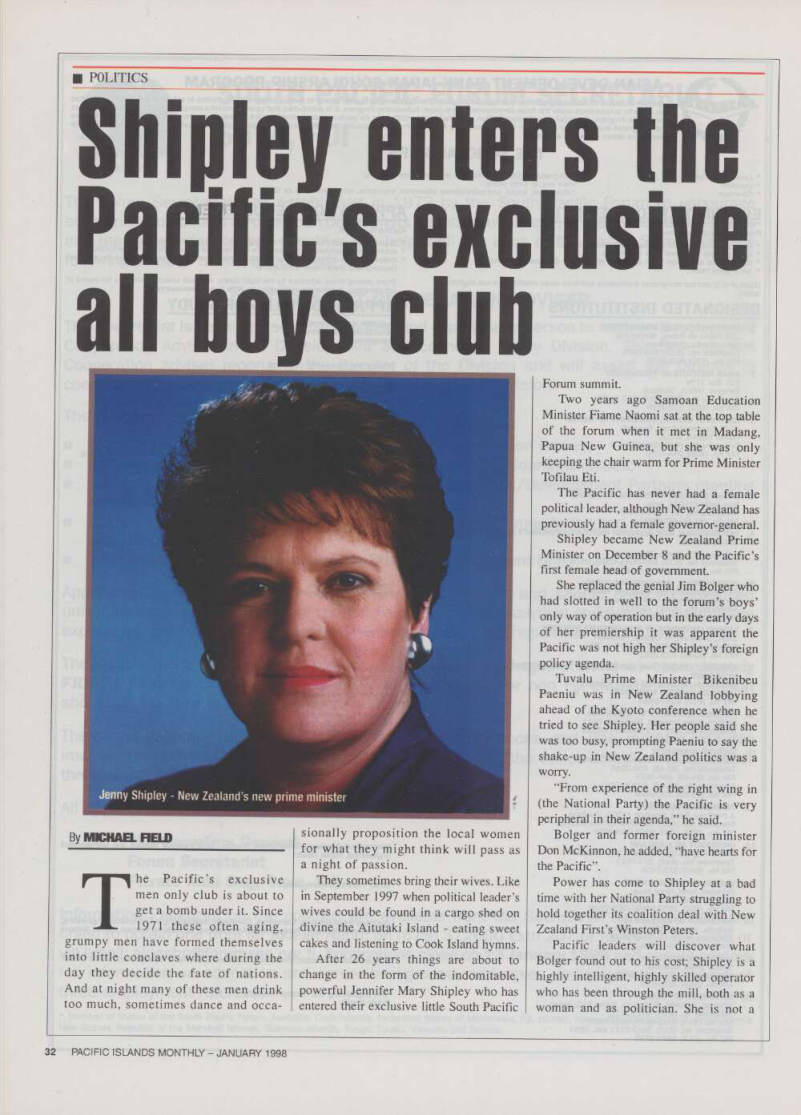
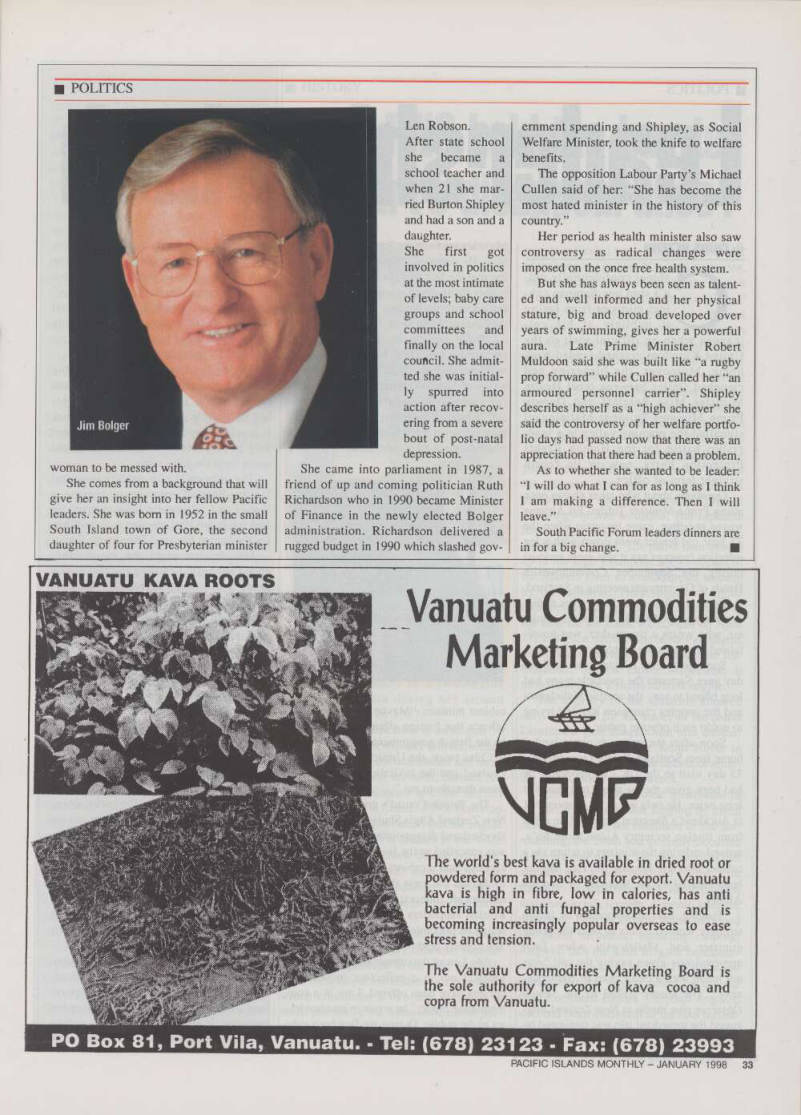
Shipley enters the Pacific's exclusive all boys club
By Michael Field
sionally proposition the local women for what they might think will pass as a night of passion.
They sometimes bring their wives. Like in September 1997 when political leader’s wives could be found in a cargo shed on divine the Aitutaki Island - eating sweet cakes and listening to Cook Island hymns.
After 26 years things are about to change in the form of the indomitable, powerful Jennifer Mary Shipley who has entered their exclusive little South Pacific
The Pacific’s exclusive men only club is about to get a bomb under it. Since 1971 these often aging, grumpy men have formed themselves into little conclaves where during the day they decide the fate of nations.
And at night many of these men drink too much, sometimes dance and occa-
Forum summit.
Two years ago Samoan Education Minister Fiame Naomi sat at the top table of the forum when it met in Madang, Papua New Guinea, but she was only keeping the chair warm for Prime Minister Tofilau Eti.
The Pacific has never had a female political leader, although New Zealand has previously had a female governor-general.
Shipley became New Zealand Prime Minister on December 8 and the Pacific’s first female head of government.
She replaced the genial Jim Bolger who had slotted in well to the forum’s boys’ only way of operation but in the early days of her premiership it was apparent the Pacific was not high her Shipley’s foreign policy agenda.
Tuvalu Prime Minister Bikenibeu Paeniu was in New Zealand lobbying ahead of the Kyoto conference when he tried to see Shipley. Her people said she was too busy, prompting Paeniu to say the shake-up in New Zealand politics was a worry.
“From experience of the right wing in (the National Party) the Pacific is very peripheral in their agenda,” he said.
Bolger and former foreign minister Don McKinnon, he added, “have hearts for the Pacific”.
Power has come to Shipley at a bad time with her National Party struggling to hold together its coalition deal with New Zealand First’s Winston Peters.
Pacific leaders will discover what Bolger found out to his cost; Shipley is a highly intelligent, highly skilled operator who has been through the mill, both as a woman and as politician. She is not a
woman to be messed with.
She comes from a background that will give her an insight into her fellow Pacific leaders. She was bom in 1952 in the small South Island town of Gore, the second daughter of four for Presbyterian minister
Len Robson.
After state school she became a school teacher and when 21 she mar ried Burton Shipley and had a son and a
daughter.
She first got involved in politics at the most intimate of levels; baby care groups and school committees and finally on the local council. She admit ted she was initial ly spurred into action after recov ering from a severe bout of post-natal
depression.
She came into parliament in 1987, a friend of up and coming politician Ruth Richardson who in 1990 became Minister of Finance in the newly elected Bolger administration. Richardson delivered a rugged budget in 1990 which slashed gov
emment spending and Shipley, as Social Welfare Minister, took the knife to welfare benefits.
The opposition Labour Party’s Michael Cullen said of her: “She has become the most hated minister in the history of this country.”
Her period as health minister also saw controversy as radical changes were imposed on the once free health system.
But she has always been seen as talent ed and well informed and her physical stature, big and broad developed over years of swimming, gives her a powerful aura. Late Prime Minister Robert Muldoon said she was built like “a rugby prop forward” while Cullen called her “an armoured personnel carrier”. Shipley describes herself as a “high achiever” she said the controversy of her welfare portfo lio days had passed now that there was an appreciation that there had been a problem.
As to whether she wanted to be leader: “I will do what I can for as long as I think I am making a difference. Then I will leave.”
South Pacific Forum leaders dinners are in for a big change. ■
Advertisements & other items, p. 33 (1 item)
Marketing Board
VANUATU KAVA ROOTS
m T¥ *4 .mi PO Box 81, Port Vila, Vanuatu.
Vanuatu Commodities
Marketing Board
W The world's best kava is available in dried root or powdered form and packaged for export. Vanuatu kava is high in fibre, low in calories, has anti bacterial and anti fungal properties and is becoming increasingly popular overseas to ease stress and tension.
The Vanuatu Commodities Marketing Board is the sole authority for export of kava cocoa and copra from Vanuatu.
Leadership clash
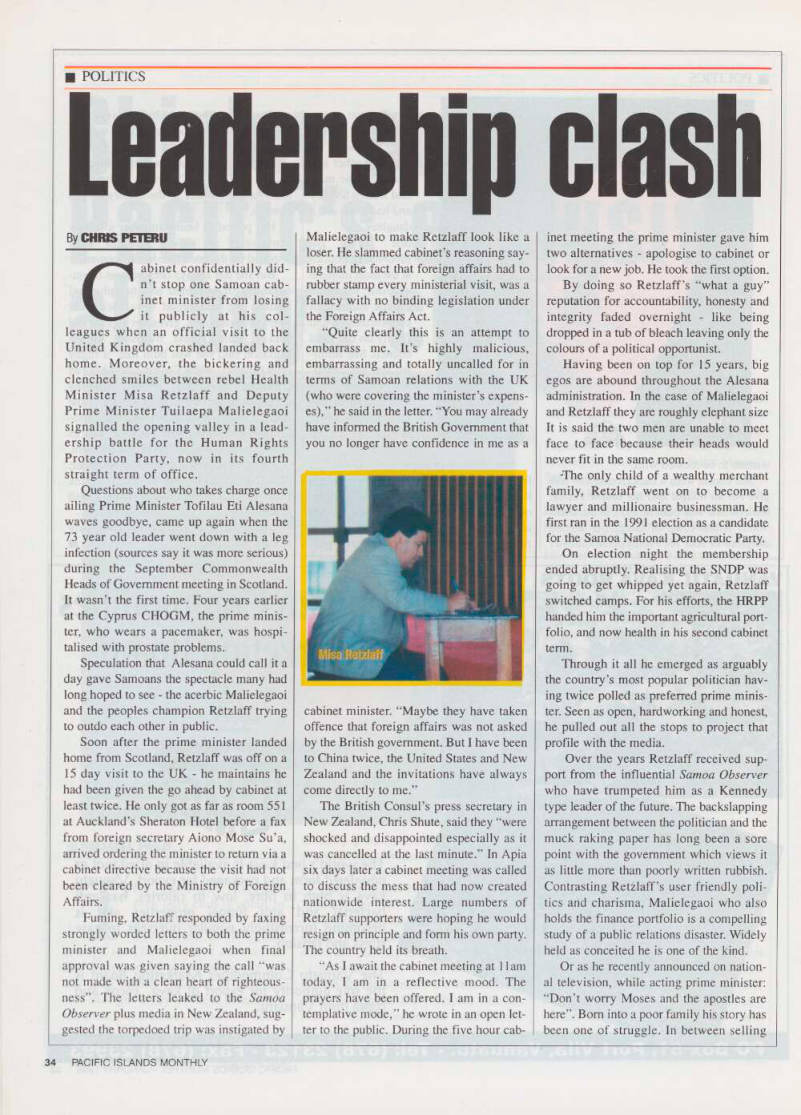
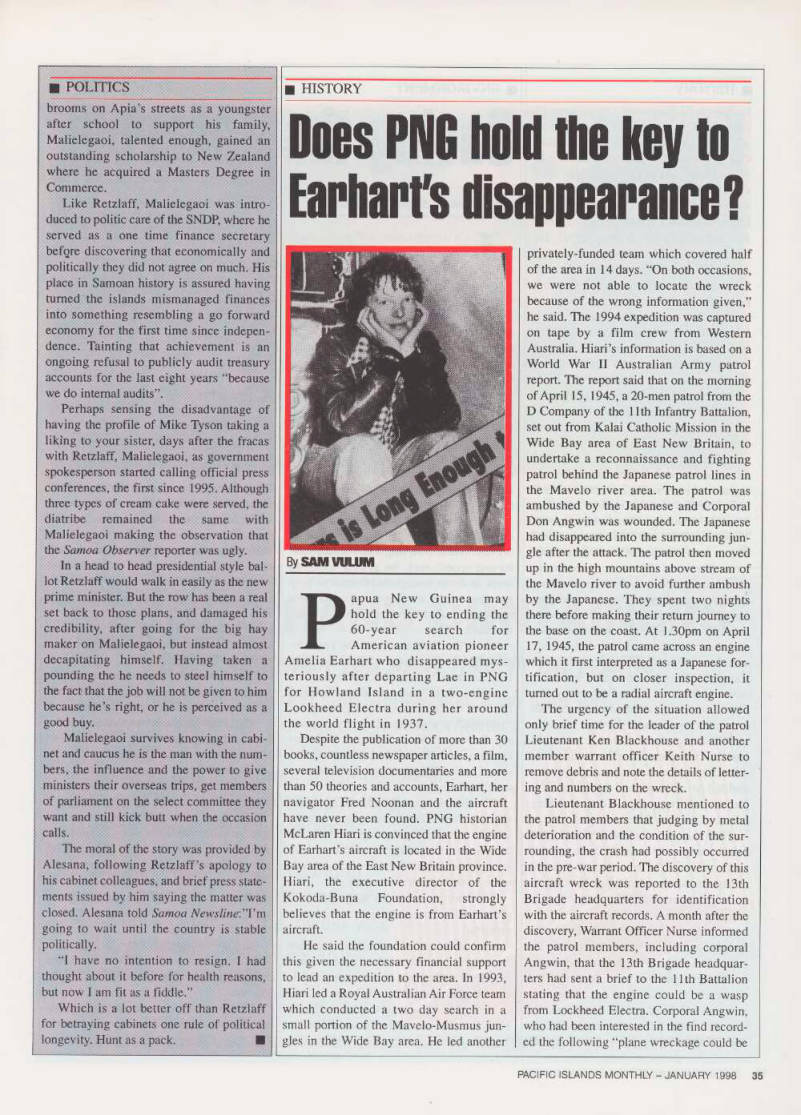
By Chris Peteru
Cabinet confidentially did
n’t stop one Samoan cab inet minister from losing it publicly at his col leagues when an official visit to the United Kingdom crashed landed back home. Moreover, the bickering and clenched smiles between rebel Health Minister Misa Retzlaff and Deputy Prime Minister Tuilaepa Malielegaoi signalled the opening valley in a lead ership battle for the Human Rights Protection Party, now in its fourth straight term of office.
Questions about who takes charge once ailing Prime Minister Tofilau Eti Alesana waves goodbye, came up again when the 73 year old leader went down with a leg infection (sources say it was more serious) during the September Commonwealth Heads of Government meeting in Scotland.
It wasn’t the first time. Four years earlier at the Cyprus CHOGM, the prime minis ter, who wears a pacemaker, was hospi talised with prostate problems.
Speculation that Alesana could call it a day gave Samoans the spectacle many had long hoped to see - the acerbic Malielegaoi and the peoples champion Retzlaff trying to outdo each other in public.
Soon after the prime minister landed home from Scotland, Retzlaff was off on a 15 day visit to the UK - he maintains he had been given the go ahead by cabinet at least twice. He only got as far as room 551 at Auckland’s Sheraton Hotel before a fax from foreign secretary Aiono Mose Su’a, arrived ordering the minister to return via a cabinet directive because the visit had not been cleared by the Ministry of Foreign Affairs.
Fuming, Retzlaff responded by faxing strongly worded letters to both the prime minister and Malielegaoi when final approval was given saying the call “was not made with a clean heart of righteous ness”. The letters leaked to the Samoa Observer plus media in New Zealand, sug gested the torpedoed trip was instigated by
Malielegaoi to make Retzlaff look like a loser. He slammed cabinet’s reasoning say ing that the fact that foreign affairs had to rubber stamp every ministerial visit, was a fallacy with no binding legislation under the Foreign Affairs Act.
“Quite clearly this is an attempt to embarrass me. It’s highly malicious, embarrassing and totally uncalled for in terms of Samoan relations with the UK (who were covering the minister’s expens es),” he said in the letter. “You may already have informed the British Government that you no longer have confidence in me as a
cabinet minister. “Maybe they have taken offence that foreign affairs was not asked by the British government. But I have been to China twice, the United States and New Zealand and the invitations have always come directly to me.”
The British Consul’s press secretary in New Zealand, Chris Shute, said they “were shocked and disappointed especially as it was cancelled at the last minute.” In Apia six days later a cabinet meeting was called to discuss the mess that had now created nationwide interest. Large numbers of Retzlaff supporters were hoping he would resign on principle and form his own party.
The country held its breath.
“As I await the cabinet meeting at 11 am today, I am in a reflective mood. The prayers have been offered. I am in a con templative mode,” he wrote in an open let ter to the public. During the five hour cab
inet meeting the prime minister gave him two alternatives - apologise to cabinet or look for a new job. He took the first option.
By doing so Retzlaff’s “what a guy” reputation for accountability, honesty and integrity faded overnight - like being dropped in a tub of bleach leaving only the colours of a political opportunist.
Having been on top for 15 years, big egos are abound throughout the Alesana administration. In the case of Malielegaoi and Retzlaff they are roughly elephant size It is said the two men are unable to meet face to face because their heads would never fit in the same room. -The only child of a wealthy merchant family, Retzlaff went on to become a lawyer and millionaire businessman. He first ran in the 1991 election as a candidate for the Samoa National Democratic Party.
On election night the membership ended abruptly. Realising the SNDP was going to get whipped yet again, Retzlaff switched camps. For his efforts, the HRPP handed him the important agricultural port folio, and now health in his second cabinet term.
Through it all he emerged as arguably the country’s most popular politician hav ing twice polled as preferred prime minis ter. Seen as open, hardworking and honest, he pulled out all the stops to project that profile with the media.
Over the years Retzlaff received sup port from the influential Samoa Observer who have trumpeted him as a Kennedy type leader of the future. The backslapping arrangement between the politician and the muck raking paper has long been a sore point with the government which views it as little more than poorly written rubbish.
Contrasting Retzlaff’s user friendly poli
tics and charisma, Malielegaoi who also holds the finance portfolio is a compelling study of a public relations disaster. Widely held as conceited he is one of the kind.
Or as he recently announced on nation al television, while acting prime minister: “Don’t worry Moses and the apostles are here”. Bom into a poor family his story has been one of struggle. In between selling
brooms on Apia’s streets as a youngster after school to support his family, Malielegaoi, talented enough, gained an outstanding scholarship to New Zealand where he acquired a Masters Degree in Commerce.
Like Retzlaff, Malielegaoi was intro duced to politic care of the SNDP, where he served as a one time finance secretary before discovering that economically and politically they did not agree on much. His place in Samoan history is assured having turned the islands mismanaged finances into something resembling a go forward economy for the first time since indepen dence. Tainting that achievement is an ongoing refusal to publicly audit treasury accounts for the last eight years “because we do internal audits”.
Perhaps sensing the disadvantage of having the profile of Mike Tyson taking a liking to your sister, days after the fracas with Retzlaff, Malielegaoi, as government spokesperson started calling official press conferences, the first since 1995. Although three types of cream cake were served, the diatribe remained the same with Malielegaoi making the observation that the Samoa Observer reporter was ugly.
In a head to head presidential style bal lot Retzlaff would walk in easily as the new prime minister. But the row has been a real set back to those plans, and damaged his credibility, after going for the big hay maker on Malielegaoi, but instead almost decapitating himself. Having taken a pounding the he needs to steel himself to the fact that the job will not be given to him because he’s right, or he is perceived as a good buy.
Malielegaoi survives knowing in cabi net and caucus he is the man with the num bers, the influence and the power to give ministers their overseas trips, get members of parliament on the select committee they want and still kick butt when the occasion calls.
The moral of the story was provided by Alesana, following Retzlaff’s apology to his cabinet colleagues, and brief press state ments issued by him saying the matter was closed. Alesana told Samoa Newslinei’Tm going to wait until the country is stable politically.
“I have no intention to resign. I had thought about it before for health reasons, but now I am fit as a fiddle.”
Which is a lot better off than Retzlaff for betraying cabinets one rule of political longevity. Hunt as a pack. ■
Eanharfs disappearance?
History
Does PNG hold the key to Eanharfs disappearance?
By Sam Vulum
Papua New Guinea may hold the key to ending the 60-year search for American aviation pioneer Amelia Earhart who disappeared mys teriously after departing Lae in PNG for Howland Island in a two-engine Lockheed Electra during her around the world flight in 1937.
Despite the publication of more than 30 books, countless newspaper articles, a film, several television documentaries and more than 50 theories and accounts, Earhart, her navigator Fred Noonan and the aircraft have never been found. PNG historian McLaren Hiari is convinced that the engine of Earhart’s aircraft is located in the Wide Bay area of the East New Britain province.
Hiari, the executive director of the Kokoda-Buna Foundation, strongly believes that the engine is from Earhart’s aircraft.
He said the foundation could confirm this given the necessary financial support to lead an expedition to the area. In 1993, Hiari led a Royal Australian Air Force team which conducted a two day search in a small portion of the Mavelo-Musmus jun gles in the Wide Bay area. He led another
privately-funded team which covered half of the area in 14 days. “On both occasions, we were not able to locate the wreck because of the wrong information given,” he said. The 1994 expedition was captured on tape by a film crew from Western Australia. Hiari’s information is based on a World War II Australian Army patrol report. The report said that on the morning of April 15, 1945, a 20-men patrol from the D Company of the 11th Infantry Battalion, set out from Kalai Catholic Mission in the Wide Bay area of East New Britain, to undertake a reconnaissance and fighting patrol behind the Japanese patrol lines in the Mavelo river area. The patrol was ambushed by the Japanese and Corporal Don Angwin was wounded. The Japanese had disappeared into the surrounding jun gle after the attack. The patrol then moved up in the high mountains above stream of the Mavelo river to avoid further ambush by the Japanese. They spent two nights there before making their return journey to the base on the coast. At 1,30 pm on April 17, 1945, the patrol came across an engine which it first interpreted as a Japanese for tification, but on closer inspection, it turned out to be a radial aircraft engine.
The urgency of the situation allowed only brief time for the leader of the patrol Lieutenant Ken Blackhouse and another member warrant officer Keith Nurse to remove debris and note the details of letter ing and numbers on the wreck.
Lieutenant Blackhouse mentioned to the patrol members that judging by metal deterioration and the condition of the sur rounding, the crash had possibly occurred in the pre-war period. The discovery of this aircraft wreck was reported to the 13th Brigade headquarters for identification with the aircraft records. A month after the discovery, Warrant Officer Nurse informed the patrol members, including corporal Angwin, that the 13th Brigade headquar ters had sent a brief to the 11th Battalion stating that the engine could be a wasp from Lockheed Electra. Corporal Angwin, who had been interested in the find record ed the following “plane wreckage could be
Lockheed El Eng wasp” on a piece of paper and placed it in his waterproof pouch. The pouch is still in his possession today. However, he had forgotten for 45 years that he has in his possession such valuable information until 1990 while watching a television program on Earhart’s aircraft. The programme carried detailed description of the aircraft. He was reminded of the wreck discovered in April 1945, and when going back through his well maintained war documents in his house, he found the description.
Corporal Angwin noted that Earhart’s route to Howland Island took her directly over the position of the discovered radial engine. Further research revealed that Earhart’s plane was a Lockheed Electra.
Although Corporal Angwin freely con cedes that his knowledge of aviation and aerial navigation is scant, he began to wonder if Earhart and her navigator had turned back after failing to find Howland Island and headed for this last land mass sighted, which was PNG. Further research also revealed that his option was very possible although American experts, including TIGHAR, The International Group for Historical Aircraft Recovery, have dismissed the new evidence as “baseless and too far away from Howland Island.” According to historical tradition, Earhard, Noonan and the aircraft van ished in the Pacific and drowned in the sea after running out of fuel. At least that was the official version for public con sumption. Despite faint radio transmis sions picked up from Earhart by the United States Coast Guard hours after, no one really knew where she was.
What most have failed to entertain based on interpretation of her radio trans missions is that Earhart too may have realised her dilemma and turned back for Lae (which is very possible), crashing into the East New Britain jungles.
Hiari said that after the 1993 and 1994 failed attempts, he made further enquiries and confirmed the area recorded in the Australian army patrol map. He said he had already written to Corporal Angwin, pointing out the proper site.
He said the foundation needed funds to help organise a team to take out an expedition to the Wide Bay area. A prop er 20-men expedition team, including six film crew members, four Australian vet erans and 10 local guides is expected to cost K 104,000. A five-men team will cost about K 15,000. ■
Saving the Kakerori

Environment
By Florence - Syme Buchanan
It’s a drab little bird with a call that sounds like the squeaking produced by rubbing two glass bottles and its existence isn’t widely known among Cook Islanders.
That’s probably because up until a year ago, just 29 Kakeori, the tiny Rarotongan Flycatcher, remained on the island. One of the world’s rarest birds, the Kakerori was
critically endangered.
They are found only in Rarotonga, inland of the Takitumu district living in an area covering about 150 hectares.
About 10 years ago a small group of passionate environmentalists got together and embarked on a difficult mission to save the bird from extinction. And they’ve been successful.
Many Rarotongans are superstitious of the deep bush covered hills in the centre of the lush island believing that’s where spir its and spooks lurk. So getting locals to work in dense unexplored forests to help save one of the world’s rarest birds from extinction was difficult, said Anna Tiraa- Passfield.
Tiraa-Passfield is one of the environ mentalists who has brought the tiny Kakerori back from the brink of extinction.
Although still endangered, the Kakerori has been off the critical list for just a year.
In 1885, it was first noticed by mission ary Reverend Wyatt Gill that Kakerori numbers were declining, a pattern that con tinued until 1989 when just 29 birds were estimated to exist.
The decline was blamed mainly on the ship rat, unintentionally introduced into the islands over a 100 years ago. Saving the bird meant eliminating the ship rat which ate eggs and often killed the female birds when it tried to protect the nest.
The tiny bird, weighs only about 23 grams and measures an average 14 cen timetres.
The Kakerori’s closest relatives are found in the outer islands of French Polynesia and are said to evolve from birds spreading from the Western Pacific.
A report by conservationist Gerald McCormack, one of the first to initiate the
steps to save the Kakerori, states that these relatives are also suffering reduced ranges and an increasing struggle to survive.
The Kakerori Recovery Programme quickly got underway in 1987 after it was taken out of the government’s hands.
Funding of $300,000 for a five year budget was obtained from the South Pacific Regional Environmental Programme
(Sprep).
Getting rid of the main predator involved the laborious, tedious job of lay ing poison bait at various stations covering the entire 155 hectare area the bird is known to exist, said Tiraa-Passfield.
Nesting trees were also banded with alu minium strips to prevent rats from climb ing them. Thanks to the Recovery Programme, the Kakerori population climbed to 134 by 1996. An achievement which has put the Cook Islands on the con servation map. But it has been a lot of hard work. Tiraa-Passfield says they have a few more labour intensive years before the bird is safely off the endangered list.
“It gets very monotonous, trudging up into the bush all the time to lay poison, some of the workers were very supersti tious and said it was too spooky or they could smell strange smells.”
Tiraa-Passfield says locals normally venture into deep bush only to collect tra ditional medicines or rare delicacies.
“But my dad has strong links with the land so my taunga, my spiritual side, is looking after me when I’m up there.”
The environmentalist has been spared from the mountain treks for some months as she is expecting her fourth child.
The Kakerori habitat has now become a reserve called the Takitumu Conservation Area (TCA). It was established last year by the group of environmentalists and the three major landowners. Tiraa-Passfield works for the Takitumu Conservation Area as its support officer coordinating all activ ities.
Guided nature walks through the Takitumu Conservation Area which charge a small fee helps support the recovery pro gramme.
“It’s been a great success because we are the only Pacific Island country to do
this, it has been cheap and we have had the experts but now we are running it our selves.”
Tiraa-Passfield says because the bird had almost totally disappeared, very few
Cook Islanders know of its existence.
And there are those who cannot under stand what the fuss is about.
The locals say the bird has no econom ic value, it’s not dramatic nor does it have
an attractive call.
Tiraa-Passfield says she always tells them: “Once its gone, its gone and we don’t want our children knowing about the birds just from picture books.” ■
Kakerori (Raratonga’s endangered flycatcher)
Advertisements & other items, p. 37 (2 items)
Environment
Second Hand Containers
WHERE AND WHEN YOU WANT THEM IN THE PACIFIC If you need a flexible and safe storage space we have the ideal solution for you. Our second hand containers provide instant secure storage. Guaranteed to be wind and waterproof these containers are ideal for both temporary and longterm storage in Pacific conditions.
We can deliver to any island in the Pacific within a month and our rates have got to be the lowest you will find. All you need to do is tell us how many you want.
CONTACT:
PASCALE MARCONNET, BP 4757 NOUMEA, NEW CALEDONIA. TEL: (687) 28 7450. FAX: (687) 26 3248
Winners of the FTIB
Advertising Feature
Exporter of the Year
Awards 1997
Prime Minister’s Exporter of the Year - United Apparel Established in June 1989, it was initial ly set up with an investment of almost $4.5 m( SUS3m) to manufacture menswear, namely pants, jackets and suits for export to Australia and New Zealand.
It now employs over 500 locals and has export outlets in Australia, New Zealand, United Kingdom, Germany and the United States.
Services Category - Pasiflka Communications The company is involved in producing video and television productions and other related services. It was established in 1994 with an investment of almost a quarter of a million dollars. It was set up initially for two purposes: to fill a need for informa tional and educational productions and to further help develop the video/television industry.
Its achievements in producing adver tisements for local companies, documen taries within Fiji and the Pacific region and in providing a service has generated more demand among the private and public sec tor in Fiji Food and Beverage - Frespac Limited The company was established in May 1994 to undertake the new venture of pro cessing syruped and crystallised ginger for export.
Household Goods - Modern Furniture Building and Industrial - Valebasoga Tropik Boards Limited The company began operations in 1993 to manufacture timber in Labasa, Vanua Levu, the northern island of Fiji investing over $4 million and employing over 100 people. It exports to Australia.
Clothing and Textiles - Mark One Apparel The company manufactures men’s clothes and is wholly owned by two Australian investors. With an investment of around slm (SUS6BO,OO) employment for over 100 people, export earnings of
over $1 million, the company has grown considerably and has excelled in achieving its targets for the production and export of menswear.
Footwear - Forum Shoes The company began manufacturing shoe uppers for export in 1991 and has invested close to slm ($US680,000) in this project. It supplies quality show uppers and shoes to Australia and New Zealand. It employs around 300 people.
Tourism and Hospitality - Rosie The Travel Service General - Sandollars The company is dedicated to supplying products and giftware, utilising Fiji’s natu ral abundant resources. They focus on developing promotional products and designs which incorporate local material and concept.
The company also designs and devel ops logo items and products for companies - these include logo design, shirts, caps, amenity bags, children’s kits, note pads and handicraft.
They also manufacture pure and natu ral sand soap, a range of surfware and products like masi dolls and isa lei salusalu.
New Exporter of the Year - Natural Waters of Viti Ltd This company was established in Fiji with an investment of close to sl.sm (UsUSlm). An integrated beverage com pany, it was set up to extract, purify and manufacture bottles to packmg the water.
Unique Exporter of the Year - Kentia
Clothing
Exporter to New Zealand - Paradise Garments This company manufactures garments under the TTF status.lt employs over 130 locals and specialises in heavy upmarket garments like oil skin jackets, overcoats and jackets. It exports over s2m (SUSI.3m) worth of garments annually to Italy, Australia and Germany. This is one of the companies utilising the duty free quota of garments under derogation to the European Union. It has been recognised as one of the companies with a 100 percent export commitment to the European Community under the EEC/Lome Derogation facility. ■
United

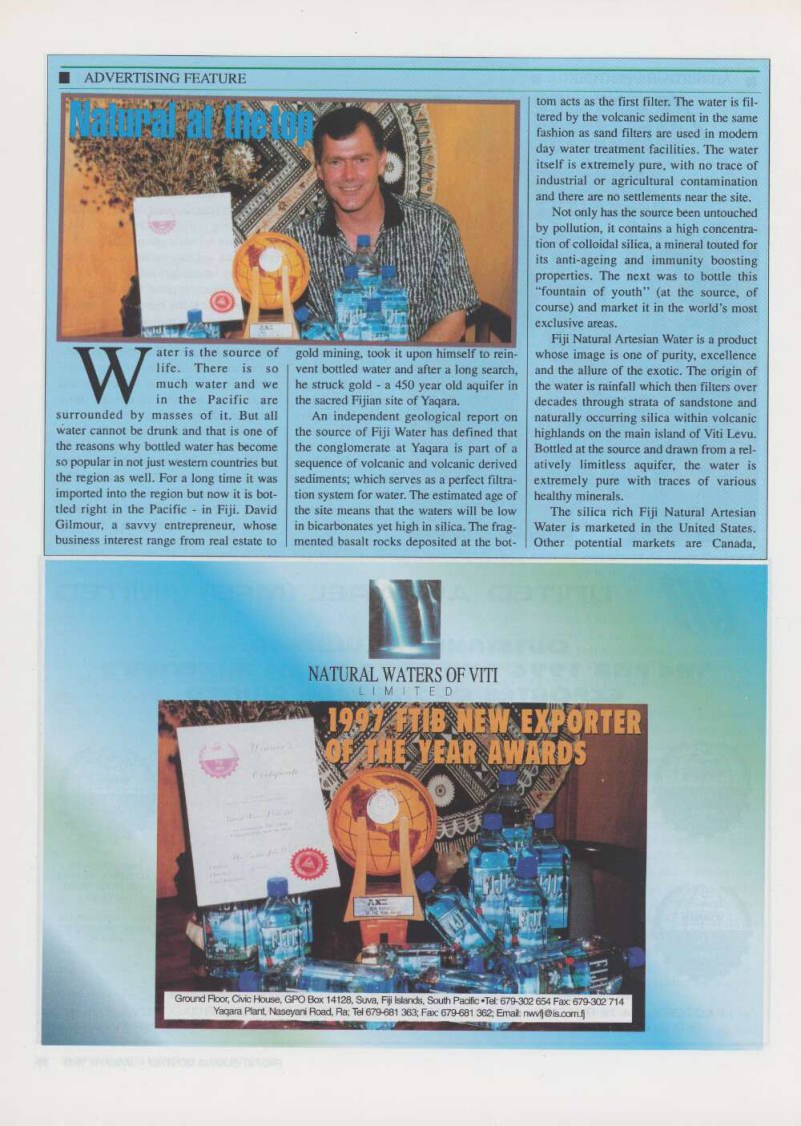

takes the lead
Unitdd Apparel (Mfg)
Limited which was established in 1989, has demonstrated that it was established after a thorough research and a sense of commitment. Company owner Ramesh Solanki has had over 40 years of involvement in the industry - his family having started a menswear tailoring busi ness in 1912.
United’s operation has been a dynamic one and evolving, consistent with the requirements of its major buyers.
The process of global liberalisation and erosion of preference has made the compa ny more determined to adopt the latest technology in its operation and improve ments in productivity, efficiency and over all management.
Today, United has established a name and reputation not only in Fiji but interna tionally. Some of its major buyers are the ones with whom United has been associat ed with since commencing operation eight years ago.
This is testimony of the confidence buy ers have in United’s export strategy, per formance and commitments. This was reflected when the company won the Fiji Trade and Investment Board’s Exporter of the Year award last month The win is taking the popularity and achievement of the company a step further.
It also reflects on the dedication and hard work of the owners to offer the best.
The company’s main line of production is the manufacture of tailored suits, trousers and jackets. It concentrates on upmarket, high quality and high volume products for niche markets. It has been suc cessful in developing markets based on its ability to produce quality products, timely delivery and by rationalising its overall cost structures.
United holds a vision which is to be known as the manufacturer of high quality
products serving the niche markers and promote Fiji as an ideal location for investment and sup plier of quality products. This is to be achieved through updating technology and pro viding further employment to improve the quality of life of the people of Fiji. The main objectives of the company are to manufacture high quality tailored gar ments for export mainly to Australia, New Zealand, Europe, the United States and explore further opportuni ties for exports to Japan and other
new markets.
United will continue to research in the markets where Fiji made garments have comparative advantage in terms of quality,
production and accessibility.
United’s success is a result of its effec tive export planning and strategy. It plans its marketing realistically to reflect what it can achieve within a given period of time rather than settling an ambitious target which may be unachievable.
The company is proud to announce that year after year it has been able to achieve targets set out in its annual export strategy.
United’s export strategjy is simple and achievable and is based on the following: Personal and detail attention to clients’ request; participation in trade fairs and exhibitions; sample; electronic mail; human resources development; to serve its main clients and market agents. The com pany’s major expansion programme to establish a new and modem factory under one roof on a 12 acre land, is well under way as envisaged. The construction of the factory is an advanced and the owners are aiming for a February opening. ■
Water is the source of life. There is so much water and we in the Pacific are surrounded by masses of it. But all water cannot be drunk and that is one of the reasons why bottled water has become so popular in not just western countries but the region as well. For a long time it was imported into the region but now it is bot tled right in the Pacific - in Fiji. David Gilmour, a savvy entrepreneur, whose business interest range from real estate to
gold mining, took it upon himself to rein vent bottled water and after a long search, he struck gold - a 450 year old aquifer in the sacred Fijian site of Yaqara.
An independent geological report on the source of Fiji Water has defined that the conglomerate at Yaqara is part of a sequence of volcanic and volcanic derived sediments; which serves as a perfect filtra tion system for water. The estimated age of the site means that the waters will be low in bicarbonates yet high in silica. The frag mented basalt rocks deposited at the bot
tom acts as the first filter. The water is fil tered by the volcanic sediment in the same fashion as sand filters are used in modem day water treatment facilities. The water itself is extremely pure, with no trace of industrial or agricultural contamination and there are no settlements near the site.
Not only has the source been untouched by pollution, it contains a high concentra tion of colloidal silica, a mineral touted for
its anti-ageing and immunity boosting
properties. The next was to bottle this “fountain of youth” (at the source, of course) and market it in the world’s most exclusive areas.
Fiji Natural Artesian Water is a product whose image is one of purity, excellence and the allure of the exotic. The origin of the water is rainfall which then filters over decades through strata of sandstone and naturally occurring silica within volcanic highlands on the main island of Viti Levu.
Bottled at the source and drawn from a rel atively limitless aquifer, the water is extremely pure with traces of various
healthy minerals.
The silica rich Fiji Natural Artesian Water is marketed in the United States.
Other potential markets are Canada,
United Kingdom, Germany, Japan and
Taiwan.
The Fiji Natural Artesian Water label has also won a number of awards. Initial success came with a gold award in New Zealand Fasson Awards. This was followed by two gold awards in the Australasian Fasson Awards, one for excellence in print, and one for innovation and creativity in use of self adhesive material. The back label has a duplex print and when viewed through the clear front label the vision of a waterfall magnified by the contents of the bottle gives a three dimensional effect. The products has an image of purity, excellence and character. Most recently it won the New Exporter of the Year Award at the Fiji Trade and Investment Board Exporter of the Year awards. This award gives the product and the people behind it an added bonus which will take it a step further in terms of excellence. Not only this, but the company also carries a certificate of the International Standard Organisation or ISO as is better known. It has been registered under ISO 9002 meaning that the product is well suited for the international market and in position to compete with products from other parts of the world. ■
Advertisements & other items, pp. 39-40 (2 items)
Urited Apparel (Mfg) Limited
un
OUTSTANDING UIINNCR.
THC FTIR 1996 AND 1997 PRIMC MINISTCR'S
CXPORTCR OF THC VCRR RUIARD
■l m i r ms . f m m it i m m
liV'm
1993* WINNER
CLOTHING, TEXTILE
AND FOOTWEAR
AWARD
1993 • RUNNER-UP
PRIME MINISTER'S
AWARD
FACTORY - 64-78 RODWELL ROAD. SUVA, FIJI. OFFICE - 86 RODWELL ROAD, SUVA, FIJI.
G.P.O. BOX 12426, SUVA, FIJI. TEL: (679) 303046, 303545, 304175 FAX: (679) 302312
NATURAL WATERS OF VITI
LIMITED
i m m 3 o w* Ground Roor, Civic House, GRO Box 14128, Suva, Rji Islands, South Pacific -Tel: 679-302 654 Fax: 679-302 714 Yaqara Plant, Naseyani Road, Ra; Tel 679-681 363; Fax: 679-681 362; Email: [email protected]
Advertising Feature
Awards recognise
excellence
The Fiji Trade and Investment Board Exporter of the Year awards were held last month and this saw many local com panies winning prestigious awards.
The awards were introduced in recognition of the paramount role played by the private sector. The presentation of the award gives the Fiji government tan opportunity to recognise the excellence in exporting.
The Exporter of the Year award is a symbol of quality and is a recognition for the outstanding work of local exporters in making Fiji’s growth for exports the envy of many nations. The Exporter of the Year
Award involves great participation from the private sector. This has been evident over the years in the successful export trade show organised by the board to exhibit a broader range of high quality.
The awards and the accompanying trade show aims to speed up and encour age export and investment in Fiji.
The trade show was a chance for fiji and the world to see the variety and quali ty of manufactured goods and services that local exporters were exporting around the globe. Running in its fourth year, the awards are organised anually in an attempt to generate public awareness in Fiji’s growing export industry. ■
Advertisements & other items, p. 41 (1 item)
pioneers in agricultural
FIJI Development
BANK
financing
'T* . ■ vf ef interest rate ranges between 8 - 13.5% assistance and advice to new farmers or a you long term repayment of up to 15 years I —-J finance for land purchase, I4f I farm housing, reading and operating expenses 'puuMcitty, 'piji A 'putwie
Super Sapolu
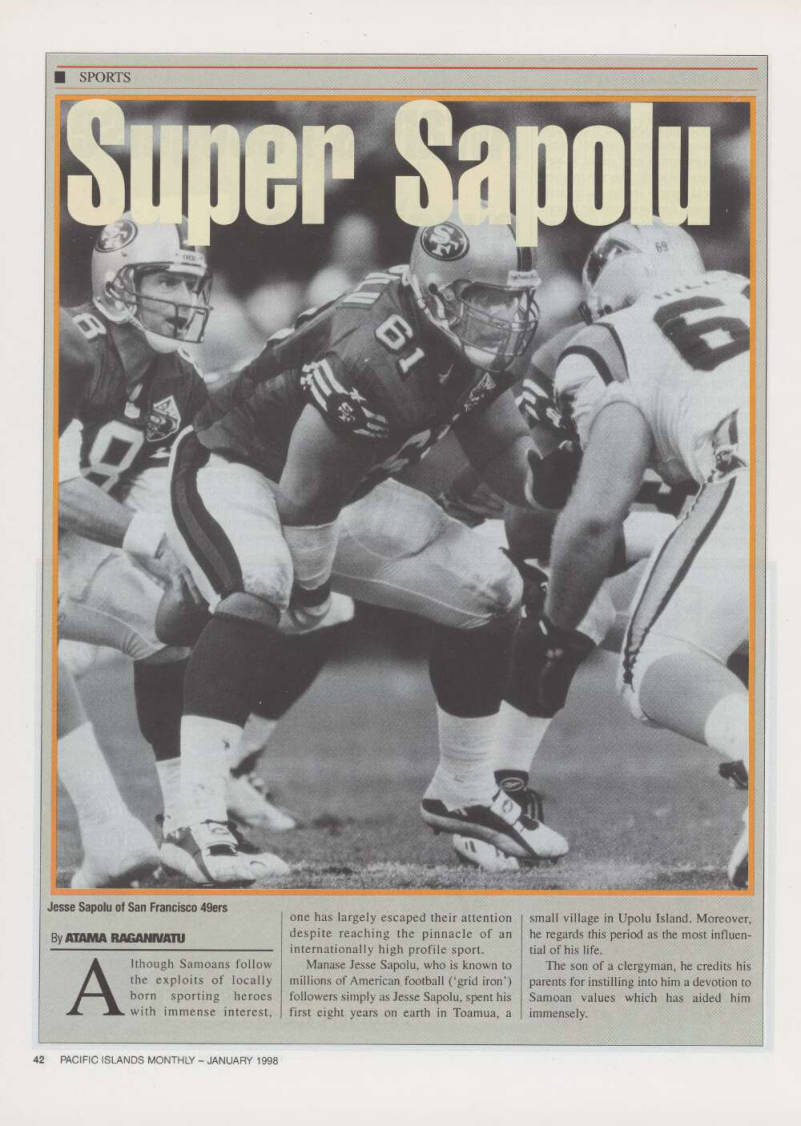
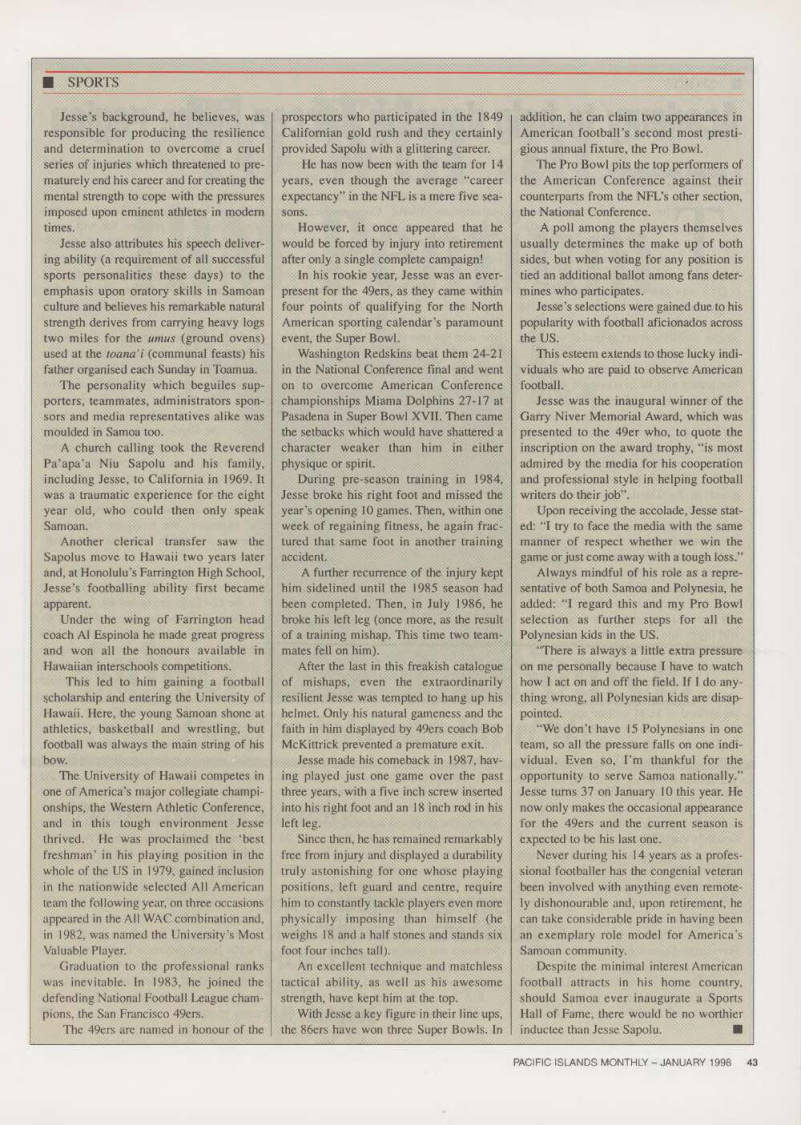
Sports
By Atama Raganivatu
Although Samoans follow the exploits of locally born sporting heroes with immense interest.
one has largely escaped their attention
despite reaching the pinnacle of an
internationally high profile sport.
Manase Jesse Sapolu, who is known to millions of American football (‘grid iron’) followers simply as Jesse Sapolu, spent his first eight years on earth in Toamua, a
small village in Upolu Island. Moreover, he regards this period as the most influen tial of his life.
The son of a clergyman, he credits his parents for instilling into him a devotion to Samoan values which has aided him
immensely.
Jesse Sapolu of San Francisco 49ers
Jesse’s background, he believes, was responsible for producing the resilience and determination to overcome a cruel series of injuries which threatened to pre maturely end his career and for creating the mental strength to cope with the pressures imposed upon eminent athletes in modem times.
Jesse also attributes his speech deliver ing ability (a requirement of all successful sports personalities these days) to the emphasis upon oratory skills in Samoan culture and believes his remarkable natural strength derives from carrying heavy logs two miles for the umus (ground ovens) used at the toana’i (communal feasts) his father organised each Sunday in Toamua.
The personality which beguiles sup porters, teammates, administrators spon sors and media representatives alike was moulded in Samoa too.
A church calling took the Reverend Pa’apa’a Niu Sapolu and his family, including Jesse, to California in 1969. It was a traumatic experience for the eight year old, who could then only speak Samoan.
Another clerical transfer saw the Sapolus move to Hawaii two years later and, at Honolulu’s Farrington High School, Jesse’s footballing ability first became apparent.
Under the wing of Farrington head coach A 1 Espinola he made great progress and won all the honours available in Hawaiian interschools competitions.
This led to him gaining a football
scholarship and entering the University of
Hawaii. Here, the young Samoan shone at athletics, basketball and wrestling, but football was always the main string of his bow.
The University of Hawaii competes in one of America’s major collegiate champi onships, the Western Athletic Conference, and in this tough environment Jesse thrived. He was proclaimed the ‘best freshman’ in his playing position in the whole of the US in 1979, gained inclusion in the nationwide selected All American team the following year, on three occasions appeared in the All WAC combination and, in 1982, was named the University’s Most Valuable Player.
Graduation to the professional ranks was inevitable. In 1983, he joined the defending National Football League cham pions, the San Francisco 49ers.
The 49ers are named in honour of the
prospectors who participated in the 1849 Californian gold rush and they certainly provided Sapolu with a glittering career.
He has now been with the team for 14 years, even though the average “career expectancy” in the NFL is a mere five sea sons.
However, it once appeared that he would be forced by injury into retirement after only a single complete campaign!
In his rookie year, Jesse was an ever present for the 49ers, as they came within four points of qualifying for the North American sporting calendar’s paramount event, the Super Bowl.
Washington Redskins beat them 24-21 in the National Conference final and went on to overcome American Conference championships Miama Dolphins 27-17 at Pasadena in Super Bowl XVII. Then came the setbacks which would have shattered a character weaker than him in either physique or spirit.
During pre-season training in 1984, Jesse broke his right foot and missed the year’s opening 10 games. Then, within one week of regaining fitness, he again frac tured that same foot in another training accident.
A further recurrence of the injury kept him sidelined until the 1985 season had been completed. Then, in July 1986, he broke his left leg (once more, as the result of a training mishap. This time two team mates fell on him).
After the last in this freakish catalogue of mishaps, even the extraordinarily resilient Jesse was tempted to hang up his helmet. Only his natural gameness and the faith in him displayed by 49ers coach Bob McKittrick prevented a premature exit.
Jesse made his comeback in 1987, hav ing played just one game over the past three years, with a five inch screw inserted into his right foot and an 18 inch rod in his left leg.
Since then, he has remained remarkably free from injury and displayed a durability truly astonishing for one whose playing positions, left guard and centre, require him to constantly tackle players even more physically imposing than himself (he weighs 18 and a half stones and stands six foot four inches tall).
An excellent technique and matchless tactical ability, as well as his awesome strength, have kept him at the top.
With Jesse a key figure in their line ups, the 86ers have won three Super Bowls. In
addition, he can claim two appearances in American football’s second most presti gious annual fixture, the Pro Bowl.
The Pro Bowl pits the top performers of the American Conference against their counterparts from the NFL’s other section, the National Conference.
A poll among the players themselves usually determines the make up of both sides, but when voting for any position is tied an additional ballot among fans deter mines who participates.
Jesse’s selections were gained due to his popularity with football aficionados across the US.
This esteem extends to those lucky indi viduals who are paid to observe American football.
Jesse was the inaugural winner of the Garry Niver Memorial Award, which was presented to the 49er who, to quote the inscription on the award trophy, “is most admired by the media for his cooperation and professional style in helping football writers do their job”.
Upon receiving the accolade, Jesse stat ed: “I try to face the media with the same manner of respect whether we win the game or just come away with a tough loss.”
Always mindful of his role as a repre sentative of both Samoa and Polynesia, he added: “I regard this and my Pro Bowl selection as further steps for all the Polynesian kids in the US.
“There is always a little extra pressure on me personally because I have to watch how I act on and off the field. If I do any thing wrong, all Polynesian kids are disap pointed.
“We don’t have 15 Polynesians in one team, so all the pressure falls on one indi vidual. Even so. I’m thankful for the opportunity to serve Samoa nationally.”
Jesse turns 37 on January 10 this year. He now only makes the occasional appearance for the 49ers and the current season is expected to be his last one.
Never during his 14 years as a profes sional footballer has the congenial veteran been involved with anything even remote ly dishonourable and, upon retirement, he can take considerable pride in having been an exemplary role model for America’s Samoan community.
Despite the minimal interest American football attracts in his home country, should Samoa ever inaugurate a Sports Hall of Fame, there would be no worthier inductee than Jesse Sapolu. ■
Academy to help develop soccer in the region
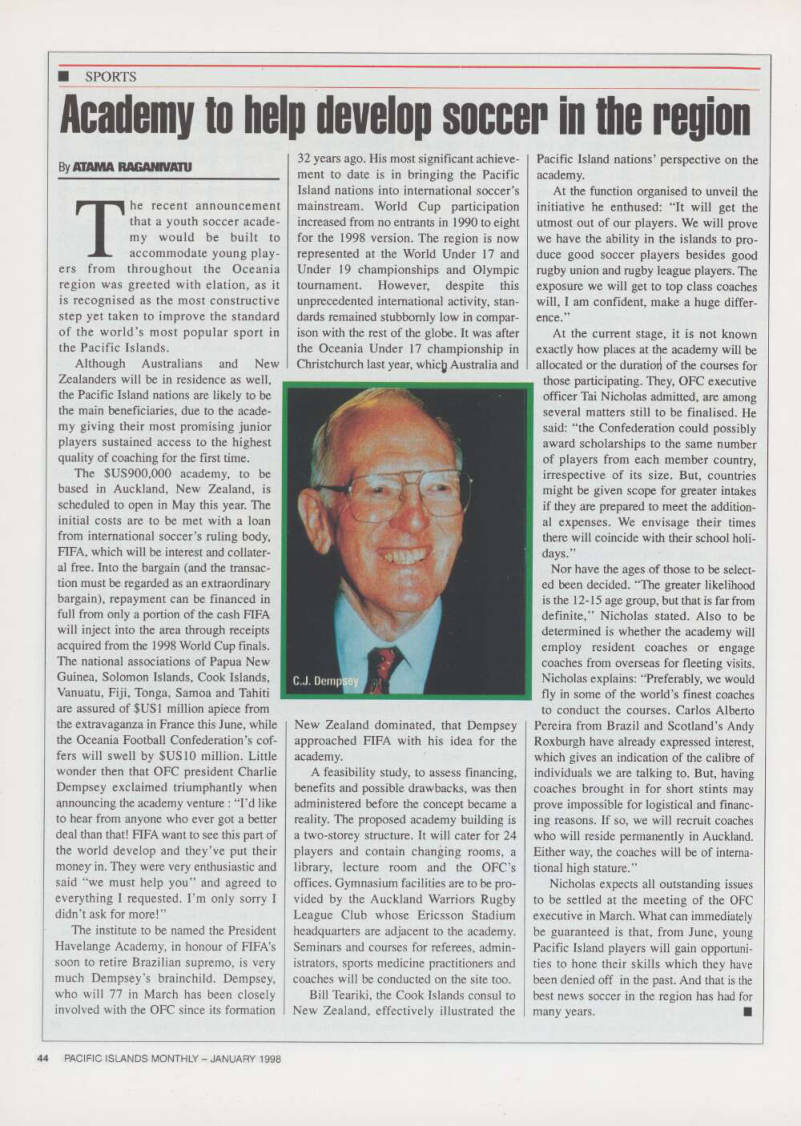
By Atama Raganivatu
The recent announcement that a youth soccer acade my would be built to accommodate young play ers from throughout the Oceania region was greeted with elation, as it is recognised as the most constructive step yet taken to improve the standard of the world’s most popular sport in the Pacific Islands.
Although Australians and New Zealanders will be in residence as well, the Pacific Island nations are likely to be the main beneficiaries, due to the acade my giving their most promising junior players sustained access to the highest quality of coaching for the first time.
The SUS9OO,OOO academy, to be based in Auckland, New Zealand, is scheduled to open in May this year. The initial costs are to be met with a loan from international soccer’s ruling body, FIFA, which will be interest and collater al free. Into the bargain (and the transac tion must be regarded as an extraordinary bargain), repayment can be financed in full from only a portion of the cash FIFA will inject into the area through receipts acquired from the 1998 World Cup finals.
The national associations of Papua New Guinea, Solomon Islands, Cook Islands, Vanuatu, Fiji, Tonga, Samoa and Tahiti are assured of SUSI million apiece from the extravaganza in France this June, while the Oceania Football Confederation’s cof fers will swell by SUSIO million. Little wonder then that OFC president Charlie
Dempsey exclaimed triumphantly when
announcing the academy venture : “I’d like to hear from anyone who ever got a better deal than that! FIFA want to see this part of the world develop and they’ve put their money in. They were very enthusiastic and said “we must help you” and agreed to everything I requested. I’m only sorry I didn’t ask for more!”
The institute to be named the President Havelange Academy, in honour of FIFA’s soon to retire Brazilian supremo, is very
much Dempsey’s brainchild. Dempsey,
who will 77 in March has been closely involved with the OFC since its formation
32 years ago. His most significant achieve ment to date is in bringing the Pacific Island nations into international soccer’s mainstream. World Cup participation increased from no entrants in 1990 to eight for the 1998 version. The region is now represented at the World Under 17 and Under 19 championships and Olympic tournament. However, despite this unprecedented international activity, stan dards remained stubbornly low in compar ison with the rest of the globe. It was after the Oceania Under 17 championship in Christchurch last year, whicjj Australia and
New Zealand dominated, that Dempsey approached FIFA with his idea for the academy.
A feasibility study, to assess financing, benefits and possible drawbacks, was then administered before the concept became a reality. The proposed academy building is a two-storey structure. It will cater for 24 players and contain changing rooms, a library, lecture room and the OFC’s offices. Gymnasium facilities are to be pro vided by the Auckland Warriors Rugby League Club whose Ericsson Stadium headquarters are adjacent to the academy.
Seminars and courses for referees, admin istrators, sports medicine practitioners and coaches will be conducted on the site too.
Bill Teariki, the Cook Islands consul to New Zealand, effectively illustrated the
Pacific Island nations’ perspective on the academy.
At the function organised to unveil the initiative he enthused: “It will get the utmost out of our players. We will prove we have the ability in the islands to pro duce good soccer players besides good rugby union and rugby league players. The exposure we will get to top class coaches will, I am confident, make a huge differ ence.”
At the current stage, it is not known exactly how places at the academy will be allocated or the duratioii of the courses for those participating. They, OFC executive officer Tai Nicholas admitted, are among several matters still to be finalised. He said; “the Confederation could possibly award scholarships to the same number of players from each member country, irrespective of its size. But, countries might be given scope for greater intakes if they are prepared to meet the addition al expenses. We envisage their times there will coincide with their school holi days.”
Nor have the ages of those to be select ed been decided. “The greater likelihood is the 12-15 age group, but that is far from definite,” Nicholas stated. Also to be determined is whether the academy will employ resident coaches or engage coaches from overseas for fleeting visits.
Nicholas explains: “Preferably, we would fly in some of the world’s finest coaches to conduct the courses. Carlos Alberto Pereira from Brazil and Scotland’s Andy Roxburgh have already expressed interest, which gives an indication of the calibre of individuals we are talking to. But, having coaches brought in for short stints may prove impossible for logistical and financ ing reasons. If so, we will recruit coaches who will reside permanently in Auckland.
Either way, the coaches will be of interna tional high stature.”
Nicholas expects all outstanding issues to be settled at the meeting of the OFC executive in March. What can immediately be guaranteed is that, from June, young Pacific Island players will gain opportuni ties to hone their skills which they have been denied off in the past. And that is the best news soccer in the region has had for many years. ■
C. J. Dempsey
Advertisements & other items, pp. 45-46 (1 item)
To Win an IBM Pentium Subscribe
IBM Pentium Subscribe to The Source.
Pacific Islands Monthly
Pacific Islands Monthly
PACIFIC ISLANDS MONTHLY
SUBSCRIPTIONS DEPARTMENT
PO BOX 1167
SUVA
FIJI ISLANDS
AFFIX
STAMP
HERE
For almost 70 years, Pacific Islands Monthly has been and still is the authority on political, business and social issues within the Pacific. And now, every 12 month subscription received before the 31st of March, 1998, goes into a draw to win an IBM Pentium Notebook*. You could even give a gift subscription to enter but it must be before the closing date. As well as the entry into the draw, you will also receive the latest news from the region. Fill in the subscription form below and send it along with payment to Pacific Islands Monthly, Subscription Department, PO Box 1167, Suva, Fiji. Or call PIM on (679) 304 111 or fax us on (679) 303 809/(679) 307 460.
Subscribe to The Source.
Pacific Islands Monthly
*Rates include Airspeeding to all destinations Conditions of Entry 1. To enter, subscriptions must be made before March 31st, 1998 which automatically enters the subscriber into the draw for the Pentium Notebook Computer. 2. Entry is open to all subscribers except employees of The Fiji Times Ltd, Pacific Islands Monthly, and Wilson Addison Ltd, 3- Subscribers need to subscribe for 12 months to qualify. 4. The winner of the Pentium Notebook will be published in Pacific Islands Monthly Magazine, May Issue, 1998 and will be notified by registered mail. 5. The winner will receive their prize within one month of the draw. 6. The prize must be taken as offered and is not redeemable. 7. In the event of any dispute the decision of the promoter is final and no correspondence will be entered into.
YES! I wish to subscribe to The Source and receive a chance to win an IBM Pentium Notebook Computer! □ Cheque/Bank Draft/Money Order made payable to Pacific Islands Monthly J Please charge my credit card: (VISA / AMEX / MASTERCARD)
12 ISSUE
SUBSCRIPTION
Rate A
I Rate B
I Rate C I Rate D Rate E Signature: Expiry date; Mr/Mrs/Ms: Delivery Address: Postal Address: This is a
□ Renewal
□ New Subscription Country; Fax:
Past and present
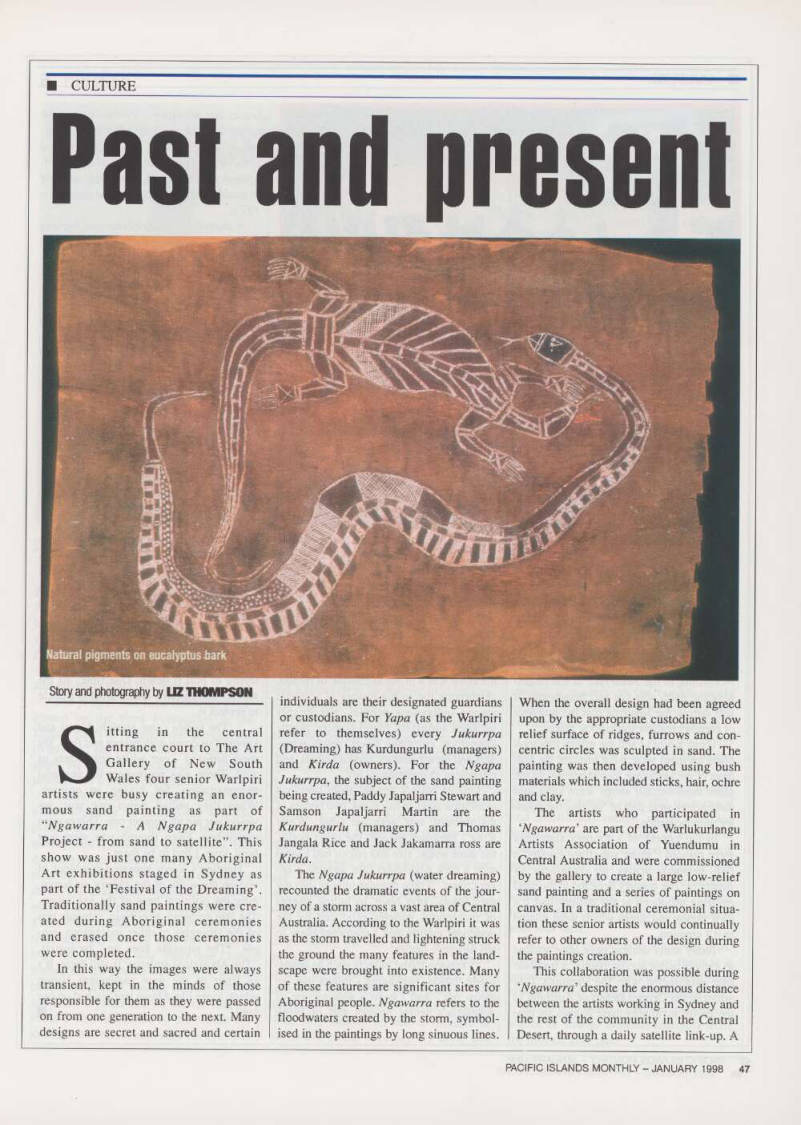
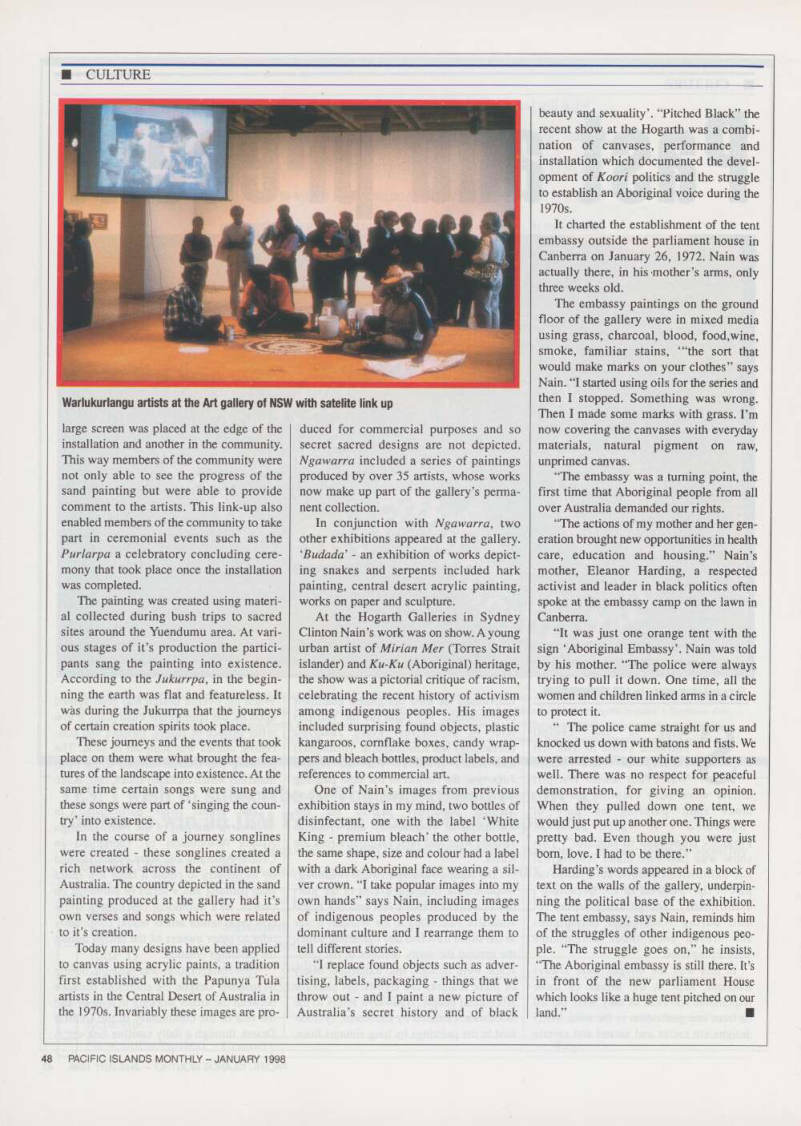
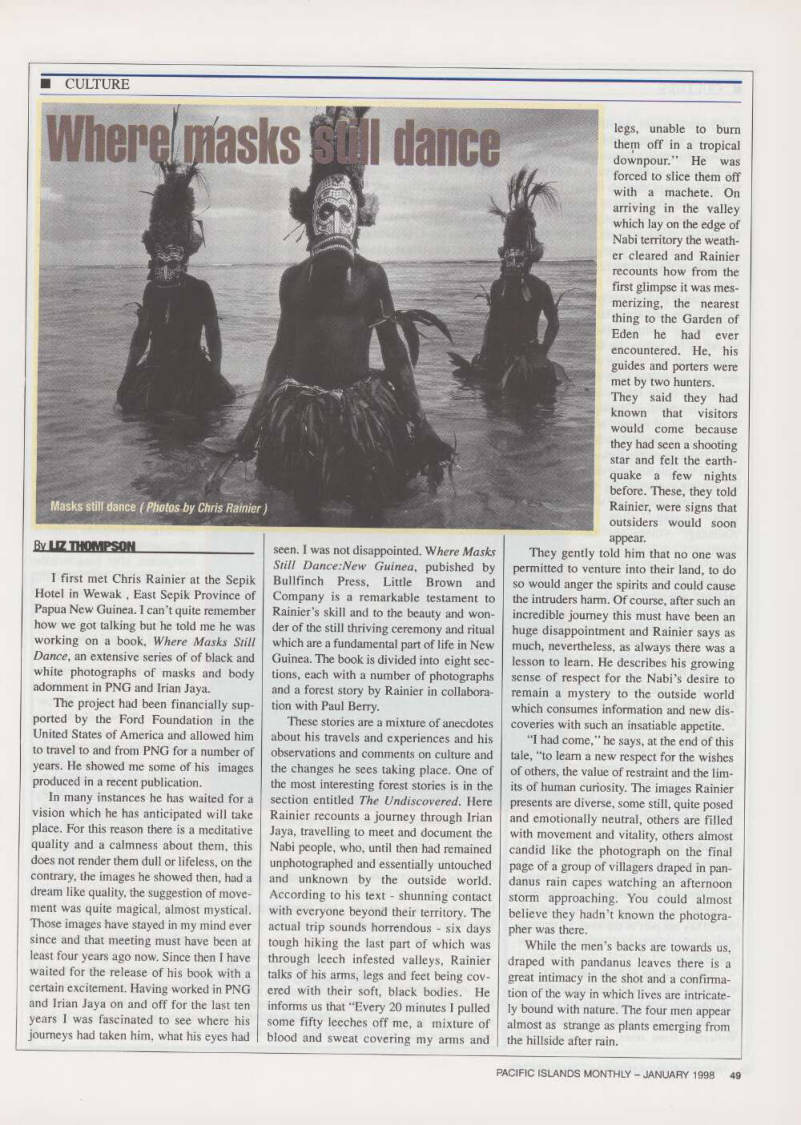
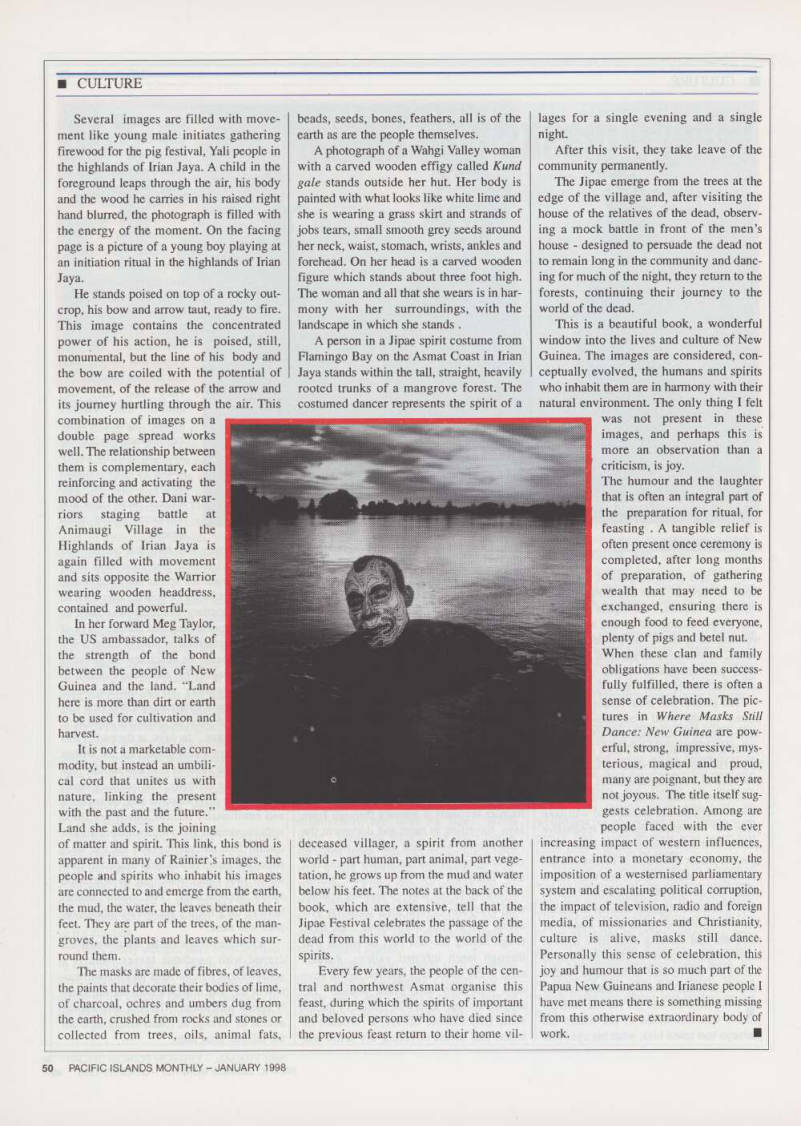
Culture
Story and photography by LIZ THOMPSON
individuals are their designated guardians or custodians. For Yapa (as the Warlpiri refer to themselves) every Jukurrpa
(Dreaming) has Kurdungurlu (managers)
and Kirda (owners). For the Ngapa Jukurrpa, the subject of the sand painting being created, Paddy Japaljarri Stewart and Samson Japaljarri Martin are the Kurdungurlu (managers) and Thomas Jangala Rice and Jack Jakamarra ross are Kirda.
The Ngapa Jukurrpa (water dreaming) recounted the dramatic events of the jour ney of a storm across a vast area of Central Australia. According to the Warlpiri it was as the storm travelled and lightening struck the ground the many features in the land scape were brought into existence. Many of these features are significant sites for Aboriginal people. Ngawarra refers to the floodwaters created by the storm, symbol ised in the paintings by long sinuous lines.
When the overall design had been agreed upon by the appropriate custodians a low relief surface of ridges, furrows and con centric circles was sculpted in sand. The painting was then developed using bush materials which included sticks, hair, ochre and clay.
The artists who participated in ‘Ngawarra ’ are part of the Warlukurlangu Artists Association of Yuendumu in Central Australia and were commissioned by the gallery to create a large low-relief sand painting and a series of paintings on canvas. In a traditional ceremonial situa tion these senior artists would continually refer to other owners of the design during the paintings creation.
This collaboration was possible during ‘Ngawarra despite the enormous distance between the artists working in Sydney and the rest of the community in the Central Desert, through a daily satellite link-up. A
Sitting in the central entrance court to The Art Gallery of New South Wales four senior Warlpiri artists were busy creating an enor mous sand painting as part of “Ngawarra - A Ngapa Jukurrpa Project - from sand to satellite”. This show was just one many Aboriginal Art exhibitions staged in Sydney as part of the ‘Festival of the Dreaming’.
Traditionally sand paintings were cre
ated during Aboriginal ceremonies
and erased once those ceremonies were completed.
In this way the images were always transient, kept in the minds of those responsible for them as they were passed on from one generation to the next. Many designs are secret and sacred and certain
large screen was placed at the edge of the installation and another in the community.
This way members of the community were not only able to see the progress of the sand painting but were able to provide comment to the artists. This link-up also enabled members of the community to take part in ceremonial events such as the Purlarpa a celebratory concluding cere mony that took place once the installation was completed.
The painting was created using materi al collected during bush trips to sacred sites around the Yuendumu area. At vari ous stages of it’s production the partici pants sang the painting into existence.
According to the Jukurrpa, in the begin ning the earth was flat and featureless. It was during the Jukurrpa that the journeys of certain creation spirits took place.
These journeys and the events that took place on them were what brought the fea tures of the landscape into existence. At the same time certain songs were sung and these songs were part of ‘singing the coun try’ into existence.
In the course of a journey songlines were created - these songlines created a rich network across the continent of Australia. The country depicted in the sand painting produced at the gallery had it’s own verses and songs which were related to it’s creation.
Today many designs have been applied
to canvas using acrylic paints, a tradition first established with the Papunya Tula artists in the Central Desert of Australia in the 19705. Invariably these images are pro
duced for commercial purposes and so secret sacred designs are not depicted.
Ngawarra included a series of paintings produced by over 35 artists, whose works now make up part of the gallery’s perma nent collection.
In conjunction with Ngawarra, two other exhibitions appeared at the gallery. ‘ Budada ’ - an exhibition of works depict ing snakes and serpents included hark painting, central desert acrylic painting, works on paper and sculpture.
At the Hogarth Galleries in Sydney Clinton Nain’s work was on show. A young urban artist of Mirian Mer (Torres Strait islander) and Ku-Ku (Aboriginal) heritage, the show was a pictorial critique of racism, celebrating the recent history of activism
among indigenous peoples. His images
included surprising found objects, plastic kangaroos, cornflake boxes, candy wrap pers and bleach bottles, product labels, and references to commercial art.
One of Nain’s images from previous exhibition stays in my mind, two bottles of disinfectant, one with the label ‘White King - premium bleach’ the other bottle, the same shape, size and colour had a label with a dark Aboriginal face wearing a sil ver crown. “I take popular images into my own hands” says Nain, including images of indigenous peoples produced by the dominant culture and I rearrange them to tell different stories.
“I replace found objects such as adver tising, labels, packaging - things that we throw out - and I paint a new picture of Australia’s secret history and of black
beauty and sexuality’. “Pitched Black” the recent show at the Hogarth was a combi nation of canvases, performance and installation which documented the devel opment of Koori politics and the struggle to establish an Aboriginal voice during the 19705.
It charted the establishment of the tent embassy outside the parliament house in Canberra on January 26, 1972. Nain was actually there, in his mother’s arms, only three weeks old.
The embassy paintings on the ground floor of the gallery were in mixed media using grass, charcoal, blood, food,wine, smoke, familiar stains, ‘“the sort that would make marks on your clothes” says Nain. “I started using oils for the series and then I stopped. Something was wrong.
Then I made some marks with grass. I’m now covering the canvases with everyday materials, natural pigment on raw,
unprimed canvas.
“The embassy was a turning point, the first time that Aboriginal people from all over Australia demanded our rights.
“The actions of my mother and her gen eration brought new opportunities in health care, education and housing.” Nain’s mother, Eleanor Harding, a respected activist and leader in black politics often spoke at the embassy camp on the lawn in Canberra.
“It was just one orange tent with the sign ‘Aboriginal Embassy’. Nain was told by his mother. “The police were always trying to pull it down. One time, all the women and children linked arms in a circle to protect it.
“ The police came straight for us and knocked us down with batons and fists. We were arrested - our white supporters as well. There was no respect for peaceful demonstration, for giving an opinion.
When they pulled down one tent, we would just put up another one. Things were pretty bad. Even though you were just bom, love. I had to be there.”
Harding’s words appeared in a block of text on the walls of the gallery, underpin ning the political base of the exhibition.
The tent embassy, says Nain, reminds him of the struggles of other indigenous peo ple. “The struggle goes on,” he insists, “The Aboriginal embassy is still there. It’s in front of the new parliament House which looks like a huge tent pitched on our land.” ■
Warlukurlangu artists at the Art gallery of NSW with satelite link up
By Liz Thompson
I first met Chris Rainier at the Sepik Hotel in Wewak , East Sepik Province of Papua New Guinea. I can’t quite remember how we got talking but he told me he was working on a book, Where Masks Still Dance, an extensive series of of black and white photographs of masks and body adornment in PNG and Irian Jaya.
The project had been financially sup ported by the Ford Foundation in the United States of America and allowed him to travel to and from PNG for a number of years. He showed me some of his images produced in a recent publication.
In many instances he has waited for a vision which he has anticipated will take place. For this reason there is a meditative quality and a calmness about them, this does not render them dull or lifeless, on the contrary, the images he showed then, had a dream like quality, the suggestion of move ment was quite magical, almost mystical.
Those images have stayed in my mind ever since and that meeting must have been at least four years ago now. Since then I have waited for the release of his book with a certain excitement. Having worked in PNG and Irian Jaya on and off for the last ten years I was fascinated to see where his journeys had taken him, what his eyes had
seen. I was not disappointed. W here Masks Still Dance:New Guinea, pubished by Bullfinch Press, Little Brown and Company is a remarkable testament to Rainier’s skill and to the beauty and won der of the still thriving ceremony and ritual which are a fundamental part of life in New Guinea. The book is divided into eight sec tions, each with a number of photographs and a forest story by Rainier in collabora tion with Paul Berry.
These stories are a mixture of anecdotes about his travels and experiences and his observations and comments on culture and the changes he sees taking place. One of the most interesting forest stories is in the section entitled The Undiscovered. Here Rainier recounts a journey through Irian Jaya, travelling to meet and document the Nabi people, who, until then had remained unphotographed and essentially untouched and unknown by the outside world.
According to his text - shunning contact with everyone beyond their territory. The actual trip sounds horrendous - six days tough hiking the last part of which was through leech infested valleys, Rainier talks of his arms, legs and feet being cov ered with their soft, black bodies. He informs us that “Every 20 minutes I pulled some fifty leeches off me, a mixture of blood and sweat covering my arms and
legs, unable to burn them off in a tropical downpour.” He was forced to slice them off with a machete. On arriving in the valley which lay on the edge of Nabi territory the weath er cleared and Rainier recounts how from the first glimpse it was mes merizing, the nearest thing to the Garden of Eden he had ever encountered. He, his guides and porters were met by two hunters.
They said they had known that visitors would come because they had seen a shooting star and felt the earth quake a few nights before. These, they told Rainier, were signs that outsiders would soon appear.
They gently told him that no one was permitted to venture into their land, to do so would anger the spirits and could cause the intruders harm. Of course, after such an incredible journey this must have been an huge disappointment and Rainier says as much, nevertheless, as always there was a lesson to learn. He describes his growing sense of respect for the Nabi’s desire to remain a mystery to the outside world which consumes information and new dis coveries with such an insatiable appetite.
“I had come,” he says, at the end of this tale, “to learn a new respect for the wishes of others, the value of restraint and the lim its of human curiosity. The images Rainier presents are diverse, some still, quite posed and emotionally neutral, others are filled with movement and vitality, others almost candid like the photograph on the final page of a group of villagers draped in pan danus rain capes watching an afternoon storm approaching. You could almost believe they hadn’t known the photogra pher was there.
While the men’s backs are towards us, draped with pandanus leaves there is a great intimacy in the shot and a confirma tion of the way in which lives are intricate ly bound with nature. The four men appear almost as strange as plants emerging from the hillside after rain.
Masks still dance (Photos by Chris Rainier)
Several images are filled with move ment like young male initiates gathering firewood for the pig festival, Yali people in the highlands of Irian Jaya. A child in the foreground leaps through the air, his body and the wood he carries in his raised right hand blurred, the photograph is filled with the energy of the moment. On the facing page is a picture of a young boy playing at an initiation ritual in the highlands of Irian
Jaya.
He stands poised on top of a rocky out crop, his bow and arrow taut, ready to fire.
This image contains the concentrated power of his action, he is poised, still, monumental, but the line of his body and the bow are coiled with the potential of movement, of the release of the arrow and its journey hurtling through the air. This
combination of images on a double page spread works well. The relationship between them is complementary, each reinforcing and activating the mood of the other. Dani war riors staging battle at Animaugi Village in the Highlands of Irian Jaya is again filled with movement and sits opposite the Warrior wearing wooden headdress, contained and powerful.
In her forward Meg Taylor, the US ambassador, talks of the strength of the bond between the people of New Guinea and the land. “Land here is more than dirt or earth to be used for cultivation and harvest.
It is not a marketable com modity, but instead an umbili cal cord that unites us with nature, linking the present with the past and the future.”
Land she adds, is the joining
of matter and spirit. This link, this bond is apparent in many of Rainier’s images, the people and spirits who inhabit his images are connected to and emerge from the earth, the mud, the water, the leaves beneath their feet. They are part of the trees, of the man groves, the plants and leaves which sur round them.
The masks are made of fibres, of leaves, the paints that decorate their bodies of lime, of charcoal, ochres and umbers dug from the earth, crushed from rocks and stones or collected from trees, oils, animal fats,
beads, seeds, bones, feathers, all is of the earth as are the people themselves.
A photograph of a Wahgi Valley woman with a carved wooden effigy called Kund gale stands outside her hut. Her body is painted with what looks like white lime and she is wearing a grass skirt and strands of jobs tears, small smooth grey seeds around her neck, waist, stomach, wrists, ankles and forehead. On her head is a carved wooden figure which stands about three foot high.
The woman and all that she wears is in har mony with her surroundings, with the landscape in which she stands .
A person in a Jipae spirit costume from Flamingo Bay on the Asmat Coast in Irian Jaya stands within the tall, straight, heavily rooted trunks of a mangrove forest. The costumed dancer represents the spirit of a
deceased villager, a spirit from another world - part human, part animal, part vege tation, he grows up from the mud and water below his feet. The notes at the back of the book, which are extensive, tell that the Jipae Festival celebrates the passage of the dead from this world to the world of the
spirits.
Every few years, the people of the cen tral and northwest Asmat organise this feast, during which the spirits of important and beloved persons who have died since the previous feast return to their home vil
lages for a single evening and a single
night.
After this visit, they take leave of the
community permanently.
The Jipae emerge from the trees at the edge of the village and, after visiting the house of the relatives of the dead, observ ing a mock battle in front of the men’s house - designed to persuade the dead not to remain long in the community and danc ing for much of the night, they return to the forests, continuing their journey to the world of the dead.
This is a beautiful book, a wonderful window into the lives and culture of New Guinea. The images are considered, con ceptually evolved, the humans and spirits who inhabit them are in harmony with their natural environment. The only thing I felt
was not present in these images, and perhaps this is more an observation than a criticism, is joy.
The humour and the laughter that is often an integral part of the preparation for ritual, for feasting . A tangible relief is often present once ceremony is completed, after long months of preparation, of gathering wealth that may need to be exchanged, ensuring there is enough food to feed everyone, plenty of pigs and betel nut.
When these clan and family obligations have been success fully fulfilled, there is often a sense of celebration. The pic tures in Where Masks Still Dance: New Guinea are pow erful, strong, impressive, mys terious, magical and proud, many are poignant, but they are not joyous. The title itself sug gests celebration. Among are people faced with the ever
increasing impact of western influences, entrance into a monetary economy, the imposition of a westernised parliamentary system and escalating political corruption, the impact of television, radio and foreign media, of missionaries and Christianity, culture is alive, masks still dance.
Personally this sense of celebration, this joy and humour that is so much part of the Papua New Guineans and Irianese people 1 have met means there is something missing from this otherwise extraordinary body of work. ■
Pictures from the past
Arts
By Nicolas Rothwell
Solemn-faced old men sit
ting cross-legged, their
betel-chewing equipment clasped before them; the grand clutter of men’s ceremonial houses on the Gulf of Papua; stately multi-hulled canoes cruising to Port Moresby - these images, seen all too rarely in today’s Papua New Guinea, are preserved in an extraordinary pho tographic archive, brought to light by Australia’s greatest museum of Oceanic art.
The Usher Photographic Collection has been on view for some months in the ornate Pacific Cultures Gallery of the South Australian Musuem. The collection encompasses the unusual, beautifully com posed visual records of an exploration tra
jectory.
In 1914, a pioneering government expe dition was dispatched to the Vailala and Purari rivers in Papua. Its goal was to
search for commercial oil deposits. It was led by Dr Arthur Wade,
geologist, and among his staff was a talent ed surveyor and photographic enthusiast named Ernest Sterne Usher. As the muse um’s curator of foreign ethnology, Barry Craig, points out, Usher’s trove of 560 photographs, most taken by himself, together with others by L L Wrathall, and yet more prints from the negatives of geol ogist Evan Richard Stanley, “recorded an indigenous culture then little changed but now rare or completely disappeared, for example, the men’s cult houses and ritual objects”. Usher’s Papua photographs pre date those of the much more famous Frank Hurley, the Antarctic photographer who made a pioneering cini-film, Pearls and Savages, in the Torres Strait and Papua Gulf region between 1920 and 1923.
These images, then, are precious records, both of a vanishing culture and of a vanishing colonial perspective; formal; inquisitive; well-ordered. The Papuan indi viduals captured in the Usher Collection had been exposed to Western existence since 1870, but were still essentially unaf
fected by its invasive, transforming touch.
In short, they were ripe to be fixed and frozen by the camera lens - and, with meticulous thoroughness, this is what Usher himself, together with his col leagues, did - until September 23, 1916.
Shortly after that date, Usher was drowned while crossing the Vailala River from the western side at its mouth.”
And so the pioneer of PNG photogra phy passed into his own footnote of histo ry, joining his many subjects in a dimly remembered, sepia-toned afterlife. In 1972. Usher’s collection was donated to the museum by his sister. Viewing the Usher Collection in the Pacific Cultures Gallery is a curiously integrated and com plete experience: Elema and Namau masks made by the peoples whose lives are recorded in the photographs are on display nearby, and the atmosphere of the Eravo men’s houses - with their front elevations 20 metres high and their 200-metre-long recesses. It is to be strongly hoped the full publication of the Usher photographic archive will follow the museum’s pioneer ing display. This exhibition, the research material prepared for it, and the gallery in which it stands, a richly crowded diorama of Oceanic arts, demonstrate the depths of Australia’s historical connection to PNG’s and the Pacific realm. A bitter debate has been running all year in South Australia over these plans, which are indicative of the broader Australian turn against involvement with the Pacific on the politi cal, economic and cultural planes.
Also in the Adelaide museum’s Pacific Cultures Gallery at present is the remark able New Ireland Malangan canoe carved by the late Hosea Linge of Libba village, together with a team of apprentices, in 1995. This canoe, named La-Sisi, is the masterwork of one of the greatest revivers of New Ireland traditions, and has done much to reinvigorate the Malangan tech nique. But both these splendid spectacles, of course, are temporary: exhibition man agement today is a field of sharply defined and illustrative priorities. If the museum in Adelaide boasts one of the world’s most impressive holdings of Pacific art, shown in a fashion that itself reveals much about historic attitudes towards Pacific ethnogra phy, then the apparent fate of those hold ings declares, in a subtle but unmistakable manner, the likely trend in Australia’s cul tural engagement with her Oceanic neigh bours. ■
Advertisements & other items, p. 51 (1 item)
Isabel Development Company Limited
HAS
“LIGOMO 4”
FOR SALE
A unique opportunity has arisen to purchase this vessel, which is in excellent condition.
PARTICULARS:
• Length 25m, Vitex hull and decking. • 11 years old (built 1987). • Main propulsion unit Volvo 121 C, 300 HP, 1800 RPM. • Capacity 90 tonnes, can carry 90 cubic metres of general cargo; 70 passengers. • Accommodation 4 cabins x 4 bunks; 1 office; 2 officer cabins at bridge; 12 bunks in crew cabin.
PRICE:
U 55245,000 or AU5350,000 This is a reluctant sale due to the need for us to acquire a larger vessel.
All enquiries should be directed to; Mr Joel Neusia General Manager Isabel Development Company Ltd PO Box 92 Honiara
SOLOMON ISLANDS
Tel +677-22122/22126 Fax+677-22009
Caught - In the great Pacific eddy
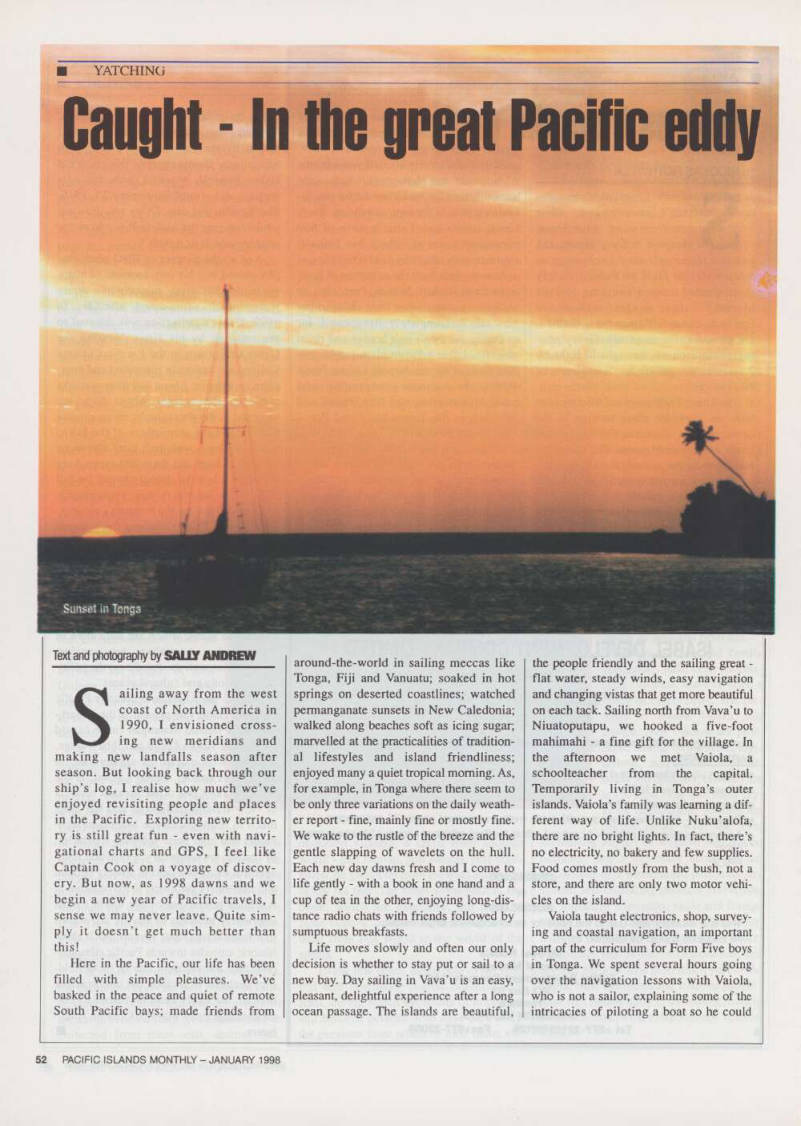
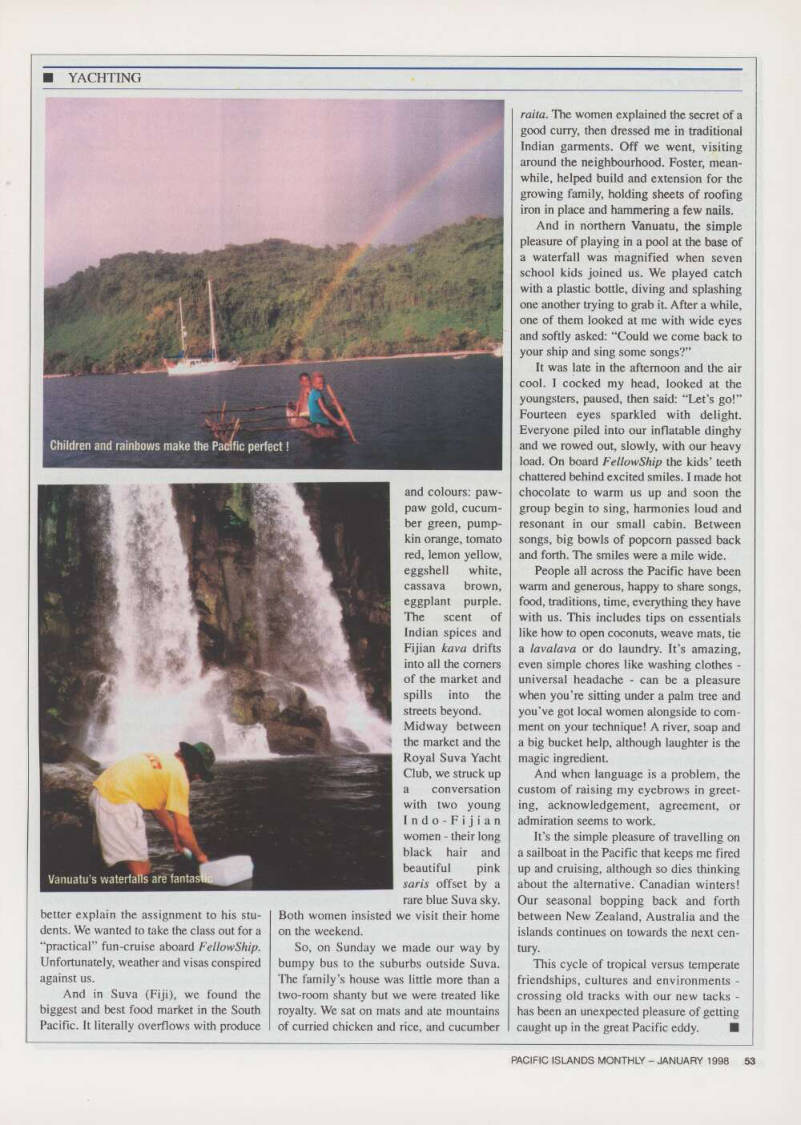
Yatching
around-the-world in sailing meccas like Tonga, Fiji and Vanuatu; soaked in hot springs on deserted coastlines; watched permanganate sunsets in New Caledonia; walked along beaches soft as icing sugar; marvelled at the practicalities of tradition al lifestyles and island friendliness; enjoyed many a quiet tropical morning. As, for example, in Tonga where there seem to be only three variations on the daily weath er report - fine, mainly fine or mostly fine.
We wake to the rustle of the breeze and the gentle slapping of wavelets on the hull.
Each new day dawns fresh and I come to life gently - with a book in one hand and a cup of tea in the other, enjoying long-dis tance radio chats with friends followed by sumptuous breakfasts.
Life moves slowly and often our only decision is whether to stay put or sail to a new bay. Day sailing in Vava’u is an easy, pleasant, delightful experience after a long ocean passage. The islands are beautiful,
Sailing away from the west coast of North America in 1990, I envisioned cross ing new meridians and making aew landfalls season after season. But looking back through our ship’s log, I realise how much we’ve enjoyed revisiting people and places in the Pacific. Exploring new territo ry is still great fun - even with navi gational charts and GPS, I feel like Captain Cook on a voyage of discov ery. But now, as 1998 dawns and we begin a new year of Pacific travels, I sense we may never leave. Quite sim ply it doesn’t get much better than this!
Here in the Pacific, our life has been filled with simple pleasures. We’ve basked in the peace and quiet of remote South Pacific bays; made friends from
the people friendly and the sailing great flat water, steady winds, easy navigation and changing vistas that get more beautiful on each tack. Sailing north from Vava’u to Niuatoputapu, we hooked a five-foot mahimahi - a fine gift for the village. In the afternoon we met Vaiola, a schoolteacher from the capital.
Temporarily living in Tonga’s outer islands. Vaiola’s family was learning a dif ferent way of life. Unlike Nuku’alofa, there are no bright lights. In fact, there’s no electricity, no bakery and few supplies.
Food comes mostly from the bush, not a store, and there are only two motor vehi cles on the island.
Vaiola taught electronics, shop, survey ing and coastal navigation, an important part of the curriculum for Form Five boys in Tonga. We spent several hours going over the navigation lessons with Vaiola, who is not a sailor, explaining some of the intricacies of piloting a boat so he could
Text and photography by SALIY ANDREW
Sunset in Tonga
better explain the assignment to his stu dents. We wanted to take the class out for a
“practical” fun-cruise aboard Fellowship.
Unfortunately, weather and visas conspired against us.
And in Suva (Fiji), we found the biggest and best food market in the South Pacific. It literally overflows with produce
Both women insisted we visit their home on the weekend.
So, on Sunday we made our way by bumpy bus to the suburbs outside Suva.
The family’s house was little more than a two-room shanty but we were treated like royalty. We sat on mats and ate mountains of curried chicken and rice, and cucumber
and colours; paw paw gold, cucum ber green, pump kin orange, tomato red, lemon yellow, eggshell white, cassava brown, eggplant purple.
The scent of Indian spices and Fijian kava drifts into all the comers of the market and spills into the streets beyond.
Midway between the market and the Royal Suva Yacht Club, we struck up a conversation with two young
Indo-Fijian
women - their long black hair and beautiful pink saris offset by a rare blue Suva sky.
raita. The women explained the secret of a good curry, then dressed me in traditional Indian garments. Off we went, visiting around the neighbourhood. Foster, mean while, helped build and extension for the
growing family, holding sheets of roofing
iron in place and hammering a few nails.
And in northern Vanuatu, the simple pleasure of playing in a pool at the base of a waterfall was magnified when seven school kids joined us. We played catch with a plastic bottle, diving and splashing one another trying to grab it. After a while, one of them looked at me with wide eyes and softly asked: “Could we come back to your ship and sing some songs?”
It was late in the afternoon and the air cool. I cocked my head, looked at the youngsters, paused, then said: “Let’s go!”
Fourteen eyes sparkled with delight.
Everyone piled into our inflatable dinghy and we rowed out, slowly, with our heavy load. On board Fellowship the kids’ teeth chattered behind excited smiles. I made hot chocolate to warm us up and soon the group begin to sing, harmonies loud and resonant in our small cabin. Between songs, big bowls of popcorn passed back and forth. The smiles were a mile wide.
People all across the Pacific have been warm and generous, happy to share songs, food, traditions, time, everything they have with us. This includes tips on essentials like how to open coconuts, weave mats, tie a lavalava or do laundry. It’s amazing, even simple chores like washing clothes universal headache - can be a pleasure when you’re sitting under a palm tree and you’ve got local women alongside to com ment on your technique! A river, soap and a big bucket help, although laughter is the
magic ingredient.
And when language is a problem, the custom of raising my eyebrows in greet
ing, acknowledgement, agreement, or
admiration seems to work.
It’s the simple pleasure of travelling on a sailboat in the Pacific that keeps me fired up and cruising, although so dies thinking about the alternative. Canadian winters!
Our seasonal bopping back and forth between New Zealand, Australia and the islands continues on towards the next cen tury.
This cycle of tropical versus temperate friendships, cultures and environments crossing old tracks with our new tacks has been an unexpected pleasure of getting caught up in the great Pacific eddy. ■
vauatu's waterfalls are fantastic
Childern and rainbows make the Pacific Perfect!
becoming overcrowded
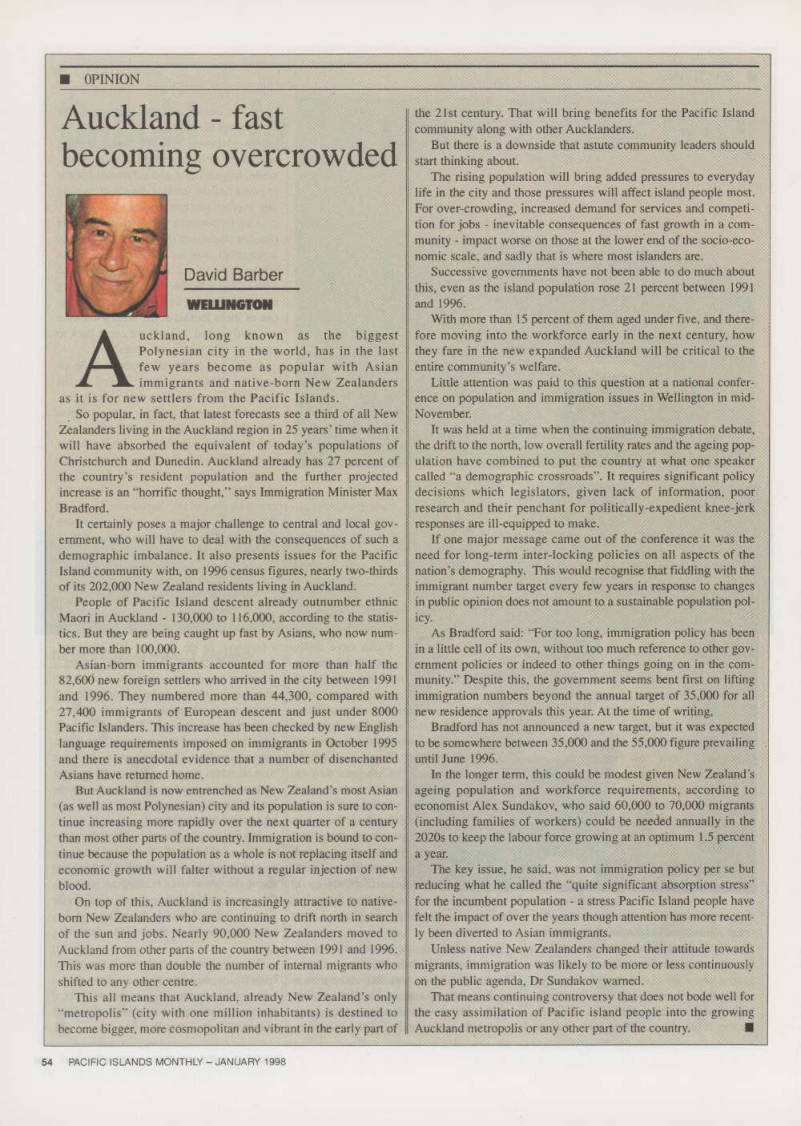
Opinion
Auckland - fast becoming overcrowded
David Barber
Wellington
Auckland, long known as the biggest Polynesian city in the world, has in the last few years become as popular with Asian immigrants and native-born New Zealanders as it is for new settlers from the Pacific Islands.
So popular, in fact, that latest forecasts see a third of all New Zealanders living in the Auckland region in 25 years’ time when it will have absorbed the equivalent of today’s populations of Christchurch and Dunedin. Auckland already has 27 percent of the country’s resident population and the further projected increase is an “horrific thought,” says Immigration Minister Max Bradford.
It certainly poses a major challenge to central and local gov ernment, who will have to deal with the consequences of such a demographic imbalance. It also presents issues for the Pacific Island community with, on 1996 census figures, nearly two-thirds of its 202,000 New Zealand residents living in Auckland.
People of Pacific Island descent already outnumber ethnic Maori in Auckland - 130,000 to 116,000, according to the statis tics. But they are being caught up fast by Asians, who now num ber more than 100,000.
Asian-bom immigrants accounted for more than half the 82,600 new foreign settlers who arrived in the city between 1991 and 1996. They numbered more than 44,300, compared with 27,400 immigrants of European descent and just under 8000 Pacific Islanders. This increase has been checked by new English language requirements imposed on immigrants in October 1995 and there is anecdotal evidence that a number of disenchanted Asians have returned home.
But Auckland is now entrenched as New Zealand’s most Asian (as well as most Polynesian) city and its population is sure to con tinue increasing more rapidly over the next quarter of a century than most other parts of the country. Immigration is bound to con tinue because the population as a whole is not replacing itself and economic growth will falter without a regular injection of new blood.
On top of this, Auckland is increasingly attractive to native born New Zealanders who are continuing to drift north in search of the sun and jobs. Nearly 90,000 New Zealanders moved to Auckland from other parts of the country between 1991 and 1996.
This was more than double the number of internal migrants who shifted to any other centre.
This all means that Auckland, already New Zealand’s only "metropolis” (city with one million inhabitants) is destined to become bigger, more cosmopolitan and vibrant in the early part of
the 21st century. That will bring benefits for the Pacific Island community along with other Aucklanders.
But there is a downside that astute community leaders should start thinking about.
The rising population will bring added pressures to everyday life in the city and those pressures will affect island people most.
For over-crowding, increased demand for services and competi tion for jobs - inevitable consequences of fast growth in a com munity - impact worse on those at the lower end of the socio-eco nomic scale, and sadly that is where most islanders are.
Successive governments have not been able to do much about this, even as the island population rose 21 percent between 1991 and 1996.
With more than 15 percent of them aged under five, and there fore moving into the workforce early in the next century, how they fare in the new expanded Auckland will be critical to the entire community’s welfare.
Little attention was paid to this question at a national confer ence on population and immigration issues in Wellington in mid- November.
It was held at a time when the continuing immigration debate, the drift to the north, low overall fertility rates and the ageing pop ulation have combined to put the country at what one speaker called “a demographic crossroads”. It requires significant policy decisions which legislators, given lack of information, poor research and their penchant for politically-expedient knee-jerk responses are ill-equipped to make.
If one major message came out of the conference it was the need for long-term inter-locking policies on all aspects of the nation’s demography. This would recognise that fiddling with the immigrant number target every few years in response to changes in public opinion does not amount to a sustainable population pol
icy.
As Bradford said; “For too long, immigration policy has been in a little cell of its own, without too much reference to other gov ernment policies or indeed to other things going on in the com munity.” Despite this, the government seems bent first on lifting immigration numbers beyond the annual target of 35,000 for all new residence approvals this year. At the time of writing, Bradford has not announced a new target, but it was expected to be somewhere between 35,000 and the 55,000 figure prevailing until June 1996.
In the longer term, this could be modest given New Zealand’s ageing population and workforce requirements, according to economist Alex Sundakov, who said 60,000 to 70,000 migrants (including families of workers) could be needed annually in the 2020 s to keep the labour force growing at an optimum 1.5 percent a year.
The key issue, he said, was not immigration policy per se but reducing what he called the “quite significant absorption stress” for the incumbent population - a stress Pacific Island people have felt the impact of over the years though attention has more recent ly been diverted to Asian immigrants.
Unless native New Zealanders changed their attitude towards migrants, immigration was likely to be more or less continuously on the public agenda, Dr Sundakov warned.
That means continuing controversy that does not bode well for the easy assimilation of Pacific island people into the growing Auckland metropolis or any other part of the country. ■
Climate debacle
Jemima Garrett
Sydney
Australia more than got its own way at the cru cial climate convention in Kyoto, Japan and in doing so may have threatened the very future of the agreement which took 159 nations 11 exhausting days to hammer out.
The Kyoto Protocol, as it is known, commits the 39 industri alised nations to reduce their total greenhouse gas emissions by 5.2 percent on 1990 levels by 2012. That is well below the Pacific Islands demand for a 20 percent reduction and even further behind the. reduction necessary to stabilise the concentrations of the warming gases in the atmosphere. Nevertheless, the fact that the industrialised nations have agreed to mandatory cuts is a major step. And it almost did not happen.
The major deal which saw Europe commit itself to a reduction of 8 percent, the United States to 7 percent and Japan to 6 percent was stitched up after midnight on the day talks were supposed to end. All six of the major greenhouse gases were included - carbon dioxide (by far the most common of the greenhouse pollutants), nitrous oxide (which is also emitted in the burning of fossil fuels), methane (put off by organic waste) and the three ‘halo carbons’ (which are substitutes for ozone damaging chemicals - small in number but powerful warming agents).
One of the key people in brokering the deal was the United Nations negotiator Raul Estrada. “This is a figure that is going to have an impact on the concentration of greenhouse gases in the atmosphere” he declared at the end of the talks.
But not Australia’s contribution. Despite being the third highest greenhouse emitter per head of population, Australia’s refusal to contemplate any cut in its greenhouse emissions saw it emerge as one of only three nations actually allowed to increase its emissions - to 8 percent above 1990 levels by 2012.
Iceland (which may increase its emissions by 10 percent) and Norway (by one percent) obtained their concessions because they derive the vast bulk of their electricity from renewable sources and therefore have few means to make real reductions.
Australian Prime Minister John Howard, who has always claimed that Australia’s specialisation in high-energy industries put it in a different category, was jubilant.
“We fought for Australian jobs every inch of the way and the outcome vindicates Australia’s stance” he said.
“It’s an outcome that will protect tens of thousands of Australian jobs and importantly, it’s an outcome that will put the world on a firmer path towards controlling greenhouse gas emis sions” Howard said. During the negotiations Australia staunchly refused to contemplate any cuts to its emissions and, even when offered its own special deal, refused to agree to sign on to the Protocol until land-clearing was included in the package of mea
sures taken into account in assessing emission reductions.
It was the last-minute inclusion of land-clearing that most wor ried Australian scientists and environmentalists because they claim it will allow Australia to go way over its 8 percent limit.
In the inventory which assessed Australia’s contribution to global warming back in 1990 land clearing contributed to just over 20 percent emissions. Professor lan Noble, from the Australian National University, who helped prepare the inventory, points out that land-clearing has already been cut by two-thirds.
Professor lan Lowe, another widely respected scientist, says the inclusion of land-clearing in Australia’s quota effectively allows Australia to increase emissions by 30 percent.
He says it is nothing more than “a license to pollute”.
Australian environmental groups were angry and embarrassed by the Howard government’s strategy at Kyoto.
“The performance of the Australian government in its whole negotiating process has been an absolute disgrace and a complete con job,” said Peter Kinrade from the Australian Conservation Foundation.
Even public opinion was not behind Prime Minister Howard. A Herald-AC Nielson-McNair survey showed 90 percent of Australians were either “concerned” or “very concerned” about the environmental effects of global warming and that 68 percent believed the government’s concern that a climate treaty would cause economic damage to Australia should not stop it signing.
Before the convention broke up, the leader of the European delegation was describing the easy treatment of Australia as a “problem” that would need to be fixed.
If the Kyoto Protocol is to be effective it still has some hurdles to overcome. First and foremost among those is the US congress and senate, which must approve the Protocol by a two thirds majority before Washington can ratify it.
The Australian precedent will be very much in the minds of congressmen and senators when they vote on the bill and will become another weapon for those opposing tough greenhouse action. Like Howard they have been concerned about the impact cuts in greenhouse emissions will have on jobs in America.
To enable the Kyoto deal to be struck. President Bill Clinton made a substantial concession, moving from his original plan to stabilise US emissions at 1990 levels to a promise to reduce emis sions by 7 percent.
With a majority in the senate opposed to the Kyoto deal, Clinton now faces a very tough job indeed.
Even if the industrialised nations meet their Kyoto Protocol promises, scientists say those cuts will not be enough to stop the phenomena associated with global warming - the increased storms and floods, sea-level rise and salt water inundation which threat ens the very existence of many of island communities.
At the Kyoto convention Nauru’s President Kinza Clodumar, while not mentioning Australia by name in his speech, nonetheless had a clear message. “The wilful destruction of entire countries and cultures with foreknowledge would represent an unspeakable crime against humanity,” he said. “No nation has the right to place its own misconstrued national interest before the physical and cul tural survival of whole countries. The crime is cultural genocide; it must not be tolerated by the family of nations,” President Clodumar said.
“The crime is no less when it is perpetrated slowly by the emis sions of invisible gases”. ■
the Pacific Islands
Press freedom in the Pacific Islands
Debbie Singh
Spc, Noumea
It has often been said that a country cannot be fully democratic unless it can boast a free press. But what exactly is a “free-press”? And how does one define press freedom in the context of media own ership, control, development, human rights and globalisa tion? The South Pacific Commission in New Caledonia played host to a regional communications conference in December 1997.
The meeting was organised by Radio France Overseas (RFO) and the Noumea based University of Communication. It was attended by both regional and international media personalities and has as its theme “Globalisation and the Islands”. Among topics dis cussed was media freedom and democracy in the Pacific Island region. I have chosen to tackle the topic from a development and human rights perspective, particularly in terms of the influential role the media can play in ensuring sustained, democratic devel opment of the region. It is clear that information is vital for the empowerment of people both as individuals, communities, groups and nations, now more so than ever as the world moves into the new millennium and increasing emphasis being placed on infor mation, communication, information technology and exchange.
The latter being particularly evident with the advent of the inter net and the democratisation of information via this network.
The mainstream news media, as we know, is a powerful force.
It is a shaper of opinions and ideology. It is what links the public with national and international events. It is often a mover and a shaker. The media has and will continue to play a large and cru cial role in launching the Pacific Island region into the 21st Century. And it is in this context that a free and informed press is vital to the democratic development of a nation. Ideally, it should also add to efforts to ensure the full and equal participation of its people in nation-building and national development. But, nothing comes without a price. And the price tag on any form if freedom is usually quite high. Coupled with freedom and independence also comes responsibility and accountability - for actions, state ments and opinions. And subsequently, the need for fair, accurate and objective reporting - that will lead to the sustained democrat ic development of nations and their people.
The Pacific Island region can be proud to boast a rich and vibrant press - one that is in tune with its cultural heritage; yet abreast of current national, regional and global affairs - the latter feature placing many Pacific media organisations on par with our more “advanced” neighbours, Australia and New Zealand.
While the regional media in this part of the world many not often have the same approach, equipment, resources (both human and financial) or technology to ensure the efficient and timely
covering of events as out larger neighbours , this has not deterred us from effectively pursuing and actively breaking major news stories. Some of these have sent turbulent waves through govern ments and subsequently led citizens to voice their concerns in a more informed, active manner and enhanced their participation in the governance of their respective nations.
Information is power. And with power comes the need for accountability and responsibility. It is, therefore imperative that we, as journalists, exercise this responsibility in ensuring facts are reported accurately, particularly in terms of the public’s “right to know” versus objectivity and fairness. This exercise of responsi bility is what I feel a democratic media is truly about - the ability to report facts, inform the masses, question injustices and abuses, raise awareness and provide an open forum for discussion - with the end result being empowerment of the masses to make up their own minds on issues - all within the framework of a mature, responsible and fully democratic press. The Pacific Island region is evolving, rich, diverse and dynamic. Pacific Island countries and territories are developing at differing paces - thus the dissem ination of information through any type of media must reflect and accommodate these varied rates of development and should ideal ly, include the needs of those “on the ground”, that is, at the local level. For instance, how can one define the information needs of tiny Niue in comparison to vast Papua New Guinea? Literacy lev els, geographical diversity, infrastructure and skills are a few fac tors that come into play here. It is here that the concept and prac tice of what I loosely term “journalism for development” plays a vital role. And how is this achievable in the context of our present topic? In discussion media freedom and democracy, I would say it is certainly necessary to look at the topic in a broad context.
Basically, this means the way in which news is covered. Who decides what makes the news, cross-cuts, influences and impacts on nations, on smaller communities, on groups, families and indi viduals. This should entail that the news be reported from forward thinking perspective; in that, the question; what happens after the opinion, interest and outcry have been generated - must be addressed to ensure the problem does not become “yesterday’s news”. Looking at the picture in this context, it is clearly evident that the opinions of the media are, to a great extent, what general ly rule. Certainly, the media plays an initial, crucial role in formu lating public opinion. Does this mean that journalists should take over the running of a country? Well, not quite. However, the media and the journalists who comprise it have huge power and influence to make or break - be that governments, individuals or institutions. Our media are directly contributing to the develop ment of the Pacific Island region - be that through uncovering of injustices and corruption or reporting on the lack of sanitation and water in a Pacific village. And it is here that I would raise these few questions: How does the news of the day not only inform but also empower the masses? How does it account for the needs of everyone, bearing in mind the special features of our region?
What is its effect and impact in terms of raising public awareness of raising public awareness of issues? Is its message effectively heard at the grassroots or local level? Does it advocate on behalf of marginal groups such as indigenous people, youth and women?
Does it address their problems? Or ignore them completely?
These are some questions which in my view, hiust be answered to enable our regional news media to fully participate in the sus tained democratic development of Pacific Island countries and territories.
Advertisements & other items, pp. 57-60 (3 items)
■■Oftm 04/12
SHIPPING
SHIPPING SCHEDULES FOR SHIPPING SERVICES (FIJI) LTD.
AUSTRALIA-NEW 7.EALAM)-FIJI-WEST COAST NORTH AMERICA SERVICES
NORTHBOUND SHUTTLE SERVICE
.■ ' WRHK 44/97
WEST COAST NORTH AMKRIC A-R.il-NEW ZEALAND-AUSTRALIA SERVICE
SOUTH BOUND SHUTTLE SERVICE
SOUTHERN CROSS SHIPPING
AUSTRALIA- ETH-PACIFIC ISLANDS
BURNS PHILIP SHIPPING AGENCIES (FIJI) LTD
AGENCY VESSELS MOVEMENTS
SOUTHEAST ASIA-EIJI DIRECT SERVICES
MANILA/TAIWAN/lIONG KONG/ KOREA SERVICE
VESSEL -7^
WlW.f
MELBOURNE
sYDNET
I"’ AUCKLAND
SUVA
LOS ANGELES
VANCOUVER
SEATTLE
OAKLAND
NEWYORK
COLUMBIA CAL,
Q52N 02-0*11 03-07/i 1 J1-12/11 15-16/11 2S.lt 01/12 04 0*12 ' 03-03/12 01-01/12 05-05/1! 2
COLUMBIA STAR
04JN 23-2*11 26-28/U 02-03/12 06-07/12 20-22/12 25-25/12 24-2*12 22-23*12 27-27/12
BRISBANE STAR
030N 07-0V12 10-12/12 16-17/12 20-21/12 0305/0) 08 08.01 0707/01 05-05/0) 10-10*01
COLUMBUS CAL,
053N 21-22/12 24 26/12 30-31/12 03-04*01 17-19/01 22-2201 21-21/01 19-19/01 24-2*1
ARGENTINA STAR
002N U-12/01 1*16/01 20-21/01 24-25/01 07 09*02 12-1202 11-11/02 09-09/02 1*1*2
BRISBANE STAR
03 IN
25-2MSI
28-30*01 03-0*02 07-08/02 21-23 m 26-2W02 25-2502 23 23/02 28-28/2 columbus cal 054N 08.09/02 U 13/02 17 18/02 221-22/02 07-09/03 12-1203 ll-il/03 09-09/03 14-1*3
ARGENTINA STAR
003N 01-02/03 04-06/03 10-U/Q3 14 15/03 28-50/03 02 02/04 01-0104 30-30/03 04-0*04
BRISBANE STAR
032N 15-16/01 24-25/03 28-29/03 II -13/04 16-16/04 15-IV04 13-13/04 18-! 8/04
COLUMBUS CAL.
055N 29-W03 SI-03/04 07-08/04 11-12/04 35-27.04 30-30/04 29-3904 27-2-//04 0242/05
ARGENUNA STAR
004N 19-20/04 22-2*04 28-29/04 02-03/05 16-18-05 221-21/05 20-20/05 18-18/05 23-2.3/08 .
mwu
POM-61
t-OAt-U
WKX-$t
t.0 'tZ'ii tO&Z‘9l tmt-sz am
HVLS VMlN'-tOaV
mmm go/sa-st {ont-it Sty$0-i6 zmt-u tmt-nt Z<H6l-6l wsi-st
«VXS 3MVaSlH3
ctm-to «w<ko «v«-sr
ZOIZZIZ
xom-w zom^o mmso avw-w S€00 avis vNLtN3oav 111111
UiSS ZSZ
irntriz imi~u Ip/StKO w/zo-zo i f , to/to-io rtm-u avxs awvastaa iom~n 10/cMf to m-m 10/f0-£0 zmtoz CI/61-01 ztm St zt.ti n szoo
aViS VHUD3DV
JWOI
zimtn euro-to ; ii/oc-61
IWl-SI
'-r? iiam-i
IIAU’t
wzvzx \
SOU)
avis-iNvaswa
■A3NOA.S:
—.mmomm
oiraonv :
VAiis
sanaoNvsoi
% iivwo
aaAncDNVA
mvis "i
•HWAOA
T3SS3A
VITVXlSflV
OMTV3ZM3N;
IflJ voraawv kx»on xsvoa issm
33n«3HDS
VESSEL
i GLADSTONE SYDNEY
BRISBANE SANTO VILA
S0VA :
FUNAFUTI
VVAUJS
APIA
PAOO VA*VAU
NUKU'AIjOPA
GLADSTONE
PRINCESS CATHS
;VN 10
■■Oftm 04/12
04/12 09/12 WM
iiili
17/12 — wn 22/12 24/12 20/01 3 31/12
PRINCESS CATHF
IYN i
01/01 02/01 02/0J 07/01 00/01 15/01 nm 18/01 20/0! 22/01 :>< 24/01 29/01
VESSEL
NZOL
NZOL
NZOL
NZOL
NZOL
"T "NZOL
COMMANDER
CHALLENGER
CRUSaDBR
( ampaionkh
COMM ANOER
5 1- CHALLENGE*
VOYAGE NO.
V21S/97 V22S/97 v&sm V24S/97 V3S/98
V02S/9K
SURABAYA
l«U 29/11 14/12 29/12
MKARATA
J;:., am 01/12 1612 01/01
PORT KELANG
ilfciiiillilliliii
19/11 04/12 19/12 04/01
BANKOK
00/11 25' II 10/12 25 12 10/01
SINGAPORE
■ IS. 1 * 40/11 15/12 . 10-12 15/01
NOUMEA
*271! 77/ tl 12/12 27/12 12/1,-98 27/1
SUVA
14/n 20‘11 14/12 29/12 ' J 14/01 29/1
VESSEL
NZOL
NZOL
NZOL
NZOL
N/OL
NZOL
COMMANDER
CHALL ENOER
CRUS ADBR
CAMPAIGNER
COMM ANDES?
CHALLENGER
VOYAGE NO,
V21N/97 V22N/97 V28N/97 V24N«>7
V0IN/9H
V20S/98
:S5»s»W* NORTHBOUND
SURABAYA
1471? 2W12 JWl 29/01 j 28/02
MKARATA
16/12 01/01/98 16/0! 01/02 16/02 01/05
PORT KELANG
wa 04-01 19/01 04/02 19/02 04/03
SINGAPORE
21/12 mm 21/01 06/02 21.-02 06/04
BANKOR
25/12 1601 25/01 10/02 25 02 10/03
PORTS
BA) HE KOU
V267/268
XIAO SHI KOti
V244/245 bai he; kou V 269/270
XIAO SHI KOU
V246/247
MANILA
- 09/i 1 30/11 21/42 //„'
KHELDNO
mmmmmmmmmmzM
10/lt 01/12 17/12
KAOSH1UNO
07' 1 1
w\ i . Jiiiiiii
15/12
HONGKONG
rnmmmmmmmmmmm 16/i) 07/12 26/12
BUSAN
06/11 27/11 27/12
SUVA
18/1! 10/12 31/12 21/01
AUCKLAND
21/11 13/12 03/01/08 24/01
LYTTELTON
26H1 16/12 05/01 26/01
FEEDER SERVICE LAVTOfCA-
■VlARELAT
.. CHINA /JAPAN DIRECT SERVICE
PORTS
BA) HE KOU
vmtm
XIAO SMI KOU
V244/245
BAI HE KOU
V260/270
XIAO 5 SHI KOU
V246/2247
DALIAN
i 4/i i
05/12
HUANGPU
14/11
IWii 05/12
' 23/12
NANKING
- 15/1! (mu 27/12
QINGDAD
- W'‘'' mm 22/32
SHANGHAI
i2/» 03/12 24/12
XINGANG
- 13/11 04/12 20/12
KOBE
02-03/13 25/11 13/12 os/oi
NAGOYA
YOKOHAMA
04-05m im i 15/12 ' 07/0!
SUVA
18/ J i
lii 10/12
3.1/12 21/01
AUCKLAND
22-23/0 13/12 o mm 24/01
LYTTELTON
25-26/11 16/12 05/01 26/01
KOBE
NAGOYA
13-14/12 05-01/98 20/0) «»*
YOKOHAMA 5 , fl
iyimz 07mm 28/01 ' 18/92 FEEDER SERVICE LAUTOKA-VIA RELAY NAGOTA CARGO CENTRALISED TO KOBE FOR WADING (RCE DNIT}
iBr
NEWZEALAND- FIJI
■ (■■■ i i CONTAINER IDRY/REEFER ).LC L RBREAKBULK SPECIALIST •; ..(W
VESSEL
VOYAGE NO-
DIRECTFALCON
■V335
DIRECT TO
V243
DIRECT KIWI
V337
DIRECT EAGLE
„ V339
DIRECT TUT
V244
IHR^EAALCON-,
LYTTELTON
■■ 14/11 |f 22/11 / 28/11 'I 1 " "‘"’I 12/12 1.3/12 l wi/98 ;x :
AUCKLAND
13-16/11 2A-26/11 29-30/11 !<■ 14.-12 1(5-17/12 - &&&<■ 8 »
SUVA
i9/u 2-3/12 3/12 17/12 23-24/12 7/1 ' •
.tAUTOKA
20/11 4/12 : 4/12 18/12 25-24/12
mri\
Jl, 1 «U« TO ISLAND FORTS AND AUSTRALIA iM Mt
VESSEL
SOUTH QUFJEN
MOANAIB
ARIKI PACIFIC
SOUTH QUEEN
TO PACIFIC
SOUTH OUESEN
VOYAGE NO.
VISE
V02 VJg
VISE
V03 '
SUVA
/ W': 8-W11 12/11 21/11 2/12 - 1 18/ 12 1 ' LAtnroKA -
VIA SUVA
V1ASU
NUKUALOFA
APIA
, li||: : . ‘ •
iiiiiipiiiii
23/1 i 24/11 : ;»?a , 21/12
PAOOFAGO
ivu 1-4/11 23/11 4/12 22/12 ' ' *
WALUS
- 13/11 27/11 „ Wi 24/12 lilt 28/11 25/12
SUVA
i'll
iPPlliiilil
30/U . 27/12 ‘ :
SYDNEY
13/11 ti 7/12 '
MELBOURNE
18/11 - . 10/12 7/j
BRISBANE
118/11 - " v imi 7/1
LANitO CtSTRAUSED AT SYDNEY ■ 1
NEPTUNE SHIPPING AGENCY
SERVING ELH DIRECT FROM NEW ZEALAND AND AUSTRALIA
NEW ZEALAND- FIJI DIRECT SERIVICE
fail
■s'K.
VESSEL
VOYAGE NO
AUCKLAND LYTTLETON TAURANGA
AUCKLAND
SUV*
CAPlTAiNE WALLIS
CAPlTAiNE WALLIS
CAPlTAiNE WALLIS
CAPlTAiNE WALLIS
CAPlTAiNE WALLIS
:; '5.::' : a¥CSsA,o::Sa 6 7 8 9 7-7/1 25- 28-28/11 X-}/|| 14-14/12 17-17/12 20-2072 6-6/J 5-5/1 12-12/1 26- 30-30/1 2/2/2
U/lT/lDjjr--
2L2I/^',^ 0' S
I , W-J9-19/H
26-27/12
1 AS9 ?X
AUSTRALIA FUI -DIRECT SERVICE
x ’. 'v . I n ' 'V'”" pp 11
VESSEL
VOYAGE NO.
BRISBANE SYDNEY MELBOURNE
5»>4^S0VA
CAPlTAiNE TASMAN
4
2-3/11 6 7/11 I0-1I/T)
CAPITAINB TASMAN
5 77-28/1 i 3Q/X1-1/12 •' \<&Sm 13-13,'12 15-16/12
CAPlTAiNE TASMAN
5 22-22/12 24-24/12 27-27/12
CAPlTAiNE TASMAN
6 5-5/1 8-9/1 12-13/1 20-20/1 21 2) 1
FUI-APiA-PAGOPAGO-FUTUNA-WALHS NOUMEA SERVICE
VESSEL
VOYAGE NO.
SUVA APIA PAOOPAGO FUTUNA
WALLIS
FUTUNA s
NOUMEA
MOANA HI
3 8-9/n - n/ii/n 14-16/11 17-17/11 21-22/11
MOANA HI
4 25-26/11 - 27-27/11 28-30/11 1-1/12
MOAN’A HI
5 3-4/12 6-6/12 9-9/12 10-10/12 14-15/12
MOANA Ilf
6 18-18/12 . 22-22/12 23-25/12 26-26/12
MOANA HI
7: 29-29/12 31-31/12 03/1-4/1 5-5/1 9-10/1
Shipping
founders saw
“In 1957,
Grand Pacific y s
their future.”
AS BRIGHT AS EVER.
This year, we're celebrating an event that should please our clients and our agents alike.
Our 40th Anniversary.
Four decades ago, the founders of Grand Pacific Life set out to create a life insurance
company designed to safeguard and serve
people in the Pacific. Today, through pioneering efforts and 40 years of steady growth, Grand Pacific Life has over $3.8 billion of life insurance in force. Which represents the trust of many thousands of people, ones whom
we've helped secure the financial indepen-
dence and peace of mind they've worked so
hard to achieve.
Our founders' spirit and vision continues
in reaching out with new ideas to other nations in the Pacific. Our steadfast dedication to our clients and agents has made history these last 40 years. The decades ahead look equally
exciting and full of promise.
Grand Pacific Life Insurance, Ltd.
American Samoa Mark Solofa Pacific Insurance & Finance, Inc.
Mark Solofa, GA Phone: 684-699-5796 Western Samoa Mark Solofa Pacific Insurance & Finance, Inc.
Mark Solofa, GA Phone: 685-24059 Chuuk State. Federated States of Micronesia Pacific Basin Insurance & General Services, Inc.
Kachutosy Paulus, GA Phone:69l-330-2606 Actouka Executive Insurance Underwriters Maridell Actouka Phone:69l-320-5331 Guam Great National Insurance Underwriters, Inc.
Domie Bumagat Jr., GA Phone. 671 -646-5736 Pacific Financial Corporation Eduardo Camacho, GA Phone: 671-646-1990 Takagi & Associates Pamela Cruz, Life Manager Phone:67l-475-4373 Marshall Islands Marshalls Insurance Agency Jerry Kramer, GA Phone: 692-625-3366 Saipan Pacific Basin Insurance Underwriters, Inc.
Mary Ann Milne, GA Phone: 670-234-7861 Pacifica Insurance Underwriters, Inc.
Norman Tenorio, GA Phone: 670-234-6267 Takagi & Associates Laurie Sturges, Branch Mgr.
Phone; 670-322-8117 Tonga Peseti Ma'afu Insurance & Finance, Ltd.
Peseti Ma'afu, GA Phone: 676-24-777 A member of the Finance Factors Family
\, Fftcinc-
3. SH^LN/EvS
N 919 n rRC^ ... .■ss»*s:s.s
111 ill
- : ; - •■>, i I ! > ' 'U /' s J lisp Some of the specs may vary according to market specifications.
Looks tough, feels comfortable - Toyota Hilux People all over the world prefer Toyota. Because it makes bestsellers like Hilux. It maintains that rugged reputation, and now it sports tough, durable body styles as well. It's ready for any terrain.
Hilux offers more. More power - with a choice of engines and precision transmissions and transfers. More effective power distribution to match the terrain, thanks to Toyota's advanced
technology.
And more passenger car-like comfort. With an ergonomic interior, all the conveniences you want, the fit and finish you'd expect from Toyota, and a ride that's smoothed out by precision-
engineered suspension.
Hilux is built to take it. And to take you anywhere you want to go.
It's remarkably tough. And incredibly comfortable. With worldleading uncompromising quality. From the champion. Toyota.
DISTRIBUTORS / DEALERS
NORFOLK ISLAND BORRY'S PTY LTD. PH 22114
SOLOMON ISLANDS ELA MOTORS PH 30314
VANUATU ASCO MOTORS PH 22341
COOK ISLANDS PACIFIC MOTORS LTD. PH 20796
® TOYOTA
KIRIBATI TARAWA MOTORS PH 21090
PAPUA NEW GUINEA ELA MOTORS PH 3229400
TAHITI NIPPON AUTOMOTO PH 429819
WESTERN SAMOA ASCO MOTORS PH 20800
FIJI ASCO MOTORS PH 384888
NEW CALEDONIA S.I.A.P. PH 275562
TONGA ASCO MOTORS PH 23500
AMERICAN SAMOA ASCO MOTORS* PH 633-4281
(*HILUX is not being handled.)