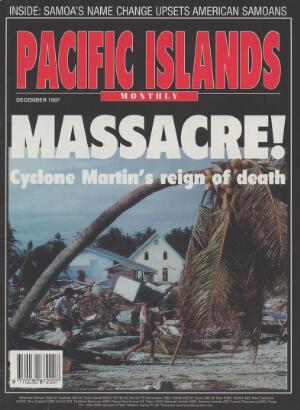
Pacific Islands
Monthly
INSIDE: SAMOA’S NAME CHANGE UPSETS AMERICAN SAMOANS
December 1997
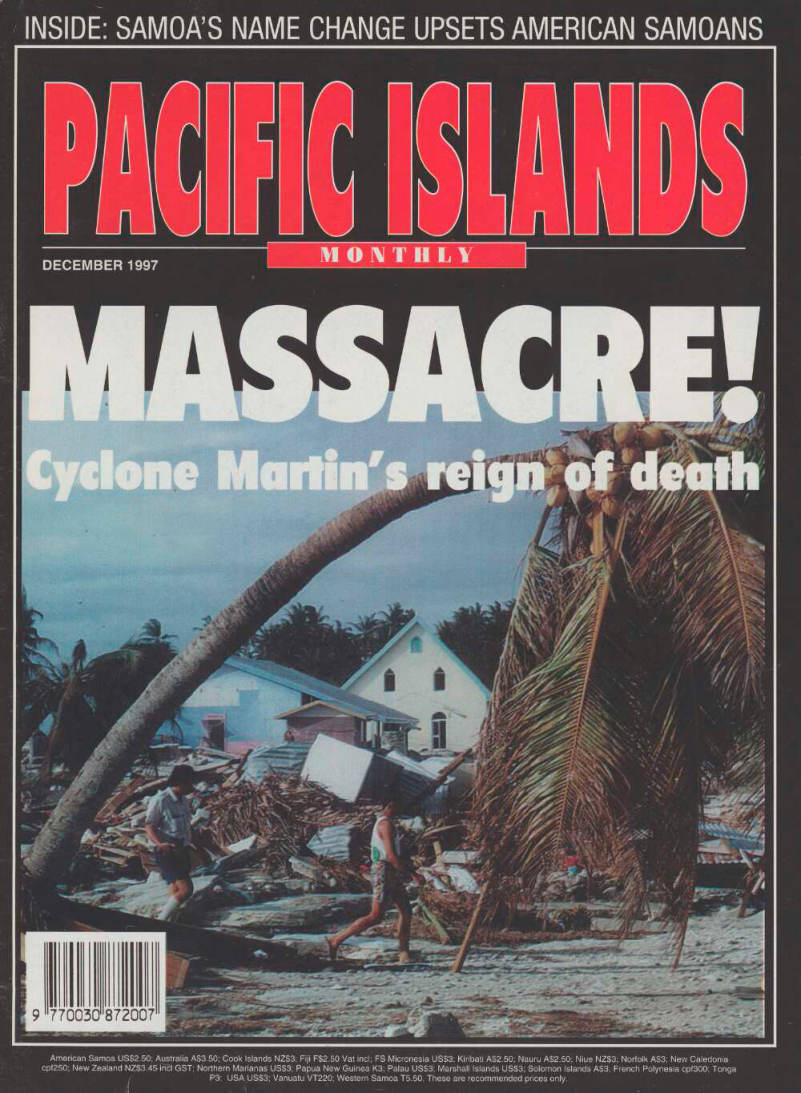
Cyclone Martin's reign of death
American Samoa US$2.5O; Australia A 53.50; Cook Islands NZ$3; Fiji F 52.50 Vat incl; FS Micronesia US$3; Kiribati A 52.50; Nauru A 52.50; Niue NZ$3; Norfolk As 3; New Caledonia cpf2so; New Zealand NZ53.45 incl GST; Northern Marianas US$3; Papua New Guinea K 3; Palau US$3; Marshall Islands US$3; Solomon Islands As 3; French Polynesia cpf3oo; Tonga P 3; USA US$3; Vanuatu VT22O; Western Samoa T 5.50. These are recommended prices only.
Advertisements & other items, pp. 2-3 (1 item)
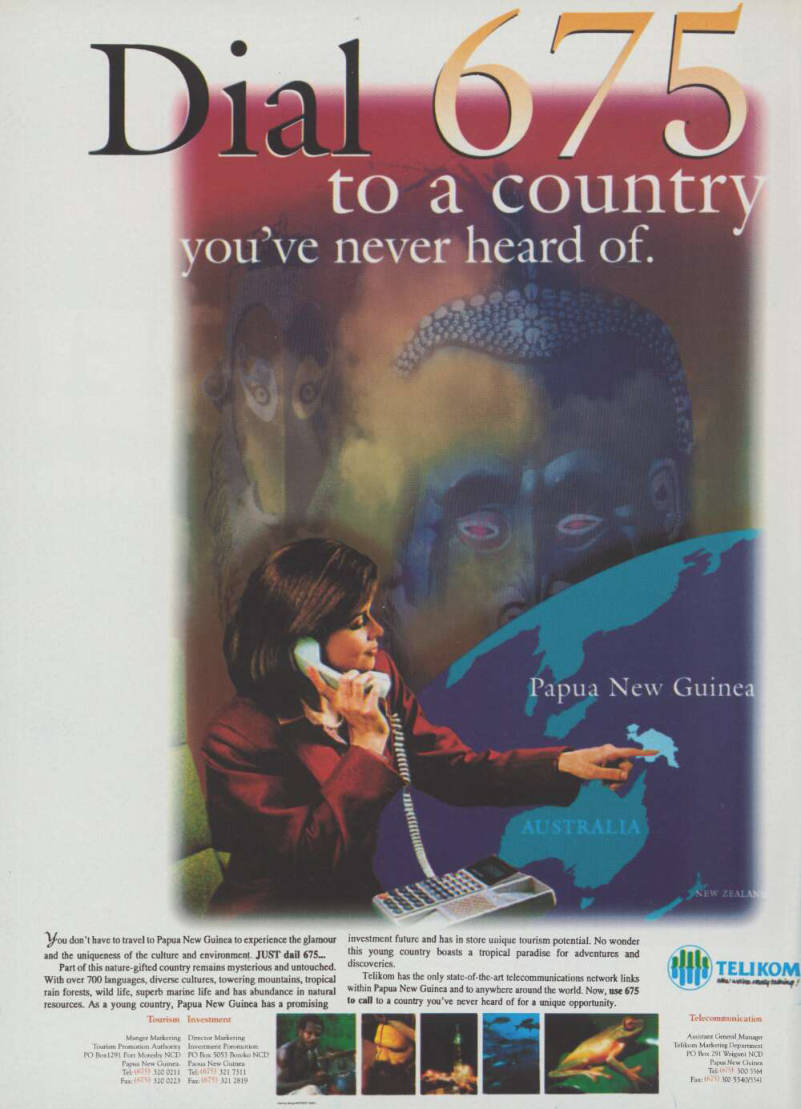
to a countn
ou’ve never heard of.
Papua New Guine
don’t have to travel to Papua New Guinea to experience the glamour and the uniqueness of the culture and environment. JUST dail 675- Part of this nature-gifted country remains mysterious and untouched.
With over 700 languages, diverse cultures, towering mountains, tropical rain forests, wild life, superb marine life and has abundance in natural resources. As a young country, Papua New Guinea has a promising Tourism Investment investment future and has in store unique tourism potential. No wonder this young country boasts a tropical paradise for adventures and discoveries.
Telikom has the only state-of-the-art telecommunications network links within Papua New Guinea and to anywhere around the world. Now, use 675 to call to a country you’ve never heard of for a unique opportunity.
(|j|ft) TELIKOM
Manger Marketing Director Marketing Tourism Promotion Authority Investment Poromotion PO 80x1291 Port Moresby NCD PO Box 5053 Boroko NCD Papua New Guinea. Paoua New Guinea Tel:i673) 320 0211 Tel: (675) 321 7311 Fax: (675) 320 0223 Fax: (675) 321 2819 Telecommunication Assistant General Manager Telikom Marketing Department PO Box 291 Waigani NCD Papua New Guinea Tel: (675) 300 5564 Fax: (675) 300 5540/5541
■ .. ’ 1 m m m e* s. ■> .»• m y n «r" w«a iffii MU fV| ; ■ ::;
WBSS
wiiiiii
mil
;v : >; Mffinaßiai . :a m mm. -.: * ■.
H|| gsa : mssam
KIAORA! BULAVINAKA!
MAEVA! ALOHA!
HOWEVER WE SAY IT,
IT MEANS WELCOME!
Budaet
Fiji 122 636 Papuo New Guinea 325 4111 Vanuatu 23170 New Caledonia 262 009 Hawaii 838 1111 Western Samoa 20561 Australia 1300 362 848 New Zealand 0800 652 221 You, Me & Him BUDSSIPA
Pacific Slands
Monthly
Vol 67 No. 12
The News Magazine
December 1997
PUBLISHER: Alan Robinson ACTING EDITOR: Bernadette Hussain SENIOR WRITER: Bernadette Hussain
Correspondents:
Sally Andrew, Patrick Decloitre, Giff Johnson, Chris Peteru, Susan Prokop, Atama Raganivatu, Florence Syme-Buchanan, Liz Thompson, Lili Tuwai, Sam Vulum. lan Williams COLUMNISTS: David Barber (Wellington), Jemima Garrett (Sydney), Debbie Singh (South Pacific Commission).
GRAPHIC ARTISTS: James Ranuku, Josefa Bola, Andrew Williams
Advertising Sales
Senior Regional Sales (South Pacific) Shabana Naaz Arun Sharma Tel (679) 304111, 303244, Fax (679) 303809.
Sydney, Canberra: Bob Hill Media Representation, Tel (61-2) 4164245, Fax (61-2)4165064.
Brisbane: Jane Fewings Media and Advertising Associates Tel (61-7) 3378 4522, Fax (61-7) 3878 1071.
Adelaide: Hastwell Williamsons Representatives. Tel (61-8) 3799522, Fax (61-8) 3799735.
Melbourne: Brown Orr Fletcher Burrows (Aust) Pty Ltd.
Tel (61-3) 98265188, Fax (61-3) 98265644.
Auckland: McKay & Bowman, International Media Representatives Limited.
Tel (64-9)4190561, Fax (64-9) 4192243.
Japan: Universal Media Corporation, Tokyo, Tel (3) 3266626741.
Cable: UNI-MEDIA Tokyo, Fax (3) 32626742.
Pacific Islands Monthly was founded in 1930
(Usps 9522480).
A Fiji Times Limited production.
Cover prices are recommended retail only. Registered by Australia Post, Publication No. NBPI2IO. © Copyright Fiji Times Limited, 177 Victoria Parade, Suva, Fiji.
Tel (679) 304111, fax (679) 303809.
Email: [email protected]] PIM Website: http://www.pim.com.lj Pacific Islands Monthly is published monthly by Fiji Times Limited, a division of Nationwide News, 2 Holt Street, Surry Hills, Sydney, NSW 2010.
Send Address Changes To:
Pacific Islands Monthly POBox 1167 Suva, Fiji.
Typeset and printed by The Fiji Times Limited. 177 Victoria Parade, Suva, Fiji.
Layout and cover design by Andrew Williams
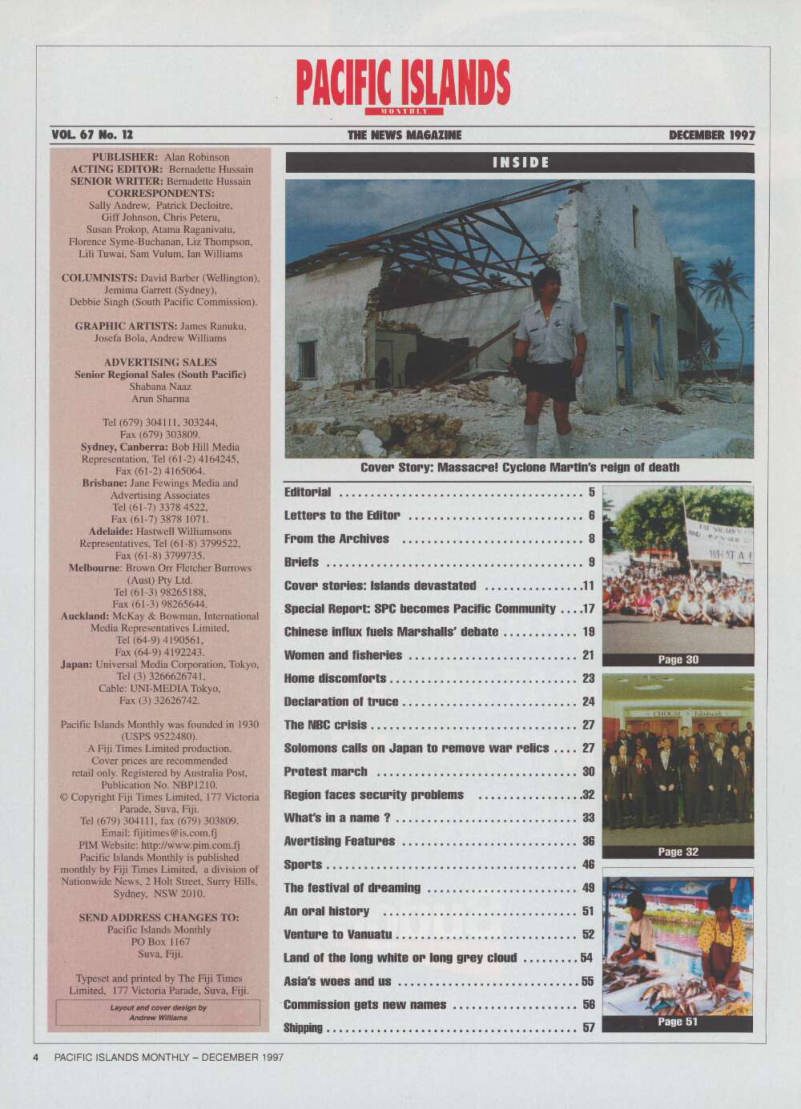
Inside
Editorial 5 Letters to the Editor 6 From the Archives 8 Briefs 9 Cover stories: Islands devastated 11 Special Report: SRC becomes Pacific Community 17 Chinese influx fuels Marshalls' debate 19 Women and fisheries 21 Home discomforts 23 Declaration of truce 24 The NBC crisis 27 Solomons calls on Japan to remove war relics 27 Protest march 30 Region faces security problems 32 What's in a name ? 33 Avertising Features 36 Sports 46 The festival of dreaming 49 An oral history 51 Venture to Vanuatu 52 Land of the long white or long grey cloud 54 Asia's woes and us 55 Commission gets new names 56 Shipping 57
Page 30
Page 32
Page 51
Cover Story: Massacre! Cyclone Martin's reign of death
Fiji welcomed back to the

Editorial
Fiji welcomed back to the Commonwealth
Fiji’s return to the Commonwealth of Nations is as welcome as it is overdue. The former British colony has always treasured its links to the crown there has been a certain yearning to return to the Commonwealth since Fiji’s membership was allowed to lapse after the coups of 1987.
Renewed membership achieves a number of benefits - regional as well as global - for Fiji.
For a start Fiji has now rejoined most of its South Pacific Island neighbours - not forgetting Australia and New Zealand - in the 54-
state grouping.
Though Fiji has always remained a leading member of region al institutions such as the South Pacific Forum, the country’s return to the Commonwealth can only strengthen the region’s standing in
that organisation.
In world terms, Fiji again has access to a powerful grouping that has had direct influence on world events while providing a powerful voice for small developing nations.
Fiji’s membership brings access to development assistance and to a shared experience of problems and how they may be addressed.
The Commonwealth is often criticised - by members and non members - as being little more than a talking shop, a club for for mer British colonies. While there may be a grain of justification for that, the Commonwealth’s achievements - in South Africa, for instance - cannot be overlooked.
Any grouping that brings together such a number and range of nations cannot help but have at least some influence on global events and development.
And renewed membership for Fiji is very obvious recognition of the nation’s achievements and progress over the past 12 months.
At considerable political risk to themselves - a risk that has by no means diminished - the prime minister Sitiveni Rabuka and the opposition leader Jai Ram Reddy combined to break the logjam that prevented reform of Fiji’s flawed 1990 constitution.
They deserve their moment on the world stage. ■
Letters To The Editor
Pound foolish: Forgetting the demand side
Dear Sir, The subject of your article “Pennywise ...”(PIM Sept) is more than timely. Thank you for initiating what should become a more public discussion of the issues of education in all Pacific Island Countries (PICs). Although the article described many of the shiny “pennies’ related to edu cation, we need to pay more attention to its dull, but individually more valuable, pound notes, equitable cost sharing and employer participation.
First, equitable cost sharing. Fiji’s pri vate sector-led education system is arguably the best system within the devel oping PICs. A major reason for this is that the communities share the operating costs of primary and secondary schools (such sharing is a common practice with church communities as well as communities and governments throughout North America).
The implication - the cost-sharing formu las used in PICs need to be changed so that more of education’s burdens and rights, rest with local communities and their area of province.
In exchange for giving more responsi
bility to local cultures for their children’s education, national funds can be applied to other forms of education.
Why change the formula? In most PICs, parents and communities see only the sub sidised costs of education. This is artificial and not sustainable. Worse, it results in parents believing that the return they are getting (in terms of their children’s
improved earning potential) on the money
they pay (their own investment) for school fees, etc., is very good. On that heavily subsidised personal level they are of course right. But for society as a whole, these sub sidies have two key negative effects. The first is that parents and students become so addicted to this expectation of (artificially) higher returns that they strongly oppose needed increases in school fees. The sec ond reality is that parents are not involved in looking for the most cost-effective ways to teach their children.
Cost-effective education for PICs will need mechanisms which are less formal than universities or university-focused sec ondary schools. Why? For two reasons.
One, most of our children don’t need such formal, academic, training because the
cash economy is not generating enough jobs for all the youths entering the job mar ket. Two, less formal mechanisms are at least as effective in improving our chil dren’s earnings potential, but they cost less, sometimes a lot less. Less formal mechanisms include ‘continuing educa tion’ (CE, using standard courses as and when a student has the time and money), non-formal education (NFE, less standard ised courses as described in the September issue of Islands Business), and vocational technical training (including apprentice ships).
Cost effective education can even be achieved in formal education. Fiji’s experi ences are not the only ones to show that community involvement in the real costs of education can be a way to make educa tion cost effective. Trial projects undertak en by USAID and others in two African countries in the early 90s revealed that community run schools were able to oper ate for some 20 percent of the cost of gov ernment-dependent schools.
What is most important though, is that the students from those schools performed at or above the average of students at gov ernment dependent schools. Why was this?
The report indicated that the increased parental and community involvement in the children’s education provided students with more of the support and incentives for learning than government dependent
schools provided.
Our nations’ leaders need to recognise that by ‘giving’ a school or classroom to a community, or by giving tuition waivers to students, they are not necessarily helping them (other than helping them to continue a dependency). PIC leaders need to take the ‘hard’ initiative to tell parents that edu cation needs to begin in homes and in com munities, not in national capitals. They need to say, ‘although education is very valuable for both social and economic nation-building, it is more valuable for household economic and community building. Therefore, national governments will do all that they can to help parents and communities to do their jobs, but that they should not be expected to do more than help. This is a ‘hard’ initiative for our lead ers to take because, in doing so they run the risk of antagonising the nascent ‘elites’ that have grown up during the decades of high levels of Cold War-inspired foreign assistance and who, as a result, see such
subsidies for their children as an unearned right. The public needs to recognise this
difficulty and compensate by increasing
their demonstrations of support for a fair and equitable sharing of the costs of edu cation.
While a dependency on subsidised edu cation is found at all school levels, it is most apparent at university. Too often, stu dents from PlC’s are given tuition-free scholarships; many get both tuition and
living allowances.
Often, these scholarships are not linked to performance criteria, so students keep studying regardless of whether they are learning (or what their grades are). Most students’ performance is not sufficient to
justify government paid living allowances;
students should earn these or have them paid by their families and communities.
Second, employer participation. The point raised in the “Pennywise” article about the effects of decreasing budget pri orities for education is relevant, but such decreases are most often due to the need to deal with self-inflicted economic wounds, like a national bank scandal, rather than dealing with any structural adjustment pro gramme.
What is more important, there is anoth er, and vital, aspect which you have over looked: PlC’s schools are supply-driven, not demand-driven.
That is, the suppliers of students (par ents), of teachers (teachers’ training insti tutions), of textbooks etc and so on deter mine the content and curricula of educa tion. Parents believe that the curricula which will get their child to/through col lege are best - but only three to five per cent of PIC youths will complete universi ty. Teacher training and text books follow the models, curricula, paradigms current in production-based economies; those economies need much higher levels of uni versity-educated people.
In the PICs, because the formal, cash economy is not generating enough jobs, half to three quarters of our youths will want or need to leam how to obtain increasing benefits (for increasing popula tions and expectations) from a subsistence economy.
The university-focused, supply side structure is not ‘wrong’: by putting so much of our resources where they cannot be fully used, it is lopsided and unsustain able. A sustainable balance can be obtained
by including the demanders of education in the teams designing educational mecha nisms, content and curricula. These demanders include employers (who want workers who can do needed tasks), con sumers (who want creative entrepreneurs and skilled workers to meet their demands for new or higher quality products), stu dents (who want an education that will help them eam-a-cash or non-cash-living), and communities (which want an increase in their quality of life in return for support ing the education of their children).
It is important to remember that the ‘demanders’ of education must include subsistence agriculture and related basic marketing and value-adding production for rural island resources, as well as care giv ing for island communities.
In addition to having different content implications, the demands of these groups are not constant nor discrete one-off (eg, one course or program) events; they will result in frequent returns to education for short periods for new or updated skills.
This is something that methods such as CE, NEE, and vocational/technical education address. Two, these methods better address ‘supply side’ issues, as people can study as they can afford the time and other costs, thus enabling them to continue to improve their income earning potential, or to main tain it during times of sudden economic shocks.
Our present supply-driven education system’s focus on graduation from univer sity or polytechnic wastes resources in other ways. A university should not be a place to send academically talented youths just to give them something to do, when they can be “doing” at home (and using CE, NEE, and so on) at a lower cost or at a higher profit. We need to direct scholar
ships toward those fields of study that relate to our needs. We need analysts (as Dr Baba indicated) and teachers, even more, we need technical skills such as sci entists and engineers (as Dr. Siwatibau mentioned).
Students wishing to study fields for which there is no present need should not receive scholarships except on exceptional merit. Scholarships should be awarded by
non-partisan, autonomous scholarship
boards comprised primarily of persons nominated by academic institutions employers and donors, with only one or two, ex-officio, government representa tives. This is the way that many Southeast Asian economies (not to mention similar totally private systems in churches and North America) treat their university stu dents.
This means that the students who can not earn a scholarship, nor find a work study program to help them to meet the costs of formal education (or whose fami lies and/communities cannot afford to sup port them in school), will also want to have alternative educational choices. This addi tional demand for alternative education is another reason for shifting our post-prima ry focus to the processes and forms of edu cation mentioned above.
Other education cost-sharing systems have been shown both more cost effective and capable of meeting the demands of both the cash and the subsistence economies. Thus, they would also be a bet ter national investment. Equally important, by including the demand-side of education in its management, students will better see how to earn an income (whether cash or non-cash), or otherwise contribute con structively within their familiar but chang ing environment.
Charles Kick,
Port Vila
Forum-a wasted opportunity
Dear Sir I wish to comment on the recent forum meeting in Rarotonga, on which all our leaders attended.
I think that it was a great opportunity wasted. There were a lot of issues that could have been sorted out, such as the
Bougainville tragedy (I grew up in Bougainville). What to do with the island of Nauru now that it is almost uninhabit able by the phosphate mining and the wreck that several Pacific Island nations find themselves in economically.
Instead, the forum was wasted by dis cussing the impact of a theory that it not really provable (note the record low tem peratures in North America and Russia as well as Europe). A theory of which the ear liest mention of I can recall was in a movie called Soylent Green, alias the Greenhouse effect, or more appropriately, green hoax.
Yes, I think that our leaders have squan dered a very good chance to help each other sort out pressing problems together.
Our prime minister (John Howard) has already got into trouble over the summit.
As for the rest of you leaders, I hope you had a good holiday at tax payers expense and I hope you get the good dressing down you so rightfully deserve.
Kisi Kilekili
Casuarina Northern Territory Australia.
Environmental concerns and cultures
Dear Sir, In response to Peter Walker (PIM June), I still maintain that the intent of Walker’s January letter was to belittle Islanders like me whose values clash with his. Walker does not need my permission to express his views as he very well knows. He is entitled to his opinions as I am entitled to mine. He said he has lived in Vanuatu for nine years and feels accepted by the people of that country.
That is wonderful. But does his nine years in Vanuatu makes him an expert on the rest of the Pacific Islands’ environmen tal concerns and cultures? If the ni-Vanuatu are appreciative of what he has done and still doing in their country then all the best to him.
However, he should not tell the rest of us Islanders how and why we should take care of our natural environment. As I have stated in my previous letters, we have been living in the Pacific for hundreds of years.
The accumulated knowledge and skills that have been passed on down to the present
Advertisements & other items, p. 7 (1 item)
Fishing Line
PLATYPUS & MONOFLEX
Top quality Top value Specialised nylon mono for commercial & recreational fishing.
Local supplier info from:
AUSTRALIAN MONOFOIL CO LTD
Tel: (61) 7 3881 1522 Fax: (61) 7 3881 1523
PO Box 5584 BRENDALE QLD 4500
AUSTRALIA
From The Archives

November, 1930
Exodus from Hospital The first plane to visit Torres Straits was one used by Captain Hurley during his expedition to Papua, in 1923, and the majority of spectators on that occasion were probably seeing for the first time in their lives. At the Thursday Island Hospital the patients, principally Aborigines, Papuans and other coloured odds and ends went mad with excitement on its appear ance. Easy chairs and beds were vacated while their owners rushed outside to see the new “bird”.
After circling around several times the plane gave a last waggle of its tail and shot off out of sight to take the water near the jetty. The crowd of the pyjama clad invalids and the crippled gaped at it open mouthed; then with the single-mindedness of a mob of goats chased by a small dog,
followed it down the road, yelling and cheer ing. One solitary patient was left in the wards ...
The AWL crowd returned, minus sundry bandages and poultices and resumed their aches
... prepared for the reprimand, which was withheld owing to the rarity of occurrence.
Not long ago another plane, this time bound for the Edie Creek goldfield, in New Guinea flew over, but the darkies did not turn a hair. Not so a white visitor to the
island, hailing from the Cairns hinterland. He was a thoroughly interested spec tator - but he confessed later, that it was the first plane he had ever seen.
Seaplanes for the islands
Outlying planters and traders will fly to such centres as Suva, or Tulagi, or Rabaul covering in an hour a journey that may now occupy a week. Seaplanes are now running a regular mail services between
Suva and the smaller Fijian ports; ... t“Air travel for the Islands” - what a slogan for an advertisement! If only the copra market would buck up, there should be a great chance for an aeroplane salesman in the Pacific. But under present conditions he would have difficulty selling a planter the air that goes under a separate airplane’s
wings.
Mission vessel sinks The mission vessel “Bromilow” owned by the Methodist Mission Society was wrecked at Amphettes near Samarai,
Papua, recently and seven natives were drowned. The Rev. G P Lassam and one native were rescued from a reef, after five days’ expo sure, without food or water and two natives reached
Salamo from the vessel. The “Bromilow” was a wooden auxiliary ketch of 14 tons gos's, and had been in service in Papuan waters since 1917. She was named after a famous missionary, Dr Bromilow, whose death recently occurred. ■
generation have enabled the islanders to survive in their varied physical environ ments, which range from low-lying coral atolls to mountainous continental-type islands.
Walker asks “...why in every village we visit, many do not know that turtles do not breed until at least they are 20 and that two out of every 100 eggs survive?” So what if the villagers do not have this knowledge.
Such knowledge does not concern the day to-day life of a villager.
There are more important considera tions in a villager’s life, such as caring for and sustaining his family, than to bother about counting the number of eggs the tur tle has or knowing the age of the turtle before it can reproduce. In traditional soci eties - such as those in most Pacific Islands - families help each other through the extended-family system and reciprocity.
Therefore, detailed knowledge such as the biology of a turtle is not considered a pri ority.
I agree that passing on and sharing this knowledge is needed and is not culturally imperialistic. But I will question any initia tive planned or organised by outsiders, which involves the Islands’ traditions and
cultures. The initiative or idea for such an undertaking should come, in the first place, from the villagers.
I believe that besides environmental and other challenges facing Pacific societies today, one that is often overlooked, is the misguided attempt by some outsiders to try to conform Islanders to their view of the world. Walker should, therefore, leave the future of Pacific Islands’ peoples and their environment etc., to us Islanders. Nobody should tell us how we should go about using our lands and marine’s resources because it will be us who will face the con sequences of our actions.
Timeon loane
Honolulu
Advertisements & other items, p. 8 (1 item)
large Format Printing .
W m im §l mtm bur M mi t arsa > Tsst, at jg |® gm EW m m I I In i/i % I I i/i I I 1 i I .Will I .1 w I I 1 jhL 1F ? 5 -3 IRS 5 Bfl i"> C^ 1 filiii l il s 3
SERI
Design and layout
Digital Image Assembly
large Format Printing .
• -n
Image Manipulation
Tel: (679) 306100 Fax: (679) 3061 I I 18 Disraeli Road, Suva P.O. Box 16149. Suva. n('-‘ 'w- S
Protect our children
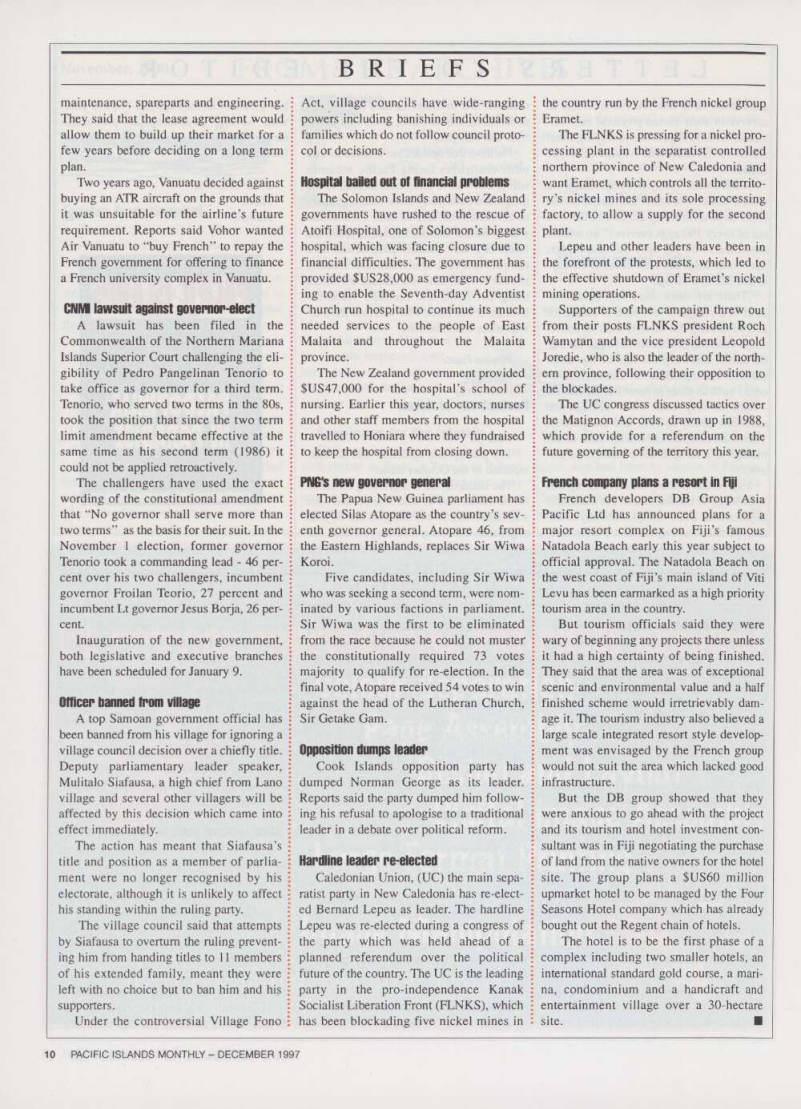
Dear Sir The paedophilia epidemic was so well reported in the October issue.
The undersigned is a grieving remorse ful Hawaiian mother who failed to see what was happening to our six year old boy, an angel then and today a destroyed man. His godfather, a teacher has died of AIDS but
left a trail of broken-spirited boys to deal with severe psychological problems.
Heaven protect my grandsons if we are fooled again.
Clair Crockett,
Maui, Hawaii.
Briefs
PNG (aces SUS 4.2 m food bill Papua New Guinea’s provincial and local level government minister, Simon Kaumi, has said that a total of K 6.4 million (sUS4.2million) was required every month to feed 650,000 people in the worst drought and frost-affected parts of the country. He said some of the worst affect ed areas were located in high altitude regions of Central, Gulf, Western Highlands, Chimbu, Eastern Highlands, Morobe and West Sepik provinces as well as coastal Madang, He said with the El Nino effect gaining momentum in the Asia-Pacific region, the drought situation in PNG was worsening. Kaumi said this had a great impact on the people who were affected in various areas and the demands for the provisions of immediate relief and assistance were increasing daily.
Kl46m (arm losses forecast (or 1998 The Rural Industries Council of PNG has said that government was expected to lose more than K 146 illionm (SUS9B million) in revenue from the agriculture sector if the
continues. Council chairman Peter Colton said the shortfall from various industries included cattle K 930,000 ($U5624,000); cocoa K 36 million (SUS 24 million); coffee K 75 million (5U550.33 million); copra Kll million (SUS7.3B million); oil palm K 18.3 million (SUS 12.28 million); rubber K 3 million (SUS 2 million); sugar K 6.6 million (.$U54.43 million); tea KlO mil lion (SUS6.7I million) and fruits and veg etables K 3.5 million (5U52.35 million).
Weekly newspaper launched A weekly newspaper known as The Fangufangumana, has been launched in Tonga. Editor Inoke Masima said the reli gious based newspaper will avoid political influences and discussion. He said content will focus on women, youth, cultural issues and religious stories. The newspaper will be compiled in Tonga and printed in New Zealand by Kalafi Moala, editor and pub lisher of The Times of Tonga.
Chan wins order to halt Cairns report Papua New Guinea’s Ombudsman
Commission has been ordered by the National Court to stop the distribution and publication of its report into the KlB mil lion (SUSI 2 million) purchase of the con troversial Cairns Conservatory Building.
Former prime minister Sir Julius Chan suc cessfully sought an injunction pending judicial review of the report’s findings.
Chan alleged the report obtained derogatory adverse comments against him and that he had not had any say during the investigation period.
Vohor rescinds plans to lease aircraft Vanuatu Prime Minister Serge Vohor has instructed the management and staff of the national carrier, Air Vanuatu, to cancel plans to lease a Saab 2000 aircraft current ly on hold for the airline in Europe. He has said to instead purchase a French made ATR plane for an estimated SUSIS million
including spareparts.
Reports have said that the pressure from Vohor had worried some of the airline’s management who said the offer on the SAAB was an excellent package including
maintenance, spareparts and engineering.
They said that the lease agreement would allow them to build up their market for a few years before deciding on a long term
plan.
Two years ago, Vanuatu decided against buying an ATR aircraft on the grounds that it was unsuitable for the airline’s future requirement. Reports said Vohor wanted Air Vanuatu to “buy French” to repay the French government for offering to finance a French university complex in Vanuatu.
CNAi lawsuit against governor-elect
A lawsuit has been filed in the Commonwealth of the Northern Mariana Islands Superior Court challenging the eli gibility of Pedro Pangelinan Tenorio to take office as governor for a third term.
Tenorio, who served two terms in the 80s, took the position that since the two term limit amendment became effective at the same time as his second term (1986) it could not be applied retroactively.
The challengers have used the exact wording of the constitutional amendment that “No governor shall serve more than two terms” as the basis for their suit. In the November 1 election, former governor Tenorio took a commanding lead - 46 per cent over his two challengers, incumbent governor Froilan Teorio, 27 percent and incumbent Lt governor Jesus Borja, 26 per cent.
Inauguration of the new government, both legislative and executive branches have been scheduled for January 9.
Officer banned from village A top Samoan government official has been banned from his village for ignoring a village council decision over a chiefly title.
Deputy parliamentary leader speaker, Mulitalo Siafausa, a high chief from Lano village and several other villagers will be affected by this decision which came into
effect immediately.
The action has meant that Siafausa’s title and position as a member of parlia ment were no longer recognised by his electorate, although it is unlikely to affect his standing within the ruling party.
The village council said that attempts by Siafausa to overturn the ruling prevent ing him from handing titles to 11 members of his extended family, meant they were left with no choice but to ban him and his supporters.
Under the controversial Village Fono
Act, village councils have wide-ranging powers including banishing individuals or families which do not follow council proto col or decisions.
Hospital bailed out of financial problems The Solomon Islands and New Zealand governments have rushed to the rescue of Atoifi Hospital, one of Solomon’s biggest hospital, which was facing closure due to financial difficulties. The government has provided SUS2B,OOO as emergency fund ing to enable the Seventh-day Adventist Church run hospital to continue its much needed services to the people of East Malaita and throughout the Malaita
province.
The New Zealand government provided $U547,000 for the hospital’s school of nursing. Earlier this year, doctors, nurses and other staff members from the hospital travelled to Honiara where they fundraised to keep the hospital from closing down.
PNG's new governor general The Papua New Guinea parliament has elected Silas Atopare as the country’s sev enth governor general. Atopare 46, from the Eastern Highlands, replaces Sir Wiwa Koroi.
Five candidates, including Sir Wiwa who was seeking a second term, were nom inated by various factions in parliament.
Sir Wiwa was the first to be eliminated from the race because he could not muster the constitutionally required 73 votes majority to qualify for re-election. In the final vote, Atopare received 54 votes to win against the head of the Lutheran Church, Sir Getake Gam.
Opposition dumps leader
Cook Islands opposition party has dumped Norman George as its leader.
Reports said the party dumped him follow ing his refusal to apologise to a traditional leader in a debate over political reform.
Hardline leader re-elected Caledonian Union, (UC) the main sepa ratist party in New Caledonia has re-elect ed Bernard Lepeu as leader. The hardline Lepeu was re-elected during a congress of the party which was held ahead of a planned referendum over the political future of the country. The UC is the leading party in the pro-independence Kanak Socialist Liberation Front (FLNKS), which has been blockading five nickel mines in
the country run by the French nickel group Eramet.
The FLNKS is pressing for a nickel pro cessing plant in the separatist controlled northern province of New Caledonia and want Eramet, which controls all the territo ry’s nickel mines and its sole processing factory, to allow a supply for the second plant.
Lepeu and other leaders have been in the forefront of the protests, which led to the effective shutdown of Eramet’s nickel mining operations.
Supporters of the campaign threw out from their posts FLNKS president Roch Wamytan and the vice president Leopold Joredie, who is also the leader of the north ern province, following their opposition to the blockades.
The UC congress discussed tactics over the Matignon Accords, drawn up in 1988, which provide for a referendum on the future governing of the territory this year.
French company plans a resort in Fiji French developers DB Group Asia Pacific Ltd has announced plans for a major resort complex on Fiji’s famous Natadola Beach early this year subject to official approval. The Natadola Beach on the west coast of Fiji’s main island of Viti Levu has been earmarked as a high priority tourism area in the country.
But tourism officials said they were wary of beginning any projects there unless it had a high certainty of being finished.
They said that the area was of exceptional scenic and environmental value and a half finished scheme would irretrievably dam age it. The tourism industry also believed a large scale integrated resort style develop ment was envisaged by the French group would not suit the area which lacked good infrastructure.
But the DB group showed that they were anxious to go ahead with the project and its tourism and hotel investment con sultant was in Fiji negotiating the purchase of land from the native owners for the hotel site. The group plans a SUS6O million upmarket hotel to be managed by the Four Seasons Hotel company which has already bought out the Regent chain of hotels.
The hotel is to be the first phase of a complex including two smaller hotels, an international standard gold course, a mari na, condominium and a handicraft and entertainment village over a 30-hectare site. ■
wake of Cyclone Marlin
Cover Stories
Islands devastated In the wake of Cyclone Marlin
By Florence Syme-Buchanan
Martin was a huge, hun gry animal who in a terrifying couple of days, devoured sever al defenceless islands, destroying lives and forever changing the lives of the shell-shocked survivors.
It was the worst cyclone to hit the South Pacific this century, snarling 2400 kilome tres across the Pacific, wiping up huge waves which destroyed everything.
When it had gone, the Pacific was lit tered with bodies.
On Manihiki in the Cook Islands 20 people were left dead. Tragically, in a cul ture where the body is central to the griev
ing process, many of the bodies have gone completely. Another nine were swept away in French Polynesia. It was also a story of remarkable miracles, of survival. There is also a terrifying familiarity about the sto ries.
The Pacific, heated by the El Nino, rose and in a blink, wiped away atolls. This was the grim reality of sea-level rising that only three months ago the Pacific’s leaders met and debated on on Aitutaki just to the south of Manihiki.
Pukapuka in the northern Cook Islands was the first victim. At 2pm on Friday, October 31, the battering began.
Fortunately for the 600 or so Pukapukans, Cyclone Martin had not reached its intensity and only a few build
ings were lost. There were no deaths.
Martin rampaged on, veering south east.
Situated 160 kilometres south west of Manihiki and further still from Rakahanga in the late afternoon of Saturday November I, Cyclone Martin was fero cious enough to wreck havoc on both islands.
All deaths and missing people in the Cooks are from Manihiki.
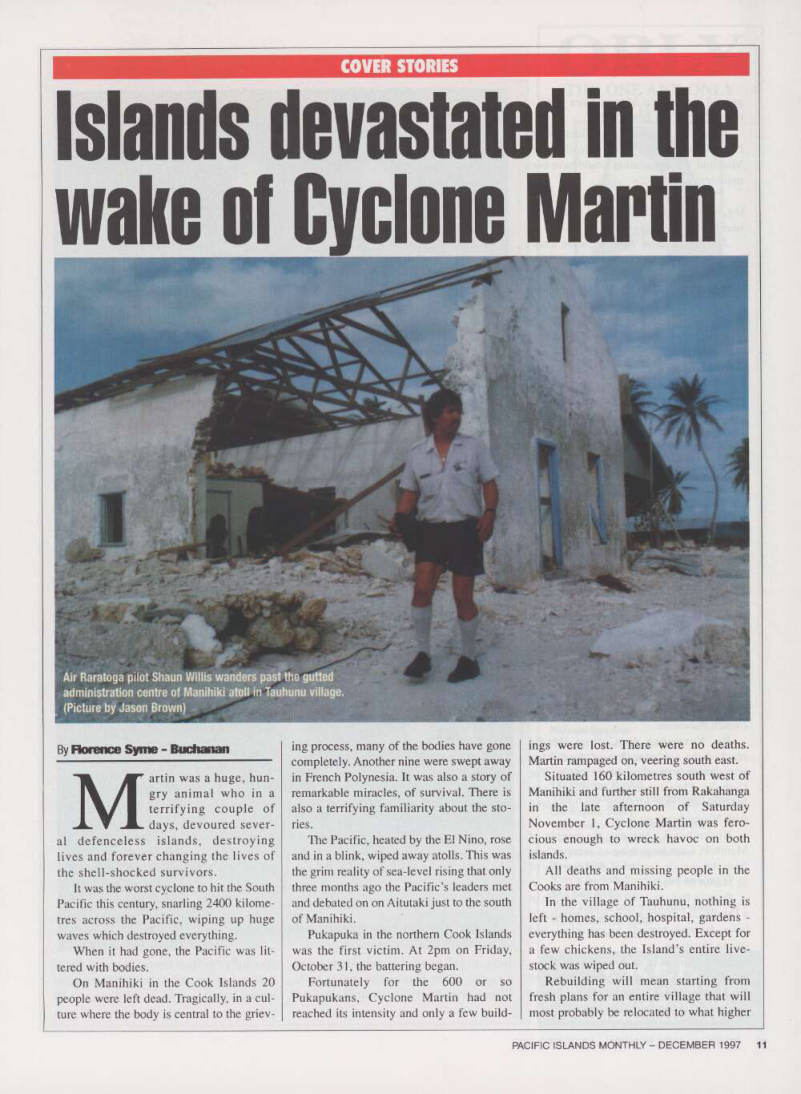
In the village of Tauhunu, nothing is left - homes, school, hospital, gardens everything has been destroyed. Except for a few chickens, the Island’s entire live stock was wiped out.
Rebuilding will mean starting from fresh plans for an entire village that will most probably be relocated to what higher
Air Raratoga pilot Shaun Willis wanders past the gutted administration centre of Manihiki atoll in Tauhunu village. (Picture by Jason Brown)
ground is available. Manihiki lies just five metres above sea level.
Chief meteorological officer Arona Ngari said had the cyclone actually struck Manihiki, the devastation would have been unimaginable.
“Nothing would have been left stand ing, not one tree, the death toll would have been much, much higher”.
Just one massive 10 metre wave totally swamped Tauhunu village in a terrifying chaos of broken homes, vegetation and bodies which were then dragged into the normally picturesque lagoon.
An aching scene of destruction for the lucky ones who for hours huddled in fish ing boats praying. The unlucky ones floun dered in the dark, heaving lagoon, battered by wind tossed debris, trying to save loved ones, trying to save themselves, seven not succeeding. Three were children.
They had been given little warning by main island Rarotonga, where officials dithered for hours before finally setting up a hurricane centre at 5.45 pm Saturday. But by that time Manihiki was already engulfed in Mother Nature’s terrifying madness.
Communications with the Island were cut off at 4pm and for two days relatives all over the Cooks agonised, feared and prayed for their loved ones in Manihiki.
When communications were partially restored two days later, the news that three were dead, 20 missing and untold devasta tion was worse than what most Cook Islanders safe and dry in their homes could fathom.
Cyclone Martin continued to veer south east on November 1 travelling towards French Polynesia .
By November 4, Cyclone Martin reached the colder waters of the Austral Islands. He will never be forgotten. The Catholic Church recognises three Saint Martins and two of them are honoured with November feast days.
November 3 - the day the people of Manihiki were beginning to receive help from the outside world - is the feast day of St Martin de Porres.
Bom in Peru in 1579 he spent his life in a Dominican Friary where he is reputed to have devoted himself to ceaseless and severe penances.
He is reputed to have been able to fly.
St. Martin of Tours is the better known of the Martins, the patron saint of soldiers.
Born in 315 in what is now Hungary he was one of the first saints, ending up in France. His feast day is November 11.
Blessedly for their distant memory, there will never be another Pacific cyclone named Martin. ■
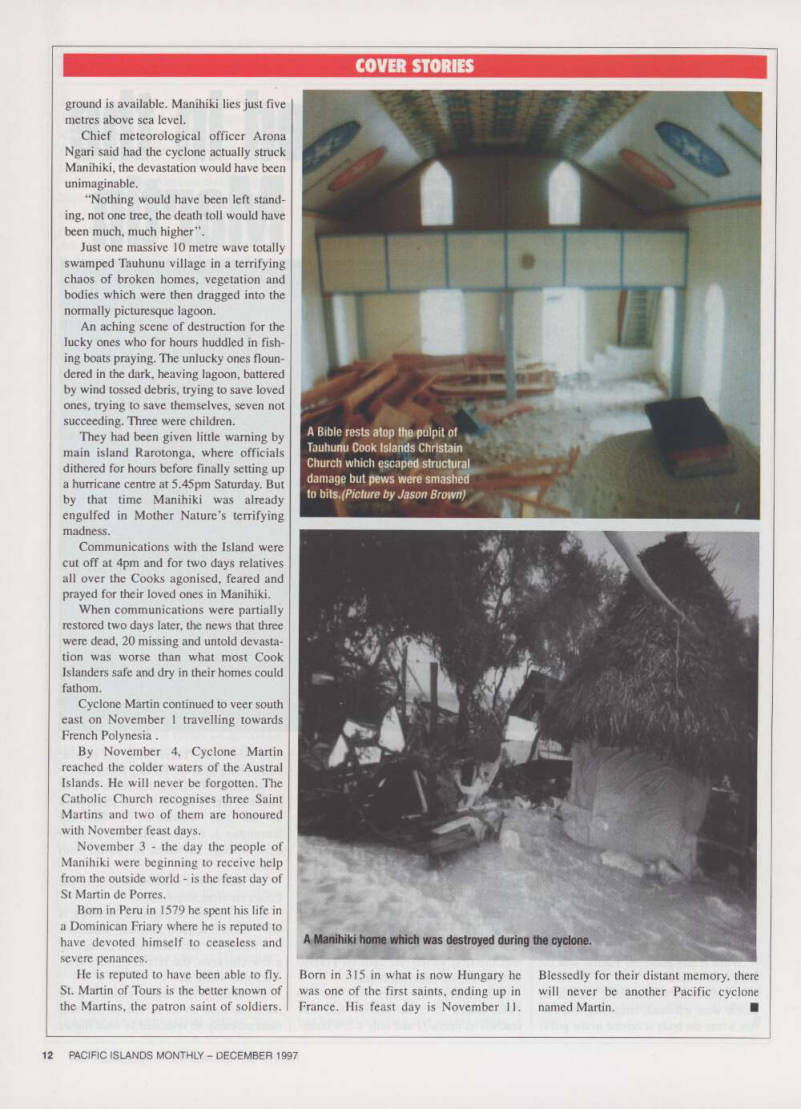
A Bible rests atop the pulpit of Tauhunu Cook Islands Christain Church which escaped structural damage but pews were smashed to bits. (Picture by Jason Brown)
A Manihiki home which was destroyed during the cyclone.
Advertisements & other items, p. 12 (1 item)
Cover Stories
Sole supvivor's nightmare
By Florence de Changy
Days after it had slammed into Manihiki and taken seven lives. Cyclone Martin moved on to the Leeward Islands in French Polynesia, about 500 kilometres northwest of Tahiti. On Bellinghausen or motu one, nine souls were swept away while on Mopelia 30 people had to be evacuat ed.
On Thursday November 5, Alice Haano was found alive but alone and haunted by what had happened. Two families lived on the atoll, traditionally uninhabited. There was the Taputu family, father, mother and their six children, aged between three to 20.
And there was Alice and her husband, Jean- Pierre Haano. Together it was a simple life of struggling to produce copra which they would sell when they could convince a ship from Papeete to come and pick it up. It was a low lying atoll, exposed to the weather and well beyond help.
“We were well and happy there. We never thought of the danger of living on this Island,” said Alice later at Faa’a Airport in Tahiti. On the night of Sunday, November 2, Cyclone Martin arrived and just as at Manihiki, it came with huge seas. Several waves crashed on the house the two fami lies had gathered into. It collapsed on them.
It went quiet for a little while then came a huge wave which wiped everything away.
They struggled to find some higher ground, calling each other’s names to stay together. Alice took with her two parcus or wrap-around skirts so that she could tie her self to a palm tree. This is what saved her.
She wanted to do the same for her husband but he had broken his leg and could not stand up. He was holding the Taputu’s baby in his arms. The rest of the family had already disappeared into the ocean.
Alice described how once she had to grab her husband by his hair to save him from being washed away. But another treacherous wave swept in again and the baby was finally taken away. She was tied to the tree while at her feet her husband lay in agony. She could do nothing but pray for him. When he finally died, she lay his body on coconut leaves and she covered him with niau leaves. She kept praying for help. The
next day, a French search plane flew over the atoll and dropped a radio.
With the news of what had happened, a rescue operation was launched.
The naval ship La Railleuse, with territo rial President Gaston Flosse abroad, headed towards Bellinghausen. They beached there and found Alice, the sole survivor. A relief team member described the scene: “There used to be 10 people here, a pig enclosure, a house, there was life. Now there is nothing.
The coconut trees have been uprooted. The concrete copra dryers have been washed away too.” Alice reckons two waves, each about three metres high, wiped the little community off the map. She said through out Cyclone Martin there was only a little rain and the winds were only moderately strong. But the sea, the enemy, was fierce.
After a full day of search on and around the motu, the soldiers gave up looking for other survivors or bodies. It is still uncertain whether the bodies stayed inside the lagoon but Alice believes they did not. She believes that the strong winds took them.
Laßaileuse brought back the body of her husband while Alice was flown with Flosse from Bora Bora to Papeete.
The day before, November 5, the navy ship Dumont D’Urville had evacuated the 20 men and 10 women who lived on Mopelia. They were taken to Maupiti, fur ther east where they would stay until the end of the cyclone season. Dumont D’Urville went on to bring food and rescue materials to Scilly, the third island in the same area.
When it was over, French President Jacques Chirac sent a condolence message in which he reminded the people of French Polynesia that “they could count on the full solidarity of metropolitan France”.
The local government has declared a special state of “natural calamity” which provides for an indepth assessment of the damages caused, upon which compensa tions could be paid to both private persons and councils. But questions are going to be asked. Could the people have been better equipped and better warned? Did the fore cast anticipate the disaster properly?
Could help have arrived earlier? But the ultimate question probably is, can a govern ment forbid its people from dangerous islands or should people’s freedom be
paramount? ■
Advertisements & other items, p. 13 (1 item)
Orly
THE ONE AND ONLY
MATCHMAKER
WHAT IS THE MEDIA
SAYING ABOUT ORLY?
The Phil Donahue Show "Orly is a unique personal matchmaker..."
Ron Reagan Show "Orly, bom a matchmaker..."
Sally Jesse Rafael Show "Orly's service is designed for the professionals...
AM Los Angeles Show "two of Orly's clients were married live on the show... The wedding of the year"
Eyewitness News (ABC) "Orly, world renowned matchmaker..”
KTLA Morning News "Orly, matchmaker in action..."
Jewish T.V. Network "Orly is real marriage broker..."
Montel Williams Show "Orly's clients are the cream de la cream..."
AM Philadelphia Show "Orly's clients are simply top of the line..."
Cleveland Tonight Show "Orly, a touch of class.."
Orange County News Channel "Orly is champagne wishes..."
AM Northwest Show, Oregon "Orly the one and only matchmaker..."
Good Evening Seattle Show "Orly is an investment in your future..."
The Dimi Petty Show, Canada "Orly has sixth sense..."
National Enquirer "Orly has a dream date for y0u..."
Orange County Register "Orly has a match for the sincere singles...”
The Heritage Weekly "Orly is nationally and internationally known..."
Los Angeles Times "Orly matches the rich and successful..."
Dallas Morning Newspaper "Orly made countless introductions..."
Beverly Hills Today "Orly is the Rolls Royce of matchmaking..."
KFI Talk Radio "Orly, a matchmaker with a sixth sense...”
WLAC Nashville Radio "Orly is a celebrity matchmaker..."
FREE
30 MINUTES PHONE CONSULTATION
(310) 659-7337 • Beverly Hills California 90211- USA
The battle to survive
By Florence Syme-Buchanan
On Manihiki everyone has lost a loved one.
Everyone is a hero. This is just one such story from that fateful All Saint’s Day in Tauhunu, a
tiny once neat village, now gone.
It was that Saturday after noon as Anna Katoa and hus band Willie were in discus sion with another family whether they should leave their new beach-front home for a large boat.
The hot, El Nino afflicted South Pacific was rising angrily.
Suddenly they heard a loud thundering and turning, saw a dark wall of water rac ing towards them.
Anna and Willie grabbed their four year old daughter Katarina and seven year old Maureen and along with the other couple, ran for their lives.
There were terrible screams and suddenly they were all being dragged with tremendous force by the wave.
“I thought we were going
to die, knowing there were houses and trees in front of us. I thought we would be bashed against them. But when I surfaced I knew it wouldn’t be my end,” said Anna.
Katarina had disappeared. Anna fought to keep herself and seven year old Maureen afloat in a salvage maelstrom of water and debris from their village now shattered into a million pieces.
Willie struggled in the churning sea to a boat still tied to a frangipani tree. He then helped nine year old Penina Simiona aboard followed by papa Teira Taana, an elderly man who kept crying that his granddaughter was missing. Anna and Maureen were next. Then the frangipani tree broke.
Nightfall came as they were swept across the lagoon. More vast waves came and lifted the boat with its fragile contents
and smashed them all onto the deadly coral. And then the sea swept in and tossed then into the Pacific Ocean.
Papa Teira, Maureen and Penina were gone.
“We called and called for her but there was no answer. We couldn’t look for them,
there were 40 foot waves and Willie was injured. “ It was hell,” said Anna.
Willie had gashed himself badly on the reef. And now Willie and Anna were alone clinging to the overturned boat.
Miracles can happen anywhere, any time. At about Sam Sunday morning on the storm battered high seas, they found John Solomona. He was floating on his back and had been in the water for 10 hours.
He had nothing to hold on to, just hope.
Then another miracle. They managed to turn the boat over and under it, kept alive in an air pocket was Penina Simiona. But life was still in the balance.
“The boat was filling with water and the sea was still rough and windy, so I told John to untie the outboard motor. It was weighing us down and we did not have the
strengthen to bail,” said Willie.
“We grabbed coconuts, a sleeping bag
and bits of wood that were floating past us.
I opened the coconuts with my teeth and fed the water and meat to Anna and Penina. John and I chewed on the husk.”
Willie packed the huge gash in his leg with chewed coconut. Using the sleeping bag and lengths of wood he made a sail.
John had a plank of wood to row with and Willie steered using the same four by two.
Willie was worried too, Anna was six months preg nant.
“I had no time to be afraid. I just had one thought, to get Anna to safety as quickly as possible. I couldn’t let her out for long because she would lose the baby, and if that happened, I could lose her too.”
An experienced fisherman, knowledgeable on the cur rents and wind patterns in the area, Willie coaxed the tiny craft through the storm to Rakahanaga, another island about 40 kilometres from Manihiki.
Anna hoped help would come from outside.
“We waited and waited for the planes that we hoped had been sent out to find us but they never came. We did hear one for a few moments in the distance and then the noise disappeared ...
“But we never lost hope. I had faith in my husband Willie.”
They reached Rakahanga almost five days after being at sea but waited until daylight to cross the reef.
“We were thrown over the reef by a big wave. It took us right up to the beach ... I cannot thank God enough.”
They were to hear of another miracle too. Their youngest child Katarina, who had disappeared in those terrifying first few minutes, had been plucked from the waters by friends. In the big airlift that fol lowed, the New Zealand airforce dropped them together in Rarotonga.
Maureen is still missing. Anna says that if the baby, which is due at the end of February, is a girl, she will be named Maureen, in honour of a beloved daughter, a little hero. ■
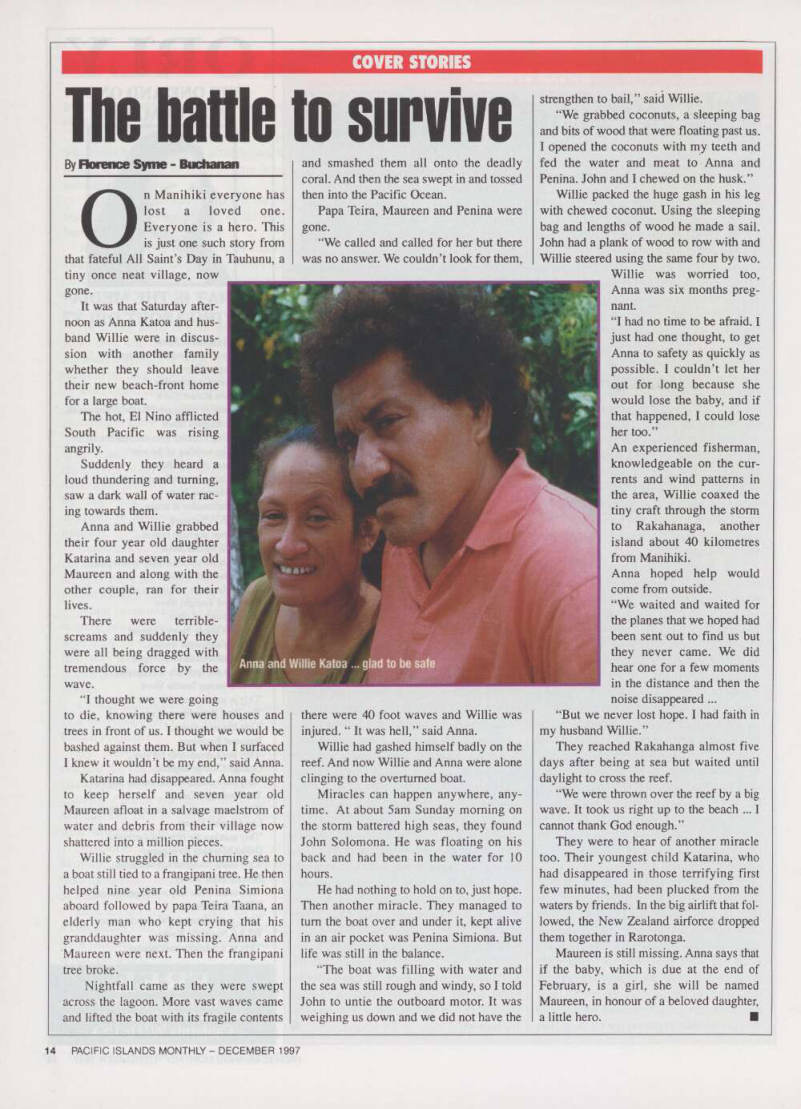
Anna and Willie katoa... glad to be safe
Pearl farming suffers
because of cyclone
By Florence Syme-Buchanan
The people of the northern Cook Islands are used to hardship and isolation and they are tough. So when they say they will rebuild their homes and their livelihoods, count on it. But they have all taken a heavy blow.
Cyclone Martin has savaged their lucra tive pearl farming industry.
Although a glamorous industry down at the retail end, in Manihiki they had to work hard and long with fierce dedication to produce what was becoming a SNZ4
million (approximately SUS 2 million) a
year enterprise.
“It’s gone from the people who were earning very little from copra and govern ment jobs and a little bit more from diving for wild shells to a million dollar indus try,” says Marine Resources secretary Raymond Newnham.
Newnham says it could take the indus try a year to recover if the underwater pearl shell lines are okay, five years if they are damaged. Willie Katoa lost his seven year old daughter, Maureen, (see previous story), a new home and about $200,000 (Approx. $US118) worth of farm equip ment and buildings.
“I’m going to go back, rebuild and carry on ... that’s no
problem.”
Like a few other pearl farmers, Katoa will leave his family on the main island of Rarotonga, go back and start again.
Separation could run for months. Sue Woonton says Manihiki pearls which make four percent of the world’s black pearls, were just becoming accepted around the
world. “We were just beginning to get a firm foothold in the world markets. We had good grades, colour, volumes were increasing and the industry was really up and running,” she said.
“The black pearls have been taken up by Tiffany’s, Aspry’s and Harry Winston, all big names.” Her husband, Robert Woonton, the Manihiki member of parlia ment, and his brother Hurihia invested $600,000 (approx. SUS3S3) into their farm. Their future is 10 metres down, the remains of the pearl farms. Everything on land associated with pearl farms - the seed ing huts, boats, diving equipments, com pressors are gone.
None of the farmers had insurance, nobody would cover such a high hurricane risk. “But I don’t believe the industry is dead, unless there has been massive pollu tion of the lagoon and every oyster is dead,” Sue said.
Tou Unuia who has been involved with the industry from the outset fears the lagoon could be polluted from fuel, chem icals, fridges and vegetation dragged into it by the cyclone. He says the huge amount of floating vegetation is prevent ing the lagoon from flushing properly.
The industry which is the Island’s eco nomic lifeline and crucial to the financial
well-being of the entire country, has taken a backseat with search and rescue opera tions and rebuilding of Manihiki foremost in recovery plans. Once the recovery of Manihiki is well established. Marine Resources will be assessing what damage may have occurred to the oysters.
Just about every farmer has a loan to repay, most with the state-owned Cook Islands Development Bank. Calls are being made on the government by the business sector for CIDB to issue soft loans so pearl farmers can rebuild an industry the financially stricken country desperately needs to get back on its feet.
Two hundred pearl farming permits have been issued by the Manihiki Island Council over the years. Not all permits are active but there were enough farms dotting the 48 square kilometre lagoon to raise concerns of the Marine resources that there could be an over population of pearl shells.
One recent survey estimated that the lagoon contained 12 million pearl shells including wild stocks which had quickly multiplied after a ban was placed on har vesting them by the Island Council some years ago.
Sue is confident. “People won’t give up. There will be a dip and some changes in the way things are redone but they won’t give up. We have put everything into the industry, people won’t walk away from that.” ■
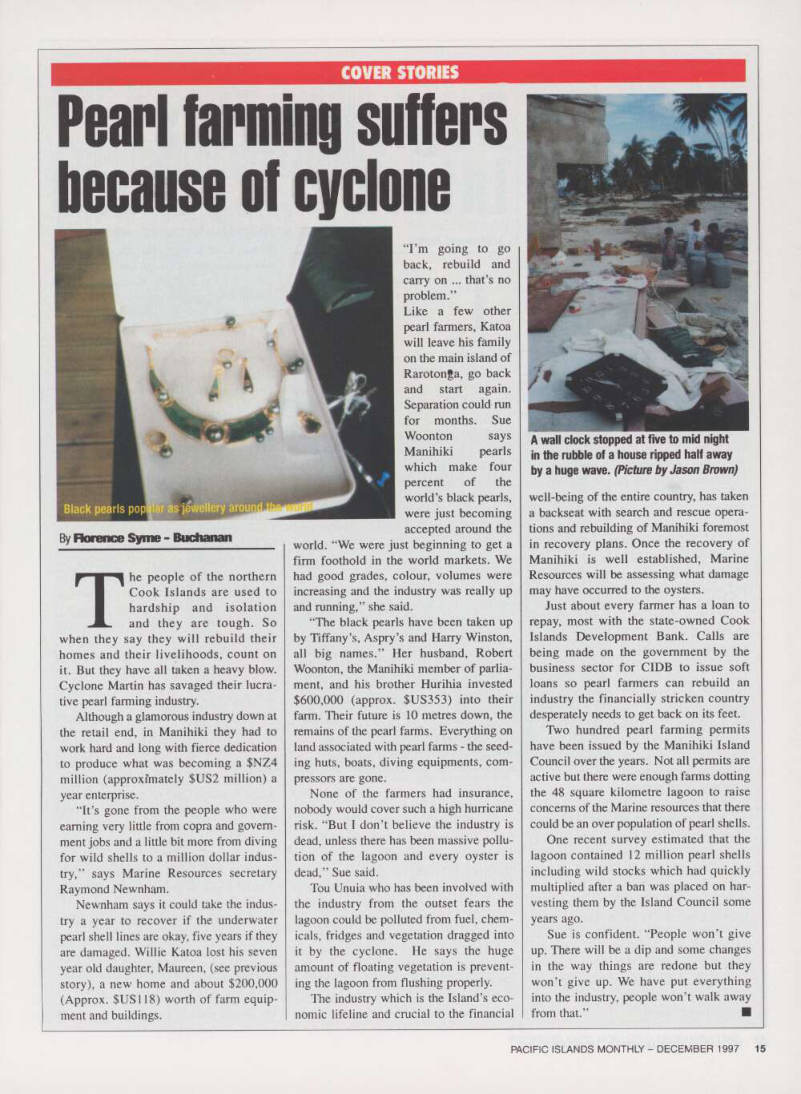
A wall clock stopped at five to mid night in the rubble of a house ripped half away by a huge wave. (Picture by Jason Brown)
Black pearls popular as jewellery around the world
Build on higher points
By Florence Syme-Buchanan
Prime Minister Sir Geoffery
Henry estimates that it is going to cost at least SNZBO million (approx, SUS 47 million) to reconstruct Manihiki, but there could be a clash between experts and the islanders over where best to rebuild.
Manihikians want to rebuild Tanhunu and Tukao villages in exactly the same areas, but Sir Geoffery has said that this may result in the loss of support from overseas donors who want a “sensible relo cation plan”. The villages are apparently built on the lowest lying areas of the two biggest atolls in Manihiki lagoon. At the highest point, the atolls are only five metres above sea water. “Cook Islanders and Polynesians as a whole have a very passionate relationship with their land and I don’t know that the people of Manihiki would agree to a more futuristic, cyclone resistant town plan or they would simply want to rebuild where they have been stuck down by a cyclone,” Sir Geoffery said.
The government is taking a long-term view on the reconstruction of the Island and wants to turn the villages into model atoll settlements built on the safest areas.
But the government has admitted that the Manihiki people can’t be forced to build in a particular area. No one has been given the task of convincing the islanders that somewhere different to the previous village sites would be safer and more acceptable to donor agencies. They are still trying to assess how much damage to the cyclone battered northern islands will cost - what they already know is that recon struction will run into tens of millions.
An immediate SUS2OO,OOO has been made available by the United Nations for emergency relief to Manihiki. AUSAID and NZODA have indicated willingness to help and the Asian Development Bank has informed that government soft loans are available, said the Ministry of Finances Tupu Araiti. The Cook Islands government already owes Asian Development Bank over SNZ23 million (Approx. SUSI 4 mil lion) and will most likely be reluctant to enter into further debt.
Setting up the Manihiki telephone sys tem will alone cost well over SNZI mil lion, estimates Araiti. ■
Region's first
internet cyclone
By Michael Held
It is a smudgy, dark picture, but it is a remarkable symbol of the terrifying power of nature - and the way even a remote place like Manihiki is on the information high way. Cyclone Martin was the South Pacific’s first internet cyclone and its hor ror was known around the world while the Cook Islands Government vainly tried to control what information was going out.
On Saturday November 1 Henry and Tarita Puna Williams were among nine people who jumped into a small boat as the cyclone tore their world apart.
Henry had with him a Canon water proof camera and in a single shot captured the drama of the moment. Then for anoth er 12 hours they drifted on the water. One of their number disappeared, later to be found dead.
By Monday November 3 Tarita Puna Williams was in Rarotonga and her fami ly’s survival story was picked up by Cook Islands Press owners Jason Brown and Barbara Dreaver. They are also stringers for Agence France-Presse (AFP) and with in hours the first survivor story was around the world.
Then Henry’s photos came to light and within days that single image appeared the Times in London, the New York Times, The Australian, the South China Morning Post and dozens of other newspapers around the world. The speed with which the world learnt of Martin is remarkable.
For Alex Sword, editor of the daily Cook Islands News, Martin was example of ridiculous political attempts to control the news. His staff, for example, were not allowed to photograph people working at the cyclone centre in Rarotonga. Neither his paper nor the Cook Islands Press were allowed to go on the early rescue flights.
The Cooks might be independent - but colonial cringe saw the Cooks government let the New Zealand Herald, state owned Television New Zealand and Canadian owned TVS from New Zealand to the
Island. Even a week after the cyclone the news was being kept out and was finally using a local stringer, Ruhau Tomaunu.
Sword felt the government constraints on information were a deliberate ploy. “They were being secretive and trying to control everything because we would have shown them to be incompetent in their cyclone disaster management plans,” Sword said.
Dreaver agreed.“ The people overseas were getting much more news and much faster than the Cook Islanders were,” she said.
“And anyway the government really didn’t know what was happening - we were well ahead of them but they would close off our information sources behind us.”
Cook Islands Television won praise from Sword for struggling against the odds to keep people informed while privately owned Radio Aktiv is in everybody’s bad books. Although their signal is only vague ly heard in Manihiki - they declined to broadcast a cyclone warning because a string band had paid for a live broadcast instead.
An official cyclone warning instead had to go out over Radio New Zealand. Brian Mason of the Prime Minister’s Office was the media spokesman, and he admitted that even before the cyclone there was a degree of tension between the government and the media that was “not helpful”.
He said there had been early concern about the media coverage going to the world so quickly and comprehensively. “It was of some concern about how it would affect the tourist industry,” he said.
“But by telling the truth you get more sympathy from people ... You have to wear the down-side.” Cook Islanders in Australia and New Zealand had the right to know what was going on.
Mason found himself fielding a flood of international media calls. “I think the media was pretty good. I didn’t get the feeling that I was dealing with a bunch of bozos.
It caught the imagination of people, this remote and tiny Island.” ■
Community and hopes
Special Report
SPC becomes Pacific Community and hopes for a new start
By Florence de Changy
Three unusual things happened at the 37th South Pacific Conference in Canberra. It was the 50th anniversary meeting of the South Pacific Commission (SPC) and the first odd thing was that Britain, less than two years after it left, announced it was coming back. Then this old organisation (one of the oldest of its kind) changed name to the more inspiring Pacific Community. And, to complete a hat-trick of surprising events, the director-general Bob Dun presented the account books showing a solid financial situa
tion.
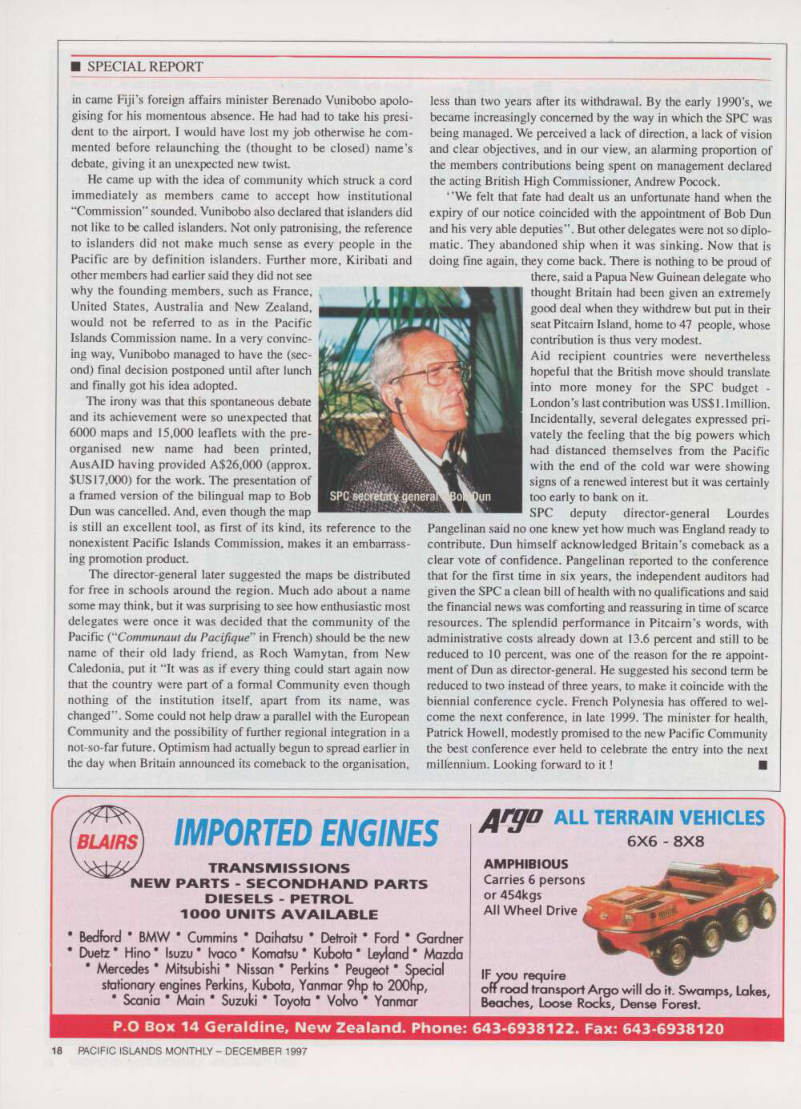
The oddities, and the intelligent debate at the meeting, produced an unexpectedly up-beat mood at the landmark meeting. It did not start like a celebration though. A chilly Sunday evening, a large and very modem hall in the new Canberra Department of Foreign Affairs and Trade (oth erwise known as DFAT) building ... No decora tion, no heating, and a rather sad entertainment programme did not augur very well. A mod est group of Aboriginal
children performed,
with little enthusiasm, some basic dances,
while at the other end of the stage, stood a rather white choir (Aborigines, Torres Strait and Pacific islanders were absent from their ranks) of neatly dressed children with nice looking hair who sang patriotic and children songs. It was a rare event, an Australian guest at the ceremony told us that Australia does not usually use Aboriginal groups in important international gather ings.
But most delegates found the whole exercise perfectly boring, all the more for those who still had in mind the vitality of the September opening of the South Pacific Forum in Rarotonga in the Cook Islands. Some others felt that the striking contrast between the two groups of Australian children on the stage was not a happy one at all, reminiscent to some extent of the late 40s
when the SPC was created as a very colonial institution. If it had not been for Fijian President Ratu Sir Kamisese Mara’s speech and some interesting comments from other speakers, most guests would rather have observed their tradition not to work on a Sunday. But Australia is not exactly a Pacific-style country and the assembly’s boredom with the whole opening proceedings became a common joke for the rest of the meeting which was to be a rather constructive and well organised one.
The first good news of the evening was to come a bit later, dur ing the ANZ Bank sponsored cocktail. An Encyclopaedia of the Pacific Islands was under way, Australian Foreign Minister Alexander Downer announced. He said it was expected to be ready in the second half of 1998 and was meant to become the most important information about Pacific Islands life, history, institutions and cultural experience.
Judging from the impressive diversity of contributors and the wide variety of topics raised, this could become a very important work indeed to deepen and clarify knowledge about this multi
faced region.
The Australian government, through AusAID, the Australian aid programme, is allocating A$ 109,000 (approx. $U572,000) to meet a substantial proportion of the production costs, while the
School of Asian and Pacific Studies at the Australian National University, Canberra, has invested more than A$ 100,000 (approx. $U566,000) in the work, which will also be avail able in a multimedia for mat (CD-Rom). The real work got under way next day with the conference opening, but things did not go at all as planned by the officials who had tried to set things up a week earlier.
The conference looked at its name. South Pacific Commission did not fit any more with members located in the North Pacific, including the Northern Marianas
and Guam. At morning tea break officials told PIM the word “Commission” was to remain as a historical reminder of the ances tor institution ; by midday, the former SPC would be called the Pacific Islands Commission. The acronym SPC would remain as PIC might be confusing as it is often used for Pacific islands coun tries (and Pacific Island Church in New Zealand).
The acronym Compac (for Commission Pacific) was widely argued for and against but the computer-like short name did not reach unanimity. The question of the acronym was to be put on the back burner, until the next conference, to give people time to see how do they naturally refer to the SPC... All therefore seemed to happen as planned, the chair woman endorsing after half an hour of pseudo-debate the Pacific Islands Commission new name. But
in came Fiji’s foreign affairs minister Berenado Vunibobo apolo gising for his momentous absence. He had had to take his presi dent to the airport. I would have lost my job otherwise he com mented before relaunching the (thought to be closed) name’s debate, giving it an unexpected new twist.
He came up with the idea of community which struck a cord immediately as members came to accept how institutional “Commission” sounded. Vunibobo also declared that islanders did not like to be called islanders. Not only patronising, the reference to islanders did not make much sense as every people in the Pacific are by definition islanders. Further more, Kiribati and other members had earlier said they did not see
why the founding members, such as France, United States, Australia and New Zealand, would not be referred to as in the Pacific Islands Commission name. In a very convinc ing way, Vunibobo managed to have the (sec ond) final decision postponed until after lunch and finally got his idea adopted.
The irony was that this spontaneous debate and its achievement were so unexpected that 6000 maps and 15,000 leaflets with the pre organised new name had been printed, AusAID having provided A 526,000 (approx.
SUS 17,000) for the work. The presentation of a framed version of the bilingual map to Bob Dun was cancelled. And, even though the map
is still an excellent tool, as first of its kind, its reference to the nonexistent Pacific Islands Commission, makes it an embarrass
ing promotion product.
The director-general later suggested the maps be distributed for free in schools around the region. Much ado about a name some may think, but it was surprising to sfce how enthusiastic most delegates were once it was decided that the community of the Pacific (“Communaut du Pacifique ” in French) should be the new name of their old lady friend, as Roch Wamytan, from New Caledonia, put it “It was as if every thing could start again now that the country were part of a formal Community even though nothing of the institution itself, apart from its name, was changed”. Some could not help draw a parallel with the European Community and the possibility of further regional integration in a not-so-far future. Optimism had actually begun to spread earlier in the day when Britain announced its comeback to the organisation,
less than two years after its withdrawal. By the early 1990’5, we became increasingly concerned by the way in which the SPC was being managed. We perceived a lack of direction, a lack of vision and clear objectives, and in our view, an alarming proportion of the members contributions being spent on management declared the acting British High Commissioner, Andrew Pocock. ‘’We felt that fate had dealt us an unfortunate hand when the expiry of our notice coincided with the appointment of Bob Dun and his very able deputies”. But other delegates were not so diplo matic. They abandoned ship when it was sinking. Now that is doing fine again, they come back. There is nothing to be proud of
there, said a Papua New Guinean delegate who thought Britain had been given an extremely good deal when they withdrew but put in their seat Pitcairn Island, home to 47 people, whose contribution is thus very modest.
Aid recipient countries were nevertheless hopeful that the British move should translate into more money for the SPC budget - London’s last contribution was USsl.lmillion.
Incidentally, several delegates expressed pri vately the feeling that the big powers which had distanced themselves from the Pacific with the end of the cold war were showing signs of a renewed interest but it was certainly too early to bank on it.
SPC deputy director-general Lourdes
Pangelinan said no one knew yet how much was England ready to contribute. Dun himself acknowledged Britain’s comeback as a clear vote of confidence. Pangelinan reported to the conference that for the first time in six years, the independent auditors had given the SPC a clean bill of health with no qualifications and said the financial news was comforting and reassuring in time of scarce resources. The splendid performance in Pitcairn’s words, with administrative costs already down at 13.6 percent and still to be reduced to 10 percent, was one of the reason for the re appoint ment of Dun as director-general. He suggested his second term be reduced to two instead of three years, to make it coincide with the biennial conference cycle. French Polynesia has offered to wel come the next conference, in late 1999. The minister for health, Patrick Howell, modestly promised to the new Pacific Community the best conference ever held to celebrate the entry into the next millennium. Looking forward to it! ■
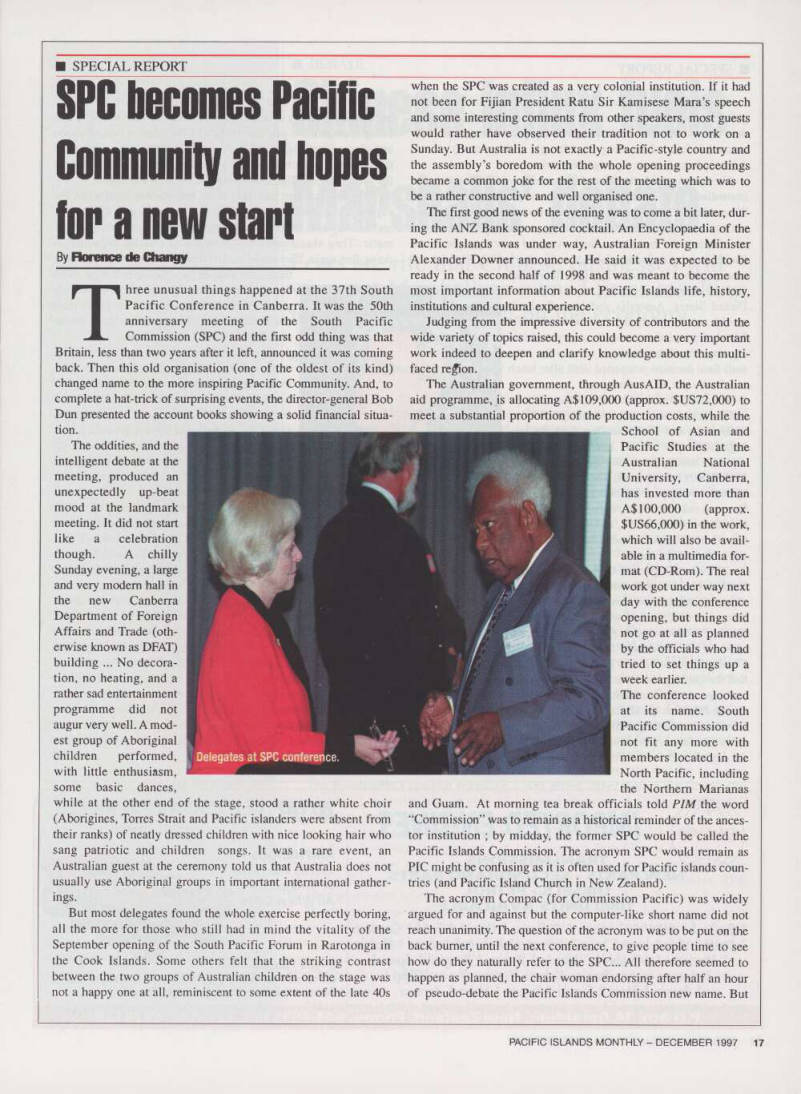
SPC secretary general Bob Dun
Advertisements & other items, p. 18 (1 item)
Imported Engines
BLAIRS
TRANSMISSIONS
NEW PARTS - SECONDHAND PARTS
DIESELS - PETROL
1000 UNITS AVAILABLE
Bedford * BMW * Cummins * Daihatsu * Detroit * Ford * Gardner Duetz * Hino * Isuzu * Ivaco * Komatsu * Kubota * Leyland * Mazda * Mercedes * Mitsubishi * Nissan * Perkins * Peugeot * Special stationary engines Perkins, Kubota, Yanmar 9hp to 200 hp, * Scania * Main * Suzuki * Toyota * Volvo * Yanmar
firga all terrain vehicles
6X6 - BXB
AMPHIBIOUS
Carries 6 persons or 454kgs All Wheel Drive IF ■you require oft road transport Argo will do it. Swamps, Lakes, Beaches, Loose Rocks, Dense Forest.
P.O Box 14 Geraldine, New Zealand. Phone: 643-6938122. Fax: 643-6938120
SPC-A historic perspective
The South Pacific Commission is the oldest
and largest regional
organisation.
It was established in 1947 under the Canberra agreement, which first set it up as a South Seas commission, signed by Australia, New Zealand, France, the United States, the United Kingdom and the Netherlands. Its aim was to promote eco nomic development and social stability in Pacific Islands territories under the colo nial administration. It quickly became committed to encourage some island par ticipation through a South Pacific confer ence which would provide advice to the Commission, but as Fiji President Ratu Sir Kamisese Mara reminded in his opening address, the discussion of politics was very firmly banned.
The first conference was held in 1950, with 14 Island countries and territories par ticipating. Two conferences have been of particular importance. In 1965, in Lae (PNG), the island nations were asked to contribute to the SPC’s budget. “When we have paid our entry fee to the club, I hope the member governments will invite us to sit with them as equals,” Ratu Mara com mented at the time. From there on territo ries shared more of the decision making process, even though most were only tak ing part to the conference, which was always followed by the meeting of the commissioners. By then, what was formal ly accepted as paternalism began to be interpreted as arrogant and even autocratic.
And the continued ban on political discus sion (mainly French testing at the time) which exhausted out patience eventually provoked the creation of the South Pacific Forum.
In 1983, all previous associate members of SPC became full participating and con tributing members and the conference itself became the supreme governing body of the SPC. Today, 26 countries, territories or associated states have a seat at the Pacific Community conference, with every member having an equal vote whether it is Tokelau or the United States.
The SPC has dedicated a lot of time and energy to fighting mosquito-borne dis eases, promoting welfare of mothers and children, nutritional and dietary issues, and to eradicate agricultural pests and diseases such as the rhinoceros beetle, fruit fly and taro leaf blight. ■
Marshalls' debate
Debate
Chinese influx fuels
Fears are rife that Chinese businesses will wipe out Marshallese-owned firms resulting in a disastrous impact on the economy
By Gift Johnson
The influx of Chinese into the Marshall Islands dur ing 1997, the result of large numbers of passport sales in the People’s Republic of China, dominated the debate in the Nitijela’s (parliament’s) September- October session, so much so that after weeks of incessant and often ran corous criticism one cabinet minister finally chastised opposition senators for “nit-picking” on the government on passport/Chinese concerns.
A significant jump in the numbers of resident Chinese in Majuro has sparked an unprecedented backlash in the community, with concern about a flood of Chinese the mainstay of discussions among rank and file Marshallese.
Those concerns kept the daily broad casts of the Nitijela spiced with harsh crit icisms about the Chinese.
Leading government officials, and even a few local businessmen, defended the Chinese.
The government’s position regarding the Chinese is understandable in view of the fact that during the past two years, passport sales have netted the government at least SUSIO million, money which has covered government payroll, subsidised Air Marshall Islands operations, and paid for other government activities.
The debate centres on the concern that aggressive Chinese armed with Marshall Islands passports that exempt them from immigration control, will simply put Marshallese out of business and into the unemployment line.
“My concern is that in the next 10 years
even Gibson’s and Robert Reimers Enterprises (the two largest local retail businesses) won’t be able to stand up to this competition,” said Charles Domnick, a leading businessman who owns a variety of firms, including a large construction, dry dock and car rental business. “Sooner or later, they’ll own everything.”
Domnick said that he didn’t hold the aggressive, hard working nature of the Chinese against them, but that in the con text of the Marshall Islands, dozens of Chinese businesses will put Marshallese owned firms out of business, having a dis astrous impact on the economy.
Resources and Development minister Jiba Kabua, who told parliament that pass port sales had brought in SUSIO million, said he doubts that the concern for a Chinese “take over” is valid.
In the past year, the Chinese influx brought new currency into the country at a crucial time of need for the aid-dependent economy of the Marshalls, Kabua said.
“I suspect strongly that the economy was active rather than in a state of with drawal (because of Chinese investors),”
Kabua said.
“This addition infusion to the cash cir culation was from Chinese investors.”
Not all local businessmen share Domnick’s pessimistic assessment. RRE chief executive officer Ramsey Reimers said that while there have been obvious problems in the same situation in other Pacific Islands, “it is too early to tell here.”
A locally-based fleet of Chinese long liners does a substantial amount of provi sioning and fuelling business locally, and recently two Chinese restaurants have
leased space at RRE’s commercial centre.
Reimers primary concern is that the economic pie in the Marshalls is getting smaller, but the businesses fighting for a piece of it are increasing. Chinese emigra tion to the Marshalls, however, is basically a government problem, he observed. “If they have passports, they have just as much right to do business as we do,” Reimers said.
That’s exactly what worries Kwajalein Senator Ataji Balos, chairman of the Nitijela’s foreign relations and trade com mittee.
Balos said that the problem might seem small now, but it could develop into a major problem in the future if the numbers of Chinese moving to Majuro continued to rise.
He said that Chinese are increasingly occupying jobs that Marshallese could hold. Foreign Ministry officials claim that about 1000 passports have been sold, most ly to PRC nationals.
As an indication of how strongly anti- Chinese sentiments have risen, Bikini Senator Henchi Balos accused the Chinese of having yellow skin, being ignorant of island customs, and of having no “jowi” (the “lineage” that is the traditional claim to being a Marshall Islander).
Another senator, Aur Atoll representa tive Norman Matthew, retorted that the new Chinese Marshallese were an extremely positive development and valuable addition for the Islands.
And the debate rolled on, day after day, at the parliament. Near the end of the ses sion, in late September, Senator Ataji Balos made a point of saying that the Nitijela should strike all references of senators say ing they don’t like Chinese because this wasn’t the point of what was being said.
“We welcorpe them coming but we have to protect the interest of the people from the Marshall Islands,” he said.
“The Marshallese people can’t compete on this level,”
Domnick said of the competition that is pitting Marshallese against Chinese in for merly Marshallese-dominated industries, such as taxi businesses, small retail take out stores, restaurants, and auto repair shops.
“Who’s going to protect the Marshallese? It really bothers me because I don’t think that people understand the enor mity of the damage that has been done (through passport sales).
I’m not against the Chinese as a people.
I’m concerned about what’s going to hap pen to Marshallese.”
Before the Marshalls recognised the PRC in the early 19905, there was a rela tively large contingent of Taiwanese pre sent in Majuro.
But their numbers, and all Taiwan gov ernment personnel, dwindled as an imme diate consequence of PRC ties. Prior to 1997, there was only a handful of Chinese in business in Majuro.
You could name all the Chinese here; they’d been here for a number of years and people knew them.
The start of big time longline fishing, with Ting Hong operating the fish base in the mid-19905, brought dozens of Chinese longliners to Majuro, with the number of fishermen here at any one time peaking at about 700 in 1995.
Americans aside, the largest residents non-Marshallese community in the country are Filipinos.
Filipino staff medical and nursing posts at the hospital, are accountants and teach ers and are the backbone of the local con struction industry.
Many have married Marshallese, start ed families and become naturalised citizens (through lengths of residency, not by pur chasing passports.
There is an active Filipino association in Majuro, which sponsors a variety volun tary efforts for the Island. In short, their connections to the community are solid and longstanding.
And despite all of this, they are the sub ject of derision by many Marshallese, being criticised for everything from not being Americans (who, among Marshallese in the community, are generally favoured foreign ers) to taking jobs away from Marshallese (though only in the very recent past have younger Marshallese begun returning with some of the technical skills that the Filipino community brings to the country).
But with the arrival of what is in actu ality probably only several dozen Chinese (nobody, least of all immigration, seems to know exactly how many Chinese are in Majuro now), the antagonism has taken a marked shift away from the Filipinos.
For many Marshallese, the chief com plaints against the Chinese are that they can’t communicate (few of the new arrivals speak English) or mix, and that they are rude and oblivious to the offence they give Marshall Islanders. ■
Passport sale
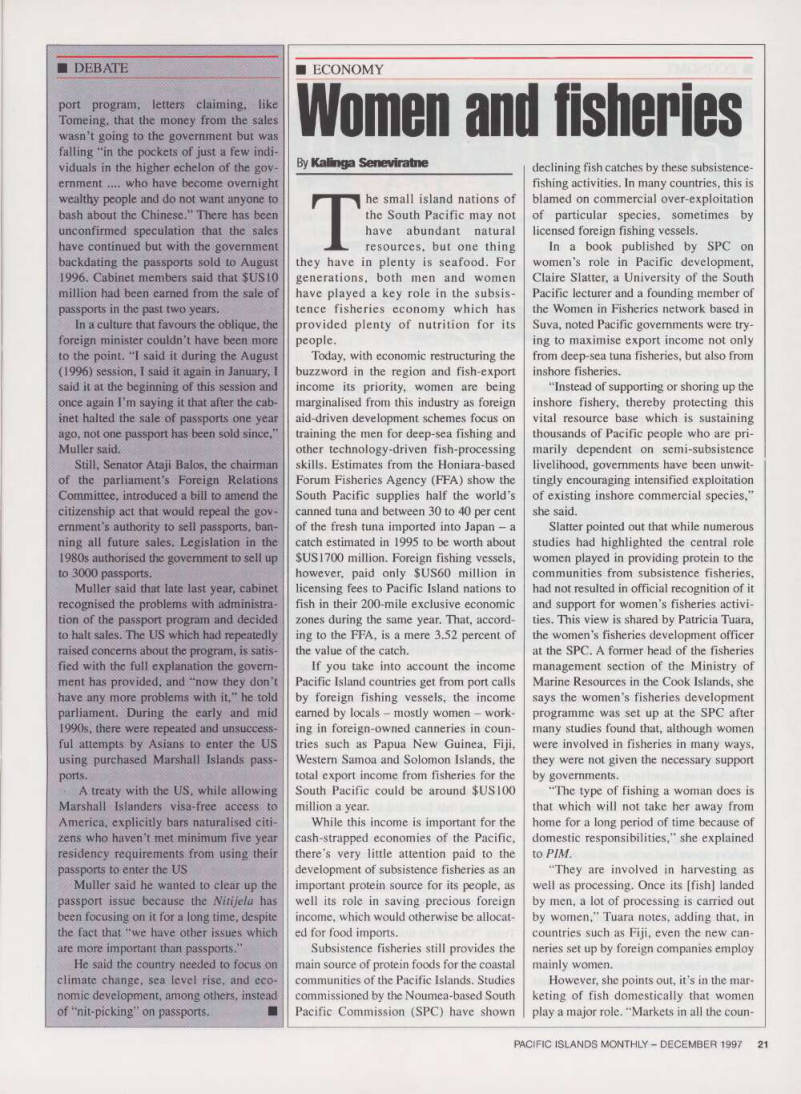
debate continues
By Giff Johnson
Despite claims that the Marshall Islands sus pended its controversial passport sales to Asians in August 1996, a cabinet minister claims that the sales continue and that money from the sales is going into the personal bank accounts of the agents.
And in an unrelated effort to shut off the apparently continuing sales pro gramme, a leading government mem ber of parliament introduced legisla tion to ban all future sales of Marshallese citizenship, a bill that was shelved until the January session of
parliament.
Criticism of Marshall Islands passport sales came from an unexpected source dur ing a nationally broadcast session of the Nitijela (parliament) in late September when government minister Litokwa Tomeing asserted that the controversial government passport sales program had not stopped in 1996, as claimed by the Ministry of Foreign Affairs.
“We heard that the sale of passports ceased a year ago, but some people are still selling passports,” he said.“ The money generated from the sale of passports is for the public and people deserve to benefit from this revenue. But the people who are still selling passports are putting this money into their personal savings,” said Tomeing, who did not name names or pro vide more details. “These people should be prosecuted and punished.”
Tomeing’s allegations were countered by foreign minister Phillip Muller who said emphatically that “not one passport has been sold since a year ago August,” and urged his Nitijela colleagues to stop “nit picking” on small issues like passports since the nation was facing many more serious challenges that need to be addressed by the leaders.
Almost every day of the most recent 25day session, critics ragged government ministers about the passport program and the sizeable influx of Chinese carrying Marshall Islands passports. The local news paper repeatedly had letters to the editorial criticising the government over the pass
port program, letters claiming, like Tomeing, that the money from the sales wasn’t going to the government but was falling “in the pockets of just a few indi viduals in the higher echelon of the gov ernment ... who have become overnight wealthy people and do not want anyone to bash about the Chinese.” There has been unconfirmed speculation that the sales have continued but with the government backdating the passports sold to August 1996. Cabinet members said that SUSIO million had been earned from the sale of passports in the past two years.
In a culture that favours the oblique, the foreign minister couldn’t have been more to the point. “I said it during the August (1996) session, I said it again in January, I said it at the beginning of this session and once again I’m saying it that after the cab inet halted the sale of passports one year ago, not one passport has been sold since,”
Muller said.
Still, Senator Ataji Balos, the chairman of the parliament’s Foreign Relations Committee, introduced a bill to amend the citizenship act that would repeal the gov ernment’s authority to sell passports, ban ning all future sales. Legislation in the 1980 s authorised the government to sell up to 3000 passports.
Muller said that late last year, cabinet recognised the problems with administra tion of the passport program and decided to halt sales. The US which had repeatedly raised concerns about the program, is satis fied with the full explanation the govern ment has provided, and “now they don’t have any more problems with it,” he told parliament. During the early and mid 19905, there were repeated and unsuccess ful attempts by Asians to enter the US using purchased Marshall Islands pass ports.
A treaty with the US, while allowing Marshall Islanders visa-free access to America, explicitly bars naturalised citi zens who haven’t met minimum five year residency requirements from using their passports to enter the US Muller said he wanted to clear up the passport issue because the Nitijela has been focusing on it for a long time, despite the fact that “we have other issues which are more important than passports.”
He said the country needed to focus on climate change, sea level rise, and eco nomic development, among others, instead of “nit-picking” on passports. ■
Women and fisheries
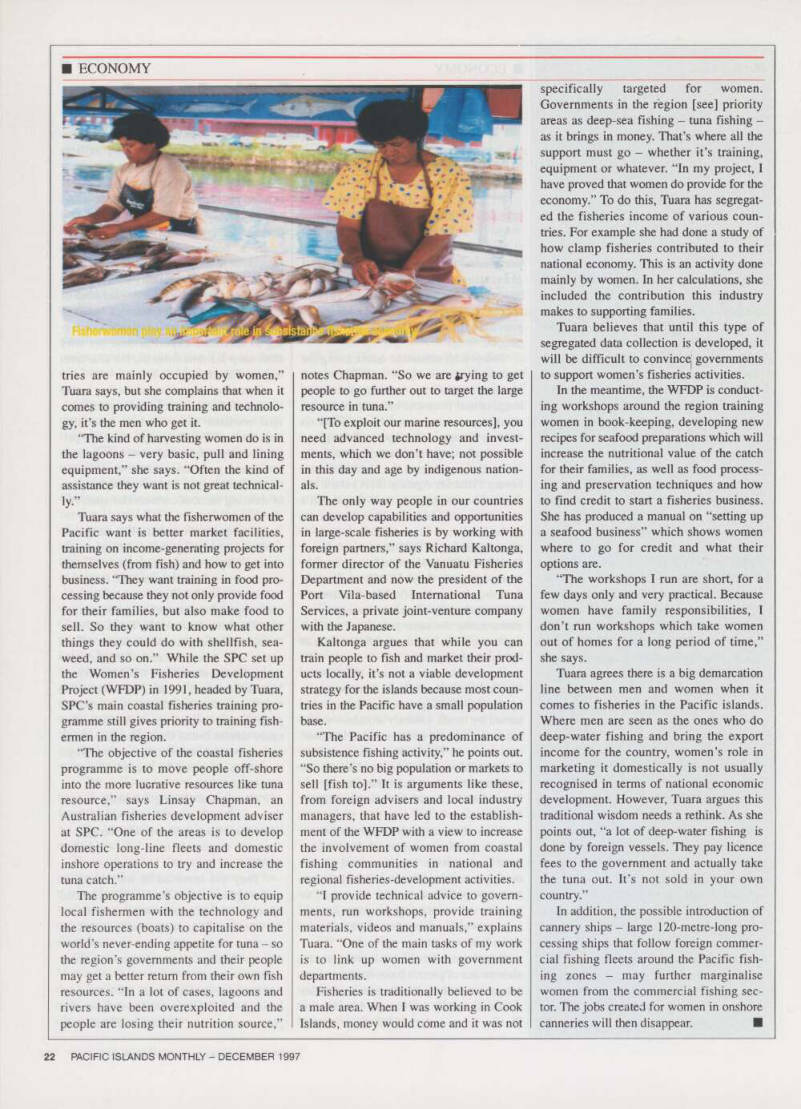
Economy
By Kalinga Seneviratne
The small island nations of the South Pacific may not have abundant natural resources, but one thing they have in plenty is seafood. For generations, both men and women have played a key role in the subsis tence fisheries economy which has provided plenty of nutrition for its people.
Today, with economic restructuring the buzzword in the region and fish-export income its priority, women are being
marginalised from this industry as foreign
aid-driven development schemes focus on training the men for deep-sea fishing and other technology-driven fish-processing skills. Estimates from the Honiara-based Forum Fisheries Agency (FFA) show the South Pacific supplies half the world’s canned tuna and between 30 to 40 per cent of the fresh tuna imported into Japan -a catch estimated in 1995 to be worth about SUSI7OO million. Foreign fishing vessels, however, paid only SUS6O million in licensing fees to Pacific Island nations to fish in their 200-mile exclusive economic zones during the same year. That, accord ing to the FFA, is a mere 3.52 percent of the value of the catch.
If you take into account the income Pacific Island countries get from port calls by foreign fishing vessels, the income earned by locals - mostly women - work ing in foreign-owned canneries in coun tries such as Papua New Guinea, Fiji, Western Samoa and Solomon Islands, the total export income from fisheries for the South Pacific could be around SUSIOO million a year.
While this income is important for the cash-strapped economies of the Pacific, there’s very little attention paid to the development of subsistence fisheries as an important protein source for its people, as well its role in saving precious foreign income, which would otherwise be allocat ed for food imports.
Subsistence fisheries still provides the main source of protein foods for the coastal communities of the Pacific Islands. Studies commissioned by the Noumea-based South Pacific Commission (SPC) have shown
declining fish catches by these subsistence fishing activities. In many countries, this is blamed on commercial over-exploitation of particular species, sometimes by
licensed foreign fishing vessels.
In a book published by SPC on women’s role in Pacific development, Claire Slatter, a University of the South Pacific lecturer and a founding member of the Women in Fisheries network based in Suva, noted Pacific governments were try ing to maximise export income not only from deep-sea tuna fisheries, but also from inshore fisheries.
“Instead of supporting or shoring up the inshore fishery, thereby protecting this vital resource base which is sustaining thousands of Pacific people who are pri marily dependent on semi-subsistence livelihood, governments have been unwit tingly encouraging intensified exploitation of existing inshore commercial species,” she said.
Slatter pointed out that while numerous studies had highlighted the central role women played in providing protein to the communities from subsistence fisheries, had not resulted in official recognition of it and support for women’s fisheries activi ties. This view is shared by Patricia Tuara, the women’s fisheries development officer at the SPC. A former head of the fisheries management section of the Ministry of Marine Resources in the Cook Islands, she says the women’s fisheries development programme was set up at the SPC after many studies found that, although women were involved in fisheries in many ways, they were not given the necessary support by governments.
“The type of fishing a woman does is that which will not take her away from home for a long period of time because of domestic responsibilities,” she explained to PIM.
“They are involved in harvesting as well as processing. Once its [fish] landed by men, a lot of processing is carried out by women,” Tuara notes, adding that, in countries such as Fiji, even the new can neries set up by foreign companies employ
mainly women.
However, she points out, it’s in the mar keting of fish domestically that women play a major role. “Markets in all the coun-
tries are mainly occupied by women,”
Tuara says, but she complains that when it comes to providing training and technolo gy, it’s the men who get it.
“The kind of harvesting women do is in the lagoons - very basic, pull and lining equipment,” she says. “Often the kind of assistance they want is not great technical ly-”
Tuara says what the fisherwomen of the Pacific want is better market facilities, training on income-generating projects for themselves (from fish) and how to get into business. “They want training in food pro cessing because they not only provide food for their families, but also make food to sell. So they want to know what other things they could do with shellfish, sea weed, and so on.” While the SPC set up the Women’s Fisheries Development Project (WFDP) in 1991, headed by Tuara, SPC’s main coastal fisheries training pro gramme still gives priority to training fish ermen in the region.
“The objective of the coastal fisheries programme is to move people off-shore into the more lucrative resources like tuna resource,” says Linsay Chapman, an Australian fisheries development adviser at SPC. “One of the areas is to develop domestic long-line fleets and domestic inshore operations to try and increase the tuna catch.”
The programme’s objective is to equip local fishermen with the technology and the resources (boats) to capitalise on the world’s never-ending appetite for tuna - so the region’s governments and their people may get a better return from their own fish resources. “In a lot of cases, lagoons and rivers have been overexploited and the people are losing their nutrition source,”
notes Chapman. “So we are trying to get people to go further out to target the large resource in tuna.”
“[To exploit our marine resources], you need advanced technology and invest ments, which we don’t have; not possible in this day and age by indigenous nation als.
The only way people in our countries can develop capabilities and opportunities in large-scale fisheries is by working with foreign partners,” says Richard Kaltonga, former director of the Vanuatu Fisheries Department and now the president of the Port Vila-based International Tuna Services, a private joint-venture company with the Japanese.
Kaltonga argues that while you can train people to fish and market their prod ucts locally, it’s not a viable development strategy for the islands because most coun tries in the Pacific have a small population base.
“The Pacific has a predominance of subsistence fishing activity,” he points out.
“So there’s no big population or markets to sell [fish to].” It is arguments like these, from foreign advisers and local industry managers, that have led to the establish ment of the WFDP with a view to increase the involvement of women from coastal fishing communities in national and regional fisheries-development activities.
“I provide technical advice to govern ments, run workshops, provide training materials, videos and manuals,” explains Tuara. “One of the main tasks of my work is to link up women with government departments.
Fisheries is traditionally believed to be a male area. When I was working in Cook Islands, money would come and it was not
specifically targeted for women.
Governments in the region [see] priority areas as deep-sea fishing - tuna fishing as it brings in money. That’s where all the support must go - whether it’s training, equipment or whatever. “In my project, I have proved that women do provide for the economy.” To do this, Tuara has segregat ed the fisheries income of various coun tries. For example she had done a study of how clamp fisheries contributed to their national economy. This is an activity done mainly by women. In her calculations, she included the contribution this industry makes to supporting families.
Tuara believes that until this type of segregated data collection is developed, it will be difficult to governments to support women’s fisheries activities.
In the meantime, the WFDP is conduct
ing workshops around the region training
women in book-keeping, developing new recipes for seafood preparations which will increase the nutritional value of the catch for their families, as well as food process ing and preservation techniques and how to find credit to start a fisheries business.
She has produced a manual on “setting up a seafood business” which shows women where to go for credit and what their options are.
“The workshops I run are short, for a few days only and very practical. Because women have family responsibilities, I don’t run workshops which take women out of homes for a long period of time,” she says.
Tuara agrees there is a big demarcation line between men and women when it comes to fisheries in the Pacific islands.
Where men are seen as the ones who do deep-water fishing and bring the export income for the country, women’s role in marketing it domestically is not usually recognised in terms of national economic development. However, Tuara argues this traditional wisdom needs a rethink. As she points out, “a lot of deep-water fishing is done by foreign vessels. They pay licence fees to the government and actually take the tuna out. It’s not sold in your own
country.”
In addition, the possible introduction of cannery ships - large 120-metre-long pro cessing ships that follow foreign commer cial fishing fleets around the Pacific fish ing zones - may further marginalise women from the commercial fishing sec tor. The jobs created for women in onshore canneries will then disappear. ■
Home discomforts
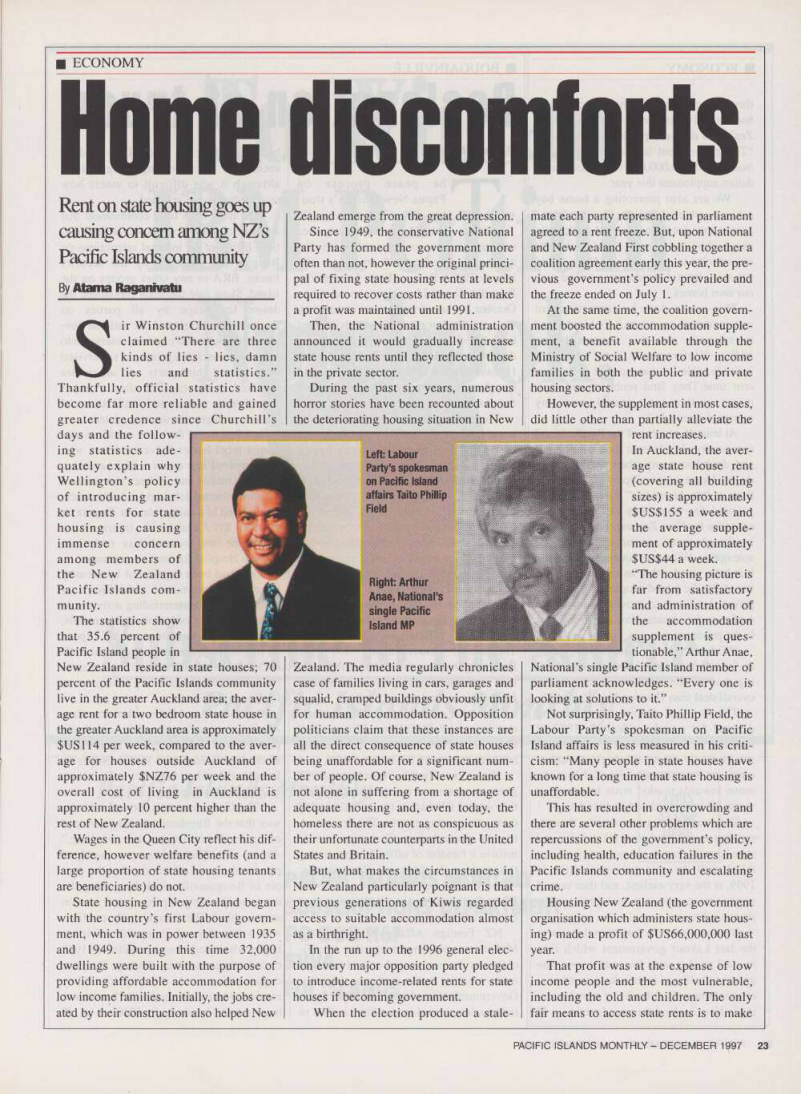
Rent on state housing goes up causing concern among NZ’s Pacific Islands community
By Atama Raganivatu
Sir Winston Churchill once claimed “There are three kinds of lies - lies, damn lies and statistics.”
Thankfully, official statistics have become far more reliable and gained greater credence since Churchill’s
days and the follow ing statistics ade quately explain why
Wellington’s policy
of introducing mar ket rents for state housing is causing immense concern among members of the New Zealand Pacific Islands com
munity.
The statistics show that 35.6 percent of Pacific Island people in
New Zealand reside in state houses; 70 percent of the Pacific Islands community live in the greater Auckland area; the aver age rent for a two bedroom state house in the greater Auckland area is approximately $US114 per week, compared to the aver age for houses outside Auckland of approximately $NZ76 per week and the overall cost of living in Auckland is approximately 10 percent higher than the rest of New Zealand.
Wages in the Queen City reflect his dif ference, however welfare benefits (and a large proportion of state housing tenants are beneficiaries) do not.
State housing in New Zealand began with the country’s first Labour govern ment, which was in power between 1935 and 1949. During this time 32,000 dwellings were built with the purpose of providing affordable accommodation for low income families. Initially, the jobs cre ated by their construction also helped New
Zealand emerge from the great depression.
Since 1949, the conservative National Party has formed the government more often than not, however the original princi pal of fixing state housing rents at levels required to recover costs rather than make a profit was maintained until 1991.
Then, the National administration announced it would gradually increase state house rents until they reflected those in the private sector.
During the past six years, numerous horror stories have been recounted about the deteriorating housing situation in New
Zealand. The media regularly chronicles case of families living in cars, garages and squalid, cramped buildings obviously unfit for human accommodation. Opposition politicians claim that these instances are all the direct consequence of state houses being unaffordable for a significant num ber of people. Of course, New Zealand is not alone in suffering from a shortage of adequate housing and, even today, the homeless there are not as conspicuous as their unfortunate counterparts in the United States and Britain.
But, what makes the circumstances in New Zealand particularly poignant is that previous generations of Kiwis regarded access to suitable accommodation almost as a birthright.
In the run up to the 1996 general elec tion every major opposition party pledged to introduce income-related rents for state houses if becoming government.
When the election produced a stale
mate each party represented in parliament agreed to a rent freeze. But, upon National and New Zealand First cobbling together a coalition agreement early this year, the pre
vious government’s policy prevailed and
the freeze ended on July 1.
At the same time, the coalition govern ment boosted the accommodation supple ment, a benefit available through the Ministry of Social Welfare to low income families in both the public and private housing sectors.
However, the supplement in most cases, did little other than partially alleviate the
rent increases.
In Auckland, the aver age state house rent (covering all building sizes) is approximately SUSSISS a week and the average supple ment of approximately SUSS44 a week.
“The housing picture is far from satisfactory and administration of the accommodation supplement is ques tionable,” Arthur Anae,
National’s single Pacific Island member of parliament acknowledges. “Every one is looking at solutions to it.”
Not surprisingly, Taito Phillip Field, the Labour Party’s spokesman on Pacific Island affairs is less measured in his criti cism: “Many people in state houses have known for a long time that state housing is unaffordable.
This has resulted in overcrowding and there are several other problems which are
repercussions of the government’s policy,
including health, education failures in the Pacific Islands community and escalating crime.
Housing New Zealand (the government organisation which administers state hous ing) made a profit of $U566,000,000 last year.
That profit was at the expense of low income people and the most vulnerable, including the old and children. The only fair means to access state rents is to make
Left: Labour Party's spokesman on Pacific Island affairs Taito Phillip Field
Right: Arthur Anae, National’s single Pacific Island MR
them income related.” Anae too obviously has misgivings over Housing New Zealand’s declared profit, but points out: “The government is allocating approxi mately $U5500,000,000 to the accommo dation supplement this year.
“We are also promoting a home buy scheme, which I believe Pacific Island people have not been informed sufficiently about. All our people should take the opportunity to own a house. If we are to get away from dependency, we must own our own homes.
This can be done by converting rent into mortgage payments.” Field admitted to sympathy for this concept before adding: “Unfortunately, home ownership is not feasible for many people at the cur rent time. They find rents beyond their means, so they can’t possibly meet any mortgage demands.”
At least 46 percent of the Pacific Island community already own their own homes and, doubtless, many others would wish to do so. Home ownership is an important facet of “the better life” Pacific islanders yearned for when they left their home countries for New Zealand. For the major ity, though, rental accommodation was the sole option. With state housing’s problems, it is little wonder that an increasing num ber of Pacific Island people are turning to private landlords to provide them with a roof over their heads. Now 18 percent rent in the private sector.
“With the price of state housing going up,” Anae observes, “Many are now find ing that private landlords offer a better overall deal than Housing New Zealand.”
The fact that, despite the continuing demand for rental residencies, 1800 of Housing New Zealand units nationwide are currently unoccupied gives further credit to the widespread belief that the move towards market rents has been, at worse, ill-conceived and, at best, hasty.
The coalition government, though, remains committed to market rents and state housing tenants can not anticipate any relief until the next general election in 1999, at the very earliest, and then only if opposition parties win and pre-election promises become post election actions.
It’s now generally forgotten that it was the last Labour government which first mooted market rents for state houses. The greatest likelihood is that the days of gov ernments heavily subsidising rental hous ing in New Zealand are gone forever. ■
Declaration of truce
Bougainville
By Sam Vulum
The peace process on Papua New Guinea’s trou
ble-torn Bougainville
Island has taken another encouraging step forward with the recent declaration of truce on the island. PNG’s Defence Force Commander Brigadier General Leo Nuia announced on October 24 that all restrictions imposed by the security forces on Bougainville had been lifted as of October 10, the signing date of the Burnham Truce in New Zealan.
He said this had been done to honour and comply with the truce and further enhance the peace process.
This now means that people who want to travel in or to Bougainville no longer need clearances from the security forces.
People are free to move anywhere, at any time; shipping companies and third-level airlines are free to operate throughout Bougainville. General Nuia urged all Bougainville traditional border crossers to report to Torato Island for immigration and customs formalities before entering the Solomon Islands territory. He also direct ed that the PNGDF vacate its camp in Buka to allow the lata people to resettle in their village. The truce was signed by gov ernment officials, Bougainville Transitional Government and the Bougainville Revolutionary Army in a two-week meeting to prepare an agenda for the third round of peace talks.
The talks envisaged another leaders’ meeting which PNG Prime Minister Bill Skate is expected to attend. The meeting has been scheduled for January 1998.
However, a Reuters report quoted NZ government sources as saying that two fur ther sets of talks are set to be held in NZ during the coming months. The first round, to take place before Christmas, would involve a handful of officials representing the various factions on Bougainville.
“They all feel comfortable here. For the BRA, Burnham is almost like a second home,” one source said.
NZ Foreign Affairs Minister Don McKinnon confirmed a meeting of offi cials was the next step, but said arrange ments were up to the parties to the talks.
Government officials did not expect pro independence rebel leader Francis Ona to
be involved in the talks. They said he seemed to be becoming marginalised, although it was difficult to assess how much influence he retained.
The truce calls for a commitment that all parties refrain from all acts of intimida tion; lifting of all internal restrictions on Bougainville enforced by the security forces, BRA or any other groups on the island. Skate said the truce formalised the desire for peace by all parties on Bougainville. Skate said the national gov ernment would also consider entering into a formal ceasefire agreement supervised by a neutral third party and all parties involved in the conflict after a proper investigation of cost and implications of such an arrangement was completed.
In a first test of the truce, notorious sep aratist rebel leader Sylvester Vane, who was involved in a motor vehicle accident, has been treated and set free. Vane, one of the most wanted rebels prior to the truce, was injured in a car accident at Tinputz on October 21. Although his injuries were minor, he was nevertheless rushed to Sohano Hospital for medical treatment.
Vane had been considered by security forces and government authorities as a notorious rebel materminding activities in the northern part of mainland Meanwhile, a delegation of Australian and NZ experts on monitoring peacekeeping visited PNG in October to assess technical requirements for agreed peace monitoring arrangements for Bougainville.
Bougainville Affairs Minister Sam Akoitai, announcing the visit, said it was part of the follow-up to agreements reached between parties to the conflict on Bougainville when they met in Burnham, NZ in early October.
“The Govemnment is pleased with the way that the Burnham truce and removal of internal restrictions are working,”
Akoitai said. “We need to move quickly to provide the sense of security that the peo ple of Bougainville need, by getting the truce monitoring group into place as soon as possible.” The Bougainville conflict, which has claimed thousands of lives, began when landowners revolted in 1988 over damage caused by the huge Panguna copper mine and the royalties they received from it. Bougainville has been a huge political headache for PNG. ■
Advertisements & other items, pp. 25-26 (1 item)
IBM Pentium
To Win an
y k j v ) l j *' l * M as £}»\ v 1
Subscribe to The Source.
Pacific Islands Monthly
Pacific Islands Monthly
PACIFIC ISLANDS MONTHLY
SUBSCRIPTIONS DEPARTMENT
PO BOX 1167
SUVA
FIJI ISLANDS
AFFIX
STAMP
HERE
For almost 70 years, Pacific Islands Monthly has been and still is the authority on political, business and social issues within the Pacific. And now, every 12 month subscription received before the 31st of March, 1998, goes into a draw to win an IBM Pentium Notebook*. You could even give a gift subscription to enter but it must be before the closing date. As well as the entry into the draw, you will also receive the latest news from the region. Fill in the subscription form below and send it along with payment to Pacific Islands Monthly, Subscription Department, PO Box 1167, Suva, Fiji. Or call PIM on (679) 304 111 or fax us on (679) 303 809/(679) 307 460.
Subscribe to The Source.
Pacific Islands Monthly
*Rates include Airspeeding to all destinations Conditions of Entry 1. To enter, subscriptions must be made before March 31st, 1998 which automatically enters the subscriber into the draw for the Pentium Notebook Computer. 2. Entry is open to all subscribers except employees of The Fiji Times Ltd, Pacific Islands Monthly, and Wilson Addison Ltd. 3- Subscribers need to subscribe for 12 months to qualify. 4. The winner of the Pentium Notebook will be published in Pacific Islands Monthly Magazine, May Issue, 1998 and will be notified by registered mail, 5. The winner will receive their prize within one month of the draw. 6. The prize must be taken as offered and is not redeemable, 7. In the event of any dispute the decision of the promoter is final and no correspondence will be entered into.
YES! I wish to subscribe to The Source and receive a chance to win an IBM Pentium Notebook Computer! □ Cheque/Bank Draft/Money Order made payable to Pacific Islands Monthly Please charge my credit card: (VISA / AMEX / MASTERCARD)
12 ISSUE
SUBSCRIPTION
Rate A I Rate B I I Rate C I Rate D Rate E This is a
□ Renewal
Signature: Expiry date: Mr/Mrs/Ms: Delivery Address; Postal Address: □ New Subscription Country: Fax:
crisis
Media
The NBC
Wrongful dismissal of employee becomes a costly affair
By Sam Vulum
A minor administrative failure by the executive management of the gov ernment-owned National
Broadcasting Corporation came close
to severing a vital communication supply line for 85 percent of Papua New Guinea’s rural population in October.
It also threatened the jobs of hundreds of others in the corporation’s 19 provincial radio stations and the future of government assets valued at more than K 7.3 million (approx.sUS4,2 million) at the Port Moresby headquarters.
The properties were ordered to be auc tioned or sold following the NBC’s failure to honour a court order to pay K 160,000 (approx. $U592,000) to a former broad caster, Peter Koringo, for wrongful dis missal in 1995.
In the event of a closure the only means of communication for people in some of the most isolated parts of the country, where there are no telephones, two-way radio systems, roads and proper shipping services, would be severely affected.
They rely heavily on the NBC through the provincial radio stations, for news, weather reports, shipping and airline movements, programs on education, health, agriculture, business and other important government services which directly affect their lives.
Koringo was a senior broadcaster with Radio Morobe in Lae, Morobe province when he was terminated. After two years since his dismissal, he successfully sought the help of the National Court sheriff’s office to order the seizure of the properties and put them up for sale unless the corpo ration paid up the damages claim.
The NBC management and staff were caught by surprise when a notice of the
seizure was posted outside the NBC head quarters on September 18.
The notice meant that the sheriff had legally seized possession to the studios and vehicles which would be sold off if NBC did not pay up or suggest alternative means about meeting the payments by September 19.
The deadline lapsed without any pay ment being made, but the corporation’s lawyer successfully sought and was referred to the Supreme Court to determine whether the National Court’s decision to award the damages could be stayed and whether leave could be granted for a judi cial review of that decision.
What followed, were a series of court challenges while confusion reigned at the NBC headquarters.
The properties again came close to being sold on October 20 when officials from the sheriff’s office confiscated and impounded the corporation’s vehicles from the headquarters.
The NBC faced double trouble on the day. While the vehicles had been confiscat ed, for the second fortnight in a row work ers’ pay was not ready in time because no money had been allocated - and neither the managing director Renagi Lohia nor his deputy Tony Boski could be found to sort out the problem.
The vehicles were returned late that afternoon with the sheriff Lawrence Newell saying the impounding had been a mistake. The pay problem had also been sorted out.
However, when this issue went to press, NBC and Koringo had yet to settle the dis pute.
The situation then was that the Supreme Court, on October 29, had again ordered the NBC to pay Kl6o,ooo(approx. $U592,000) as surely to the court by October 30.
The money would be kept pending determination of an application by NBC lawyers seeking leave for a review of the 1995 National Court decision which awarded Koringo this amount plus other additional costs.
If the NBC fails to pay, the court will discharge the writ for stay of levy of the properties at the NBC headquarters, giving Koringo the liberty to auction the proper ties and recover what was owned to him with eight percent interest and costs, the amount owed has increased to about K 260,000 (approx, SUS 148,000).
The writ for stay of levy of the proper
ties was granted by Judge Kubulan Los in September following an ex-parte applica tion filed by the solicitor-general acting for the NBC.
In early October, Judge Salamo Injia, sitting as a one-man Supreme Court judge, referred the matter to the full bench of the
Supreme Court.
On October 29, the full bench, compris ing Chief Justice Sir Arnold Amet, Justice Moses Jalina and Justice Gibbs Salika, which heard substantive matters on the application for a review of the 1995 deci sion, ordered that the NBC must pay the judgement debt.
It is likely that the government will foot the bill to save the corporation.
Acting Prime Minister and Provincial and Local-Level Government Minister Simon Kaumi on October 30 ordered finance secretary Isaac Lupari to pay the amount.
He was carrying out an earlier commit ment by Prime Minister Bill Skate that the government would pay off the damages claim if the Supreme Court review of the 1995 judgement was denied.
Skate had earlier said that government would not allow the sale of NBC under any circumstances.
“NBC is more important than most Papua New Guineans realise. The average villager relies on NBC for information, education and entertainment, and it has a loyal and steady following.
“Radio is the only national communica tion network that reaches the majority of our remote rural areas, as well as our city residents,” he said.
Earlier in the year, before the Koringo case broke out, speculations were rife that Telikom was going to take over the corpo ration’s commercial arm, Kalang Advertising Pty Ltd, after it failed to pay up a K 1,5 million (approx. $US860,000) debt for telephone, broadcast and facsimile lines which had accrued since the 1980 s.
The speculations were put to rest in October following the announcement by communications minister Simeon Wai that Telikom would not take over Kalang.
Instead, it would be given a period of six months to see if it was profitable.
Wajtsaid he had discussed the issue in a meeting with Telikom managing director Gerea Aopi and NBC chairman Renagi Lohia.
He said that it was agreed that Kalang Advertising would be given time to pay up the debt. ■
Solomon Islands calls on Japan to
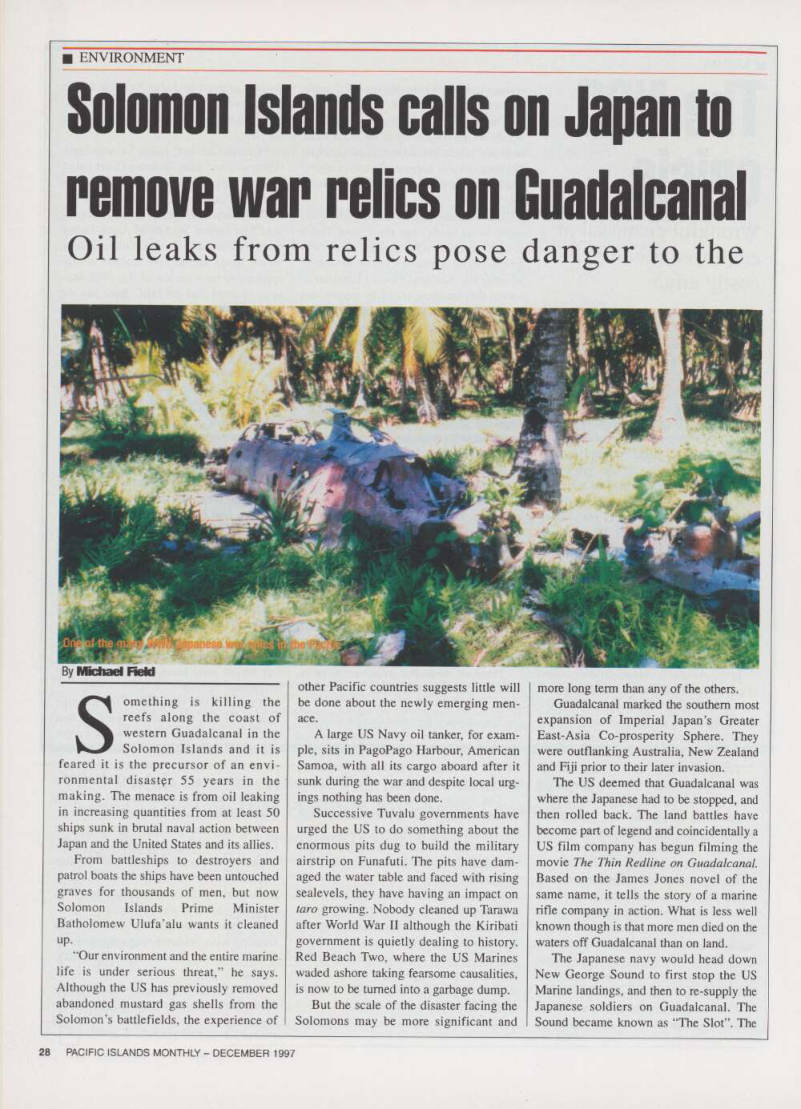

Environment
Solomon Islands calls on Japan to remove war relics on Guadalcanal Oil leaks from relics pose danger to the
Something is killing the
reefs along the coast of western Guadalcanal in the Solomon Islands and it is feared it is the precursor of an envi ronmental disaster 55 years in the making. The menace is from oil leaking in increasing quantities from at least 50 ships sunk in brutal naval action between Japan and the United States and its allies.
From battleships to destroyers and patrol boats the ships have been untouched graves for thousands of men, but now Solomon Islands Prime Minister Batholomew Ulufa’alu wants it cleaned up.
“Our environment and the entire marine life is under serious threat,” he says.
Although the US has previously removed abandoned mustard gas shells from the Solomon’s battlefields, the experience of
other Pacific countries suggests little will be done about the newly emerging men ace.
A large US Navy oil tanker, for exam ple, sits in PagoPago Harbour, American Samoa, with all its cargo aboard after it sunk during the war and despite local urg ings nothing has been done.
Successive Tuvalu governments have urged the US to do something about the enormous pits dug to build the military airstrip on Funafuti. The pits have dam aged the water table and faced with rising sealevels, they have having an impact on taro growing. Nobody cleaned up Tarawa after World War II although the Kiribati government is quietly dealing to history.
Red Beach Two, where the US Marines waded ashore taking fearsome causalities, is now to be turned into a garbage dump.
But the scale of the disaster facing the Solomons may be more significant and
more long term than any of the others.
Guadalcanal marked the southern most expansion of Imperial Japan’s Greater
East-Asia Co-prosperity Sphere. They
were outflanking Australia, New Zealand and Fiji prior to their later invasion.
The US deemed that Guadalcanal was where the Japanese had to be stopped, and then rolled back. The land battles have become part of legend and coincidentally a US film company has begun filming the movie The Thin Redline on Guadalcanal.
Based on the James Jones novel of the same name, it tells the story of a marine rifle company in action. What is less well known though is that more men died on the waters off Guadalcanal than on land.
The Japanese navy would head down New George Sound to first stop the US Marine landings, and then to re-supply the Japanese soldiers on Guadalcanal. The Sound became known as “The Slot”. The
“Tokyo Express ” as the ships became known, terminated their missions in Iron Bottom Sound, a vast placid sea of water between Guadalcanal and the Florida Islands. Entry to the Sounds is dominated by the volcanic Savo Island.
The Battle of Savo Island on August 9, 1942, between Savo and Cape Esperance, was one of the most humiliating defeats in US Navy history. Four heavy ships were lost, including USS Quincy and the Australian heavy cruiser Canberra. The Japanese got away undamaged.
American revenge came in the two bat tles collectively known as the Battle of Guadalcanal between November 12 and 15, 1942. The Japanese lost an aircraft car rier, Kinugasa. Also lost was the Japanese battleship Kirishima which ended up upside down on the sea floor following one of the last battleship-to-battleship encounters ever to take place.
When it was all over both sides had each lost 24 combatant hips, as well as dozens of patrol boats, auxiliaries and transports.
The affair stirs deep American emotion and their celebrated naval historian has written of it that Guadalcanal is not a name
but an emotion. “Tactically, Guadalcanal was a profitable lesson book for the US navy, army and marine corps.
Strategically, it stopped the enemy in his many-taloned reach for the antipodes ...
The jagged cone of Savo Island, forever brooding over the once blood-thickened waters of Iron Bottom Sound, stands as a perpetual monument to the men and ships who here rolled back the enemy tide.”
In 1992, American oceanographer Robert Ballard mounted a multi-million dollar exploration of Iron Bottom Sound.
He made his name with his discovery of the wreck of Titanic. He located 13 of the wrecks in the deep sound which is swept with strong currents.
“We found wrecks in remarkably good shape, given the beating they took, and wrecks blasted into pieces almost beyond recognition,” he writes in his book The Lost Ships of Guadalcanal. He said the Iron Bottom Sound was as chaotic and confused as the battles themselves.
“No one has turned the graveyard into a well-manicured park, or etched inscrip tions on its gravestones. But it is a quiet and contemplative place.” That will change if the new Solomon’s government
gets its way. Minister of State Alfred Sasako told PIM the reefs were dying around western Guadalcanal and the prob lem was spreading towards the Russell Islands.
“We can’t pinpoint it to anything else, there is no industry there, and so believe it must be the ships,” he said. “We can’t sit and wait for anything more to happen, something has to be done.”
Ulufa’alu raised the issue initially in a letter to the Japanese government while he was in Tokyo for the Pacific Summit. He is also taking it up with the US. His govern ment could not handle it, although the country was facing an environmental dis aster of phenomenal proportions because nearly all the warships had begun oozing oil. Fish and marine life were beginning to die.
“It the biggest environmental threat my country will face and there is no way that we can handle such an emergency on our own,” he said. He did not want those responsible for the ships to act only after the disaster had become obvious. “I am therefore calling on the allies and Japanese government to start doing something before it is too late.” ■
Advertisements & other items, p. 29 (1 item)
Second Hand Containers
WHERE AND WHEN YOU WANT THEM IN THE PACIFIC If you need a flexible and safe storage space we have the ideal solution for you. Our second hand containers provide instant secure storage. Guaranteed to be wind and waterproof these containers are ideal for both temporary and longterm storage in Pacific conditions.
We can deliver to any island in the Pacific within a month and our rates have got to be the lowest you will find. All you need to do is tell us how many you want.
CONTACT:
PASCALS MARCONNET, BP 4757 NOUMEA, NEW CALEDONIA. TEL: (687) 28 7450. FAX: (687) 26 3248
Protest march
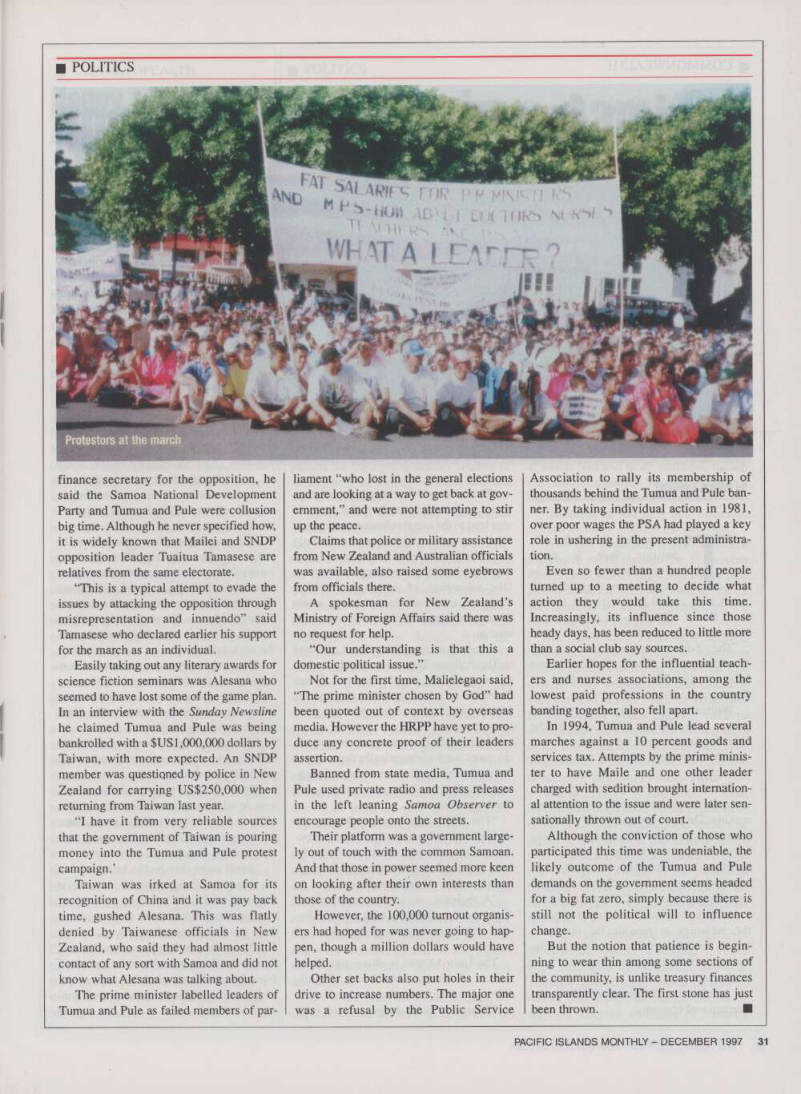
Politics
earns a fat zero
But patience with a government largely out of touch with the common Samoan is wearing out
By Chris Peteru
Samoans rate patience as the guiding principle in any kind of disagreement. That patience turned to protest when in an unprecedented move a 5000 strong demonstration called for the ruling Human Rights Protection Party (HRPP) government to step down.
Organised by the Tumua and Pule, a tra ditional coalition of chiefs and orators, their leader Faamatuainu Mailei says frus tration over the soaring cost of living, hefty taxes and eight years of unaudited public accounts from treasury, had led to the coalition protest taking place.
On a dry, hot morning villagers from both main islands assembled at Vaimoso village, about two miles from Apia. Joining them were a group from neighbouring American Samoa.
“Whatever happens in Samoa also affects us here. That’s why we are taking part” said a spokesperson for the group.
Waving banners and accompanied by
brass bands, the procession slowly weaned its way to the government complex in the middle of town.
Escorted by dozens of police on the streets and hundreds more at the rally point, no arrests were made, even at one
point when acting prime minister Tuilaepa
Malielegaoi drove his land cruiser along side the march in what seemed to be a flaky attempt to ridicule or intimidate. Least impressed by his antics were a contingent from his own electorates on the front line of the demonstration.
As the protest entered the frontage to the government complex, which was cor doned off to isolate the procession, scuffles involving several protesters and police broke out. No arrests were made.
“We want you (the government) to resign, the reasons are already clear,”
Mailei told Malielegaoi and cabinet mem bers at the steps of the seven storey state building.
“People are tired of the never ending struggle, the political scandals and lies that
everything is going alright because it’s
only that way for very few people. The rest
are paying for them,” he said afterwards.
A deadline of 14 days was requested for the government to respond to the seven page document handed to them.
Traditional courtesies of quiet respect were replaced with dissent as jeers and cat calls from the crowd peppered
Malielegaoi’s replying speech.
“You are not controlling your people Faamatuainu,” he said as marshals called for calm.
Cabinet needed time to discuss the pro posals then give their response, said Malielegaoi, adding he had given up an important meeting in Africa because of the protest.
In the weeks leading up to the march, the HRPP launched a propaganda cam paign that verged on overkill. While taking every opportunity to publicly label the protest a flop, backstage they acted more like a sequel to Tianemanu Square was about to descend on the Chinese bankrolled complex they now inhabit.
Days before, the Public Service Commission released a four-part internal memorandum, on how the several hundred employees should react if the building was taken over by protesters.
Signed by the secretary to the commis sion Dr Luaiufi Moli, it stressed undivided
loyalty to the government “by refraining
from interfering in any way with the order ly process of government, even if it might be in his personal interest to do so.”
The tacit warning was obvious enough.
March and you may not have your job or future prospects much longer.
With Prime Minister Tofilau Eti Alesana overseas, Malielegaoi lost no time taking centre stage. For days he splashed himself across state television and radio with a mind numbing tirade about the futil ity of the demonstration. A one time
finance secretary for the opposition, he said the Samoa National Development Party and Tumua and Pule were collusion big time. Although he never specified how, it is widely known that Mailei and SNDP opposition leader Tuaitua Tamasese are relatives from the same electorate.
“This is a typical attempt to evade the issues by attacking the opposition through misrepresentation and innuendo” said Tamasese who declared earlier his support for the march as an individual.
Easily taking out any literary awards for science fiction seminars was Alesana who seemed to have lost some of the game plan.
In an interview with the Sunday Newsline he claimed Tumua and Pule was being bankrolled with a SUS 1,000,000 dollars by Taiwan, with more expected. An SNDP member was questioned by police in New Zealand for carrying U 55250,000 when returning from Taiwan last year.
“I have it from very reliable sources that the government of Taiwan is pouring money into the Tumua and Pule protest
campaign.’
Taiwan was irked at Samoa for its recognition of China and it was pay back time, gushed Alesana. This was flatly denied by Taiwanese officials in New Zealand, who said they had almost little contact of any sort with Samoa and did not know what Alesana was talking about.
The prime minister labelled leaders of Tumua and Pule as failed members of par
liament “who lost in the general elections and are looking at a way to get back at gov ernment,” and were not attempting to stir up the peace.
Claims that police or military assistance from New Zealand and Australian officials was available, also raised some eyebrows from officials there.
A spokesman for New Zealand’s Ministry of Foreign Affairs said there was no request for help.
“Our understanding is that this a domestic political issue.”
Not for the first time, Malielegaoi said, “The prime minister chosen by God” had been quoted out of context by overseas media. However the HRPP have yet to pro duce any concrete proof of their leaders assertion.
Banned from state media, Tumua and Pule used private radio and press releases in the left leaning Samoa Observer to encourage people onto the streets.
Their platform was a government large ly out of touch with the common Samoan.
And that those in power seemed more keen on looking after their own interests than those of the country.
However, the 100,000 turnout organis ers had hoped for was never going to hap pen, though a million dollars would have
helped.
Other set backs also put holes in their drive to increase numbers. The major one was a refusal by the Public Service
Association to rally its membership of thousands behind the Tumua and Pule ban ner. By taking individual action in 1981, over poor wages the PSA had played a key role in ushering in the present administra tion.
Even so fewer than a hundred people turned up to a meeting to decide what action they would take this time.
Increasingly, its influence since those heady days, has been reduced to little more than a social club say sources.
Earlier hopes for the influential teach ers and nurses associations, among the lowest paid professions in the country banding together, also fell apart.
In 1994, Tumua and Pule lead several marches against a 10 percent goods and services tax. Attempts by the prime minis ter to have Maile and one other leader charged with sedition brought internation al attention to the issue and were later sen sationally thrown out of court.
Although the conviction of those who participated this time was undeniable, the likely outcome of the Tumua and Pule demands on the government seems headed for a big fat zero, simply because there is still not the political will to influence change.
But the notion that patience is begin ning to wear thin among some sections of the community, is unlike treasury finances transparently clear. The first stone has just been thrown. ■
Protestors at the march
Advertisements & other items, p. 30 (1 item)
Japanese Used Vehicles
Exporting around the Pacific
Fiji, Kiribati, Palau, Nauru Is, Norfolk Is, Solomon Is, Papua New Guinea, Niue, New Zealand, Tonga, Samoa.
All Shipping and Documentation arranged for YOU. Buy direct from Japan and save sss. Vehicles from USDSIOOO plus Freight.
Fax today for your Order form and List of Vehicles. Big Selection of used Japanese Motor vehicles.
Special P.I.M. Offer. $lOO off your purchase with this advertisement. r > i ' r ‘
Trust Company Ltd
Kobac Bldg 3F, 3-2-26 Nishiki Naka ku, Nagoya 460, JAPAN Phone (81) 52 953 5602 Fax (81) 52 953 5634/1
Region faces security problem
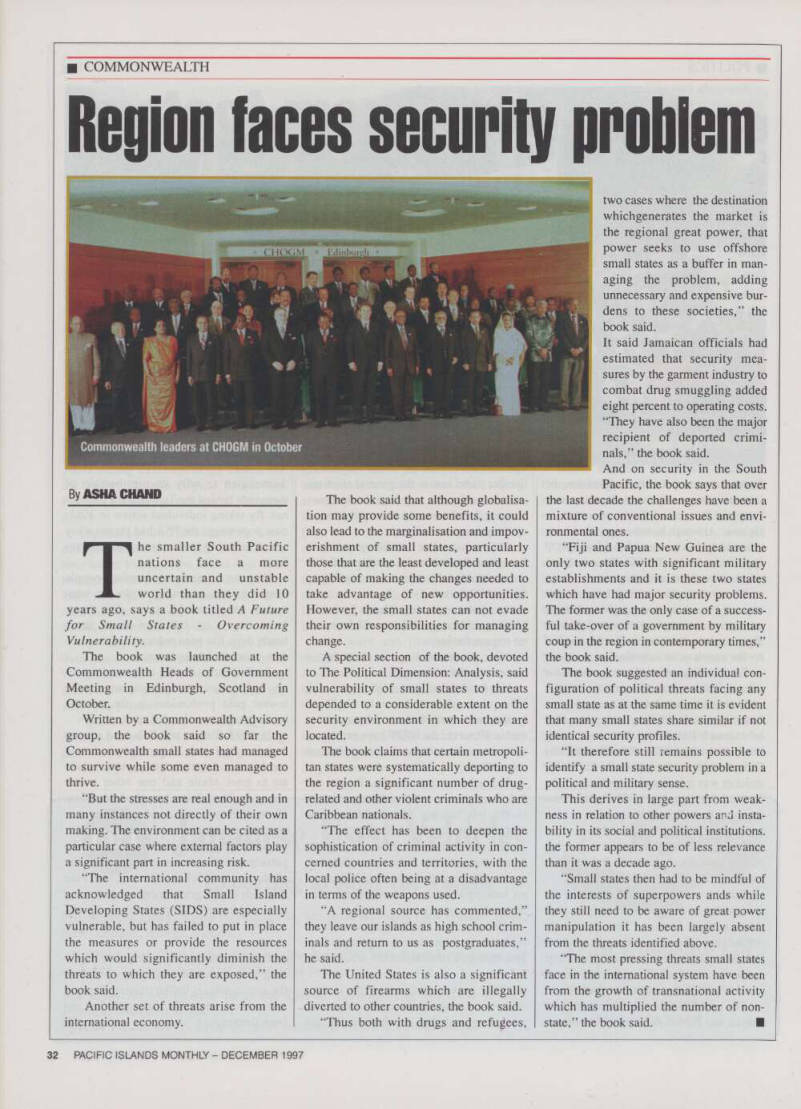
Commonwealth
By Asha Chand
The smaller South Pacific nations face a more uncertain and unstable world than they did 10 years ago, says a book titled A Future for Small States - Overcoming Vulnerability.
The book was launched at the Commonwealth Heads of Government Meeting in Edinburgh, Scotland in October.
Written by a Commonwealth Advisory group, the book said so far the Commonwealth small states had managed to survive while some even managed to thrive.
“But the stresses are real enough and in many instances not directly of their own making. The environment can be cited as a particular case where external factors play a significant part in increasing risk.
“The international community has acknowledged that Small Island Developing States (SIDS) are especially vulnerable, but has failed to put in place the measures or provide the resources which would significantly diminish the threats to which they are exposed,” the book said.
Another set of threats arise from the international economy.
The book said that although globalisa tion may provide some benefits, it could also lead to the marginalisation and impov erishment of small states, particularly those that are the least developed and least capable of making the changes needed to take advantage of new opportunities.
However, the small states can not evade their own responsibilities for managing change.
A special section of the book, devoted to The Political Dimension: Analysis, said vulnerability of small states to threats depended to a considerable extent on the security environment in which they are located.
The book claims that certain metropoli tan states were systematically deporting to the region a significant number of drug related and other violent criminals who are Caribbean nationals.
“The effect has been to deepen the sophistication of criminal activity in con cerned countries and territories, with the local police often being at a disadvantage in terms of the weapons used.
“A regional source has commented,” they leave our islands as high school crim inals and return to us as postgraduates,” he said.
The United States is also a significant source of firearms which are illegally diverted to other countries, the book said.
“Thus both with drugs and refugees,
two cases where the destination whichgenerates the market is the regional great power, that power seeks to use offshore small states as a buffer in man
aging the problem, adding
unnecessary and expensive bur dens to these societies,” the book said.
It said Jamaican officials had estimated that security mea sures by the garment industry to combat drug smuggling added eight percent to operating costs.
“They have also been the major recipient of deported crimi nals,” the book said.
And on security in the South Pacific, the book says that over
the last decade the challenges have been a mixture of conventional issues and envi ronmental ones.
“Fiji and Papua New Guinea are the only two states with significant military establishments and it is these two states which have had major security problems.
The former was the only case of a success ful take-over of a government by military coup in the region in contemporary times,” the book said.
The book suggested an individual con figuration of political threats facing any small state as at the same time it is evident that many small states share similar if not identical security profiles.
“It therefore still remains possible to identify a small state security problem in a political and military sense.
This derives in large part from weak ness in relation to other powers and insta bility in its social and political institutions, the former appears to be of less relevance than it was a decade ago.
“Small states then had to be mindful of the interests of superpowers ands while they still need to be aware of great power manipulation it has been largely absent from the threats identified above.
“The most pressing threats small states face in the international system have been from the growth of transnational activity which has multiplied the number of non state,” the book said. ■
Commonwealth leaders at CHOGM in October
Happy to be back
By Asha Chand
Fiji’s re-entry into the Commonwealth fold after a lapse of 10 years has set the ball rolling for the country in terms of technical aid pack ages and training programmes under the Commonwealth banner.
When membership lapsed soon after the 1987 military coups which were staged by then brigadier-general and now Prime Minister Sitiveni Rabuka, Fiji was shut out from all Commonwealth programmes. A popular sporting nation, she could not even participate in the Commonwealth Games.
But with the return, the Commonwealth Games in Malaysia next year would per haps be the first major event the country will participate in after the re-entry. And Fiji’s high commissioner to the United Kingdom, Filimoni Jitoko, is busy arrang ing meetings, forums, study attachments and visits by technical cooperation groups to Fiji.
Even Rabuka regrets the failure to rejoin the Commonwealth 10 years ago.
“My only regret is that we did not come back then,” he said during the Commonwealth Heads of Government meeting in October. He said no efforts had been made because at that time Fiji was being led by two paramount chiefs who did not see it fitting to return. We did not make any efforts in the past 10 years because it would have been unchiefly to go back into a home from where they had been ... I can use the word expelled from,” Rabuka said.
He said there was an underlying regret even in leaders of the other CHOGM members that Fiji was not approached to seek re-entry. Rabuka compared the Fiji situation 10 years ago to what is happening in countries like Nigeria which has several political prisoners. He said compared with all these other nations, Fiji’s situation was at least reasonable - there was no blood shed during the two military coups and a few weeks later the country had returned to civilian rule. “Our example can never be emulated by anyone ... perhaps we are small enough to be so close,” he said. He said Fiji was given a warm reception at the Commonwealth. “Fiji is very happy to be back in the Commonwealth. Now we want to be an example to the world,” he said. “I still think Fiji is the way the world should be,” Rabuka said. ■
What's in a name?
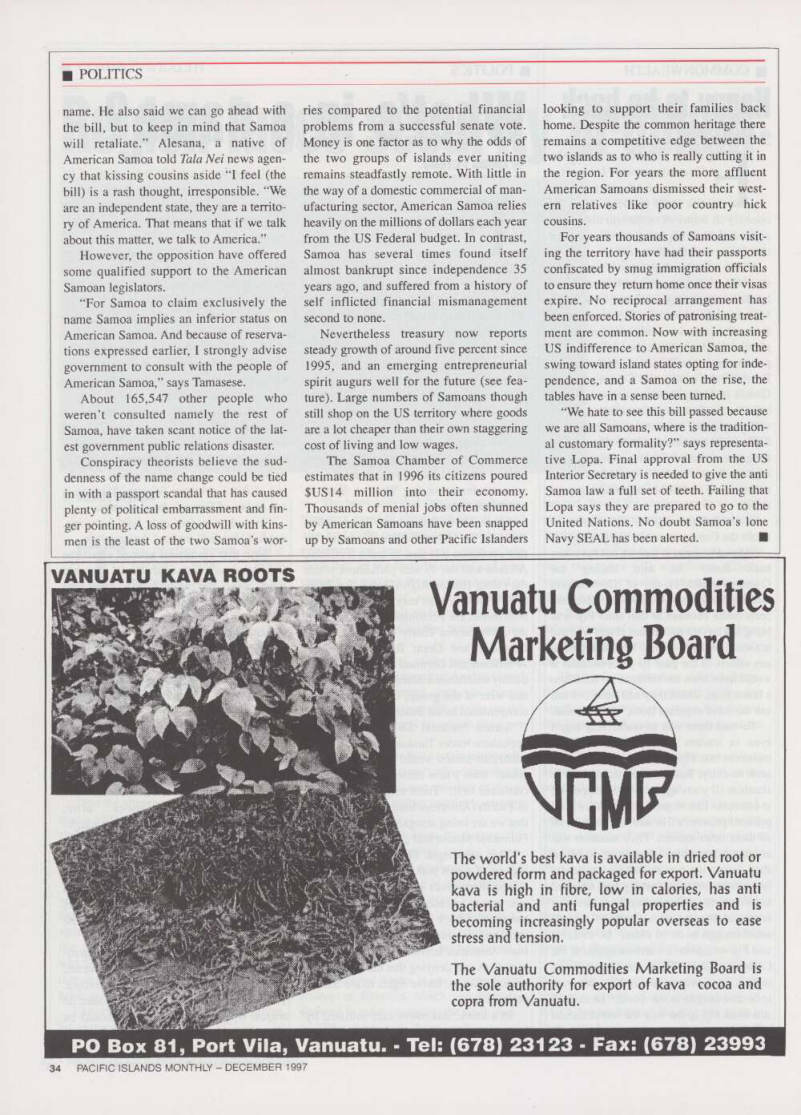
By Chris Peteru
Few would have thought discarding the Western from Samoa would be seen as cultural genocide mixed with top of the line treachery.
However, those are the kind of charges being put to the Samoan government by their American Samoan counterparts resid ing 80 miles to the east.
As far as the United States territory is concerned, they have been sold down the river by their cousins, leaving them with a half baked identity and hurt feelings to boot. It’s all set to turn even more unsavoury soon.
The rumbling began back in August when Prime Minister Tofilau Eti Alesana pushed the third parliamentary reading of an amendment saying Western Samoan was to be no more.
Since 1976, the country been called Samoa at the United Nations. To avoid fur ther confusion it is time to make it official, Alesana told the 49 seat parliament where the ruling Human Rights Protection Party (HRPP) hold a huge majority. Historically, both names are a colonial throwback under the 1899 Berlin Treaty between the US, Germany and Great Britain. With the Americans and Germans carving up the 17 mainly uninhabited islands lying to the east and west of the group, Great Britain was compensated in the Solomons.
Samoa National Development Party opposition leader Tuiatua Tamasese argued American Samoa would get riled over the Island state’s new identity without being consulted first. “There might be a thought in Tutuila (American Samoa’s main island) that we are being arrogant” SNDP member Fuimaono Mimio told parliament.
They were right. Following an escalat ing war of words both sides have now posi tioned themselves to play hardball over who gets to be called what. Little room has been left to back down. Long before any cock had crowed three times, Seti Lopa from American territories house of repre sentatives was denying that the HRPP gov ernment had exclusive rights to the Samoa
designation.
In a drink, this move care initiated by Lopa, American Samoa is in the process of
finalising some prickly legislation of its
own. If passed next month it means any passports and official documents with Government of Samoa written will get bounced back from the US territory.
“We are just as 100 percent Samoan as they are, we are non -palagis (Europeans) but only they can be called Samoans,” he told his fellow representatives.
Feelings of a looming identity crisis increased, during the South Pacific Mini Games hosted by them in August this year.
There for all to hear was the name Samoa being announced publicly he added. It was gold medal humiliation.
“Where are the official steps that should have been taken to find out how Tutuila and Manus would feel about the change?”
He received support from house speak er Mailo Nua and other members, includ ing district governor Sauvusa Tauileva a son in law of Samoa’s head of state.
“It makes us feel only half Samoans, not full blooded” insisted the governor.
With that emotional ground swell the legislation sailed through the 21 member lower house. But the main play comes next month when the bill comes before the 18 seat upper house senate. If passed, there it all but turns the bill into law.
The sense of a Judas type betrayal heightened when a group of American Samoa officials including Lopa flew into to Apia to try and reach an understanding with the head of state Malietoa Tanumafili II and deputy prime pinister Tuilaepa Malielegaoi. As it turned out the highlight of the trip could have been the plane ride.
While talks with Malietoa were cordial enough, the pleasantries ended there.
When tricky situations arise, Malielegaoi often takes on the characteris tics of a US Navy SEAL, specifically an ability to dive to great depths effortlessly, plus a talent for armed and unarmed com bat. The grim silence as the American Samoan representatives came out of his office said it all. They had taken one in the forehead.
“What has happened shows the arro gance of the leaders of Samoa,” a vexed Lopa said after the 45 minute meeting.
Tuilaepa (Malielegaoi) told us he sees no reason why American Samoa should be affected with the changing of Samoa’s
name. He also said we can go ahead with the bill, but to keep in mind that Samoa will retaliate.” Alesana, a native of American Samoa told Tala Nei news agen cy that kissing cousins aside “I feel (the bill) is a rash thought, irresponsible. “We are an independent state, they are a territo ry of America. That means that if we talk about this matter, we talk to America.”
However, the opposition have offered some qualified support to the American
Samoan legislators.
“For Samoa to claim exclusively the name Samoa implies an inferior status on American Samoa. And because of reserva tions expressed earlier, I strongly advise government to consult with the people of American Samoa,” says Tamasese.
About 165,547 other people who weren’t consulted namely the rest of Samoa, have taken scant notice of the lat est government public relations disaster.
Conspiracy theorists believe the sud denness of the name change could be tied in with a passport scandal that has caused plenty of political embarrassment and fin ger pointing. A loss of goodwill with kins men is the least of the two Samoa’s wor
ries compared to the potential financial problems from a successful senate vote.
Money is one factor as to why the odds of the two groups of islands ever uniting remains steadfastly remote. With little in the way of a domestic commercial of man ufacturing sector, American Samoa relies heavily on the millions of dollars each year from the US Federal budget. In contrast, Samoa has several times found itself almost bankrupt since independence 35 years ago, and suffered from a history of self inflicted financial mismanagement second to none.
Nevertheless treasury now reports steady growth of around five percent since 1995, and an emerging entrepreneurial spirit augurs well for the future (see fea ture). Large numbers of Samoans though still shop on the US territory where goods are a lot cheaper than their own staggering cost of living and low wages.
The Samoa Chamber of Commerce estimates that in 1996 its citizens poured SUSI 4 million into their economy.
Thousands of menial jobs often shunned by American Samoans have been snapped up by Samoans and other Pacific Islanders
looking to support their families back home. Despite the common heritage there remains a competitive edge between the two islands as to who is really cutting it in the region. For years the more affluent American Samoans dismissed their west ern relatives like poor country hick cousins.
For years thousands of Samoans visit ing the territory have had their passports confiscated by smug immigration officials to ensure they return home once their visas expire. No reciprocal arrangement has been enforced. Stories of patronising treat ment are common. Now with increasing US indifference to American Samoa, the swing toward island states opting for inde pendence, and a Samoa on the rise, the tables have in a sense been turned.
“We hate to see this bill passed because we are all Samoans, where is the tradition al customary formality?” says representa tive Lopa. Final approval from the US Interior Secretary is needed to give the anti Samoa law a full set of teeth. Failing that Lopa says they are prepared to go to the United Nations. No doubt Samoa’s lone Navy SEAL has been alerted. ■
Advertisements & other items, pp. 34-35 (1 item)
Mcui?
VANUATU KAVA ROOTS
p m -■■r, ■ mm
Vanuatu Commodities
Marketing Board
MCUI?
The world's best kava is available in dried root or powdered form and packaged for export. Vanuatu kava is high in fibre, low in calories, has anti bacterial and anti fungal properties and is becoming increasingly popular overseas to ease stress and tension.
The Vanuatu Commodities Marketing Board is the sole authority for export of kava cocoa and copra from Vanuatu.
PO Box 81, Port Vila, Vanuatu. • Tel: (678) 23123 - Fax: (678) 23993
TAUTIM
o*2*
WttTEWH SAMOA ]
I K*VTtCM>scf
THE SAMOA POLYTECHNIC
Associated Member of the Association of Polytechnic in New Zealand
MISSION STATEMENT
“To provide a wide diversity of continuing education, including vocational training, that contributes to the maintenance, advancement and dissemination of knowledge and expertise and promotes community learning, and by research, particularly applied and technological research, that aids development in Samoa.”
CURRENT PROGRAMMES
1. Secretarial Studies: Diploma 2. Business Studies & Tourism: Diploma 3. Computer Studies: Certificates 4. Radio & Electronics: Diploma 5. Refrigeration & Airconditioning: Diploma 6. Automotive: Certificate 7. Fitting & Machining: Certificate 8. Carpentry & Joinery: Certificate 9. Plumbing & Sheetmetal: Certificate 10. Welding & Fabrication: Certificate 11. Electrical Engineering: Certificate 12. Tutor Training: Certificate 13. Blacksmithing: Certificate 14. Building Construction: Certificate 15. Horticulture: Certificate 16. Hospitality & Catering: Certificate 17. Sewing Machine Repair: Certificate 18. Blocklaying: Certificate
PROPOSED FUTURE PROGRAMMES
• Cert: Landscaping • Cert: Painting and Decoration • Cert: Motor Rewinding • Cert: Heavy Equipment Maintenance • Dip: Computer Studies • Dip: Electrical Engineering • Dip: Civil Engineering • Dip: Mechanical Engineering • Dip. Surveying • Dip. Drafting
For Further Information Please Contact:
Samoa Polytechnic, P.O. Box 861, Apia, Samoa Phone (685) 21 428, Fax (685) 25 489
Samoa's economic recovery
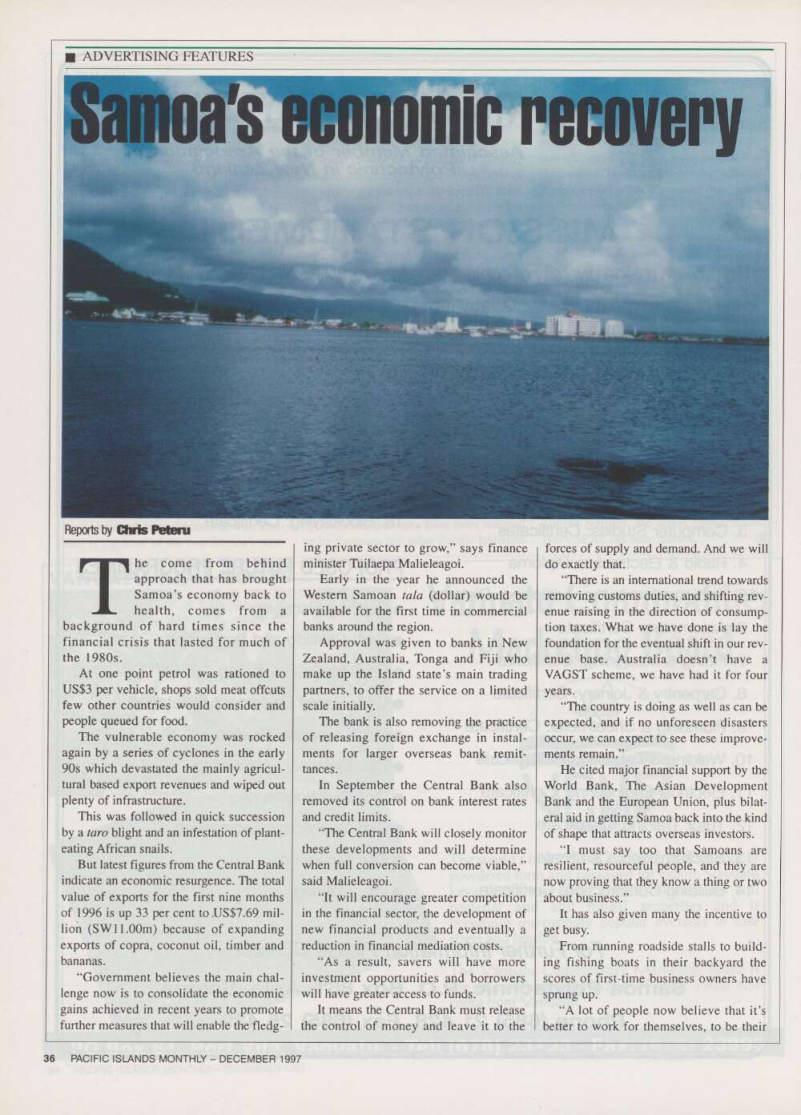
Advertising Features
The come from behind approach that has brought Samoa’s economy back to health, comes from a background of hard times since the financial crisis that lasted for much of the 1980 s.
At one point petrol was rationed to US$3 per vehicle, shops sold meat offcuts few other countries would consider and people queued for food.
The vulnerable economy was rocked again by a series of cyclones in the early 90s which devastated the mainly agricul tural based export revenues and wiped out plenty of infrastructure.
This was followed in quick succession by a taro blight and an infestation of plant eating African snails.
But latest figures from the Central Bank indicate an economic resurgence. The total value of exports for the first nine months of 1996 is up 33 per cent to U 557.69 mil lion (SW 11.00 m) because of expanding exports of copra, coconut oil, timber and bananas.
“Government believes the main chal lenge now is to consolidate the economic gains achieved in recent years to promote further measures that will enable the fledg
ing private sector to grow,” says finance minister Tuilaepa Malieleagoi.
Early in the year he announced the Western Samoan tala (dollar) would be available for the first time in commercial banks around the region.
Approval was given to banks in New Zealand, Australia, Tonga and Fiji who make up the Island state’s main trading partners, to offer the service on a limited scale initially.
The bank is also removing the practice of releasing foreign exchange in instal ments for larger overseas bank remit tances.
In September the Central Bank also removed its control on bank interest rates and credit limits.
“The Central Bank will closely monitor these developments and will determine when full conversion can become viable,” said Malieleagoi.
“It will encourage greater competition in the financial sector, the development of new financial products and eventually a reduction in financial mediation costs.
“As a result, savers will have more investment opportunities and borrowers will have greater access to funds.
It means the Central Bank must release the control of money and leave it to the
forces of supply and demand. And we will do exactly that.
“There is an international trend towards removing customs duties, and shifting rev enue raising in the direction of consump tion taxes. What we have done is lay the foundation for the eventual shift in our rev enue base. Australia doesn’t have a VAGST scheme, we have had it for four years.
“The country is doing as well as can be expected, and if no unforeseen disasters occur, we can expect to see these improve ments remain.”
He cited major financial support by the World Bank, The Asian Development Bank and the European Union, plus bilat eral aid in getting Samoa back into the kind of shape that attracts overseas investors.
“I must say too that Samoans are resilient, resourceful people, and they are now proving that they know a thing or two about business.”
It has also given many the incentive to get busy.
From running roadside stalls to build ing fishing boats in their backyard the scores of first-time business owners have sprung up.
“A lot of people now believe that it’s better to work for themselves, to be their
Reports by Chris Peteru
own bosses, than working for the govern ment or whoever. The difference now is that people are willing to take a risk, now everyone wants in,” says store owner Pat Bentley.
“People now know that if they apply sound business practices, and are thor oughly prepared there is every chance things will happen for them,” says Audrey Aumua formerly a consultant at the Small Business Centre, a hands-on training facil ity initially set up by the New Zealand government.
In a rapidly changing world tiny devel oping states in the region have often had to move at double time to stay afloat. In Samoa the government has positioned the country to become more market driven promising a gradual deregulation in the economy and more opportunities for those with drive and initiative to prosper.
The government has already signalled its intention to lead the way in freeing up the market, with the sale in the last 24 months of government shares in the national bank, now ANZ owned, and the post office banking division to private local interests.
While importance is still attached to agriculture, the latest development being a budding beef industry, diversification and producing quality products in any market has become today’s new standard.
“We believe that the economic future of our country lies more in tourism and in manufacturing.”
The moves show the government’s confidence that the economy is entering a period of sustained growth. To ensure fair play, the Central Bank has warned the local business community that it will come down hard on those selling acquired for eign currency on the black market instead of to local banks.
“We are getting reports now from the banks about how much firms are cashing in. There is a very small amount going back into banks,” said bank Governor
Papalii Scanlan.
A senior bank official says that using the black market and illegal money chang ers cost the country “hundreds of thou sands of dollars a year.”
If the situation did not improve, public notices and the on-site inspection of busi ness houses would be carried out, said Scanlan.
Businesses and hotels were obliged to trade foreign exchange at bank rates, and to make sure the banks received the money. ■
The growing
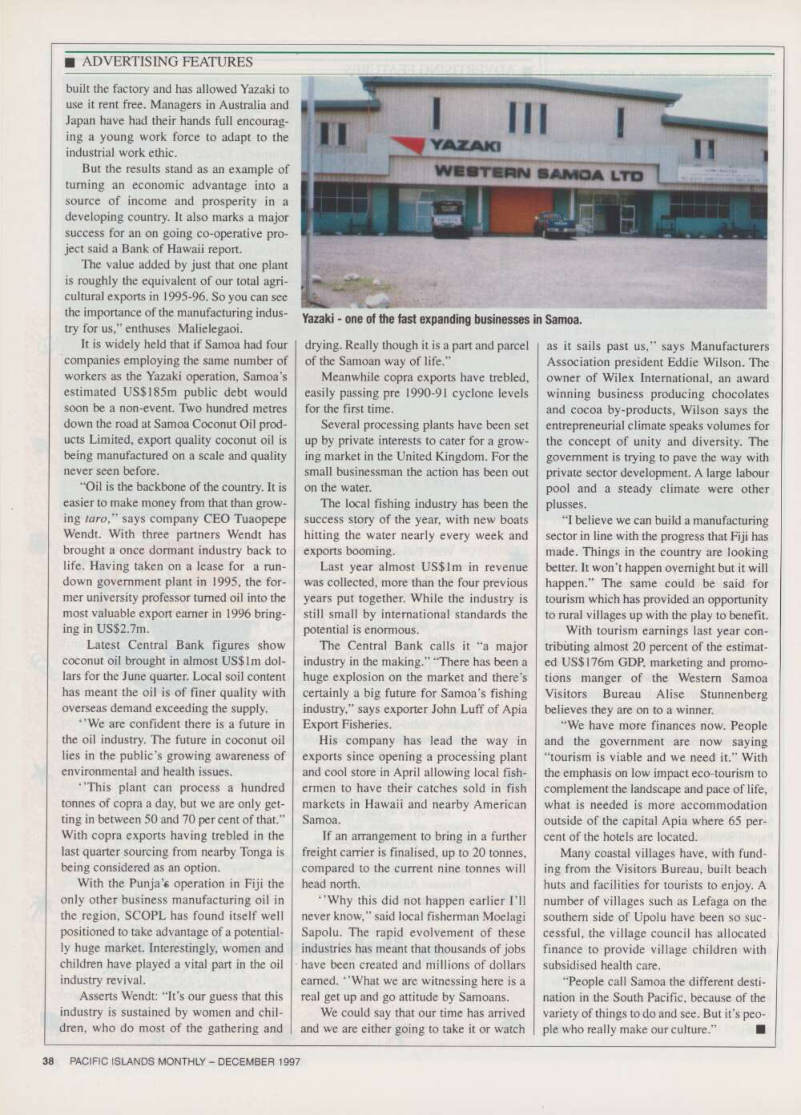
industries
Despite Samoa’s geo graphically isolated position, a diversified industrial base made up of several local and overseas ventures
are turning up trumps for the Islands new economic direction. The biggest of these is the arrival of Japanese company Yazaki in 1991 to produce wire harnesses for cars.
Yazaki employs some 2000 people, mostly female in a labour intensive opera tion. By relocating from Australia the com pany has made a significant contribution to local incomes and the trade balance. Tax holidays anddr costs were two incentives offered by the government, which also
built the factory and has allowed Yazaki to use it rent free. Managers in Australia and Japan have had their hands full encourag ing a young work force to adapt to the industrial work ethic.
But the results stand as an example of turning an economic advantage into a source of income and prosperity in a developing country. It also marks a major success for an on going co-operative pro ject said a Bank of Hawaii report.
The value added by just that one plant is roughly the equivalent of our total agri cultural exports in 1995-96. So you can see the importance of the manufacturing indus try for us,” enthuses Malielegaoi.
It is widely held that if Samoa had four companies employing the same number of workers as the Yazaki operation, Samoa’s estimated USslBsm public debt would soon be a non-event. Two hundred metres down the road at Samoa Coconut Oil prod ucts Limited, export quality coconut oil is being manufactured on a scale and quality never seen before.
“Oil is the backbone of the country. It is easier to make money from that than grow ing taro,” says company CEO Tuaopepe Wendt. With three partners Wendt has brought a once dormant industry back to life. Having taken on a lease for a run down government plant in 1995, the for mer university professor turned oil into the most valuable export earner in 1996 bring ing in USs2.7m.
Latest Central Bank figures show coconut oil brought in almost US$l m dol lars for the June quarter. Local soil content has meant the oil is of finer quality with overseas demand exceeding the supply. ‘’We are confident there is a future in the oil industry. The future in coconut oil lies in the public’s growing awareness of environmental and health issues. ‘This plant can process a hundred tonnes of copra a day, but we are only get ting in between 50 and 70 per cent of that.”
With copra exports having trebled in the last quarter sourcing from nearby Tonga is being considered as an option.
With the Punjab operation in Fiji the only other business manufacturing oil in the region, SCOPE has found itself well positioned to take advantage of a potential ly huge market. Interestingly, women and children have played a vital part in the oil industry revival.
Asserts Wendt: “It’s our guess that this industry is sustained by women and chil dren, who do most of the gathering and
drying. Really though it is a part and parcel of the Samoan way of life.”
Meanwhile copra exports have trebled, easily passing pre 1990-91 cyclone levels for the first time.
Several processing plants have been set up by private interests to cater for a grow ing market in the United Kingdom. For the small businessman the action has been out on the water.
The local fishing industry has been the success story of the year, with new boats hitting the water nearly every week and
exports booming.
Last year almost US$l m in revenue was collected, more than the four previous years put together. While the industry is still small by international standards the potential is enormous.
The Central Bank calls it “a major industry in the making.” “There has been a huge explosion on the market and there’s certainly a big future for Samoa’s fishing industry,” says exporter John Luff of Apia Export Fisheries.
His company has lead the way in exports since opening a processing plant and cool store in April allowing local fish ermen to have their catches sold in fish markets in Hawaii and nearby American Samoa.
If an arrangement to bring in a further freight carrier is finalised, up to 20 tonnes, compared to the current nine tonnes will head north. ‘’Why this did not happen earlier I’ll never know,” said local fisherman Moelagi Sapolu. The rapid evolvement of these industries has meant that thousands of jobs have been created and millions of dollars earned. ‘’What we are witnessing here is a real get up and go attitude by Samoans.
We could say that our time has arrived and we are either going to take it or watch
as it sails past us,” says Manufacturers Association president Eddie Wilson. The owner of Wilex International, an award
winning business producing chocolates
and cocoa by-products, Wilson says the entrepreneurial climate speaks volumes for the concept of unity and diversity. The government is trying to pave the way with private sector development. A large labour pool and a steady climate were other plusses.
“I believe we can build a manufacturing sector in line with the progress that Fiji has made. Things in the country are looking better. It won’t happen overnight but it will happen.” The same could be said for tourism which has provided an opportunity to rural villages up with the play to benefit.
With tourism earnings last year con tributing almost 20 percent of the estimat ed USsl76m GDP, marketing and promo tions manger of the Western Samoa Visitors Bureau Alise Stunnenberg believes they are on to a winner.
“We have more finances now. People and the government are now saying “tourism is viable and we need it.” With the emphasis on low impact eco-tourism to complement the landscape and pace of life, what is needed is more accommodation outside of the capital Apia where 65 per cent of the hotels are located.
Many coastal villages have, with fund ing from the Visitors Bureau, built beach huts and facilities for tourists to enjoy. A number of villages such as Lefaga on the southern side of Upolu have been so suc cessful, the village council has allocated finance to provide village children with subsidised health care.
“People call Samoa the different desti nation in the South Pacific, because of the variety of things to do and see. But it’s peo ple who really make our culture.” ■
Yazaki-one of the fast expanding businesses in Samoa.
Advertisements & other items, pp. 37-39 (1 item)
Polynesian Airlines PolyPass
m •; *'* f 2 'A*-"* A Wf 4* ¥M V. ••'■ * /••;.*•»■*,s: //m-' • <4<SU -*! • < ' £/<%• %OW< m %
Cfif ’i
fit
Him
Polynesian Airlines PolyPass
Discover the Pacific
- 6 countries for just US$999
plus Honolulu for an extra US$l5O
or Los Angeles for an extra US$3OO With Polynesian Airlines PolyPass you can explore all corners of the Pacific.
The Polynesian Airlines international route network includes: Samoa,
Polynesian’s home of history, myths and
legends, the friendliness of Fiji, the unspoiled islands of Tonga, the enchantment of Pago Pago in American Samoa; Honolulu with its year-round beach lifestyle, mainland USA through Los Angeles; the choice of three Australian destinations - cosmopolitan Interline Partners Sydney, cultural Melbourne, or the holiday atmosphere of Brisbane and the choice of three destinations in New Zealand - Wellington, the nation’s capital, Auckland, the city of sails, or the Samoa; (685) 22 737 traditional garden city of Christchurch. Fax: (685) 20 023 Take up to 45 days, write your own American Samoa: (684) 6999126 itinerary and explore our world. Your Australia: 1.300 653 737 PolyPass is your ticket to paradise. Cook Islands: (682) 20 845 Best business deal, too! If you’ve flying Fiji: Nadi (679) 723 189 Pacific on business, you’ll soon see how Suva (679) 315 055 Polynesian Airlines PolyPass adds up to New Zealand: 0800 800 993 best deal going. Tonga: (676) 24 566
USA: 1800 644 7659
ss Polynesian Airlines
Airline of Samoa
'■mi i f&a /As
SmMskL
Mm r!7
v • PAGO PAGO
■v-O FIJI
TONGA
md
, Site
r • AUCKLAND
(Maximum one international or one Australian or New Zealand internal return interline connection only.) For more information, contact Polynesian Airlines. e-mail: [email protected] ¥7 -¥> ;
rf.i.
'imfi
’ rH *~ Zj €•■ ' if*
. fMM
vy.( ,•
yfV-'Mr*'
http://www.PolynesianAirlines.co.nz PA1628 A
SiSS
inn
XV
irr
AMPIN
Collect the World Cup Stamp issue and commemorate Fiji's victory at the 1997 Rugby World Cup Sevens , • $ ? ■ •
50-(FIJI* SO€IJI*SO-f IJ>*so-
- W f : h n ** 1 : § J $ jbi
I *Vr
50
UfSO
FIJI RUGBY WORLD CUP SEVENS CHAMPIONS 1997
MELROSE CUP
IJ V I FIJIANS WIN THE RUGBY WORLD CUP SEVENS IN HONG KONG FIJI - SEVEN TIMES WINNERS OF HONG KONG SEVENS Now available at all major Post Offices Presentation Pack - $lO.OO Souvenir Sheet (above) - $6.00 First Day Cover - 6.00 & $2.00
~Fijm
For more information: The Manager, Philatelic Bureau, PO Box 100, Suva, Fiji Islands.
Mail orders are also welcome. Major credit cards accepted on mail orders: AMERICAN EXPRESS,
MASTER CARD, VISA CARD, DINERS CLUB.
Stamps for rugby victors

Products In The Pacific
Fijians are renowned for their prowess in sevens rugby. Since the first Hong Kong Sevens in 1976, the world never stopped marvelling at the uncanny understanding Fijians have for sevens. Today, Fiji is considered one of the world’s best. It has been a drawcard in Hong Kong since day one.
Noticing the changing trends in world rugby, the International Rugby Football Board finally approved to sanction a Sevens Rugby World Cup. The hosts won the first World Cup, which was held in England in 1993.
At the second tournament held this year in Hong Kong, the Fiji team, led by their captain, the magical Waisale Serevi set the crowd alight from day one with their own brand display of world class rugby.
On the sevens field, the Fijian is said to be wild, intuitive, artistic and a joy to watch. Serevi first played in Hong Kong in
1989 and has never missed a year since, he captured Hong Kong by surprise and the rugby world has been fascinated by the man ever since.
He won the player of the tournament in 1989 and 1990.
As the Brazilians are to soccer, the Fijians are to sevens rugby.
Fiji won the finals in 1977, 1978, 1980, 1984, 1990, 1991 and 1992. With a four year lapse leading up to the 1997 World Cup, the Fiji teams dedicated itself to months of unpublicised mental, physical and spiritual preparation.
In the finals against the South Africans, the Springboks raced to an early two tries but the Fijians 1 romped back in style to beat them 24-21, sending a thunderous applause from the 40,000 crowd while triggering a frenzy of wild celebrations back home.
It was one of the finest exhibition of sevens rugby football of all time.
It was a great moment for the people of
Fiji. They accepted it as one of the greatest sporting achievement in the history of Fiji sports.
Winning the cup was the culmination of 21 years of tough competition among the best rugby nations on Hong Kong soil.
To commemorate this achievement, Fiji’s philatelic bureau has released a miniature sheet consisting of 11 stamps, showing the 10 players and the officials.
The price of the souvenir sheet is SF6, first day cover for SF6, SF2 and the presenta tion pack for $lO.
These stamps are for sale at the Philatelic Bureau in the post office build ing in Suva.
But those living abroad who would like to the purchase the stamps can write to the bureau on GPO Box 100 Suva, Fiji, to acquire application forms and payments can be made by British postal order, bank draft and bank cheque or major credit cards. ■
Advertisements & other items, pp. 40-41 (1 item)
packs more
mmm
mmmmm ... : . * jTV m &9P IF m m mm m m.
\ zar^
\ mm i m \ . -;5 .smm \m h m m
iipv,i
\r/; v. ■v'
One airline
packs more
value and the
best connections
in business trips...
Whether you’re travelling around
the globe or across the nation, Air Niugini takes care of business with the right connections, and the largest network of regular services throughout Papua New Guinea.
To find out how we’re taking care of business, call Air Niugini or our nearest representative now.
If you’re travelling on business, why not stay and see more of our wonderful country.
Contact Air Niugini or your travel agent for full details.
Air Niugini
lit!
Him WIN THE
mmmwHfm mam world cup sevens mi , Rugby world cup sevens its? JJ rugby world cop swmmT •
FIJIANS WIN THE
RUGBY WORLD CUP SEVENS mi
FIJIANS WIN THE
RUGBY WORLD CUP SEVENS 1997
■ £5O-^0 2SO-€ 5(1 J
FMtftHS WIN THE
RUGBY WORLD CUP SEVENS 199?
FIJIANS WIN THE
RUGBY WORLD CUP SEVENS Iff?
FIJIANS WIN THE
RUGBY WORLD CUP SEVENS t 99?
FIJIANS WIN THE
RUGBY WORLD CUP SEVENS 1987
ms ■* M mm u
PACIFIC ISLAND LIQUOR DISTRIBUTORS
WANTED
for
GOLD CUP PRODUCT RANGE
& BARDINET NEGRITA RHUM
Neff’s Number One selling spirits ideally sized, priced and blended for the pacific island market.
For more information please contact:
FAIRDEAL LIQUORS
Sales & Marketing Department P.O. Box 4207, Boroko, N.C.D.
Papua New Guinea Tel: (675) 325 8925 Fax; (675) 325 0061
Taste of Papua New Guinea
Blending and bottling alcoholic spirit bever ages in Papua New Guinea for the past 12 years has earned Fairdeal Liquors a respected international reputation among its peers. The company’s success began with the introduction of its first generic spirit range Gold Cup in 1986 which still today is clearly recognised as PNG’s number one selling spirit range.
Gold Cup products are blended from high quality imported spirit concentrates which are compounded with locally pro duced alcohol. This is then reduced to the correct strength using ultra high purity water to produce the six varieties of the range. They are brandy, whisky, red rum, white rum, dry gin and vodka.
Gold Cup brandy has a sweet fruity aroma complemented by a deep amber colour. Brandy is Gold Cup’s flagship in terms of its highest selling variety and has a lively spirited taste and finish. The
whisky is blended from a choice of malt and maize whiskies which are supplied from Scotland. This product remains sec ond to the brandy in sales. It has a malt aroma and its light amber colour has the appeal which is important to traditional Scotch drinkers.
The company’s gin also boasts an excellent aroma which has been classed as characteristic of the world’s leading gins.
The fragrances of juniper, coriander, angel ica and its other natural ingredients simply bloom from this traditional London dry
style gin.
Like all it’s other drinks, Fairdeal Liquors’ rum is also an upmarket product.
The rum is distilled from molasses and boasts a sweet fruity aroma which is char acteristic of a sweet rum. Its spirited taste and finish make this product very popular with the mass market.
The most recent addition to the range of drinks was Gold Cup red rum which was released in the market in 1997. Styled after
Jamaica rum, the Gold Cup red rum has the same reminiscent sweet aroma and a deep reddish amber colour appreciated by rum connoisseurs.
All of the Gold Cup range are produced in both 175 ml and 350 ml size bottles and have an alcohol volume of 38 percent.
These smaller sizes enable Fairdeal to pro duce top quality products at affordable prices. They are all specifically blended to suit the taste of the Melanesian market and
continue to enjoy brand loyalty. Looking
into 1998, Fairdeal has many new projects in store. Their main aim is to continue to build and maintain market share in PNG while also looking to develop new markets
for export. Having completed a major
expansion project of their production plant
in October this year, has paved the way for new market development and expansion.
Fairdeal Liquors are confident of being able to meet the high volume production demands that such market development would place on its capacity.
Meeting such challenges, while ensur ing that everyone gets a “Fair Deal”, has always been Fairdeal Liquors motto and they intend to continue to adopt that strate gy well into the Year 2000. ■
Advertisements & other items, pp. 42-43 (1 item)
Supplies
"Introducing Papua New Guinea’s very first".
Now you can purchase all Hair & Beauty Products at Paradise Hair & Beauty supplies All Paradise products have large sizes Total Professional range of products Range of various US Hair & Beauty products now available \P
liektim
P.0.80x 1671 Port Moresby Tel/Fax: 325 0519 (0
LVA
n br>.
SUPPLIES
& PRO-LINE p.'
MS
PALMER’S® SHEEN
I T’ummit ,
/JOHNSON
PRODUCTS
PORT MORESBY LAE GOROKA MT.HAGEN MADANG MANUS KAVIENG BUKA • Waigani • Boroko • Koki • Town
Invest in
New Caledonia
1 1 ? * <s f m - A' ?
Authorities in France and New Caledonia recently formed ADECAL : The Economic Development Bureau of New Caledonia.
Member of the "Invest in France Network", ADECAL advises foreign investors and entrepreneurs on doing business in New Caledonia, from tourism to industry.
Our free of charge services include: - Identification of opportunities and strategic alliances, - Liaison with government and local economic actors, - Assistance in financial negotiations and business plan preparation, - Advice on regulatory environment and bridging cultures.
Your contacts at ADECAL: Tourism and Domestic Business Development: Yarn Pitollet International Projects : David H. Deusle 15, rue Guynemer • PO Box 2384 * 98846 Noumea Cedex • New Caledonia • Tel: (687) 24 90 77 • Fax: (687) 24 90 87
Promoting New Caledonia

as an ideal destination
With a per capita GDP much higher than the
neighbouring Pacific
Islands, New
Caledonia being under European
influence is different from the rest of the South Pacific.
Its high level of infrastructure together with the French touch, makes New Caledonia more modem and dynamite.
French affluence in business environ ment makes it the technical base for French companies in the South Pacific area.
Therefore, by being the South Pacific outpost for France, New Caledonia can draw on a wide range of technologically advanced skills and products. In addition to this, as a French Territory ,New
Caledonia is also associated with the European Union which means its exempt ed from customs duties on original export ed products to European Union member countries. Thanks to these advantages, New Caledonia is experiencing a significant expansion of the daily used services and technology. The reached level of quality in these areas will, from now on, allows firms and institutes in the territoiy to look abroad, indeed some already have refer ences in the Pacific region.
This has incited various companies to come together with the GEST (Group for the Exportation of Services and Technology in New Caledonia) which comprises 30 or so firms and organisations This group is active in sectors such as energy, public construction and works, research, engineering, finance, telecom
munications and various other services and technology.
This association is without doubt the preferred way of providing a response to the growing demand and expectations of countries in Aisa-Pacific zone.
One of the GEST’s assets is the excel lence of French technology thanks to the coordinated participation within its sub sidiaries of world famous French films and efficient Caledonian companies.
Different promotional campaigns will be organised beyond their borders, such as specialised expositions and conferences, in order to make the different partners and their services known to others.
One of the aims of ADECAL is to pro mote New Caledonia as a very good desti nation for investors by facilitating their
implementation. ■
Advertisements & other items, pp. 44-45 (1 item)
Round Tea Bags
Specially selected teas from the highlands of PNG,blended to give a smooth and satisfying cup of tea. mw vS -v v '<»■ m mm -tgsgt A
te* //ah
MM
WARREN PLANTATION
(MT. HAGEN) PTY LTD
P.O. Box 95, Mt Hagen Papua New Guinea Telephone:, 545 1335 Fax: 545 1239
m •- . ■. N Port Moresby
PNG -
Honiara
SOLOMON ISLANDS
Nadi Port vita
VANUATU
Brisbane '
AUSTRALIA
X * Auckland
NEW ZEALAND
■BXw-j
r IS2* mt ■taSS 0 i £ < W A ■ v % ■■■" 4
VJIfP
1 .
H if a LWt & rs *l% 4 W mm //
irk
1 #■ SOLOMON ISLANDS: Honiara Tel: +677 20031 Fax; +677 23992. AUSTRALIA: Brisbane Tel: +6l (07) 3867 7188 Fax: +6l (07) 32291399; Melbourne Tel: +6l (03) 9679 6860 Fax: +6l (03) 9679 6880; Sydney Tel; +6l (02) 9321 9189 Fax: +6l (02) 9290 3306.
FIJI: Nadi Tel: +679 722831. Fax: +679 722140; Suva Tel: +679 315224 Fax: +679 315992. NEW ZEALAND: Auckland Tel: +64 (09) 308 9098 Fax: +64 (09) 377 5648. PAPUA NEW GUINEA: Port Moresby Tel: +675 325 5724 Fax: +675 325 0975, UNITED KINGDOM: London Tel: +44 (01959) 540737 Fax: +44 (01959) 540656. UNITED STATES: Los Angeles Tel: +1 (310) 670 7302 Fax: +1 (310) 338 0708. VANUATU: Port Vila Tel: +678 23878 Fax: +678 23250. k : m
Jolting Joe conies of age
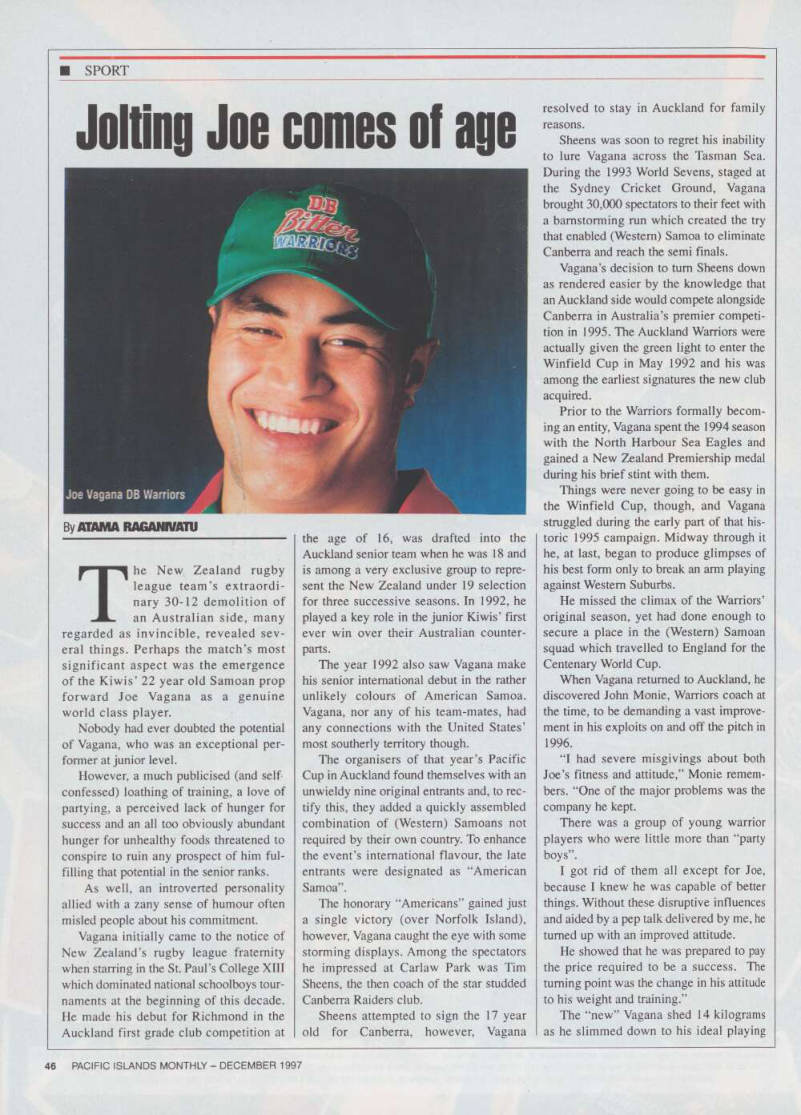
Sport
By Atama Raganivatu
The New Zealand rugby league team’s extraordi nary 30-12 demolition of an Australian side, many regarded as invincible, revealed sev eral things. Perhaps the match’s most significant aspect was the emergence of the Kiwis’ 22 year old Samoan prop forward Joe Vagana as a genuine world class player.
Nobody had ever doubted the potential of Vagana, who was an exceptional per former at junior level.
However, a much publicised (and self confessed) loathing of training, a love of partying, a perceived lack of hunger for success and an all too obviously abundant hunger for unhealthy foods threatened to conspire to ruin any prospect of him ful filling that potential in the senior ranks.
As well, an introverted personality allied with a zany sense of humour often misled people about his commitment.
Vagana initially came to the notice of New Zealand’s rugby league fraternity when starring in the St. Paul’s College XIII which dominated national schoolboys tour naments at the beginning of this decade.
He made his debut for Richmond in the Auckland first grade club competition at
the age of 16, was drafted into the Auckland senior team when he was 18 and is among a very exclusive group to repre sent the New Zealand under 19 selection for three successive seasons. In 1992, he played a key role in the junior Kiwis’ first ever win over their Australian counter parts.
The year 1992 also saw Vagana make his senior international debut in the rather unlikely colours of American Samoa.
Vagana, nor any of his team-mates, had any connections with the United States’ most southerly territory though.
The organisers of that year’s Pacific Cup in Auckland found themselves with an unwieldy nine original entrants and, to rec tify this, they added a quickly assembled combination of (Western) Samoans not required by their own country. To enhance the event’s international flavour, the late entrants were designated as “American Samoa”.
The honorary “Americans” gained just a single victory (over Norfolk Island), however, Vagana caught the eye with some storming displays. Among the spectators he impressed at Carlaw Park was Tim Sheens, the then coach of the star studded Canberra Raiders club.
Sheens attempted to sign the 17 year old for Canberra, however, Vagana
resolved to stay in Auckland for family reasons.
Sheens was soon to regret his inability to lure Vagana across the Tasman Sea.
During the 1993 World Sevens, staged at the Sydney Cricket Ground, Vagana brought 30,000 spectators to their feet with a barnstorming run which created the try that enabled (Western) Samoa to eliminate Canberra and reach the semi finals.
Vagana’s decision to turn Sheens down as rendered easier by the knowledge that an Auckland side would compete alongside Canberra in Australia’s premier competi tion in 1995. The Auckland Warriors were actually given the green light to enter the Winfield Cup in May 1992 and his was among the earliest signatures the new club
acquired.
Prior to the Warriors formally becom ing an entity, Vagana spent the 1994 season with the North Harbour Sea Eagles and gained a New Zealand Premiership medal during his brief stint with them.
Things were never going to be easy in
the Winfield Cup, though, and Vagana
struggled during the early part of that his toric 1995 campaign. Midway through it he, at last, began to produce glimpses of his best form only to break an arm playing against Western Suburbs.
He missed the climax of the Warriors’ original season, yet had done enough to secure a place in the (Western) Samoan squad which travelled to England for the Centenary World Cup.
When Vagana returned to Auckland, he discovered John Monie, Warriors coach at the time, to be demanding a vast improve ment in his exploits on and off the pitch in 1996.
“I had severe misgivings about both Joe’s fitness and attitude,” Monie remem bers. “One of the major problems was the company he kept.
There was a group of young warrior players who were little more than “party boys”.
I got rid of them all except for Joe, because I knew he was capable of better things. Without these disruptive influences and aided by a pep talk delivered by me, he turned up with an improved attitude.
He showed that he was prepared to pay the price required to be a success. The turning point was the change in his attitude to his weight and training.”
The “new” Vagana shed 14 kilograms as he slimmed down to his ideal playing
Joe Vagana DB Warriors
weight of 114 kilograms. Even so, he was far from an automatic choice for the Warriors at the commencement of the 1996 season and, for a while, cousins Linda and Nigel Vagana threatened to overshadow him.
Linda is a prominent member of the New Zealand national netball team and Nigel, her brother, has created consider able waves in rugby league too. He was top try scorer in the 1997 European
Super League.
By the end of 1996, Vagana was enjoying more time on the pitch and less on the replacements’ bench. Early the following season, he won a regular place in the Warriors’ first grade start ing line up and then went about consol idating his reputation.
A constant improvement was under lined with dynamic performances for New Zealand against Queensland and New South Wales in Super League’s inaugural tri series and in the stunning test defeat of Australia.
After the later, Australian coach John Lang stated “Joe Vagana is well on the way to becoming the world’s best prop”.
Although Monie is keen to take cred it for Vagana’s transformation, the true reason, according to the player himself, can be found closer to home.
“My mother died two years ago and that forced me into reassessing things,” he explains. “I decided then that I had to give myself every opportunity in rugby league for her sake. Now, I play
for my family really.
They were never a rich family, but they supported us as we set out. There were no scholarships for us, or anything like that. I want to put something back into the family. Once I’ve done that, it would be nice if I could make a com fortable living for myself.”
There is no doubt that Vagana has already made his family proud.
Anybody requiring proof of that need do no more than go to the village of in Samoa’s Aleipata district.
It is here that Vagana’s father, Sonny, has retired to after 25 years working as a carpenter in Auckland.
His house is easy to find for, above the building, a Warriors flag flies on permanent display! ■
United, we stand
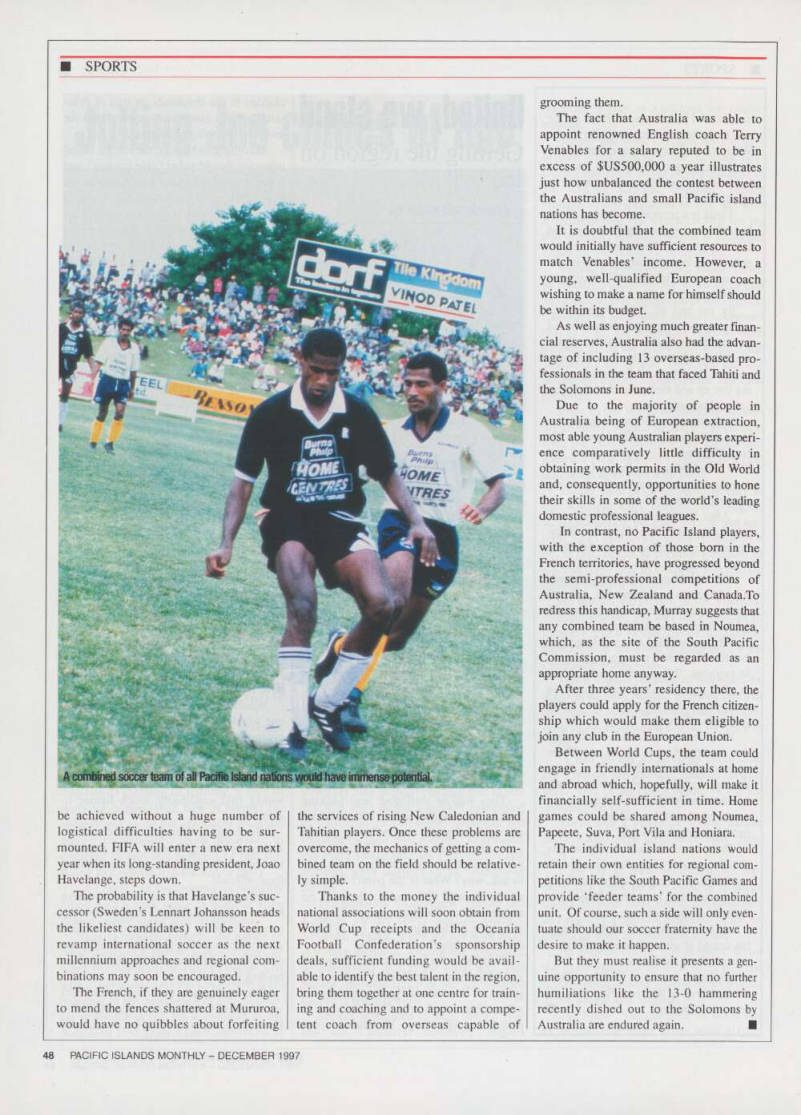
Getting the region on the ball
By Atama Raganivatu
Any observer of the Australian soccer scene would be forgiven if believing Les Murray was omnipresent. He seems to be everywhere - on television, in maga zines, on the radio, in newspapers ...
It is almost a surprise, when entering an Australian soccer stadium, to discover that Murray is not there to take your admission money.
Murray has his detractors. His guttural Hungarian accent is not ideal for match commentating, he is perceived by many to be arrogant and he certainly does not adhere to the old adage about being nice to people on the way up because you might meet them on the way down. However, nobody can dispute Murray’s ency clopaedic knowledge of international soc cer or his perceptiveness. Therefore, when he called, in the migrants’ newspaper II Globo, for Pacific Island nations to field a combined team in the World Cup, the con cept should be given more than a cursory glance.
Murray claims that, individually, the small Pacific Island nations simply cannot compete due to their sparse populations.
His article, published just before Tahiti and the Solomon Islands met Australia in World Cup qualifying series matches in Sydney, stated: “They [Tahiti and the Solomons] are trying, in total futility, to make their mark.
They will be walloped; sent packing back to their sandy beaches with a sackful of conceded goals matched only by the coconuts that await them. Their morale will, again, be shattered leaving them only to ask, why? What is the point? Why are we bothering? Of course, there is no answer to that. There is no point. The soc cer region of Oceania at large has to take a deep look at itself and its future.
“It is clear that the nations of Polynesia and Melanesia, as individual nations, in a game as internationally competitive as soccer, have no future. Oceania, as it is now, has nowhere to go. Nations with pop
ulations in the thousands, or tens of thou sands, cannot compete no matter what the levels of coaching or funding.”
According to Murray, the Pacific Island minnows should either “give it away”, and leave Australia and New Zealand as the sole contestants in subsequent Oceania World Cup qualifying tournaments, or field a combined team or teams. He muses briefly over the possibilities of a united Polynesian selection and a united Melanesian combination, without realising that the former would, beyond much doubt, consist solely of Tahitians; all the other Polynesian nations having little interest in soccer.
As Murray points out, “A soccer com bination of all South Pacific nations, prop erly coached and adequately funded, would surely be a lethal force.” He then goes on to cite New Caledonian Christian Karembeu, a French international who is now one of the game’s superstars, as proof that the region is capable of producing players of exceptional quality.
Indeed, such a team, which Murray dubs Pacific United, would have immense potential but several complications need to be conquered before it comes to fruition.
Murray himself mentions one. FIFA, international soccer’s ruling body, only recognises nations as entities for competi tive international matches and not regions.
Its constitution would have to be amended if a combined team is to get off the ground.
Karembeu is among a handful of play ers from New Caledonia and Tahiti who have represented France.
Would the French Football Association, one wonders, be prepared to allow equally promising individuals to represent the combined team in future rather than “the Tricolours”? Without Tahitian and New Caledonian talent, a united selection would find credibility much harder to achieve.
The greatest obstacle to any combined
side materialising, though, is the probable
lack of will for such a development among local officials.
Officebearers of our administrative
bodies enjoy travelling to regional tourna
ments, rubbing shoulders with their Australian and New Zealand counterparts and savouring the bright lights of the cities hosting those events.
The emergence of a combined team would greatly reduce such opportunities.
However, if the will exists, the way should
be achieved without a huge number of logistical difficulties having to be sur mounted. FIFA will enter a new era next year when its long-standing president, Joao Havelange, steps down.
The probability is that Havelange’s suc cessor (Sweden’s Lennart Johansson heads the likeliest candidates) will be keen to revamp international soccer as the next millennium approaches and regional com binations may soon be encouraged.
The French, if they are genuinely eager to mend the fences shattered at Mururoa, would have no quibbles about forfeiting
the services of rising New Caledonian and Tahitian players. Once these problems are overcome, the mechanics of getting a com bined team on the field should be relative ly simple.
Thanks to the money the individual national associations will soon obtain from World Cup receipts and the Oceania Football Confederation’s sponsorship deals, sufficient funding would be avail able to identify the best talent in the region, bring them together at one centre for train ing and coaching and to appoint a compe tent coach from overseas capable of
grooming them.
The fact that Australia was able to appoint renowned English coach Terry Venables for a salary reputed to be in excess of SUSSOO,OOO a year illustrates just how unbalanced the contest between the Australians and small Pacific island nations has become.
It is doubtful that the combined team would initially have sufficient resources to match Venables’ income. However, a young, well-qualified European coach wishing to make a name for himself should be within its budget.
As well as enjoying much greater finan cial reserves, Australia also had the advan tage of including 13 overseas-based pro fessionals in the team that faced Tahiti and the Solomons in June.
Due to the majority of people in Australia being of European extraction, most able young Australian players experi ence comparatively little difficulty in obtaining work permits in the Old World and, consequently, opportunities to hone their skills in some of the world’s leading domestic professional leagues.
In contrast, no Pacific Island players, with the exception of those bom in the French territories, have progressed beyond
the semi-professional competitions of
Australia, New Zealand and Canada.To redress this handicap, Murray suggests that any combined team be based in Noumea, which, as the site of the South Pacific Commission, must be regarded as an appropriate home anyway.
After three years’ residency there, the players could apply for the French citizen ship which would make them eligible to join any club in the European Union.
Between World Cups, the team could engage in friendly internationals at home and abroad which, hopefully, will make it financially self-sufficient in time. Home games could be shared among Noumea, Papeete, Suva, Port Vila and Honiara.
The individual island nations would retain their own entities for regional com petitions like the South Pacific Games and provide ‘feeder teams’ for the combined unit. Of course, such a side will only even tuate should our soccer fraternity have the desire to make it happen.
But they must realise it presents a gen uine opportunity to ensure that no further humiliations like the 13-0 hammering recently dished out to the Solomons by Australia are endured again. ■
A combined soccer team of all Pacific Island nations would have immense potential.
The festival of the dreaming
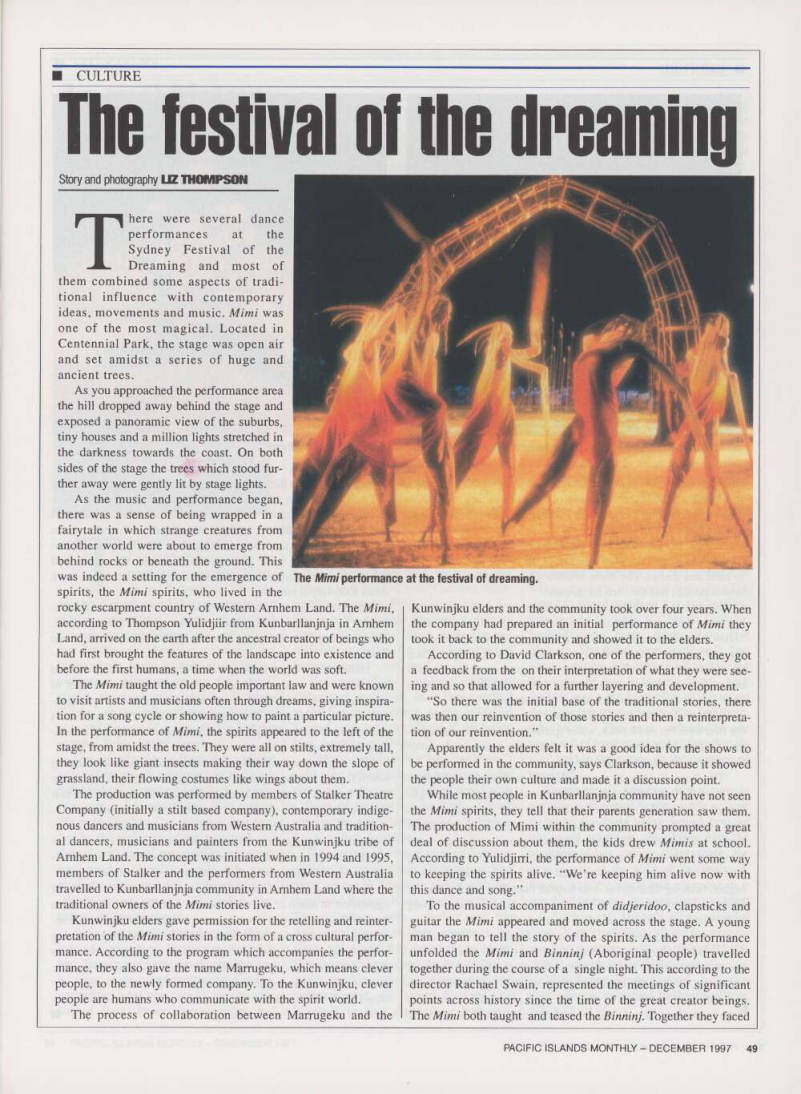
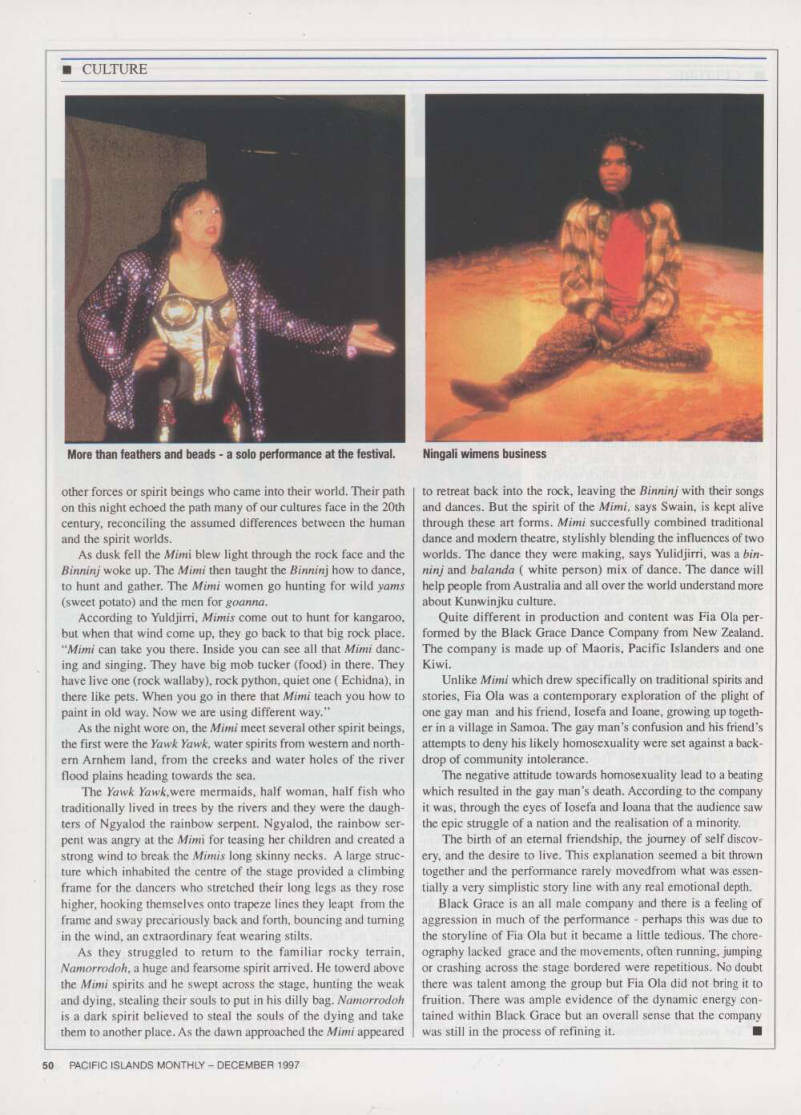
Culture
Story and photography LIZ THOMPSON
There were several dance performances at the Sydney Festival of the Dreaming and most of them combined some aspects of tradi tional influence with contemporary ideas, movements and music. Mimi was one of the most magical. Located in Centennial Park, the stage was open air and set amidst a series of huge and ancient trees.
As you approached the performance area the hill dropped away behind the stage and exposed a panoramic view of the suburbs, tiny houses and a million lights stretched in the darkness towards the coast. On both sides of the stage the trees which stood fur ther away were gently lit by stage lights.
As the music and performance began, there was a sense of being wrapped in a fairytale in which strange creatures from another world were about to emerge from behind rocks or beneath the ground. This was indeed a setting for the emergence of spirits, the Mimi spirits, who lived in the
rocky escarpment country of Western Arnhem Land. The Mimi, according to Thompson Yulidjiir from Kunbarllanjnja in Amhem Land, arrived on the earth after the ancestral creator of beings who had first brought the features of the landscape into existence and before the first humans, a time when the world was soft.
The Mimi taught the old people important law and were known to visit artists and musicians often through dreams, giving inspira tion for a song cycle or showing how to paint a particular picture.
In the performance of Mimi, the spirits appeared to the left of the stage, from amidst the trees. They were all on stilts, extremely tall, they look like giant insects making their way down the slope of grassland, their flowing costumes like wings about them.
The production was performed by members of Stalker Theatre Company (initially a stilt based company), contemporary indige nous dancers and musicians from Western Australia and tradition al dancers, musicians and painters from the Kunwinjku tribe of Amhem Land. The concept was initiated when in 1994 and 1995, members of Stalker and the performers from Western Australia travelled to Kunbarllanjnja community in Amhem Land where the traditional owners of the Mimi stories live.
Kunwinjku elders gave permission for the retelling and reinter pretation of the Mimi stories in the form of a cross cultural perfor mance. According to the program which accompanies the perfor mance, they also gave the name Marrugeku, which means clever people, to the newly formed company. To the Kunwinjku, clever people are humans who communicate with the spirit world.
The process of collaboration between Marrugeku and the
Kunwinjku elders and the community took over four years. When the company had prepared an initial performance of Mimi they took it back to the community and showed it to the elders.
According to David Clarkson, one of the performers, they got a feedback from the on their interpretation of what they were see ing and so that allowed for a further layering and development.
“So there was the initial base of the traditional stories, there was then our reinvention of those stories and then a reinterpreta tion of our reinvention.”
Apparently the elders felt it was a good idea for the shows to be performed in the community, says Clarkson, because it showed the people their own culture and made it a discussion point.
While most people in Kunbarllanjnja community have not seen the Mimi spirits, they tell that their parents generation saw them.
The production of Mimi within the community prompted a great deal of discussion about them, the kids drew Mimis at school.
According to Yulidjirri, the performance of Mimi went some way to keeping the spirits alive. “We’re keeping him alive now with this dance and song.”
To the musical accompaniment of didjeridoo, clapsticks and guitar the Mimi appeared and moved across the stage. A young man began to tell the story of the spirits. As the performance unfolded the Mimi and Binninj (Aboriginal people) travelled together during the course of a single night. This according to the director Rachael Swain, represented the meetings of significant points across history since the time of the great creator beings.
The Mimi both taught and teased the Binninj. Together they faced
The Mimi performance at the festival of dreaming.
other forces or spirit beings who came into their world. Their path on this night echoed the path many of our cultures face in the 20th century, reconciling the assumed differences between the human and the spirit worlds.
As dusk fell the Mimi blew light through the rock face and the Binninj woke up. The Mimi then taught the Binninj how to dance, to hunt and gather. The Mimi women go hunting for wild yams (sweet potato) and the men for goanna.
According to Yuldjirri, Mimis come out to hunt for kangaroo, but when that wind come up, they go back to that big rock place.
“Mimi can take you there. Inside you can see all that Mimi danc ing and singing. They have big mob tucker (food) in there. They have live one (rock wallaby), rock python, quiet one ( Echidna), in there like pets. When you go in there that Mimi teach you how to paint in old way. Now we are using different way.”
As the night wore on, the Mimi meet several other spirit beings, the first were the Yawk Yawk, water spirits from western and north ern Arnhem land, from the creeks and water holes of the river flood plains heading towards the sea.
The Yawk Yawk,were mermaids, half woman, half fish who traditionally lived in trees by the rivers and they were the daugh ters of Ngyalod the rainbow serpent. Ngyalod, the rainbow ser pent was angry at the Mimi for teasing her children and created a strong wind to break the Mimis long skinny necks. A large struc ture which inhabited the centre of the stage provided a climbing frame for the dancers who stretched their long legs as they rose higher, hooking themselves onto trapeze lines they leapt from the frame and sway precariously back and forth, bouncing and turning in the wind, an extraordinary feat wearing stilts.
As they struggled to return to the familiar rocky terrain, Namorrodoh, a huge and fearsome spirit arrived. He towerd above the Mimi spirits and he swept across the stage, hunting the weak and dying, stealing their souls to put in his dilly bag. Namorrodoh is a dark spirit believed to steal the souls of the dying and take them to another place. As the dawn approached the Mimi appeared
to retreat back into the rock, leaving the Binninj with their songs and dances. But the spirit of the Mimi, says Swain, is kept alive through these art forms. Mimi succesfully combined traditional dance and modem theatre, stylishly blending the influences of two worlds. The dance they were making, says Yulidjirri, was a bin ninj and balanda ( white person) mix of dance. The dance will help people from Australia and all over the world understand more about Kunwinjku culture.
Quite different in production and content was Fia Ola per formed by the Black Grace Dance Company from New Zealand.
The company is made up of Maoris, Pacific Islanders and one Kiwi.
Unlike Mimi which drew specifically on traditional spirits and stories, Fia Ola was a contemporary exploration of the plight of one gay man and his friend, losefa and loane, growing up togeth er in a village in Samoa. The gay man’s confusion and his friend’s attempts to deny his likely homosexuality were set against a back drop of community intolerance.
The negative attitude towards homosexuality lead to a beating which resulted in the gay man’s death. According to the company it was, through the eyes of losefa and loana that the audience saw the epic struggle of a nation and the realisation of a minority.
The birth of an eternal friendship, the journey of self discov ery, and the desire to live. This explanation seemed a bit thrown together and the performance rarely movedfrom what was essen tially a very simplistic story line with any real emotional depth.
Black Grace is an all male company and there is a feeling of aggression in much of the performance - perhaps this was due to the storyline of Fia Ola but it became a little tedious. The chore ography lacked grace and the movements, often running, jumping or crashing across the stage bordered were repetitious. No doubt there was talent among the group but Fia Ola did not bring it to fruition. There was ample evidence of the dynamic energy con tained within Black Grace but an overall sense that the company was still in the process of refining it. ■
More than feathers and beads-a solo performance at the festival.
Ningali wimens business
An oral history
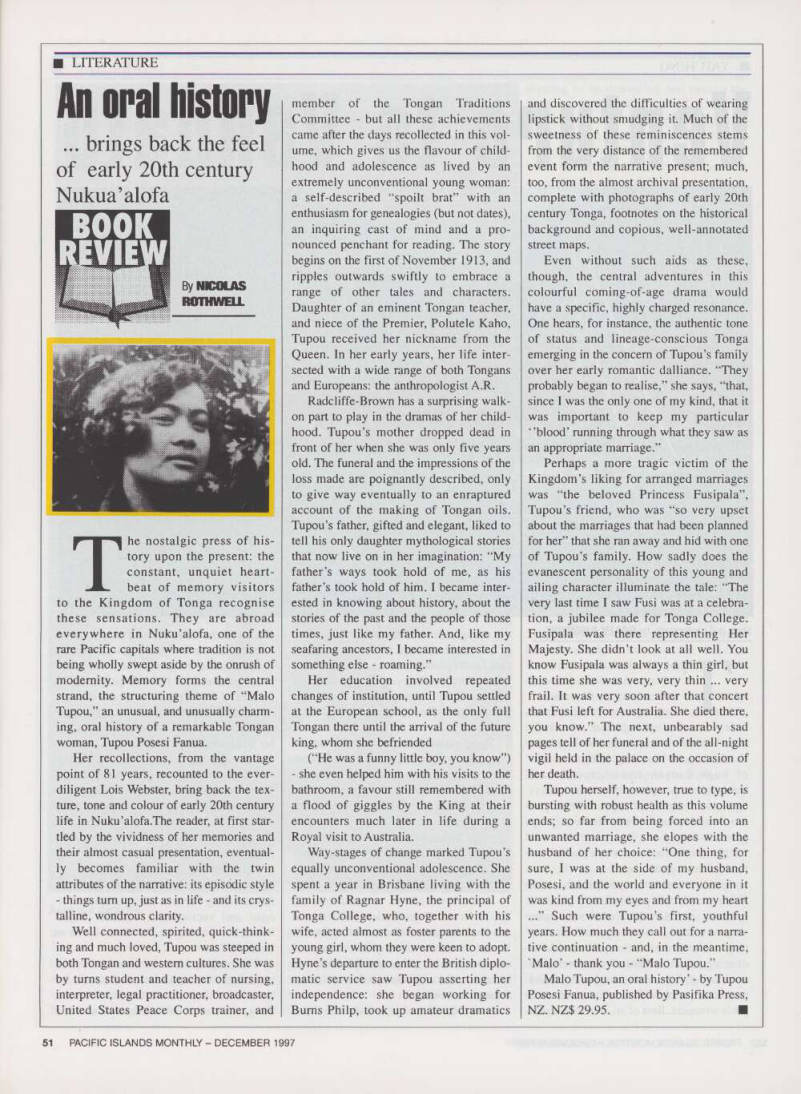
Literature
...brings back the feel of early 20th century Nukua’alofa
By Nicolas
Rothwell
The nostalgic press of his tory upon the present: the constant, unquiet heart beat of memory visitors to the Kingdom of Tonga recognise these sensations. They are abroad everywhere in Nuku’alofa, one of the rare Pacific capitals where tradition is not being wholly swept aside by the onrush of modernity. Memory forms the central strand, the structuring theme of “Malo Tupou,” an unusual, and unusually charm ing, oral history of a remarkable Tongan woman, Tupou Posesi Fanua.
Her recollections, from the vantage point of 81 years, recounted to the ever diligent Lois Webster, bring back the tex ture, tone and colour of early 20th century life in Nuku’alofa.The reader, at first star tled by the vividness of her memories and their almost casual presentation, eventual ly becomes familiar with the twin attributes of the narrative; its episodic style - things turn up, just as in life - and its crys talline, wondrous clarity.
Well connected, spirited, quick-think ing and much loved, Tupou was steeped in both Tongan and western cultures. She was by turns student and teacher of nursing, interpreter, legal practitioner, broadcaster, United States Peace Corps trainer, and
member of the Tongan Traditions Committee - but all these achievements came after the days recollected in this vol ume, which gives us the flavour of child hood and adolescence as lived by an extremely unconventional young woman: a self-described “spoilt brat” with an enthusiasm for genealogies (but not dates), an inquiring cast of mind and a pro nounced penchant for reading. The story begins on the first of November 1913, and ripples outwards swiftly to embrace a range of other tales and characters.
Daughter of an eminent Tongan teacher, and niece of the Premier, Polutele Kaho, Tupou received her nickname from the Queen. In her early years, her life inter sected with a wide range of both Tongans and Europeans: the anthropologist A.R.
Radcliffe-Brown has a surprising walk on part to play in the dramas of her child hood. Tupou’s mother dropped dead in front of her when she was only five years old. The funeral and the impressions of the loss made are poignantly described, only to give way eventually to an enraptured account of the making of Tongan oils.
Tupou’s father, gifted and elegant, liked to tell his only daughter mythological stories that now live on in her imagination: “My father’s ways took hold of me, as his father’s took hold of him. I became inter ested in knowing about history, about the stories of the past and the people of those times, just like my father. And, like my seafaring ancestors, I became interested in something else - roaming.”
Her education involved repeated changes of institution, until Tupou settled at the European school, as the only full Tongan there until the arrival of the future king, whom she befriended (“He was a funny little boy, you know”) - she even helped him with his visits to the bathroom, a favour still remembered with a flood of giggles by the King at their encounters much later in life during a Royal visit to Australia.
Way-stages of change marked Tupou’s equally unconventional adolescence. She spent a year in Brisbane living with the family of Ragnar Hyne, the principal of Tonga College, who, together with his wife, acted almost as foster parents to the young girl, whom they were keen to adopt.
Hyne’s departure to enter the British diplo matic service saw Tupou asserting her independence: she began working for Bums Philp, took up amateur dramatics
and discovered the difficulties of wearing lipstick without smudging it. Much of the sweetness of these reminiscences stems from the very distance of the remembered event form the narrative present; much, too, from the almost archival presentation, complete with photographs of early 20th century Tonga, footnotes on the historical background and copious, well-annotated street maps.
Even without such aids as these, though, the central adventures in this colourful coming-of-age drama would have a specific, highly charged resonance.
One hears, for instance, the authentic tone of status and lineage-conscious Tonga emerging in the concern of Tupou’s family over her early romantic dalliance. “They probably began to realise,” she says, “that, since I was the only one of my kind, that it was important to keep my particular ‘’blood’ running through what they saw as an appropriate marriage.”
Perhaps a more tragic victim of the
Kingdom’s liking for arranged marriages
was “the beloved Princess Fusipala”, Tupou’s friend, who was “so very upset about the marriages that had been planned for her” that she ran away and hid with one of Tupou’s family. How sadly does the evanescent personality of this young and ailing character illuminate the tale: “The very last time I saw Fusi was at a celebra tion, a jubilee made for Tonga College.
Fusipala was there representing Her Majesty. She didn’t look at all well. You know Fusipala was always a thin girl, but this time she was very, very thin ... very frail. It was very soon after that concert that Fusi left for Australia. She died there, you know.” The next, unbearably sad pages tell of her funeral and of the all-night vigil held in the palace on the occasion of her death.
Tupou herself, however, true to type, is bursting with robust health as this volume ends; so far from being forced into an unwanted marriage, she elopes with the husband of her choice: “One thing, for sure, I was at the side of my husband, Posesi, and the world and everyone in it was kind from my eyes and from my heart ...” Such were Tupou’s first, youthful years. How much they call out for a narra tive continuation - and, in the meantime, 'Malo’ - thank you - “Malo Tupou.”
Malo Tupou, an oral history’ - by Tupou Posesi Fanua, published by Pasifika Press,
Nz. Nz$ 29.95. ■
Venture to Vanuatu
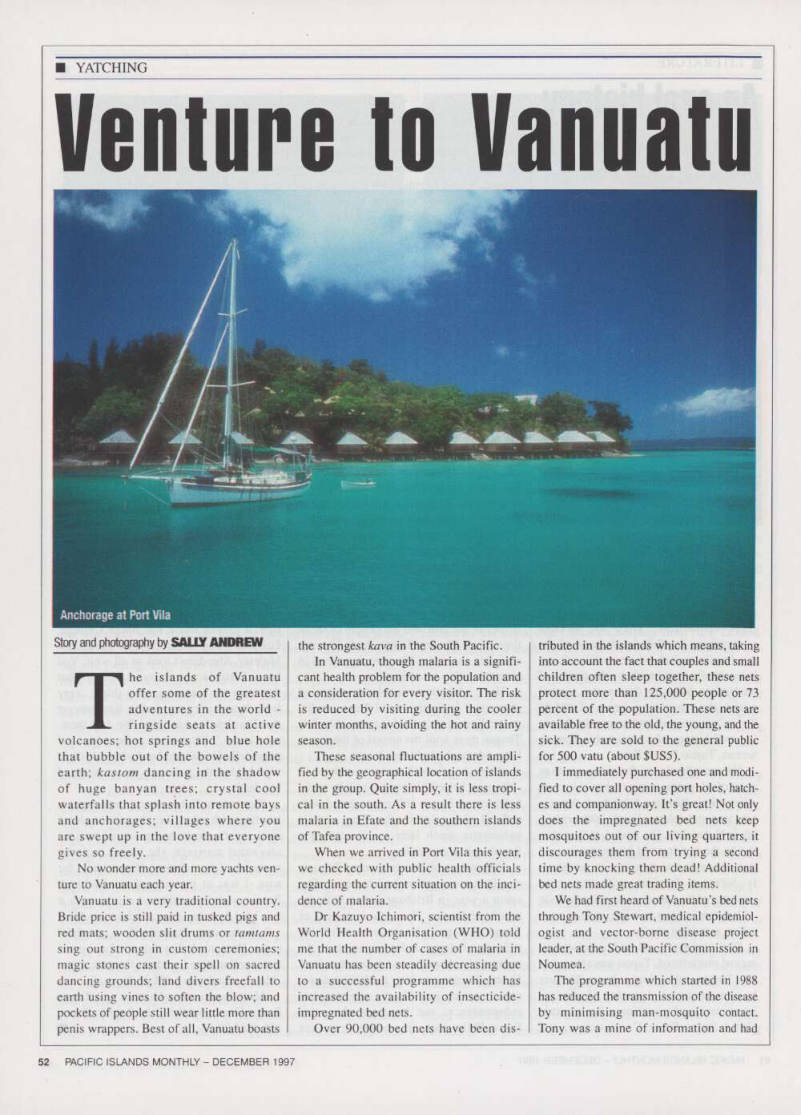
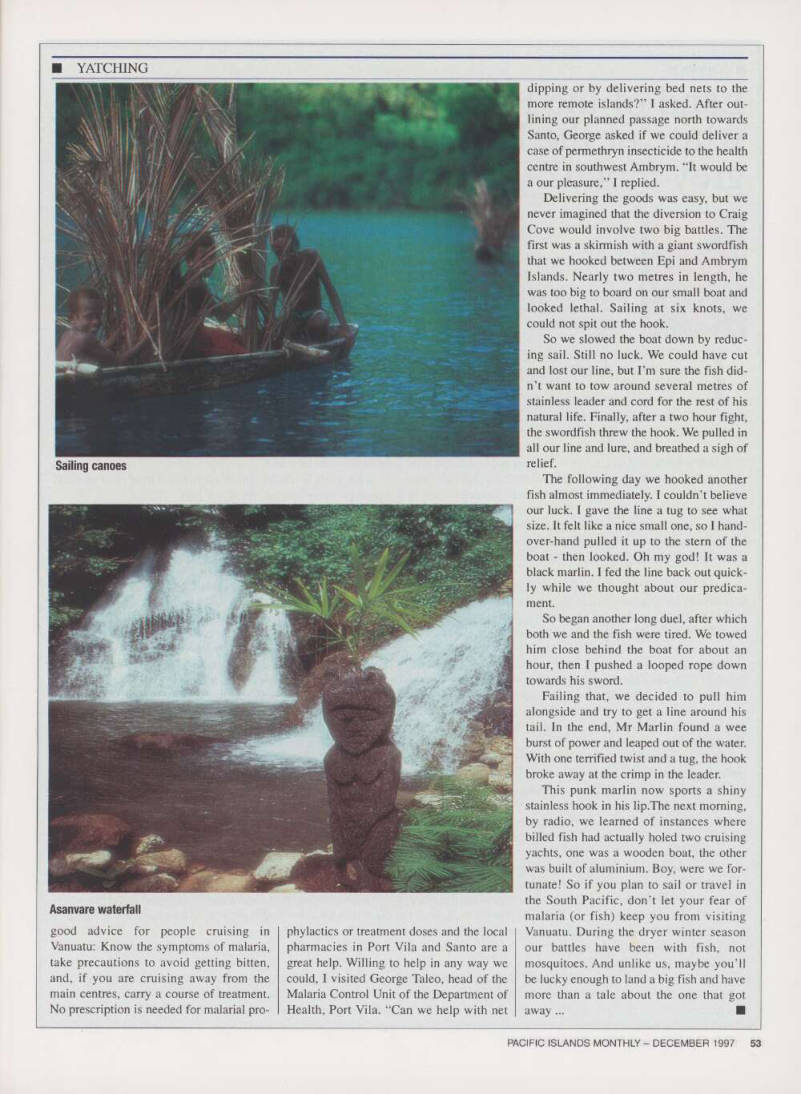
Yatching
Story and photography by SALLY ANDREW
The islands of Vanuatu offer some of the greatest adventures in the world ringside seats at active volcanoes; hot springs and blue hole that bubble out of the bowels of the earth; kastom dancing in the shadow of huge banyan trees; crystal cool waterfalls that splash into remote bays and anchorages; villages where you are swept up in the love that everyone
gives so freely.
No wonder more and more yachts ven ture to Vanuatu each year.
Vanuatu is a very traditional country.
Bride price is still paid in tusked pigs and red mats; wooden slit drums or tamtams sing out strong in custom ceremonies; magic stones cast their spell on sacred dancing grounds; land divers freefall to earth using vines to soften the blow; and pockets of people still wear little more than penis wrappers. Best of all, Vanuatu boasts
the strongest kava in the South Pacific.
In Vanuatu, though malaria is a signifi cant health problem for the population and a consideration for every visitor. The risk is reduced by visiting during the cooler winter months, avoiding the hot and rainy season.
These seasonal fluctuations are ampli fied by the geographical location of islands in the group. Quite simply, it is less tropi cal in the south. As a result there is less malaria in Efate and the southern islands of Tafea province.
When we arrived in Port Vila this year, we checked with public health officials regarding the current situation on the inci dence of malaria.
Dr Kazuyo Ichimori, scientist from the World Health Organisation (WHO) told me that the number of cases of malaria in Vanuatu has been steadily decreasing due to a successful programme which has increased the availability of insecticide impregnated bed nets.
Over 90,000 bed nets have been dis
tributed in the islands which means, taking into account the fact that couples and small children often sleep together, these nets protect more than 125,000 people or 73 percent of the population. These nets are available free to the old, the young, and the sick. They are sold to the general public for 500 vatu (about SUSS).
I immediately purchased one and modi fied to cover all opening port holes, hatch es and companionway. It’s great! Not only does the impregnated bed nets keep mosquitoes out of our living quarters, it discourages them from trying a second time by knocking them dead! Additional bed nets made great trading items.
We had first heard of Vanuatu’s bed nets through Tony Stewart, medical epidemiol ogist and vector-borne disease project leader, at the South Pacific Commission in Noumea.
The programme which started in 1988 has reduced the transmission of the disease by minimising man-mosquito contact.
Tony was a mine of information and had
Anchorage at Port Vila
good advice for people cruising in Vanuatu: Know the symptoms of malaria, take precautions to avoid getting bitten, and, if you are cruising away from the main centres, carry a course of treatment.
No prescription is needed for malarial pro
phylactics or treatment doses and the local pharmacies in Port Vila and Santo are a great help. Willing to help in any way we could, I visited George Taleo, head of the Malaria Control Unit of the Department of Health, Port Vila. “Can we help with net
dipping or by delivering bed nets to the more remote islands?” I asked. After out lining our planned passage north towards Santo, George asked if we could deliver a case of permethryn insecticide to the health centre in southwest Ambrym. “It would be a our pleasure,” I replied.
Delivering the goods was easy, but we never imagined that the diversion to Craig Cove would involve two big battles. The first was a skirmish with a giant swordfish that we hooked between Epi and Ambrym Islands. Nearly two metres in length, he was too big to board on our small boat and looked lethal. Sailing at six knots, we could not spit out the hook.
So we slowed the boat down by reduc ing sail. Still no luck. We could have cut and lost our line, but I’m sure the fish did n’t want to tow around several metres of stainless leader and cord for the rest of his natural life. Finally, after a two hour fight, the swordfish threw the hook. We pulled in all our line and lure, and breathed a sigh of relief.
The following day we hooked another fish almost immediately. I couldn’t believe our luck. I gave the line a tug to see what size. It felt like a nice small one, so I hand over-hand pulled it up to the stern of the boat - then looked. Oh my god! It was a black marlin. I fed the line back out quick ly while we thought about our predica ment.
So began another long duel, after which both we and the fish were tired. We towed him close behind the boat for about an hour, then I pushed a looped rope down towards his sword.
Failing that, we decided to pull him alongside and try to get a line around his tail. In the end, Mr Marlin found a wee burst of power and leaped out of the water.
With one terrified twist and a tug, the hook broke away at the crimp in the leader.
This punk marlin now sports a shiny stainless hook in his lip. The next morning, by radio, we learned of instances where billed fish had actually holed two cruising yachts, one was a wooden boat, the other was built of aluminium. Boy, were we for tunate! So if you plan to sail or travel in the South Pacific, don’t let your fear of malaria (or fish) keep you from visiting Vanuatu. During the dryer winter season our battles have been with fish, not mosquitoes. And unlike us, maybe you’ll be lucky enough to land a big fish and have more than a tale about the one that got away... ■
Sailing canoes
Asanvare waterfall
white or the long
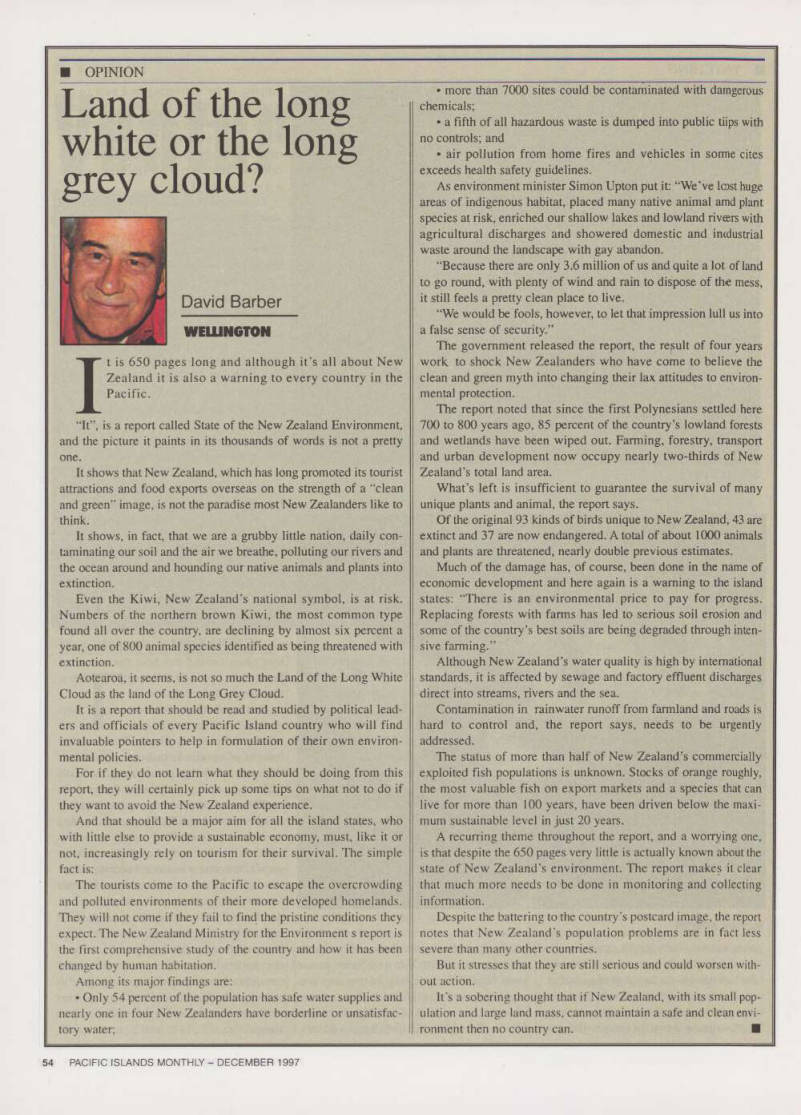
Opinion
Land of the long white or the long grey cloud?
It is 650 pages long and although it’s all about New Zealand it is also a warning to every country in the Pacific.
“It”, is a report called State of the New Zealand Environment, and the picture it paints in its thousands of words is not a pretty one.
It shows that New Zealand, which has long promoted its tourist attractions and food exports overseas on the strength of a “clean and green” image, is not the paradise most New Zealanders like to think.
It shows, in fact, that we are a grubby little nation, daily con taminating our soil and the air we breathe, polluting our rivers and the ocean around and hounding our native animals and plants into extinction.
Even the Kiwi, New Zealand’s national symbol, is at risk.
Numbers of the northern brown Kiwi, the most common type found all over the country, are declining by almost six percent a year, one of 800 animal species identified as being threatened with extinction.
Aotearoa, it seems, is not so much the Land of the Long White Cloud as the land of the Long Grey Cloud.
It is a report that should be read and studied by political lead ers and officials of every Pacific Island country who will find invaluable pointers to help in formulation of their own environ
mental policies.
For if they do not leam what they should be doing from this report, they will certainly pick up some tips on what not to do if they want to avoid the New Zealand experience.
And that should be a major aim for all the island states, who with little else to provide a sustainable economy, must, like it or not, increasingly rely on tourism for their survival. The simple fact is: The tourists come to the Pacific to escape the overcrowding and polluted environments of their more developed homelands.
They will not come if they fail to find the pristine conditions they expect. The New Zealand Ministry for the Environment s report is the first comprehensive study of the country and how it has been changed by human habitation.
Among its major findings are: • Only 54 percent of the population has safe water supplies and nearly one in four New Zealanders have borderline or unsatisfac tory water;
• more than 7000 sites could be contaminated with daingerous chemicals; • a fifth of all hazardous waste is dumped into public dips with no controls; and • air pollution from home fires and vehicles in sorme cites exceeds health safety guidelines.
As environment minister Simon Upton put it: “We’ve lost huge areas of indigenous habitat, placed many native animal amd plant species at risk, enriched our shallow lakes and lowland riveers with agricultural discharges and showered domestic and industrial waste around the landscape with gay abandon.
“Because there are only 3.6 million of us and quite a lot of land to go round, with plenty of wind and rain to dispose of the mess, it still feels a pretty clean place to live.
“We would be fools, however, to let that impression lull us into a false sense of security.”
The government released the report, the result of four years work to shock New Zealanders who have come to believe the clean and green myth into changing their lax attitudes to environ mental protection.
The report noted that since the first Polynesians settled here 700 to 800 years ago, 85 percent of the country’s lowland forests and wetlands have been wiped out. Farming, forestry, transport and urban development now occupy nearly two-thirds of New Zealand’s total land area.
What’s left is insufficient to guarantee the survival of many unique plants and animal, the report says.
Of the original 93 kinds of birds unique to New Zealand, 43 are extinct and 37 are now endangered. A total of about 1000 animals and plants are threatened, nearly double previous estimates.
Much of the damage has, of course, been done in the name of economic development and here again is a warning to the island states: “There is an environmental price to pay for progress.
Replacing forests with farms has led to serious soil erosion and some of the country’s best soils are being degraded through inten sive farming.”
Although New Zealand’s water quality is high by international standards, it is affected by sewage and factory effluent discharges direct into streams, rivers and the sea.
Contamination in rainwater runoff from farmland and roads is hard to control and, the report says, needs to be urgently addressed.
The status of more than half of New Zealand’s commercially exploited fish populations is unknown. Stocks of orange roughly, the most valuable fish on export markets and a species that can live for more than 100 years, have been driven below the maxi mum sustainable level in just 20 years.
A recurring theme throughout the report, and a worrying one, is that despite the 650 pages very little is actually known about the state of New Zealand’s environment. The report makes it clear that much more needs to be done in monitoring and collecting information.
Despite the battering to the country's postcard image, the report notes that New Zealand's population problems are in fact less severe than many other countries.
But it stresses that they are still serious and could worsen with out action.
It's a sobering thought that if New Zealand, with its small pop ulation and large land mass, cannot maintain a safe and clean envi ronment then no country can. ■
David Barber
Wellington
Asia’s woes and us
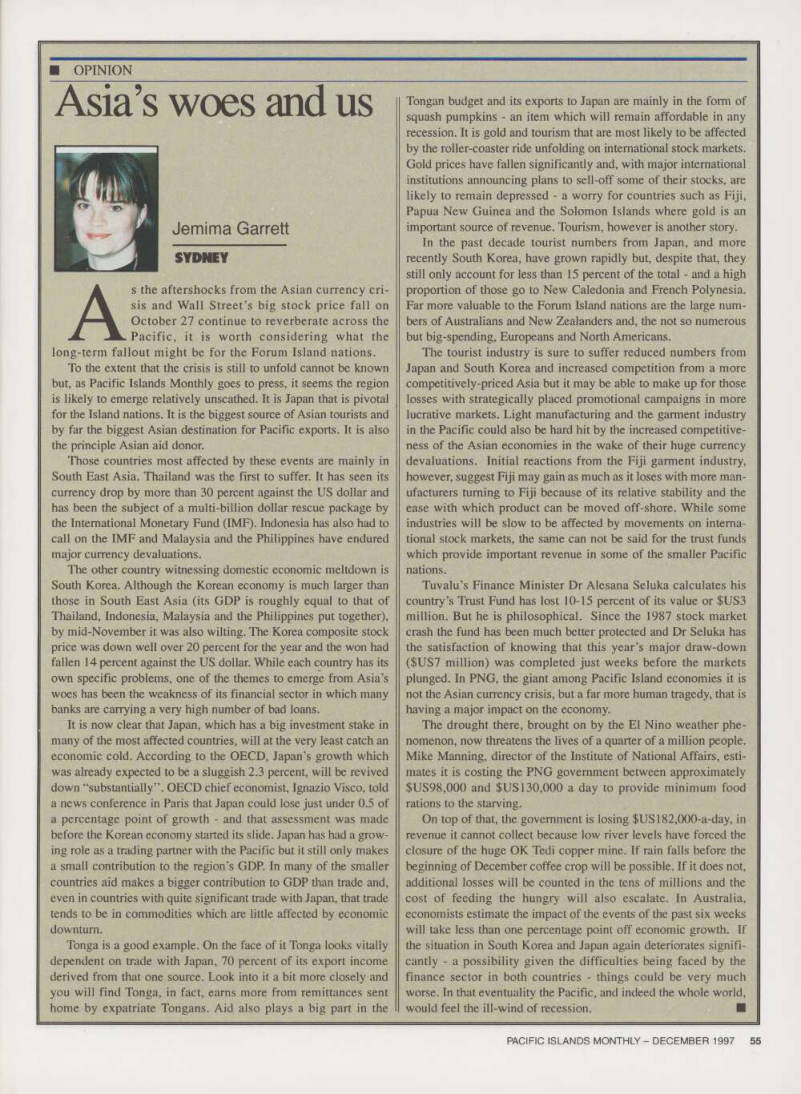
As the aftershocks from the Asian currency cri sis and Wall Street’s big stock price fall on October 27 continue to reverberate across the Pacific, it is worth considering what the long-term fallout might be for the Forum Island nations.
To the extent that the crisis is still to unfold cannot be known but, as Pacific Islands Monthly goes to press, it seems the region is likely to emerge relatively unscathed. It is Japan that is pivotal for the Island nations. It is the biggest source of Asian tourists and by far the biggest Asian destination for Pacific exports. It is also the principle Asian aid donor.
Those countries most affected by these events are mainly in South East Asia. Thailand was the first to suffer. It has seen its currency drop by more than 30 percent against the US dollar and has been the subject of a multi-billion dollar rescue package by the International Monetary Fund (IMF). Indonesia has also had to call on the IMF and Malaysia and the Philippines have endured major currency devaluations.
The other country witnessing domestic economic meltdown is South Korea. Although the Korean economy is much larger than those in South East Asia (its GDP is roughly equal to that of Thailand, Indonesia, Malaysia and the Philippines put together), by mid-November it was also wilting. The Korea composite stock price was down well over 20 percent for the year and the won had fallen 14 percent against the US dollar. While each country has its own specific problems, one of the themes to emerge from Asia’s woes has been the weakness of its financial sector in which many banks are carrying a very high number of bad loans.
It is now clear that Japan, which has a big investment stake in many of the most affected countries, will at the very least catch an economic cold. According to the OECD, Japan’s growth which was already expected to be a sluggish 2.3 percent, will be revived down “substantially”. OECD chief economist, Ignazio Visco, told a news conference in Paris that Japan could lose just under 0.5 of a percentage point of growth - and that assessment was made before the Korean economy started its slide. Japan has had a grow ing role as a trading partner with the Pacific but it still only makes a small contribution to the region’s GDP. In many of the smaller countries aid makes a bigger contribution to GDP than trade and, even in countries with quite significant trade with Japan, that trade tends to be in commodities which are little affected by economic downturn.
Tonga is a good example. On the face of it Tonga looks vitally dependent on trade with Japan, 70 percent of its export income derived from that one source. Look into it a bit more closely and you will find Tonga, in fact, earns more from remittances sent home by expatriate Tongans. Aid also plays a big part in the
Tongan budget and its exports to Japan are mainly in the form of squash pumpkins - an item which will remain affordable in any recession. It is gold and tourism that are most likely to be affected by the roller-coaster ride unfolding on international stock markets.
Gold prices have fallen significantly and, with major international institutions announcing plans to sell-off some of their stocks, are likely to remain depressed - a worry for countries such as Fiji, Papua New Guinea and the Solomon Islands where gold is an important source of revenue. Tourism, however is another story.
In the past decade tourist numbers from Japan, and more recently South Korea, have grown rapidly but, despite that, they still only account for less than 15 percent of the total - and a high proportion of those go to New Caledonia and French Polynesia.
Far more valuable to the Forum Island nations are the large num bers of Australians and New Zealanders and, the not so numerous but big-spending, Europeans and North Americans.
The tourist industry is sure to suffer reduced numbers from Japan and South Korea and increased competition from a more competitively-priced Asia but it may be able to make up for those losses with strategically placed promotional campaigns in more lucrative markets. Light manufacturing and the garment industry in the Pacific could also be hard hit by the increased competitive ness of the Asian economies in the wake of their huge currency devaluations. Initial reactions from the Fiji garment industry, however, suggest Fiji may gain as much as it loses with more man ufacturers turning to Fiji because of its relative stability and the ease with which product can be moved off-shore. While some industries will be slow to be affected by movements on interna tional stock markets, the same can not be said for the trust funds which provide important revenue in some of the smaller Pacific nations.
Tuvalu’s Finance Minister Dr Alesana Seluka calculates his country’s Trust Fund has lost 10-15 percent of its value or SUS 3 million. But he is philosophical. Since the 1987 stock market crash the fund has been much better protected and Dr Seluka has the satisfaction of knowing that this year’s major draw-down (SUS 7 million) was completed just weeks before the markets plunged. In PNG, the giant among Pacific Island economies it is not the Asian currency crisis, but a far more human tragedy, that is having a major impact on the economy.
The drought there, brought on by the El Nino weather phe nomenon, now threatens the lives of a quarter of a million people.
Mike Manning, director of the Institute of National Affairs, esti mates it is costing the PNG government between approximately SUS9B,OOO and SUS 130,000 a day to provide minimum food rations to the starving.
On top of that, the government is losing SUSIB2,OOO-a-day, in revenue it cannot collect because low river levels have forced the closure of the huge OK Tedi copper mine. If rain falls before the beginning of December coffee crop will be possible. If it does not, additional losses will be counted in the tens of millions and the cost of feeding the hungry will also escalate. In Australia, economists estimate the impact of the events of the past six weeks will take less than one percentage point off economic growth. If the situation in South Korea and Japan again deteriorates signifi cantly - a possibility given the difficulties being faced by the finance sector in both countries - things could be very much worse. In that eventuality the Pacific, and indeed the whole world, would feel the ill-wind of recession. ■
Jemima Garrett
Sydney
Commision gets new name
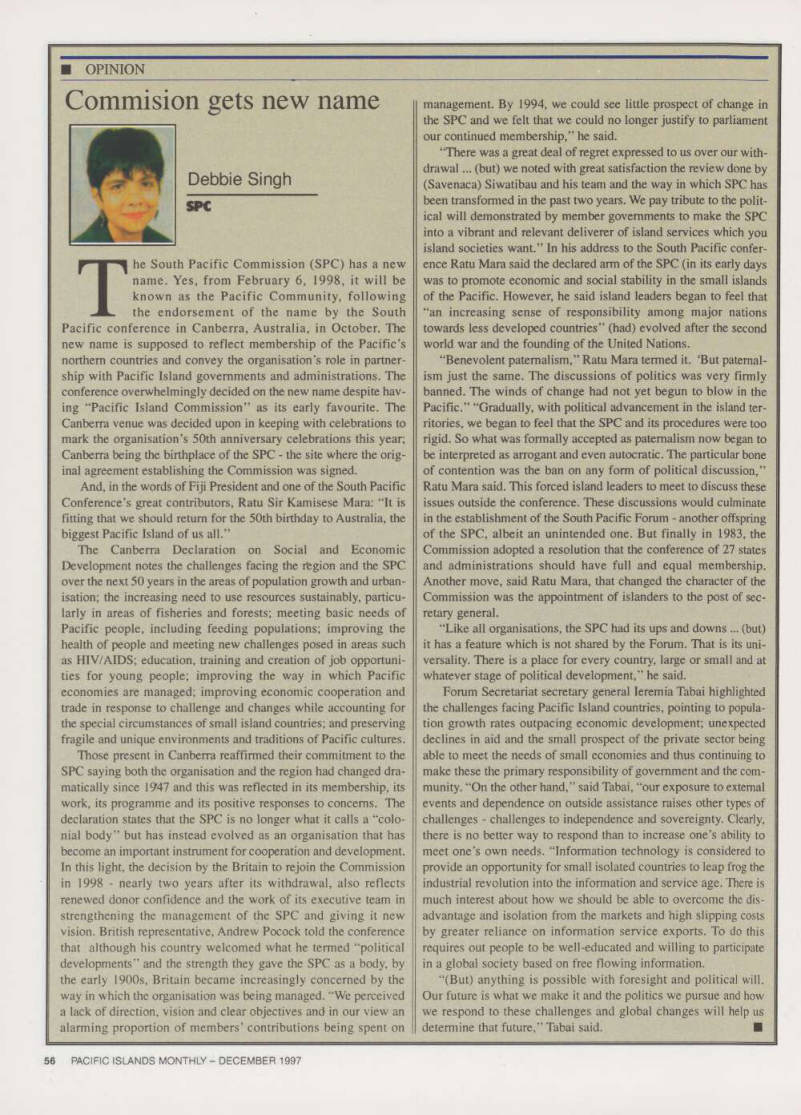
The South Pacific Commission (SPC) has a new name. Yes, from February 6, 1998, it will be known as the Pacific Community, following the endorsement of the name by the South Pacific conference in Canberra, Australia, in October. The new name is supposed to reflect membership of the Pacific’s northern countries and convey the organisation’s role in partner ship with Pacific Island governments and administrations. The conference overwhelmingly decided on the new name despite hav ing “Pacific Island Commission” as its early favourite. The Canberra venue was decided upon in keeping with celebrations to mark the organisation’s 50th anniversary celebrations this year; Canberra being the birthplace of the SPC - the site where the orig inal agreement establishing the Commission was signed.
And, in the words of Fiji President and one of the South Pacific Conference’s great contributors, Ratu Sir Kamisese Mara: “It is fitting that we should return for the 50th birthday to Australia, the biggest Pacific Island of us all.”
The Canberra Declaration on Social and Economic Development notes the challenges facing the region and the SPC over the next 50 years in the areas of population growth and urban isation; the increasing need to use resources sustainably, particu larly in areas of fisheries and forests; meeting basic needs of Pacific people, including feeding populations; improving the health of people and meeting new challenges posed in areas such as HIV/AIDS; education, training and creation of job opportuni ties for young people; improving the way in which Pacific economies are managed; improving economic cooperation and trade in response to challenge and changes while accounting for the special circumstances of small island countries; and preserving fragile and unique environments and traditions of Pacific cultures.
Those present in Canberra reaffirmed their commitment to the SPC saying both the organisation and the region had changed dra matically since 1947 and this was reflected in its membership, its work, its programme and its positive responses to concerns. The declaration states that the SPC is no longer what it calls a “colo nial body” but has instead evolved as an organisation that has become an important instrument for cooperation and development.
In this light, the decision by the Britain to rejoin the Commission in 1998 - nearly two years after its withdrawal, also reflects renewed donor confidence and the work of its executive team in strengthening the management of the SPC and giving it new vision. British representative, Andrew Pocock told the conference that although his country welcomed what he termed “political developments” and the strength they gave the SPC as a body, by the early 1900 s, Britain became increasingly concerned by the way in which the organisation was being managed. “We perceived a lack of direction, vision and clear objectives and in our view an alarming proportion of members’ contributions being spent on
management. By 1994, we could see little prospect of change in the SPC and we felt that we could no longer justify to parliament our continued membership,” he said.
“There was a great deal of regret expressed to us over our with drawal ... (but) we noted with great satisfaction the review done by (Savenaca) Siwatibau and his team and the way in which SPC has been transformed in the past two years. We pay tribute to the polit ical will demonstrated by member governments to make the SPC into a vibrant and relevant deliverer of island services which you island societies want.” In his address to the South Pacific confer ence Ratu Mara said the declared arm of the SPC (in its early days was to promote economic and social stability in the small islands of the Pacific. However, he said island leaders began to feel that “an increasing sense of responsibility among major nations towards less developed countries” (had) evolved after the second world war and the founding of the United Nations.
“Benevolent paternalism,” Ratu Mara termed it. ‘But paternal ism just the same. The discussions of politics was very firmly banned. The winds of change had not yet begun to blow in the Pacific.” “Gradually, with political advancement in the island ter ritories, we began to feel that the SPC and its procedures were too rigid. So what was formally accepted as paternalism now began to be interpreted as arrogant and even autocratic. The particular bone of contention was the ban on any form of political discussion,”
Ratu Mara said. This forced island leaders to meet to discuss these issues outside the conference. These discussions would culminate in the establishment of the South Pacific Forum - another offspring of the SPC, albeit an unintended one. But finally in 1983, the Commission adopted a resolution that the conference of 27 states and administrations should have full and equal membership.
Another move, said Ratu Mara, that changed the character of the Commission was the appointment of islanders to the post of sec
retary general.
“Like all organisations, the SPC had its ups and downs ... (but) it has a feature which is not shared by the Forum. That is its uni versality. There is a place for every country, large or small and at whatever stage of political development,” he said.
Forum Secretariat secretary general leremia Tabai highlighted the challenges facing Pacific Island countries, pointing to popula tion growth rates outpacing economic development; unexpected declines in aid and the small prospect of the private sector being able to meet the needs of small economies and thus continuing to make these the primary responsibility of government and the com munity. “On the other hand,” said Tabai, “our exposure to external events and dependence on outside assistance raises other types of challenges - challenges to independence and sovereignty. Clearly, there is no better way to respond than to increase one’s ability to meet one’s own needs. “Information technology is considered to provide an opportunity for small isolated countries to leap frog the industrial revolution into the information and service age. There is much interest about how we should be able to overcome the dis advantage and isolation from the markets and high slipping costs by greater reliance on information service exports. To do this requires out people to be well-educated and willing to participate in a global society based on free flowing information.
“(But) anything is possible with foresight and political will.
Our future is what we make it and the politics we pursue and how we respond to these challenges and global changes will help us determine that future,” Tabai said. ■
Debbie Singh
Spc
% Commander
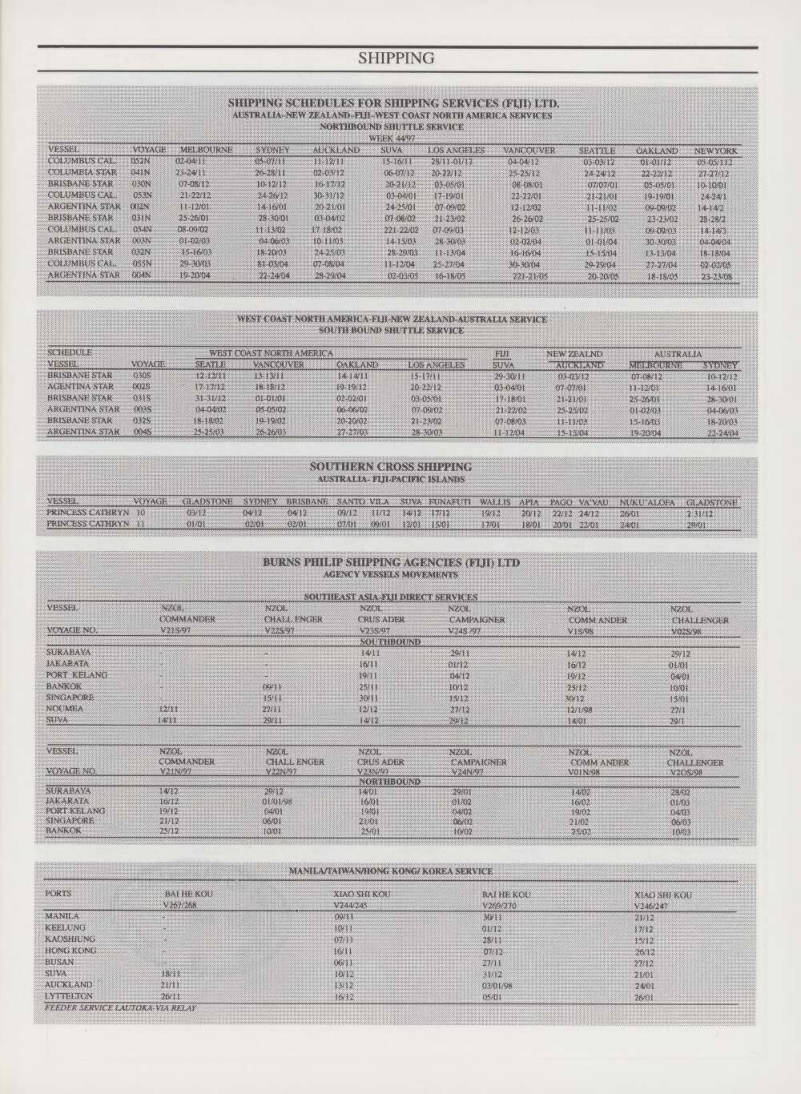
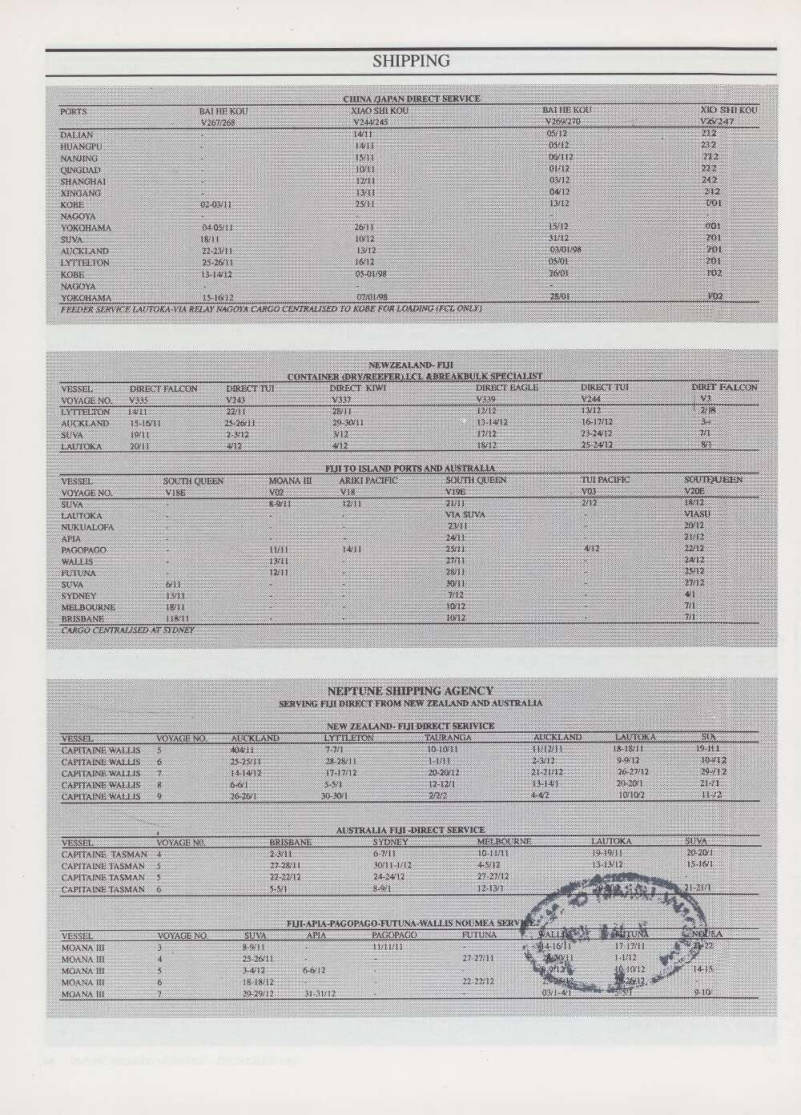
Shipping
SHIPPING SCHEDULES FOR SHIPPING SERVICES (FIJI) LTD.
AUSTRALIA-NEW ZEALAND FIJI-WEST COAST NORTH AMERICA SERVICES
Northbound Shuttle Service
West Coast North Amehica-Fuj-New Zealand-Australia Service
South Bound Shuttle Service
Southern Cross Shipping
Australia- Eui-Pacific Islands
Burns Philip Shipping Agencies (Fiji) Ltd
Agency Vessels Movements
iililp
So/81'81 90-02-02 So/It-122 So,•« 1-91
so/eVto
P0/6Zsz :
6062-22 60/02-/si N600
Svj5 Vn1.1M30Xv
so/tim nVLl'Ll 60/62*62 ip; W)/0f -0C ;
Wusl
60/2H1 pomto 60&0-18 £0/0£-62 N5S0 'Ivd snawmco W/81-81 fO/n-£i t-o/swt ♦0/fi-n zmi'U £0/S262 £0/01*81 €0/91-51
Nzco
Hvxs Hnvssihlf
w/mw) : com-m 60/10*10 60/20-20 mm-u £0/9161 son oi £0/9060: £0/20*10
Nfoo
avxs vNitN3oav C/H*>1 •comw «vn-u smi-ti £0/60-to
20/22 Izz
zm\-u 20/ft-n 20/60 80 M6S0 "tvo saavumco mz*u zmi'cz 20/S2-S2 : 20/92-92 20/22-12 .20/80-tO zo/kko I0/D£*82 io m-sz N1£0 avxs aNvasrao
mmm
Z0/60-60 20/1 Til 20/21-21 20/60* tO 10/S262 10/12-02 10/9161 lo/ri-n N200
Wis Vn1Xm3Dkv
mz~n i 0/61-6! 10/12-12 10/22-22 10/61'tl ■ co/w-eo
2I/U'-Q£
21/9262 21/22-12
" Neso
"TO snawmoo lo/so-so 10/t0/t0 10/80-S0 10/S0-£0 21/12-02 21/21 OI 1 21/21-01 n/so-to mz o i avis aNvasraa ' ZMOrlZ 2!<tt-22 21/62-62 ti/st-st 21/22-02 21/1.0-90 Zl/tO-20 tt/82-92 T1/62-S2 M160 avis viaw/noD zit/so-so 21/10-10 timta: 21M*60 21/10-11/82 11/91-91 ll/tl-lf U/tO-90 11/60*20 N290 ‘•ivn Siiawmco
5H10Aa3N
(Jm'ltlmvo
3'ULl.vaS
H3A(1(X>Nva
saiHOMvso'i VAftS
Unvtm/Hw
Ahnoas
aNMnoa'isiw anvAOA
T3Ss3A
L6t n M39A
SCHEDULE WEST COAST NORTH AMERICA 1 ... EOT ij NEWZEALND AUSIXAL1A ' VESSEL VOYAGE SEATl.E VANCOUVER OAKLAND LOS ANGELES SUVA ~AT'("R'L'ANP' MELBOURNE SYDNEY BRISBANE S7AR 030S 12-12/11 IS 13/11 1414/1! 15-17/11 29 30.'It 03 03/12 07-08/12 10-12/12 AGENTINA STAR 002S ' 17-17/12 18-18/12 19-19/12 20 22/12 03-04/0! 07-07/01 11-12/01 1406/01 BRISBANE STAR 031S 31-31/12 01-01/01 02-02/01 03-03/01 17-18/01 21-21/01 25-26/0! 28-30/01 ARGENTINA STAR 003S 04-04/02 03-05/02 06-06412 07-09/02 21-22/02 25-25/02 K 014)2/03 04-06/03 BRISBANE STAR 0325 18-18/02 19-19/02 20-21*02 21-23/02 07-08TO II -11/03 15-16/03 18-20/03 ARGENTINA STAR 004S 25-25/03 26-26/03 27-27/03 28-30/03 1 '3-13/04 19-2604 22-244)4
Vessel
Voyage
Gladstone
Sydney
Brisbane:
Santo
Vila
Suva
Wjnaeut!
Wallis
Apia
Pai.C* Va’Vali
Nuku’Alofa
Gladstone
Prfnchss Cathryn
to 93.12 04/12 04'12 09/12
lipil
17/12 19/12 20/12 33/12 34/12 3<yoi 2 31/52
Princess Cajhrtn
01/01 ami \ 02/01 07/01 00/01 52/01 15/0! 17/01 mm 20/01 22«n 24/01 29/01
Sot Itheast Ast A-Ff.Tl Direct Services
Vessel
' Nzol
Nzol
Nzol '
Nzol
nzol sliiiisilli
Nzol
■■■;■ Commander
Challenger
Crus Ader
Campaigner
Commander
Challenger
Voyage No,
V21S/9?
V22S/97 V23S/97 V24S ;97
Vjs/98
V02S’9S
Southbound
Surabaya
- 14/11 29/11 14/12 29/12
2Akarata
16'1! 01/12 1612 01/01 ,
Port Kelang
Ill 11
04/12 .19/12 04/01
Bankok
illllil 09/11 25/11 10/12 25/12 10/01
Singapore
■■ 15/11 .tom 15/12 30/12 : 15/01
Noumea
12/11 ««» 12/12 27/12 12/1/98 27/1
Suva
14/11 29ft 1 14/12 29/12 14/01 29/1
Vessel
Nzot
Nzol
Nzol
Nzol
Nzol
Nzol
% Commander
?#• Challenger I 1
Crus Ader
Campaigner
Sltli Commander
Challenger
Voyage No.
V21N/97 V22N/97
Vhn/97
V24N/97 Volninw V20S/98
Northbound
Surabaya
14/12 29/12 14/01 /■ 29/0t 14.02 2602
Iakarata .
16/22 01/01/98 16/01 01/02 1602 ‘ 01/03
Port Kelang
19/13 04/01 19/01 (mi I9,'02 04/03
Singapore
21/12 06/01 21/01 06/02 21/02 0603
Bankok
25/12 . 10/01 25/01 10/02 23/02 10/03
Manila/Fa1Wan/Hono Kong/Korea Service
Ports
Ba1Hek00
V267/268
Xiao Shi Kou
V244/245 ■ '
Baf He Kou
V269/270
Xiao Shi Kou
Ii V246/2471
Manila
4 09/ n 30/1 i ‘ 21/12
Kkeluno
- 10/11 01/12 17/12
Kaoshjunx:
- 07/11 mu 15/12
Hong Kong
16/11 07/12 26/12
Busan
06/1) 27/11 27/12
Suva
18/11 10/12 ■ 31/12 21/01
Auckland '
21.11 13/12 03/01/98 24/01
Lyttelton
26/ It 16/12 05/01 26/01 FEEDER SERVICE IAVTOKA VIA REIAY i - m / ,
Neptune Shipping Agency
SERVING FIJI DIRECT FROM NEW ZEALAND AND AUSTRALIA
jte *
l&M&U \
China /Japan Direct Service
Ports
Bal He Kou
Xiao Shi Kou
, Bal He Kou
Xto Shi Kou
V267/268 V244/245 ""1 •••"•• V269/270 V16/247
Dalian
14/11 05/12 222
Huangpu
14/1 f 05/12 232
Nanjing
15/11 06/112 212
Qingdad
ill 1 ’ i si: 1 • • 1 1111111*111^111 1CM1 01/12 222
Shanghai
' III ■ ill liiili: iillilllillll mi 03/12 24 2
Xingang
Wmmmmmmmmx
12-11 04/12 212
Kobe
02-03/H 25/n 13/12 001
Nagoya
- ■iiiiiSliiiii
Yokohama
04-05/11 • 26/11 15/12 001
Suva
18/11 10/12 31/12 201
Auckland
22-23/11 13/12 03/01/98 201
Lyttelton
25-26/11 16/12 05/01 201
Kobe
13-14/12 05-01/98 26/01 1*02
Nagoya
Yokohama
15-16/12
07/01/98 : - Tl:;*Ww
28/01 K02 FEEDEX SERVICE IAUTOKA-VIA RELAY EAGOYA CARGO CENTEAUSEO TO KOBE FOR WADING (FCL OKLY} j
■ Newzealand- Fiji
Contains® {0Rv/Rebfer).Lcl Abreakbulk Speciausht
Vessel
Direct Falcon
direct tui
Direct Kiwi
Direct Eagle
Direct Tui
Dirit Falcon
Voyage No.
: V335 V243 V337 V339 S V244 ■ VA
Lyttelton
14/11 22/11 28/11 JMm'/'' 12/12 13/12
Auckland
15-16/11 25-30/11 29-30/51 13-14/12 16-17/12 3-<
Suva
19/U 3-3/12 n/i2 23-24/13 7/1
Lautoka '
20/1 i 4/12 4/12 18/12 25-24/12 8/1-
Fiji To Island Ports And Australia
Vessel
South Queen
Moanaui
' Arikt Pacific
South Queen
Tui Pacific
S001S?Ueen
Voyage No,
Vise
V02 "
Vlg V19E , V03 V20E
Suva
"" 8-9/11 12/11 21/11 2/13 18/12
Lautoka
'+ '' y 'w .
Via Suva
V1Asu
Nukualofa
23/11 20/12
Apia
- % W:t- 24/11 - 21/12
Paoopago
■ |g||| ■ mi i 14/(1 25/11 4/12 22' 12
Walus
wmmmmmm 13/11
mtfmmmmmmmmmmik
27/11 - 24/(2
Futuna
. 12/11 wmmmmmmmmmm- 28/11 - 25/12
Suva
6HI
iiiiiiiiiii
li 30m - 27/12 -
Sydney
13/11 - 7/12 4/1
Melbourne
18/11 - - 10/12 : ||s 7/1
Brisbane
118/11 - - 10/12 - 7/1
Cargo Cestrmjsed At Si Dney
NEW ZEALAND- FIJI DIRECT SERIVTCE ' J
Vessel
Voyage No.
Auckland
Lyttleton
Tauranga
Auckland
Lautoka
Six
Capita1Ne Wallis
Wm 404411 7-7/1 lO-iO/11
Iu12/I1
18-18/11 19 It I
Capita1Ne Walus
6 : : 25-25/11 : 28-28/U 1-l/il 2-3/12 9-9/12 10Y12
Capitainfc Wallis
7 54-14/12 17-17/12 20-20/12 21-21/12 26-27/12 29-/12
Capjta1Ne Wallis
8 5-5/1 12-12/1 15-54/1 20-20/1 21-/1 , .4
Capitajns Wallis
9 26-26/1 30-50/1 2/2/2 4-4/2 10/10/2 11-/2
, Australia Fiji •Direct Service
Vessel
Voyage No.
Brisbane Sydney
Melbourne
Lautoka
Suva
Cap1Tajne Tasman
4 2-3.'li ■ cj?n 10-11/11 ■ 19-19/11 / 20-20/1
Capitainr Tasman
5 27-28/11 30/11-1/12 4-S/12 11-15.12 15-16/1
Cap1Tainh Tasman
5 22-22/12 24-24/12 27-27/12
Cap1Ta1Ne Tasman
6 5-5/1 ■ 8-9/1 : : ; ¥i| 12-13/1 ■■ ■•^2 1-21U "V :
Ful-Apla-Pagopago-Futl'na-Wallis Noumea Servjj
,V —
Vessel
Voyage No.
Suva
Apia Pagopaco
Futuna ?
jI^sutun!
Si£N0Dsa
Moana Hi
3 8-9/11 11/11/11 17-17/11 : |T^22
Moana Hi
4 25-26/11 . ' 27-27/11 > 1-1/12
Moana M
5 3-4/12 6-6') 2 i&to/ia
Moana Hi
6 18-18/12 22-22/12 - Jp*13>
Moana Iii
PiPPiil
29-29/12 31-51/12 03/1-4/1*'** 9-10/
Advertisements & other items, pp. 58-60 (2 items)
Shipping
founders saw
40 YEARS LATER, Il'S
3 1508 00697375 9 C 2? 1957-1997 “In 1957,
Grand Pacific’s
founders saw
their future.”
AS BRIGHT AS EVER.
This year, we're celebrating an event that should please our clients and our agents alike.
Our 40th Anniversary.
Four decades ago, the founders of Grand Pacific Life set out to create a life insurance
company designed to safeguard and serve
people in the Pacific. Today, through pioneering efforts and 40 years of steady growth, Grand Pacific Life has over $3.8 billion of life insurance in force. Which represents the trust of many thousands of people, ones whom
we've helped secure the financial indepen-
dence and peace of mind they've worked so
hard to achieve.
Our founders' spirit and vision continues
in reaching out with new ideas to other nations in the Pacific. Our steadfast dedication to our clients and agents has made history these last 40 years. The decades ahead look equally
exciting and full of promise.
Grand Pacific Life Insurance, Ltd.
American Samoa Mark Solofa Pacific Insurance & Finance, Inc.
Mark Solofa, GA Phone: 684-699-5796 Western Samoa Mark Solofa Pacific Insurance & Finance, Inc.
Mark Solofa, GA Phone: 685-24059 Chuuk State. Federated States of Micronesia Pacific Basin Insurance & General Services, Inc.
Kachutosy Paulus, GA Phone: 691-330-2606 Actouka Executive Insurance Underwriters Maridell Actouka Phone: 691-320-5331 Guam Great National Insurance Underwriters, Inc.
Domie Bumagat Jr., GA Phone: 671-646-5736 Pacific Financial Corporation Eduardo Camacho, GA Phone: 671-646-1990 Takagi & Associates Pamela Cruz, Life Manager Phone: 671-475-4373 Marshall Islands Marshalls Insurance Agency Jerry Kramer, GA Phone: 692-625-3366 Saipan Pacific Basin Insurance Underwriters, Inc.
Mary Ann Milne, GA Phone: 670-234-7861 Pacifica Insurance Underwriters, Inc.
Norman Tenorio, GA Phone: 670-234-6267 Takagi & Associates Laurie Sturges, Branch Mgr.
Phone: 670-322-8117 Tonga Peseti Ma'afu Insurance & Finance, Ltd.
Peseti Ma'afu, GA Phone: 676-24-777 A member of the Finance Factors Family
cl rab-s
3, SHELMES
N °i\q
PPICL-
-2£
LAND CRUISER
V - "s H - •-■• . -■■ - ■-■*
LAND CRUISE
A □ 3 □ 5 m mM Some of the specs may vary according to market specifications.
Heavy duty beauties - Toyota Land Cruiser and Land Cruiser PRADO Land Cruiser’s got a reputation for go anywhere toughness, with style and ability to take you there in total comfort, on road or off.
Its luxury matches most expensive sedans. And it has more space than many large passenger cars. With impeccable fit and finish.
And graceful, elegant form.
Land Cruiser PRADO inherits these traditions, and all Toyota’s 4x4 know-how for great performance off road and passenger car comfort on the highway, and stylish beauty everywhere it goes.
What you can’t see is also important. Tough frames. Suspensions built to take you as far off road as you want to go, in comfort. Your choice of powerful petrol or diesel engines. And bodies thoroughly protected from rust.
Land Cruiser and Land Cruiser PRADO - two champions, on and off the road.
® TOYOTA
DISTRIBUTORS/DEALERS
NORFOLK ISLAND BORRY’S PTY LTD. PH 22114
SOLOMON ISLANDS ELA MOTORS PH 30314
VANUATU ASCO MOTORS PH 22341
COOK ISLANDS PACIFIC MOTORS LTD. PH 20796
KIRIBATI TARAWA MOTORS PH 21090
PAPUA NEW GUINEA ELA MOTORS PH 3229400
TAHITI NIPPON AUTOMOTO PH 429819
WESTERN SAMOA ASCO MOTORS PH 20800
FIJI ASCO MOTORS PH 384888
NEW CALEDONIA S.I.A.P. PH 275562
TONGA ASCO MOTORS PH 23500
AMERICAN SAMOA* ASCO MOTORS PH 633-4281
(*PRADO is not being handled.)