Pacific Islands
Monthly
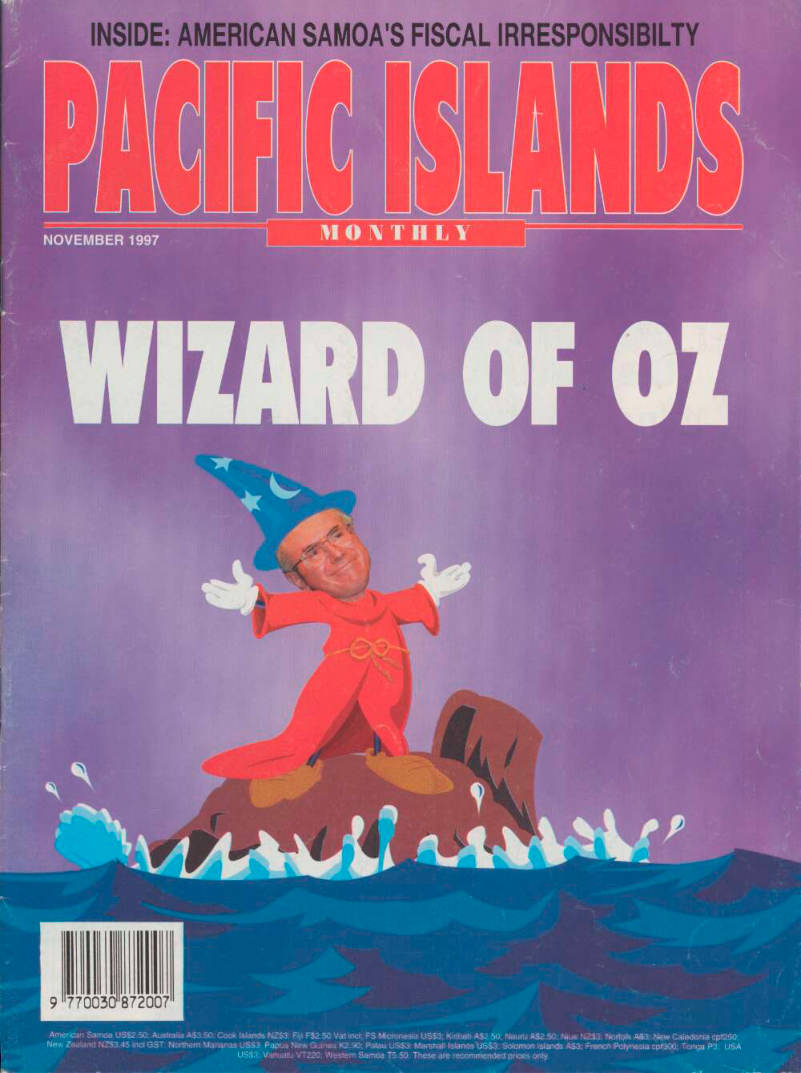
Inside; American Samoa's Fiscal Irresponsibilty
November 1997
Wizard Of Oz
American Samoa US$2.5O: Australia A 53.50: Cook Islands NZ$3; Fiji F 52.50 Vat incl; FS Micronesia US$3; Kiribati A 52.50: Nauru A 52.50; Niue NZI3, Norfolk AS3; New Caledonia cpf2so; New Zealand NZ53.45: incl GST; Northern Mananas US$3; Papua Mew Guinea K 2.90: Palau US$3; Marshall Islands'USs3; Solomon Islands As 3; French Polynesia cpf3oo: Tonga P 3; USA US$3; Vanuatu VT22O; Western Samoa T 5.50. These are recommended prices only
Advertisements & other items, pp. 2-3 (1 item)
Telikom
-you don’t have to travel to Papua New Guinea to experience the glamour and the uniqueness of the culture and environment. JUST dail 675 Part of this nature-gifted country remains mysterious and untouched.
With over 700 languages, diverse cultures, towering mountains, tropical rain forests, wild life, superb marine life and has abundance in natural resources. As a young country, Papua New Guinea has a promising Tourism Investment Manger Marketing Director Marketing Tourism Promotion Authority Investment Poromotion PO Box 1291 Port Moresby NCD PO Box 5053 Boroko NCD Papua New Guinea. Paoua New Guinea Tel: (675)320 0211 Tel: 1675)321 7311 Fax: (675)320 0223 Fax: (675)321 2819 investment future and has in store unique tourism potential. No wonder this young country boasts a tropical paradise for adventures and discoveries.
Telikom has the only state-of-the-art telecommunications network links within Papua New Guinea and to anywhere around the world. Now, use 675 to call to a country you’ve never heard of for a unique opportunity.
"9L .-
TELIKOM
Telecommunication Assistant General Manager Telikom Marketing Department PO Box 291 Waigani NCD Papua New Guinea Tel: (675)300 5564 Fax: (675)300 5540/5541
When in The Kingdom of Tonga
Stay at ■ The International Dateline Hotel Seventy-six airconditioned rooms with all amenities over-looking sparkling Nuku’alofa Harbour make the International Dateline Hotel the perfect retreat for complete relaxation.
Delicious international and local cuisine at our licensed a-la-carte restaurant, exotic cocktails at our two bars, floor shows, private guest lounge, open air dancing terrace, swimming pool, variety shop and duty free shopping, baby sitting on request, everything you could want for a relaxing holiday in the sun.
Major upgrading and expansion is planned for late 1997 and 1998. And for those of you here on business we offer two conference rooms, business centre, international direct dial telephones, telex and facsimile services, daily laundry and drycleaning services and a safety deposit facility to make life a little more convenient when you’re doing business away from home.
Pacific Islands
Monyhly
Vol 61 No. 11
The News Magazine
November 1997
PUBLISHER: Alan Robinson EDITOR; Manivannan Naidu SENIOR WRITER; Bernadette Hussein
Correspondents:
Sally Andrew, Patrick Decloitre, Giff Johnson, Chris Peteru, Susan Prokop, Atama Raganivatu, Kalinga Seneviratne, Florence Syme-Buchanan, Liz Thompson, Lili Tuwai, Sam Vulum, lan Williams COLUMNISTS: David Barber (Wellington), Jemima Garrett (Sydney), Debbie Singh (South Pacific Commission).
GRAPHIC ARTISTS: James Ranuku, Josefa Bola, Andrew Williams
Advertising Sales
Senior Regional Sales (South Pacific) Shabana Naaz Tel (679) 304111.303244, Fax (679) 303809.
Sydney, Canberra: Bob Hill Media Representation, Tel (61-2) 4164245, Fax (61-2)4165064.
Brisbane: Jane Fewings Media and Advertising Associates Tel (61-7) 3378 4522, Fax (61-7) 3878 1071.
Adelaide: Hastwell Williamsons Representatives, Tel (61-8) 3799522, Fax (61-8) 3799735.
Melbourne: Brown Orr Fletcher Burrows (Aust) Pty Ltd.
Tel (61-3)98265188, Fax (61-3) 98265644.
Auckland: McKay & Bowman, International Media Representatives Limited, Tel (64-9)4190561, Fax (64-9) 4192243.
Japan: Universal Media Corporation, Tokyo, Tel (3) 3266626741, Cable: UNI-MEDIA Tokyo, Fax (3) 32626742.
Pacific Islands Monthly was founded in 1930
(Usps 9522480).
A Fiji Times Limited production.
Cover prices are recommended retail only. Registered by Australia Post, Publication No. NBPI2IO. © Copyright Fiji Times Limited, 177 Victoria Parade, Suva, Fiji.
Tel (679) 304111, fax (679) 303809.
Email: [email protected] PIM Website: http://www.pim.com.fj Pacific Islands Monthly is published monthly by Fiji Times Limited, a division of Nationwide News. 2 Holt Street, Surry Hills, Sydney, NSW 2010.
Send Address Changes To:
Pacific Islands Monthly POBox 1167 Suva, Fiji.
Typeset and printed by The Fiji Times Limited. 177 Victoria Parade, Suva, Fiji.
Layout and cover design by Josefa Bola
Inside
Cover Story: Climate change in the Pacific
Editorial 5 Letters to the Editor 6 From the Archives 8 Briefs 9 Cover stories: Australia - a global warning 11 Special Report: IMuciear reactions 19 Dredging profits 24 A question of Public Trust 27 'Going Samoan' 28 United we stand 30 Paliamentary debate 32 The passport saga continues 33 The drought 34 Not many Cooks can flavour the broth 37 Aviation Feature 39 PNG made products Feature 42 Bale battles on 46 Queen Bea 48 Life journey 50 Fish dreaming 51 Keeping a weather-eye open 53 Australia, Greenhouse warrior? 55 Beyond preferential agreements 56 Shipping pages 57
Page 19
Page 34
Page 51
Australia
Editorial
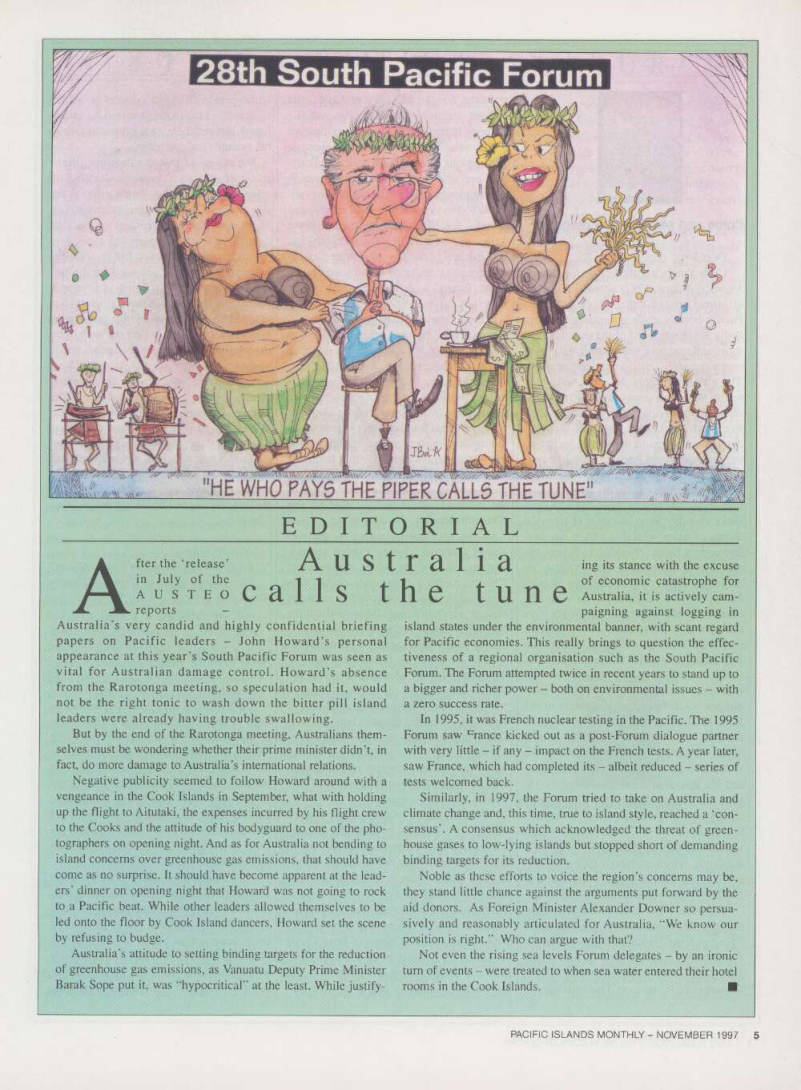
Australia calls the tune
After the ‘release’ in July of the
Aus T E O
reports -
Australia’s very candid and highly confidential briefing papers on Pacific leaders - John Howard’s personal appearance at this year’s South Pacific Forum was seen as vital for Australian damage control. Howard’s absence from the Rarotonga meeting, so speculation had it, would not be the right tonic to wash down the bitter pill island leaders were already having trouble swallowing.
But by the end of the Rarotonga meeting, Australians them selves must be wondering whether their prime minister didn’t, in fact, do more damage to Australia’s international relations.
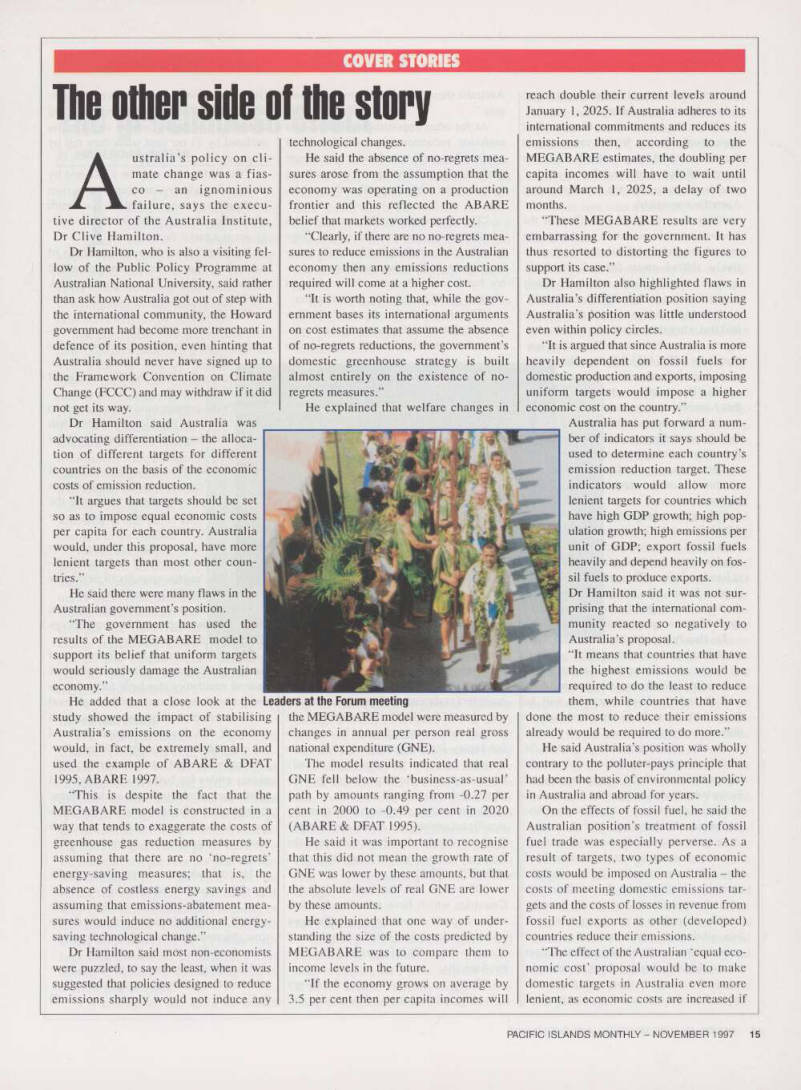
Negative publicity seemed to follow Howard around with a vengeance in the Cook Islands in September, what with holding up the flight to Aitutaki, the expenses incurred by his flight crew to the Cooks and the attitude of his bodyguard to one of the pho tographers on opening night. And as for Australia not bending to island concerns over greenhouse gas emissions, that should have come as no surprise. It should have become apparent at the lead ers’ dinner on opening night that Howard was not going to rock to a Pacific beat. While other leaders allowed themselves to be led onto the floor by Cook Island dancers, Howard set the scene by refusing to budge.
Australia’s attitude to setting binding targets for the reduction of greenhouse gas emissions, as Vanuatu Deputy Prime Minister Barak Sope put it, was "hypocritical” at the least. While justify
ing its stance with the excuse of economic catastrophe for Australia, it is actively cam paigning against logging in
island states under the environmental banner, with scant regard for Pacific economies. This really brings to question the effec tiveness of a regional organisation such as the South Pacific Forum. The Forum attempted twice in recent years to stand up to a bigger and richer power - both on environmental issues - with a zero success rate.
In 1995, it was French nuclear testing in the Pacific. The 1995 Forum saw kicked out as a post-Forum dialogue partner with very little - if any - impact on the French tests. A year later, saw France, which had completed its - albeit reduced - series of tests welcomed back.
Similarly, in 1997, the Forum tried to take on Australia and climate change and, this time, true to island style, reached a ‘con sensus’. A consensus which acknowledged the threat of green house gases to low-lying islands but stopped short of demanding binding targets for its reduction.
Noble as these efforts to voice the region’s concerns may be, they stand little chance against the arguments put forward by the aid donors. As Foreign Minister Alexander Downer so persua sively and reasonably articulated for Australia, “We know our position is right.” Who can argue with that?
Not even the rising sea levels Forum delegates - by an ironic turn of events - were treated to when sea water entered their hotel rooms in the Cook Islands. ■
Letters To The Editor
Come and see: the IDS response
Dear Sir Chris Peteru’s article (Pacific Islands Monthly, August, 1997) about The Church of Jesus Christ of Latter-day Saints in the Pacific islands made interesting reading.
Sadly, his descriptions of the church’s doc trines and practices were surprisingly inac curate for such a well-regarded journalist.
The article certainly did not present the reality behind an internationally respected religious institution which is making posi tive contributions to the well-being of communities around the world, including those in the South Pacific. May I be per mitted this official response?
The article appears to draw its informa tion about our beliefs from old and tired anti-Latter-day Saint literature or from the words of those who don’t have our best interests at heart. Wishing to follow the example of our saviour, Jesus Christ, we do not get involved in contentious debate.
Nor do we feel it appropriate for us to crit icise the beliefs of others. All people have the right to worship how, where, or what they may. With this in mind, rather than responding at length to each incorrect com ment, we hope to briefly address just four examples. The establishment of the church did not result from the production of the Book of Mormon, though this was one of a number of important events which occurred. Rather, Latter-day Saint doctrine is founded on a vision of God the Father and his Son, Jesus Christ, received by 14year-old Joseph Smith in 1820. Joseph Smith later helped bring about a restora tion of the primitive Church of Jesus Christ made necessary by the falling away from the truth, which occurred following the death of the ancient apostles. The Book of Mormon was not produced until 1830.
Suggesting that parts of the article are constructed around hearsay, the statement, "Tonga's King Taufaahau Tupou IV has for the past few yeas refused to renew any LDS land leases” is quite untrue. In fact, the opposite is the case. Our relationship
with the Tongan Ministry of Lands, the cabinet, the nobles of the realm and His Majesty is perhaps at its most productive and cordial level. Recently the Tongan government enacted the Charitable Trusts Act, one of the main objectives of which was to provide a legal framework for reli gious bodies to register as legal entities and thereby legally hold land leases in the name of their faith. The Church has become one of the first, if not the first, to register and transfer all of our leases to the Trust Board, with the approval of his
majesty’s cabinet.
Peteru quotes one individual who claims, “The Mormons are not a Christian church... They are a sect with a doctrine that has nothing to do with the Bible.” On the contrary, the Old and New Testaments are so intrinsic to the doctrine of the Church that two years out of the Church’s four-year adult Sunday School programme are devoted to these sacred records. There are no “doctrines in the Church that [we] never teach [our] people”. Instead, our reli gious education system is probably one of the most advanced and detailed of any Christian church. On almost any given weekday, all Church youth arise early to attend scripture classes (which include lengthy study of the Bible) at their local Church meeting house or school. Our young adults are also enrolled in weekday classes which are in addition to the three hours they spend in church on Sunday.
The article also created a false impres sion of the Church’s income and wealth.
The vast majority of the earnings of the Church come from the tithes of Church members, not from investments. Most of its assets - meaning chapels, temples, wel fare farms and schools - are money con suming and not money producing.
However, the real strength of the Church can be found in what it offers mankind spiritually, not monetarily.
The first article of faith of the Church states, "We believe in God, the Eternal Father, and in His Son, Jesus Christ, and in the Holy Ghost.” The saviour, Jesus Christ, is at the centre of our beliefs. Through him, and no other, all mankind will be resurrect ed, the just and the unjust. Through his sac rifice, those who repent may be redeemed from their sins. The Church of Jesus Christ of Latter Day Saints bears his name. His name is used to close every sermon and prayer given in our chapels or in members’
homes and in all of our ordinances. While no one lives up to the standard he estab lished, our members try their best to follow his example and teachings.
We recognise that our doctrine differs in significant ways from the doctrine of other churches, as they often differ from one another. These differences should not be reasons for disagreement or for our neighbours in our villages and communi ties to find reasons not to live in civilised harmony with us. We are happy to discuss these differences in a spirit of love and friendship. However, as the saviour did not respond to false claims at his mock trial (see Mark 14:57-61), we do not wish to be diverted from our work to debate incorrect statements about us.
Our answer to those with genuine ques tions is simple - come and see! Our Sunday services and weekly activities are open to all. Visitors can participate in class discussion if they wish, or they can observe quietly. They will find a Christ-centred church and a people, neither fanatical nor extreme, whose lives have been enriched by their knowledge of the gospel of Jesus Christ.
Alan Wakeley
Pacific Area Director of Public Affairs The Church of Jesus Christ of Latter day Saints New South Wales Australia
Questions to banks
Dear Sir Last week, I was able to purchase a copy of the Central Bank (CB) 1996 annu al report and its quarterly report ending March, 1997 at $lO each. Before going to the CB Office, I did presume that, as a Solomon Islander, I’d be given a free copy of this report so I could fully understand the true financial situation of our country. I was mistaken. Anyway, what’s $20.00 for these two reports if, by reading them, I can find out the actual reasons why: • as a landowner with a felling licence to export almost 60,000 cubic metres of round logs per year, valued approximately at $26 million per year, I was declined by three commercial banks when I sought financial assistance from them to finance my intention to purchase logging equip ment for less than SSI2 million (not men
tioning the fact that I have over SUS 2 mil lion in letters of credit from my overseas buyers to ship to them around 13,000 cubic metres of round timber logs); • last week, when I asked one of the banks to issue an international bank draft in US dollars in favour of an American publisher as payment for some trade books I’m trying to order by mail, the bank insist ed that the SUS2OO (in US dollar notes) I had on hand would have to be converted first to Solomon Islands dollars (at a rate of $513.48 to SUSI) then purchase US cur rency (at a rate of $513.71 to SUSI) plus a SSI3B bank fee so they could issue the bank draft. I realised that for this small transaction alone, I was losing $510.23 to every SUS 1 which I already have, or a total of SSI46, excluding bank fees.
I understand that the current CB rate is an average of $513.36 to SUSI for the last three years. So, these commercial banks already cheated and robbed me of $510.15 for every SUSI I have in my personal pos session. I’m wondering if these banks will report such earnings in their books and income statements.
Several years ago, I met a banker from Asia who told me: “Don’t ever think that piracy has been eradicated in this time of modern history. Bankers are the elusive pirates that will fleece you naked of your hard-earned monies.” I didn't believe him then, but since I heard about the roles played by Swiss bankers in hiding those deposits/assets rightfully belonging to the Jewish community during the WW 11, I really began wondering if those bankers I usually meet in downtown Honiara are among the latter days pirates and white collar conrnen. After reviewing both of the mentioned CB reports, I discovered that the three commercial banks in the country as of March 31,1997 had combined; • total assets of $81409,282,000; • total liabilities of $81377,055,000; and • total capital and reserve of $8132,227,000.
Meanwhile, according to the CB, the; • foreign exchange receipt (one year to March 31,97) was $81988,436,000; and • foreign exchange payment (for the same period) was $51954,216,000.
These foreign exchange (forex) transac tions are not fully reported by these banks.
Thus, I asked myself if local ’shell money' bank in Auki, Malaita Province, is now the one handling all of our country's forex
transactions? Based on my previous expe rience, these banks are supposed to earn: • income on forex receipts of $5142,605,000; • income on forex payments of $5163,066,000; or • a total combined income of $81105,671,000.
This income is only for their forex transactions. What about their earnings on loan fees and interests, and other charges?
ANZ Bank and Westpac Bank never provide a copy of their annual report to the general public of their operations in the country except a consolidated report of their holding company operations around the world wherein their Solomon Inlands operations are not reflected individually as it was grouped together with their other branches within the Asia-Pacific region.
NBSIL provided me a copy of their 1996 annual report - and it’s really quite surpris ing to leam the following: • interest income - $818,443,942; • forex earnings - $814,977,515; • other non-interest income - $514,102,089; and • total assets - $81229,101,399.
I understand that NBSIL is almost the same size as the total combined assets of both Westpac and ANZ banks. So, assum ing that both Westpac and ANZ have the same forex earnings as the NBSIL at a total average of SSI 10 million, what happened to almost SSI9O million in forex earnings that these three commercial banks were supposed to be earning last year? The gov ernment losses runs to about SSI3O million in uncollected taxes on this hidden income - income that is badly needed to increase the government financial resources. Is there anybody out there who can explain to me this discrepancy? Can someone in higher authority allow me to look and dig deeper into these commercial banks’ activ ities and into their account books?
NBSIL has a paid-up capital of SSI2 million but in 1995 and 1996 it paid a total of $818,500,000 in dividends to its share holders - a return of almost 425 per cent within a two-year period while poor Solomon Islanders are getting a maximum of five per cent per year on their hard earned monies. It is unfair, isn't it?
I believe that it is now the right time for the new government to initiate an investi gation into these commercial banks.
Isn't it time that the government nation
alise these commercial banks - in order for Solomon Islanders like me to get the nec essary assistance to start my logging oper ations, which are a forex earner? Those
foreign companies operating in the country
are not forex earners as they continuously send their earnings to their mother coun tries overseas.
I hope and urge the government to have these banks open their books of accounts to the proper incorruptible officers and have them audited - not only for the last year but since they started their operations - to find out how many billions of dollars they fleeced from our country.
I challenge the new govemmlent to have this matter taken as a national priority and fully investigate if they really want to have changes in the country’s economy.
Establish a commission of inquiry immedi ately into this matter and let us all work together for the betterment and upliftment of our country and of our people so that in the days to come we can tell our children that during the start of Prime Minister Bartholomew Ulufa’alu’s term, we, the people of the Solomon Islands, were able to take our country to prosperity.
I will much appreciate it if you publish this letter in order for our new government to realise that out there in the vastness of Solomon Islands are people who care.
Andrew Lagwaeano Loboi
Honiara Solomon Islands
Fiji Indians compromised

Dear Sir I write with regard to the cover story of your September issue, in particular the interview with the leader of the opposition, Jai Ram Reddy, titled “From opposition to cooperation”.
Reddy's attempt to defend the reversal of the open/communal seats allocation, as proposed by the Reeves Commission, is an insult to the intelligence of your readers. It must be remembered that Reddy and
Sitiveni Rabuka brokered the seat alloca tion agreement privately after consensus could not be reached at the joint parliamen tary select committee (JPSC) level.
Readers must understand that the open/communal seat allocation in the Reeves Report was for a very specific rea son: to bring about true multiracialism. Not surprisingly, the joint NFP/FLP submission to the Reeves Commission also called for 46 open and 25 communal seats. In light of this, one must ask: why did Reddy not adhere to his own party’s submission to the Reeves Commission?
Reddy, elsewhere in his interview, says, “I don’t believe anybody has sacrificed anything.” (P 24) However, in the Daily Post of April 15, 1997 Reddy is on record as saying: “...the Indian population had to make some sacri fices while trying to reach the parliamen tary composition.” (P 2) Are the two statements not a direct con tradiction of each other?
He then went on to state, “The commu nal seats...are based on fairness and on pro portionality.” (PIM P 24)
According to population numbers, Indians number 43.6 per cent of the popu lation, which in round figures equates to 20 seats. So why did Reddy agree to 19?
Where is the fairness and proportionality in this, Mr Reddy?
Suffice to say Reddy’s actions on the constitution review have totally compro mised Indian interests, yet again!
Rajendra P Chaudhry
Admin!Research Ojficer Fiji Labour Party Suva Fiji
From The Archives
November, 1930
The breaking of
the drought
The prolonged
drought, which has been causing the gravest concern, has broken at last; sever al showers have fall en during the past week, and there are promises of more to come.
At one time, residents were faced with the possibility of no ice - a dire catastrophe as Messrs Carpenter and Co’s own supply was exhausted, and the Administration was obliged to conserve the little left at the old Government Ice Works. Fortunately, Carpenter and Co arranged that an incoming cargo steamer m.v. Talleyrand should bring 300 tons of water for their ice works and inter-island steamers.
Kava and the Major When we met the Chief Justice of Tonga,
in Nukualofa, he intro duced us to the Minister for Lands and then the five of us went to a lit tle cafe to drink kava.
Nixon and I had had a taste of the stuff over in the Cook Islands.
Nick said it was like washing water of the week before last, kept in a soap-vat and flavoured with pepper. I agreed.
But kava was new to Major O’Sullivan. The sound of the name tick led his palate. He had tasted many liq uids in many lands and in jovial compa
ny - he was eager to add to his experiences...
We drank. I watched the
Major’s face delightedly.
It changed from anticipa
tion to incredulity, then to \ horror and disgust. I checked C his hurried attempt to empty his mouthful back in the wooden mug
by whispering that such a procedure would give serious offence.
The Chief Justice was proudly show ing Nick the skin of his hands, when he rubbed it gave off a crumbly powder.
That, he explained, happened to all white kava drinkers.
Hindu Propaganda
The Pacific Press - a Suva weekly printed in English, Hindi and Fijian published an article in Hindi which was headed “May the British Empire be
destroyed”.
Then [translated] an article taken from an Indian anti-British paper where in were offensive passages regarding the attitude of India to the Empire.
In the legislative council, the Hon A
Barker was informed, in reply to his question, that the ; Government had seen the arti f cle and was considering the introduction, at an early date, P of a Bill, to provide punish- D ment for seditious acts and sedi ? tious libel to facilitate the sup pression of seditious publications,
and to provide for the suspension of newspapers containing seditious mat ters.
The incident caused some excited comment “on the beach”.
Pacific Islands Monthly
Established 1930
Advertisements & other items, p. 8 (1 item)
Page Assembly
WE P
Colour Separation Page Assembly Design and layout Large Format Printing 'VUt* * ■ Hi I m (679) 306100 Fax: (679) 306111 18 Disraeli Road, Suva P.O. Box 16149, Suva, %
Australian damage control
Dear Sir I am writing to you to express my belief that the organisers of the Sydney Olympics should invite several Pacific island coun tries, which have not as yet competed in the Olympics, to compete in the Sydney Olympics; these countries being: Marshall Islands, Niue, Kiribati, Tuvalu, Palau and the Federated States of Micronesia.
I believe that if these countries were to be invited, some of the damage caused to
Australia’s reputation at the recent South Pacific Forum meeting could be repaired.
Ted Davis
New South Wales Australia
Letters to the Editor should be addressed to: The Editor Pacific Islands Monthly PO Box 1167 Suva Fiji
The names and addresses of the
following letter writers were
inadvertently omitted last month:
• “Mormons - doing more, recognised less?"
John Uri Sydney Australia • “Media to be blamed for Di's untimely demise"
Dr Vijay Naidu Suva Fiji • “The century turns - but when?”
Robert Silberstorf Antioquia Colombia
Briefs

Forum secretary-general named Papua New Guinea’s Noel Levi was unan imously accepted as the new secretary general of the South Pacific Forum by Forum leaders in Rarotonga last month.
Levi will take up the post in early January from leremia Tabai.
Moruroa report out
An independent report on the possible con sequences of French nuclear tests on the health and well-being of the people of French Polynesia has been released.
Titled Moruroa and Us, the book was
put together by Dr Pieter de Vries and Dr Han Seur, two economists from the University of Wageningen, the Netherlands.
They conducted the study with the assistance of a team of the Polynesian non government organisations Hid Tau and the Eglise Evangelique de Polynesie Francaise (EEPF). They spoke to former test site workers and islanders living in the vicinity of Moruroa and Fangatafua (the test sites).
Pacific Islands Monthly highlighted the contents of the report in January after an interview with Gabriel Tetiarahi of Hiti Tau.
Bougainville peace talks The chairman of the Bougainville peace talks which signed the Burnham truce, Solomon Islands Home Affairs Minister the Reverend Leslie Boseto, says the recent talks did not specifically address the ques tion of Bougainville independence, Pacnews reported.
He said this would be an issue to dis cuss at the next round of talks set for
January 31, 1998.
Fiji rejoins Commonwealth
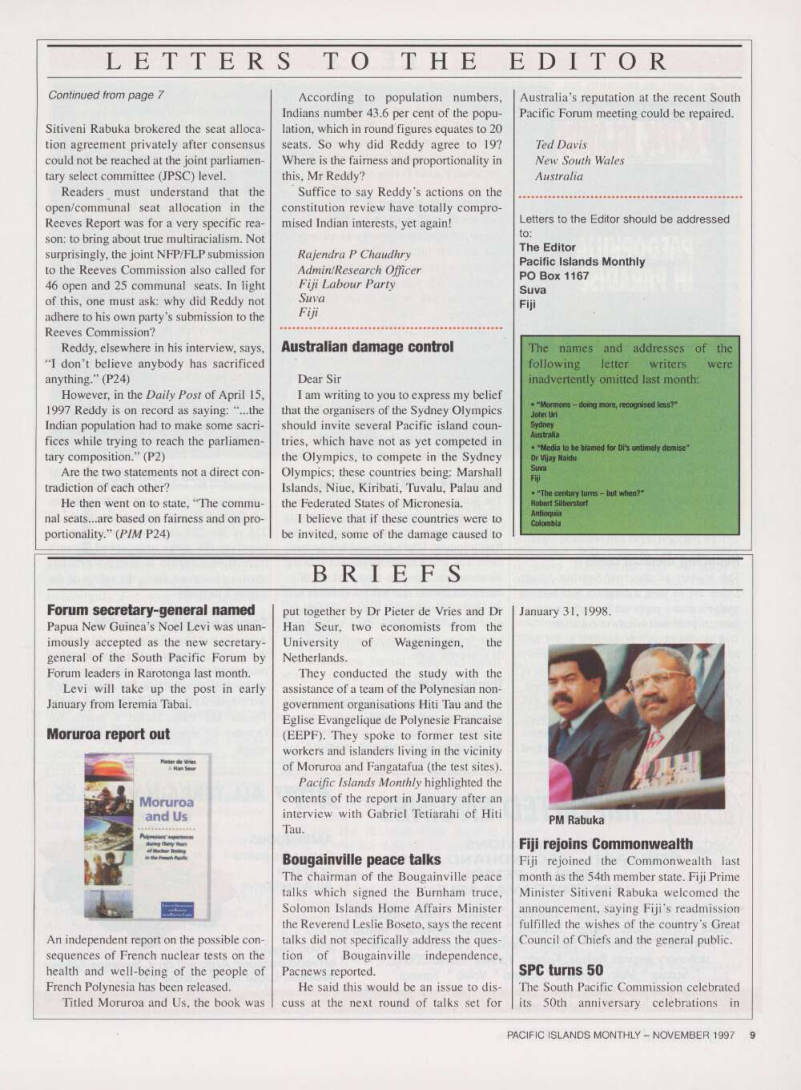
Fiji rejoined the Commonwealth last month as the 54th member state. Fiji Prime Minister Sitiveni Rabuka welcomed the announcement, saying Fiji’s readmission fulfilled the wishes of the country’s Great Council of Chiefs and the general public.
SRC turns 50 The South Pacific Commission celebrated its 50th anniversary celebrations in
PM Rabuka
Pacific Islands Monthly has its own Internet website and users can access the magazine for a selection of what’s available each month as well as subscription details.
http://www.pim.com.fj
Reducing medical costs The leaders of the five Smaller Island States are to seek a detailed cost-benefit analysis into a proposal for bulk procure ment of pharmaceuticals to cut costs.
The chairman of the SIS and Cook Islands Prime Minister Sir Geoffrey Henry will also consult with French Polynesia to see whether the French would be interest ed in joining the scheme. At the last SIS meeting in Rarotonga, Cook Islands, lead ers expressed concern over the high costs of medical treatment and the need to find
ways to reduce these costs.
The members of the SIS are Cook Islands, Kiribati, Nauru, Niue and Tuvalu.
A final decision on the scheme will follow a cost-benefit analysis to be arranged by the South Pacific Forum Secretariat.
Renewable energy Leaders of the Smaller Island States have identified renewable energy as an impor tant area for further collaboration which could be addressed through regional pro grammes. This was done at the last meet ing of the SIS in the Cook Islands in September.
Areas for collaboration included improving the quality and availability of information on energy sources such as solar and wind, as well as strengthening project appraisal techniques and planning.
Renewable energy technologies that are technically proven and in use in the SIS include small-scale photovoltaic (PV) sys tems, solar water heating and solar drying.
Solomons plans nuclear fees The Solomon Islands is planning to charge ships carrying nuclear waste through its waters, Pacnews reported. Prime Minister Bartholomew Ulufa’alu said his govern ment was going to use payment for using its waters as a way to stop nuclear ship ments. Ulufa’alu said his government had decided to draw up and implement legisla tion which would allow them to charge a huge fee to nuclear ships passing through its economic zone.
Tourism awards The Tourism Council of the South Pacific have announced the 1997 Tourism Award winners: Photography - Paul Miles (Solomon Islands); Domestic Airline - Air
Rarotonga (Cook Islands); Budget
Accommodation - Homestay Suva (Fiji); Standard Accommodation - Hideaway Resort (Fiji); Deluxe Accommodation - Turtle Island Lodge (Fiji); Tourism Transportation - Apia Rentals Ltd (Samoa); Inbound Tour Operator - Island Hopper Vacations (Cook Is); Ecotourism - Eco Tour Samoa (Samoa); Heritage Cultural - Jean Marie Tjibaou Cultural Centre (New Caledonia).
Marry or leave, expat couples told
Samoa told expatriate couples in de-facto relationships “who want to stay on” to either marry or face deportation, AFP reported. Secretary to the Prime Minister’s Department, Vaasatia Poloma, in October, said de-facto relationships were not part of the Samoan way.
Guam flights cancelled Korean Air decided to discontinue flights between Guam and the South Korean cap ital, Seoul, as of last month, Pacnews reported. The cessation of flights was a direct result of the August crash of Korean Air flight 801, resulting in the deaths of 228 of the 254 crew and passengers on board as the plane approached Guam’s international airport. Korean Air officials remain concerned about the safety of the airport’s facilities.
Samoa protest worries PM Australia and New Zealand would come to the aid of Samoan police if a looming protest proves too difficult to handle, Prime Minister Tofilau Eti Alesana said last month, AFP reported. The chief group, Tumua Ma Pule, called a march for October 29 aimed at forcing the PM to resign.
PIM goes on the Net
Advertisements & other items, pp. 9-10 (2 items)
Letters To The Editor
PACIFIC ISLANDS MONTHLY - NOVEMBER 1997
Continued from page 7
Imported Engines
BLAIRS
TRANSMISSIONS
NEW PARTS - SECONDHAND PARTS
DIESELS - PETROL
1000 UNITS AVAILABLE
Bedford * BMW * Cummins * Daihatsu * Detroit * Ford * Gardner Duetz * Hino * Isuzu * Ivaco * Komatsu * Kubota * Leyland * Mazda * Mercedes * Mitsubishi * Nissan * Perkins * Peugeot * Special stationary engines Perkins, Kubota, Yanmar 9hp to 200 hp, * Scania * Main * Suzuki * Toyota * Volvo * Yanmar
Argo ALL TERRAIN VEHICLES
6X6 - BXB
AMPHIBIOUS
Carries 6 persons or 454kgs All Wheel Drive IF you require offroad transport Argo will do it. Swamps, Lakes, Beaches, Loose Rocks, Dense Forest.
P.O Box 14 Geraldine, New Zealand. Phone: 643-6938122. Fax: 643-6938120
Thebig
Cover Stories
Thebig retreat
The tides are rising and, slowly, low-lying coun tries are sinking. It is not happening at a rapid pace and will take time, but it will happen.
As these states go down, so will their sovereignty and, with it, the land the people of that country once called home.
These were the sentiments expressed by the Smaller Island States at the 28th South Pacific Forum meeting in Rarotonga, Cook Islands, in September when Australia refused to back down from its position on the emission of greenhouse gases.
This topic dominated the Forum agenda, with economic and trade issues given very little attention in comparison.
So intense was the discussion, Forum leaders could not decide at the end of the first day of the retreat what the Forum’s stand on the issue was.
In the past, the first day of the retreat has been when the wordings for the communique were finalised.
But this year, it was different.
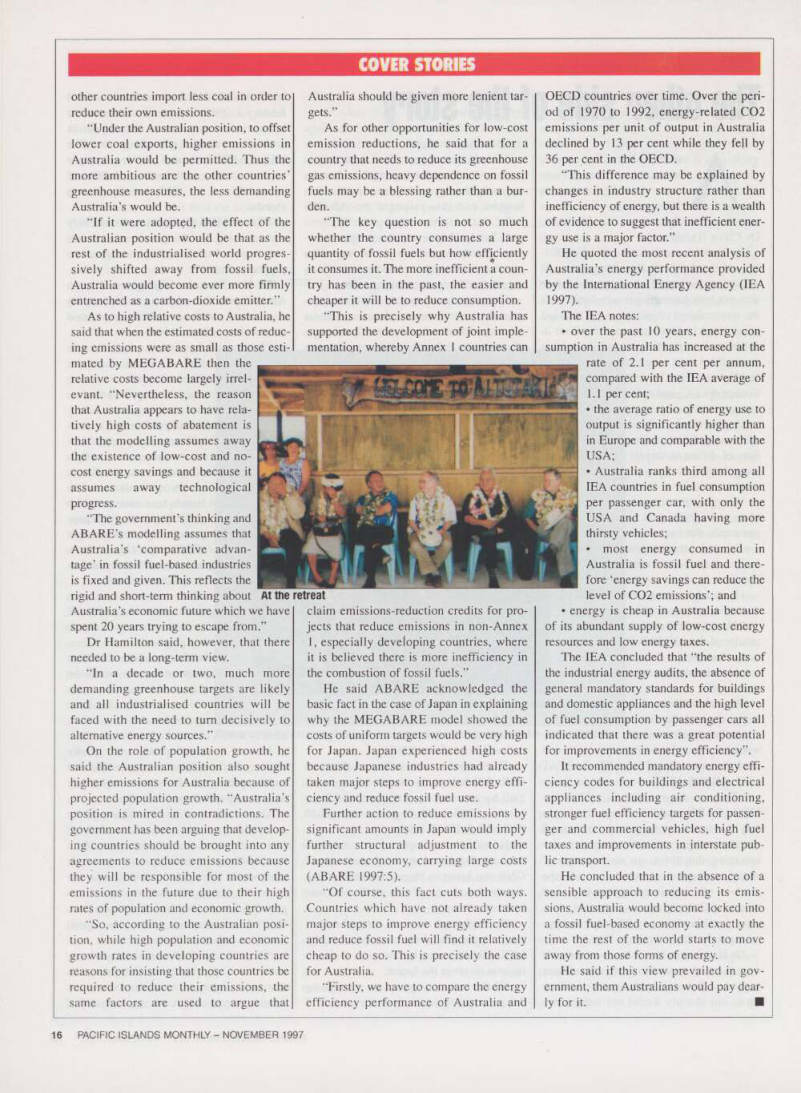
When the leaders went on their retreat onboard the Royal New Zealand Air Force jet to Aitutaki, they were aware what Australia’s stand would be.
Australian Prime Minister John Howard had made it clear from day one that he was not going to agree to binding targets for greenhouse gas reduction
because at stake were millions of Australian jobs.
On the second day of the retreat, as media representatives waited at the local airport for the arrival of the leaders, word got around that the communique had still not been finalised.
What followed was an intense two hour session behind the closed doors of the airport’s VIP lounge, the end of which saw Forum island states giving in to Australia.
Tuvalu (one of the low-lying islands) PM Bikenibeu Paeniu, who had spent several intense hours negotiating the issue with Howard, pointed to Australia’s size and the aid it provided in the region as reasons why the island states gave in.
“Australia dominates us so much in this region. For once, we wuuld have liked to have got some respect,” he remarked.
Howard, on the other hand, was obvi ously elated.
While the decision took time to reach, it was not difficult to get there, Howard self-assuredly asserted.
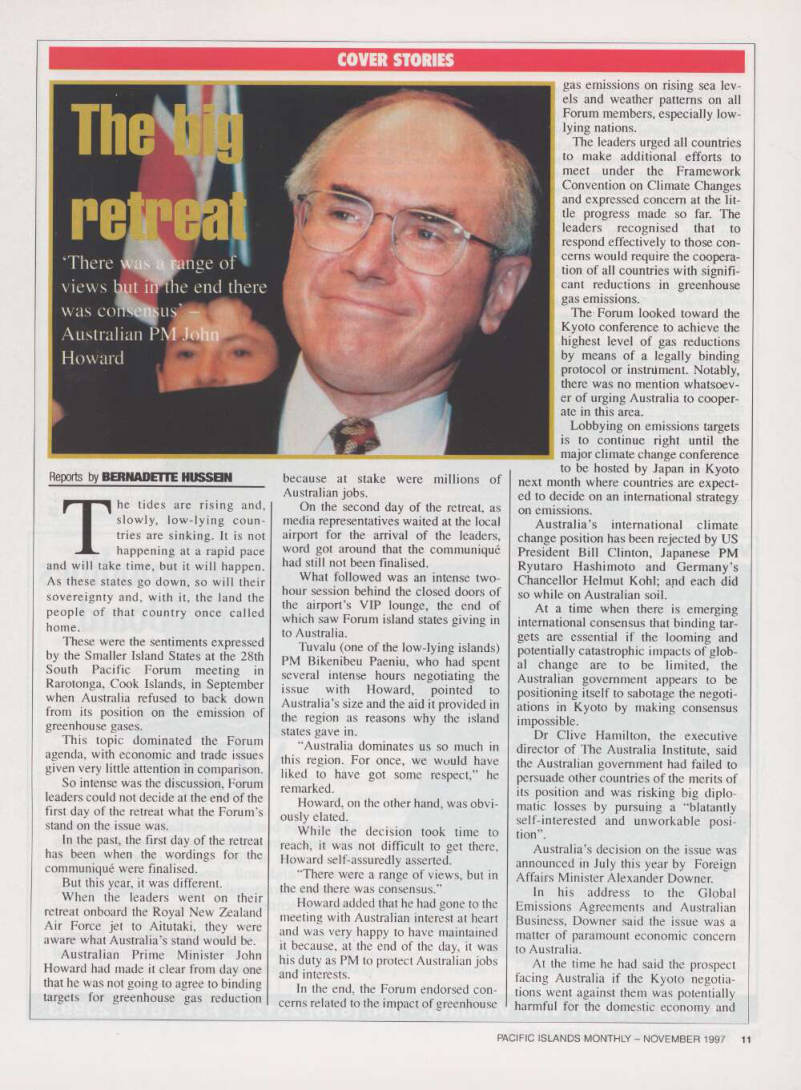
“There were a range of views, but in the end there was consensus.”
Howard added that he had gone to the meeting with Australian interest at heart and was very happy to have maintained it because, at the end of the day, it was his duty as PM to protect Australian jobs and interests.
In the end, the Forum endorsed con cerns related to the impact of greenhouse
gas emissions on rising sea lev els and weather patterns on all Forum members, especially low
lying nations.
The leaders urged all countries to make additional efforts to meet under the Framework Convention on Climate Changes and expressed concern at the lit tle progress made so far. The leaders recognised that to respond effectively to those con cerns would require the coopera tion of all countries with signifi cant reductions in greenhouse gas emissions.
The Forum looked toward the Kyoto conference to achieve the highest level of gas reductions
by means of a legally binding
protocol or instrument. Notably, there was no mention whatsoev er of urging Australia to cooper ate in this area.
Lobbying on emissions targets is to continue right until the
major climate change conference
to be hosted by Japan in Kyoto
next month where countries are expect ed to decide on an international strategy on emissions.
Australia’s international climate change position has been rejected by US President Bill Clinton, Japanese PM Ryutaro Hashimoto and Germany’s Chancellor Flelmut Kohl; and each did so while on Australian soil.
At a time when there is emerging international consensus that binding tar gets are essential if the looming and potentially catastrophic impacts of glob al change are to be limited, the Australian government appears to be positioning itself to sabotage the negoti ations in Kyoto by making consensus impossible.
Dr Clive Hamilton, the executive director of The Australia Institute, said the Australian government had failed to persuade other countries of the merits of its position and was risking big diplo matic losses by pursuing a “blatantly self-interested and unworkable posi tion”.
Australia’s decision on the issue was announced in July this year by Foreign Affairs Minister Alexander Downer.
In his address to the Global Emissions Agreements and Australian Business, Downer said the issue was a matter of paramount economic concern to Australia.
At the time he had said the prospect
facing Australia if the Kyoto negotia
tions went against them was potentially harmful for the domestic economy and
Reports by BERNADETTE HUSSEIN
‘There was a range of views hut none end there was consensus' Australian PM John Howard
its international trade. Downer said his government had left no one in any doubt where Australia stood on either front.
“We have pursued the issue vigorous ly and relentlessly in our contacts with world leaders and other decision makers,
sometimes against quite openly hostile
opposition. But the stakes for Australia are far too high for any of us to worry about the personal or political discom fort that we might occasionally encounter in our defence of Australia’s
position.
“In any case, we know our position is
right,” he argued.
Downer said that since Australia’s was an energy-intensive economy with a relatively rapid rate of population growth, its trade linkages with develop ing countries, particularly in East Asia, were strong and therefore the only target it could agree to in Kyoto would be one that allowed reasonable growth in its greenhouse gas emissions.
The Rio Earth Summit approached the issue of climate change in terms of reducing global emissions growth to the Year 2010.
The Australian government’s argu ment is that since Australia is so heavily dependent on fossil fuels for export and
relies on fossil fuel as the chief source of domestic energy, uniform emission reductions targets would be very costly and would impose a disproportionate economic burden on Australia compared to other developed countries.
Australia is arguing against binding
uniform targets, preferring the concept of differentiation which would consider the varying economic circurmstances of
developed countries.
Howard has rejected calls from the European Union for across-the-board 15 per cent cuts in emissions from 1990 levels by 2010.
He has also rejected a proposal from Japan for a self-imposed five per cent reduction and a global format that would allow for some differentiation.
Australia is using an economic model prepared by the Australian Bureau of Agricultural and Resource Economics (ABARE). ABARE estimates that any cuts in carbon-dioxide emissions will cost the Australian economy SAISO bil lion (SUSIOS billion) by 2020.
But 131 economists, including 16 professors of economics, said there were policies available to reduce Australia’s greenhouse gas emissions without harm ing the economy.
In contrast to the government’s pur suit of more lenient greenhouse gas reduction targets, the economists, in a joint statement, said that it was equitable and efficient for countries that have higher emissions per capita to reduce their emissions by more.
They said there was deep disquiet in the economics profession about the direction of the government’s climate
change policy and that the government’s
views appeared to have been unduly influenced by sectional interests.
As a result, Australia appears to be headed for diplomatic humiliation in Kyoto.
The economists recommended a number of policy measures including taxes and tradable emission permits.
They said a package of measures based on economic instruments would be effective at reducing emissions below any likely target agreed at Kyoto.
They added that, if implemented properly, there would be no additional unemployment as over time, investment would shift to less fossil-fuel-intensive sectors of the economy.
Australia is now on a public relations tour around the world to promote its pol icy on greenhouse gas emissions. ■
Advertisements & other items, p. 12 (2 items)
Cover Stories
vnup 7
VANUATU KAVA ROOTS
..V: V;,.» mi ■ - r. >. '
Vanuatu Commodities
Marketing Board
vnup 7
The world's best kava is available in dried root or powdered form and packaged for export. Vanuatu kava is high in fibre, low in calories, has anti bacterial and anti fungal properties and is becoming increasingly popular overseas to ease stress and tension.
The Vanuatu Commodities Marketing Board is the sole authority for export of kava cocoa and copra from Vanuatu.
PO Box 81, Port Vila, Vanuatu. - Tel; (678) 23123 • Fax: (678) 23993
The Australian argument
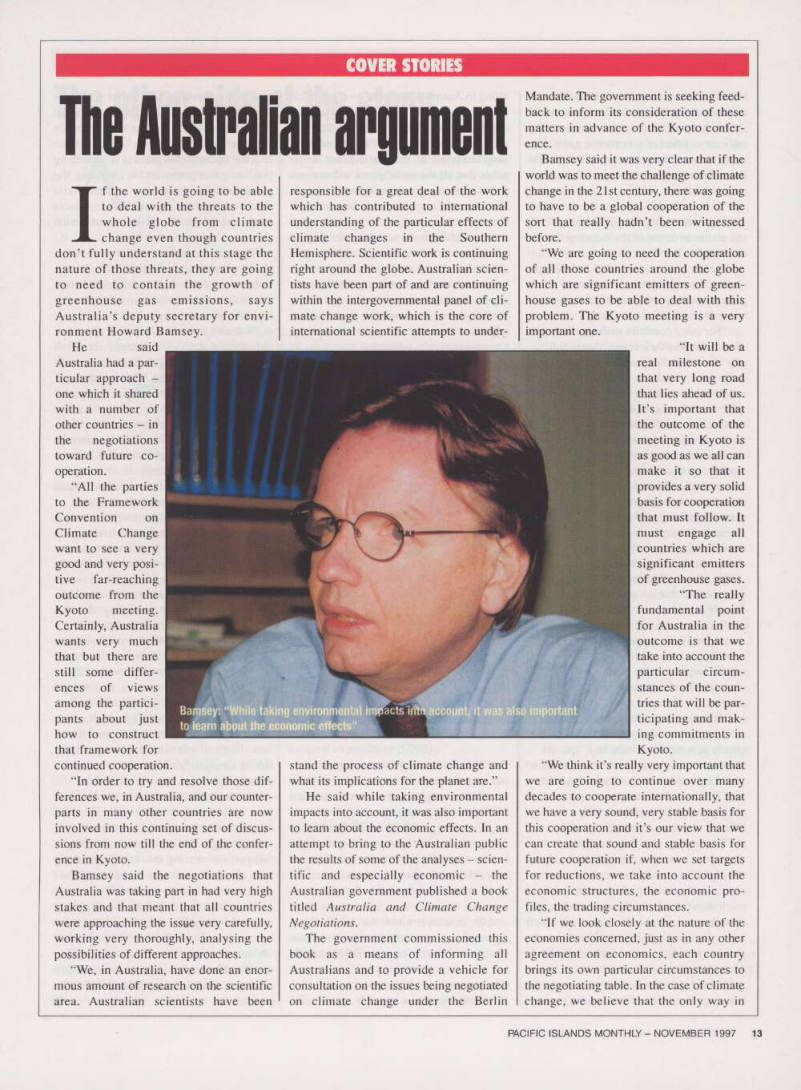
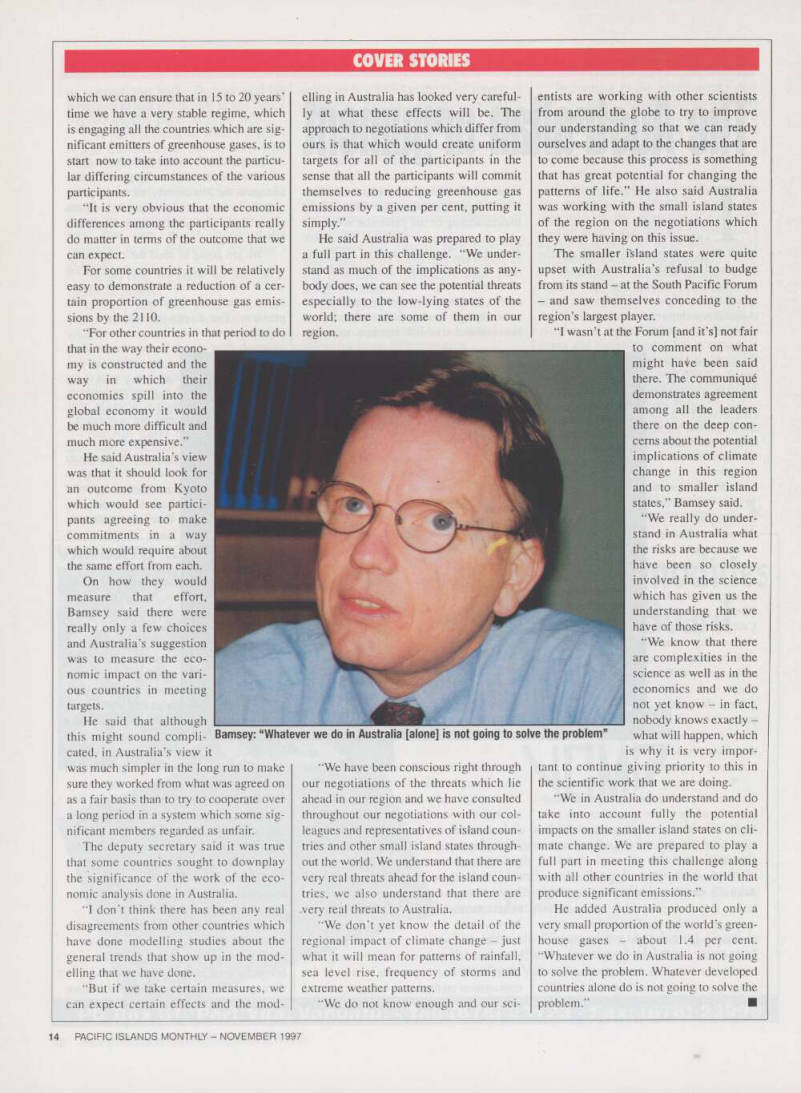
If the world is going to be able to deal with the threats to the whole globe from climate change even though countries don’t fully understand at this stage the nature of those threats, they are going to need to contain the growth of greenhouse gas emissions, says Australia’s deputy secretary for envi ronment Howard Bamsey.
He said Australia had a par ticular approach one which it shared with a number of other countries - in
the negotiations
toward future co operation.
“All the parties to the Framework Convention on Climate Change want to see a very good and very posi tive far-reaching outcome from the Kyoto meeting.
Certainly, Australia wants very much that but there are still some differ ences of views among the partici pants about just how to construct that framework for
continued cooperation.
“In order to try and resolve those dif ferences we, in Australia, and our counter parts in many other countries are now involved in this continuing set of discus sions from now till the end of the confer ence in Kyoto.
Bamsey said the negotiations that Australia was taking part in had very high stakes and that meant that all countries were approaching the issue very carefully, working very thoroughly, analysing the possibilities of different approaches.
"We, in Australia, have done an enor mous amount of research on the scientific area. Australian scientists have been
responsible for a great deal of the work which has contributed to international understanding of the particular effects of climate changes in the Southern Hemisphere. Scientific work is continuing right around the globe. Australian scien tists have been part of and are continuing within the intergovernmental panel of cli mate change work, which is the core of international scientific attempts to under-
stand the process of climate change and what its implications for the planet are.”
He said while taking environmental impacts into account, it was also important to leam about the economic effects. In an attempt to bring to the Australian public the results of some of the analyses - scien tific and especially economic - the Australian government published a book titled Australia and Climate Change Negotiations.
The government commissioned this book as a means of informing all Australians and to provide a vehicle for consultation on the issues being negotiated on climate change under the Berlin
Mandate. The government is seeking feed back to inform its consideration of these matters in advance of the Kyoto confer ence.
Bamsey said it was very clear that if the world was to meet the challenge of climate change in the 21 st century, there was going to have to be a global cooperation of the sort that really hadn’t been witnessed before.
“We are going to need the cooperation of all those countries around the globe which are significant emitters of green house gases to be able to deal with this problem. The Kyoto meeting is a very important one.
“It will be a real milestone on that very long road that lies ahead of us.
It’s important that the outcome of the meeting in Kyoto is as good as we all can make it so that it provides a very solid basis for cooperation that must follow. It must engage all countries which are significant emitters of greenhouse gases.
“The really fundamental point for Australia in the outcome is that we take into account the particular circum stances of the coun tries that will be par ticipating and mak ing commitments in Kyoto.
“We think it’s really very important that we are going to continue over many decades to cooperate internationally, that we have a very sound, very stable basis for this cooperation and it’s our view that we can create that sound and stable basis for future cooperation if, when we set targets for reductions, we take into account the economic structures, the economic pro files, the trading circumstances.
“If we look closely at the nature of the economies concerned, just as in any other agreement on economics, each country brings its own particular circumstances to the negotiating table. In the case of climate change, we believe that the only way in
Bamsey: “While taking environmental impacts into account, it was also important to learn about the economic effects”
which we can ensure that in 15 to 20 years’ time we have a very stable regime, which is engaging all the countries which are sig nificant emitters of greenhouse gases, is to start now to take into account the particu lar differing circumstances of the various participants.
“It is very obvious that the economic differences among the participants really do matter in terms of the outcome that we can expect.
For some countries it will be relatively easy to demonstrate a reduction of a cer tain proportion of greenhouse gas emis sions by the 2110.
“For other countries in that period to do
that in the way their econo my is constructed and the way in which their economies spill into the global economy it would be much more difficult and much more expensive.”
He said Australia’s view was that it should look for an outcome from Kyoto which would see partici pants agreeing to make commitments in a way which would require about the same effort from each.
On how they would measure that effort, Bamsey said there were really only a few choices and Australia’s suggestion was to measure the eco nomic impact on the vari ous countries in meeting targets.
He said that although this might sound compli cated, in Australia’s view it
was much simpler in the long run to make sure they worked from what was agreed on as a fair basis than to try to cooperate over a long period in a system which some sig nificant members regarded as unfair.
The deputy secretary said it was true that some countries sought to downplay the significance of the work of the eco nomic analysis done in Australia.
"I don't think there has been any real disagreements from other countries which have done modelling studies about the general trends that show up in the mod elling that we have done.
"But if we take certain measures, we can expect certain effects and the mod
elling in Australia has looked very careful ly at what these effects will be. The approach to negotiations which differ from ours is that which would create uniform targets for all of the participants in the sense that all the participants will commit themselves to reducing greenhouse gas emissions by a given per cent, putting it
simply.”
He said Australia was prepared to play a full part in this challenge. “We under stand as much of the implications as any body does, we can see the potential threats especially to the low-lying states of the world; there are some of them in our region.
"We have been conscious right through our negotiations of the threats which lie ahead in our region and we have consulted throughout our negotiations with our col leagues and representatives of island coun tries and other small island states through out the world. We understand that there are very real threats ahead for the island coun tries, we also understand that there are very real threats to Australia.
"We don't yet know the detail of the regional impact of climate change - just what it will mean for patterns of rainfall, sea level rise, frequency of storms and extreme weather patterns.
"We do not know enough and our sci
entists are working with other scientists from around the globe to try to improve our understanding so that we can ready ourselves and adapt to the changes that are to come because this process is something that has great potential for changing the patterns of life.” He also said Australia was working with the small island states of the region on the negotiations which they were having on this issue.
The smaller island states were quite upset with Australia’s refusal to budge from its stand - at the South Pacific Forum - and saw themselves conceding to the region’s largest player.
“I wasn’t at the Forum [and it’s] not fair
, to comment on what might haie been said there. The communique demonstrates agreement among all the leaders there on the deep con cerns about the potential implications of climate change in this region and to smaller island states,” Bamsey said.
“We really do under stand in Australia what the risks are because we have been so closely involved in the science which has given us the understanding that we have of those risks.
I “We know that there are complexities in the science as well as in the economics and we do not yet know - in fact, nobody knows exactly what will happen, which is why it is very impor
tant to continue giving priority to this in the scientific work that we are doing.
"We in Australia do understand and do take into account fully the potential impacts on the smaller island states on cli mate change. We are prepared to play a full part in meeting this challenge along with all other countries in the world that produce significant emissions.”
He added Australia produced only a very small proportion of the world's green house gases - about 1.4 per cent.
"Whatever we do in Australia is not going to solve the problem. Whatever developed countries alone do is not going to solve the problem.” ■
Bamsey: “Whatever we do in Australia [alone] is not going to solve the problem”
The other side of the story
Australia’s policy on cli
mate change was a fias co - an ignominious failure, says the execu tive director of the Australia Institute, Dr Clive Hamilton.
Dr Hamilton, who is also a visiting fel low of the Public Policy Programme at Australian National University, said rather than ask how Australia got out of step with the international community, the Howard government had become more trenchant in defence of its position, even hinting that Australia should never have signed up to the Framework Convention on Climate Change (FCCC) and may withdraw if it did not get its way.
Dr Hamilton said Australia was advocating differentiation - the alloca tion of different targets for different countries on the basis of the economic costs of emission reduction.
“It argues that targets should be set so as to impose equal economic costs per capita for each country. Australia would, under this proposal, have more lenient targets than most other coun tries.”
He said there were many flaws in the Australian government’s position.
“The government has used the results of the MEGABARE model to support its belief that uniform targets would seriously damage the Australian economy.”
He added that a close look at the
study showed the impact of stabilising Australia’s emissions on the economy would, in fact, be extremely small, and used the example of ABARE & DFAT
1995, Abare 1997.
"This is despite the fact that the MEGABARE model is constructed in a way that tends to exaggerate the costs of greenhouse gas reduction measures by assuming that there are no "no-regrets’ energy-saving measures; that is, the absence of costless energy savings and assuming that emissions-abatement mea sures would induce no additional energy saving technological change.”
Dr Hamilton said most non-economists were puzzled, to say the least, when it was suggested that policies designed to reduce emissions sharply would not induce any
technological changes.
He said the absence of no-regrets mea sures arose from the assumption that the economy was operating on a production frontier and this reflected the ABARE belief that markets worked perfectly.
“Clearly, if there are no no-regrets mea sures to reduce emissions in the Australian economy then any emissions reductions required will come at a higher cost.
“It is worth noting that, while the gov ernment bases its international arguments on cost estimates that assume the absence of no-regrets reductions, the government’s domestic greenhouse strategy is built almost entirely on the existence of no regrets measures.”
He explained that welfare changes in
the MEGABARE model were measured by changes in annual per person real gross national expenditure (GNE).
The model results indicated that real GNE fell below the ‘business-as-usual’ path by amounts ranging from -0.27 per cent in 2000 to -0.49 per cent in 2020
(Abare & Dfat 1995).
He said it was important to recognise that this did not mean the growth rate of GNE was lower by these amounts, but that the absolute levels of real GNE are lower by these amounts.
He explained that one way of under standing the size of the costs predicted by MEGABARE was to compare them to income levels in the future.
“If the economy grows on average by 3.5 per cent then per capita incomes will
reach double their current levels around January 1, 2025. If Australia adheres to its international commitments and reduces its emissions then, according to the MEGABARE estimates, the doubling per capita incomes will have to wait until around March 1, 2025, a delay of two months.
“These MEGABARE results are very embarrassing for the government. It has thus resorted to distorting the figures to support its case.”
Dr Hamilton also highlighted flaws in Australia’s differentiation position saying Australia’s position was little understood even within policy circles.
“It is argued that since Australia is more heavily dependent on fossil fuels for domestic production and exports, imposing uniform targets would impose a higher economic cost on the country.”
Australia has put forward a num ber of indicators it says should be used to determine each country’s emission reduction target. These indicators would allow more lenient targets for countries which have high GDP growth; high pop ulation growth; high emissions per unit of GDP; export fossil fuels heavily and depend heavily on fos sil fuels to produce exports.
Dr Hamilton said it was not sur prising that the international com munity reacted so negatively to Australia’s proposal.
“It means that countries that have the highest emissions would be required to do the least to reduce them, while countries that have
done the most to reduce their emissions already would be required to do more.”
He said Australia’s position was wholly contrary to the polluter-pays principle that had been the basis of environmental policy in Australia and abroad for years.
On the effects of fossil fuel, he said the Australian position’s treatment of fossil fuel trade was especially perverse. As a result of targets, two types of economic costs would be imposed on Australia - the costs of meeting domestic emissions tar gets and the costs of losses in revenue from fossil fuel exports as other (developed) countries reduce their emissions.
"The effect of the Australian ’equal eco nomic cost’ proposal would be to make domestic targets in Australia even more lenient, as economic costs are increased if
Leaders at the Forum meeting
other countries import less coal in order to reduce their own emissions.
“Under the Australian position, to offset lower coal exports, higher emissions in Australia would be permitted. Thus the more ambitious are the other countries’ greenhouse measures, the less demanding Australia’s would be.
“If it were adopted, the effect of the Australian position would be that as the rest of the industrialised world progres sively shifted away from fossil fuels, Australia would become ever more firmly entrenched as a carbon-dioxide emitter.”
As to high relative costs to Australia, he said that when the estimated costs of reduc ing emissions were as small as those esti
mated by MEGABARE then the relative costs become largely irrel evant. “Nevertheless, the reason that Australia appears to have rela tively high costs of abatement is that the modelling assumes away the existence of low-cost and no cost energy savings and because it assumes away technological progress.
“The government’s thinking and ABARE’s modelling assumes that Australia’s ‘comparative advan tage’ in fossil fuel-based industries is fixed and given. This reflects the rigid and short-term thinking about
Australia’s economic future which we have spent 20 years trying to escape from.”
Dr Hamilton said, however, that there needed to be a long-term view.
“In a decade or two, much more demanding greenhouse targets are likely and all industrialised countries will be faced with the need to turn decisively to alternative energy sources.”
On the role of population growth, he said the Australian position also sought higher emissions for Australia because of projected population growth. “Australia’s position is mired in contradictions. The government has been arguing that develop ing countries should be brought into any agreements to reduce emissions because they will be responsible for most of the emissions in the future due to their high rates of population and economic growth.
"So, according to the Australian posi tion, while high population and economic growth rates in developing countries are reasons for insisting that those countries be required to reduce their emissions, the same factors are used to argue that
Australia should be given more lenient tar gets.”
As for other opportunities for low-cost emission reductions, he said that for a country that needs to reduce its greenhouse gas emissions, heavy dependence on fossil fuels may be a blessing rather than a bur den.
“The key question is not so much whether the country consumes a large quantity of fossil fuels but how efficiently it consumes it. The more inefficient a coun try has been in the past, the easier and cheaper it will be to reduce consumption.
“This is precisely why Australia has supported the development of joint imple mentation, whereby Annex 1 countries can
claim emissions-reduction credits for pro jects that reduce emissions in non-Annex 1, especially developing countries, where it is believed there is more inefficiency in the combustion of fossil fuels.”
He said ABARE acknowledged the basic fact in the case of Japan in explaining why the MEGABARE model showed the costs of uniform targets would be very high for Japan. Japan experienced high costs because Japanese industries had already taken major steps to improve energy effi ciency and reduce fossil fuel use.
Further action to reduce emissions by significant amounts in Japan would imply further structural adjustment to the Japanese economy, carrying large costs
(Abare 1997:5).
"Of course, this fact cuts both ways.
Countries which have not already taken major steps to improve energy efficiency and reduce fossil fuel will find it relatively cheap to do so. This is precisely the case for Australia.
"Firstly, we have to compare the energy efficiency performance of Australia and
OECD countries over time. Over the peri od of 1970 to 1992, energy-related CO2 emissions per unit of output in Australia declined by 13 per cent while they fell by 36 per cent in the OECD.
“This difference may be explained by changes in industry structure rather than inefficiency of energy, but there is a wealth of evidence to suggest that inefficient ener gy use is a major factor.”
He quoted the most recent analysis of
Australia’s energy performance provided
by the International Energy Agency (lEA 1997).
The lEA notes: • over the past 10 years, energy con sumption in Australia has increased at the
rate of 2.1 per cent per annum, compared with the lEA average of 1.1 per cent; • the average ratio of energy use to output is significantly higher than in Europe and comparable with the
Usa;
• Australia ranks third among all lEA countries in fuel consumption per passenger car, with only the USA and Canada having more thirsty vehicles; • most energy consumed in Australia is fossil fuel and there fore ‘energy savings can reduce the level of CO2 emissions’; and
• energy is cheap in Australia because of its abundant supply of low-cost energy resources and low energy taxes.
The lEA concluded that “the results of the industrial energy audits, the absence of general mandatory standards for buildings and domestic appliances and the high level of fuel consumption by passenger cars all indicated that there was a great potential for improvements in energy efficiency”.
It recommended mandatory energy effi ciency codes for buildings and electrical appliances including air conditioning, stronger fuel efficiency targets for passen ger and commercial vehicles, high fuel taxes and improvements in interstate pub lic transport.
He concluded that in the absence of a sensible approach to reducing its emis sions, Australia would become locked into a fossil fuel-based economy at exactly the time the rest of the world starts to move away from those forms of energy.
He said if this view prevailed in gov ernment, them Australians would pay dear ly for it. ■
At the retreat
The greenhouse effect
By Mahendra Kumar
The "greenhouse effect” is used to describe the increase in the Earth’s surface temperature above its normal effective emitting temperature. This is due to the pro cesses of absorption and emission by certain gases in the atmosphere of cer tain wavelengths of radiation.
The principles of the greenhouse effect have been understood for a very long time.
The topic of current interest is the
enhancement of this effect due to the increase in the concentration of gases such as carbon-dioxide, methane, nitrous oxide, halocarbons and other halo gentaed compounds. This has meant a shift in the equilibrium, resulting in a warming of the Earth and changes in the climate.
These changes are, to a large degree, attributed to human activities such as the use of fossil fuels, land-use change and agriculture. The changes are projected to change regional and global
climate and climate-related parameters such as temperature, precipitation, soil moisture and sea-levels.
The current status The Intergovernmental Panel on Climate Change (IPCC), jointly estab lished by the World Meteorological Organisation (WMO) and UNEP in 1988 has made detailed analyses on the science of climate change and the main findings can be summarised as follows: the increas ing levels of greenhouse gases (GHGs) for example, 0.4 per cent per year for car bon dioxide (CO2) -and their effect on enhancing the heating of the earth (2.5 Wm-2) are well established. A doubling of CO2 concentration would directly increase global temperatures by I.2°C. When feed back mechanisms are considered, a total heating of 1.5-4.5°C has been agreed to over the past 20 years.
It is also agreed the world has heated
0.3-O.6°C since 1860, but there is debate whether this can be attributed to an enhanced greenhouse effect. However, the IPCC stated that it was unlikely the heat ing was entirely natural. There is now a discernible effect of human activity. But how much the Earth will warm and the sea level rise in the future depends on many factors.
By 2100, the temperature is expected to increase by 1-4°C (I.7°C middle scenario) and global sea level by 13-94 cm (49cm middle scenario).
Unfortunately, at present, little can be
said with any certainty about regional scale changes, especially in the Pacific. A review of scientific information and understand ing in the Pacific regarding Climate Change and Sea Level Rise (CC & SLR) draws on information from a range of sources. They show that temperatures have been increasing by 0.1 °C per decade in the region and sea levels by 2mm/yr. There is also evidence that climate phenomena such as EL Nino and Southern Oscillation (ENSO) will have major influences in the, impact of CC & SLR. It is also recognised that the Pacific region plays an important role in understanding global climate change.
The Pacific Basin Modeling, scenario development and vulnerability assessments will play key roles in helping the Pacific respond to CC & SLR. Models currently suggest a dou bling of CO2 concentration will increase
sea-surface temperatures by I°C and increase rainfall intensity in the central equatorial Pacific. Although the second assessment of IPCC did not reveal a con sensus regarding tropical cyclones in a changed climate regime, recent research has indicated possible intensity increase of 10-20 per cent with a doubling of CO2.
The situation Pacific island countries are vulnerable to changes in atmospheric and oceanic conditions with a low capacity to respond.
Climate change and sea-level rise are recognised as two important environmen tal concerns for Pacific island nations and territories.
The issues were accorded high priority
as evidenced in the various South Pacific Forum com muniques (1992-1994).
For example, the following is extracted from the com munique of the 25th Forum, held in Brisbane in 1994: “The Forum reaffirmed that global warming and sea-level rise were among the most serious threats to the Pacific region and the survival of some island states. The Forum recog nised that existing com mitments in the Framework Convention on
Climate Change (FCCC) will not meet the ultimate objective of the Convention and called for early agreement on a process for negotiating one or more protocols to implement and elaborate the Convention so that reductions of Greenhouse gas emis sions are achieved. It called on Annex 1 Parties to the Framework Convention to meet their obligations and on all non-par ties to adhere to the Convention by the end of 1994. Annex 1 countries should ensure
that joint implementation complements
and does not replace action at home.
Priority should be given to activities in support of the Framework Convention's objectives, including both research and also those activities which will assist Forum countries to meet their Convention commitments. The Forum urged enhanced efforts to implement energy efficiency and the use of renewable energy sources.”
The high priority given to climate change strategies is further reflected in the
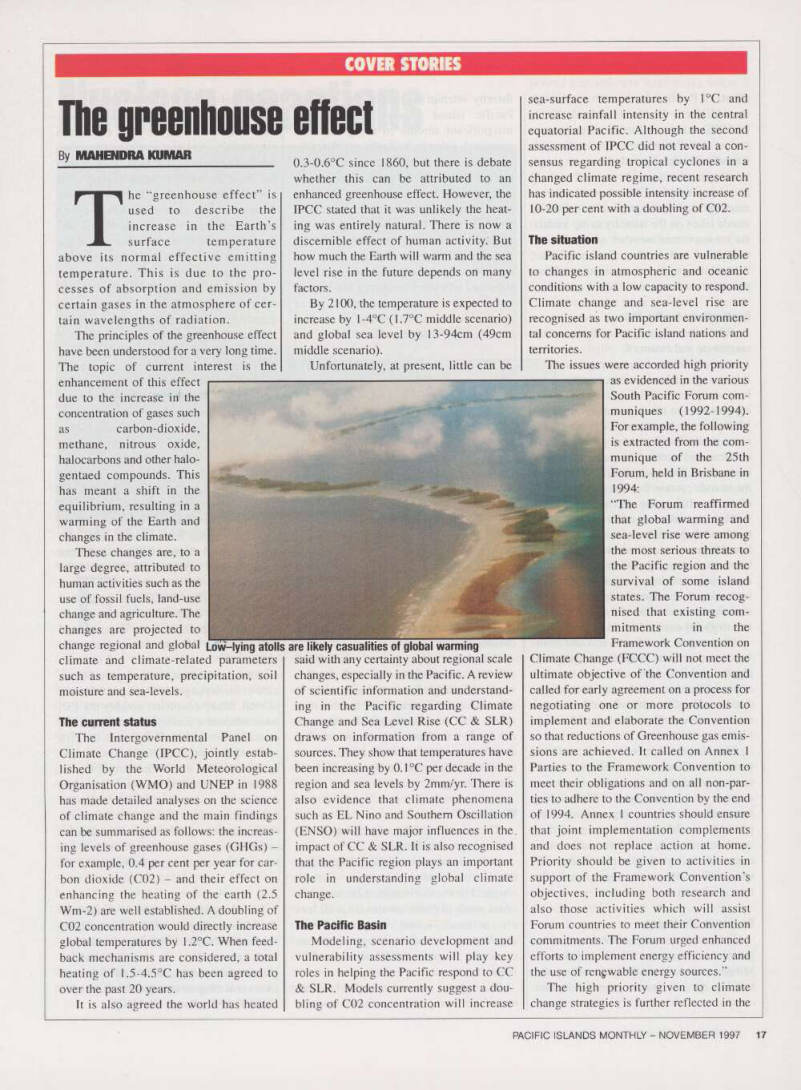
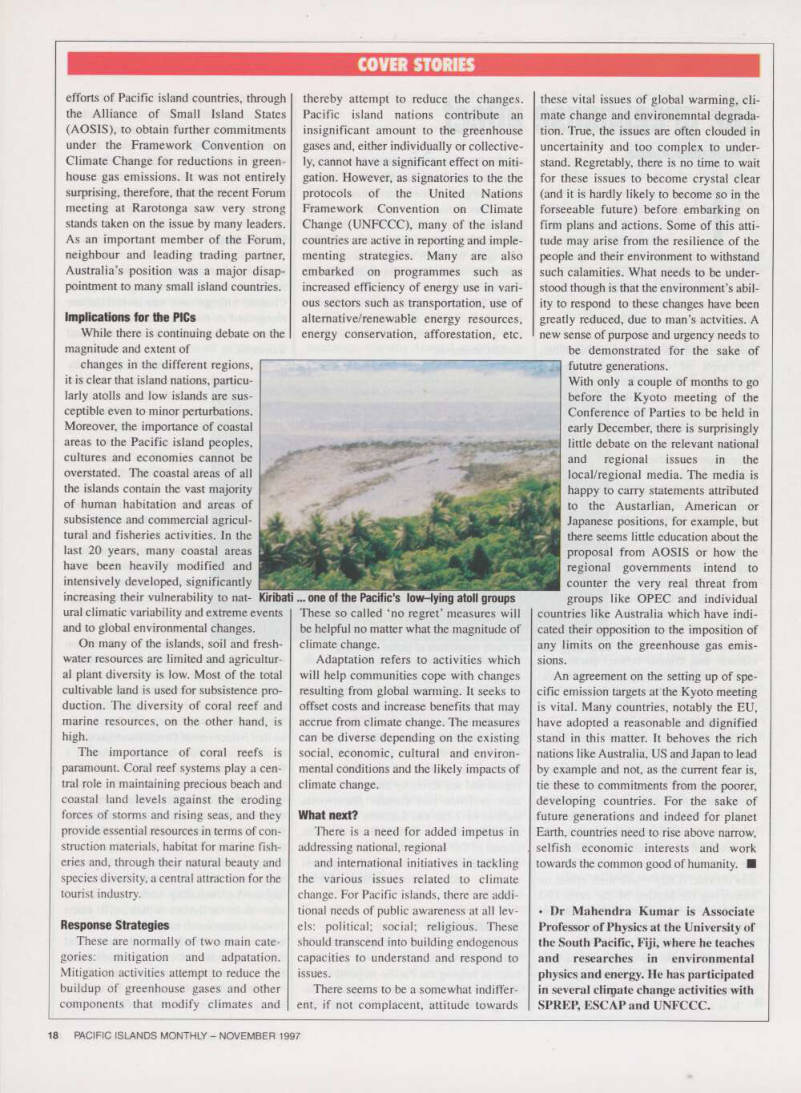
Low-lying atolls are likely casualties of global warming
efforts of Pacific island countries, through the Alliance of Small Island States (AOSIS), to obtain further commitments under the Framework Convention on Climate Change for reductions in green house gas emissions. It was not entirely surprising, therefore, that the recent Forum meeting at Rarotonga saw very strong stands taken on the issue by many leaders.
As an important member of the Forum, neighbour and leading trading partner, Australia’s position was a major disap pointment to many small island countries.
Implications for the PICs While there is continuing debate on the magnitude and extent of
changes in the different regions, it is clear that island nations, particu larly atolls and low islands are sus ceptible even to minor perturbations.
Moreover, the importance of coastal areas to the Pacific island peoples, cultures and economies cannot be overstated. The coastal areas of all the islands contain the vast majority of human habitation and areas of subsistence and commercial agricul tural and fisheries activities. In the last 20 years, many coastal areas have been heavily modified and intensively developed, significantly increasing their vulnerability to nat
ural climatic variability and extreme events and to global environmental changes.
On many of the islands, soil and fresh water resources are limited and agricultur al plant diversity is low. Most of the total cultivable land is used for subsistence pro duction. The diversity of coral reef and marine resources, on the other hand, is high.
The importance of coral reefs is paramount. Coral reef systems play a cen tral role in maintaining precious beach and coastal land levels against the eroding forces of storms and rising seas, and they provide essential resources in terms of con struction materials, habitat for marine fish eries and, through their natural beauty and species diversity, a central attraction for the tourist industry.
Response Strategies
These are normally of two main cate gories: mitigation and adpatation.
Mitigation activities attempt to reduce the buildup of greenhouse gases and other components that modify climates and
thereby attempt to reduce the changes.
Pacific island nations contribute an insignificant amount to the greenhouse gases and, either individually or collective ly, cannot have a significant effect on miti gation. However, as signatories to the the protocols of the United Nations Framework Convention on Climate Change (UNFCCC), many of the island countries are active in reporting and imple menting strategies. Many are also embarked on programmes such as increased efficiency of energy use in vari ous sectors such as transportation, use of altemative/renewable energy resources, energy conservation, afforestation, etc.
These so called ‘no regret’ measures will be helpful no matter what the magnitude of climate change.
Adaptation refers to activities which will help communities cope with changes resulting from global warming. It seeks to offset costs and increase benefits that may accrue from climate change. The measures can be diverse depending on the existing social, economic, cultural and environ mental conditions and the likely impacts of climate change.
What next?
There is a need for added impetus in addressing national, regional and international initiatives in tackling the various issues related to climate change. For Pacific islands, there are addi tional needs of public awareness at all lev els: political; social; religious. These should transcend into building endogenous capacities to understand and respond to issues.
There seems to be a somewhat indiffer ent, if not complacent, attitude towards
these vital issues of global warming, cli mate change and environemntal degrada tion. True, the issues are often clouded in uncertainity and too complex to under stand. Regretably, there is no time to wait for these issues to become crystal clear (and it is hardly likely to become so in the forseeable future) before embarking on firm plans and actions. Some of this atti tude may arise from the resilience of the people and their environment to withstand such calamities. What needs to be under stood though is that the environment’s abil ity to respond to these changes have been greatly reduced, due to man’s actvities. A new sense of purpose and urgency needs to
be demonstrated for the sake of fututre generations.
With only a couple of months to go before the Kyoto meeting of the Conference of Parties to be held in early December, there is surprisingly little debate on the relevant national and regional issues in the local/regional media. The media is happy to carry statements attributed to the Austarlian, American or Japanese positions, for example, but there seems little education about the proposal from AOSIS or how the regional governments intend to counter the very real threat from
groups like OPEC and individual countries like Australia which have indi cated their opposition to the imposition of any limits on the greenhouse gas emis sions.
An agreement on the setting up of spe cific emission targets at the Kyoto meeting is vital. Many countries, notably the EU, have adopted a reasonable and dignified stand in this matter. It behoves the rich nations like Australia, US and Japan to lead by example and not, as the current fear is, tie these to commitments from the poorer, developing countries. For the sake of future generations and indeed for planet Earth, countries need to rise above narrow, selfish economic interests and work towards the common good of humanity. ■ • Dr Mahendra Kumar is Associate Professor of Physics at the University of the South Pacific, Fiji, where he teaches and researches in environmental physics and energy. He has participated in several cliipate change activities with
Sprep, Escap And Unfccc.
Kiribati ... one of the Pacific’s low-lying atoll groups
Nuclear reactions
Special Reports
By Maniuannan Naidu
Feeling very much the mis understood victims of mis information, the producers (France and the UK) and consumers (Japan) of nuclear fuel organised what was called the “Evidence Information Tour”.
Invitations were extended to aca demics and journalists from the South Pacific, South Africa South America, the Caribbean, UK and US to partici pate in a “visual and hands-on pro ject” about the nuclear fuel industry, said Jean-Claude Guais, vice-presi dent of COGEMA Inc.
The programme, organised by COGE MA (France), British Nuclear Fuels (UK) and Overseas Reprocessing Committee (Japan), included guided tours of nuclear reprocessing plants and shipment facilities in the UK and France as well as formal and informal discussions with academics (sym pathetic to the nuclear-energy cause) and representatives of the nuclear industry.
Breaking years of a silence synony mous with the industry, the producers and transporters of nuclear fuel wanted to con
vey their side of the story and were ready to answer any questions. In a major public relations exercise designed to rival the efforts of environmental lobbyists - partic ularly, Greenpeace - they hoped to dispel at least some of the myths and quash some of the hysteria that went with the word “nuclear”.
But before discussing the pros and cons of nuclear fuel from a South Pacific per spective, it is important to look at how the region fits into the picture.
Nuclear power accounts for about 17 per cent of the world’s electric energy and about 30 per cent of Japan’s. With scarce energy sources of its own, Japan promotes the recycling of nuclear fuel as an alterna tive to oil and a means of securing a more reliable energy source.
Essentially, nuclear recycling involves dissolving the spent fuel in nitric acid, after which the uranium and plutonium (which constitutes 97 per cent of the fuel) is sepa rated from the solution and then from each other. The separated plutonium and urani um can be used to produce fresh uranium or Mixed Oxide (MOX) fuel. The three per cent waste is dried to powder, mixed with glass-forming materials, melted and
poured into stainless steel flasks where it solidifies.
The recycled fuel and vitrified waste are returned to the country of origin. The shipments between between France and Japan are carried out by PNTL (Pacific Nuclear Transport Limited), the sharehold ers of which are BNFL (62.5 per cent), COGEM A (12.5 per cent) and Japanese utilities (25 per cent).
It is during the transport of spent fuel from Japan to French nuclear facilities and the transport back to Japan of recycled fuel and vitrified waste - that the South Pacific enters the scene, lying as it does en route of the shipment. The major protests against nuclear trans-shipment are based on the possibility of an accident (as remote as the nuclear companies would have them believe the chances for this are) and the consequences on the region.
Protest surrounding the industry is also based on the premise that the use of pluto nium as a nuclear fuel source increases the potential for proliferation of nuclear weapons. But W Reed Johnson, Emeritus Professor of Nuclear Physics, University of Virginia, in his paper (The Clinton Administration’s No-plutonium-use Policy: Should It Be Scrapped?) argues against this. Referring to the “threat to world secu rity posed by the large amounts of weapons-grade plutonium left in the for mer Soviet Union”, Johnson argues that “this material, formed into plutonium oxide and mixed with uranium oxide can be burned as a fuel...and virtually destroyed as a weapons material”.
One journalist on the Evidence Tour highlighted security risks and offered the scenario of a nuclear shipment being hijacked by terrorists. The terrorist sce nario may not be so far-fetched a possibil ity. There have been three bomb threats directed at BNFL operations in the past three years, the most recent in December last year. BNFL is, of course, quick to state that this represents a smalt percentage of the UK total and that it has security mea sures in place to deal with such incidents. ”We follow a detailed set of procedures, compiled in conjunction with the UK secu rity services and other police authorities, as well as the Atomic Energy Authority Constabulary, which deal with how we handle the credibility of such threats,” says Gavin Carter, BNFL's international trans port coordinator. “We also have procedures to check ships prior to each voyage which,
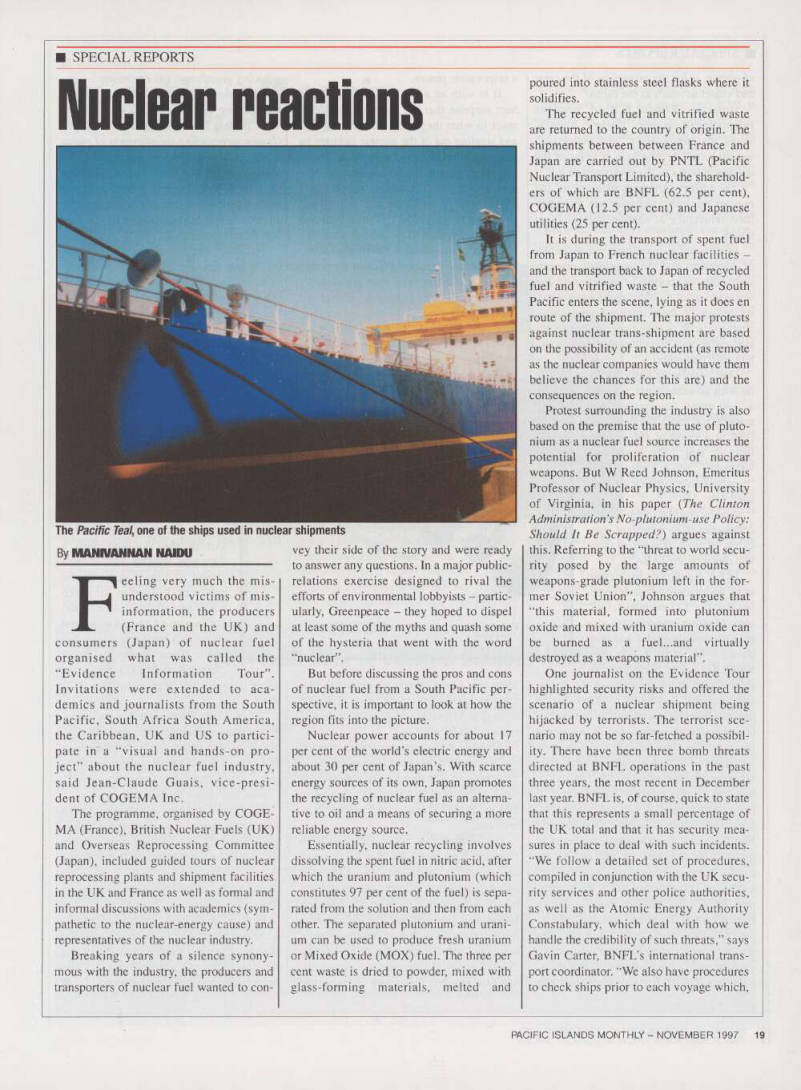
The Pacific Teal, one of the ships used in nuclear shipments
of course, is for the protection of the crew and vessel as much as the cargo.”
Ironically, Richard R Rawl, from the International Atomic Energy Agency, states that the fuel is “self-protective” against would-be hijackers in terms of the dangers it poses to those exposed to it.
The terrorist threat is also one of the reasons nuclear companies use to justify their reluctance at announcing shipment routes.
In response to questions over the safety of shipments and the possibility of acci dents, the transporters of nuclear fuel and waste are quick to point to the sophisticat ed design of their double-hulled ships, complete with twin engines and anti-colli sion radar, and 25-centimetre-thick stain less steel containers.
One popular example has to do with an experiment whereby a 140-tonne locomotive was made to run into a stainless-steel flask at a speed of 160 kilome tres an hour. The train was wrecked while the flask “received only superficial dam age”.
And, according to the nuclear companies, they maintain stan dards “at least as strict as those laid down by the lAEA”. lAEA regulations are agreed to by international experts repre senting the 122 member coun tries. Member countries are also able to send delegates and pro posals - but at their own cost.
While this would likely pose lit
tie problem to the majority of the devel oped nations, it is likely to disadvantage the less developed, and usually non-nucle ar powers. In response to this, Rawl argued that there was some funding available upon application for such situations, admitting, however, that this was limited. The lAEA, however, merely recommends measures. It is up to member states to enforce regula tions. One criticism is that COGEMA and BNFL are to some extent self-regulatory in maintaining standards, in that checks are carried out by the respective governments - who are also shareholders in the compa nies. But Claire Chaubert, from the British Department of Trade and Industry (stress ing that she could only speak for the British government) brushed aside criti cism of such an arrangement. Her argu ment was that the British government was
a responsible power.
It is with an air of bewilderment and hurt surprise that the nuclear companies react to what they see as a victimisation and singling out of the nuclear industry by environmental organisations. As an exam ple, they point to the environmental dan gers posed by oil tankers, which run a higher risk of accidents and attract less vehement protests. The Evidence Tour was part of a campaign to rationalise what they see as an overly emotional response to any thing nuclear - truer perhaps in the South Pacific, which has been used unabashedly by France, the UK and US as nuclear test sites. The bombing of the Greenpeace flag ship, the Rainbow Warrior, by French agents is still too recent an event to forgive and forget for many in the region.
Memories of the French government’s bla tant disregard of regional opinion against testing at Moruroa and Fangataufa atolls remain still fresher.
That the British government conducted nuclear tests in the Australian outbacks in proximity of Aboriginal settlements adds little conviction to Chaubert's argument that the British provide a responsible gov ernment.
While there are some who condemn French testing in the Pacific, the industry are eager to highlight the difference between civil and military uses of nuclear power. In espousing the benefits of nuclear energy as a source of fuel, the industry has, interestingly, adopted an environmental message; and one capable of generating much support in the current political cli mate surrounding the setting of targets for
reducing greenhouse gas emissions.
As Professor Willard Pinnock, from the Department of Chemistry, University of West Indies, Jamaica, states in his paper (Issues surrounding the shipment of pluto nium, spent reactor fuel and radioactive waste through the Caribbean), “Perhaps the most compelling reason for wanting to reduce fossil-fuel burning is the adverse environmental impact caused by the car bon dioxide generated.”
He adds: “The Intergovernmental Panel on Climate Change...assesses the vulnera bility of small island developing states to the effects of global warming to be two or three times that of developed countries.”
But despite the pluses nuclear energy is able to muster, it remains a dan gerous force. And notwithstanding the low
probability of accidents claimed by the nuclear industry, improbable does not equate impossible, bringing to mind an article which appeared in Flying, an American aviation magazine, and later the Calgary Herald (July 12, 97). The story, recounted by a delegate during the tour, had to do with the very unlikely event of a cow falling out of the sky and onto a Japanese trawler. But it hap pened. It turned out that the pilots of a Russian air force cargo jet had decided to “liber ate” a cow which had wandered on to a Siberian military air field. When the animal went "berserk at 30,000 feet”, the
pilots lowered the cargo ramp and let it
jump.
While it is true that there is very little if anything - which can be classified risk free, if nuclear energy is to exist, the nature of it is such that it requires the most strin gent controls and safety measures.
And herein lies the paradox.
While the nuclear companies claim allegations against the safety of the indus try are greatly exaggerated, they cannot easily dismiss the the thought that pressure from environmental groups - such as Greenpeace - may have some bearing on their safety record.
Perhaps, the bigger nuclear danger lies in the world relaxing its vigilance over the industry. Emeritus Professor of Physics at the University of California put it, "The worst threat to safety is complacency.” ■
Technical drawing of the TN 28 VT transport flask
On again, off again
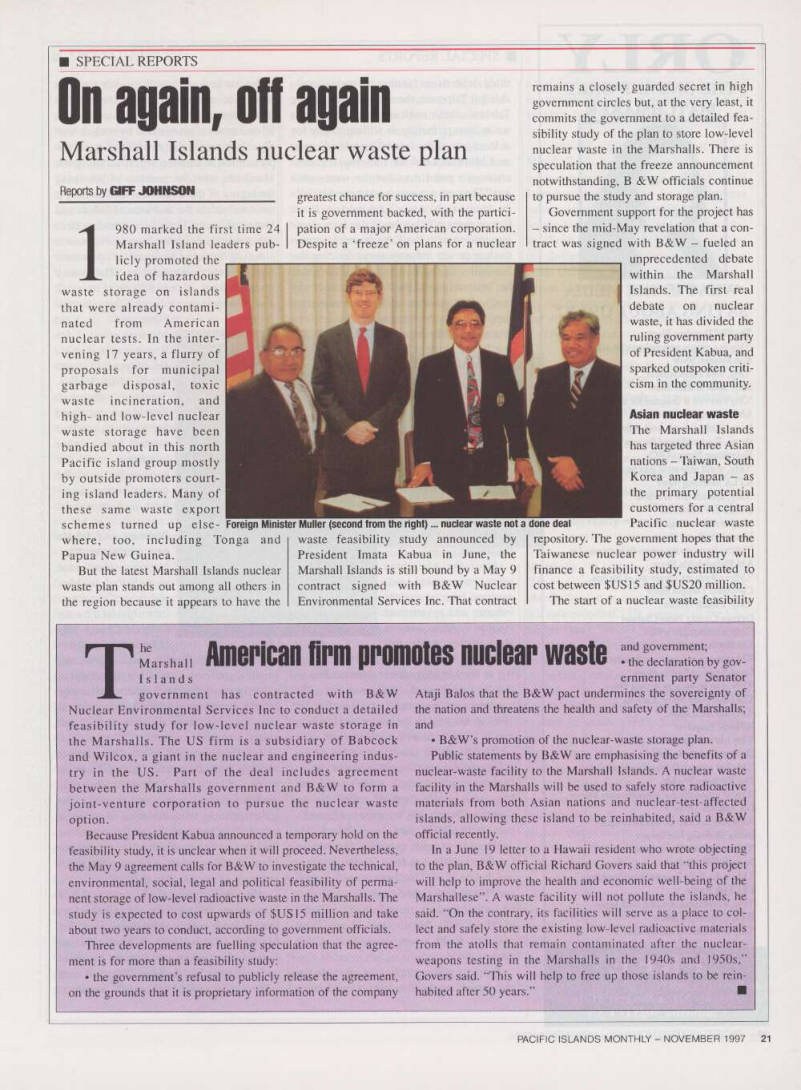
Marshall Islands nuclear waste plan
Reports by GIFF JOHNSON
1 980 marked the first time 24 Marshall Island leaders pub
licly promoted the
idea of hazardous
waste storage on islands that were already contami nated from American nuclear tests. In the inter vening 17 years, a flurry of
proposals for municipal
garbage disposal, toxic
waste incineration, and high- and low-level nuclear waste storage have been bandied about in this north Pacific island group mostly by outside promoters court ing island leaders. Many of these same waste export schemes turned up else
where, too, including Tonga and Papua New Guinea.
But the latest Marshall Islands nuclear waste plan stands out among all others in the region because it appears to have the
greatest chance for success, in part because it is government backed, with the partici pation of a major American corporation.
Despite a ‘freeze’ on plans for a nuclear
waste feasibility study announced by President Imata Kabua in June, the Marshall Islands is still bound by a May 9 contract signed with B&W Nuclear Environmental Services Inc. That contract
remains a closely guarded secret in high government circles but, at the very least, it commits the government to a detailed fea sibility study of the plan to store low-level nuclear waste in the Marshalls. There is speculation that the freeze announcement notwithstanding, B &W officials continue to pursue the study and storage plan.
Government support for the project has - since the mid-May revelation that a con tract was signed with B&W - fueled an
unprecedented debate within the Marshall Islands. The first real debate on nuclear waste, it has divided the ruling government party of President Kabua, and sparked outspoken criti cism in the community.
Asian nuclear waste The Marshall Islands has targeted three Asian nations - Taiwan, South Korea and Japan -as the primary potential customers for a central Pacific nuclear waste
repository. The government hopes that the Taiwanese nuclear power industry will finance a feasibility study, estimated to cost between SUSIS and SUS2O million.
The start of a nuclear waste feasibility
Foreign Minister Muller (second from the right)... nuclear waste not a done deal
study depends on funding becoming avail able but Taipower, the agency that operates Taiwan’s three nuclear power plants and waste storage facility, is willing to pay for at least part of the feasibility-related costs, said Minister Litokwa Tomeing, the gov ernment’s point man for the waste pro ject.’They are anxious to start the feasibil ity study right away,” he said in June.
Government officials have also been com municating with the Korean and Japanese nuclear power industry about funding the feasibility study, Tomeing said, adding that he believed that if the Taiwanese back the study, the Japanese and Koreans may also
support it. The Marshalls is aware of the impend ing Taiwan nuclear waste exports to North Korea,
Tomeing indicated.
Marshalls officials believe, however, that the controversy and opposition that the exports to N Korea have generated will work in favor of the Marshalls’ proposal to establish a permanent storage facili ty for nuclear waste in the islands.
Over the past three years, government lead ers have lobbied nuclear industry and government leaders in Asian nations about nuclear waste stor
age in the Marshall Islands. But the sign ing of the May agreement with B&W was the first positive development since the government announced its intention in 1994 to help solve the major world prob lem of what to do with nuclear waste.
Rumors about movement cn the nucle ar waste scheme began circulating in Majuro in mid-May. It wasn’t until late May at a public meeting called by the Catholic Church that Tomeing confirmed a pact with B&W had been inked. He declined to provide details, other than to say the contract was for a feasibility study and that no islands had been named. Erikub and Wotho atolls, the former an uninhabit ed turtle breeding ground, the later home to about 150 Marshallese, have been rumored to be under consideration for nuclear waste.
Nuclear waste proponents promote the plan largely on the idea that playing host to
Asian nuclear waste will provide the cash needed to underwrite the multi-million dollar cleanup programmes needed to reha bilitate atolls contaminated by nuclear test ing. They emphasise the US did not com
plete nuclear cleanup work, saddling the
Marshalls with the problem of resolving the legacy of the 67 nuclear tests, which is not confined to the test sites of Bikini and Enewetak atolls. Government leaders have painstakingly explained the waste plan is closely connected to cleaning up islands that are now uninhabitable. “The money given to these islands (Bikini, Enewetak and Rongelap/) is not adequate for
cleanups,” said Minister for Resources, Development and Works Jiba Kabua.
Tomeing observed that money received for handling nuclear waste from other countries could be used to deal with the contamination prob lems on these islands.
Divisions and debate over nuclear waste Majuro residents who participated in May and July public meet ings organised by the Catholic Church reg istered strong objec
tions to the plan. Twenty-seven doctors and medical professionals at Majuro Hospital signed a petition to the health minister urg ing the government to abandon considera tion of nuclear waste storage on health and safety grounds.
In response, Minister Jiba Kabua charged that the Catholic Church, the com munity at large and environmental groups such as Greenpeace had over-reacted to the government’s consideration of nuclear waste. “It’s not even in the first step,” he said responding to critics of the waste pro posal at a July public meeting. "It’s just a proposal; it’s not a done deal.”
He was particularly critical of Greenpeace for providing detailed infor mation about nuclear waste to people in the Marshall Islands, saying that all this dis cussion about waste was missing the point and confusing Marshallese. “Why stir it up when it’s not really happening?” he asked.
Minister Litokwa Tomeing is the government's point man for negotiations on nuclear waste proposals
But local residents fear that there has been a great deal of progress on the waste plan since May and, at public meetings, have expressed concern the government is not being forthcoming in releasing details
about the waste plan. Hospital pharmacist
Sandy Alfred commmented the communi ty had not over-reacted at all. “It has beena spontaneous community reaction” critical of the government for not providing infor mation. “We don’t know what’s going on, what’s in the feasibility study,” he said.
Biram Stege, an adult aducation adminis trator at the College of the Marshall Islands, said: “As concerned citizens, we can’t sit back and let the government decide things on its own. We have the right
to know what’s going on and the gov ernment should be forthcoming.”
Confirming that the feasibility study pact between the Marshalls government and B&W wasn’t merely a community concern, Kwajalein Senator Ataji Balos, who chairs the Nitijela’s (parliament’s) Foreign Affairs and Trade committee, blasted the agreement, saying it undermined the sovereignty of the nation and should be terminated. Opposition by Balos, a key government party offi cial, underscored the serious divi
sions that escalation of the waste scheme has caused within the government. In a country where circumlocution is an art form, Balos’s direct words were a harsh wake-up call. He promised to use his posi tion to ensure the Marshall Islands “will not consider in the future any agreements pertaining to the storage or disposal of radioactive wastes from other countries”.
He accused B&W of taking advantage of government officials and “aggressively and repeatedly” pressuring them to sign an agreement that “is beginning to have severe effects on our relations with our allies and neighbours”.
Balos declared he wanted Marshallese people and friends in the international community to know "the Marshall Islands government will not tolerate any situation which may compromise the health and safety of the Marshallese people, or our neighbours, nor which threatens our ability to govern in the best interest of the nation”.
Clinton administration officials in Washington DC have refused to support the waste storage plan since it first sur faced three years ago. Although US con gressional leaders have been split on the
plan, in recent months as the Marshalls plan moved ahead, several key US legisla tors made it clear the Marshalls would not get the support it desperately needed on other key budget issues with the waste fea sibility study on the boards. President Kabua was set to make his first state visit to Washington in late June. It became clear that he was going to have to focus much of his time on the high-profile nuclear waste scheme instead of on the two primary issues - renegotiation of the Compact treaty with the US that expires in four years and getting US recognition of its obligation to provide additional medical services and compensation to nuclear test victims - that top the Marshalls’ agenda
with Washington. In one of his first meet ings with US Interior Secretary Bruce Babbitt, President Kabua announced the feasibility study was being put on indefi nite hold. His stance was praised by US officials.
The debate heats up despite freeze While the president’s freeze may have deflated concerns that waste imports are imminent, it has fueled a top-level debate within the ranks of the parliament.
“We cannot just come out and say that nuclear waste will resolve our economic problems,” said Senator Alvin Jacklick, who represents Jaluit. The country needs to look at its range of options - including foreign aid donors who can assist - and come up with a comprehensive develop ment plan, not embark on a plan to import nuclear waste.
Jacklick is especially concerned that lit tle information about nuclear waste plans of the government is being made public.
“The person on the street doesn't know much because the leaders don't discuss it publicly,” he said, adding that if people know what was happening, they "will say
no to nuclear waste”. The study is setting in motion the nuclear waste plan which Jacklick believes Marshallese people will oppose.
Jacklick said he believed most Marshallese leaders knew the impact nuclear materials can have - the Marshall Islands was ground zero for 67 American nuclear tests and islanders continue to suf fer the health effects of exposure to nucle ar fallout - but the leaders are “blinded” by the dollar signs they see in the nuclear waste trade, particularly at a time when the nation’s economic woes are forcing it to lay off hundreds of government workers and drastically cut back spending.
The opposite view |is espoused by
Majuro Senator Wilfred Kendall, the Marshalls former ambassador to Washington, who believes the president made a grave mistake in freezing the feasibility study.
“The bottom line is - is nuclear waste in our national interest?
Yes, I believe it is.” Kendall, who chaired a government commission established to develop the nuclear waste storage plan in the mid-90s, fervently argues that low-level nuclear waste storage does not pose health hazards to the
Marshalls. “It is definitely safe,” he said.
“Many scientific experts agree that it [the Marshalls plan to import low level waste] is a safe proposal.” He argues that the fea sibility study “would have really explored the mater and told us how the project can be done safely”.
Jacklick, on the other hand, is delighted with the freeze announcement, and said he had “high hopes that this project is heading toward its grave yard”. But he cautions that, because of the involvement of American corporation B&W, it is too early to say the project is dead.
The debate continues, but a major gov ernment policy shifts is evident from the mid-90s when Kendall was chairing the nuclear commission. At that time, Kendall kept the media informed of developments and maintained a high level of transparen cy in his dealings with the nuclear waste issue. The government’s current refusal to release the contract with B&W speaks for itself. Still, Foreign Minister Phillip Muller and Minister Kabua both confirm no deci sion will be made on nuclear waste with out consultation with South Pacific Forum leaders in the region. ■
Minister for Resources, Development and Works Jiba Kabua
American firm promotes nuclear waste
T Marshall MCail (frill PPOH
Islands government has contracted with B&W Nuclear Environmental Services Inc to conduct a detailed feasibility study for low-level nuclear waste storage in the Marshalls. The US firm is a subsidiary of Babcock and Wilcox, a giant in the nuclear and engineering indus try in the US. Part of the deal includes agreement between the Marshalls government and B&W to form a joint-venture corporation to pursue the nuclear waste
option.
Because President Kabua announced a temporary hold on the feasibility study, it is unclear when it will proceed. Nevertheless, the May 9 agreement calls for B&W to investigate the technical, environmental, social, legal and political feasibility of perma nent storage of low-level radioactive waste in the Marshalls. The study is expected to cost upwards of SUSIS million and take about two years to conduct, according to government officials.
Three developments are fuelling speculation that the agree ment is for more than a feasibility study: • the government’s refusal to publicly release the agreement, on the grounds that it is proprietary information of the company
and government; • the declaration by gov ernment party Senator
Ataji Balos that the B&W pact undermines the sovereignty of the nation and threatens the health and safety of the Marshalls; and • B&W’s promotion of the nuclear-waste storage plan.
Public statements by B&W are emphasising the benefits of a nuclear-waste facility to the Marshall Islands. A nuclear waste facility in the Marshalls will be used to safely store radioactive materials from both Asian nations and nuclear-test-affected islands, allowing these island to be reinhabited, said a B&W official recently.
In a June 19 letter to a Hawaii resident who wrote objecting to the plan, B&W official Richard Covers said that "this project will help to improve the health and economic well-being of the Marshallese”. A waste facility will not pollute the islands, he said. "On the contrary, its facilities will serve as a place to col lect and safely store the existing low-level radioactive materials from the atolls that remain contaminated after the nuclear weapons testing in the Marshalls in the 1940 s and 19505,”
Covers said. "This will help to free up those islands to be rein habited after 50 years.” ■
Advertisements & other items, p. 22 (1 item)
Orly
THE ONE AND ONLY
MATCHMAKER
WHAT IS THE MEDIA
SAYING ABOUT ORLY?
The Phil Donahue Show "Orly is a unique personal matchmaker..."
Ron Reagan Show "Orly, bom a matchmaker..."
Sally Jesse Rafael Show "Orly's service is designed for the professionals...' AM Los Angeles Show "two of Orly's clients were married live on the show... The wedding of the year"
Eyewitness News (ABC) "Orly, world renowned matchmaker.."
KTLA Morning News "Orly, matchmaker in action..."
Jewish T.V. Network "Orly is real marriage broker..."
Montel Williams Stow "Orly's clients are the cream de la cream..."
AM Philadelphia Stow "Orly's clients are simply top of the line..."
Cleveland Tonight Show "Orly, a touch of class.."
Orange County News Channel "Orly is champagne wishes..."
AM Northwest Show, Oregon "Orly the one and only matchmaker..."
Good Evening Seattle Show "Orly is an investment in your future..."
The Dimi Petty Show, Canada "Orly has sixth sense..."
National Enquirer "Orly has a dream date for y0u..."
Orange County Register "Orly has a match for the sincere singles..."
The Heritage Weekly "Orly is nationally and internationally known..."
Los Angeles Times "Orly matches the rich and successful..."
Dallas Morning Newspaper "Orly made countless introductions..."
Beverly Hills Today "Orly is the Rolls Royce of matchmaking..."
KFI Talk Radio "Orly, a matchmaker with a sixth sense...' WLAC Nashville Radio "Orly is a celebrity matchmaker...'
FREE
30 MINUTES PHONE CONSULTATION
(310) 659-7337 • Beverly Hills California 90211- USA
Dredging profits

Economy
Cooks bank on undersea manganese mining
By Michael Feld
About a million years ago, eons before we people happened upon these waters, a small organic fragment, a shark’s tooth or perhaps a squid beak, fell to the bottom of the immensely deep Pacific Ocean.
Five kilometres down, it reached a cold, mineral-rich current sweeping up from Antarctica and in a mysterious process a rich cocktail of elements began attaching itself to that shred. Over that “single day of eternity”, as one writer put it in a different context, a lump of rock between the size of a walnut and a tennis ball formed. Today, billions of these manganese nodules - rich in manganese, cobalt, nickel and copper and, in places, platinum and gold - are scattered across the sea-floor.
They were discovered in 1873 when HMS Challenger, on a worldwide scientif ic voyage, dredged up nodules near the Canary Islands in the Atlantic. They amount to the last great non-renewable resource still untouched on our planet. On September 4, Cook Islands Prime Minister Sir Geoffrey Henry quietly took a signifi cant new step to change that. His govern ment signed a Memorandum of Understanding (MOU) with the newly
formed Norwegian Deep-Sea Mining
Group (NDSMG) to determine how to utilise the Cooks’ manganese. Norway has come up with a simple sea-bed mining option. While the Japanese, French and Indians have looked at sophisticated con veyer and suction technologies, Norwegians have figured out that the nod ules can be had, relatively cheaply, the same way bottom-dwelling fish and seashells are taken now - by trawlers.
The Cook's resource is immensely rich on paper. The problem is most of it is five kilometres down near the junction of the Aitutaki Passage and the Penrhyn Basin.
Antarctic bottom water flows north-east ward in the area like a river, providing the rich brew that created the nodules in the irst place.
In places, around 30 kg of nodules are contained in every square metre - lying on
the flat bottom of the Pacific.
The numbers are so vast as to be hilari ous and quite meaningless. For example, the Cooks has enough cobalt alone to feed the world’s demand for the strategic miner al for the next 520 years. Dump that amount on a small market and cobalt would neither be strategic, nor worth much.
Hawaii’s East-West Center estimates that the Cooks has 32.5 million tonnes of cobalt, 24.4 million tonnes of nickel and 14 million tonnes of copper.
They even reckon the cobalt has a mar ket worth of $U5967.34 billion but neither they, nor anybody else, can quite say who would buy that much - or pay £hat much.
Manganese has little international value while nickel is essential for the iron and
steel industry which uses more than 60 per cent of the world nickel production in the manufacture of stainless steel. The value of copper is diminishing. Experts reckon that these days a once-rich mine like that at Panguna in troubled Bougainville is no longer viable. Cobalt, a by-product of nick el mining, is much more interesting and in the later stages of the Cold War was the subject of high-level Washington panic. It is one of several vital alloying elements used in aerospace and electrical industry and the major source was Zambia, Zaire, Russia and Cuba - chronically unstable and politically dangerous. To protect defence industries, the US Defense
Logistic Agency purchased big stockpiles
of cobalt which still exist. The Cold War is over and cobalt is no longer the big worry it was. For starters, fewer combat jet engine aircraft are being built.
Only 25,000 tonnes of cobalt a year is needed and the cobalt mines in the Shaba province of Zaire are in near ruins although Gecamines of Zaire and ZCCM of Zambia still largely determine the world price.
That may change soon as Canada and
Australia bring new mines into production.
Sir Geoffrey has been persistent with his nodules dream and last year, with a SUS3OO,OOO grant from the US Trade and Development Agency, his government hired California’s Bechtel Corporation to look at the feasibility of trawling for nod ules.
Bechtel are the world’s biggest, most influential engineering consultants. If they didn’t build the 20th Century, they will have a lot to do with the way the 21st
Century looks.
They produced an enormous review, handily summarised in a 24-page report.
“Four dedicated trawleys will be used for harvesting,” Bechtel say, drawing the picture of the scene north of lovely, lonely Aitutaki.
“Each trawler will transfer the nodules into a bulk carrier vessel of about 30,000 tons capacity for transportation to the pro cessing plant. There will be three transport vessels employed by the project. One will be stationed at the harvesting site to receive the nodules from the trawlers while the other two will be sailing to or from the processing plant.”
Bechtel assume the processing plant would be in New Zealand.
“The basic criterion for the Cook Islands operation is the production of 2652 tons of cobalt per year, which represents approximately 10 per cent of the current world consumption of the metal. In order to produce such quantity, 1,097,360 tons of wet nodules must be harvested and pro cessed annually.”
These figures would make the Cooks the world’s fifth largest cobalt producer.
They ran computer simulations of the dredging. “There are elements of uncer tainty related to harvesting by trawls, the main one being that bottom trawling has never been done in waters deeper than about 1200 metres.” While oceanographic vessels have had no problems lifting up small amounts of nodules, Bechtel checked this out on a computer too. “The studies found the proposed method technically feasible with no fatal flaws; however, they pointed to the need for a rigorous design, testing and evaluation programme in the course of the implementation of the pro ject.” The problem with the dream is cobalt pricing - it is not traded on a commodity market anywhere and as it is a by-product, metal market conditions have little to do with the price paid. “The major uncertain
ties for cobalt pricing exist on the supply side,” says Bechtel in a commentary straight out of high school economics classes. “If supply increases faster than demand, prices will fa 11... Cobalt prices have been historically volatile and difficult to predict, particularly over the past few years.” Bechtel’s report, completed last year, was circulated worldwide and attract ed the attention of Oslo’s Fridtjof Nansen Institute. Nansen was a polar explorer with interests in oceanography and the institute
which honours his memory is engaged in applied social science research on interna tional issues concerning energy, resource management and the environment. They liked what they saw in Bechtel’s report and formed NDSMG made up of companies active in offshore production, shipbuilding and marine electronics. The MOU signed with the Cooks government has been the cause of celebration in Avarua.
"Deep-sea mining seems to have been a grand joke amongst our resident cynics,”
Sir Geoffrey wrote in his Cook Islands Press column recently.
Mindful though of the way the world has wearied of Pacific schemes and dreams, he has taken on a more modest tone; putting out the MOU was not cause just yet for excitement, but rather a signal of possible excitement to come. ‘This is not the billion-dollar bonanza that some would wish for but, as a start, additional government revenue of SNZ2I million (SUS 12.4 million) per annum by, say, 2004 is better than a poke in the eye.”
The operation would be relatively easi ly done, and with little trouble to the envi ronment. “Since the trawls are fitted with ski-like runners, they are intended to slide on the seabed surface, allowing the nod ules to be scraped up with very little dis turbance of the bottom itself. Since each trawl is hauled to the surface at a speed of two metres per second, any mud would be washed away in the first kilometre of trav el, leaving nothing but 120 tons of small rock to.pass through the surface into the trawler’s hold.”
He says production is at best four or five years off, given that the Norwegian scheme involves the building of four trawlers, three ore carriers and single pro cessing plant. “However, there is some good news built into that delay for, once an investor/operator is committed to proceed, that time could be well used to train as many Cook Islanders as possible for the many good jobs involved.”
The Suva-based South Pacific Applied Geoscience Commission (SOPAC) has sounded a warning though, saying signifi cant marketing and engineering problems were still ahead.
"It is not so much that I am sceptical but at first thought I am doubtful it will hap pen; we need to know so much more,”
SOPAC director Philip Muller said. Muller said the idea of bottom trawling for nod ules at such depths involved "monstrous draglines” with major engineering implica tions alone. It was not known because it had not been done, whether such lines would even work. Muller does not dismiss the notion of mining the Pacific.
It will happen; when is the major vari able. His fear is the Norway-Cooks scheme will proceed too rapidly and will collapse in the face of the immense difficulties of mining so deep. Then nobody will be inter ested in coming back into the Pacific for a long time. ■
Advertisements & other items, pp. 25-26 (1 item)
Notebook,
To Win an
IBM Pentium
mm Get the latest on political, business and social issues happening throughout the region every month, as well as the chance to win an IBM Pentium Notebook! Every 12issue subscription received before March 31st, 1998 will go into the draw. Subscribe to Pacific Islands Monthly today by calling (679) 304 111 or fax (679)303 809/(679)307 460.
Subscribe to The Source.
Pacific Islands Monthly
Conditions of Entry I. To enter, subscriptions must be made before March 31st, 1998 which automatically enters the subscriber into the draw for the Pentium Notebook Computer. 2. Entry is open to all subscribers except employees ofThe Fiji Times Ltd, Pacific Islands Monthly and Wilson Addison Ltd. 3- Subscribers need to subscribe for at least 12 months to qualify. 4.The winner of the Pentium Notebook will be published in the Pacific Islands Monthly Magazine, May Issue, 1998 and will be notified by registered mail. s.The winner will receive their prize within one month of the draw. 6. The prize must me taken as offered and is not redeemable. 7. In the event of any dispute the decision of the promoter is final and no correspondence will be entered into.
TOURISM COUNCIL OF THE SOUTH PACIFIC
VACANCY
Manager Human Resources and Training
Applications are invited for the position of Manager Human Resources and Training for the Tourism Council of the South Pacific (TCSP), an intergovernmental organisation of twelve countries.
The main objectives of the TCSP are to promote, co-ordinate, plan and implement projects and activities designed to strengthen regional co-operation in tourism development and optimise the contribution of tourism to the socioeconomic development of the member countries.
The Manager Human Resources and Training heads one of the five Divisions within TCSP and is responsible to the Chief Executive for planning, organising and executing the human resources and training components of the work programme. Amongst others, these include: organisation and co-ordination of courses, seminars, workshops and similar activities; providing advice and assistance to member countries on education, training and internal awareness; any other educational, training and internal awareness activities.
Applications are restricted to the nationals of the member countries of the
TCSP*
Applicants should have qualifications and experience appropriate to the post and a record of achievement in tourism or related training fields in the region, at a senior level.
Those interested in the appointment are advised to obtain a copy of further particulars, which is available from the TCSP Secretariat, Phone (679) 304 177; Fax: (679) 301 995 before applying. Applications, including a detailed curriculum vitae and names and addresses of three referees with whom the applicant has been associated in a professional capacity, must be submitted by 30 November, 1997 to the Chief Executive, Tourism Council of the South Pacific, P O Box 13119, Suva, Fiji. Envelopes should be marked “Professional Staff Application”. The successful candidate is expected to take up the position in January, 1998. □ * TCSP Member Countries: Cook Islands, Fiji, French Polynesia, Kiribati, New Caledonia, Niue, Papua New Guinea, Samoa, Solomon Islands, Tonga, Tuvalu, Vanuatu.
A question of Public Trust
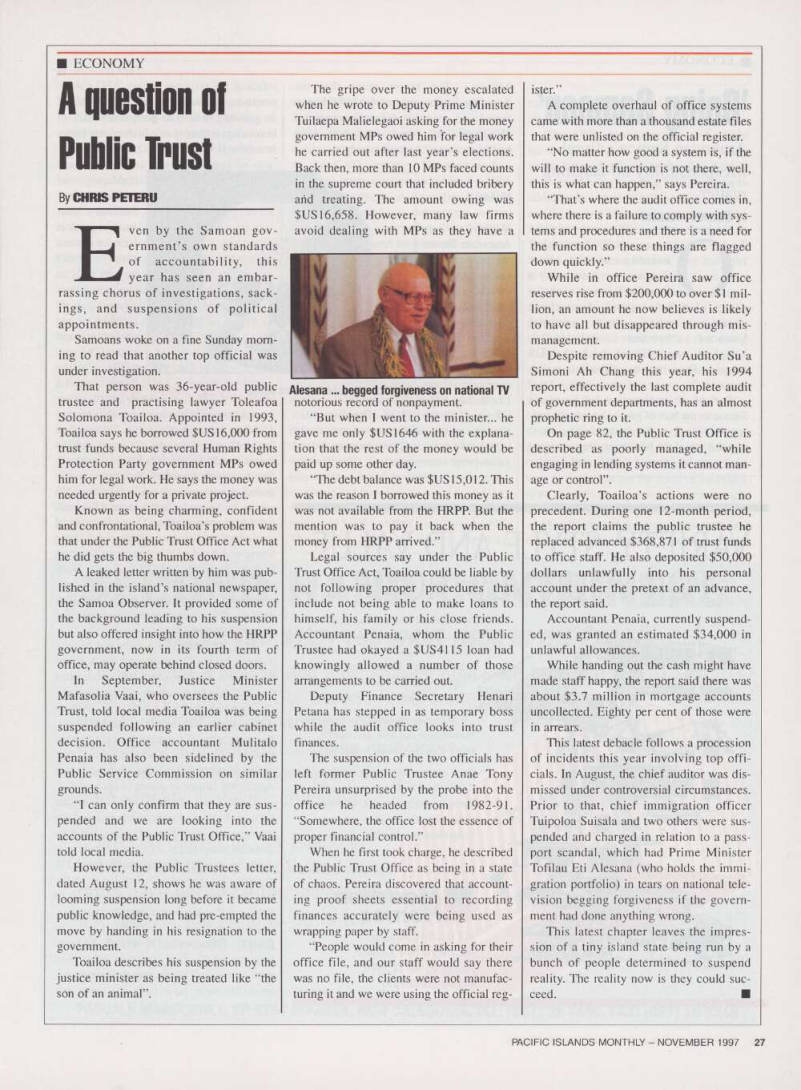
Public Trust
By Chris Peieru
Even by the Samoan gov ernment’s own standards of accountability, this year has seen an embar rassing chorus of investigations, sack
ings, and suspensions of political
appointments.
Samoans woke on a fine Sunday morn ing to read that another top official was
under investigation.
That person was 36-year-old public trustee and practising lawyer Toleafoa Solomona Toailoa. Appointed in 1993, Toailoa says he borrowed SUS 16,000 from trust funds because several Human Rights Protection Party government MPs owed him for legal work. He says the money was needed urgently for a private project.
Known as being charming, confident and confrontational, Toailoa’s problem was that under the Public Trust Office Act what he did gets the big thumbs down.
A leaked letter written by him was pub lished in the island’s national newspaper, the Samoa Observer. It provided some of the background leading to his suspension but also offered insight into how the HRPP government, now in its fourth term of office, may operate behind closed doors.
In September, Justice Minister Mafasolia Vaai, who oversees the Public Trust, told local media Toailoa was being suspended following an earlier cabinet decision. Office accountant Mulitalo Penaia has also been sidelined by the Public Service Commission on similar grounds.
“I can only confirm that they are sus pended and we are looking into the accounts of the Public Trust Office,” Vaai told local media.
However, the Public Trustees letter, dated August 12, shows he was aware of looming suspension long before it became public knowledge, and had pre-empted the move by handing in his resignation to the government.
Toailoa describes his suspension by the justice minister as being treated like “the son of an animal”.
The gripe over the money escalated when he wrote to Deputy Prime Minister Tuilaepa Malielegaoi asking for the money government MPs owed him for legal work he carried out after last year’s elections.
Back then, more than 10 MPs faced counts in the supreme court that included bribery arid treating. The amount owing was SUS 16,658. However, many law firms avoid dealing with MPs as they have a
“But when I went to the minister... he gave me only SUSI 646 with the explana tion that the rest of the money would be paid up some other day.
“The debt balance was $U515,012. This was the reason 1 borrowed this money as it was not available from the HRPP. But the mention was to pay it back when the money from HRPP arrived.”
Legal sources say under the Public Trust Office Act, Toailoa could be liable by not following proper procedures that include not being able to make loans to himself, his family or his close friends.
Accountant Penaia, whom the Public Trustee had okayed a SUS4IIS loan had knowingly allowed a number of those arrangements to be carried out.
Deputy Finance Secretary Henari Petana has stepped in as temporary boss while the audit office looks into trust finances.
The suspension of the two officials has left former Public Trustee Anae Tony Pereira unsurprised by the probe into the office he headed from 1982-91.
“Somewhere, the office lost the essence of proper financial control.”
When he first took charge, he described the Public Trust Office as being in a state of chaos. Pereira discovered that account ing proof sheets essential to recording finances accurately were being used as wrapping paper by staff.
“People would come in asking for their office file, and our staff would say there was no file, the clients were not manufac turing it and we were using the official reg
ister.”
A complete overhaul of office systems came with more than a thousand estate files that were unlisted on the official register.
“No matter how good a system is, if the will to make it function is not there, well, this is what can happen,” says Pereira.
“That’s where the audit office comes in, where there is a failure to comply with sys tems and procedures and there is a need for the function so these things are flagged down quickly.”
While in office Pereira saw office reserves rise from $200,000 to over $1 mil lion, an amount he now believes is likely to have all but disappeared through mis management.
Despite removing Chief Auditor Su’a Simoni Ah Chang this year, his 1994 report, effectively the last complete audit of government departments, has an almost prophetic ring to it.
On page 82, the Public Trust Office is described as poorly managed, “while engaging in lending systems it cannot man age or control”.
Clearly, Toailoa’s actions were no precedent. During one 12-month period, the report claims the public trustee he replaced advanced $368,871 of trust funds to office staff. He also deposited $50,000 dollars unlawfully into his personal account under the pretext of an advance, the report said.
Accountant Penaia, currently suspend ed, was granted an estimated $34,000 in unlawful allowances.
While handing out the cash might have made staff happy, the report said there was about $3.7 million in mortgage accounts uncollected. Eighty per cent of those were in arrears.
This latest debacle follows a procession of incidents this year involving top offi cials. In August, the chief auditor was dis missed under controversial circumstances.
Prior to that, chief immigration officer Tuipoloa Suisala and two others were sus pended and charged in relation to a pass port scandal, which had Prime Minister Tofilau Eti Alesana (who holds the immi gration portfolio) in tears on national tele vision begging forgiveness if the govern ment had done anything wrong.
This latest chapter leaves the impres sion of a tiny island state being run by a bunch of people determined to suspend reality. The reality now is they could suc ceed. ■
Alesana ... begged forgiveness on national TV notorious record of nonpayment.
'Going Samoan'

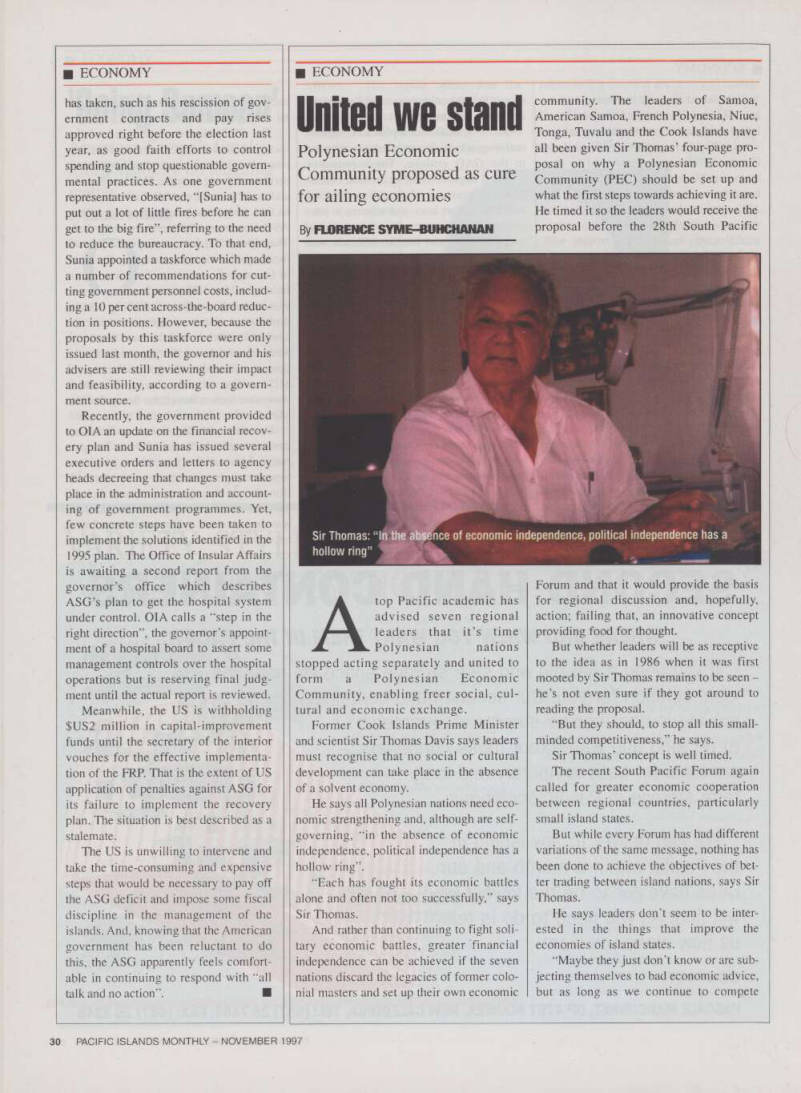
American Samoa’s fiscal irresponsibility no laughing matter
By Susan Prokop
On a crisp September evening at the New
Zealand embassy’s
Pacific Islands night, a group of people talked about those occasions when their personal finances become unbalanced.
Laughed one official with the US Interior Department, ‘"I call it going Samoan.”
Part of the explanation for American Samoa as the butt of jokes about fiscal irre sponsibility can be found in the most recent State of the Islands, the report issued each year by Interior’s Office of Insular
Affairs. The report notes that the American Samoa government [ASG] has a cumulative operating deficit "in excess of SUS3O million”, which amounts to about half of its annual operating budget.
Last year, the ASG took in SUS6O.6 million but spent SUS6B.3 million.
American Samoa receives consid erable sums from the US. Over one-third of its
operating budget
is the SUS 23million direct subsidy ASG receives from Uncle Sam. The
US sends another SUS 6-10 million each year in capital improvement funds to the islands and many millions more in federal grant programme monies. Despite this
influx of US taxpayer dollars, ASG contin ues to be unable to finance its way out of its growing debt. The government has no borrowing authority nor is there any entity to whom it could turn to pay off its debt.
ASG just accu mulates an ongoing short fall each year and, to deal with its deficit, simply doesn’t pay its bills to vendors, to tax payers owed refunds or on accounts owed to the US.
Stories in the local media paint an ongo
ing picture of mismanagement and inap propriate use of public funds. As reported in the Samoa News, the governor’s office recently paid SUSBB,OOO for non-competi tive contracts to refurbish the executive mansion with custom-made furniture. No money had been included in the ASG bud get for the renovation. However, after a conversation between Governor Tauese Sunia and head of the American Samoan Power Authority (ASPA), funds were transferred from ASPA into the ASG gen eral fund - the fund with the SUS3Om deficit - from which came the money for the redecorating.
At a July hearing conducted by the Appropriations Committee of the Samoan legislature, a government official admitted the ASG had been selling off surplus vehi cles in need of repair for SUSSO, without the required public notice and auction.
Because some of the vehicles only needed modest repairs to be in working order once again, the government was losing out on a significant source of potential revenue.
That same month, the American Samoan Farmers Cooperative revealed the government had been buying Western Samoan bananas for its school lunch pro gramme at SUSI.SO per pound. Even US mainlanders, thousands of miles from the source of this tropical fruit, don't have to shell out that kind of money for bananas, paying on average about 59 cents per pound. Meanwhile, American Samoan farmers, on the rare occasion when they were able to sell bananas to their own gov ernment, were paid only 80 cents per pound.
American Samoan Governor Sunia
Poor accounting and business practices by ASG have jeopardised the ability of island residents to obtain local hospital ser vices. The US Department of Health and Human Services has threatened to stop honouring Medicare and Medicaid charges from the territory’s sole hospital after the ASG submitted a poorly written plan for clearing up problems in its health care sys tem. Not only has HHS had trouble with the island health department, some suppli ers of pharmaceuticals have refused to send medicine to the hospital because of the notoriously long time it takes ASG to pay its bills. At the same time, American Samoans’ ability to obtain off-island care may be uncertain. Millions of dollars are owed by ASG to hospitals in Hawaii and the mainland, making it one of the larger medical care deadbeats in the US health system. American Samoa’s troubles are documented at least as far back as 1992 when an audit by the US General Accounting Office [GAO] cited poor fiscal management and inadequate budget disci pline as reasons for the poor condition of the government’s finances. These prob lems have been compounded, the OIA sug gests, by a rapidly increasing population,
recent natural calamities, and “a limited economic and tax base”.
In 1993, ASG sent a plan to Congress outlining actions it would take to respond to the GAO critique. These measures included improvements in revenue collec tion, enforcement of American Samoan balanced budget laws, and reforms in pro curement and contracting. A working group of ASG and Interior officials was appointed the next year to clarify specific objectives to implement the plan of action set out in 1993. In 1995, working with a consultant from OIA, the ASG put togeth er a Financial Recovery Plan [FRP] to complement the efforts of the working group. This recovery plan identified a number of corrective actions that required only an executive order, not lengthy leg islative deliberations, to be put into effect.
For example, one of the FRP recom mendations was that ASG reduce what all agree is an oversized workforce. Yet, a hir ing freeze for the government that was in place at the time of the FRP has been large ly ignored. According to sources at OIA, bimonthly payroll costs rose from SUS 2.2 million in 1995 to SUS 2.6 million in 1997.
The SUS6O million the ASG is spending
each year on personnel represents almost all of its general fund revenues.
The FRP also recommended slight increases in local government fees for court, hospital, telephone, hotel and other services to bring in some SUS 3 million in additional revenue to ASG. In the words of an OIA budget analyst, the response of the ASG has been: “We need to study that.
They [the ASG] have managed to put off the tough decisions because they have yet to face any dire consequences from their failure to do so. What we have is a nega tive recovery going on.” Calling ASG’s problems a matter of “misplaced priori ties”, this official cited the fact that many Samoan schools are in dilapidated condi tion, at a time when the government spent SUSI million to build a playing field when American Samoa hosted the South Pacific Mini Games.
Defenders of the American Samoan government insist Sunia, who was inaugu rated in January this year, has to be given time to straighten out the mess he inherited from the previous governor, [even though this somewhat overlooks the fact that he was the lieutenant governor in that admin istration]. Officials point to actions Sunia
has taken, such as his rescission of gov ernment contracts and pay rises approved right before the election last year, as good faith efforts to control spending and stop questionable govern mental practices. As one government representative observed, “[SuniaJ has to put out a lot of little fires before he can get to the big fire”, referring to the need to reduce the bureaucracy. To that end, Sunia appointed a taskforce which made a number of recommendations for cut ting government personnel costs, includ ing a 10 per cent across-the-board reduc tion in positions. However, because the proposals by this taskforce were only issued last month, the governor and his advisers are still reviewing their impact and feasibility, according to a govern ment source.
Recently, the government provided to OIA an update on the financial recov ery plan and Sunia has issued several executive orders and letters to agency heads decreeing that changes must take place in the administration and account ing of government programmes. Yet, few concrete steps have been taken to implement the solutions identified in the 1995 plan. The Office of Insular Affairs is awaiting a second report from the governor’s office which describes ASG’s plan to get the hospital system under control. OIA calls a “step in the right direction”, the governor’s appoint ment of a hospital board to assert some management controls over the hospital operations but is reserving final judg ment until the actual report is reviewed.
Meanwhile, the US is withholding SUS 2 million in capital-improvement funds until the secretary of the interior vouches for the effective implementa tion of the FRR That is the extent of US application of penalties against ASG for its failure to implement the recovery plan. The situation is best described as a stalemate.
The US is unwilling to intervene and take the time-consuming and expensive steps that would be necessary to pay off the ASG deficit and impose some fiscal discipline in the management of the islands. And, knowing that the American government has been reluctant to do this, the ASG apparently feels comfort able in continuing to respond with "all talk and no action”. ■
Advertisements & other items, pp. 28-29 (2 items)
■ Economy
Variety, style and value
FOR YOUR NEW HOME
■ A New Zealand is recognised world-wide as a leading manufacturer of kitset homes. As one of the pioneers in this field, Maddren Homes have been supplying quality homes throughout the Pacific for over a decade.
We know the demands of your unique environment and have developed a range of designs for all conditions.
From our low cost, cyclone resistant, Pacific Panel System to our luxurious European designer series, we are sure to have a home design to suit your budget and your lifestyle.
For information on designs and costs contact:
Maddren
Homes
P.O Box 244, Kumeu, Auckland, New Zealand Phone: 64-9-412 9070 Fax 64-9-412 7251
MAD46B9
SECOND HAND CONTAINERS
WHERE AND WHEN YOU WANT THEM IN THE PACIFIC If you need a flexible and safe storage space we have the ideal solution for you. Our second hand containers provide instant secure storage. Guaranteed to be wind and waterproof these containers are ideal for both temporary and longterm storage in Pacific conditions.
We can deliver to any island in the Pacific within a month and our rates have got to be the lowest you will find. All you need to do is tell us how many you want.
CONTACT:
PASCALE MARCONNET, BP 4757 NOUMEA, NEW CALEDONIA. TEL (687) 28 7450. FAX: (687) 26 3248
United we stand
Polynesian Economic Community proposed as cure for ailing economies
By Florence Syme-Buhchanan
Atop Pacific academic has advised seven regional leaders that it’s time Polynesian nations stopped acting separately and united to form a Polynesian Economic Community, enabling freer social, cul tural and economic exchange.
Former Cook Islands Prime Minister and scientist Sir Thomas Davis says leaders must recognise that no social or cultural development can take place in the absence of a solvent economy.
He says all Polynesian nations need eco nomic strengthening and, although are self governing, “in the absence of economic independence, political independence has a hollow ring”.
"Each has fought its economic battles alone and often not too successfully,” says Sir Thomas.
And rather than continuing to fight soli tary economic battles, greater financial independence can be achieved if the seven nations discard the legacies of former colo nial masters and set up their own economic
community. The leaders of Samoa, American Samoa, French Polynesia, Niue, Tonga, Tuvalu and the Cook Islands have all been given Sir Thomas’ four-page pro posal on why a Polynesian Economic Community (PEC) should be set up and what the first steps towards achieving it are.
He timed it so the leaders would receive the proposal before the 28th South Pacific
Forum and that it would provide the basis for regional discussion and, hopefully, action; failing that, an innovative concept providing food for thought.
But whether leaders will be as receptive to the idea as in 1986 when it was first mooted by Sir Thomas remains to be seen he’s not even sure if they got around to reading the proposal.
“But they should, to stop all this small minded competitiveness,” he says.
Sir Thomas’ concept is well timed.
The recent South Pacific Forum again called for greater economic cooperation between regional countries, particularly small island states.
But while every Forum has had different variations of the same message, nothing has been done to achieve the objectives of bet ter trading between island nations, says Sir Thomas.
He says leaders don’t seem to be inter ested in the things that improve the economies of island states.
“Maybe they just don’t know or are sub jecting themselves to bad economic advice, but as long as we continue to compete
Sir Thomas: “In the abfence of economic independence, political independence has a hollow ring”
against each other, the region will stay this way for another 100 years.”
Sir Thomas points to dependency on foreign aid as one of the reasons succes sive leaders fail to establish vibrant economies. But that in itself is another story. (See side bar) In his proposal, the former prime minis ter states, “Because of limited development in colonial times and failure to maintain the exclusive nature of markets for the products developed by rulers of that time, there has always been a need for Polynesian island states to exploit and mar ket whatever resources each may have and, where possible, to share them with one another.”
“The tourism industry, for instance, might be greatly enhanced for all member states if it were developed, promoted and marketed regionally rather than individual ly. The recent AUSTEO report has validity in many respects, but the former rulers have not been helpful in making its mar kets freely and preferentially accessible to whatever products island states may devel op, especially if the products compete with their own. They have jealously protected their markets from invasion of our goods, but have freely exploited and burgeoned their exports to the island states. From the point of view of Pacific island states, SPARTECA is a failure.”
Sir Thomas says island states have been influenced into dealing only with former colonial masters, regardless of the disad vantages.
His proposal adds, “In independence arrangements, some disincentives were built into the new system to discourage countries from developing new markets for imports and exports.”
“Exporting has become more and more difficult while imports have flourished at high cost to island countries. Export mar kets we once had no longer exist because former masters went elsewhere for what used to be exclusive to us,” he says citing fruit and vegetable exports to New Zealand, which have steadily declined over the years.
Sir Thomas says island states have been let down in many ways by past colonial rulers who should have remained their partners.
"But we have also let ourselves down by continuing with the heritage of obsolete social and economic methods the former rulers left island countries to follow. They
have also sapped motivation for develop ment and self-reliance - with not always well directed aid.
“The economy of a country is just like the economy of a home - when your coun try is at stake, your home is at stake and the only way to earn for your home is to use the skills you have and sell it outside,”
Sir Thomas says.
“You do all the things that earn you money, you sell your skills, but you don’t sell it to your husband or your kids,” is the parallel he uses for Polynesian countries selling goods to each other without tax breaks.
In his proposal, Sir Thomas said the
Polynesian community would gain
strength by uniting and become an eco nomic and social force of its own in its dealings within the region, Pacific rim countries and beyond.
“At this time we might not see clearly what goods or services we can trade with one another or with the outside world. But have we looked in depth and with creative thinking?”
The simple examples he gives are American Samoa’s cheap American imports, Tonga’s access to high-quality housing at attractive prices, Samoan and Tongan beer, Cook Islands oranges, “and the list goes on”.
While there are difficulties such as transportation and transfer of agricultural products. Sir Thomas believes these can be overcome easily if the seven countries work at it together.
"The aim of a united community is to wash away valueless hindrances to com mercial development while maintaining each of our political autonomies and valu able economic and cultural differences,”
Sir Thomas told Polynesian leaders.
First steps that need to be taken to establish a PEC are; • abolishing visas between member countries with passports the only require ment; • removing all protective tariffs and other disincentives on goods and services traded between member countries; • facilitating the movement of goods and services between member countries; • ensuring trading between member states is performed freely by the private sectors of each country with incentives as needed; • ensuring trading between member states and to the outside world protects the
economic survival of its members; and • ensuring the development of efficient communication and transportation systems between member states and the outside world.
He reminded leaders that Polynesians “are one people with the same heritage”.
Because of this, he says, “it should not be difficult for us to combine our forces for our mutual benefit, survival and the suste nance of a good life for our people”.
Sir Thomas was PM between 1978 and 1987, with the exception of about three months in 1983. During his tenure, Sir Thomas applied his own economic medicine to the ailing, aid-dependent Cook Islands economy. His prescription resulted in the Cook Islands experiencing unprece dented economic growth of 12 per cent per annum, rated as one of the highest in the world. ■
Advertisements & other items, p. 30 (1 item)
30
■ ECONOMY
PACIFIC ISLANDS MONTHLY - NOVEMBER 1997
■ ECONOMY
problem
The aid problem
Small island states need to wean themselves off foreign aid to achieve economic indepen dence, says the Cook Island gov ernment’s financial secretary, Lloyd Powell.
Lloyd Powell is in charge of the Cook Islands economic reform pro gramme. He says economic reforms in small island states are difficult to achieve because of the Pacific paradigm - dependency on aid.
He says the Cooks and other small countries "need to figure out how to give up that drug [aid] dependency” because "any small island state can stand on its own two feet”.
"Aid is a drug to be used carefully to get a state to be independent and free,” and that’s the real challenge facing the Cooks and other small Pacific countries, according to Lloyd Powell. ■
Parliamentary debate
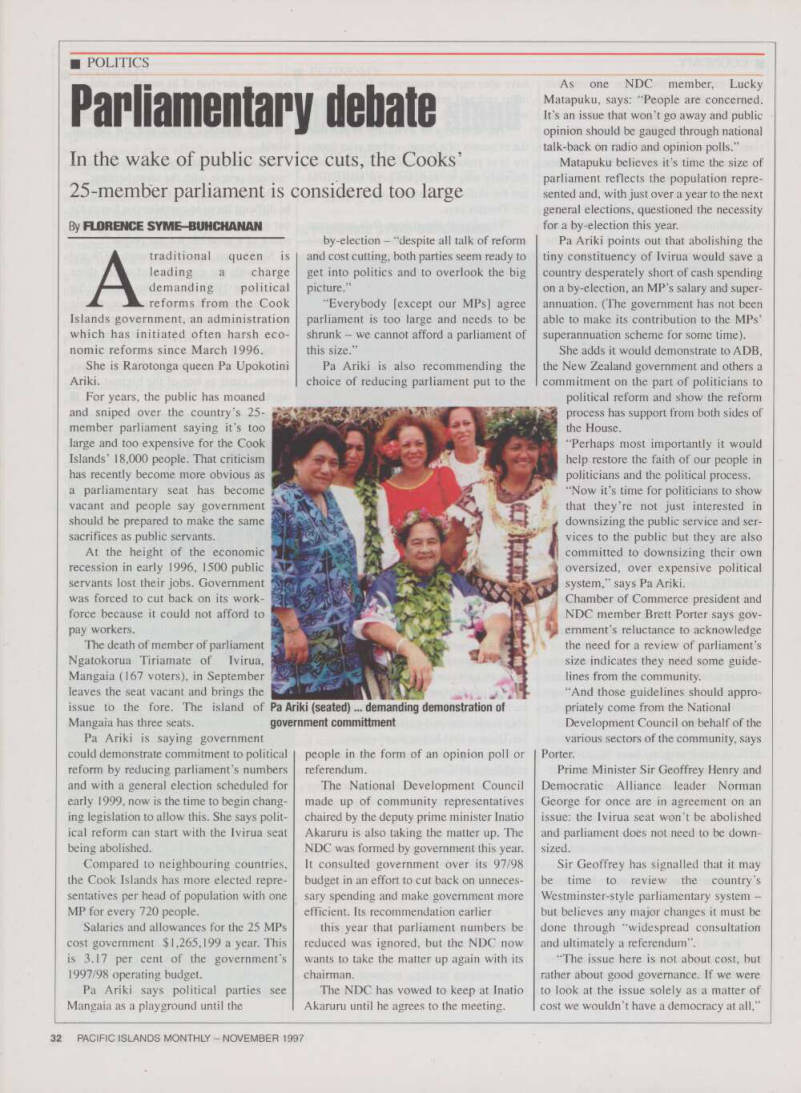
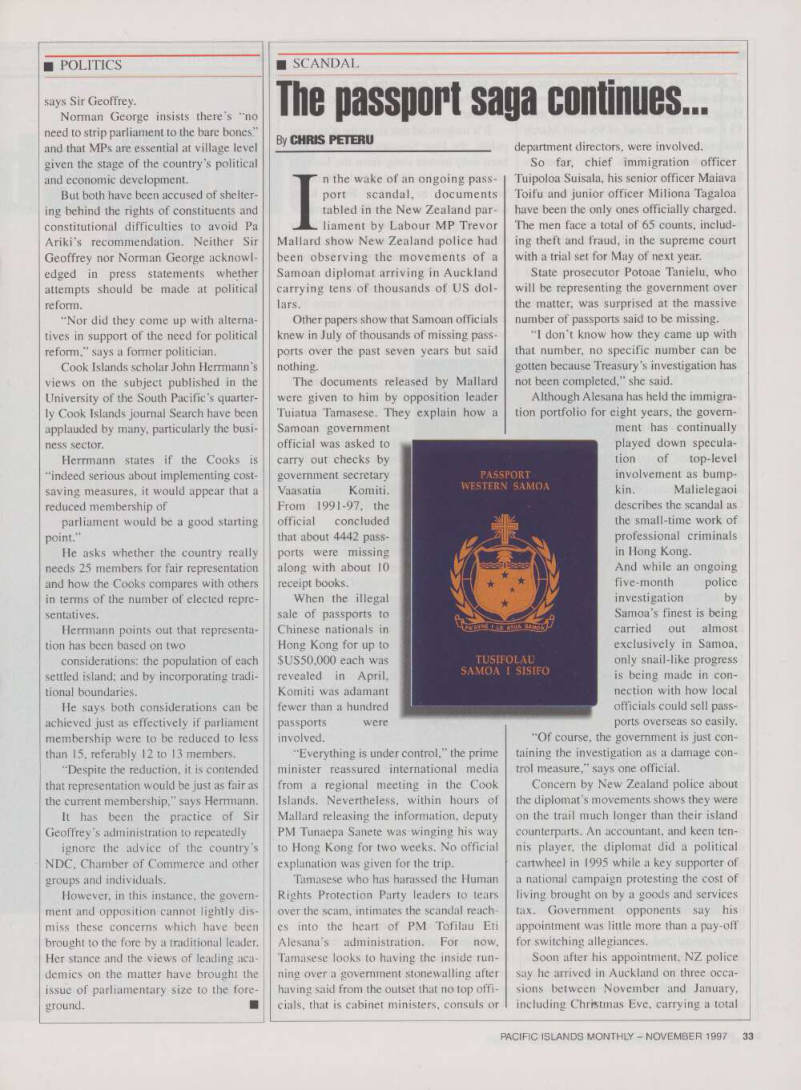
Politics
In the wake of public service cuts, the Cooks’ 25-member parliament is considered too large
By Florence Syme-Buhchanan
A traditional queen is leading a charge demanding political reforms from the Cook Islands government, an administration which has initiated often harsh eco nomic reforms since March 1996.
She is Rarotonga queen Pa Upokotini Ariki.
For years, the public has moaned and sniped over the country’s 25member parliament saying it’s too large and too expensive for the Cook Islands’ 18,000 people. That criticism has recently become more obvious as a parliamentary seat has become vacant and people say government should be prepared to make the same sacrifices as public servants.
At the height of the economic recession in early 1996, 1500 public servants lost their jobs. Government was forced to cut back on its work force because it could not afford to pay workers.
The death of member of parliament Ngatokorua Tiriamate of Ivirua, Mangaia (167 voters), in September leaves the seat vacant and brings the issue to the fore. The island of Mangaia has three seats.
Pa Ariki is saying government
could demonstrate commitment to political reform by reducing parliament’s numbers and with a general election scheduled for early 1999, now is the time to begin chang ing legislation to allow this. She says polit ical reform can start with the Ivirua seat being abolished.
Compared to neighbouring countries, the Cook Islands has more elected repre sentatives per head of population with one MP for every 720 people.
Salaries and allowances for the 25 MPs cost government $1,265,199 a year. This is 3.17 per cent of the government’s 1997/98 operating budget.
Pa Ariki says political parties see Mangaia as a playground until the
by-election - “despite all talk of reform and cost cutting, both parties seem ready to get into politics and to overlook the big picture.”
“Everybody [except our MPs] agree parliament is too large and needs to be shrunk - we cannot afford a parliament of this size.”
Pa Ariki is also recommending the choice of reducing parliament put to the
people in the form of an opinion poll or referendum.
The National Development Council made up of community representatives chaired by the deputy prime minister Inatio Akaruru is also taking the matter up. The NDC was formed by government this year.
It consulted government over its 97/98 budget in an effort to cut back on unneces sary spending and make government more efficient. Its recommendation earlier this year that parliament numbers be reduced was ignored, but the NDC now wants to take the matter up again with its chairman.
The NDC has vowed to keep at Inatio Akaruru until he agrees to the meeting.
As one NDC member, Lucky Matapuku, says; “People are concerned.
It’s an issue that won’t go away and public opinion should be gauged through national talk-back on radio and opinion polls.”
Matapuku believes it’s time the size of parliament reflects the population repre sented and, with just over a year to the next general elections, questioned the necessity for a by-election this year.
Pa Ariki points out that abolishing the tiny constituency of Ivirua would save a country desperately short of cash spending on a by-election, an MP’s salary and super annuation. (The government has not been able to make its contribution to the MPs’ superannuation scheme for some time).
She adds it would demonstrate to ADB, the New Zealand government and others a commitment on the part of politicians to
political reform and show the reform process has support from both sides of the House.
“Perhaps most importantly it would help restore the faith of our people in politicians and the political process.
"Now it’s time for politicians to show that they’re not just interested in downsizing the public service and ser vices to the public but they are also committed to downsizing their own oversized, over expensive political system,” says Pa Ariki.
Chamber of Commerce president and NDC member Brett Porter says gov ernment’s reluctance to acknowledge the need for a review of parliament’s size indicates they need some guide lines from the community.
"And those guidelines should appro priately come from the National Development Council on behalf of the
various sectors of the community, says Porter.
Prime Minister Sir Geoffrey Henry and Democratic Alliance leader Norman George for once are in agreement on an issue: the Ivirua seat won't be abolished and parliament does not need to be down sized.
Sir Geoffrey has signalled that it may be time to review the country's Westminster-style parliamentary system but believes any major changes it must be done through "widespread consultation and ultimately a referendum”.
"The issue here is not about cost, but rather about good governance. If we were to look at the issue solely as a matter of cost we wouldn't have a democracy at all,”
Pa Ariki (seated) ... demanding demonstration of government committment
says Sir Geoffrey.
Norman George insists there's "no need to strip parliament to the bare bones” and that MPs are essential at village level given the stage of the country’s political and economic development.
But both have been accused of shelter ing behind the rights of constituents and constitutional difficulties to avoid Pa Ariki’s recommendation. Neither Sir Geoffrey nor Norman George acknowl edged in press statements whether attempts should be made at political reform.
“Nor did they come up with alterna tives in support of the need for political reform,” says a former politician.
Cook Islands scholar John Herrmann's views on the subject published in the University of the South Pacific's quarter ly Cook Islands journal Search have been applauded by many, particularly the busi ness sector.
Herrmann states if the Cooks is “indeed serious about implementing cost saving measures, it would appear that a reduced membership of parliament would be a good starting point.”
He asks whether the country really needs 25 members for fair representation and how the Cooks compares with others in terms of the number of elected repre sentatives.
Herrmann points out that representa tion has been based on two considerations: the population of each settled island; and by incorporating tradi tional boundaries.
He says both considerations can be achieved just as effectively if parliament membership were to be reduced to less than 15, referably 12 to 13 members.
"Despite the reduction, it is contended that representation would be just as fair as the current membership,” says Herrmann.
It has been the practice of Sir Geoffrey's administration to repeatedly ignore the advice of the country's NDC, Chamber of Commerce and other groups and individuals.
However, in this instance, the govern ment and opposition cannot lightly dis miss these concerns which have been brought to the fore by a traditional leader.
Her stance and the views of leading aca demics on the matter have brought the issue of parliamentary size to the fore ground. ■
Hie passport saga continues...
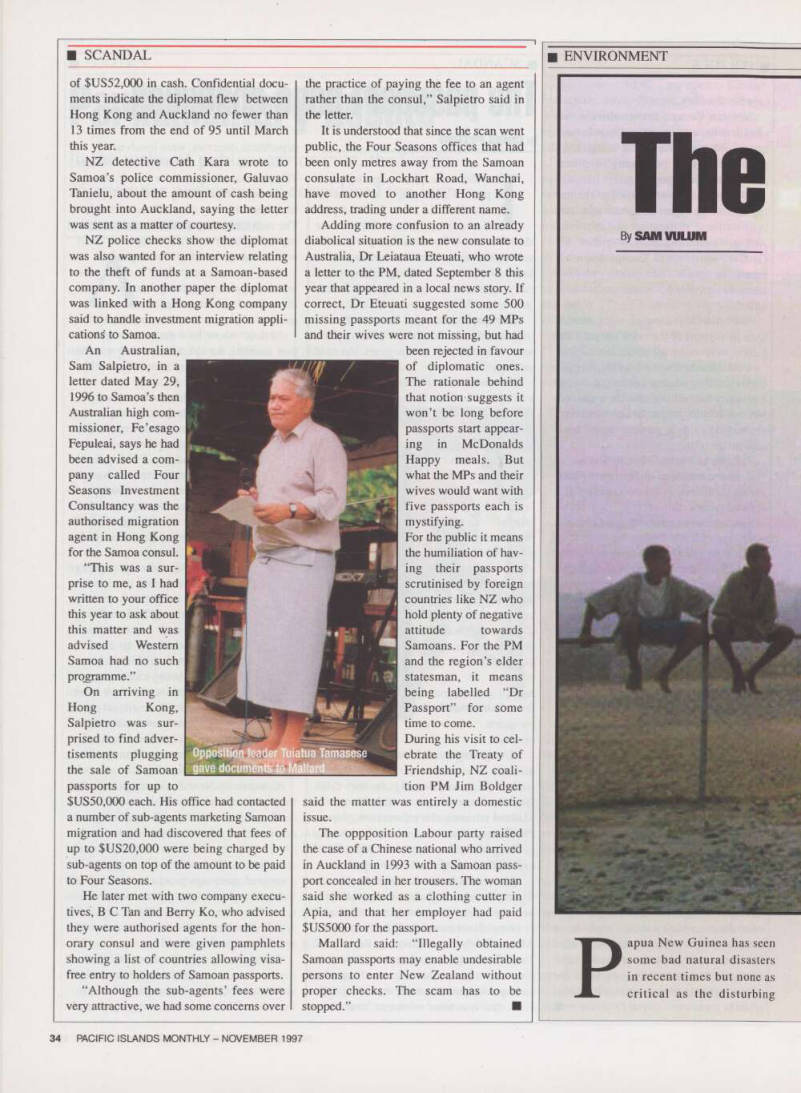
Scandal
By Chris Peteru
In the wake of an ongoing pass port scandal, documents tabled in the New Zealand par liament by Labour MP Trevor Mallard show New Zealand police had been observing the movements of a Samoan diplomat arriving in Auckland carrying tens of thousands of US dol lars.
Other papers show that Samoan officials knew in July of thousands of missing pass ports over the past seven years but said
nothing.
The documents released by Mallard were given to him by opposition leader Tuiatua Tamasese. They explain how a Samoan government
official was asked to carry out checks by government secretary Vaasatia Komiti.
From 1991-97, the official concluded that about 4442 pass ports were missing along with about 10 receipt books.
When the illegal sale of passports to Chinese nationals in Hong Kong for up to SUSSO,OOO each was revealed in April, Komiti was adamant fewer than a hundred passports were involved.
"Everything is under control,” the prime minister reassured international media from a regional meeting in the Cook Islands. Nevertheless, within hours of Mallard releasing the information, deputy PM Tunaepa Sanete was winging his way to Hong Kong for two weeks. No official explanation was given for the trip.
Tamasese who has harassed the Human Rights Protection Party leaders to tears over the scam, intimates the scandal reach es into the heart of PM Tofilau Eti Alesana's administration. For now, Tamasese looks to having the inside run ning over a government stonewalling after having said from the outset that no top offi cials, that is cabinet ministers, consuls or
department directors, were involved.
So far, chief immigration officer Tuipoloa Suisala, his senior officer Maiava Toifu and junior officer Miliona Tagaloa have been the only ones officially charged.
The men face a total of 65 counts, includ ing theft and fraud, in the supreme court with a trial set for May of next year.
State prosecutor Potoae Tanielu, who will be representing the government over the matter, was surprised at the massive number of passports said to be missing.
“I don’t know how they came up with that number, no specific number can be gotten because Treasury’s investigation has not been completed,” she said.
Although Alesana has held the immigra tion portfolio for eight years, the govem
merit has continually played down specula tion of top-level involvement as bump kin. Malielegaoi describes the scandal as the small-time work of professional criminals in Hong Kong.
And while an ongoing five-month police investigation by Samoa’s finest is being carried out almost exclusively in Samoa, only snail-like progress is being made in con nection with how local officials could sell pass ports overseas so easily.
“Of course, the government is just con taining the investigation as a damage con trol measure,” says one official.
Concern by New Zealand police about the diplomat's movements shows they were on the trail much longer than their island counterparts. An accountant, and keen ten nis player, the diplomat did a political cartwheel in 1995 while a key supporter of a national campaign protesting the cost of living brought on by a goods and services tax. Government opponents say his appointment was little more than a pay-off for switching allegiances.
Soon after his appointment, NZ police say he arrived in Auckland on three occa sions between November and January, including Christmas Eve, carrying a total
of $U552,000 in cash. Confidential docu ments indicate the diplomat flew between Hong Kong and Auckland no fewer than 13 times from the end of 95 until March this year.
NZ detective Cath Kara wrote to Samoa’s police commissioner, Galuvao Tanielu, about the amount of cash being brought into Auckland, saying the letter was sent as a matter of courtesy.
NZ police checks show the diplomat was also wanted for an interview relating to the theft of funds at a Samoan-based company. In another paper the diplomat was linked with a Hong Kong company said to handle investment migration appli
cations to Samoa.
An Australian, Sam Salpietro, in a letter dated May 29, 1996 to Samoa’s then Australian high com missioner, Fe’esago Fepuleai, says he had been advised a com pany called Four Seasons Investment Consultancy was the authorised migration agent in Hong Kong for the Samoa consul.
“This was a sur prise to me, as I had written to your office this year to ask about this matter and was advised Western Samoa had no such programme.”
On arriving in
Hong Kong,
Salpietro was sur prised to find adver tisements plugging the sale of Samoan passports for up to
SUSSO,OOO each. His office had contacted a number of sub-agents marketing Samoan migration and had discovered that fees of up to SUS2O,OOO were being charged by sub-agents on top of the amount to be paid to Four Seasons.
He later met with two company execu tives, B C Tan and Berry Ko, who advised they were authorised agents for the hon orary consul and were given pamphlets showing a list of countries allowing visa free entry to holders of Samoan passports.
“Although the sub-agents’ fees were very attractive, we had some concerns over
the practice of paying the fee to an agent rather than the consul,” Salpietro said in the letter.
It is understood that since the scan went public, the Four Seasons offices that had been only metres away from the Samoan consulate in Lockhart Road, Wanchai, have moved to another Hong Kong address, trading under a different name.
Adding more confusion to an already diabolical situation is the new consulate to Australia, Dr Leiataua Eteuati, who wrote a letter to the PM, dated September 8 this year that appeared in a local news story. If correct, Dr Eteuati suggested some 500 missing passports meant for the 49 MPs and their wives were not missing, but had
been rejected in favour of diplomatic ones.
The rationale behind that notion suggests it won’t be long before passports start appear ing in McDonalds Happy meals. But what the MPs and their wives would want with five passports each is mystifying.
For the public it means the humiliation of hav ing their passports scrutinised by foreign countries like NZ who hold plenty of negative attitude towards Samoans. For the PM and the region’s elder statesman, it means being labelled “Dr Passport” for some time to come.
During his visit to cel ebrate the Treaty of Friendship, NZ coali tion PM Jim Boldger
said the matter was entirely a domestic issue.
The oppposition Labour party raised the case of a Chinese national who arrived in Auckland in 1993 with a Samoan pass port concealed in her trousers. The woman said she worked as a clothing cutter in Apia, and that her employer had paid SUSSOOO for the passport.
Mallard said: “Illegally obtained Samoan passports may enable undesirable persons to enter New Zealand without proper checks. The scam has to be stopped.” ■
Opposition leader Tuiatua Tamasese gave documents to Mallard
The drought

Environment
By Sam Vulum
Papua New Guinea has seen some bad natural disasters in recent times but none as critical as the disturbing
impacts of the prolonged El Nino related drought currently wreaking havoc throughout the country and claimed to be the worst in 50 years.
The dreadful El Nino, the weather pat tern blamed for spreading crippling drought throughout the eastern states, has descended on PNG since June and is fore
cast to continue into next year. It claimed 73 lives, as of September 22, and the num ber was expected to rise if the relief sup plies were slow in coming. More than
Local residents at Kiurtga airport in Papua New Guinea watch the unloading of desperately needed goods which were trucked out of Kiunga to Tabubil after being unloaded from a Royal Australian Airforce Hercules (In background). The RAAF are in PNG to distribute and drop badly needed supplies to the drought-ridden country, (AP Photo/Rick Stevens)
750,000 people - about a sixth of the coun try’s population - are affected by the drought and frost.
Those being the worst hit are those in rural areas, whose main livelihood - food gardens - have been destroyed by the pro longed drought in the coastal areas and frost in the highlands. Schools have shut down and health institutions have scaled down their operations.
Coffee producers have expressed con cern over the impact of the frost and dry spell on their fruits and tea manufacturers have reported PNG is losing more than K 1 million (SUSO.6 million) a month in tea exports.
The country’s only sugar manufacturer, Ramu Sugar, has reported a threat on its production and severe impact on its cattle ranch at Markham Valley. Former Madang MP and disaster relief agency chairman Peter Barter said: “Professional judgment indicated the drought will be with PNG until March, 1988. The odds are that 1988 will also be a dry year. We can expect dif ficult times ahead.
"The medium-to-long-term prognosis is not good for all our people.” Barter’s agen cy was established by the government to oversee and facilitate relief operations throughout the country. The four-month drought has so far attracted K 34,155 mil lion ($U521.68 million) from the PNG government for relief operations. The gov ernment has already spent K 1.2 million (SUSO.76 million) from the amount on var ious provinces in amounts ranging from K 200,000 (SUS 127,000) in Enga and Southern Highlands to K 20,000 each in New Ireland and Oro provinces. The other funds were to be distributed to the people through their MPs.
The Australian government pledged to provide an initial $A500,000
($U5370,000) drought assistance package
and has been delivering supplies since September 22. While announcing the pack age on September 15, Australian Federal Foreign Minister Alexander Downer said the Australian National University would assess the situation immediately and report back to the PNG and Australian govern ments.
The team, led by Bryant Allan, an agri culture expert from the university, began assessing the situation in 10 groups.
Commenting on the assessment, Allan con tradicted reports by PNG authorities that people were dying from starvation because of the drought and was critical of the deci
sion by the Australian government to pro vide relief supplies.
He said that while the harsh conditions may have placed children and elderly peo ple at risk, he doubted anyone had starved to death. Allan said some people facing food shortages still had the option of eat ing “famine food” such as banana roots and wild yams which would help them sur vive the crisis.
"We are frankly rather sceptical that anybody has died of starvation,” he was quoted as saying by AAP.
"You have to understand that in Papua New Guinea a lot of people live on the margin - it’s not Australia, there isn't a welfare state. People live tough here, a lot of children die when they are very small, a lot die before the age of five.”
His comments did not go down too well with PNG’s opposition leader Bernard Narokobi, questioning Prime Minister Bill Skate and his government as to whether they subscribed to Allan’s comment that Papua New Guineans could live on famine food to survive the crisis.
He told parliament, "Here is an expert who tells us we actually should not give money and food to our people because they are not dying of starvation.”
Skate deferred answering the questions to a later date.
The Australian government was also reportedly under attack for allowing all food deliveries into PNG to be made to one town which has close connections to min ing giant BHP Cos Ltd.
The accusation levelled at the govern ment was that more than 50,000 kg of food being flown in by the air force was being delivered to the remote mining town of Tabubil, close to the Ok Tedi mine in which BHP is a major shareholder, ABC radio reported.
Frank Willet, who operates a supermar ket in nearby Kiunga, said he could not get any assistance from the air force. “We can’t get any assistance from the Royal Australian Air Force plane - it’s like those guys in Kiunga don’t exist,” Willet said on ABC radio.
An RAAF spokesman said food had been included on training flights into Tabubil because the opportunity had arisen. In Canberra, Australian Foreign Minister Downer denied suggestions that Australian assistance was slanted towards the Ok Tedi mine area. Downer told parlia ment the RAAF was delivering supplies to affected areas of the Western province.
"But I emphasise these are arecas very much in need, not because the 0)K Tedi mine just happens to be in the Western province,” Downer said. "Australiarn coop eration was requested by PNG’s prime minister for provincial- and local-level governments.
"To suggest the Australian government is somehow focusing on the area around the Ok Tedi mine because of some sinister relationship between the Australian gov ernment and the Ok Tedi mine is frankly misleading.”
The food was not going to the towns but to stores in surrounding drought-stricken villages.
Back on the home front, local business houses have committed up to K 2.41 mil lion (SUS 1.53 million) in a drought-relief fund account managed by the Papua New Guinea Banking Corporation. The Westpac bank went a step further by introducing drought relief for some of its customers in certain areas affected by the drought.
The help is in the form of deferred loan repayments or a moratorium on principal loan reductions for up to three months. It will be available to customers on applica tion.
Meanwhile, Barter has appealed for an extra K3OO million (SUSI9O million) for relief efforts. He said the cost of feeding those affected would exceed several hun dred million kina. The committee has already met international donor countries and agencies to seek help in managing the crisis.
Provincial Affairs and Local Level Governments minister Simon Kaumi told parliament on September 25 initial statis tics compiled from the provinces so far indicated K 750,000 ($U5476,000) per day was required for food alone. While pre senting the first drought report to parlia ment, Kaumi said the nation could not afford the high cost. He confirmed media reports that 200,000 people from Kandeep in the Enga Province were directly affected in the worst-hit areas of Enga, Southern Highlands and Western Highlands provinces.
He said these people began moving to clans and traditional friends in the lower lying areas. In the Upper Fly of Western Province, he said people were relying on store-bought food.
Kaumi said; "While cash may be avail able to buy store food, the drought has closed off their supply line, which is barge transport up the Fly River.
“Food and fuel stocks are desperately short and prices have risen up to 30 per cent as some stores fly in supplies.”
He said in the atolls and small island communities in several provinces yet to recover from Cyclone Justin earlier this year, the drought has affected water and food supplies and this was compounded by increased health problems.
It’s not only the village that have been affected. Residents in major towns throughout the country are also suffering from acute water shortages. Almost all major centres, including Port Moresby, have reported that water levels have been dropping in catchments and dams.
Authorities in Manus, for example, fear that the situation could turn into a serious disaster if the dry spell continues for another few months.
Provincial water supervisor, John Rokam, said: "I would predict that if we do not have rain in the next four or five months, we will be faced with a disas ter.”
To prepare for any outbreak of dis eases, the health department has already submitted a list of essential drugs to donor agencies for funding.
Health authorities have cautioned against food-bome diseases if people are not careful in handling food and used contaminated water.
Already reports indicate an increase in miscarriages. Authorities said diar rhoea, dysentery, malnutrition, coughs and other respiratory problems were spreading through the highlands.
Individual reports of deaths have also emerged. In one such report in the Western Highlands province, two chil dren who fled the frost-ravaged Tambul district died at Waghi where they reset tled with their families. They died from eating poisonous wild beans after going without a meal for a day. The number of deaths is increasing. Also in Tambul, the area most affected by the frost, people have been reportedly saying that they are waiting for death as crops have been killed by the frost.
The PNG National Weather Service reported that the dry spell is expected to continue unless there are major changes in the pressure anomalies associated with the El Nino phenomenon this side of the world is facing. Although mon soonal rains were expected by the end of last month but this will not be sufficient to offset the drought. ■
Not many Cooks can still
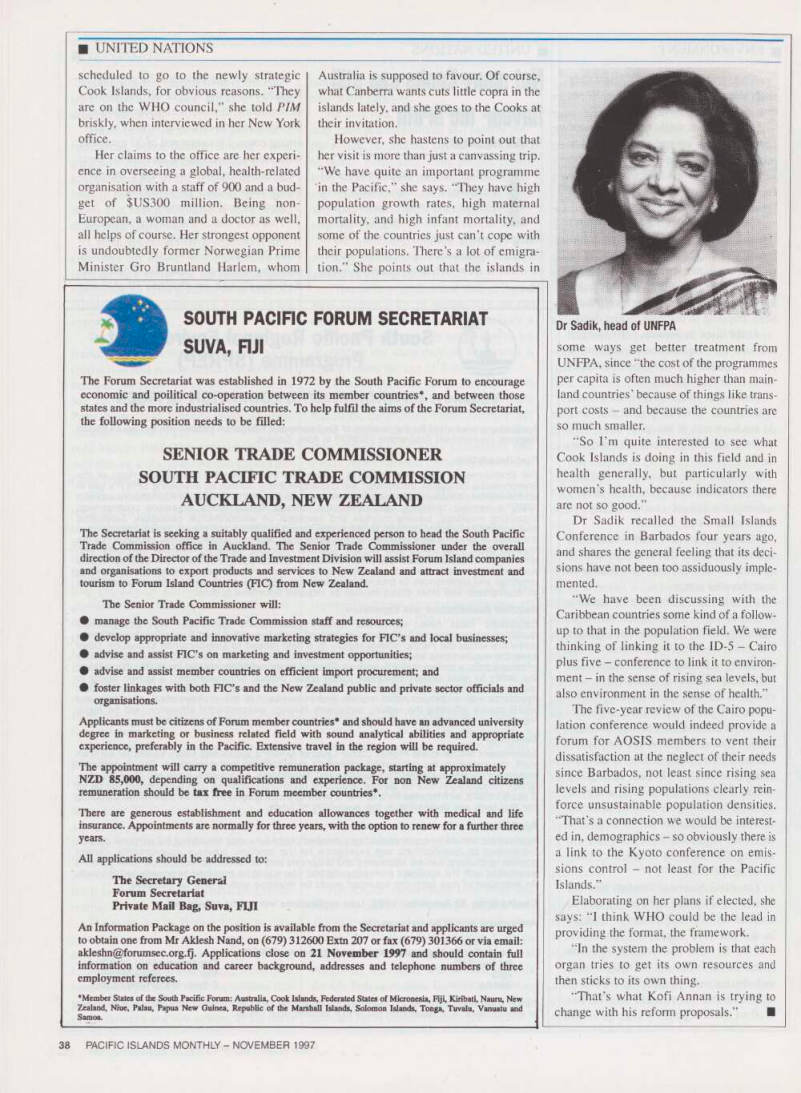
United Nations
Not many Cooks can still flavour the broth
By Lan Williams
In one of the odder twists of geopolitics, the not-so-big Cook Islands have just replaced oh-so-big China on the governing council of the World Health Organisation, just as the battle to elect a new director-general heats up.
Last time, the Japanese incumbent Dr Hiroshi Nakajima fought off accusations of nepotism, cronyism and incompetence to win a second five-year term. The gov erning council is composed of 32 members who are supposed to be elected for their own personal medical excellence and to be independent of their governments.
And some of them might be.
This time one of the leading contenders is Pakistani Nafis Sadik, for the past 10 years the head of UNFPA, the UN’s family planning wing or “Fund for Population Activities”, and on October 10 she was
scheduled to go to the newly strategic Cook Islands, for obvious reasons. “They are on the WHO council,” she told PIM briskly, when interviewed in her New York office.
Her claims to the office are her experi ence in overseeing a global, health-related organisation with a staff of 900 and a bud get of SUS3OO million. Being non- European, a woman and a doctor as well, all helps of course. Her strongest opponent is undoubtedly former Norwegian Prime Minister Gro Bruntland Harlem, whom
Australia is supposed to favour. Of course, what Canberra wants cuts little copra in the islands lately, and she goes to the Cooks at their invitation.
However, she hastens to point out that her visit is more than just a canvassing trip.
“We have quite an important programme in the Pacific,” she says. “They have high population growth rates, high maternal
mortality, and high infant mortality, and
some of the countries just can’t cope with their populations. There’s a lot of emigra tion.” She points out that the islands in
some ways get better treatment from UNFPA, since "the cost of the programmes per capita is often much higher than main land countries’ because of things like trans port costs - and because the countries are so much smaller.
“So I’m quite interested to see what Cook Islands is doing in this field and in health generally, but particularly with women’s health, because indicators there are not so good.”
Dr Sadik recalled the Small Islands Conference in Barbados four years ago, and shares the general feeling that its deci sions have not been too assiduously imple mented.
“We have been discussing with the Caribbean countries some kind of a follow up to that in the population field. We were thinking of linking it to the ID-5 - Cairo plus five - conference to link it to environ ment - in the sense of rising sea levels, but also environment in the sense of health.”
The five-year review of the Cairo popu lation conference would indeed provide a forum for AOSIS members to vent their dissatisfaction at the neglect of their needs since Barbados, not least since rising sea levels and rising populations clearly rein force unsustainable population densities.
"That’s a connection we would be interest ed in, demographics - so obviously there is a link to the Kyoto conference on emis sions control - not least for the Pacific Islands.”
Elaborating on her plans if elected, she says; "I think WHO could be the lead in providing the format, the framework.
"In the system the problem is that each organ tries to get its own resources and then sticks to its own thing.
"That’s what Kofi Annan is trying to change with his reform proposals.” ■
Dr Sadik, head of UNFPA
Advertisements & other items, pp. 37-38 (1 item)
Programme (SPREP)
South Pacific Regional Environment
Vacancy: ENVIRONMENTAL EDUCATION OFFICER
Applications are invited for the position of Environmental Education Officer with the South Pacific Regional Environment Programme (SPREP) in Apia, Samoa.
Post Description: The Environmental Education Officer is responsible to the Director through the Head of the Environmental Education, Information and Capacity-building Division for evaluating SPREP’s role in environmental education and associated training in consultation with other SPREP Officers and with SPREP’s member countries, and developing national environmental education programmes; organising meetings, training courses and seminars on environmental education; developing environmental education material for the region, including articles and papers for publication within the scope of SPREP’s work programme; preparing draft papers on Environmental Education for the biennial Work Programme and Budget approval process; assisting member countries with production of environmental education materials and advising them on how best to secure additional finances from donor organisations for further in-country material production; attending meetings and conferences to present information on SPREP’s environmental education activities as appropriate; and other duties as may be required from time to time.
Required Qualifications and Experience Candidates must have appropriate tertiary qualifications (preferably with post-graduate qualifications in a relevant field) from a recognised institution and at least 5 years’ work experience, preferably within the Pacific islands region, in a field related to Environmental Education. Other essential requirements are: proven project management experience: the ability to manage the work of consultants; a proven ability to work as a part of an inter-disciplinary and/or multi-cultural team; the ability to meet project deadlines (often under difficult circumstances): a proven ability to prepare proposals and reports; a proven ability to live and work within Pacific island communities.
Applicants with a demonstrated interest and involvement in the environmental, economic and social issues affecting the region, particularly through environmental education, will be highly regarded as will applicants with teaching and curriculum development experience.
Appointment will be at the Project Officer Level of SPREP’s authorised salary scales for contract staff, depending on the successful applicant’s qualifications and experience. The package will include annual return airfares for appointee and dependents, a housing subsidy and other benefits.
SPREP remuneration may be tax-free depending upon circumstances. The appointment will be for 3 years initially, with renewal for a further 3 years depending upon the officer’s performance during the first term and depending on the availability of fands.
Applications
Applications should be accompanied by a detailed curriculum vitae containing full personal details, information on qualifications and experience for the position, previous appointments, current position and salary, names, addresses and telephone and/or fax contact numbers of three persons associated with the applicant professionally and who would be prepared to provide testimonials.
An indication of how soon the applicant would be available should also be indicated.
Closing Date: 30 November 1997. Late applications will not be considered.
Applications should be addressed to: The Director South Pacific Regional Environment Programme (SPREP) Conditions PO Box 240 Apia Samoa Telephone: (685) 21929 Fax : (685) 20 231 E-mail: [email protected] Further information, including a full post description and details of remuneration and terms and conditions of appointments, is available from the SPREP Administration Officer.
SOUTH PACIFIC FORUM SECRETARIAT
SUVA, FIJI
The Forum Secretariat was established in 1972 by the South Pacific Forum to encourage economic and poilitical co-operation between its member countries*, and between those states and the more industrialised countries. To help fulfil the aims of the Forum Secretariat, the following position needs to be filled: The Secretariat is seeking a suitably qualified and experienced person to head the South Pacific Trade Commission office in Auckland. The Senior Trade Commissioner under the overall direction of the Director of the Trade and Investment Division will assist Forum Island companies and organisations to export products and services to New Zealand and attract investment and tourism to Forum Island Countries (FIC) from New Zealand.
The Senior Trade Commissioner will: • manage the South Pacific Trade Commission staff and resources; • develop appropriate and innovative marketing strategies for FlC’s and local businesses; • advise and assist FlC’s on marketing and investment opportunities; • advise and assist member countries on efficient import procurement; and • foster linkages with both FlC’s and the New Zealand public and private sector officials and
organisations.
Applicants must be citizens of Forum member countries* and should have an advanced university degree in marketing or business related field with sound analytical abilities and appropriate experience, preferably in the Pacific. Extensive travel in the region will be required.
The appointment will carry a competitive remuneration package, starting at approximately NZD 85,000, depending on qualifications and experience. For non New Zealand citizens remuneration should be tax free in Forum meember countries*.
There are generous establishment and education allowances together with medical and life insurance. Appointments are normally for three years, with the option to renew for a further three years.
All applications should be addressed to: The Secretary General Forum Secretariat Private Mail Bag, Suva, FIJI An Information Package on the position is available from the Secretariat and applicants are urged to obtain one from Mr Aklesh Nand, on (679) 312600 Extn 207 or fax (679) 301366 or via email: [email protected]. Applications close on 21 November 1997 and should contain full information on education and career background, addresses and telephone numbers of three
employment referees.
•Member States of the South Pacific Forum: Australia, Cook Islands, Federated States of Micronesia, Fiji, Kiribati, Nauru, New Zealand, Niue, Palau, Papua New Guinea, Republic of the Marshall Islands, Solomon Islands, Tonga, Tuvalu, Vanuatu and Samoa.
SENIOR TRADE COMMISSIONER
SOUTH PACIFIC TRADE COMMISSION
AUCKLAND, NEW ZEALAND
airspace
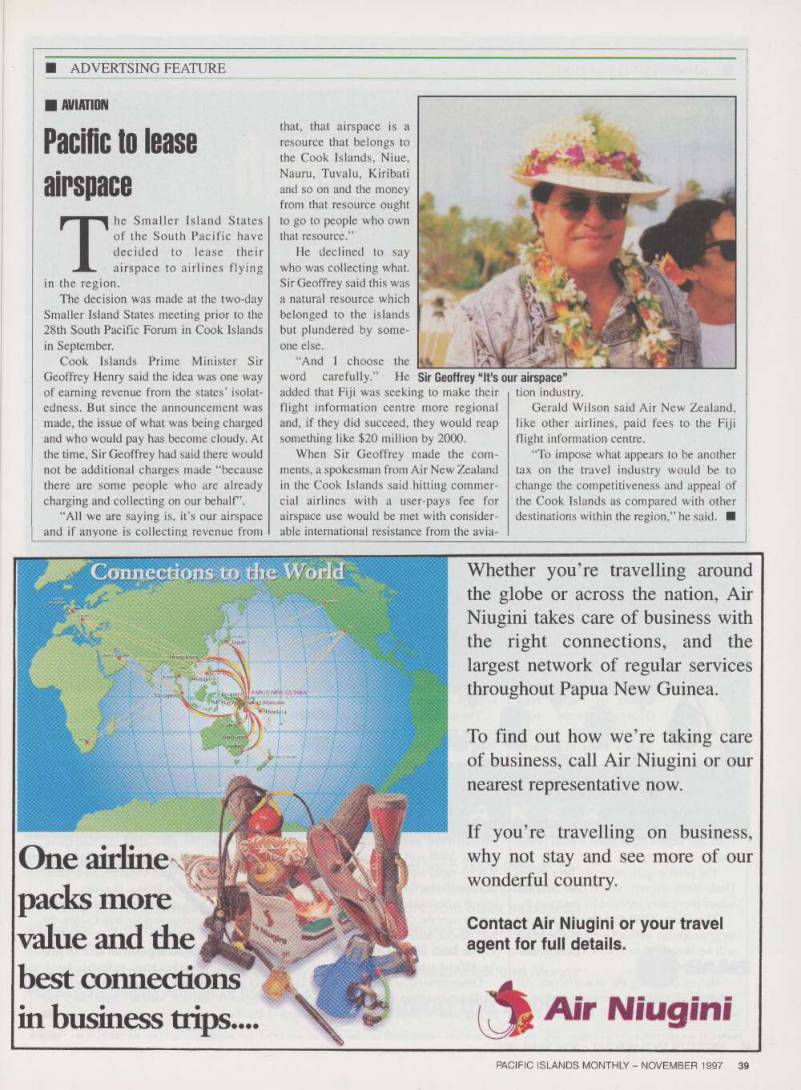
Advertsing Feature
Aviation
Pacific to lease airspace
The Smaller Island States of the South Pacific have decided to lease their airspace to airlines flying in the region.
The decision was made at the two-day Smaller Island States meeting prior to the 28th South Pacific Forum in Cook Islands
in September.
Cook Islands Prime Minister Sir Geoffrey Henry said the idea was one way of earning revenue from the states’ isolat edness. But since the announcement was made, the issue of what was being charged and who would pay has become cloudy. At the time, Sir Geoffrey had said there would not be additional charges made “because there are some people who are already charging and collecting on our behalf’.
“All we are saying is, it’s our airspace and if anyone is collecting revenue from
that, that airspace is a resource that belongs to the Cook Islands, Niue, Nauru, Tuvalu, Kiribati and so on and the money from that resource ought to go to people who own that resource.”
He declined to say who was collecting what.
Sir Geoffrey said this was a natural resource which belonged to the islands
but plundered by some
one else.
“And I choose the word carefully.” He
added that Fiji was seeking to make their flight information centre more regional and, if they did succeed, they would reap something like $2O million by 2000.
When Sir Geoffrey made the com ments, a spokesman from Air New Zealand in the Cook Islands said hitting commer cial airlines with a user-pays fee for airspace use would be met with consider able international resistance from the avia-
tion industry.
Gerald Wilson said Air New Zealand, like other airlines, paid fees to the Fiji flight information centre.
“To impose what appears to be another tax on the travel industry would be to change the competitiveness and appeal of the Cook Islands as compared with other destinations within the region,” he said. ■
Sir Geoffrey “It’s our airspace”
Advertisements & other items, p. 39 (1 item)
packs more 'Jp
II ma 3 ■ « ■
One airline
value and the jPIIN :
best connections
in business trips...
Whether you’re travelling around the globe or across the nation, Air Niugini takes care of business with the right connections, and the largest network of regular services throughout Papua New Guinea.
To find out how we’re taking care of business, call Air Niugini or our nearest representative now.
If you’re travelling on business, why not stay and see more of our wonderful country.
Contact Air Niugini or your travel agent for full details.
(fh Air Niugini
Air Niugini on a high
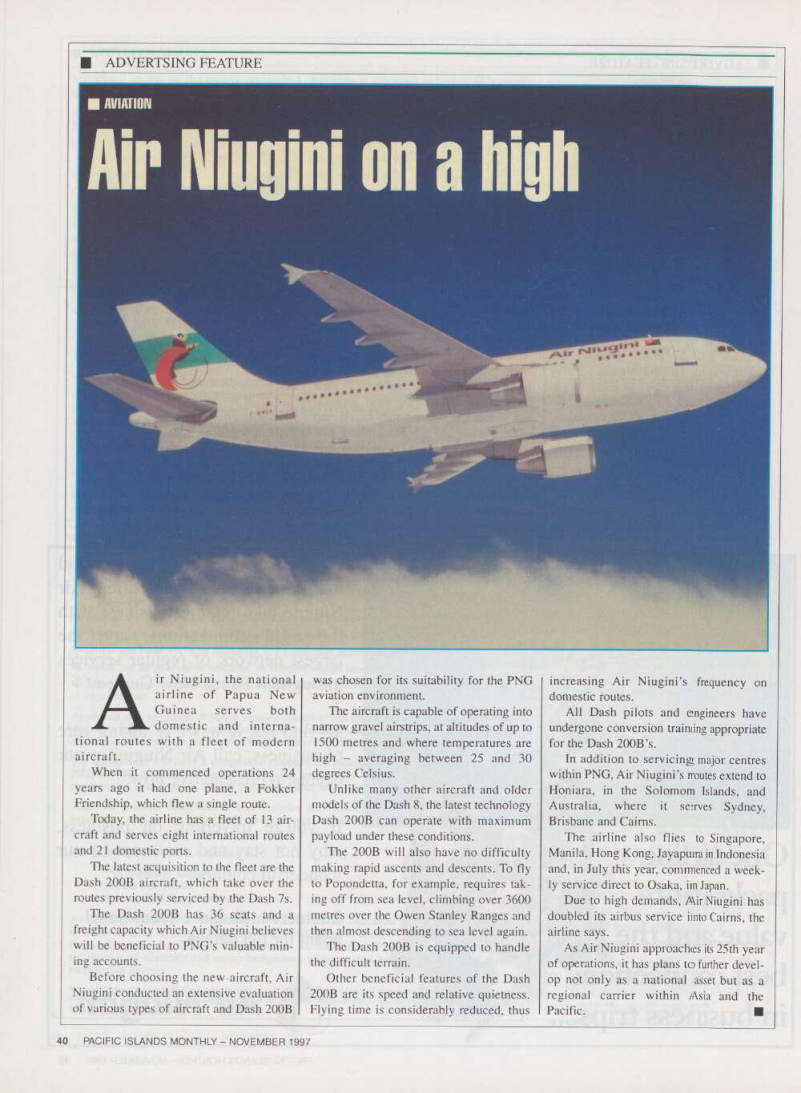
Air Niugini, the national airline of Papua New Guinea serves both domestic and interna tional routes with a fleet of modern aircraft.
When it commenced operations 24 years ago it had one plane, a Fokker Friendship, which flew a single route.
Today, the airline has a fleet of 13 air craft and serves eight international routes and 21 domestic ports.
The latest acquisition to the fleet are the Dash 2008 aircraft, which take over the routes previously serviced by the Dash 7s.
The Dash 2008 has 36 seats and a freight capacity which Air Niugini believes will be beneficial to PNG's valuable min ing accounts.
Before choosing the new aircraft, Air Niugini conducted an extensive evaluation of various types of aircraft and Dash 2008
was chosen for its suitability for the PNG aviation environment.
The aircraft is capable of operating into narrow gravel airstrips, at altitudes of up to 1500 metres and where temperatures are high - averaging between 25 and 30 degrees Celsius.
Unlike many other aircraft and older models of the Dash 8, the latest technology Dash 2008 can operate with maximum payload under these conditions.
The 2008 will also have no difficulty making rapid ascents and descents. To fly to Popondetta, for example, requires tak ing off from sea level, climbing over 3600 metres over the Owen Stanley Ranges and then almost descending to sea level again.
The Dash 2008 is equipped to handle the difficult terrain.
Other beneficial features of the Dash 2008 are its speed and relative quietness.
Flying time is considerably reduced, thus
increasing Air Niugini’s frequency on domestic routes.
All Dash pilots and engineers have undergone conversion traiming appropriate for the Dash 200 B’s.
In addition to servicing major centres within PNG, Air Niugini’s rroutes extend to Honiara, in the Solomom Islands, and Australia, where it se;rves Sydney, Brisbane and Cairns.
The airline also flies to Singapore, Manila, Hong Kong, Jayapuira in Indonesia and, in July this year, comnnenced a week ly service direct to Osaka, im Japan.
Due to high demands, Air Niugini has doubled its airbus service imto Cairns, the airline says.
As Air Niugini approaches its 25th year of operations, it has plans to further devel op not only as a national asset but as a regional carrier within Asia and the Pacific. ■
Advertisements & other items, pp. 40-41 (2 items)
40
■ AVIATION
■ ADVERTSING FEATURE
PACIFIC ISLANDS MONTHLY - NOVEMBER 1997
Uniting the Pacific
ißsaaMamiaiMS MM in ns -- ■' ■■ SB ;'' .* s?r! o@3 1
MARKET
Ocean Shrinker The new generation 50-seat Saab 2000 Jet Prop, flying nearly 180 mph faster than the competition, is shrinking the long distances of the Pacific, slashing hours from other turboprop schedules. With flexibility to meet the needs of passengers and airlines, the Saab 2000 is the Pacific's best choice. Fly the Saab 2000 and enjoy a new era of passenger comfort and service. Saab 2000 - the Market Maker and Money Maker now uniting nations of the Pacific! .. -■
Uniting the Pacific
Saab Aircraft AB http ://www/saab. com. se SWEDEN • +46 13 182000 * FAX +46 13 18210 AUSTRALIA * +6l 2 9369 1666 * FAX +6l 2 9369 2500 HONG KONG • +852 2810 4220 * FAX +852 2810 4135 UK • +44 1753 859991 * FAX +44 1753 858884
Ef Kay

Png Made Products
A new range of skin care and beauty products can now be found in Papua New Guinea designed specifically for darker skin tones and features in this part of the world.
EF Kay products were introduced into PNG five years ago. Frances Kalu of Kay products said the wide range of cosmetics were very popular in PNG.
“[The products] include ingredients such as Vitamin B, and mixtures of natural oils - coconut, sesame, almond, jojoba and lanolin,” Kalu said.
“Haircare products are made from oils and other lubricating ingredients to rid problems such as split ends, dryness, dan druff and hair loss. This system of prod
ucts stimulates growth and helps maintain a healthy head of hair,” Kalu claims.
The products which were developed in
the United States are also made and packaged in PNG, Kalu says.
"While this is happening one important thing to remember is that most of the raw
materials are imported from the US.”
Kalu said what made the range distinc tive was that it was designed for the skin
texture of people in this pairt of the world.
Kalu said the reason he (decided to bring in the range was because \what was avail able on the market did not especially cater
for the skiin types of the people of PNG.
“So we lhad all these unhappy people who could not find products suitable for their skin and hair types.”
For hair care there are hair straightners, relaxers, perms, curly maintenance products for both natural hair and chemically treat ed hair. Clear scalp is designed to eradicate fun gus growth on the scalp.
Also available are shaving gels and after-shave
creams designed for smoother shaves, ton ers and moisturisers and lipsticks and nail polish. ■
Advertisements & other items, pp. 42-43 (1 item)
Suppuies
"Introducing Papua New Guinea's very first".
Now you can purchase all Hair & Beauty Products at Paradise Hair & Beauty supplies All Paradise products have large sizes \Pt M, f Total Professional range of products Range of various US Hair & Beauty products now available P.0.80x 1671 Port Moresby Tel/Fax: 325 0519 Jr U A ft to
PRO-LINE pL"
E
PALMER’S® &
I
®SOFT SHEEN
i) JOHNSON
PRODUCTS
PORT MORESBY LAE GOROKA MT.HAGEN MADANG MANUS KAVIENG BUKA • Waigani • Boroko • Koki • Town
MIII *
sciHini*
Benefit from over 20 years
Pacific Islands experience
• Ship refitting to 100 - Metre Length • Dumb barge design & construction to 600 - tonne capacity • Civil & Structural engineering works within the Solomon Islands • Tug design & construction to 20 Metres • Landing Craft design & Construction to 30 Metres in steel and aluminium • Specialists in Aluminium canoes, runabouts and dinghies Competitive Prices and an understanding of the Pacific make contacting us worthwhile. rtcrr mami .. -
!!fU lIIKC
11*
R R ENGINEERING LTD
Marine, Structural & General Engineering, Metals Fabricators.
P.0.80x 710, Honiara, Guadalcanal, Solomon Islands. Phone: (677) 30441 Fax: (677) 30279 E Mail: [email protected]
Warren Plantations

One tea company which is mak ing quite a name for itself in Papua New Guinea is Warren Plantations (Mt Hagen) Pty Ltd. Since receiving the best new product award at the 1996 PNG Trade Fair, there has been no looking back.
Papua New Guinea’s Warren Plantations (Mt Hagen) Pty Ltd pro ducers of Kurumul Round teabags as well as the the Green and Blue packets has seven tea plantations in the Western Highlands Province with two processing factories to cater for both domestic supplies and exports.
Kurumul tea packets and tea bags are exported to Fiji, Solomon Islands, Vanuatu, the United States, United Kingdom and Europe, Europe and
Australia.
Kurumul tea has the distinction in Papua New Guinea of being grown at an altitude of 6500 to 7000 feet. The cooler
temperature, the Warren Plantations main tains, is responsible for its high quality and distinctive flavour.
The company’s total annual production is 2.50 million kilograms, with a value of approximately K 3 million (SUSI. 9 million) per annum.
The company employs 1200 workers daily.
As an organisation conscientious in environmental protection, Warren Plantations declares itself the first company to experiment and success fully convert the firewood boilers into Residue and Naptha, both of which are by-products of B P Hides Gas - and
thereby saving Highlands forestry.
As part of its modernisation plan, the company introduced the string and tag less round tea bags on the local market
in 1995. It was the quality and uniqueness of the product which resulted in Warren winning the Best New Product award at the PNG Trade Fair in 1996. ■
Advertisements & other items, p. 44 (2 items)
44
PACIFIC ISLANDS MONTHLY - NOVEMBER 1997
■ PNG MADE PRODUCTS
■ ADVERTSING FEATURE
Round Tea Bags
ii
ggTB«B
1-9-9-6 /iv/
Round Tea Bags
Specially selected teas from the highlands of PNG,blended to give a smooth and satisfying cup of tea. . c.- -V i IP m Wit
WARREN PLANTATION
(MT. HAGEN) PTY LTD
P.O. Box 95, Mt Hagen % Papua New Guinea Telephone: 545 1335 Fax: 545 1239
Liquors

Faindeal Liquors
Fairdeal Liquors was established in 1985 as the first company to blend and
bottle a wide range of alco holic spirit bever ages in Papua New Guinea.
The company specialises in producing its own generic products which have been specifically developed and blended for the tastes of the Melanesian PNG domes tic market.
Its manufacturing plant is located in Port Moresby while a second distribution office is based in Lae. The company has a
total of 100 employees.
Their Gold Cup range of products are blended from A high-quality imported spir- M it concentrates which are mwa/ compounded with local ly produced alcohol, mml
This is then I I reduced to the I I correct strength U X” (38 per
Alc>Vol)W
using ultra-high % \ purified water to produce the six eties in the range. They
are brandy, whisky, red rum, white rum, dry gin and vodka
and are available in 175 ml and 350 ml bottles. Gold Cup whisky is also available in a 750 ml size.
Fairdeal’s Bardionet’s Negrita Rhum, has established an international reputation
for itself as PNG’s number-one selling rum and particularly popular in the islands.
This line is available in 175m1, 350 ml, 750 ml and 1000 ml v bottles. The concentrates imported from % France a(nd are com f||/ \ % pounded with local- I ly produced alcohol ) {I and once again is i** I I reduced to the cor /~jL I a rect strength using Mm ultra-high purified ji m water.
Sc MW Last year, Fairdeal /mm Liq Uors was contracted r by United Distillers in Australia to produce their range of Bundaberg Rum, Gordon’s Gin, Vat 69 Scotch whisky,
Real McCoy Bourbon and Cossack Vodka.
The company is now looking further afield in its search to develop other South Pacific markets.
Management is confident of under standing the region, which it believes in many respects is similar to the PNG mar ket.
The company’s philosophy is to offer a wide variety of high-quality and afford able products specifically blended for the Melanesian tastes.
It is confident that this combination is also the key to volume sales in the South Pacific region.
With the production capacity to com fortably meet both the domestic and inter national market demands, Fairdeal Liquors says it is looking forward to growing and developing its business fur ther in their second decade of operation.■
Bundy Good Times
Gold Cup
“gulpela olgeta taim !”
Advertisements & other items, p. 45 (2 items)
45
PACIFIC ISLANDS MONTHLY - NOVEMBER 1997
■ PNG MADE PRODUCTS
■ ADVERTSING FEATURE
ideatty sized, priced and S[ended for
PACIFIC ISLAND LIQUOR DISTRIBUTORS
WANTED
for
GOLD CUP PRODUCT RANGE
& BARDINET NEGRITA RHUM
P9(Q’s UfumSer On setting spirits
ideatty sized, priced and S[ended for
tfie Pacific IsCand martlet.
For more information please contact:
FAIRDEAL LIQUORS
Sales & Marketing Department P.O. Box 4207, Boroko, N.C.D Papua New Guinea Tell: (675) 325 8925 Fax: (675) 325 0061.
Bale battles on
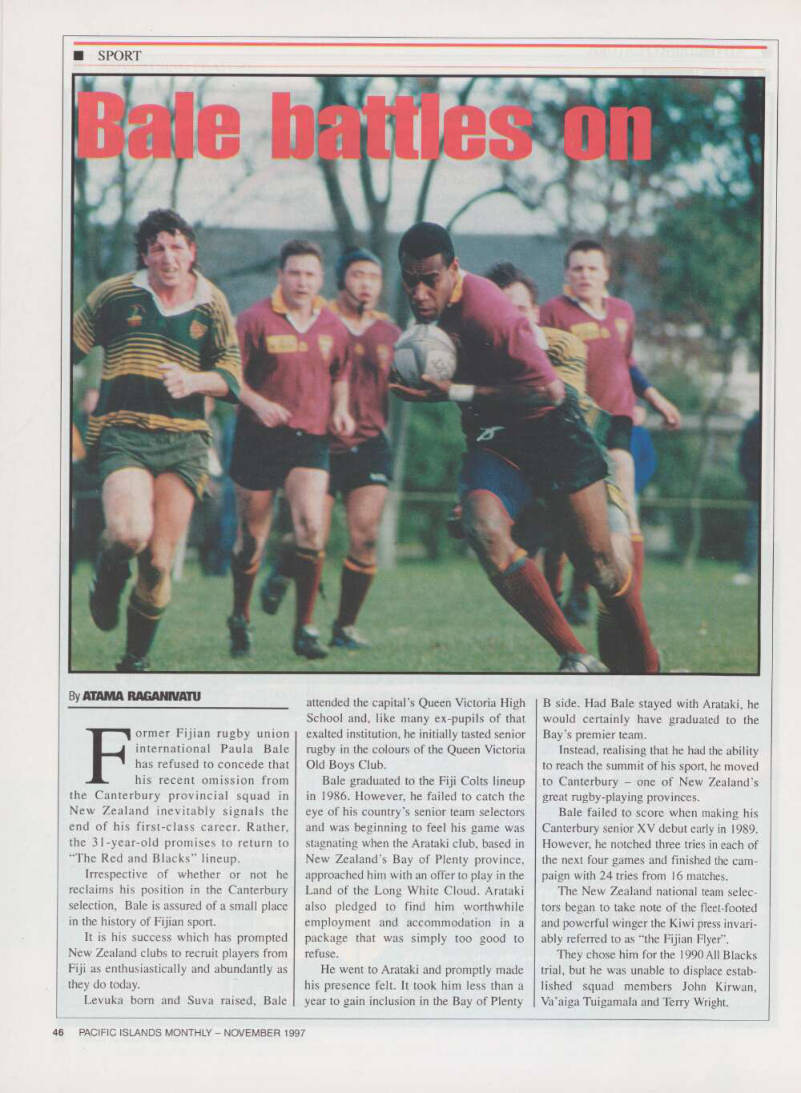
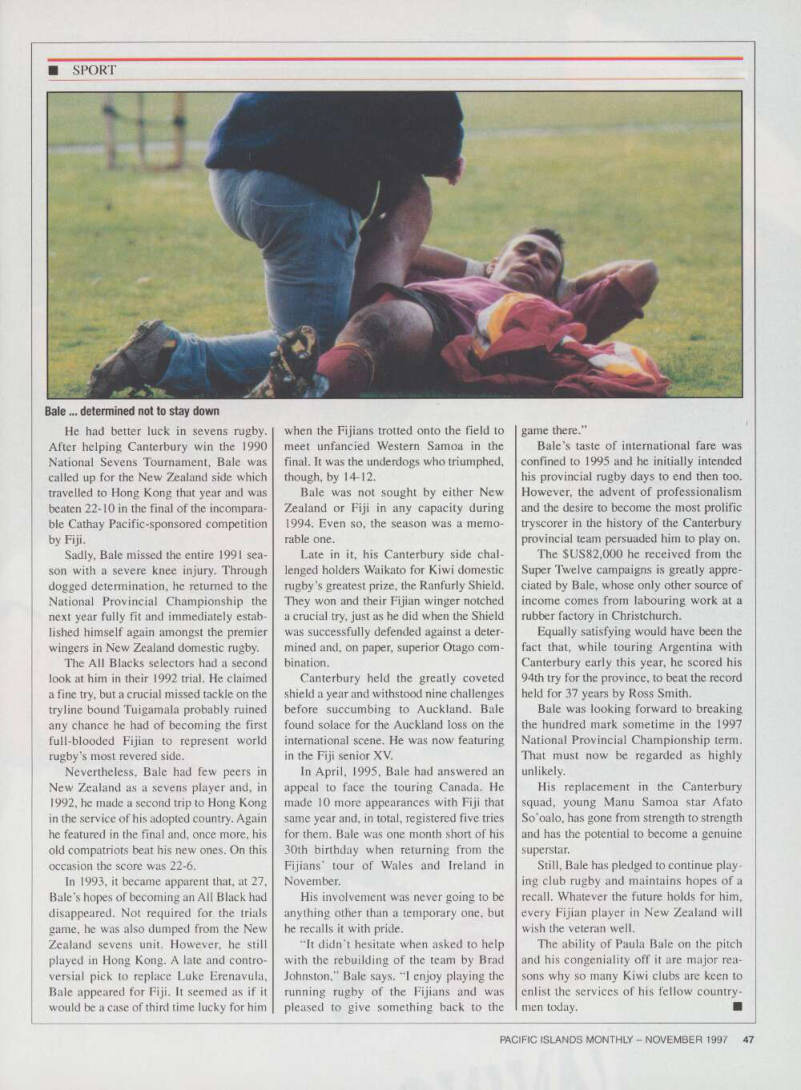
Sport
By Atama Raganivatu
Former Fijian rugby union international Paula Bale has refused to concede that his recent omission from the Canterbury provincial squad in New Zealand inevitably signals the end of his first-class career. Rather, the 31 -year-old promises to return to “The Red and Blacks” lineup.
Irrespective of whether or not he reclaims his position in the Canterbury selection, Bale is assured of a small place in the history of Fijian sport.
It is his success which has prompted New Zealand clubs to recruit players from Fiji as enthusiastically and abundantly as they do today.
Levuka born and Suva raised, Bale
attended the capital’s Queen Victoria High School and, like many ex-pupils of that exalted institution, he initially tasted senior rugby in the colours of the Queen Victoria Old Boys Club.
Bale graduated to the Fiji Colts lineup in 1986. However, he failed to catch the eye of his country’s senior team selectors and was beginning to feel his game was stagnating when the Arataki club, based in New Zealand’s Bay of Plenty province, approached him with an offer to play in the Land of the Long White Cloud. Arataki also pledged to find him worthwhile employment and accommodation in a package that was simply too good to refuse.
He went to Arataki and promptly made his presence felt. It took him less than a year to gain inclusion in the Bay of Plenty
B side. Had Bale stayed with Arataki, he would certainly have graduated to the Bay’s premier team.
Instead, realising that he had the ability to reach the summit of his sport, he moved to Canterbury - one of New Zealand’s great rugby-playing provinces.
Bale failed to score when making his Canterbury senior XV debut early in 1989.
However, he notched three tries in each of the next four games and finished the cam paign with 24 tries from 16 matches.
The New Zealand national team selec tors began to take note of the fleet-footed and powerful winger the Kiwi press invari ably referred to as “the Fijian Flyer”.
They chose him for the 1990 All Blacks trial, but he was unable to displace estab lished squad members John Kirwan, Va’aiga Tuigamala and Terry Wright.
He had better luck in sevens rugby.
After helping Canterbury win the 1990 National Sevens Tournament, Bale was called up for the New Zealand side which travelled to Hong Kong that year and was beaten 22-10 in the final of the incompara ble Cathay Pacific-sponsored competition
by Fiji.
Sadly, Bale missed the entire 1991 sea son with a severe knee injury. Through dogged determination, he returned to the National Provincial Championship the next year fully fit and immediately estab lished himself again amongst the premier wingers in New Zealand domestic rugby.
The All Blacks selectors had a second look at him in their 1992 trial. He claimed a fine try, but a crucial missed tackle on the tryline bound Tuigamala probably ruined any chance he had of becoming the first full-blooded Fijian to represent world rugby’s most revered side.
Nevertheless, Bale had few peers in New Zealand as a sevens player and, in 1992, he made a second trip to Hong Kong in the service of his adopted country. Again he featured in the final and, once more, his old compatriots beat his new ones. On this occasion the score was 22-6.
In 1993, it became apparent that, at 27, Bale’s hopes of becoming an All Black had disappeared. Not required for the trials game, he was also dumped from the New Zealand sevens unit. However, he still played in Hong Kong. A late and contro versial pick to replace Luke Erenavula, Bale appeared for Fiji. It seemed as if it would be a case of third time lucky for him
when the Fijians trotted onto the field to meet unfancied Western Samoa in the final. It was the underdogs who triumphed, though, by 14-12.
Bale was not sought by either New Zealand or Fiji in any capacity during 1994. Even so, the season was a memo rable one.
Fate in it, his Canterbury side chal lenged holders Waikato for Kiwi domestic rugby’s greatest prize, the Ranfurly Shield.
They won and their Fijian winger notched a crucial try, just as he did when the Shield was successfully defended against a deter mined and, on paper, superior Otago com bination.
Canterbury held the greatly coveted shield a year and withstood nine challenges before succumbing to Auckland. Bale found solace for the Auckland loss on the international scene. He was now featuring in the Fiji senior XV.
In April, 1995, Bale had answered an appeal to face the touring Canada. He made 10 more appearances with Fiji that same year and, in total, registered five tries for them. Bale was one month short of his 30th birthday when returning from the Fijians’ tour of Wales and Ireland in November.
His involvement was never going to be anything other than a temporary one, but he recalls it with pride. ”It didn't hesitate when asked to help with the rebuilding of the team by Brad Johnston,” Bale says. “I enjoy playing the running rugby of the Fijians and was pleased to give something back to the
game there.”
Bale’s taste of international fare was confined to 1995 and he initially intended his provincial rugby days to end then too.
However, the advent of professionalism and the desire to become the most prolific tryscorer in the history of the Canterbury provincial team persuaded him to play on.
The SUSB2,OOO he received from the Super Twelve campaigns is greatly appre ciated by Bale, whose only other source of income comes from labouring work at a rubber factory in Christchurch.
Equally satisfying would have been the fact that, while touring Argentina with Canterbury early this year, he scored his 94th try for the province, to beat the record held for 37 years by Ross Smith.
Bale was looking forward to breaking the hundred mark sometime in the 1997 National Provincial Championship term.
That must now be regarded as highly unlikely.
His replacement in the Canterbury squad, young Manu Samoa star Afato So’oalo, has gone from strength to strength and has the potential to become a genuine superstar.
Still, Bale has pledged to continue play ing club rugby and maintains hopes of a recall. Whatever the future holds for him, every Fijian player in New Zealand will wish the veteran well.
The ability of Paula Bale on the pitch and his congeniality off it are major rea sons why so many Kiwi clubs are keen to enlist the services of his fellow country men today. ■
Bale determined not to stay down
Queen

Bea
I■ A Mk: ’Ji %. ~'W^'
WR ■ * n .
By Atama Ragan Ivatu
Samoan discus thrower Beatrice Faumuina added her name to Pacific island sport’s roll of honour when claiming the gold medal at the recent World Athletics Championships in Athens. However, she almost gave her many admirers heart attacks in the process.
Faumuina produced foul throws for the initial two of the three attempts permitted each competitor in the qualifying round and prompted memories of the previous year’s Olympics in Atlanta, when she was eliminated at the earliest stage; being over awed by the occasion. Thankfully, Faumuina’s nerve held this time and she hurled the discus 64.58 metres - two metres beyond the qualifying mark and the second best length of the evening.
Her temperament was again tested two days later during the finals. Faumuina overbalanced in the follow through of the opening effort and the second was also judged a foul, although she felt the latter to
be legitimate.
“It was an excellent one,” she contends.
“I felt comfortable with my technique and I didn’t think my foot went outside the cir cle as the officials claimed. I contemplated arguing with them, but realised I would be the only one to lose if I did and kept my cool.” That discounted fling appeared to exceed 63 metres in length and would, if judged valid, have ensured Faumuina four more shots in the final and breathing space as she went about consolidating her posi tion. Instead, she found herself being required to conjure up a long - and legal throw in order to remain in the competition and avoid a repeat of her Atlanta embar rassment.
Faumuina responded to the challenge with a fling of 66.82 metres.
This more than ensured her survival - it won a gold medal. For the remainder of the event, she and the seven other finalists strived to heave their spheres further. They failed.
The victory may herald a long reign for Faumuina as queen of the discus. She was the youngest finalist by two years and, at 22, could well dominate for the next decade a discipline in which the majority of participants don’t hit their peaks until past 30.
Belorussian Ellina Zvereva, the World Championships silver medallist, is 36. If she does exert a stranglehold, there will be hardly any complaints. Used to top-level discus throwing as the almost sole domain of Eastern Europeans, the emergence of the Samoan was greeted with delight by ath letics fans, officials and media personnel alike.
Her motioning of the hands as she willed the winning throw on with cries of “go, fly” and her silent prayer of thanks when it landed, provided the champi onships with one of their most enduring memories. Over 90 congratulatory faxes awaited Faumuina at her hotel as she returned from the triumph and they were still being received on the evening she left for home.
Faumuina’s mother, Roini, had every justification to be supremely proud as she saw her daughter sparkle in both the stadi um and the press conference afterwards.
Making her only trip beyond New Zealand, Roini was in the Greek capital to witness the triumph and happily provided details of a quintessential rags-to-riches story.
Faumuina was bom and has lived her entire life in the upretentious Auckland suburb of Mount Roskill. She was raised by Roini, a second generation New Zealander of Samoan heritage, and grand mother, Pepe Faumuina. Beatrice has never met her father. “I learnt early in life the importance of discipline and respect,”
Beatrice reflected in Athens soon after cap turing her gold medal.
“We were, and remain, an extremely close-knit family. Many people believed that, as an only child, I would be spoilt.
But, whenever I stepped out of line, I cer tainly became aware of it.”
Roini then added: “My mother did actu ally spoil Beatrice at times, but she could also give her a good old-fashioned tongue lashing when it was required. And, on the rare occasions Beatrice did misbehave, 1 would provide a couple of slaps across the backside. That was rarely necessary, though, and she gave us no major prob lems.”
One of Beatrice’s very few regrets is that Pepe was unable to see her accomplish glory in Athens.
She died early in 1996 (on the day her granddaughter qualified for that year's Olympics) of a kidney disease.
At the time of Pepe’s death, Beatrice’s
career was gaining momentum under the coaching of former Commonwealth Games gold medallist and currently Auckland mayor, Les Mills. Eleven months earlier, Miriam Stanley, Faumuina’s original mentor, had also passed away and Mills agreed to step into Stanley’s shoes.
“Coaching Beatrice is my hobby,” Mills says today. “Other people play golf to relax, I coach Beatrice.”
Although Mills is not in a position to devote as many hours to Faumuina as the coaches of rival athletes spend alongside their charges, his input has been invalu able.
“Les has been the single most important factor in Beatrice’s advancement,” the manager of the New Zealand athletics team, Dave Norris claims. “He changed the emphasis of her training to weights follow ing the loss of Miriam. Les got her training for five hours each day and increased her strength work by a huge degree. The weights he has got her on have to be wit nessed to be believed and we are now see ing the results of those.”
With Mills’ strict routine, Faumuina augmented her weight by 18 kilograms much of it muscle - last year and now tips the scales at 116 kilograms.
When asked to explain the secret of her success, Faumuina replies earnestly: “I lis ten to my coach and am committed to what I want to achieve. I focus hard on my goals and strive hard to realise them.”
Male Pacific island sportsmen already have an abundance of admirable role mod els and now their sisters too have an exam ple they can look up to and endeavour to emulate. And, it appears likely Faumuina will provide numerous inspirational moments for them in the future. As well as a gold medal, she returned from Athens clutching a cheque for SUS6O,OOO. In addi tion, the New Zealand Sports Foundation has just announced it will increase her funding.
As a result, Faumuina is now a full-time athlete and, hopefully, this will enable her to maintain her edge against the other top 10 leading women’s discus throwers, whose sport is also their occupation.
Her sights are now set upon next year's Commonwealth Games in Malaysia. After that, it will be the 2000 Olympics and, per haps, Pacific islands sports’ greatest moment. ■
Life journey
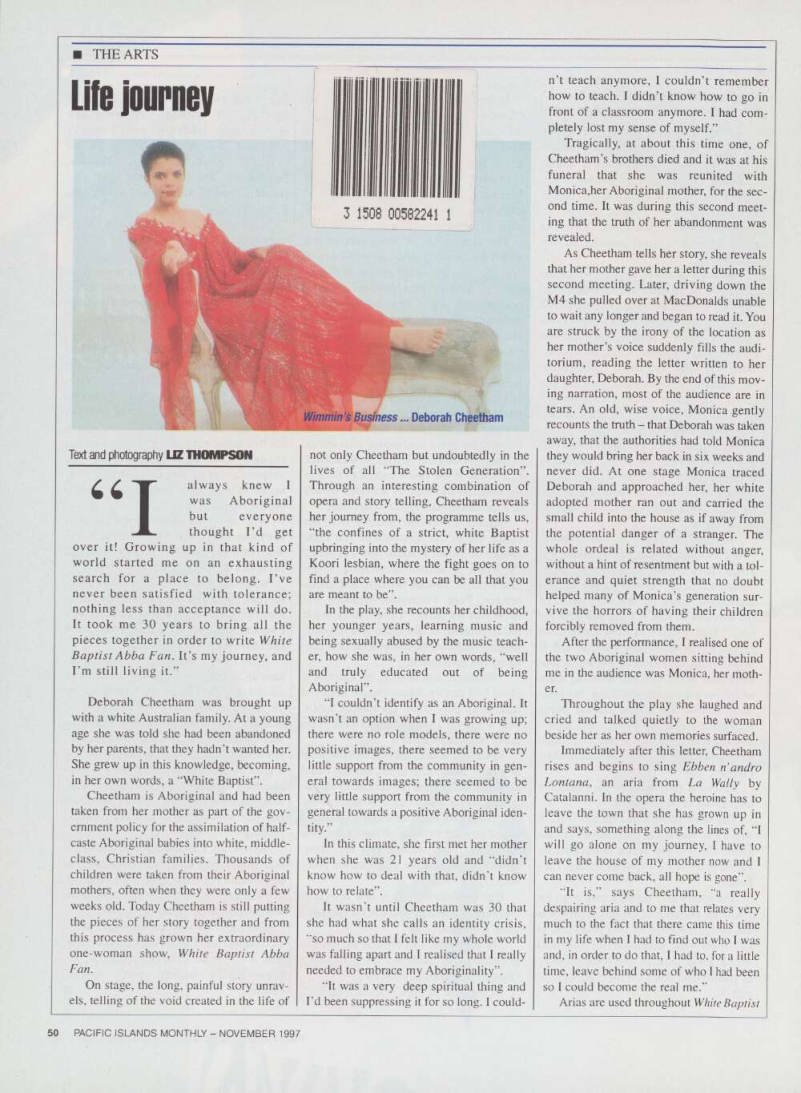
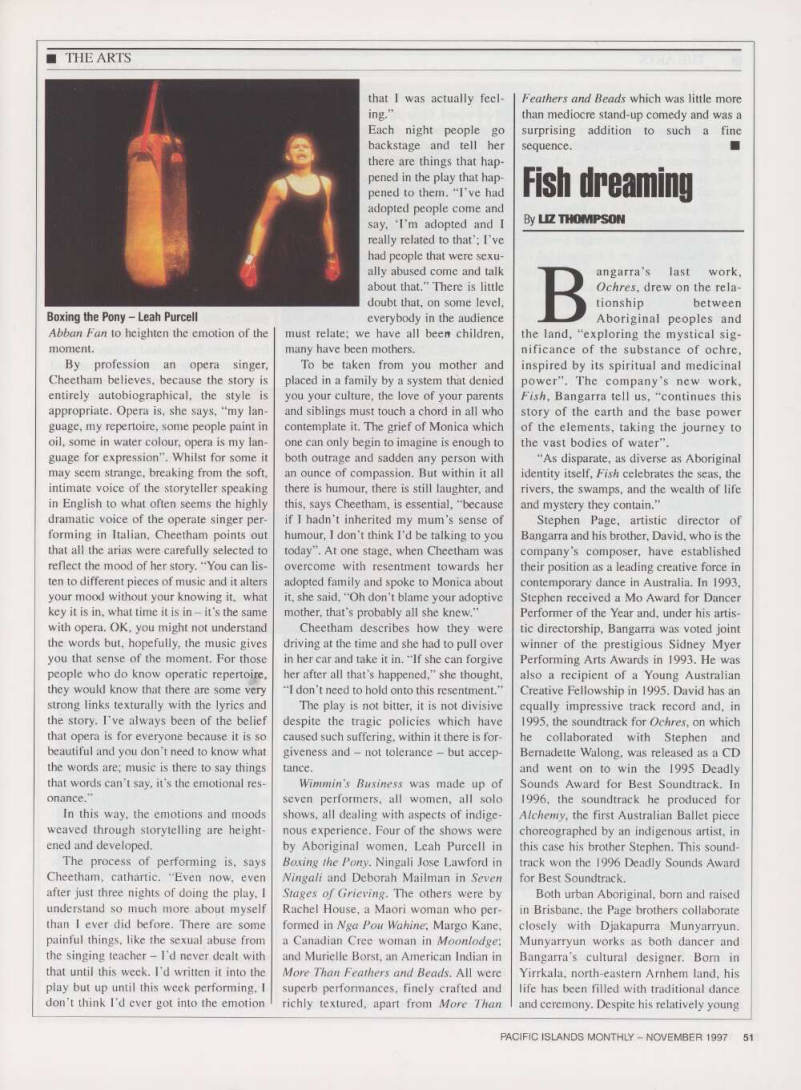
The Arts
not only Cheetham but undoubtedly in the lives of all ‘The Stolen Generation”.
Through an interesting combination of opera and story telling, Cheetham reveals her journey from, the programme tells us, “the confines of a strict, white Baptist upbringing into the mystery of her life as a Koori lesbian, where the fight goes on to find a place where you can be all that you are meant to be”.
In the play, she recounts her childhood, her younger years, learning music and being sexually abused by the music teach er, how she was, in her own words, “well and truly educated out of being Aboriginal”.
“I couldn’t identify as an Aboriginal. It wasn’t an option when I was growing up; there were no role models, there were no positive images, there seemed to be very little support from the community in gen eral towards images; there seemed to be very little support from the community in general towards a positive Aboriginal iden
tity.”
In this climate, she first met her mother when she was 21 years old and "didn't know how to deal with that, didn’t know how to relate”.
It wasn’t until Cheetham was 30 that she had what she calls an identity crisis, "so much so that I felt like my whole world was falling apart and I realised that I really needed to embrace my Aboriginality”.
“It was a very deep spiritual thing and I’d been suppressing it for so long. I could
/ / always knew I
was Aboriginal
but everyone M thought I’d get over it! Growing up in that kind of world started me on an exhausting search for a place to belong. I’ve never been satisfied with tolerance; nothing less than acceptance will do.
It took me 30 years to bring all the pieces together in order to write White Baptist Abba Fan. It’s my journey, and I’m still living it.”
Deborah Cheetham was brought up with a white Australian family. At a young age she was told she had been abandoned by her parents, that they hadn’t wanted her.
She grew up in this knowledge, becoming, in her own words, a “White Baptist”.
Cheetham is Aboriginal and had been taken from her mother as part of the gov ernment policy for the assimilation of half caste Aboriginal babies into white, middle class, Christian families. Thousands of children were taken from their Aboriginal mothers, often when they were only a few weeks old. Today Cheetham is still putting the pieces of her story together and from this process has grown her extraordinary one-woman show, White Baptist Abba Fan.
On stage, the long, painful story unrav els, telling of the void created in the life of
rft teach anymore, I couldn’t remember how to teach. I didn’t know how to go in front of a classroom anymore. I had com pletely lost my sense of myself.”
Tragically, at about this time one, of Cheetham’s brothers died and it was at his funeral that she was reunited with Monica,her Aboriginal mother, for the sec ond time. It was during this second meet ing that the truth of her abandonment was revealed.
As Cheetham tells her story, she reveals that her mother gave her a letter during this second meeting. Later, driving down the M 4 she pulled over at MacDonalds unable to wait any longer and began to read it. You are struck by the irony of the location as her mother’s voice suddenly fills the audi torium, reading the letter written to her daughter, Deborah. By the end of this mov ing narration, most of the audience are in tears. An old, wise voice, Monica gently recounts the truth - that Deborah was taken away, that the authorities had told Monica they would bring her back in six weeks and never did. At one stage Monica traced Deborah and approached her, her white adopted mother ran out and carried the small child into the house as if away from the potential danger of a stranger. The whole ordeal is related without anger, without a hint of resentment but with a tol erance and quiet strength that no doubt helped many of Monica’s generation sur vive the horrors of having their children forcibly removed from them.
After the performance, I realised one of the two Aboriginal women sitting behind me in the audience was Monica, her moth er.
Throughout the play she laughed and cried and talked quietly to the woman beside her as her own memories surfaced.
Immediately after this letter, Cheetham rises and begins to sing Ebben n’andro Lontana, an aria from La Wally by Catalanni. In the opera the heroine has to leave the town that she has grown up in and says, something along the lines of, ”1 will go alone on my journey, 1 have to leave the house of my mother now and 1 can never come back, all hope is gone”.
"It is,” says Cheetham, "a really despairing aria and to me that relates very much to the fact that there came this time in my life when I had to find out who I was and, in order to do that, I had to, for a little time, leave behind some of who I had been so 1 could become the real me.”
Arias are used throughout White Baptist
Text and photography UZ THOMPSON
Wimmin’s Business ... Deborah Cheetham
Abban Fan to heighten the emotion of the moment.
By profession an opera singer, Cheetham believes, because the story is entirely autobiographical, the style is appropriate. Opera is, she says, “my lan guage, my repertoire, some people paint in oil, some in water colour, opera is my lan guage for expression”. Whilst for some it may seem strange, breaking from the soft, intimate voice of the storyteller speaking in English to what often seems the highly dramatic voice of the operate singer per forming in Italian, Cheetham points out that all the arias were carefully selected to reflect the mood of her story. “You can lis ten to different pieces of music and it alters your mood without your knowing it, what key it is in, what time it is in - it’s the same with opera. OK, you might not understand the words but, hopefully, the music gives you that sense of the moment. For those people who do know operatic repertoire, they would know that there are some very strong links texturally with the lyrics and the story. I’ve always been of the belief that opera is for everyone because it is so beautiful and you don’t need to know what the words are; music is there to say things that words can’t say, it’s the emotional res onance.”
In this way, the emotions and moods weaved through storytelling are height ened and developed.
The process of performing is, says Cheetham, cathartic. "Even now, even after just three nights of doing the play, 1 understand so much more about myself than 1 ever did before. There are some painful things, like the sexual abuse from the singing teacher - I’d never dealt with that until this week. Fd written it into the play but up until this week performing, 1 don't think I’d ever got into the emotion
that I was actually feel
ing.”
Each night people go backstage and tell her there are things that hap pened in the play that hap pened to them. “I’ve had adopted people come and say, T’m adopted and I really related to that’; I’ve had people that were sexu ally abused come and talk about that.” There is little doubt that, on some level, everybody in the audience
must relate; we have all been children, many have been mothers.
To be taken from you mother and placed in a family by a system that denied you your culture, the love of your parents and siblings must touch a chord in all who contemplate it. The grief of Monica which one can only begin to imagine is enough to both outrage and sadden any person with an ounce of compassion. But within it all there is humour, there is still laughter, and this, says Cheetham, is essential, “because if I hadn’t inherited my mum’s sense of humour, I don’t think I’d be talking to you today”. At one stage, when Cheetham was overcome with resentment towards her adopted family and spoke to Monica about it, she said, “Oh don’t blame your adoptive mother, that’s probably all she knew.”
Cheetham describes how they were driving at the time and she had to pull over in her car and take it in. “If she can forgive her after all that’s happened,” she thought, “I don’t need to hold onto this resentment.”
The play is not bitter, it is not divisive despite the tragic policies which have caused such suffering, within it there is for giveness and - not tolerance - but accep tance.
Wimmin’s Business was made up of seven performers, all women, all solo shows, all dealing with aspects of indige nous experience. Four of the shows were by Aboriginal women, Leah Purcell in Boxing the Pony. Ningali Jose Lawford in Ningali and Deborah Mailman in Seven Stages of Grieving. The others were by Rachel House, a Maori woman who per formed in Nga Pou Wahine; Margo Kane, a Canadian Cree woman in Moonlodge\ and Murielle Borst, an American Indian in More Than Feathers and Beads. All were superb performances, finely crafted and richly textured, apart from More Than
Feathers and Beads which was little more than mediocre stand-up comedy and was a surprising addition to such a fine sequence. ■
Boxing the Pony - Leah Purcell
Fish dreaming
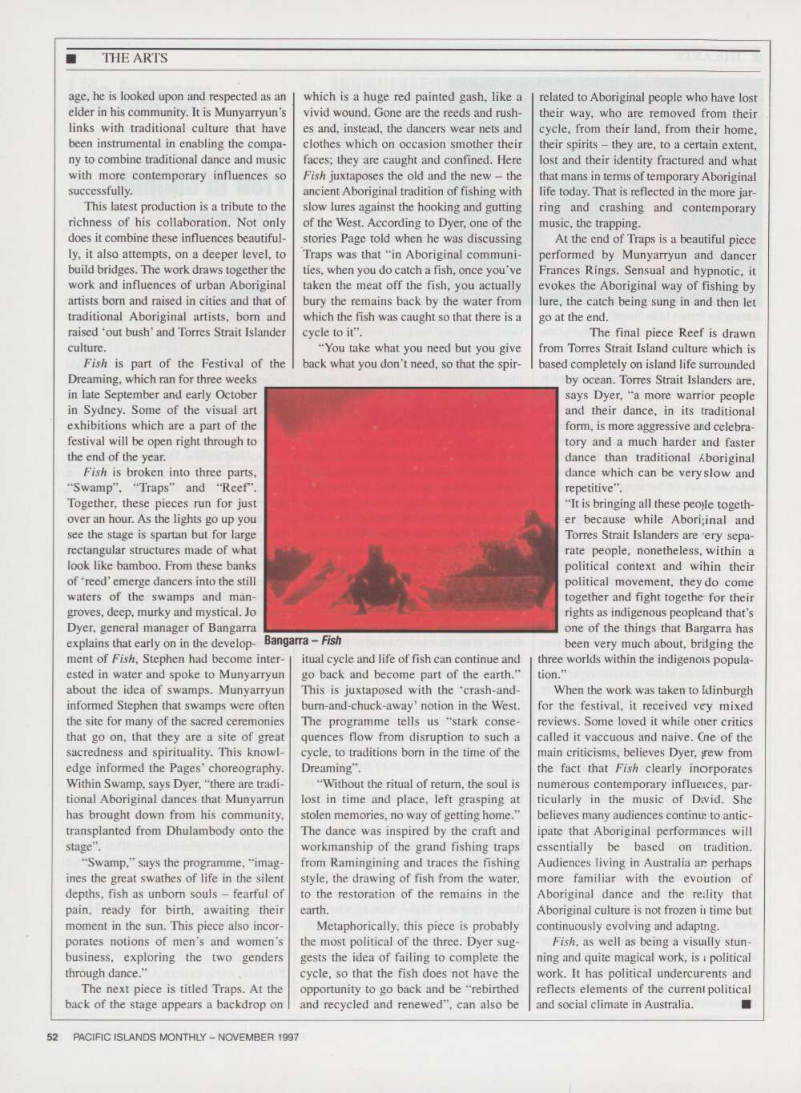
By Liz Thompson
Bangarra’s last work.
Ochres, drew on the rela tionship between Aboriginal peoples and the land, “exploring the mystical sig nificance of the substance of ochre, inspired by its spiritual and medicinal power”. The company’s new work, Fish, Bangarra tell us, “continues this story of the earth and the base power of the elements, taking the journey to the vast bodies of water”.
“As disparate, as diverse as Aboriginal identity itself, Fish celebrates the seas, the rivers, the swamps, and the wealth of life and mystery they contain.”
Stephen Page, artistic director of Bangarra and his brother, David, who is the company’s composer, have established their position as a leading creative force in contemporary dance in Australia. In 1993, Stephen received a Mo Award for Dancer Performer of the Year and, under his artis tic directorship, Bangarra was voted joint winner of the prestigious Sidney Myer Performing Arts Awards in 1993. He was also a recipient of a Young Australian Creative Fellowship in 1995. David has an equally impressive track record and, in 1995, the soundtrack for Ochres, on which he collaborated with Stephen and Bernadette Walong, was released as a CD and went on to win the 1995 Deadly Sounds Award for Best Soundtrack. In 1996, the soundtrack he produced for Alchemy, the first Australian Ballet piece choreographed by an indigenous artist, in this case his brother Stephen. This sound track won the 1996 Deadly Sounds Award for Best Soundtrack.
Both urban Aboriginal, born and raised in Brisbane, the Page brothers collaborate closely with Djakapurra Munyarryun.
Munyarryun works as both dancer and Bangarra's cultural designer. Born in Yirrkala, north-eastern Arnhem land, his life has been filled with traditional dance and ceremony. Despite his relatively young
age, he is looked upon and respected as an elder in his community. It is Munyarryun’s links with traditional culture that have been instrumental in enabling the compa ny to combine traditional dance and music with more contemporary influences so successfully.
This latest production is a tribute to the richness of his collaboration. Not only does it combine these influences beautiful ly, it also attempts, on a deeper level, to build bridges. The work draws together the work and influences of urban Aboriginal artists bom and raised in cities and that of traditional Aboriginal artists, bom and raised ‘out bush’ and Torres Strait Islander culture.
Fish is part of the Festival of the
Dreaming, which ran for three weeks in late September and early October in Sydney. Some of the visual art exhibitions which are a part of the festival will be open right through to the end of the year.
Fish is broken into three parts, “Swamp”, “Traps” and “Reef’.
Together, these pieces run for just
over an hour. As the lights go up you see the stage is spartan but for large rectangular structures made of what look like bamboo. From these banks of Teed’ emerge dancers into the still waters of the swamps and man groves, deep, murky and mystical. Jo Dyer, general manager of Bangarra explains that early on in the develop
ment of Fish, Stephen had become inter ested in water and spoke to Munyarryun about the idea of swamps. Munyarryun informed Stephen that swamps were often the site for many of the sacred ceremonies that go on, that they are a site of great sacredness and spirituality. This knowl
edge informed the Pages’ choreography.
Within Swamp, says Dyer, "there are tradi tional Aboriginal dances that Munyarrun has brought down from his community, transplanted from Dhulambody onto the stage”.
“Swamp,” says the programme, “imag ines the great swathes of life in the silent depths, fish as unborn souls - fearful of pain, ready for birth, awaiting their moment in the sun. This piece also incor porates notions of men’s and women’s business, exploring the two genders
through dance.”
The next piece is titled Traps. At the back of the stage appears a backdrop on
which is a huge red painted gash, like a vivid wound. Gone are the reeds and rush es and, instead, the dancers wear nets and clothes which on occasion smother their faces; they are caught and confined. Here Fish juxtaposes the old and the new - the ancient Aboriginal tradition of fishing with slow lures against the hooking and gutting of the West. According to Dyer, one of the stories Page told when he was discussing Traps was that “in Aboriginal communi ties, when you do catch a fish, once you’ve taken the meat off the fish, you actually bury the remains back by the water from which the fish was caught so that there is a cycle to it”.
“You take what you need but you give back what you don’t need, so that the spir-
itual cycle and life of fish can continue and go back and become part of the earth.”
This is juxtaposed with the ‘crash-and bum-and-chuck-away’ notion in the West.
The programme tells us “stark conse quences flow from disruption to such a cycle, to traditions bom in the time of the
Dreaming”.
“Without the ritual of return, the soul is lost in time and place, left grasping at stolen memories, no way of getting home.”
The dance was inspired by the craft and workmanship of the grand fishing traps from Ramingining and traces the fishing style, the drawing of fish from the water, to the restoration of the remains in the earth.
Metaphorically, this piece is probably the most political of the three. Dyer sug gests the idea of failing to complete the cycle, so that the fish does not have the opportunity to go back and be “rebirthed and recycled and renewed”, can also be
related to Aboriginal people who have lost their way, who are removed from their cycle, from their land, from their home, their spirits - they are, to a certain extent, lost and their identity fractured and what that mans in terms of temporary Aboriginal life today. That is reflected in the more jar ring and crashing and contemporary music, the trapping.
At the end of Traps is a beautiful piece performed by Munyarryun and dancer Frances Rings. Sensual and hypnotic, it evokes the Aboriginal way of fishing by lure, the catch being sung in and then let go at the end.
The final piece Reef is drawn from Torres Strait Island culture which is based completely on island life surrounded
by ocean. Torres Strait Islanders are, says Dyer, “a more warrior people and their dance, in its traditional form, is more aggressive and celebra tory and a much harder and faster dance than traditional Aboriginal dance which can be very slow and repetitive”.
“It is bringing all these peo)le togeth er because while Aboriginal and Torres Strait Islanders are cry sepa rate people, nonetheless, within a political context and wihin their political movement, they do come together and fight togethe- for their rights as indigenous peopleand that’s one of the things that Bargarra has been very much about, bridging the
three worlds within the indigenois popula tion.”
When the work was taken to Idinburgh for the festival, it received vey mixed reviews. Some loved it while oner critics called it vaccuous and naive. Cne of the main criticisms, believes Dyer, gew from the fact that Fish clearly inorporates numerous contemporary influeices, par ticularly in the music of Drvid. She believes many audiences continu; to antic ipate that Aboriginal performances will essentially be based on tradition.
Audiences living in Australia an perhaps more familiar with the evoution of Aboriginal dance and the redity that Aboriginal culture is not frozen ii time but continuously evolving and adaptng.
Fish, as well as being a visuilly stun ning and quite magical work, is j political work. It has political undercurents and reflects elements of the current political and social climate in Australia. ■
Bangarra - Fish
Keeping a wea ther-eye open
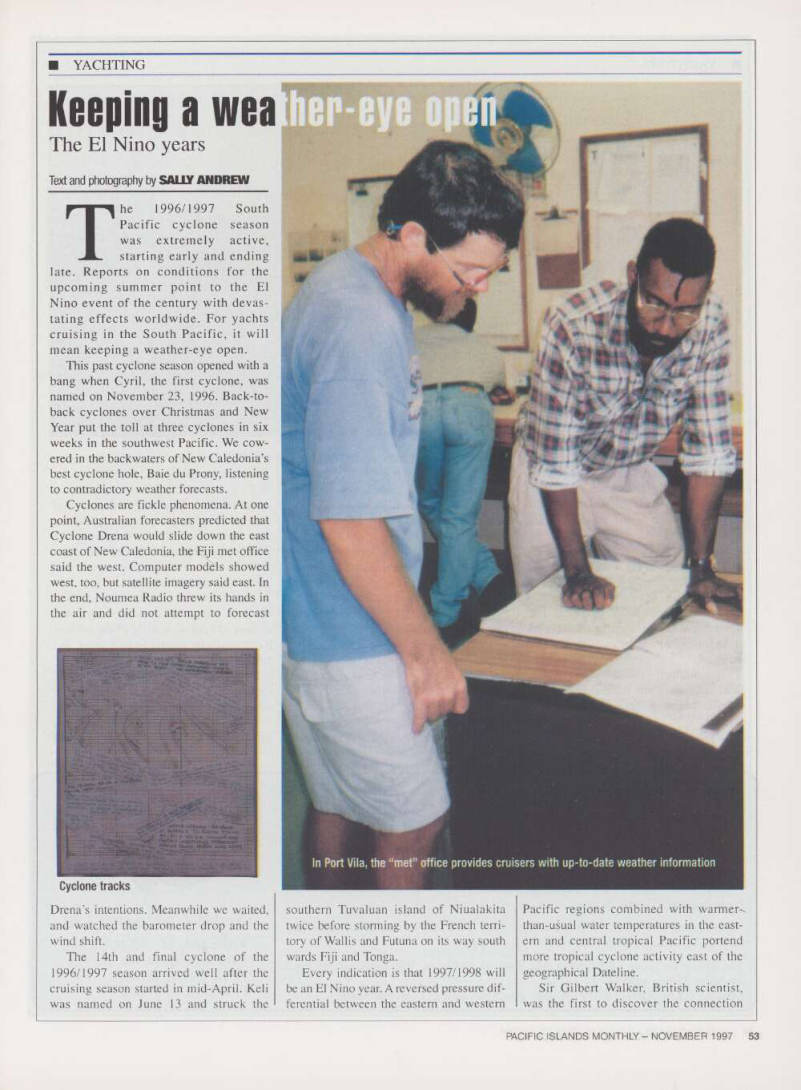
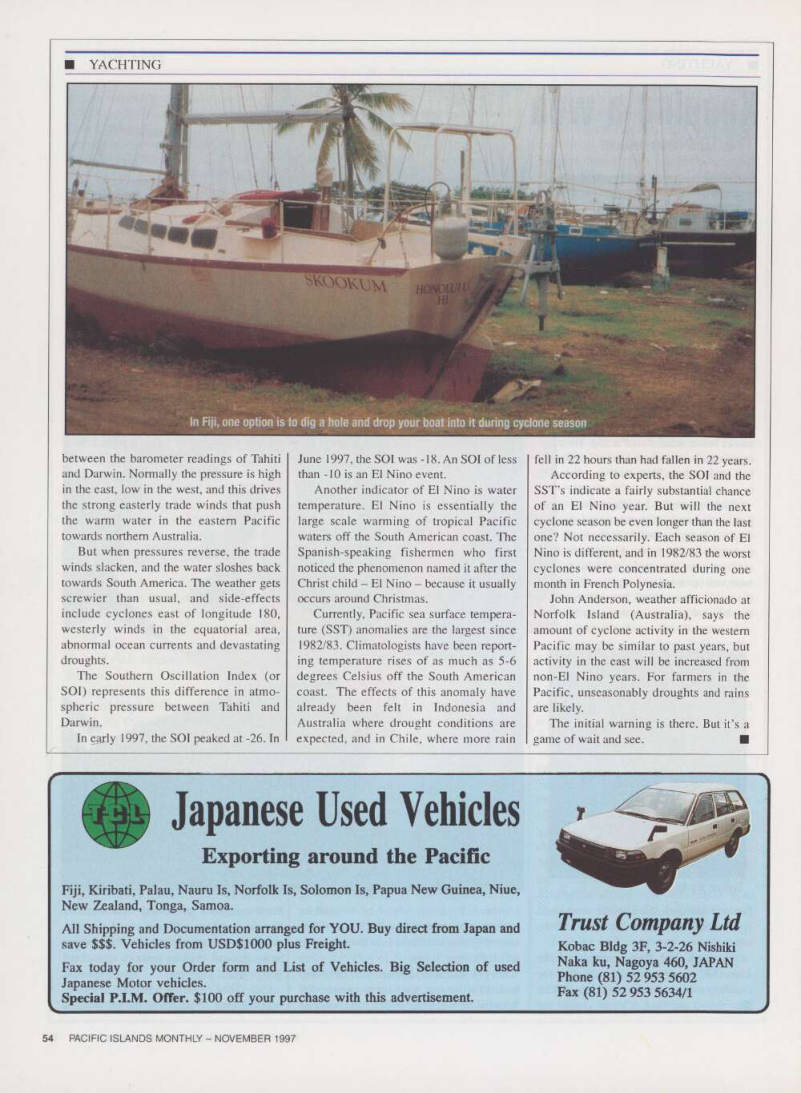
Yachting
Keeping a wea ther-eye open The El Nino years
Text and photography by SALLY ANDREW
The 1996/1997 South Pacific cyclone season was extremely active, starting early and ending late. Reports on conditions for the upcoming summer point to the El Nino event of the century with devas tating effects worldwide. For yachts cruising in the South Pacific, it will mean keeping a weather-eye open.
This past cyclone season opened with a bang when Cyril, the first cyclone, was named on November 23, 1996. Back-to back cyclones over Christmas and New Year put the toll at three cyclones in six weeks in the southwest Pacific. We cow ered in the backwaters of New Caledonia’s best cyclone hole, Baie du Prony, listening to contradictory weather forecasts.
Cyclones are fickle phenomena. At one point, Australian forecasters predicted that Cyclone Drena would slide down the east coast of New Caledonia, the Fiji met office said the west. Computer models showed west, too, but satellite imagery said east. In the end, Noumea Radio threw its hands in the air and did not attempt to forecast
Drena’s intentions. Meanwhile we waited, and watched the barometer drop and the wind shift.
The 14th and final cyclone of the 1996/1997 season arrived well after the cruising season started in mid-April. Keli was named on June 13 and struck the
southern Tuvaluan island of Niualakita twice before storming by the French terri tory of Wallis and Futuna on its way south wards Fiji and Tonga.
Every indication is that 1997/1998 will be an El Nino year. A reversed pressure dif ferential between the eastern and western
Pacific regions combined with warmer--. than-usual water temperatures in the east ern and central tropical Pacific portend more tropical cyclone activity east of the geographical Dateline.
Sir Gilbert Walker, British scientist, was the first to discover the connection
Cyclone tracks
In Port Vila, the “met” office provides cruisers with up-to-date weather information
between the barometer readings of Tahiti and Darwin. Normally the pressure is high in the east, low in the west, and this drives the strong easterly trade winds that push the warm water in the eastern Pacific towards northern Australia.
But when pressures reverse, the trade winds slacken, and the water sloshes back towards South America. The weather gets screwier than usual, and side-effects include cyclones east of longitude 180, westerly winds in the equatorial area, abnormal ocean currents and devastating droughts.
The Southern Oscillation Index (or SOI) represents this difference in atmo spheric pressure between Tahiti and Darwin.
In early 1997, the SOI peaked at -26. In
June 1997, the SOI was -18. An SOI of less than -10 is an El Nino event.
Another indicator of El Nino is water temperature. El Nino is essentially the
large scale warming of tropical Pacific
waters off the South American coast. The Spanish-speaking fishermen who first noticed the phenomenon named it after the Christ child - El Nino - because it usually occurs around Christmas.
Currently, Pacific sea surface tempera ture (SST) anomalies are the largest since 1982/83. Climatologists have been report ing temperature rises of as much as 5-6 degrees Celsius off the South American coast. The effects of this anomaly have already been felt in Indonesia and Australia where drought conditions are expected, and in Chile, where more rain
fell in 22 hours than had fallen in 22 years.
According to experts, the SOI and the SST’s indicate a fairly substantial chance of an El Nino year. But will the next cyclone season be even longer than the last one? Not necessarily. Each season of El Nino is different, and in 1982/83 the worst cyclones were concentrated during one month in French Polynesia.
John Anderson, weather afficionado at Norfolk Island (Australia), says the amount of cyclone activity in the western Pacific may be similar to past years, but activity in the east will be increased from non-El Nino years. For farmers in the Pacific, unseasonably droughts and rains are likely.
The initial warning is there. But it’s a game of wait and see. ■
In Fiji, one option is to dig a hole and drop your boat into it during cyclone season
Advertisements & other items, p. 54 (1 item)
Japanese Used Vehicles
Exporting around the Pacific
Fiji, Kiribati, Palau, Nauru Is, Norfolk Is, Solomon Is, Papua New Guinea, Niue, New Zealand, Tonga, Samoa.
All Shipping and Documentation arranged for YOU. Buy direct from Japan and save sss. Vehicles from USDSIOOO plus Freight.
Fax today for your Order form and List of Vehicles. Big Selection of used Japanese Motor vehicles.
Special P.I.M. Offer. $lOO off your purchase with this advertisement. r
Trust Company Ltd
Kobac Bldg 3F, 3-2-26 Nishiki Naka ku, Nagoya 460, JAPAN Phone (81) 52 953 5602 Fax (81) 52 953 5634/1
Australia, Greenhouse
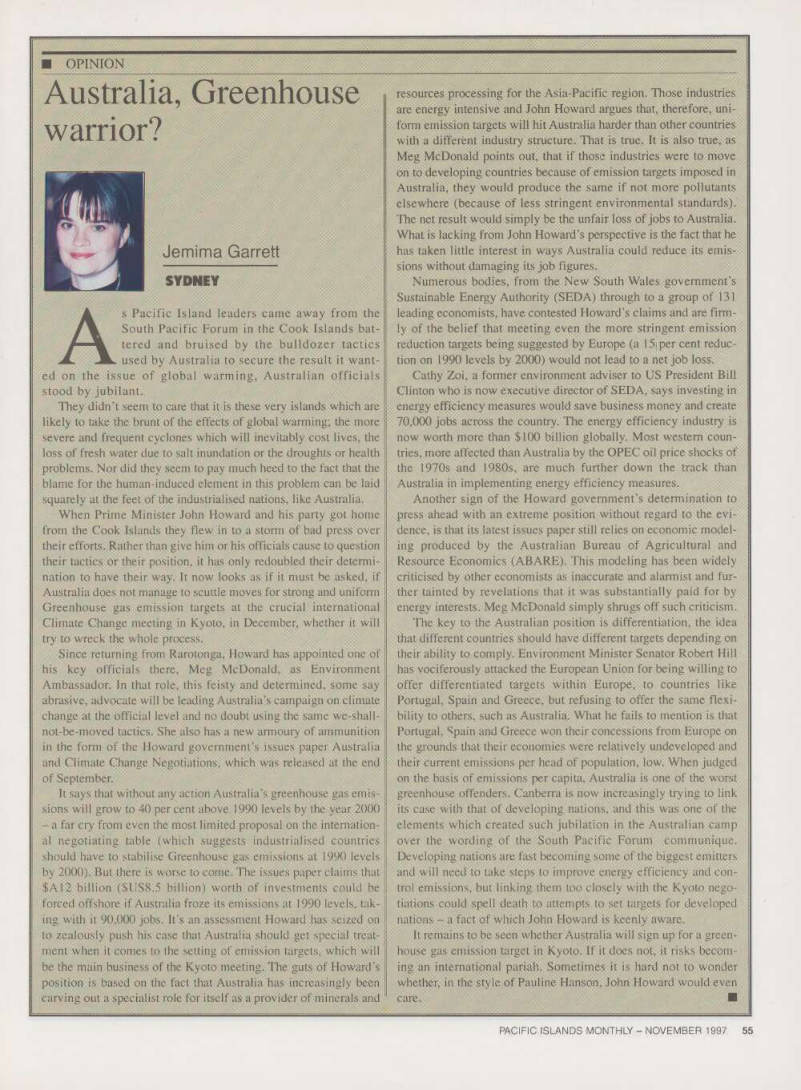
Opinion
Australia, Greenhouse warrior?
As Pacific Island leaders came away from the South Pacific Forum in the Cook Islands bat tered and bruised by the bulldozer tactics used by Australia to secure the result it want ed on the issue of global warming, Australian officials stood by jubilant.
They didn’t seem to care that it is these very islands which are likely to take the brunt of the effects of global warming; the more severe and frequent cyclones which will inevitably cost lives, the loss of fresh water due to salt inundation or the droughts or health problems. Nor did they seem to pay much heed to the fact that the blame for the human-induced element in this problem can be laid squarely at the feet of the industrialised nations, like Australia.
When Prime Minister John Howard and his party got home from the Cook Islands they flew in to a storm of bad press over their efforts. Rather than give him or his officials cause to question their tactics or their position, it has only redoubled their determi nation to have their way. It now looks as if it must be asked, if Australia does not manage to scuttle moves for strong and uniform Greenhouse gas emission targets at the crucial international Climate Change meeting in Kyoto, in December, whether it will try to wreck the whole process.
Since returning from Rarotonga, Howard has appointed one of his key officials there, Meg McDonald, as Environment Ambassador, In that role, this feisty and determined, some say abrasive, advocate will be leading Australia’s campaign on climate change at the official level and no doubt using the same we-shall not-be-moved tactics. She also has a new armoury of ammunition in the form of the Howard government's issues paper Australia and Climate Change Negotiations, which was released at the end
of September.
It says that without any action Australia’s greenhouse gas emis sions will grow to 40 per cent above 1990 levels by the year 2000 - a far cry from even the most limited proposal on the internation al negotiating table (which suggests industrialised countries should have to stabilise Greenhouse gas emissions at 1990 levels by 2000). But there is worse to come. The issues paper claims that SAI2 billion (SUSB.S billion) worth of investments could be forced offshore if Australia froze its emissions at 1990 levels., tak ing with it 90.000 jobs. It's an assessment Howard has seized on to zealously push his case that Australia should get special treat ment when it comes to the setting of emission targets, which will be the main business of the Kyoto meeting. The guts of Howard's position is based on the fact that Australia has increasingly been carving out a specialist role for itself as a provider of minerals and
resources processing for the Asia-Pacific region. Those industries are energy intensive and John Howard argues that, therefore, uni form emission targets will hit Australia harder than other countries with a different industry structure. That is true. It is also true, as Meg McDonald points out, that if those industries were to move on to developing countries because of emission targets imposed in Australia, they would produce the same if not more pollutants elsewhere (because of less stringent environmental standards).
The net result would simply be the unfair loss of jobs to Australia.
What is lacking from John Howard's perspective is the fact that he has taken little interest in ways Australia could reduce its emis sions without damaging its job figures.
Numerous bodies, from the New South Wales government’s Sustainable Energy Authority (SEDA) through to a group of 131 leading economists, have contested Howard’s claims and are firm ly of the belief that meeting even the more stringent emission reduction targets being suggested by Europe (a 15| per cent reduc tion on 1990 levels by 2000) would not lead to a net job loss.
Cathy Zoi, a former environment adviser to US President Bill Clinton who is now executive director of SEDA, says investing in energy efficiency measures would save business money and create 70,000 jobs across the country. The energy efficiency industry is now worth more than $lOO billion globally. Most western coun tries, more affected than Australia by the OPEC oil price shocks of the 1970 s and 1980 s, are much further down the track than Australia in implementing energy efficiency measures.
Another sign of the Howard government’s determination to press ahead with an extreme position without regard to the evi dence, is that its latest issues paper still relies on economic model ing produced by the Australian Bureau of Agricultural and Resource Economics (ABARE). This modeling has been widely criticised by other economists as inaccurate and alarmist and fur ther tainted by revelations that it was substantially paid for by energy interests. Meg McDonald simply shrugs off such criticism.
The key to the Australian position is differentiation, the idea that different countries should have different targets depending on their ability to comply. Environment Minister Senator Robert Hill has vociferously attacked the European Union for being willing to offer differentiated targets within Europe, to countries like Portugal, Spain and Greece, but refusing to offer the same flexi bility to others, such as Australia. What he fails to mention is that Portugal, Spain and Greece won their concessions from Europe on the grounds that their economies were relatively undeveloped and their current emissions per head of population, low. When judged on the basis of emissions per capita, Australia is one of the worst greenhouse offenders. Canberra is now increasingly trying to link its case with that of developing nations, and this was one of the elements which created such jubilation in the Australian camp over the wording of the South Pacific Forum communique.
Developing nations are fast becoming some of the biggest emitters and will need to take steps to improve energy efficiency and con trol emissions, but linking them too closely with the Kyoto nego tiations could spell death to attempts to set targets for developed nations - a fact of which John Howard is keenly aware.
It remains to be seen whether Australia will sign up for a green house gas emission target in Kyoto. If it does not, it risks becom ing an international pariah. Sometimes it is hard not to wonder whether, in the style of Pauline Hanson, John Howard would even care. ■
Jemima Garrett
Sydney
Beyond preferential
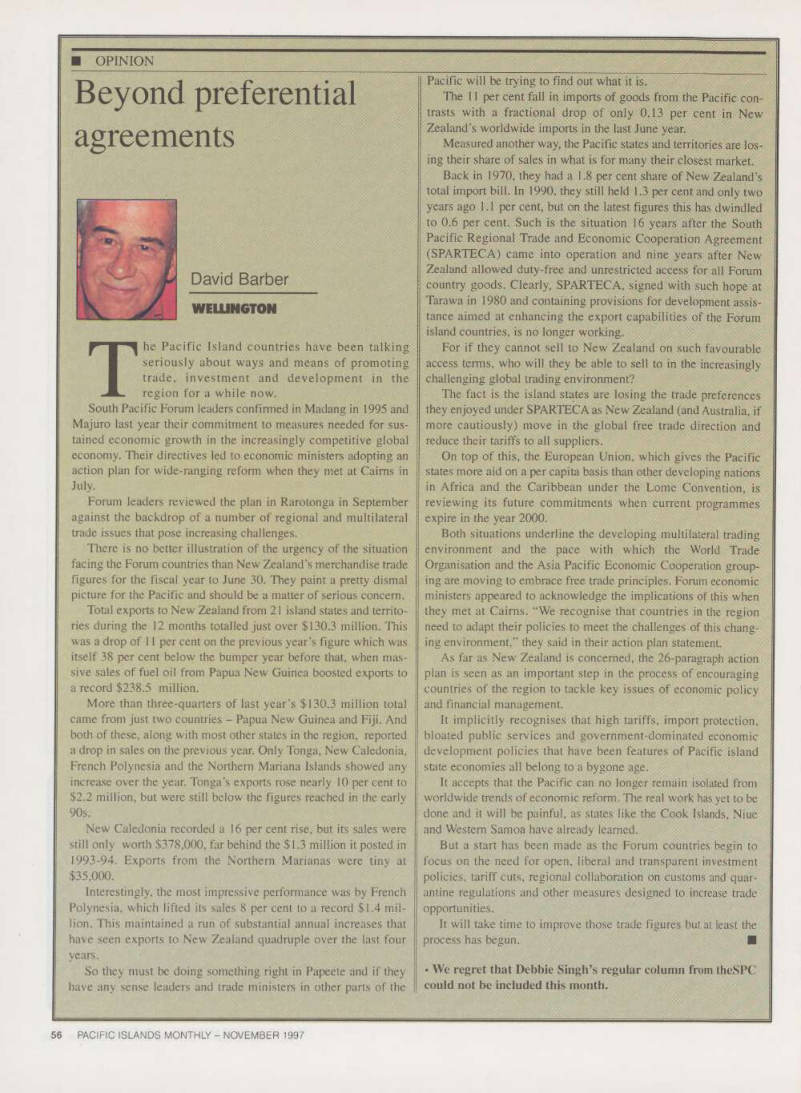
agreements
The Pacific Island countries have been talking seriously about ways and means of promoting trade, investment and development in the region for a while now.
South Pacific Forum leaders confirmed in Madang in 1995 and Majuro last year their commitment to measures needed for sus tained economic growth in the increasingly competitive global economy. Their directives led to economic ministers adopting an action plan for wide-ranging reform when they met at Caims in July.
Forum leaders reviewed the plan in Rarotonga in September against the backdrop of a number of regional and multilateral trade issues that pose increasing challenges.
There is no better illustration of the urgency of the situation facing the Forum countries than New Zealand’s merchandise trade figures for the fiscal year to June 30. They paint a pretty dismal picture for the Pacific and should be a matter of serious concern.
Total exports to New Zealand from 21 island states and territo ries during the 12 months totalled just over $130.3 million. This was a drop of 11 per cent on the previous year’s figure which was itself 38 per cent below the bumper year before that, when mas sive sales of fuel oil from Papua New Guinea boosted exports to a record $238.5 million.
More than three-quarters of last year’s $130.3 million total came from just two countries - Papua New Guinea and Fiji. And both of these, along with most other states in the region, reported a drop in sales on the previous year. Only Tonga, New Caledonia, French Polynesia and the Northern Mariana Islands showed any increase over the year. Tonga’s exports rose nearly 10 per cent to $2.2 million, but were still below the figures reached in the early 90s.
New Caledonia recorded a 16 per cent rise, but its sales were still only worth $378,000, far behind the $1.3 million it posted in 1993-94. Exports from the Northern Marianas were tiny at $35,000.
Interestingly, the most impressive performance was by French Polynesia, which lifted its sales 8 per cent to a record $1.4 mil lion. This maintained a run of substantial annual increases that have seen exports to New Zealand quadruple over the last four years.
So they must be doing something right in Papeete and if they have any sense leaders and trade ministers in other parts of the
Pacific will be trying to find out what it is.
The 11 per cent fall in imports of goods from the Pacific con trasts with a fractional drop of only 0.13 per cent in New Zealand’s worldwide imports in the last June year.
Measured another way, the Pacific states and territories are los ing their share of sales in what is for many their closest market.
Back in 1970, they had a 1.8 per cent share of New Zealand's total import bill. In 1990, they still held 1.3 per cent and only two years ago 1.1 per cent, but on the latest figures this has dwindled to 0.6 per cent. Such is the situation 16 years after the South Pacific Regional Trade and Economic Cooperation Agreement (SPARTECA) came into operation and nine years after New Zealand allowed duty-free and unrestricted access for all Forum country goods. Clearly, SPARTECA, signed with such hope at Tarawa in 1980 and containing provisions for development assis tance aimed at enhancing the export capabilities of the Forum island countries, is no longer working.
For if they cannot sell to New Zealand on such favourable access terms, who will they be able to sell to in the increasingly challenging global trading environment?
The fact is the island states are losing the trade preferences they enjoyed under SPARTECA as New Zealand (and Australia, if more cautiously) move in the global free trade direction and reduce their tariffs to all suppliers.
On top of this, the European Union, which gives the Pacific states more aid on a per capita basis than other developing nations in Africa and the Caribbean under the Lome Convention, is reviewing its future commitments when current programmes expire in the year 2000.
Both situations underline the developing multilateral trading environment and the pace with which the World Trade Organisation and the Asia Pacific Economic Cooperation group ing are moving to embrace free trade principles. Forum economic ministers appeared to acknowledge the implications of this when they met at Cairns. “We recognise that countries in the region need to adapt their policies to meet the challenges of this chang ing environment,” they said in their action plan statement.
As far as New Zealand is concerned, the 26-paragraph action plan is seen as an important step in the process of encouraging countries of the region to tackle key issues of economic policy and financial management.
It implicitly recognises that high tariffs, import protection, bloated public services and government-dominated economic development policies that have been features of Pacific island state economies all belong to a bygone age.
It accepts that the Pacific can no longer remain isolated from worldwide trends of economic reform. The real work has yet to be done and it will be painful, as states like the Cook Islands, Niue and Western Samoa have already learned.
But a start has been made as the Forum countries begin to focus on the need for open, liberal and transparent investment policies, tariff cuts, regional collaboration on customs and quar antine regulations and other measures designed to increase trade opportunities.
It will take time to improve those trade figures but at least the process has begun. ■ • We regret that Debbie Singh’s regular column from theSPC could not be included this month.
David Barber
Wellington
Shipping
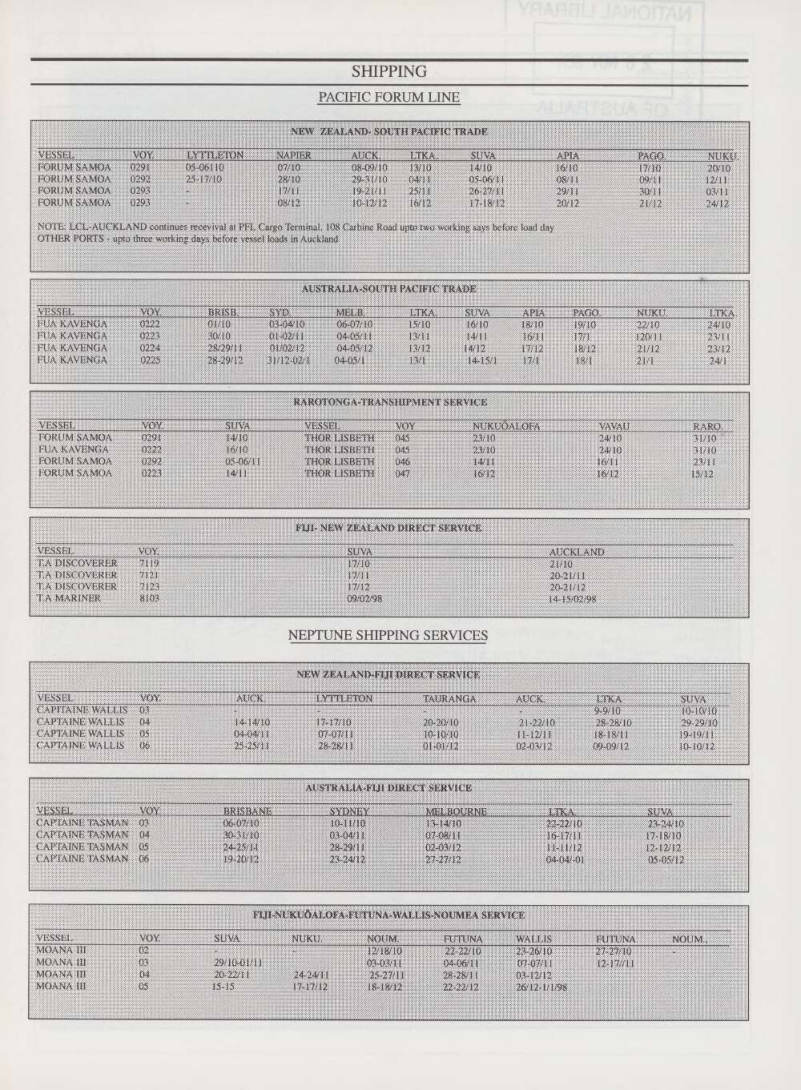
Pacific Forum Line
New Zealand* South Pacific Trade
Australia-South Pacific Trade
Rarotonga-Transhipment Service
Fuji- New Zealand Direct Service
Vessel
Voy. Lytileton
Napier
Auck.
Utica
• • Suva
Apia
Pago,
Nuku.
Forum Samoa
0291 05-06110 07/10 08-09/10 13/10 14/10 16/10 mo 20/10
Forum Samoa
0292 25-17/10 28/10 29-31/10 04/11 05-06/11 08/11 09/11 12/11
Forum Samoa
0293 17/11 19-21/11 25/11 26-27/11 29/11 30/11 03/11
Forum Samoa
0293 08/12 10-12/12 16/12 17-18/12 20/12 21/12 24/12 NOTE; LCL-AUCKLAND continues removal at PFL Cargo Terminal, 108 Carbine Road upto two working says before load day
Other Ports -
upto three working days before vessel loads in Auckland
Vessel
Voy,
Brisb.
Syd.
Melb.
Ltka.
Suva
Apia
Pago.
Nuku.
Ltka.
Fua Kavenga
0222 v:; olio i 03-04/10 064)7/10 15/10 16/10 18/10 19/10 22/10 24/10
Fda Kavenga
0223 mo 01-02/11 04-05/ti i3/n 14/11 16/11 17/1 120/1! 23/11
Fua Kavenga
0224 28/29/11 01/02/12 04-05/12 13/12 14/12 17/12 18/12 21/12 23/12
Fua Kavenga
0225 28-29/12 31/12-02/1 04-05/1 13/1 14-15/1 17/1 18/1 21/1 / 24/1
Vessel
Voy.
Suva
Vessel
Voy
Nukuoalofa
Vavau
Raro.
Forum Samoa
0291 14/10
Thor Lis Beth
045 23/10 24/10 31/10
Fua Kavenga
0222 16/10
Thor Us Beth
045 23/10 Ip;;: , . 24/10 31/10
Forum Samoa
0292 05-06/11
Thor Lis Beth
046 14/11 16/11 23/11
Forum Samoa
0223 14/lJ
Thor Lis Beth
047 16/12 16/12 15/12
Vessel
Voy,
Suva
Lt- Auckland
T.A Discoverer
7119 I A' ' 17/10 31/Jo
T.A Discoverer
T.A Discoverer
7121 712.1 17/11 17/12 20-21/11 20-21/12
T.A Mariner
8103 09/02/98 14-15/02/98
io-lit
Neptune Shipping Services
New Zealand-Eiji Direct Service
Australia*Fui Direct Service
Fiji-Nukcaalofa-Fitcna-Waiajs-Noumea Service
Vessel
Voy.
; ' Auck.
Lyttlbto.N
? Tauranga
Auck.
Ltka
Suva
Cap1Ta1Ne Wallis
03 4""
""" 9-9/10 10-10/10
Captaine Wallis
04 14-14/10 17-17/10 20-2000 21 22/10 28-28/10 29-29/10
Captaine Wallis
05 04-04/11 07-07/1 i 10-10/10 11-12/11 18-18/11 19-19/11
Captaine Wallis
06 A : 25-25/11 28-28/11 01-01/12 02-03/12 09-09/12
io-lit
% s $ D CO < O ■rj At °? *r fi iS ;|| I c2 5 9 : a - <p s* l| S-£ <^4
li|i
££ rr*; ■*"*
Sydneyj
' o — — S * & o <n O N pi| ** <*k
Brisbane
o o O r<*v ;v5 3- CN) m 2 9 ss s s d !Si CO tu >! p p til O) z z < < p p bk c~ < < u u
Captaine Tasman
z < s to IS ia z <c r* CL < u
Vessel
Voy.
Suva
Nuku.
Noum.
Futuna
Wallis
Futuna : :
Noum.,
Moana 111
02 - - , 12/18/10 22-22/10 23-26/10 27-27/10 -
Moana Hi
03 29/J 0-01/11 03-03/11 : 04-06/11 07-07/11 12-17//11
Moana Hi
04 20-22/1 i 24-24/11 25-27/11 28-28/11 03-12/12
Moana Iii
05 15-15 17-17/12 18-18,02 22-22/12 26/12-1/1/98
Burns Philip Shipping
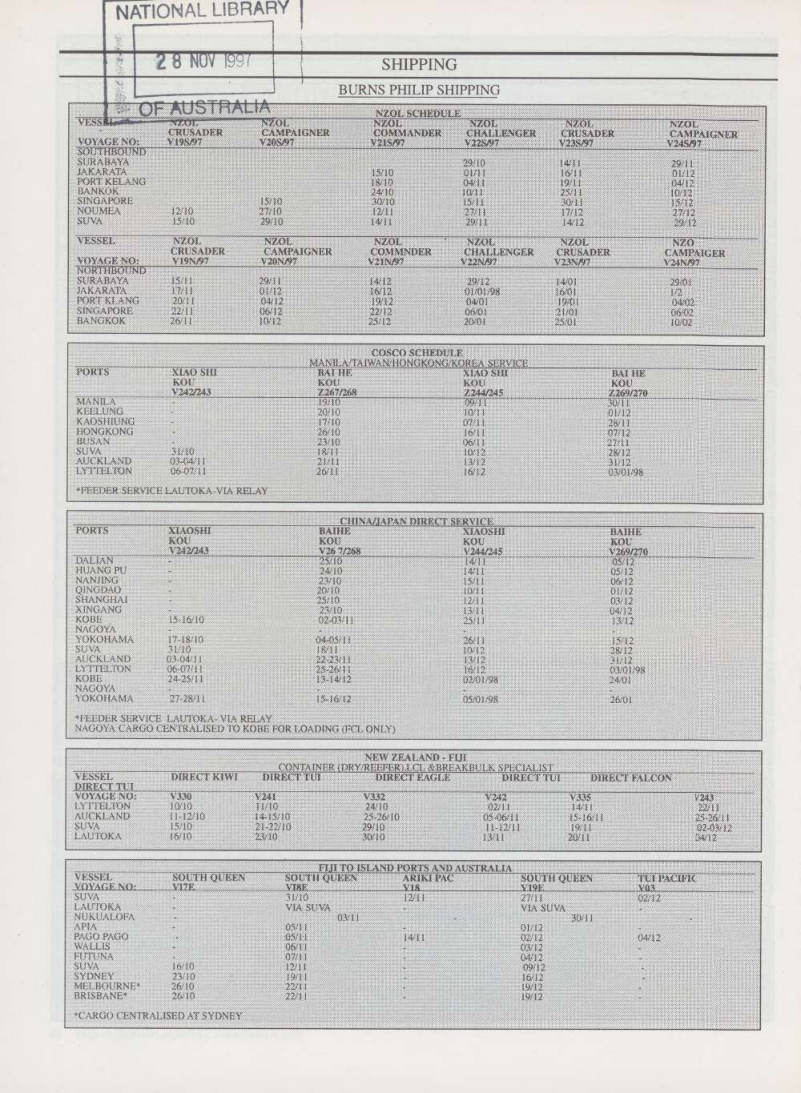
Cosco Schedule
Manila/Taiwan/Hongkqng/Korea Service
china/japan direct service
New Zealand - Fiji
Container (Dry/Rehfer).Lcl & Break Bulk Specialist
Fiji To Island Ports And Australia
Imm
-Auo \ nn
Nzolschedule
VESSifaim*— —
— Ntol
NzOu
Nzol
Nzol
Nzol
Nzol
Crusader
Campaigner
Commander
Challenger
Crusader
Campaigner
Voyage No:
V19S/97 V20S/97 V21S/97 V22S/97 V23S/97 V24S/97
Southbound
Surabaya
29/10 14/11 29/11
Jakarata
15/10 01/11 16/11 01/12
Port Kelang
18/10 04/11 19/11 04/12
Bankok
24/10 10/11 25/1) 10/12
Singapore
15/10 30/10 15/11 30/11 15/12
Noumea
12/10 27/10 12/11 27/11 17/12 27/12
Suva
15/10 29/10 14/11 29/11 14/12 29/12
Vessel
Nzol
Nzol
Nzol
Nzol
Nzol
Nzo
Crusader
Campaigner
Commnder
Challenger
Crusader
Campaiger
Voyageno:
V19N/97 V20N/97 V21N/97 V22N/97 V23N797 V24N/97 Northbound
Surabaya
15/11 29/11 14/12 29/12 14/01 29/01
Jakarata
17/11 01/12 16/12 01/01/98 16/01 1/2
Port Klang
20/11 04/12 19/12 04/03 19/01 04/02
Singapore
22/11 06/12 22/12 06/0! 21/01 0602
Bangkok
26/1J 10/12 25/12 20/01 25/01 10/02
Pori's
Xiao Shj
Kou
V242/243
Bai He
Kou
Z 267/268 xiao sin
Kou
Z244/245
Bai He
Kou
Z269/270
Manila
19/10 09/11 30/11
K Belling
20/10 10/11 01/12
Kaoshtuwg
17/10 07/11 28/1 1
Hongkong
26/10 16/1) 07/12
Busan
23/10 06/11 27/11
Suva
31/10 18/11 10/12 28/12
Auckland
03-04/11 21/11 13/12 31/12
Lyttelton
06-07/11 26/11 16/12 03/01/98
* Feeder Service Lautoka-Via Relay
Ports
Xiaoshi
Kou
V242/243
Bathe
Kou
V26 7/268
Xiaoshi
Kou
¥244/245
Baihe
Kou
V269/270
Dalian
- 55715 14/11 05H2
Huang Pu
24/10 14/11 05/12
Nanjing
23/10 15/11 06/12
Qingdao
20/10 10/1! 01/12
Shanghai
25/10 12/11 03/12
X Ingang
- 23/10 13/11 04/12
Kobe
15-16*10 02-03/11 25/11 13/12
Nagoya
Yokohama
1748/10 04-05/11 26/11 15/12
Suva
31/10 18/11 10/12 28/12
Auckland
03-04/11 22-23/11 13/12 31/12
Lyttelton
06-07/11 25-26/11 16/12 03/01/98
Kobe
24-25/11 13-14/12 02/01/98 24/01
Nagoya
Yokohama
27-2&/11 15-16/12 05/01/98 26/01
♦Feeder Service Lautoka- Via Relay
NAGOYA CARGO CENTRALISED TO KOBE FOR LOADING <FCL ONLY)
Vessel
Direct Tui
Direct Kiwi
Direct Tui
Direct Eagle
Direct Tui
Direct Falcon
Voyage No:
V330 V24I V332 V242 V335 V243
Lyttelton
1Q/10 11/10 24/10 02/11 14/11 22/11
Auckland
11-12/10 14-15/10 25-26/10 05-06/11 15-16/11 25-26/11
Suva
15/10 21-22/10 29/10 11-12/11 19/11 02-03/12
Lautoka
16/10 23/10 30/10 13/11 20/11 94/12
Vessel
.Voyage No-
South Queen
Vt7R
South Queen
vr«E
Akikipac
Vis
South Queen
Vi9E
Tui Pacific
vm
Suva
31/10 12/11 27/1 i 02/12
Lautoka
Via Suva
Via Suva
Nukualofa
- 03/ LI 30/11 ,
Apia
> 05/11 - 01/12 -
Pago Pago
- 05/11 14/11 02/12 04/12
Wallis
- 06/11 03/12
Futuna
07/11 04/12 -
Suva
16/10 12/11 - 09/12 -
Sydney
23/ JO 19/11 16/12
Melbourne* 26/10
22/11 19/12 ,
Brisbane* 26/10
♦Cargo Centralised At Sydney
22/11 19/12
Advertisements & other items, pp. 58-60 (2 items)
Shipping
founders saw
“In 195?
Grand Pacific y s
their future.”
AS BRIGHT AS EVER.
This year, we're celebrating an event that should please our clients and our agents alike.
Our 40th Anniversary.
Four decades ago, the founders of Grand Pacific Life set out to create a life insurance
company designed to safeguard and serve
people in the Pacific. Today, through pioneering efforts and 40 years of steady growth, Grand Pacific Life has over $3.8 billion of life insurance in force. Which represents the trust of many thousands of people, ones whom
we've helped secure the financial indepen-
dence and peace of mind they've worked so
hard to achieve.
Our founders' spirit and vision continues
in reaching out with new ideas to other nations in the Pacific. Our steadfast dedication to our clients and agents has made history these last 40 years. The decades ahead look equally
exciting and full of promise.
Grand Pacific Life Insurance, Ltd.
American Samoa Mark Solofa Pacific Insurance & Finance, Inc, Mark Solofa, GA Phone: 684-699-5796 Western Samoa Mark Solofa Pacific Insurance & Finance, Inc.
Mark Solofa, GA Phone: 685-24059 Chuuk State. Federated States of Micronesia Pacific Basin Insurance & General Services, Inc.
Kachutosy Paulus, GA Phone:s9l-330-2606 Actouka Executive Insurance Underwriters Maridell Actouka Phone: 691-320-5331 Guam Great National Insurance Underwriters, Inc.
Domie Bumagat Jr., GA Phone: 671-646-5736 Pacific Financial Corporation Eduardo Camacho, GA Phone: 671-646-1990 Takagi & Associates Pamela Cruz, Life Manager Phone: 671-475-4373 Marshall Islands Marshalls Insurance Agency Jerry Kramer, GA Phone: 692-625-3365 Saipan Pacific Basin Insurance Underwriters, Inc.
Mary Ann Milne, GA Phone: 670-234-7861 Pacifica Insurance Underwriters, Inc.
Norman Tenorio, GA Phone: 670-234-6267 Takagi & Associates Laurie Sturges, Branch Mgr, Phone: 670-322-8117 Tonga Peseti Ma'afu Insurance & Finance, Ltd.
Peseti Ma'afu, GA Phone: 676-24-777 A member of the Finance Factors Family
N 9 19 PR c-
HERMES
■ Sl*
LAND CRUISER
2 m lIP
CRUIS
'■ it . . ■- □ n ■' ... -- HU. : '■U, ia ~. ■■ ■,v« Some of the specs may vary according to market specifications.
Heavy duty beauties - Toyota Land Cruiser and Land Cruiser PRADO Land Cruiser’s got a reputation for go anywhere toughness, with style and ability to take you there in total comfort, on road or off.
Its luxury matches most expensive sedans. And it has more space than many large passenger cars. With impeccable fit and finish.
And graceful, elegant form.
Land Cruiser PRADO inherits these traditions, and all Toyota’s 4x4 know-how for great performance off road and passenger car comfort on the highway, and stylish beauty everywhere it goes.
What you can’t see is also important. Tough frames. Suspensions built to take you as far off road as you want to go, in comfort. Your choice of powerful petrol or diesel engines. And bodies thoroughly protected from rust.
Land Cruiser and Land Cruiser PRADO - two champions, on and off the road.
DISTRIBUTORS/DEALERS
NORFOLK ISLAND BORRY'S PTV LTD. PH 22114
SOLOMON ISLANDS ELA MOTORS PH 30314
VANUATU ASCO MOTORS PH 22341
COOK ISLANDS PACIFIC MOTORS LTD. PH 20796
<Sg> TOYOTA
KIRIBATI TARAWA MOTORS PH 21090
PAPUA NEW GUINEA ELA MOTORS PH 3229400
TAHITI NIPPON AUTOMOTO PH 429819
WESTERN SAMOA ASCO MOTORS PH 20800
FIJI ASCO MOTORS PH 384888
NEW CALEDONIA S.I.A.P. PH 275562
TONGA ASCO MOTORS PH 23500
AMERICAN SAMOA* ,ASCO MOTORS PH 633-4281
(*PRADO is not being handled.)