Past and present
pp. 47-50 · Read in the full issue
Culture
Story and photography by LIZ THOMPSON
individuals are their designated guardians or custodians. For Yapa (as the Warlpiri refer to themselves) every Jukurrpa
(Dreaming) has Kurdungurlu (managers)
and Kirda (owners). For the Ngapa Jukurrpa, the subject of the sand painting being created, Paddy Japaljarri Stewart and Samson Japaljarri Martin are the Kurdungurlu (managers) and Thomas Jangala Rice and Jack Jakamarra ross are Kirda.
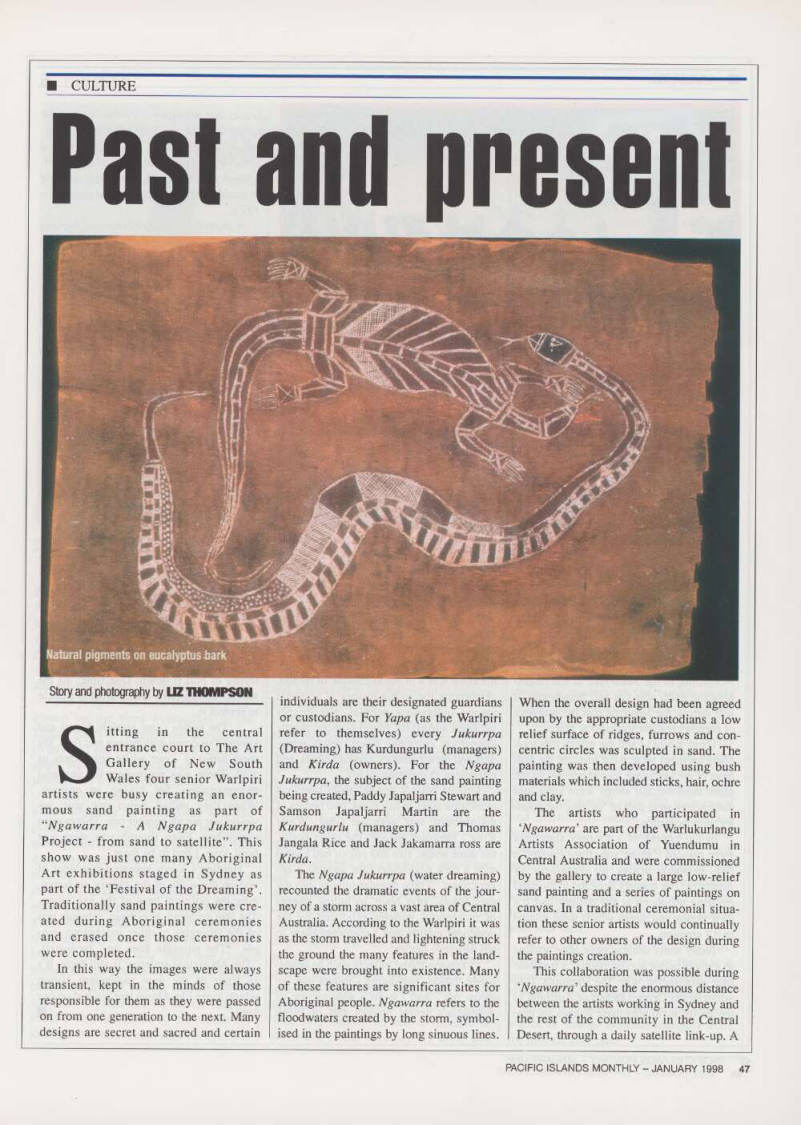
The Ngapa Jukurrpa (water dreaming) recounted the dramatic events of the jour ney of a storm across a vast area of Central Australia. According to the Warlpiri it was as the storm travelled and lightening struck the ground the many features in the land scape were brought into existence. Many of these features are significant sites for Aboriginal people. Ngawarra refers to the floodwaters created by the storm, symbol ised in the paintings by long sinuous lines.
When the overall design had been agreed upon by the appropriate custodians a low relief surface of ridges, furrows and con centric circles was sculpted in sand. The painting was then developed using bush materials which included sticks, hair, ochre and clay.
The artists who participated in ‘Ngawarra ’ are part of the Warlukurlangu Artists Association of Yuendumu in Central Australia and were commissioned by the gallery to create a large low-relief sand painting and a series of paintings on canvas. In a traditional ceremonial situa tion these senior artists would continually refer to other owners of the design during the paintings creation.
This collaboration was possible during ‘Ngawarra despite the enormous distance between the artists working in Sydney and the rest of the community in the Central Desert, through a daily satellite link-up. A
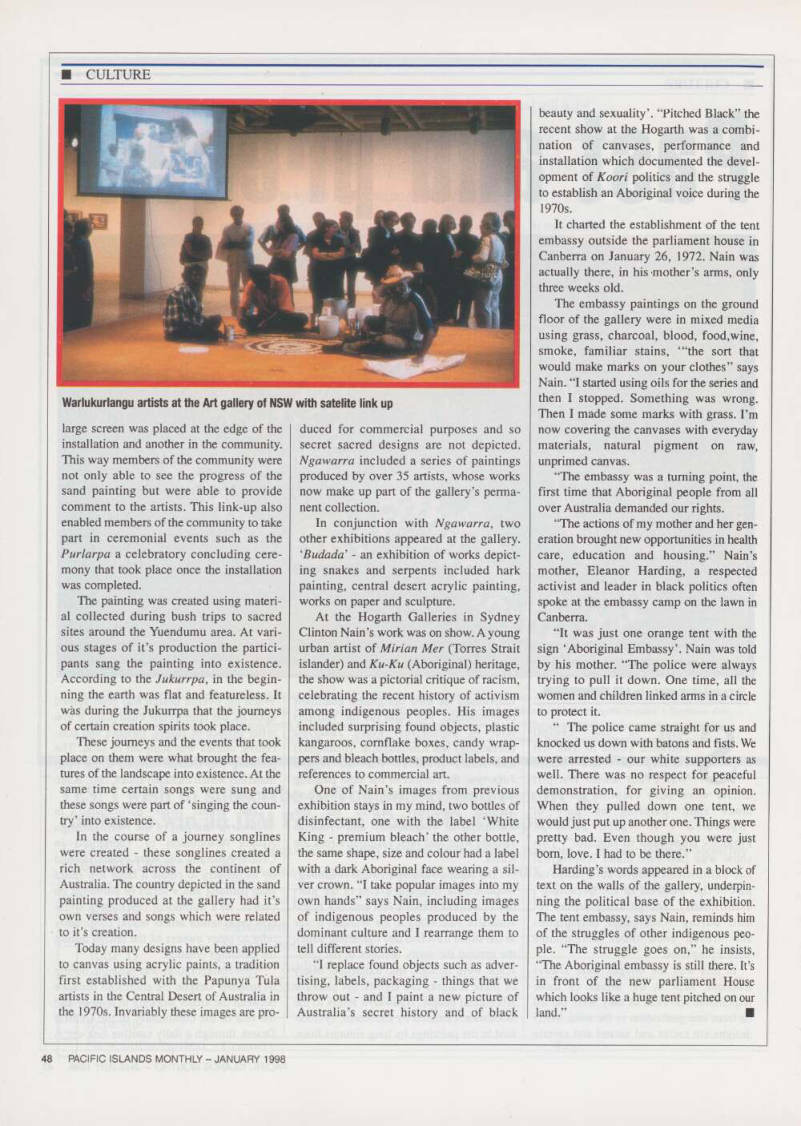
Sitting in the central entrance court to The Art Gallery of New South Wales four senior Warlpiri artists were busy creating an enor mous sand painting as part of “Ngawarra - A Ngapa Jukurrpa Project - from sand to satellite”. This show was just one many Aboriginal Art exhibitions staged in Sydney as part of the ‘Festival of the Dreaming’.
Traditionally sand paintings were cre
ated during Aboriginal ceremonies
and erased once those ceremonies were completed.
In this way the images were always transient, kept in the minds of those responsible for them as they were passed on from one generation to the next. Many designs are secret and sacred and certain
large screen was placed at the edge of the installation and another in the community.
This way members of the community were not only able to see the progress of the sand painting but were able to provide comment to the artists. This link-up also enabled members of the community to take part in ceremonial events such as the Purlarpa a celebratory concluding cere mony that took place once the installation was completed.
The painting was created using materi al collected during bush trips to sacred sites around the Yuendumu area. At vari ous stages of it’s production the partici pants sang the painting into existence.
According to the Jukurrpa, in the begin ning the earth was flat and featureless. It was during the Jukurrpa that the journeys of certain creation spirits took place.
These journeys and the events that took place on them were what brought the fea tures of the landscape into existence. At the same time certain songs were sung and these songs were part of ‘singing the coun try’ into existence.
In the course of a journey songlines were created - these songlines created a rich network across the continent of Australia. The country depicted in the sand painting produced at the gallery had it’s own verses and songs which were related to it’s creation.
Today many designs have been applied
to canvas using acrylic paints, a tradition first established with the Papunya Tula artists in the Central Desert of Australia in the 19705. Invariably these images are pro
duced for commercial purposes and so secret sacred designs are not depicted.
Ngawarra included a series of paintings produced by over 35 artists, whose works now make up part of the gallery’s perma nent collection.
In conjunction with Ngawarra, two other exhibitions appeared at the gallery. ‘ Budada ’ - an exhibition of works depict ing snakes and serpents included hark painting, central desert acrylic painting, works on paper and sculpture.
At the Hogarth Galleries in Sydney Clinton Nain’s work was on show. A young urban artist of Mirian Mer (Torres Strait islander) and Ku-Ku (Aboriginal) heritage, the show was a pictorial critique of racism, celebrating the recent history of activism
among indigenous peoples. His images
included surprising found objects, plastic kangaroos, cornflake boxes, candy wrap pers and bleach bottles, product labels, and references to commercial art.
One of Nain’s images from previous exhibition stays in my mind, two bottles of disinfectant, one with the label ‘White King - premium bleach’ the other bottle, the same shape, size and colour had a label with a dark Aboriginal face wearing a sil ver crown. “I take popular images into my own hands” says Nain, including images of indigenous peoples produced by the dominant culture and I rearrange them to tell different stories.
“I replace found objects such as adver tising, labels, packaging - things that we throw out - and I paint a new picture of Australia’s secret history and of black
beauty and sexuality’. “Pitched Black” the recent show at the Hogarth was a combi nation of canvases, performance and installation which documented the devel opment of Koori politics and the struggle to establish an Aboriginal voice during the 19705.
It charted the establishment of the tent embassy outside the parliament house in Canberra on January 26, 1972. Nain was actually there, in his mother’s arms, only three weeks old.
The embassy paintings on the ground floor of the gallery were in mixed media using grass, charcoal, blood, food,wine, smoke, familiar stains, ‘“the sort that would make marks on your clothes” says Nain. “I started using oils for the series and then I stopped. Something was wrong.
Then I made some marks with grass. I’m now covering the canvases with everyday materials, natural pigment on raw,
unprimed canvas.
“The embassy was a turning point, the first time that Aboriginal people from all over Australia demanded our rights.
“The actions of my mother and her gen eration brought new opportunities in health care, education and housing.” Nain’s mother, Eleanor Harding, a respected activist and leader in black politics often spoke at the embassy camp on the lawn in Canberra.
“It was just one orange tent with the sign ‘Aboriginal Embassy’. Nain was told by his mother. “The police were always trying to pull it down. One time, all the women and children linked arms in a circle to protect it.
“ The police came straight for us and knocked us down with batons and fists. We were arrested - our white supporters as well. There was no respect for peaceful demonstration, for giving an opinion.
When they pulled down one tent, we would just put up another one. Things were pretty bad. Even though you were just bom, love. I had to be there.”
Harding’s words appeared in a block of text on the walls of the gallery, underpin ning the political base of the exhibition.
The tent embassy, says Nain, reminds him of the struggles of other indigenous peo ple. “The struggle goes on,” he insists, “The Aboriginal embassy is still there. It’s in front of the new parliament House which looks like a huge tent pitched on our land.” ■
Warlukurlangu artists at the Art gallery of NSW with satelite link up
By Liz Thompson
I first met Chris Rainier at the Sepik Hotel in Wewak , East Sepik Province of Papua New Guinea. I can’t quite remember how we got talking but he told me he was working on a book, Where Masks Still Dance, an extensive series of of black and white photographs of masks and body adornment in PNG and Irian Jaya.
The project had been financially sup ported by the Ford Foundation in the United States of America and allowed him to travel to and from PNG for a number of years. He showed me some of his images produced in a recent publication.
In many instances he has waited for a vision which he has anticipated will take place. For this reason there is a meditative quality and a calmness about them, this does not render them dull or lifeless, on the contrary, the images he showed then, had a dream like quality, the suggestion of move ment was quite magical, almost mystical.
Those images have stayed in my mind ever since and that meeting must have been at least four years ago now. Since then I have waited for the release of his book with a certain excitement. Having worked in PNG and Irian Jaya on and off for the last ten years I was fascinated to see where his journeys had taken him, what his eyes had
seen. I was not disappointed. W here Masks Still Dance:New Guinea, pubished by Bullfinch Press, Little Brown and Company is a remarkable testament to Rainier’s skill and to the beauty and won der of the still thriving ceremony and ritual which are a fundamental part of life in New Guinea. The book is divided into eight sec tions, each with a number of photographs and a forest story by Rainier in collabora tion with Paul Berry.
These stories are a mixture of anecdotes about his travels and experiences and his observations and comments on culture and the changes he sees taking place. One of the most interesting forest stories is in the section entitled The Undiscovered. Here Rainier recounts a journey through Irian Jaya, travelling to meet and document the Nabi people, who, until then had remained unphotographed and essentially untouched and unknown by the outside world.
According to his text - shunning contact with everyone beyond their territory. The actual trip sounds horrendous - six days tough hiking the last part of which was through leech infested valleys, Rainier talks of his arms, legs and feet being cov ered with their soft, black bodies. He informs us that “Every 20 minutes I pulled some fifty leeches off me, a mixture of blood and sweat covering my arms and
legs, unable to burn them off in a tropical downpour.” He was forced to slice them off with a machete. On arriving in the valley which lay on the edge of Nabi territory the weath er cleared and Rainier recounts how from the first glimpse it was mes merizing, the nearest thing to the Garden of Eden he had ever encountered. He, his guides and porters were met by two hunters.
They said they had known that visitors would come because they had seen a shooting star and felt the earth quake a few nights before. These, they told Rainier, were signs that outsiders would soon appear.
They gently told him that no one was permitted to venture into their land, to do so would anger the spirits and could cause the intruders harm. Of course, after such an incredible journey this must have been an huge disappointment and Rainier says as much, nevertheless, as always there was a lesson to learn. He describes his growing sense of respect for the Nabi’s desire to remain a mystery to the outside world which consumes information and new dis coveries with such an insatiable appetite.
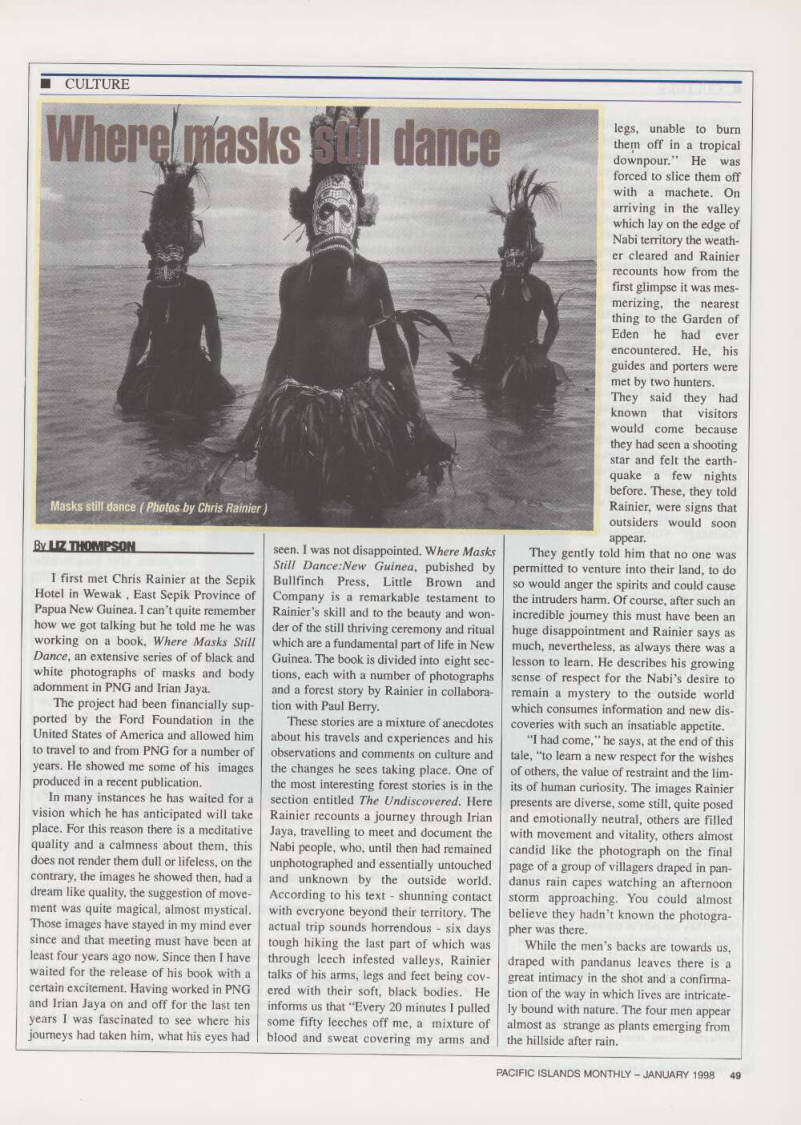
“I had come,” he says, at the end of this tale, “to learn a new respect for the wishes of others, the value of restraint and the lim its of human curiosity. The images Rainier presents are diverse, some still, quite posed and emotionally neutral, others are filled with movement and vitality, others almost candid like the photograph on the final page of a group of villagers draped in pan danus rain capes watching an afternoon storm approaching. You could almost believe they hadn’t known the photogra pher was there.
While the men’s backs are towards us, draped with pandanus leaves there is a great intimacy in the shot and a confirma tion of the way in which lives are intricate ly bound with nature. The four men appear almost as strange as plants emerging from the hillside after rain.
Masks still dance (Photos by Chris Rainier)
Several images are filled with move ment like young male initiates gathering firewood for the pig festival, Yali people in the highlands of Irian Jaya. A child in the foreground leaps through the air, his body and the wood he carries in his raised right hand blurred, the photograph is filled with the energy of the moment. On the facing page is a picture of a young boy playing at an initiation ritual in the highlands of Irian
Jaya.
He stands poised on top of a rocky out crop, his bow and arrow taut, ready to fire.
This image contains the concentrated power of his action, he is poised, still, monumental, but the line of his body and the bow are coiled with the potential of movement, of the release of the arrow and its journey hurtling through the air. This
combination of images on a double page spread works well. The relationship between them is complementary, each reinforcing and activating the mood of the other. Dani war riors staging battle at Animaugi Village in the Highlands of Irian Jaya is again filled with movement and sits opposite the Warrior wearing wooden headdress, contained and powerful.
In her forward Meg Taylor, the US ambassador, talks of the strength of the bond between the people of New Guinea and the land. “Land here is more than dirt or earth to be used for cultivation and harvest.
It is not a marketable com modity, but instead an umbili cal cord that unites us with nature, linking the present with the past and the future.”
Land she adds, is the joining
of matter and spirit. This link, this bond is apparent in many of Rainier’s images, the people and spirits who inhabit his images are connected to and emerge from the earth, the mud, the water, the leaves beneath their feet. They are part of the trees, of the man groves, the plants and leaves which sur round them.
The masks are made of fibres, of leaves, the paints that decorate their bodies of lime, of charcoal, ochres and umbers dug from the earth, crushed from rocks and stones or collected from trees, oils, animal fats,
beads, seeds, bones, feathers, all is of the earth as are the people themselves.
A photograph of a Wahgi Valley woman with a carved wooden effigy called Kund gale stands outside her hut. Her body is painted with what looks like white lime and she is wearing a grass skirt and strands of jobs tears, small smooth grey seeds around her neck, waist, stomach, wrists, ankles and forehead. On her head is a carved wooden figure which stands about three foot high.
The woman and all that she wears is in har mony with her surroundings, with the landscape in which she stands .
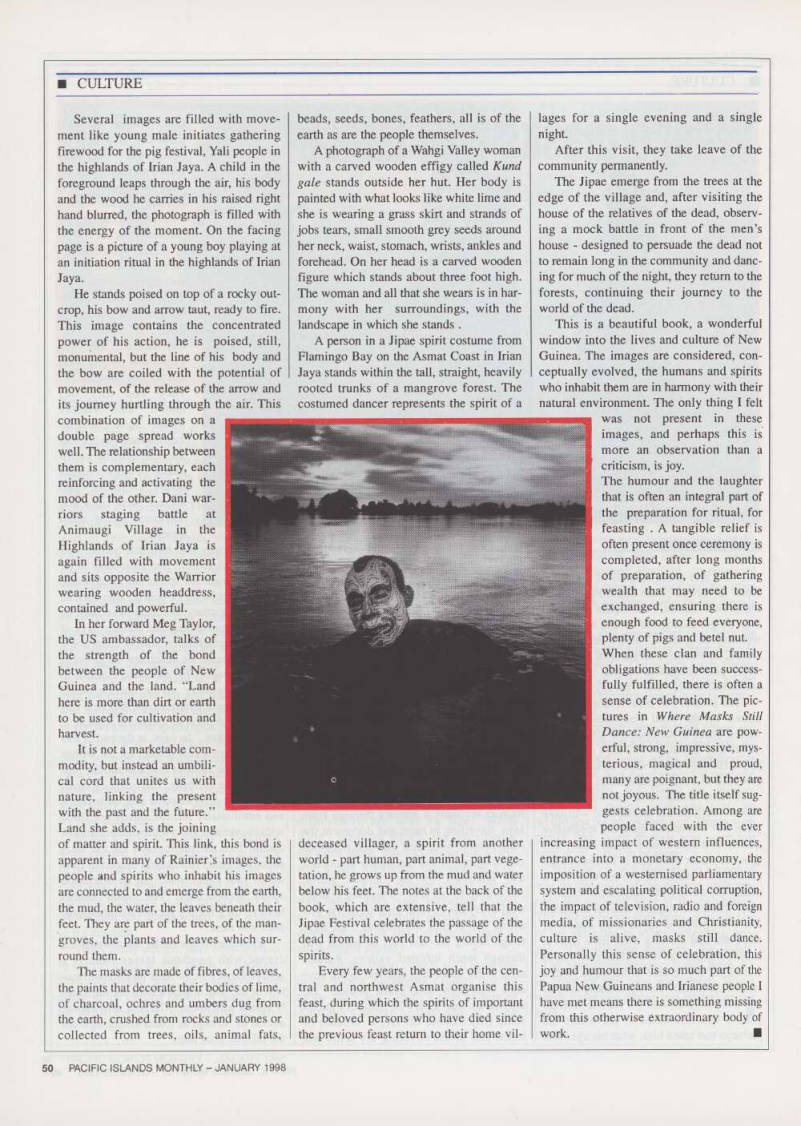
A person in a Jipae spirit costume from Flamingo Bay on the Asmat Coast in Irian Jaya stands within the tall, straight, heavily rooted trunks of a mangrove forest. The costumed dancer represents the spirit of a
deceased villager, a spirit from another world - part human, part animal, part vege tation, he grows up from the mud and water below his feet. The notes at the back of the book, which are extensive, tell that the Jipae Festival celebrates the passage of the dead from this world to the world of the
spirits.
Every few years, the people of the cen tral and northwest Asmat organise this feast, during which the spirits of important and beloved persons who have died since the previous feast return to their home vil
lages for a single evening and a single
night.
After this visit, they take leave of the
community permanently.
The Jipae emerge from the trees at the edge of the village and, after visiting the house of the relatives of the dead, observ ing a mock battle in front of the men’s house - designed to persuade the dead not to remain long in the community and danc ing for much of the night, they return to the forests, continuing their journey to the world of the dead.
This is a beautiful book, a wonderful window into the lives and culture of New Guinea. The images are considered, con ceptually evolved, the humans and spirits who inhabit them are in harmony with their natural environment. The only thing I felt
was not present in these images, and perhaps this is more an observation than a criticism, is joy.
The humour and the laughter that is often an integral part of the preparation for ritual, for feasting . A tangible relief is often present once ceremony is completed, after long months of preparation, of gathering wealth that may need to be exchanged, ensuring there is enough food to feed everyone, plenty of pigs and betel nut.
When these clan and family obligations have been success fully fulfilled, there is often a sense of celebration. The pic tures in Where Masks Still Dance: New Guinea are pow erful, strong, impressive, mys terious, magical and proud, many are poignant, but they are not joyous. The title itself sug gests celebration. Among are people faced with the ever
increasing impact of western influences, entrance into a monetary economy, the imposition of a westernised parliamentary system and escalating political corruption, the impact of television, radio and foreign media, of missionaries and Christianity, culture is alive, masks still dance.
Personally this sense of celebration, this joy and humour that is so much part of the Papua New Guineans and Irianese people 1 have met means there is something missing from this otherwise extraordinary body of work. ■