Super Sapolu
pp. 42-43 · Read in the full issue
Sports
By Atama Raganivatu
Although Samoans follow the exploits of locally born sporting heroes with immense interest.
one has largely escaped their attention
despite reaching the pinnacle of an
internationally high profile sport.
Manase Jesse Sapolu, who is known to millions of American football (‘grid iron’) followers simply as Jesse Sapolu, spent his first eight years on earth in Toamua, a
small village in Upolu Island. Moreover, he regards this period as the most influen tial of his life.
The son of a clergyman, he credits his parents for instilling into him a devotion to Samoan values which has aided him
immensely.
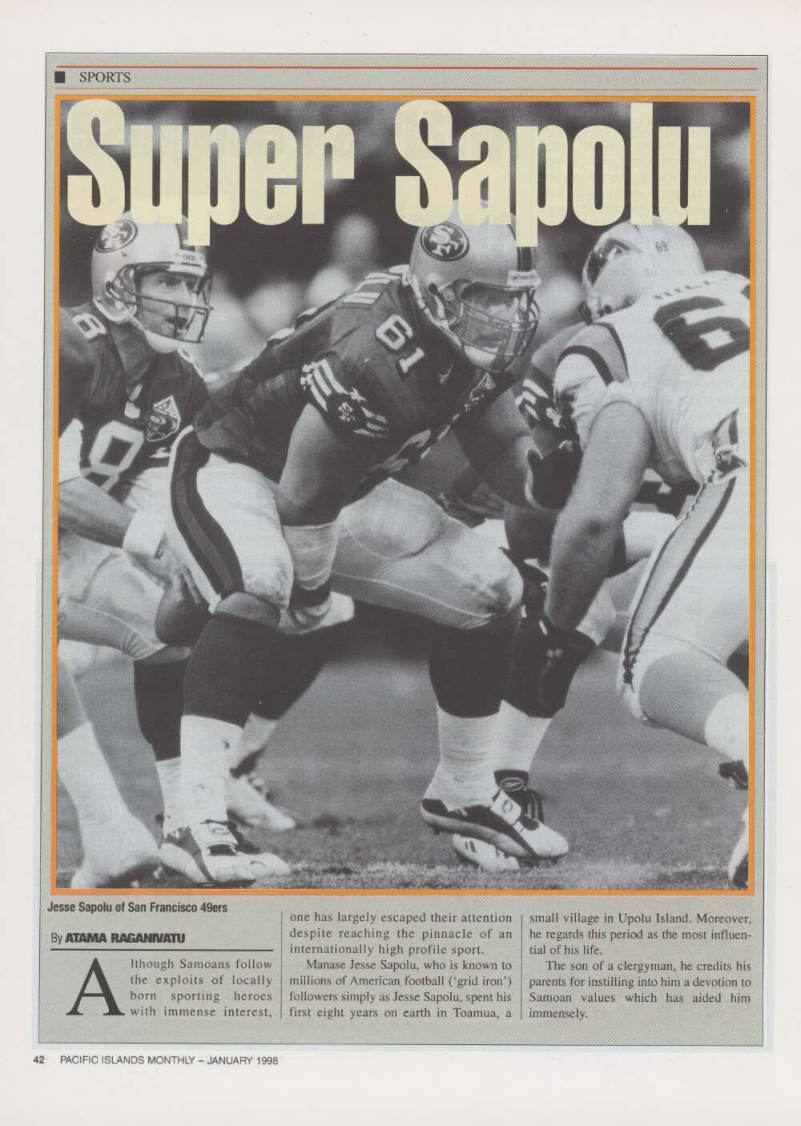
Jesse Sapolu of San Francisco 49ers
Jesse’s background, he believes, was responsible for producing the resilience and determination to overcome a cruel series of injuries which threatened to pre maturely end his career and for creating the mental strength to cope with the pressures imposed upon eminent athletes in modem times.
Jesse also attributes his speech deliver ing ability (a requirement of all successful sports personalities these days) to the emphasis upon oratory skills in Samoan culture and believes his remarkable natural strength derives from carrying heavy logs two miles for the umus (ground ovens) used at the toana’i (communal feasts) his father organised each Sunday in Toamua.
The personality which beguiles sup porters, teammates, administrators spon sors and media representatives alike was moulded in Samoa too.
A church calling took the Reverend Pa’apa’a Niu Sapolu and his family, including Jesse, to California in 1969. It was a traumatic experience for the eight year old, who could then only speak Samoan.
Another clerical transfer saw the Sapolus move to Hawaii two years later and, at Honolulu’s Farrington High School, Jesse’s footballing ability first became apparent.
Under the wing of Farrington head coach A 1 Espinola he made great progress and won all the honours available in Hawaiian interschools competitions.
This led to him gaining a football
scholarship and entering the University of
Hawaii. Here, the young Samoan shone at athletics, basketball and wrestling, but football was always the main string of his bow.
The University of Hawaii competes in one of America’s major collegiate champi onships, the Western Athletic Conference, and in this tough environment Jesse thrived. He was proclaimed the ‘best freshman’ in his playing position in the whole of the US in 1979, gained inclusion in the nationwide selected All American team the following year, on three occasions appeared in the All WAC combination and, in 1982, was named the University’s Most Valuable Player.
Graduation to the professional ranks was inevitable. In 1983, he joined the defending National Football League cham pions, the San Francisco 49ers.
The 49ers are named in honour of the
prospectors who participated in the 1849 Californian gold rush and they certainly provided Sapolu with a glittering career.
He has now been with the team for 14 years, even though the average “career expectancy” in the NFL is a mere five sea sons.
However, it once appeared that he would be forced by injury into retirement after only a single complete campaign!
In his rookie year, Jesse was an ever present for the 49ers, as they came within four points of qualifying for the North American sporting calendar’s paramount event, the Super Bowl.
Washington Redskins beat them 24-21 in the National Conference final and went on to overcome American Conference championships Miama Dolphins 27-17 at Pasadena in Super Bowl XVII. Then came the setbacks which would have shattered a character weaker than him in either physique or spirit.
During pre-season training in 1984, Jesse broke his right foot and missed the year’s opening 10 games. Then, within one week of regaining fitness, he again frac tured that same foot in another training accident.
A further recurrence of the injury kept him sidelined until the 1985 season had been completed. Then, in July 1986, he broke his left leg (once more, as the result of a training mishap. This time two team mates fell on him).
After the last in this freakish catalogue of mishaps, even the extraordinarily resilient Jesse was tempted to hang up his helmet. Only his natural gameness and the faith in him displayed by 49ers coach Bob McKittrick prevented a premature exit.
Jesse made his comeback in 1987, hav ing played just one game over the past three years, with a five inch screw inserted into his right foot and an 18 inch rod in his left leg.
Since then, he has remained remarkably free from injury and displayed a durability truly astonishing for one whose playing positions, left guard and centre, require him to constantly tackle players even more physically imposing than himself (he weighs 18 and a half stones and stands six foot four inches tall).
An excellent technique and matchless tactical ability, as well as his awesome strength, have kept him at the top.
With Jesse a key figure in their line ups, the 86ers have won three Super Bowls. In
addition, he can claim two appearances in American football’s second most presti gious annual fixture, the Pro Bowl.
The Pro Bowl pits the top performers of the American Conference against their counterparts from the NFL’s other section, the National Conference.
A poll among the players themselves usually determines the make up of both sides, but when voting for any position is tied an additional ballot among fans deter mines who participates.
Jesse’s selections were gained due to his popularity with football aficionados across the US.
This esteem extends to those lucky indi viduals who are paid to observe American football.
Jesse was the inaugural winner of the Garry Niver Memorial Award, which was presented to the 49er who, to quote the inscription on the award trophy, “is most admired by the media for his cooperation and professional style in helping football writers do their job”.
Upon receiving the accolade, Jesse stat ed: “I try to face the media with the same manner of respect whether we win the game or just come away with a tough loss.”
Always mindful of his role as a repre sentative of both Samoa and Polynesia, he added: “I regard this and my Pro Bowl selection as further steps for all the Polynesian kids in the US.
“There is always a little extra pressure on me personally because I have to watch how I act on and off the field. If I do any thing wrong, all Polynesian kids are disap pointed.
“We don’t have 15 Polynesians in one team, so all the pressure falls on one indi vidual. Even so. I’m thankful for the opportunity to serve Samoa nationally.”
Jesse turns 37 on January 10 this year. He now only makes the occasional appearance for the 49ers and the current season is expected to be his last one.
Never during his 14 years as a profes sional footballer has the congenial veteran been involved with anything even remote ly dishonourable and, upon retirement, he can take considerable pride in having been an exemplary role model for America’s Samoan community.
Despite the minimal interest American football attracts in his home country, should Samoa ever inaugurate a Sports Hall of Fame, there would be no worthier inductee than Jesse Sapolu. ■