Politics
pp. 28-29 · Read in the full issue
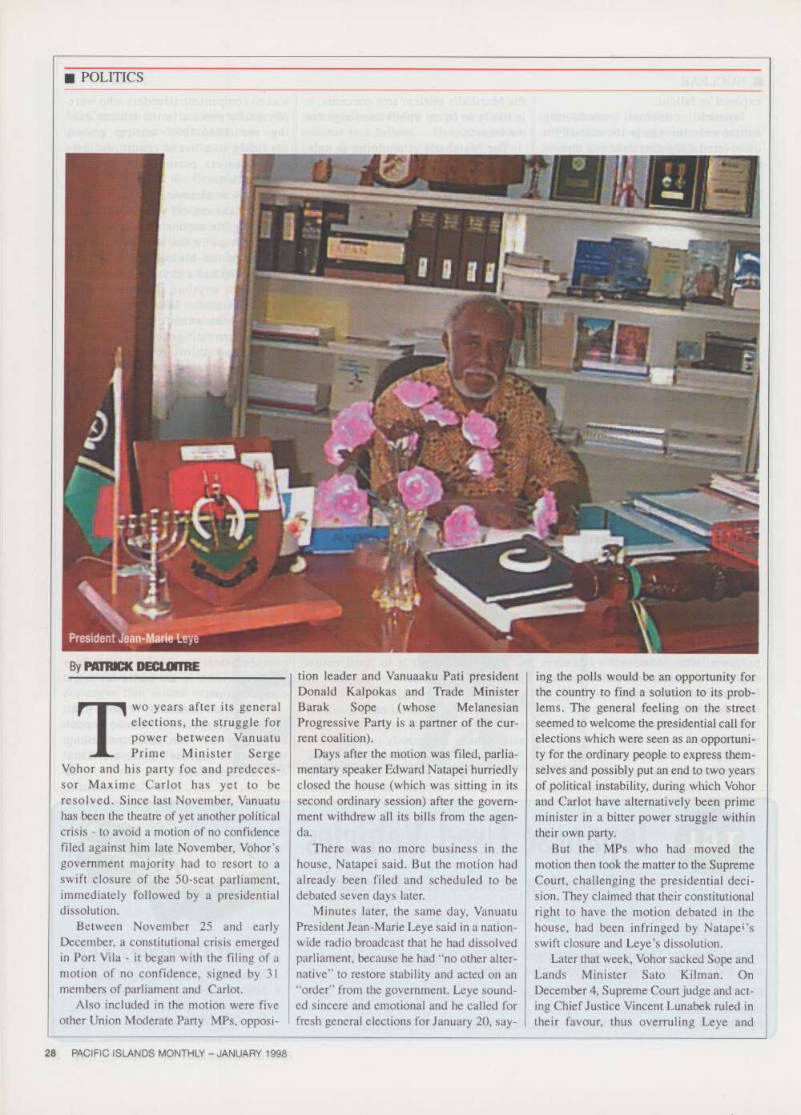
By Patrick Decloitre
tion leader and Vanuaaku Pati president Donald Kalpokas and Trade Minister Barak Sope (whose Melanesian Progressive Party is a partner of the cur rent coalition).
Days after the motion was filed, parlia
mentary speaker Edward Natapei hurriedly
closed the house (which was sitting in its second ordinary session) after the govern ment withdrew all its bills from the agen da.
There was no more business in the house, Natapei said. But the motion had already been filed and scheduled to be debated seven days later.
Minutes later, the same day, Vanuatu President Jean-Marie Leye said in a nation wide radio broadcast that he had dissolved parliament, because he had '‘no other alter native” to restore stability and acted on an “order” from the government. Leye sound ed sincere and emotional and he called for fresh general elections for January 20, say
ing the polls would be an opportunity for the country to find a solution to its prob lems. The general feeling on the street seemed to welcome the presidential call for elections which were seen as an opportuni ty for the ordinary people to express them selves and possibly put an end to two years of political instability, during which Vohor and Carlot have alternatively been prime minister in a bitter power struggle within their own party.
But the MPs who had moved the motion then took the matter to the Supreme Court, challenging the presidential deci sion. They claimed that their constitutional right to have the motion debated in the house, had been infringed by Natape«’s swift closure and Leye’s dissolution.
Later that week, Vohor sacked Sope and Lands Minister Sato Kilman. On December 4, Supreme Court judge and act ing Chief Justice Vincent Lunabek ruled in their favour, thus overruling Leye and
Two years after its general elections, the struggle for power between Vanuatu Prime Minister Serge Vohor and his party foe and predeces sor Maxime Carlot has yet to be resolved. Since last November, Vanuatu has been the theatre of yet another political crisis - to avoid a motion of no confidence filed against him late November, Vohor’s government majority had to resort to a swift closure of the 50-seat parliament, immediately followed by a presidential dissolution.
Between November 25 and early December, a constitutional crisis emerged in Port Vila - it began with the filing of a motion of no confidence, signed by 31 members of parliament and Carlot.
Also included in the motion were five other Union Moderate Party MPs, opposi-
Natapei’s decisions. Lunabek said there was a “link” between the parliament's clo sure and the presidential dissolution and that “even if (Leye) had the constitutional discretion to dissolve parliament, he “failed to take into account that there was an outstanding business before the house”.
The ruling nullified Leye’s dissolution, his call for elections, as well as the parlia ment’s closing.
The parliament was therefore immedi ately brought back to life and summoned to resume debates the same day to debate the only item left on the agenda - the defi ance motion. At that stage, either Carlot or Kalpokas were expected to be close to becoming prime minister.
Things took another twist later that day, when Vohor’s government made a last minute application to the Supreme Court
to obtain that the ruling’s execution be frozen pending an appeal. Before it could debate the motion, parliament was sus
pended.
In a late-night Supreme court session later that ended one of the most volatile days in the country’s history, both parties settled on a status quo until a Court of Appeal was convened to confirm or infirm Lunabek’s ruling. The truce effectively put a hold on the motion, but also went back in time to set the clocks back to November 25, before the situation had begun to dete riorate.
The agreement said in substance until a Court of Appeal convened here (which had not happened when this edition went to press), the President was no longer to men tion January 20 as the date for general elections and not even mention any other possible date, neither side is to take steps to dissolve parliament (which cannot be convened either), and the government restored as it was before November 25.
Sope and Kilman were therefore reinstated in Vohor’s government.
“This agreement preserves all the bene fits (the motion’s supporters) got from the Supreme Court decision while at the same time recognising the right of the unsuc cessful parties to appeal,” John Ridgway, the motion supporters’ lawyer said.
“We’ll just have to wait and see what the Court of Appeal decides.”
In Vanuatu, the Court of Appeal sits on an ad hoc basis and consists of local, but also foreign judges flown in for the occa sion.
It was expected to once but possibly not for all, rule on Vanuatu’s shaky political future. ■
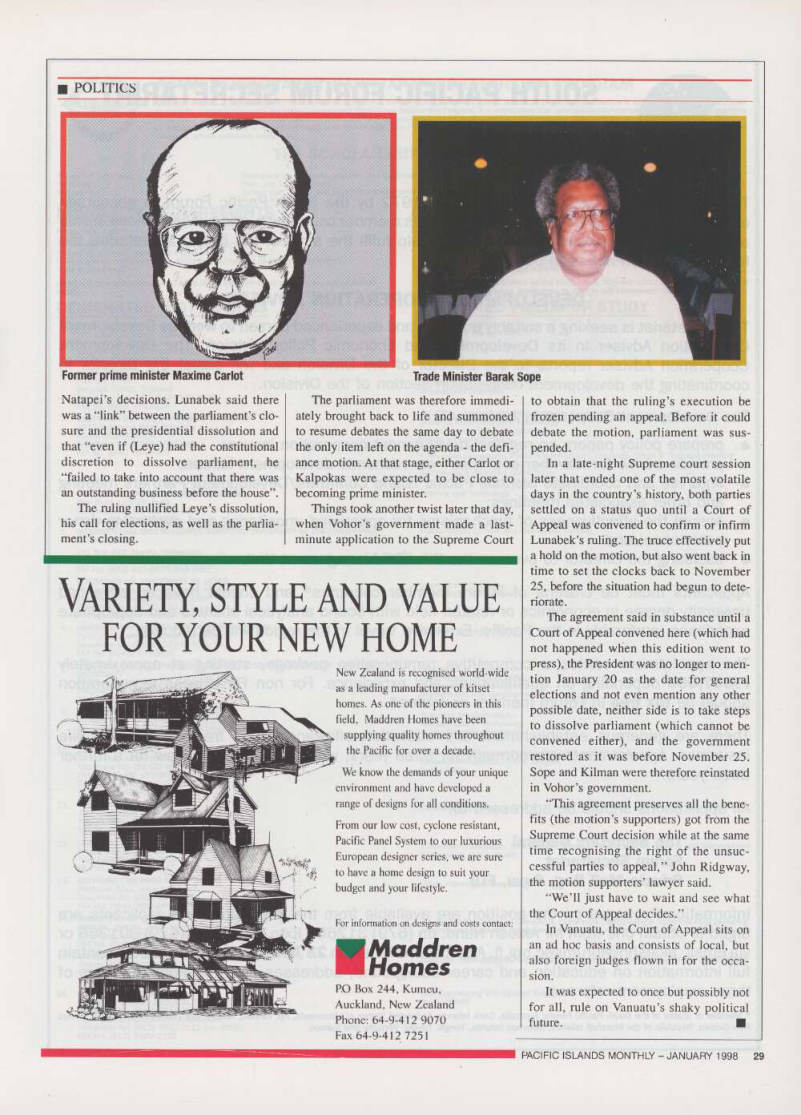
Former prime minister Maxime Carlot
Trade Minister Barak Sope