Marshalls wants nuclear
pp. 25-27 · Read in the full issue
Nuclear
Marshalls wants nuclear test problems resolved
By Off Johnson
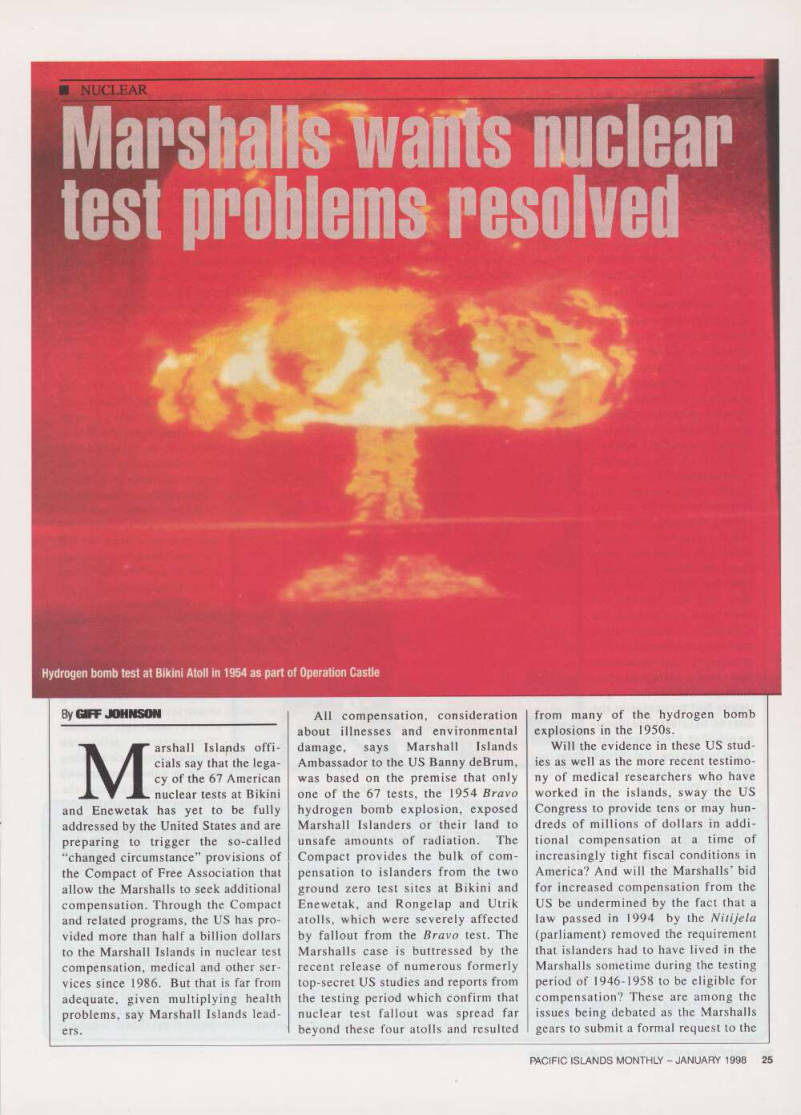
All compensation, consideration about illnesses and environmental damage, says Marshall Islands Ambassador to the US Banny deßrum, was based on the premise that only one of the 67 tests, the 1954 Bravo
hydrogen bomb explosion, exposed
Marshall Islanders or their land to unsafe amounts of radiation. The Compact provides the bulk of com pensation to islanders from the two ground zero test sites at Bikini and Enewetak, and Rongelap and Utrik atolls, which were severely affected by fallout from the Bravo test. The Marshalls case is buttressed by the recent release of numerous formerly top-secret US studies and reports from the testing period which confirm that nuclear test fallout was spread far beyond these four atolls and resulted
Marshall Islands offi
cials say that the lega cy of the 67 American nuclear tests at Bikini and Enewetak has yet to be fully addressed by the United States and are preparing to trigger the so-called
“changed circumstance” provisions of
the Compact of Free Association that allow the Marshalls to seek additional compensation. Through the Compact and related programs, the US has pro vided more than half a billion dollars to the Marshall Islands in nuclear test compensation, medical and other ser vices since 1986. But that is far from adequate, given multiplying health problems, say Marshall Islands lead ers.
from many of the hydrogen bomb explosions in the 19505.
Will the evidence in these US stud ies as well as the more recent testimo ny of medical researchers who have worked in the islands, sway the US Congress to provide tens or may hun dreds of millions of dollars in addi tional compensation at a time of increasingly tight fiscal conditions in America? And will the Marshalls’ bid for increased compensation from the US be undermined by the fact that a law passed in 1994 by the Nitijela
(parliament) removed the requirement
that islanders had to have lived in the Marshalls sometime during the testing period of 1946-1958 to be eligible for compensation? These are among the issues being debated as the Marshalls gears to submit a formal request to the
Hydrogen bomb test at Bikini Atoll in 1954 as part of Operation Castle
US Congress in early 1998 asking for greatly expanded compensation and medical programs for Marshall islanders.
A provision in the Compact allows the Marshalls to come back for more compensation if it can prove that there are “changed circumstances” since the
Compact was initially negotiated in
the mid-1980s that render the current
compensation “manifestly inade
quate.”
“If the Marshalls submit a claim to
Congress for additional compensation, the US gov ernment will give full con sideration to the request,” said US Ambassador to the Marshall Islands Joan Plaisted recently, confirm ing the US obligation spelled out in the Compact.
What are the “changed circumstances”?
“We have accepted full responsibility (for nuclear testing damage), and pro vided over half.a billion dollars in compensation to the Marshall Islands,”
Plaisted said. While she says that the US and the Marshalls agreed that the Compact compensation package represented a “full settlement” of all nuclear test claims. Marshalls lead ers argue that island nego tiators had no access to the dozens of classified docu ments that have now sur faced, showing the broad extent of radioactive fallout from the bomb tests.
Moreover, the intervening 12 years since the Compact was implemented have seen the development of a large number of cancers documented by independent doctors and the Nuclear Claims Tribunal, a Majuro-based agency that provides compensation to islanders. Among new developments: The US radiation monitoring dur ing Operation Castle a series of six of the largest US nuclear tests in the Marshall Islands held at Bikini in 1954 shows that two atolls thft the US claims were not exposed to radiation actually received more than the “per
missible” level of exposure from nuclear test fallout. Despite receiv ing a dose of radiation in excess of what US test officials considered to be safe levels at the time, the islanders living on Ailuk and Wotje atolls were not evacuated after these hydrogen bomb tests and have received no med ical follow up by a US medical pro gram that monitors the populations of nearly Rongelap and Utrik.
This same Atomic Energy Commission report also shows that
some southern islands in the Marshalls 400 to 500 miles distant from the ground zero at Bikini received more fallout exposure from hydrogen bomb tests Romeo and Koon than from Bravo, the largest US hydrogen ever exploded.
Although these exposures were rel atively small (from 400 to 594 milirems over a three month period), Arno, Mili and Jaluit atolls received from two to 15 times the amount of fallout from these later Castle tests compared to Bravo, confirming that it was not only the massive 15 megaton Bravo shot that was responsible for
fallout around the Marshall Islands.
“Nuclear weapons tests conducted outside the Marshall Islands in 1961 and 1962 at Christmas Island also exposed the Marshall Islands to sub stantial amounts of radiation,” deßrum said.
The “tremendous differences” between the rate of cancer in the US and the Marshall Islands are “alarm ing,” Dr. Neal A. Palafox, a former US Public Health Service physician who worked in the Marshall Islands for
seven years and is now at the University of Hawaii John A. Burns Medical School, told a Washington, DC. medical conference recently. He blamed the cancers on risk factors including radiation expo sure, diet changes, and lack of diagnostic medical screening in the country.
Breast and gastrointestinal (stomach) cancer rates are five fold higher, while lung cancer is three times the US rate, he said. “For all types of cancers listed (by the US Centres for Disease Control), the cancer mortal ity rates of the Marshallese are magnitudes higher than the US,” he said. But even when the Marshalls statis tics are compared to Asian nations and developing countries, the cancer fig ures remain high, he said.
“Comparisons with an Asian country such as Hong Kong, a non-industrialised
country such as Uruguay, and the Republic of Palau all show that the Marshall Islands cancer mortality rates are extreme,” Palafox said.
Long-term studies mounted by the US to monitor the effects of fallout on the people of Rongelap Atoll, and assumptions that have guided predic tions about the expected incidence of health problems are based on compar isons with a faulty control group of Rongelapese a group that US scien tists claimed was “unexposed” but was, in fact, exposed by virtue of islanders living in the same radioac tive environment as those directly
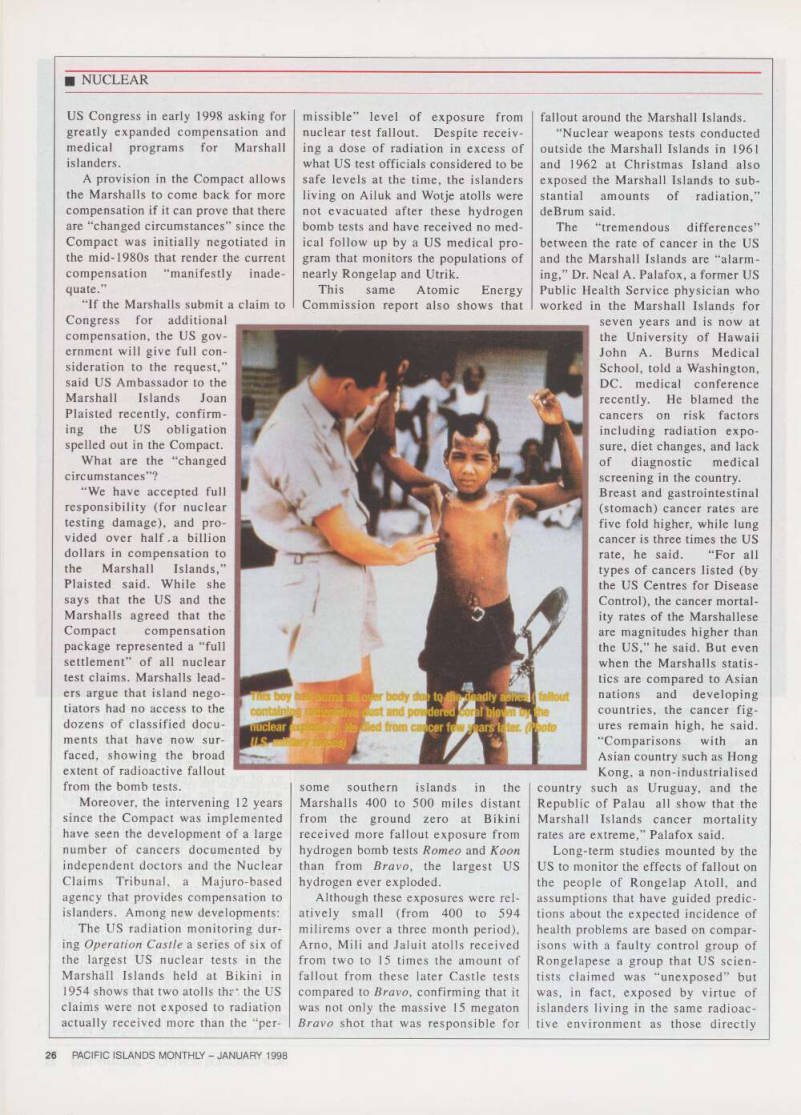
This boy hao burns all over boby due to the deadly ashes (fallout contining radioastive dust and powdered coral blewn by the nuclear axp[?]sio[?] He dked trom cancer few tew years later. (Photo
U.S. miitiar [?]ces)
exposed to fallout.
Japanese doctors conducting nation-wide surveys in the mid-1990s discovered a high incidence of thyroid tumours, with about 10 percent of the several thousand islanders surveyed found to have tumours.
But can the Marshalls sell the US Congress on more compensation? “As partners, as friends, as historical allies, the Marshall Islands govern ment looks forward to working with the US to define the full extent of human and environmental damage caused by the US nuclear weapons testing program,” deßrum said recently.
“I am thankful to the US govern ment for its willingness to work with the Marshall Islands to address these
lingering problems.”
But it may prove difficult to get the US to dig into its Congressional cof fers and come up with more money and expanded medical programs. Dr Palafox expressed concern that, with the Compact between the US and the Marshalls nearing its end, there will be resistance from the US government to continue health care funding to the Marshalls to deal with the serious can cer problems in the islands.
His fears were not erased by the US Department of Energy which, despite a recommendation from a US Presidential panel that a US medical program for Marshall Islanders •exposed to nuclear test fallout should be expanded, said there is no justifica tion for increasing the number of islanders included in the medical
monitoring.
Despite a number of key US Congressmen who are sympathetic to
the Marshalls nuclear test concerns, it is likely to be an uphill campaign for the islands.
The Marshalls is planning to sub mit a formal request for more compen sation early in 1998, well ahead of the planned renegotiations of the Compact that will start in 1999. Additional compensation and expanded medical care for Marshall islanders is an issue that should be handled separately
from the Compact renegotiations,
Foreign Minister Phillip Muller said.
“We want to get this issue out of the way (before we start negotiations with the US),” Muller said. “It’s an issue under the current arrangement.
It shouldn’t be left to cloud future dis cussions and arrangements.”
It may possibly be dealt with before the 1999 talks take up broader US-Marshall Islands relations and
budget issues for the post-2001 peri
od.
But a Nitijela amendment to the original regulations establishing eligi bility for Nuclear Claims Tribunal compensation could be one point of contention that complicates an other wise strong case for additional fund ing. The Tribunal is receiving SUS4S million from the US to compensate Marshall islanders but, because of an increasingly large number of claims, has already awarded over SUS6O mil lion.
This has forced it to limit actual payments to islanders to less than 60 percent of their actual awards for lack of funds. The Tribunal has repeatedly said that the SUS4S million compen sation funds are grossly inadequate to fully satisfy all compensation awards.
The original policy of the Tribunal
was to compensate islanders who were physically present in the islands dur ing the 1946-1958 testing period according to a list of conditions, pri marily cancers, presumed to be caused by radiation.
That was amended by the Nitijela to delete the cut-off year of 1958 and make eligible anyone who had a phys ical presence in the Marshall Islands or who is the biological child of a mother who had a physical presence in the islands anytime since 1946. This makes eligible for compensation islanders who weren’t born during the testing, providing compensation to second and third generations who have illnesses on the tribunal’s list of compensable conditions.
Tribunal scientific advisors who have otherwise supported expansion of the list of illnesses that receive compensation say that there is little scientific evidence to confirm a link between exposure to radiation and genetic effects in offspring of exposed individuals.
Since Clinton administration offi cials have already indicated they are not warmly disposed to the Marshalls claims for additional compensation and medical care, US officials will undoubtedly attempt to use this expansion of the Tribunal’s compen sation program against the govern ment in its campaign for additional compensation. Nevertheless, this is a minor skirmish in the battle for more compensation.
As deßrum remarked: “From a pub lic health perspective, we need to con sider why the Marshalls has among the world’s highest cancer mortality and incidence rates” ■