Pacific's exclusive
pp. 32-33 · Read in the full issue
Shipley enters the Pacific's exclusive all boys club
By Michael Field
sionally proposition the local women for what they might think will pass as a night of passion.
They sometimes bring their wives. Like in September 1997 when political leader’s wives could be found in a cargo shed on divine the Aitutaki Island - eating sweet cakes and listening to Cook Island hymns.
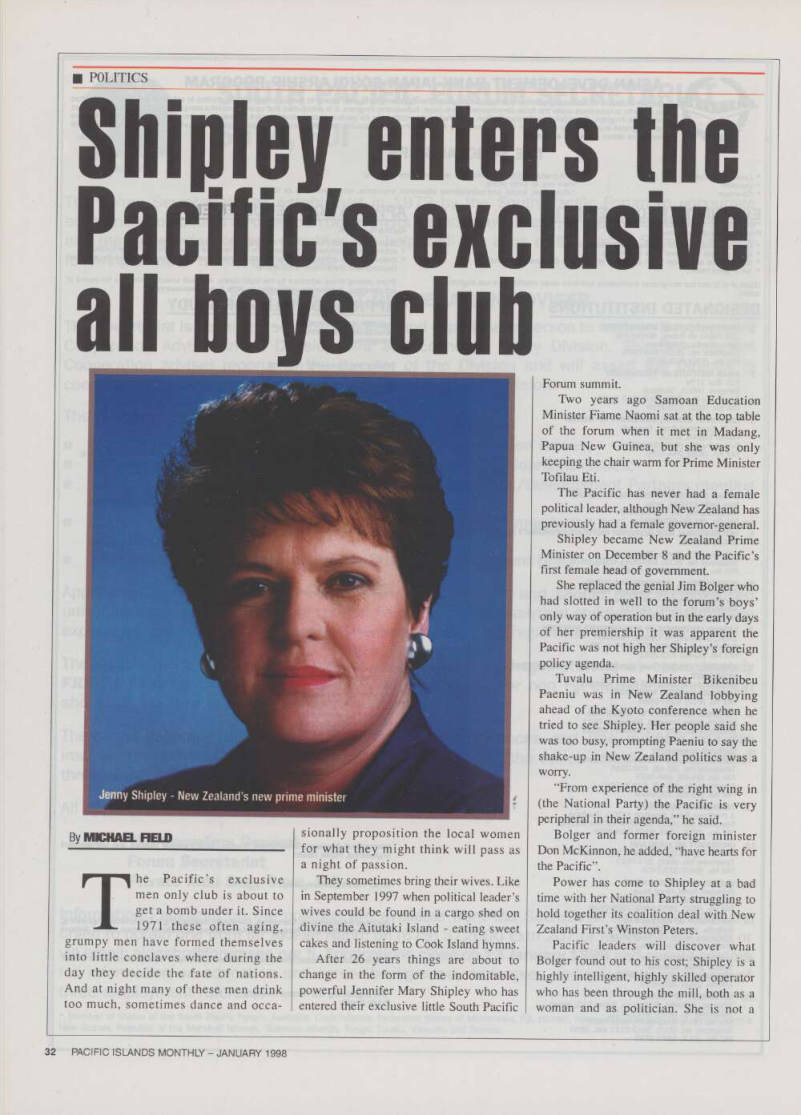
After 26 years things are about to change in the form of the indomitable, powerful Jennifer Mary Shipley who has entered their exclusive little South Pacific
The Pacific’s exclusive men only club is about to get a bomb under it. Since 1971 these often aging, grumpy men have formed themselves into little conclaves where during the day they decide the fate of nations.
And at night many of these men drink too much, sometimes dance and occa-
Forum summit.
Two years ago Samoan Education Minister Fiame Naomi sat at the top table of the forum when it met in Madang, Papua New Guinea, but she was only keeping the chair warm for Prime Minister Tofilau Eti.
The Pacific has never had a female political leader, although New Zealand has previously had a female governor-general.
Shipley became New Zealand Prime Minister on December 8 and the Pacific’s first female head of government.
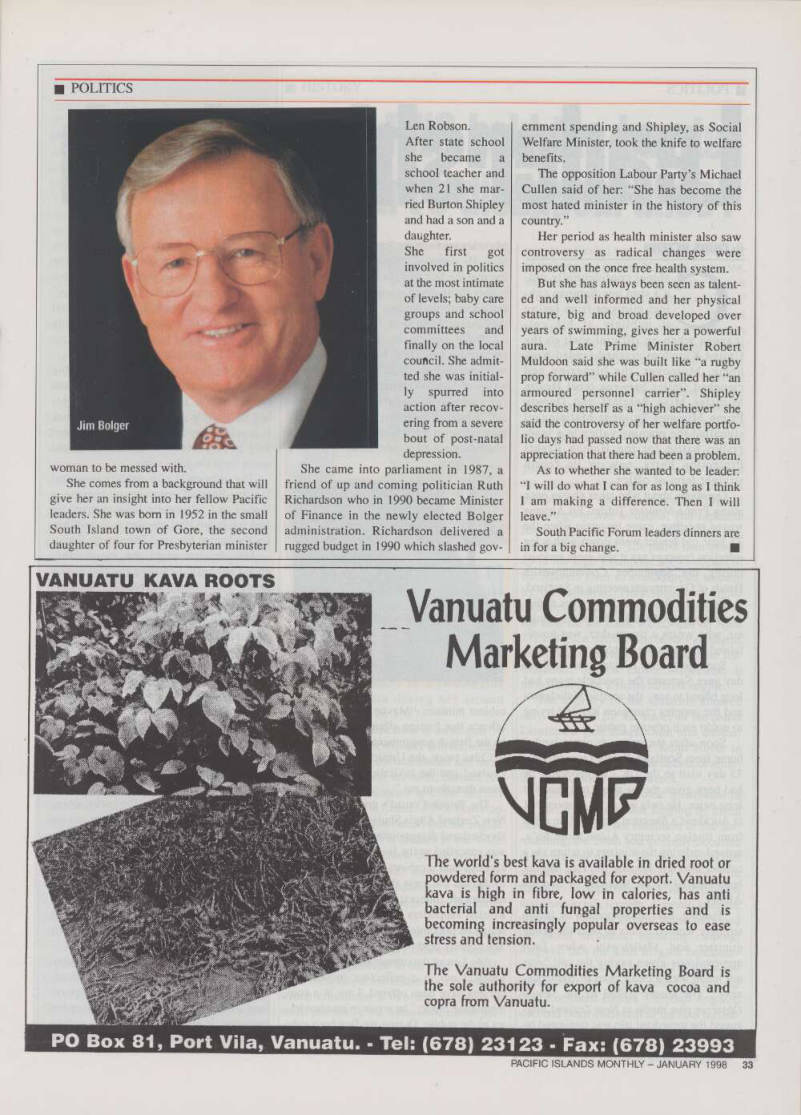
She replaced the genial Jim Bolger who had slotted in well to the forum’s boys’ only way of operation but in the early days of her premiership it was apparent the Pacific was not high her Shipley’s foreign policy agenda.
Tuvalu Prime Minister Bikenibeu Paeniu was in New Zealand lobbying ahead of the Kyoto conference when he tried to see Shipley. Her people said she was too busy, prompting Paeniu to say the shake-up in New Zealand politics was a worry.
“From experience of the right wing in (the National Party) the Pacific is very peripheral in their agenda,” he said.
Bolger and former foreign minister Don McKinnon, he added, “have hearts for the Pacific”.
Power has come to Shipley at a bad time with her National Party struggling to hold together its coalition deal with New Zealand First’s Winston Peters.
Pacific leaders will discover what Bolger found out to his cost; Shipley is a highly intelligent, highly skilled operator who has been through the mill, both as a woman and as politician. She is not a
woman to be messed with.
She comes from a background that will give her an insight into her fellow Pacific leaders. She was bom in 1952 in the small South Island town of Gore, the second daughter of four for Presbyterian minister
Len Robson.
After state school she became a school teacher and when 21 she mar ried Burton Shipley and had a son and a
daughter.
She first got involved in politics at the most intimate of levels; baby care groups and school committees and finally on the local council. She admit ted she was initial ly spurred into action after recov ering from a severe bout of post-natal
depression.
She came into parliament in 1987, a friend of up and coming politician Ruth Richardson who in 1990 became Minister of Finance in the newly elected Bolger administration. Richardson delivered a rugged budget in 1990 which slashed gov
emment spending and Shipley, as Social Welfare Minister, took the knife to welfare benefits.
The opposition Labour Party’s Michael Cullen said of her: “She has become the most hated minister in the history of this country.”
Her period as health minister also saw controversy as radical changes were imposed on the once free health system.
But she has always been seen as talent ed and well informed and her physical stature, big and broad developed over years of swimming, gives her a powerful aura. Late Prime Minister Robert Muldoon said she was built like “a rugby prop forward” while Cullen called her “an armoured personnel carrier”. Shipley describes herself as a “high achiever” she said the controversy of her welfare portfo lio days had passed now that there was an appreciation that there had been a problem.
As to whether she wanted to be leader: “I will do what I can for as long as I think I am making a difference. Then I will leave.”
South Pacific Forum leaders dinners are in for a big change. ■