affected by EI Nino
pp. 20-22 · Read in the full issue
Special Report
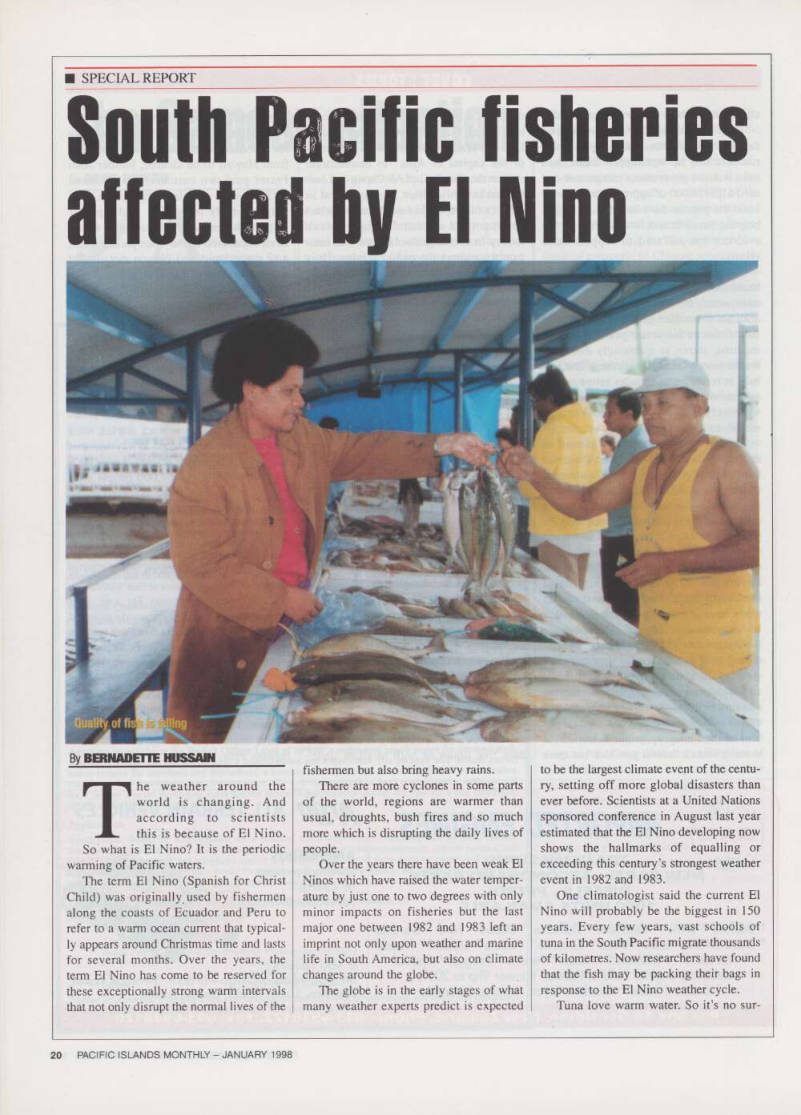
South Pacific fisheries affected by EI Nino
By Bernadette Hussain
fishermen but also bring heavy rains.
There are more cyclones in some parts of the world, regions are warmer than usual, droughts, bush fires and so much more which is disrupting the daily lives of people.
Over the years there have been weak El Ninos which have raised the water temper ature by just one to two degrees with only minor impacts on fisheries but the last major one between 1982 and 1983 left an imprint not only upon weather and marine life in South America, but also on climate changes around the globe.
The globe is in the early stages of what many weather experts predict is expected
to be the largest climate event of the centu ry, setting off more global disasters than ever before. Scientists at a United Nations sponsored conference in August last year estimated that the El Nino developing now shows the hallmarks of equalling or exceeding this century’s strongest weather event in 1982 and 1983.
One climatologist said the current El Nino will probably be the biggest in 150 years. Every few years, vast schools of tuna in the South Pacific migrate thousands of kilometres. Now researchers have found that the fish may be packing their bags in response to the El Nino weather cycle.
Tuna love warm water. So it’s no sur-
The weather around the world is changing. And according to scientists this is because of El Nino.
So what is El Nino? It is the periodic warming of Pacific waters.
The term El Nino (Spanish for Christ Child) was originally used by fishermen along the coasts of Ecuador and Peru to refer to a warm ocean current that typical ly appears around Christmas time and lasts for several months. Over the years, the term El Nino has come to be reserved for these exceptionally strong warm intervals that not only disrupt the normal lives of the
prise that huge numbers congregate just north of Papua New Guinea, in what tends to be the balmiest part of the Pacific. But fishermen have noticed that every few years they can catch plenty of fish thou sands of miles far east.
After a few months, however, the fish •swim back to PNG, Scientists have sug gested that El Nino might influence these tuna migrations. Patrick Lehodey and col leagues at the Oceanic Fisheries Program at South Pacific Commission, an interna tional agency based in Noumea, New Caledonia, set out to see if the two phe nomena were indeed linked.
They dug out catch records from 1988 to 1995 for skipjack tuna in the South Pacific, as well as records for temperature and the Southern Oscillation Index (SOI), which is a measure of the barometric pres sures that drive El Nino. Lehodey’s team found that two months after the SOI dropped, indicating El Nino conditions, the Pacific’s warm water would extend thou sands of kilometres to the east as would the most productive fishing area.
Lehodey says they are effectively con cerned about the influence of El Nino on the tuna fisheries in the Pacific. He says the distribution of tuna is largely influ enced by environmental conditions such as temperature, dissolved oxygen, but mainly by the presence of available food.
“The tuna food consists of small crus taceans, squids and fish. The production of these tuna prey depends on the oceanic pri mary (algae) production which can be evaluated and located from satellites that measure ocean colour,” he said.
“However, the development of tuna for age from this primary production takes several weeks (small crustaceans) to sever al months (small pelagic fish) during which both the ocean currents and the ran dom movements of the organisms generate the final distribution of the prey chased by tuna.
“So favourable zones for tuna general ly are close to areas with high primary pro ductivity or/and fronts between water masses known to aggregate the small prey organisms.” According to an article titled ENSO And Tuna In the Western Pacific which was published earlier this year, near ly 70 percent of the world’s annual tuna harvest, currently 3.2 million tonnes, comes from the Pacific Ocean. Skipjack tuna dominate the catch.
The article says that although skipjack are distributed in the surface mixed layer throughout the equatorial and subtropical Pacific, catches are highest in the western equatorial Pacific warm pool, a region characterised by low primary productivity rates and the warmest surface waters of the world’s ocean.
Lehodey says the presence of this pro ductive fishery in the region is in a first view surprising since the primary produc tion is low particularly in comparison with the eastern and central equatorial Pacific.
“The main oceanic zones with high prima ry productivity in the western Pacific are close to the islands, particularly the large ones that enrich the surrounded waters with terrestrial inputs due to run off mech anisms, said Lehodey.
“This is particularly clear around PNG.
A second major source of high primary productivity, at the boundary of the west ern equatorial region (usually around 160 degrees east), is the central equatorial region (equatorial upwelling).
“However, the boundary (front) between these two regions is moving in longitude according to the climatic oscilla tion ENSO.” He explains that during El Nino events, the front moves eastward, so enriching the fishing grounds of Kiribati, Nauru and Tuvalu.
During the converse La Nina event is a cooling of the equatorial ocean and the front moves westward, so drawing more fish into such major fishing zones as those of PNG and the Federated States of Micronesia.
“Regarding the fishing ground close to PNG, the influence of El Nino on the pri mary productivity around the island is not evident from the satellite images for the period of the strong El Nino if 1982 to 1983 to which the present El Nino event can be compared.
However, since the El Nino generates severe droughts in the region we should expect a decrease in the run off and conse quently in primary productivity/available fish food around the islands.
“In summary, we can describe the west ern equatorial region with two major attractive poles for surface tuna which are skipjack and young yellowfin which are caught by purse seine which are the sur rounding waters of PNG/Irian Jaya Island and the mobile front between the western and the central water masses.”
He further explains that in La Nina phase, the front is moving westward, close to PNG, the runoff is maximum and the warm waters are concentrated in the west; these effects combine to produce a very attractive region between PNG, FSM and the Solomon Islands.
In El Nino phase, the front is moving eastward, the runoff is low and the surface layer of warm water is expanding east ward; consequently the tuna resource is much more dispersed throughout the whole western equatorial region with one part of the stock following the eastward move ment of the front and the other dispersing between spot prey aggregation such as local fronts, islands, seamounts, logs and so on. He added that from a fishing per spective an El Nino event may cause reduced catch rates (measured in tonnes per day) in Irian Jaya due to a lack of float ing objects or fish aggregating devices (FAD). Examples of FAD are floating logs or payaos. “For some reason which we do not completely understand, fish such as skipjack and juvenile yellowfin and big eye often associate and concentrate under
Fad’S.
“In the last decade, purse seining tech niques have gradually shifted from fishing on free-swimming schools of skipjack and yellowfin to fishing on FAD’s “In summary, for purse seine fishermen who fish on FAD’s, there will probably be less natural FAD’s during an El Nino.
Thus, vessels may spend more time search ing for decent size fish schools and catch rates maybe lower. Conversely, if purse seiners fish on free swimming schools the number of schools in the PNG, Irian Jaya, FSM and the Solomon Islands area will probably be reduced because the stock shifts eastwards due to environmental rea sons previously mentioned.”
He adds that if there are less natural floating objects in a fishing area, the fleet could always set its own artificial objects such as drifting FAD’s or anchored FAD’s to offset the lack of natural objects.
Lehodey says that during El Nino, most of the commercial fleets from distant water nations such as Japan, the United States and Korea move eastward.
“While there is less fishing activity in PNG, Irian Jaya, FSM and the Solomon Islands during El Nino, we do not want to sound entirely pessimistic about fishing opportunities in these areas. In the extend
ed El Nino from 1991 to 1995 a lot of fish were still caught in FSM, PNG, the Philippines and Indonesia. The fishing fleets within these countries continue to remain economically viable even under the poorer environmental conditions.”
He says that while they (SPC) under stand the regional picture fairly well, it is difficult to predict what may happen in a localised area.
“With advances in more comprehensive fishing data and better satellite products, our understanding of the fisheries and ocean is improving each year.
“More specifically for the area around Fiji, two pelagic fisheries have historically operated in the Fijian FEZ, a surface pole and line fishery and offshore longline fish ery. The domestic Fijian pole-and-line fish ery has operated over a number of ENSO events (1975-92), but neither total catch nor catch rates (catch per unit effort, measured as tonnes per day fished) appear to have any correlation with ENSO events.
“Catch and catch rates in a pole and line fishery often are determined by other fac tors, most importantly, the availability of baitfish” He explains further saying that the
fishery is also seasonal, with most of the catch produced from January to March. In December, the oceanography of the Fiji FEZ changes abruptly from winter to sum mer conditions. The arrival of summer usu ally marks the onset of the surface fishery.
“In contrast to the pole and line fishery, there appears to be a marked change in the catchability or migration of tunas in the subsurface longline fishery.”
While the SPC looks at the change from the scientific perspective, the Solomon Islands based Forum Fisheries Agency’s duty is to develop fisheries management in the region. They are working closely with the SPC to understand the movement of fish in the region. lan Cartwright of FFA said at present it was too early to exactly say what they were going to do.
“We are in the beginning of this El Nino and anything could happen. We know what the scientists are telling us and will react on the stock situation once we know for defi nite what is happening,” he said. He said they were alive to the situation and were watching carefully and collecting all the information they could for future manage ment. ■