The Samoan situation
pp. 18-19 · Read in the full issue
By Chris Peteru
./ A sked once ✓ /% whether the Samoan gov- X. .m. ernment was corrupt, Deputy Prime Minister Tuilaepa Malielegaoi replied
that “corruption is a relative term.”
In the past 12 months the volume of corrupt episodes that fell at the door of the Human Rights Protection Party govern ment snowballed to a point where the visi tors bureau could have advertised cheap ski holidays. A record of infrastructural development of embarrassing events
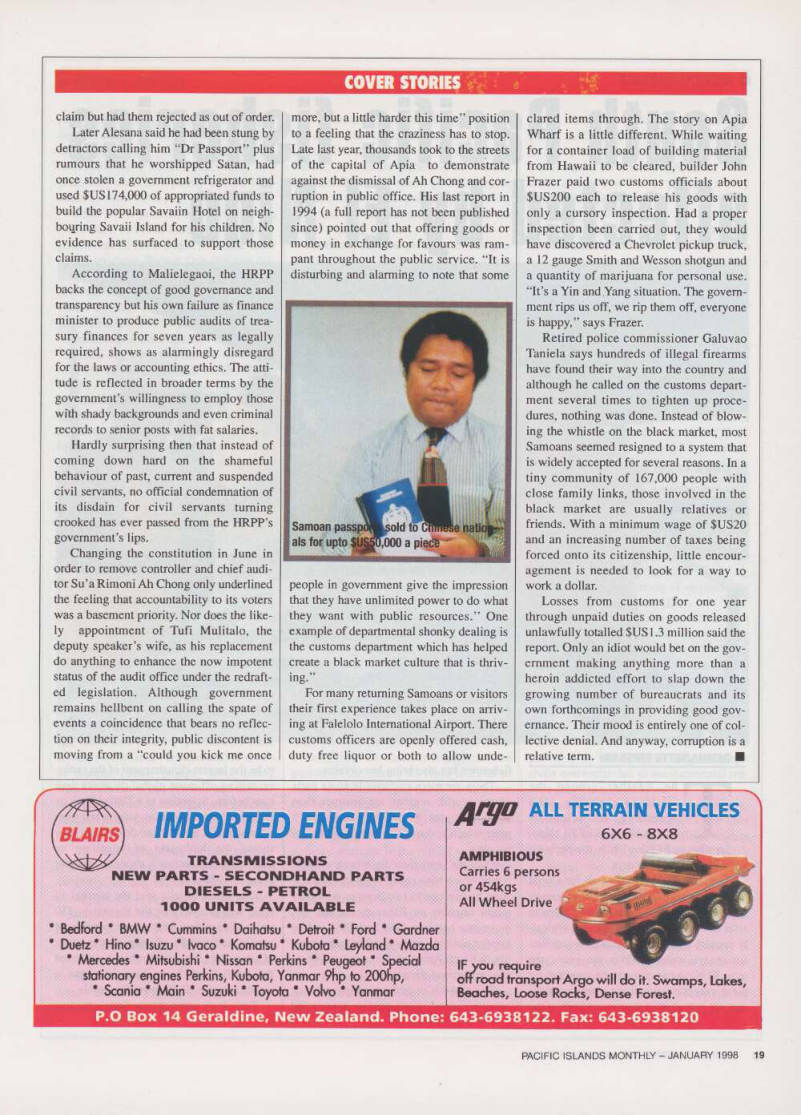
involving government officials. The Chinese lunar calendar marked 1997 as the “Year of the Boar” and the behaviour of some individuals charged or under investi gation seemed similar in character. By far, the biggest dent to the credibility of the Tofilau Eti Alesana led administration hap pened in April last year when revelations of a scam involving the illegal sale of hun dreds of passports to Chinese nationals for up to SUSSO,OOO a piece by immigration
department officers. Although speculation
that some of the deals may have taken place through Samoa’s Hong Kong con sulate, so far nothing has been substantiat ed.
Despite ramifications internationally of Chinese nationals travelling on dud
Samoan documents, police investigations
have stayed firmly in Apia. All the while Alesana who held the immigration portfo lio for 12 years repeatedly stated he had no knowledge of the scam. Malilegaoi believes a Chinese crime syndicate is at the heart of the operation but few support the theory.
Government assertions that no top offi cials were involved in the scam evaporated when police charged former ambassador to the United States and member of parlia ment Dr Tuaopepe Felix Wendt with 28 counts including theft, forgery and con spiracy to defraud during his time at the Washington Embassy. The prominent com munity figure has denied everything. Chief immigration officer Tuipoloa Suisala plus three other officers have also been sus
pended and charged.
But Wendt isn’t the only bureaucrat now being called to answer. Public Trustee Solomona Toialoa was suspended in August for taking thousands of dollars of trust funds. Allowed to keep a law practice going even while investigation, Toialoa says the money was owed to him by four government members of parliament he defended against bribery allegations dur ing the last elections. Meanwhile, an inves tigation into a huge fraud at the consul gen eral’s office in Wellington by a Samoan employee is being carried out by New Zealand police.
Even the prime minister has not been spared from accusations of corruption.
Opposition leader Tuitua Tamsese said in parliament that Alesana was “the only prime minister in the whole world who is a confirmed (in court) thief.” He later pre sented police documents supporting that
claim but had them rejected as out of order.
Later Alesana said he had been stung by detractors calling him “Dr Passport” plus rumours that he worshipped Satan, had once stolen a government refrigerator and used SUS 174,000 of appropriated funds to build the popular Savaiin Hotel on neigh bouring Savaii Island for his children. No evidence has surfaced to support those claims.
According to Malielegaoi, the HRPP backs the concept of good governance and transparency but his own failure as finance minister to produce public audits of trea sury finances for seven years as legally required, shows as alarmingly disregard for the laws or accounting ethics. The atti tude is reflected in broader terms by the government’s willingness to employ those with shady backgrounds and even criminal records to senior posts with fat salaries.
Hardly surprising then that instead of coming down hard on the shameful behaviour of past, current and suspended civil servants, no official condemnation of its disdain for civil servants turning crooked has ever passed from the HRPP’s
government’s lips.
Changing the constitution in June in order to remove controller and chief audi tor Su’a Rimoni Ah Chong only underlined the feeling that accountability to its voters was a basement priority. Nor does the like ly appointment of Tufi Mulitalo, the deputy speaker’s wife, as his replacement do anything to enhance the now impotent status of the audit office under the redraft ed legislation. Although government remains hellbent on calling the spate of events a coincidence that bears no reflec tion on their integrity, public discontent is moving from a “could you kick me once
more, but a little harder this time” position to a feeling that the craziness has to stop.
Late last year, thousands took to the streets of the capital of Apia to demonstrate against the dismissal of Ah Chong and cor ruption in public office. His last report in 1994 (a full report has not been published since) pointed out that offering goods or money in exchange for favours was ram pant throughout the public service. “It is disturbing and alarming to note that some
people in government give the impression that they have unlimited power to do what they want with public resources.” One example of departmental shonky dealing is the customs department which has helped create a black market culture that is thriv
ing.”
For many returning Samoans or visitors their first experience takes place on arriv ing at Falelolo International Airport. There customs officers are openly offered cash, duty free liquor or both to allow unde
dared items through. The story on Apia Wharf is a little different. While waiting for a container load of building material from Hawaii to be cleared, builder John Frazer paid two customs officials about SUS2OO each to release his goods with only a cursory inspection. Had a proper inspection been carried out, they would have discovered a Chevrolet pickup truck, a 12 gauge Smith and Wesson shotgun and a quantity of marijuana for personal use.
“It’s a Yin and Yang situation. The govern ment rips us off, we rip them off, everyone is happy,” says Frazer.
Retired police commissioner Galuvao Taniela says hundreds of illegal firearms have found their way into the country and although he called on the customs depart ment several times to tighten up proce dures, nothing was done. Instead of blow ing the whistle on the black market, most Samoans seemed resigned to a system that is widely accepted for several reasons. In a tiny community of 167,000 people with close family links, those involved in the black market are usually relatives or friends. With a minimum wage of SUS2O and an increasing number of taxes being forced onto its citizenship, little encour agement is needed to look for a way to work a dollar.
Losses from customs for one year through unpaid duties on goods released unlawfully totalled SUS 1.3 million said the report. Only an idiot would bet on the gov ernment making anything more than a heroin addicted effort to slap down the growing number of bureaucrats and its own forthcomings in providing good gov ernance. Their mood is entirely one of col lective denial. And anyway, corruption is a relative term. ■