Fiji faces a gnawing
p. 17 · Read in the full issue
tide af corruption
By Michael Field
Ahigh - p o w - ✓ ered weapon has been
X XL dropped on
Fiji Finance Minister Jim Ah Koy’s desk in the form of a
25-page report.
Do nothing about its contents and it will explode as corruption and fraud engulfs Fiji. Act on it and the state will arm itself with tough new powers ... with enormous political and civil liberties ramifications.
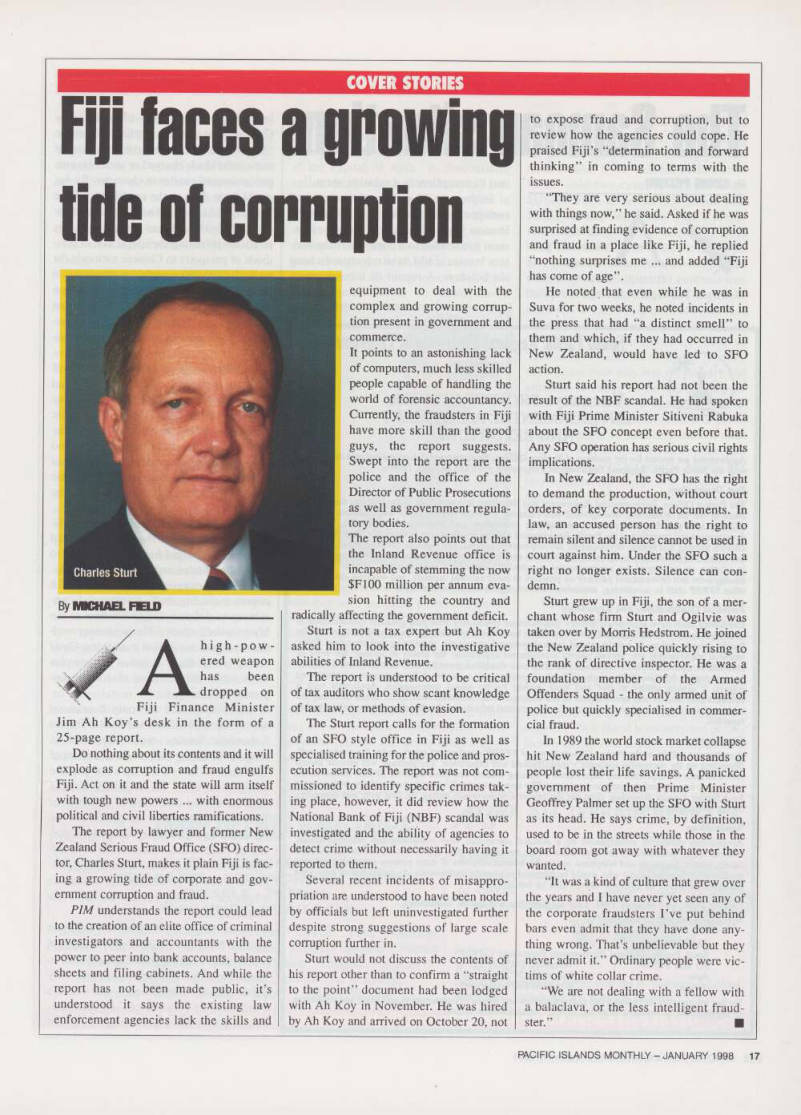
The report by lawyer and former New Zealand Serious Fraud Office (SFO) direc tor, Charles Sturt, makes it plain Fiji is fac ing a growing tide of corporate and gov ernment corruption and fraud.
PIM understands the report could lead to the creation of an elite office of criminal investigators and accountants with the power to peer into bank accounts, balance sheets and filing cabinets. And while the report has not been made public, it’s understood it says the existing law enforcement agencies lack the skills and
equipment to deal with the
complex and growing corrup
tion present in government and commerce.
It points to an astonishing lack of computers, much less skilled people capable of handling the world of forensic accountancy.
Currently, the fraudsters in Fiji have more skill than the good guys, the report suggests.
Swept into the report are the police and the office of the Director of Public Prosecutions as well as government regula tory bodies.
The report also points out that the Inland Revenue office is incapable of stemming the now SFIOO million per annum eva sion hitting the country and
radically affecting the government deficit.
Sturt is not a tax expert but Ah Koy asked him to look into the investigative abilities of Inland Revenue.
The report is understood to be critical of tax auditors who show scant knowledge of tax law, or methods of evasion.
The Sturt report calls for the formation of an SFO style office in Fiji as well as specialised training for the police and pros ecution services. The report was not com missioned to identify specific crimes tak ing place, however, it did review how the National Bank of Fiji (NBF) scandal was investigated and the ability of agencies to detect crime without necessarily having it reported to them.
Several recent incidents of misappro priation are understood to have been noted by officials but left uninvestigated further despite strong suggestions of large scale corruption further in.
Sturt would not discuss the contents of his report other than to confirm a “straight to the point” document had been lodged with Ah Koy in November. He was hired by Ah Koy and arrived on October 20, not
to expose fraud and corruption, but to review how the agencies could cope. He praised Fiji’s “determination and forward thinking” in coming to terms with the issues.
“They are very serious about dealing with things now,” he said. Asked if he was
surprised at finding evidence of corruption
and fraud in a place like Fiji, he replied “nothing surprises me ... and added “Fiji has come of age”.
He noted that even while he was in Suva for two weeks, he noted incidents in the press that had “a distinct smell” to them and which, if they had occurred in New Zealand, would have led to SFO action.
Sturt said his report had not been the result of the NBF scandal. He had spoken with Fiji Prime Minister Sitiveni Rabuka about the SFO concept even before that.
Any SFO operation has serious civil rights
implications.
In New Zealand, the SFO has the right to demand the production, without court orders, of key corporate documents. In law, an accused person has the right to remain silent and silence cannot be used in court against him. Under the SFO such a right no longer exists. Silence can con demn.
Sturt grew up in Fiji, the son of a mer chant whose firm Sturt and Ogilvie was taken over by Morris Hedstrom. He joined the New Zealand police quickly rising to the rank of directive inspector. He was a foundation member of the Armed Offenders Squad - the only armed unit of police but quickly specialised in commer cial fraud.
In 1989 the world stock market collapse hit New Zealand hard and thousands of people lost their life savings. A panicked government of then Prime Minister Geoffrey Palmer set up the SFO with Sturt as its head. He says crime, by definition, used to be in the streets while those in the board room got away with whatever they wanted.
“It was a kind of culture that grew over the years and I have never yet seen any of the corporate fraudsters I’ve put behind bars even admit that they have done any thing wrong. That’s unbelievable but they never admit it.” Ordinary people were vic tims of white collar crime.
“We are not dealing with a fellow with a balaclava, or the less intelligent fraud ster.” ■