EI Nino hits the North Pacific
pp. 22-24 · Read in the full issue
North Pacific
By Off Johnson
As the El Nino-caused drought sweeps through the western part of Micronesia heading for the Marshall Islands, the islands are taking unprecedented action in response to the dire predictions of meteorologists. In the Federated States of Micronesia, legislation has been introduced into the national congress calling for SUS 2 million to be spent to build water storage tanks, neighborhood catchments and wells, and desalination facilities. In response to predictions of an impending drastic drought in Majuro, the Marshall Islands capital, the development bank is offering loans to help families buy and install rainwater catchment tanks, while city water company officials are
improving pumping capa bility to tap a large under ground fresh water lens well to reduce the atoll’s dependence on rainfall which is now virtually total. A national disaster
preparedness committee
in the Marshalls has kicked into gear, launch ing visits to schools and church groups to promote water conservation.
When virtually all the fresh water comes from rain, talk of a drought is serious business. And thanks to the region-wide weather net work monitoring El Nino progress, which developed after the severe 1983 El Nino drought, these islands are the best informed that they’ve ever been.
“This will be one of the strongest El Nino’s we’ve ever seen,” Guam-based meteorologist Charles “Chip” Guard told Majuro’s Chamber of Commerce, church
groups and government officials during an awareness raising visit in November.
Majuro, which normally gets more than 12 inches of rain in November to help
stock up water supplies as it heads into the January-April dry season, was well below normal, and Guard said that all signs “point to a severe drought.” City water, which is always rationed in Majuro, was further cut back on only every third day in November as reservoir levels plummet edto “danger” levels.
Earlier in the summer, weath er forecasters had predicted increased typhoon and tropi cal storm activity starting in the vicini|ty of the Marshalls in the October/November period.
“The last three super typhoons all started between Majuro and Kwajalein and moved west (causing major damage in Saipan and Guam),” Guard said, empha
sizing the point that the predictions by meteorologists tracking El Nino have been on the mark so far this year.
The peak of the expected drought, he
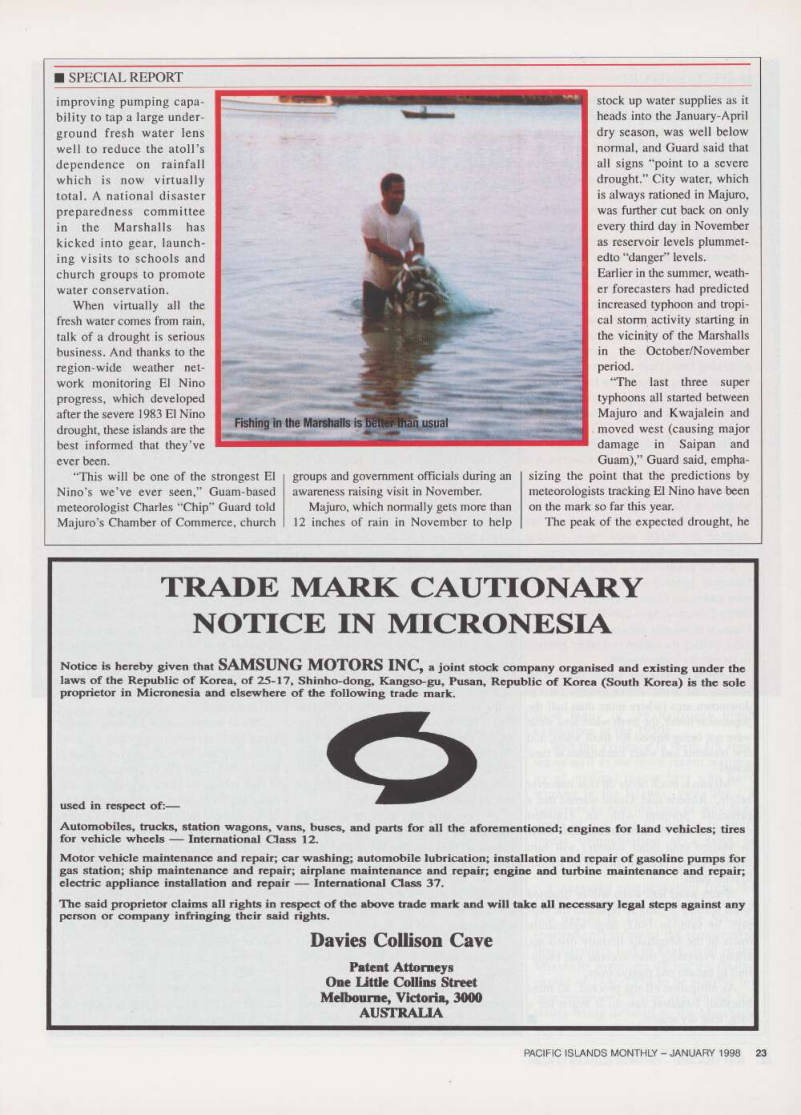
Fishing in the Marshalls than usual
said, will be in the January to March period, when forecasters predict there will be less than one inch of rain per month. For the January to June period, Guard predicts that Majuro’s rainfall will be 40 inches below normal or only about 20 percent of the usual rainfall.
Because El Nino changes the water tem perature, it affects both fisheries and reefs.
As a massive area of warm water has moved to the east, aside from weather patterns this has changed the sea level in the western Pacific. In the Guam/Yap area, the sea water is 15 inches lower than normal, while off the coast of South America, water levels are 20 inches above normal. Guard said. In Western Pacific Islands, coral reefs are bleaching from their exposure to the sun because of the lowered sea level from El Nino, he said. Guard, however, does not expect sea level to change dramatically in the Marshalls.
He said sea level difference in Majuro is likely to be in the range of six inches, not enough to cause reef problems.
But Guard predicts the drought will be tougher on Majuro residents than a similar El Nino in 1983, because the population has doubled to 30,000 since then, placing greater strain on limited water resources.
On the positive side, Marshalls Energy Company general manager Billy Roberts who doubles as a board member for the City Water Company, says that Majuro’s water situation is actually greatly improved since 1983, putting the capital in a better position to survive the long drought.
Roberts pointed out that in 1983, there was no salt water sewer system for the downtown area (where more than half the population lives), the fresh water lens wells were not being tapped for fresh water, and few residents had water catchments at their homes.
“Majuro is much better off now than ever before,” Roberts said. Guard warned that a particular problem with an extended drought is that the underground lens wells in Majuro (and other islands) will turn brackish (salty) because there is no rainfall to refill them.
“Fresh water lens wells will be depleted when nothing is there to replenish the sup ply,” he said. In 1983, large agriculture tracts in the Marshalls literally dried up, killing everything from coconut and bread fruit to banana and papaya trees.
As mitigation efforts proceed, all most Marshall Islanders can do is brace for a long, long dry season. ■