United, we stand
pp. 47-48 · Read in the full issue
Getting the region on the ball
By Atama Raganivatu
Any observer of the Australian soccer scene would be forgiven if believing Les Murray was omnipresent. He seems to be everywhere - on television, in maga zines, on the radio, in newspapers ...
It is almost a surprise, when entering an Australian soccer stadium, to discover that Murray is not there to take your admission money.
Murray has his detractors. His guttural Hungarian accent is not ideal for match commentating, he is perceived by many to be arrogant and he certainly does not adhere to the old adage about being nice to people on the way up because you might meet them on the way down. However, nobody can dispute Murray’s ency clopaedic knowledge of international soc cer or his perceptiveness. Therefore, when he called, in the migrants’ newspaper II Globo, for Pacific Island nations to field a combined team in the World Cup, the con cept should be given more than a cursory glance.
Murray claims that, individually, the small Pacific Island nations simply cannot compete due to their sparse populations.
His article, published just before Tahiti and the Solomon Islands met Australia in World Cup qualifying series matches in Sydney, stated: “They [Tahiti and the Solomons] are trying, in total futility, to make their mark.
They will be walloped; sent packing back to their sandy beaches with a sackful of conceded goals matched only by the coconuts that await them. Their morale will, again, be shattered leaving them only to ask, why? What is the point? Why are we bothering? Of course, there is no answer to that. There is no point. The soc cer region of Oceania at large has to take a deep look at itself and its future.
“It is clear that the nations of Polynesia and Melanesia, as individual nations, in a game as internationally competitive as soccer, have no future. Oceania, as it is now, has nowhere to go. Nations with pop
ulations in the thousands, or tens of thou sands, cannot compete no matter what the levels of coaching or funding.”
According to Murray, the Pacific Island minnows should either “give it away”, and leave Australia and New Zealand as the sole contestants in subsequent Oceania World Cup qualifying tournaments, or field a combined team or teams. He muses briefly over the possibilities of a united Polynesian selection and a united Melanesian combination, without realising that the former would, beyond much doubt, consist solely of Tahitians; all the other Polynesian nations having little interest in soccer.
As Murray points out, “A soccer com bination of all South Pacific nations, prop erly coached and adequately funded, would surely be a lethal force.” He then goes on to cite New Caledonian Christian Karembeu, a French international who is now one of the game’s superstars, as proof that the region is capable of producing players of exceptional quality.
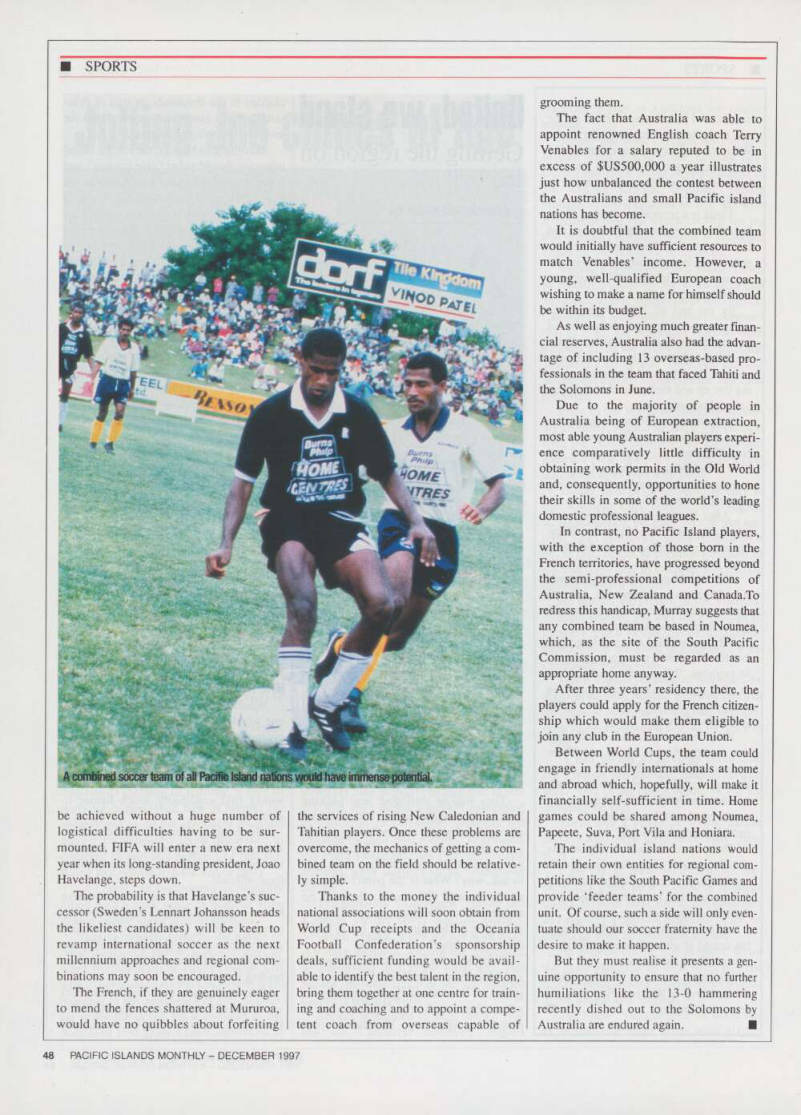
Indeed, such a team, which Murray dubs Pacific United, would have immense potential but several complications need to be conquered before it comes to fruition.
Murray himself mentions one. FIFA, international soccer’s ruling body, only recognises nations as entities for competi tive international matches and not regions.
Its constitution would have to be amended if a combined team is to get off the ground.
Karembeu is among a handful of play ers from New Caledonia and Tahiti who have represented France.
Would the French Football Association, one wonders, be prepared to allow equally promising individuals to represent the combined team in future rather than “the Tricolours”? Without Tahitian and New Caledonian talent, a united selection would find credibility much harder to achieve.
The greatest obstacle to any combined
side materialising, though, is the probable
lack of will for such a development among local officials.
Officebearers of our administrative
bodies enjoy travelling to regional tourna
ments, rubbing shoulders with their Australian and New Zealand counterparts and savouring the bright lights of the cities hosting those events.
The emergence of a combined team would greatly reduce such opportunities.
However, if the will exists, the way should
be achieved without a huge number of logistical difficulties having to be sur mounted. FIFA will enter a new era next year when its long-standing president, Joao Havelange, steps down.
The probability is that Havelange’s suc cessor (Sweden’s Lennart Johansson heads the likeliest candidates) will be keen to revamp international soccer as the next millennium approaches and regional com binations may soon be encouraged.
The French, if they are genuinely eager to mend the fences shattered at Mururoa, would have no quibbles about forfeiting
the services of rising New Caledonian and Tahitian players. Once these problems are overcome, the mechanics of getting a com bined team on the field should be relative ly simple.
Thanks to the money the individual national associations will soon obtain from World Cup receipts and the Oceania Football Confederation’s sponsorship deals, sufficient funding would be avail able to identify the best talent in the region, bring them together at one centre for train ing and coaching and to appoint a compe tent coach from overseas capable of
grooming them.
The fact that Australia was able to appoint renowned English coach Terry Venables for a salary reputed to be in excess of SUSSOO,OOO a year illustrates just how unbalanced the contest between the Australians and small Pacific island nations has become.
It is doubtful that the combined team would initially have sufficient resources to match Venables’ income. However, a young, well-qualified European coach wishing to make a name for himself should be within its budget.
As well as enjoying much greater finan cial reserves, Australia also had the advan tage of including 13 overseas-based pro fessionals in the team that faced Tahiti and the Solomons in June.
Due to the majority of people in Australia being of European extraction, most able young Australian players experi ence comparatively little difficulty in obtaining work permits in the Old World and, consequently, opportunities to hone their skills in some of the world’s leading domestic professional leagues.
In contrast, no Pacific Island players, with the exception of those bom in the French territories, have progressed beyond
the semi-professional competitions of
Australia, New Zealand and Canada.To redress this handicap, Murray suggests that any combined team be based in Noumea, which, as the site of the South Pacific Commission, must be regarded as an appropriate home anyway.
After three years’ residency there, the players could apply for the French citizen ship which would make them eligible to join any club in the European Union.
Between World Cups, the team could engage in friendly internationals at home and abroad which, hopefully, will make it financially self-sufficient in time. Home games could be shared among Noumea, Papeete, Suva, Port Vila and Honiara.
The individual island nations would retain their own entities for regional com petitions like the South Pacific Games and provide ‘feeder teams’ for the combined unit. Of course, such a side will only even tuate should our soccer fraternity have the desire to make it happen.
But they must realise it presents a gen uine opportunity to ensure that no further humiliations like the 13-0 hammering recently dished out to the Solomons by Australia are endured again. ■
A combined soccer team of all Pacific Island nations would have immense potential.