The festival of the dreaming
pp. 49-50 · Read in the full issue
Culture
Story and photography LIZ THOMPSON
There were several dance performances at the Sydney Festival of the Dreaming and most of them combined some aspects of tradi tional influence with contemporary ideas, movements and music. Mimi was one of the most magical. Located in Centennial Park, the stage was open air and set amidst a series of huge and ancient trees.
As you approached the performance area the hill dropped away behind the stage and exposed a panoramic view of the suburbs, tiny houses and a million lights stretched in the darkness towards the coast. On both sides of the stage the trees which stood fur ther away were gently lit by stage lights.
As the music and performance began, there was a sense of being wrapped in a fairytale in which strange creatures from another world were about to emerge from behind rocks or beneath the ground. This was indeed a setting for the emergence of spirits, the Mimi spirits, who lived in the
rocky escarpment country of Western Arnhem Land. The Mimi, according to Thompson Yulidjiir from Kunbarllanjnja in Amhem Land, arrived on the earth after the ancestral creator of beings who had first brought the features of the landscape into existence and before the first humans, a time when the world was soft.
The Mimi taught the old people important law and were known to visit artists and musicians often through dreams, giving inspira tion for a song cycle or showing how to paint a particular picture.
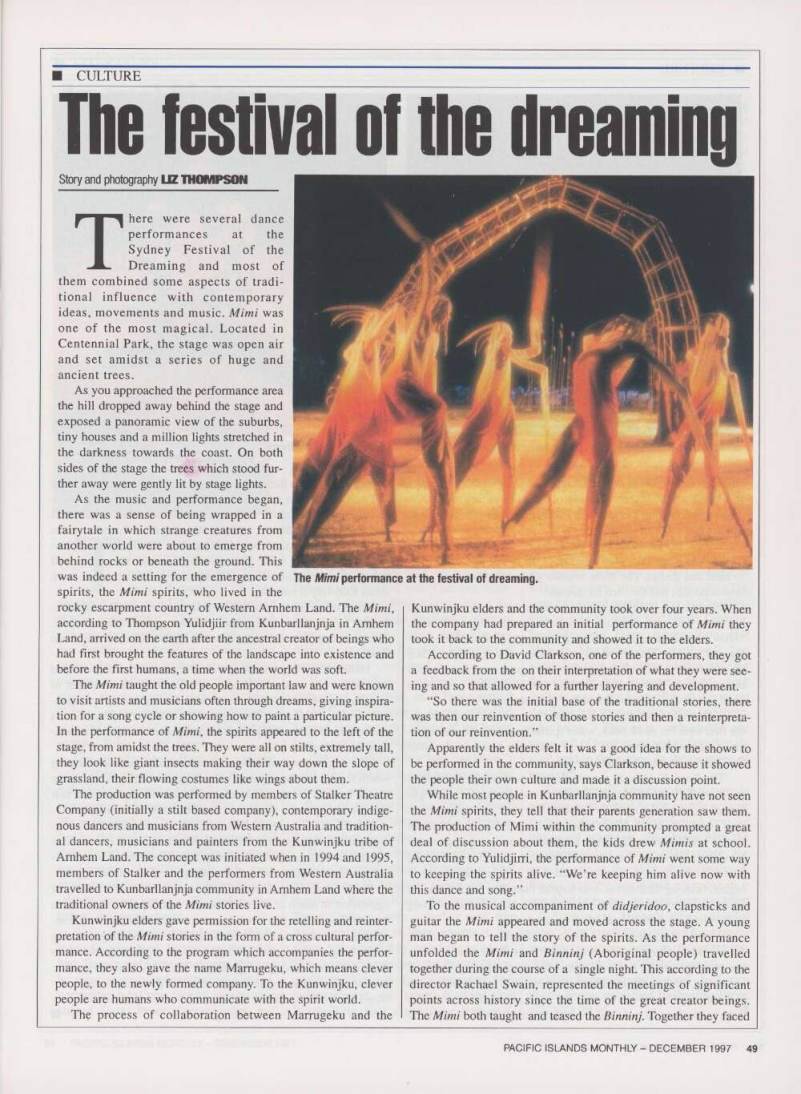
In the performance of Mimi, the spirits appeared to the left of the stage, from amidst the trees. They were all on stilts, extremely tall, they look like giant insects making their way down the slope of grassland, their flowing costumes like wings about them.
The production was performed by members of Stalker Theatre Company (initially a stilt based company), contemporary indige nous dancers and musicians from Western Australia and tradition al dancers, musicians and painters from the Kunwinjku tribe of Amhem Land. The concept was initiated when in 1994 and 1995, members of Stalker and the performers from Western Australia travelled to Kunbarllanjnja community in Amhem Land where the traditional owners of the Mimi stories live.
Kunwinjku elders gave permission for the retelling and reinter pretation of the Mimi stories in the form of a cross cultural perfor mance. According to the program which accompanies the perfor mance, they also gave the name Marrugeku, which means clever people, to the newly formed company. To the Kunwinjku, clever people are humans who communicate with the spirit world.
The process of collaboration between Marrugeku and the
Kunwinjku elders and the community took over four years. When the company had prepared an initial performance of Mimi they took it back to the community and showed it to the elders.
According to David Clarkson, one of the performers, they got a feedback from the on their interpretation of what they were see ing and so that allowed for a further layering and development.
“So there was the initial base of the traditional stories, there was then our reinvention of those stories and then a reinterpreta tion of our reinvention.”
Apparently the elders felt it was a good idea for the shows to be performed in the community, says Clarkson, because it showed the people their own culture and made it a discussion point.
While most people in Kunbarllanjnja community have not seen the Mimi spirits, they tell that their parents generation saw them.
The production of Mimi within the community prompted a great deal of discussion about them, the kids drew Mimis at school.
According to Yulidjirri, the performance of Mimi went some way to keeping the spirits alive. “We’re keeping him alive now with this dance and song.”
To the musical accompaniment of didjeridoo, clapsticks and guitar the Mimi appeared and moved across the stage. A young man began to tell the story of the spirits. As the performance unfolded the Mimi and Binninj (Aboriginal people) travelled together during the course of a single night. This according to the director Rachael Swain, represented the meetings of significant points across history since the time of the great creator beings.
The Mimi both taught and teased the Binninj. Together they faced
The Mimi performance at the festival of dreaming.
other forces or spirit beings who came into their world. Their path on this night echoed the path many of our cultures face in the 20th century, reconciling the assumed differences between the human and the spirit worlds.
As dusk fell the Mimi blew light through the rock face and the Binninj woke up. The Mimi then taught the Binninj how to dance, to hunt and gather. The Mimi women go hunting for wild yams (sweet potato) and the men for goanna.
According to Yuldjirri, Mimis come out to hunt for kangaroo, but when that wind come up, they go back to that big rock place.
“Mimi can take you there. Inside you can see all that Mimi danc ing and singing. They have big mob tucker (food) in there. They have live one (rock wallaby), rock python, quiet one ( Echidna), in there like pets. When you go in there that Mimi teach you how to paint in old way. Now we are using different way.”
As the night wore on, the Mimi meet several other spirit beings, the first were the Yawk Yawk, water spirits from western and north ern Arnhem land, from the creeks and water holes of the river flood plains heading towards the sea.
The Yawk Yawk,were mermaids, half woman, half fish who traditionally lived in trees by the rivers and they were the daugh ters of Ngyalod the rainbow serpent. Ngyalod, the rainbow ser pent was angry at the Mimi for teasing her children and created a strong wind to break the Mimis long skinny necks. A large struc ture which inhabited the centre of the stage provided a climbing frame for the dancers who stretched their long legs as they rose higher, hooking themselves onto trapeze lines they leapt from the frame and sway precariously back and forth, bouncing and turning in the wind, an extraordinary feat wearing stilts.
As they struggled to return to the familiar rocky terrain, Namorrodoh, a huge and fearsome spirit arrived. He towerd above the Mimi spirits and he swept across the stage, hunting the weak and dying, stealing their souls to put in his dilly bag. Namorrodoh is a dark spirit believed to steal the souls of the dying and take them to another place. As the dawn approached the Mimi appeared
to retreat back into the rock, leaving the Binninj with their songs and dances. But the spirit of the Mimi, says Swain, is kept alive through these art forms. Mimi succesfully combined traditional dance and modem theatre, stylishly blending the influences of two worlds. The dance they were making, says Yulidjirri, was a bin ninj and balanda ( white person) mix of dance. The dance will help people from Australia and all over the world understand more about Kunwinjku culture.
Quite different in production and content was Fia Ola per formed by the Black Grace Dance Company from New Zealand.
The company is made up of Maoris, Pacific Islanders and one Kiwi.
Unlike Mimi which drew specifically on traditional spirits and stories, Fia Ola was a contemporary exploration of the plight of one gay man and his friend, losefa and loane, growing up togeth er in a village in Samoa. The gay man’s confusion and his friend’s attempts to deny his likely homosexuality were set against a back drop of community intolerance.
The negative attitude towards homosexuality lead to a beating which resulted in the gay man’s death. According to the company it was, through the eyes of losefa and loana that the audience saw the epic struggle of a nation and the realisation of a minority.
The birth of an eternal friendship, the journey of self discov ery, and the desire to live. This explanation seemed a bit thrown together and the performance rarely movedfrom what was essen tially a very simplistic story line with any real emotional depth.
Black Grace is an all male company and there is a feeling of aggression in much of the performance - perhaps this was due to the storyline of Fia Ola but it became a little tedious. The chore ography lacked grace and the movements, often running, jumping or crashing across the stage bordered were repetitious. No doubt there was talent among the group but Fia Ola did not bring it to fruition. There was ample evidence of the dynamic energy con tained within Black Grace but an overall sense that the company was still in the process of refining it. ■
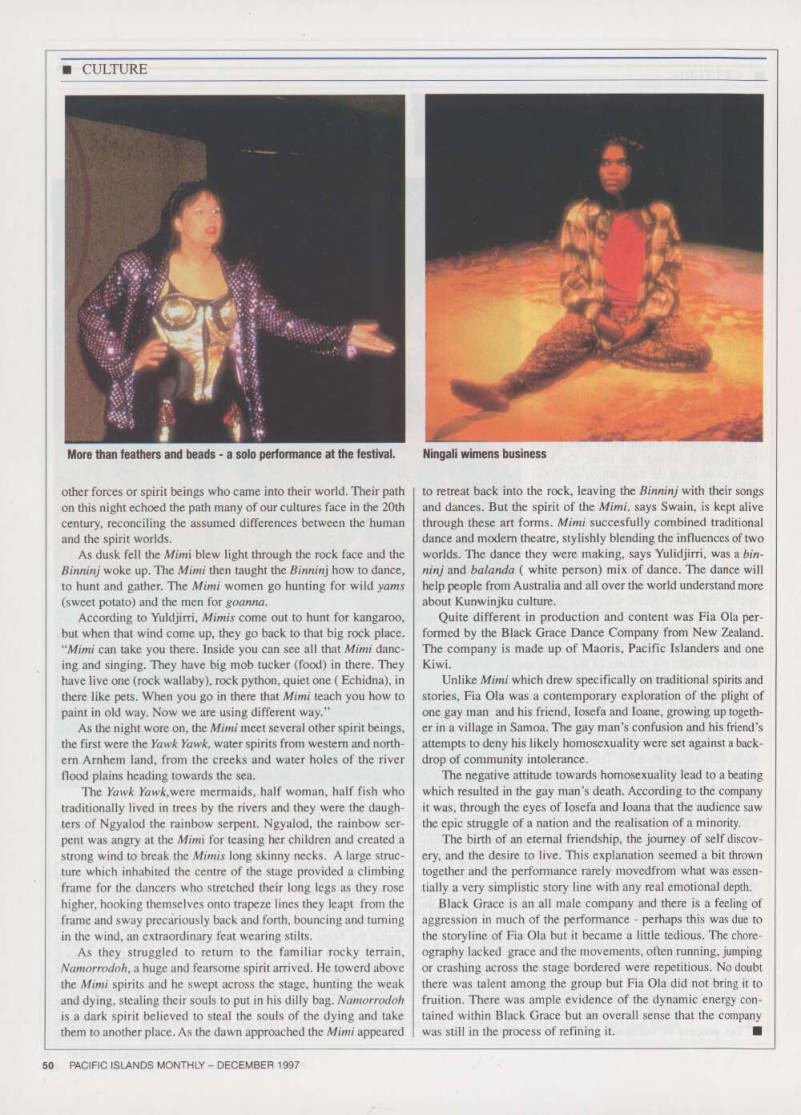
More than feathers and beads-a solo performance at the festival.
Ningali wimens business