Jolting Joe conies of age
pp. 46-47 · Read in the full issue
Sport
By Atama Raganivatu
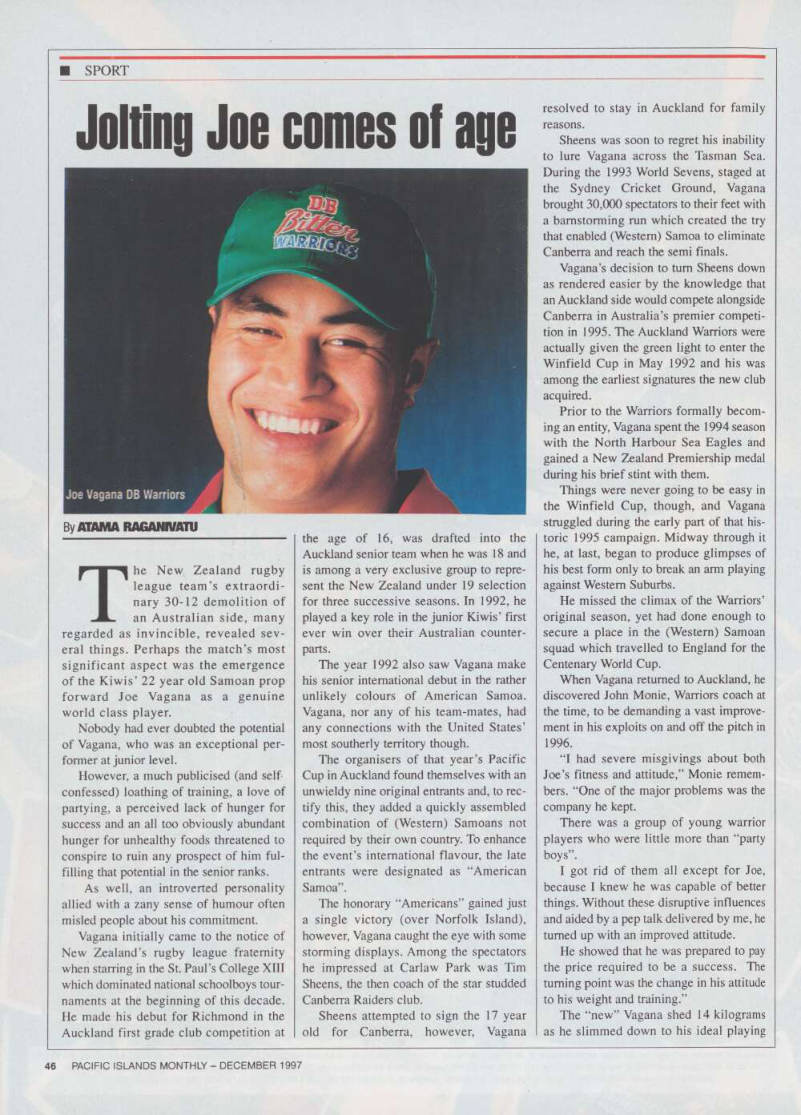
The New Zealand rugby league team’s extraordi nary 30-12 demolition of an Australian side, many regarded as invincible, revealed sev eral things. Perhaps the match’s most significant aspect was the emergence of the Kiwis’ 22 year old Samoan prop forward Joe Vagana as a genuine world class player.
Nobody had ever doubted the potential of Vagana, who was an exceptional per former at junior level.
However, a much publicised (and self confessed) loathing of training, a love of partying, a perceived lack of hunger for success and an all too obviously abundant hunger for unhealthy foods threatened to conspire to ruin any prospect of him ful filling that potential in the senior ranks.
As well, an introverted personality allied with a zany sense of humour often misled people about his commitment.
Vagana initially came to the notice of New Zealand’s rugby league fraternity when starring in the St. Paul’s College XIII which dominated national schoolboys tour naments at the beginning of this decade.
He made his debut for Richmond in the Auckland first grade club competition at
the age of 16, was drafted into the Auckland senior team when he was 18 and is among a very exclusive group to repre sent the New Zealand under 19 selection for three successive seasons. In 1992, he played a key role in the junior Kiwis’ first ever win over their Australian counter parts.
The year 1992 also saw Vagana make his senior international debut in the rather unlikely colours of American Samoa.
Vagana, nor any of his team-mates, had any connections with the United States’ most southerly territory though.
The organisers of that year’s Pacific Cup in Auckland found themselves with an unwieldy nine original entrants and, to rec tify this, they added a quickly assembled combination of (Western) Samoans not required by their own country. To enhance the event’s international flavour, the late entrants were designated as “American Samoa”.
The honorary “Americans” gained just a single victory (over Norfolk Island), however, Vagana caught the eye with some storming displays. Among the spectators he impressed at Carlaw Park was Tim Sheens, the then coach of the star studded Canberra Raiders club.
Sheens attempted to sign the 17 year old for Canberra, however, Vagana
resolved to stay in Auckland for family reasons.
Sheens was soon to regret his inability to lure Vagana across the Tasman Sea.
During the 1993 World Sevens, staged at the Sydney Cricket Ground, Vagana brought 30,000 spectators to their feet with a barnstorming run which created the try that enabled (Western) Samoa to eliminate Canberra and reach the semi finals.
Vagana’s decision to turn Sheens down as rendered easier by the knowledge that an Auckland side would compete alongside Canberra in Australia’s premier competi tion in 1995. The Auckland Warriors were actually given the green light to enter the Winfield Cup in May 1992 and his was among the earliest signatures the new club
acquired.
Prior to the Warriors formally becom ing an entity, Vagana spent the 1994 season with the North Harbour Sea Eagles and gained a New Zealand Premiership medal during his brief stint with them.
Things were never going to be easy in
the Winfield Cup, though, and Vagana
struggled during the early part of that his toric 1995 campaign. Midway through it he, at last, began to produce glimpses of his best form only to break an arm playing against Western Suburbs.
He missed the climax of the Warriors’ original season, yet had done enough to secure a place in the (Western) Samoan squad which travelled to England for the Centenary World Cup.
When Vagana returned to Auckland, he discovered John Monie, Warriors coach at the time, to be demanding a vast improve ment in his exploits on and off the pitch in 1996.
“I had severe misgivings about both Joe’s fitness and attitude,” Monie remem bers. “One of the major problems was the company he kept.
There was a group of young warrior players who were little more than “party boys”.
I got rid of them all except for Joe, because I knew he was capable of better things. Without these disruptive influences and aided by a pep talk delivered by me, he turned up with an improved attitude.
He showed that he was prepared to pay the price required to be a success. The turning point was the change in his attitude to his weight and training.”
The “new” Vagana shed 14 kilograms as he slimmed down to his ideal playing
Joe Vagana DB Warriors
weight of 114 kilograms. Even so, he was far from an automatic choice for the Warriors at the commencement of the 1996 season and, for a while, cousins Linda and Nigel Vagana threatened to overshadow him.
Linda is a prominent member of the New Zealand national netball team and Nigel, her brother, has created consider able waves in rugby league too. He was top try scorer in the 1997 European
Super League.
By the end of 1996, Vagana was enjoying more time on the pitch and less on the replacements’ bench. Early the following season, he won a regular place in the Warriors’ first grade start ing line up and then went about consol idating his reputation.
A constant improvement was under lined with dynamic performances for New Zealand against Queensland and New South Wales in Super League’s inaugural tri series and in the stunning test defeat of Australia.
After the later, Australian coach John Lang stated “Joe Vagana is well on the way to becoming the world’s best prop”.
Although Monie is keen to take cred it for Vagana’s transformation, the true reason, according to the player himself, can be found closer to home.
“My mother died two years ago and that forced me into reassessing things,” he explains. “I decided then that I had to give myself every opportunity in rugby league for her sake. Now, I play
for my family really.
They were never a rich family, but they supported us as we set out. There were no scholarships for us, or anything like that. I want to put something back into the family. Once I’ve done that, it would be nice if I could make a com fortable living for myself.”
There is no doubt that Vagana has already made his family proud.
Anybody requiring proof of that need do no more than go to the village of in Samoa’s Aleipata district.
It is here that Vagana’s father, Sonny, has retired to after 25 years working as a carpenter in Auckland.
His house is easy to find for, above the building, a Warriors flag flies on permanent display! ■