Protest march
pp. 30-31 · Read in the full issue
Politics
earns a fat zero
But patience with a government largely out of touch with the common Samoan is wearing out
By Chris Peteru
Samoans rate patience as the guiding principle in any kind of disagreement. That patience turned to protest when in an unprecedented move a 5000 strong demonstration called for the ruling Human Rights Protection Party (HRPP) government to step down.
Organised by the Tumua and Pule, a tra ditional coalition of chiefs and orators, their leader Faamatuainu Mailei says frus tration over the soaring cost of living, hefty taxes and eight years of unaudited public accounts from treasury, had led to the coalition protest taking place.
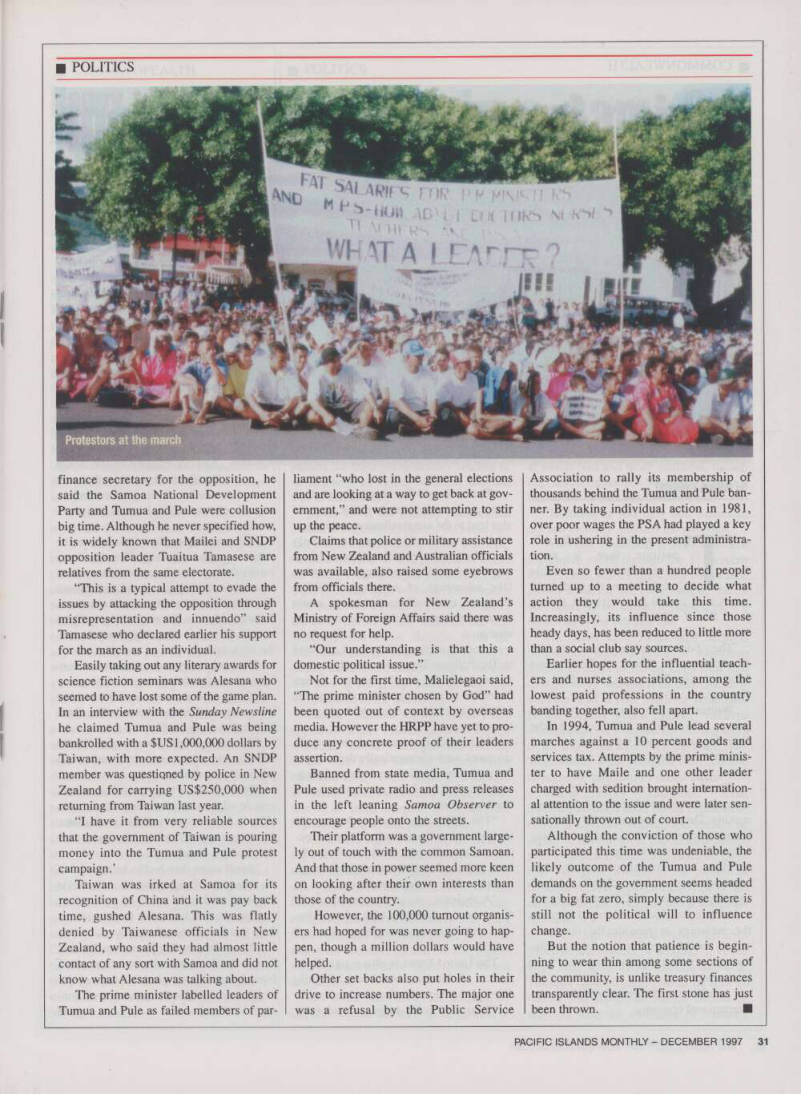
On a dry, hot morning villagers from both main islands assembled at Vaimoso village, about two miles from Apia. Joining them were a group from neighbouring American Samoa.
“Whatever happens in Samoa also affects us here. That’s why we are taking part” said a spokesperson for the group.
Waving banners and accompanied by
brass bands, the procession slowly weaned its way to the government complex in the middle of town.
Escorted by dozens of police on the streets and hundreds more at the rally point, no arrests were made, even at one
point when acting prime minister Tuilaepa
Malielegaoi drove his land cruiser along side the march in what seemed to be a flaky attempt to ridicule or intimidate. Least impressed by his antics were a contingent from his own electorates on the front line of the demonstration.
As the protest entered the frontage to the government complex, which was cor doned off to isolate the procession, scuffles involving several protesters and police broke out. No arrests were made.
“We want you (the government) to resign, the reasons are already clear,”
Mailei told Malielegaoi and cabinet mem bers at the steps of the seven storey state building.
“People are tired of the never ending struggle, the political scandals and lies that
everything is going alright because it’s
only that way for very few people. The rest
are paying for them,” he said afterwards.
A deadline of 14 days was requested for the government to respond to the seven page document handed to them.
Traditional courtesies of quiet respect were replaced with dissent as jeers and cat calls from the crowd peppered
Malielegaoi’s replying speech.
“You are not controlling your people Faamatuainu,” he said as marshals called for calm.
Cabinet needed time to discuss the pro posals then give their response, said Malielegaoi, adding he had given up an important meeting in Africa because of the protest.
In the weeks leading up to the march, the HRPP launched a propaganda cam paign that verged on overkill. While taking every opportunity to publicly label the protest a flop, backstage they acted more like a sequel to Tianemanu Square was about to descend on the Chinese bankrolled complex they now inhabit.
Days before, the Public Service Commission released a four-part internal memorandum, on how the several hundred employees should react if the building was taken over by protesters.
Signed by the secretary to the commis sion Dr Luaiufi Moli, it stressed undivided
loyalty to the government “by refraining
from interfering in any way with the order ly process of government, even if it might be in his personal interest to do so.”
The tacit warning was obvious enough.
March and you may not have your job or future prospects much longer.
With Prime Minister Tofilau Eti Alesana overseas, Malielegaoi lost no time taking centre stage. For days he splashed himself across state television and radio with a mind numbing tirade about the futil ity of the demonstration. A one time
finance secretary for the opposition, he said the Samoa National Development Party and Tumua and Pule were collusion big time. Although he never specified how, it is widely known that Mailei and SNDP opposition leader Tuaitua Tamasese are relatives from the same electorate.
“This is a typical attempt to evade the issues by attacking the opposition through misrepresentation and innuendo” said Tamasese who declared earlier his support for the march as an individual.
Easily taking out any literary awards for science fiction seminars was Alesana who seemed to have lost some of the game plan.
In an interview with the Sunday Newsline he claimed Tumua and Pule was being bankrolled with a SUS 1,000,000 dollars by Taiwan, with more expected. An SNDP member was questioned by police in New Zealand for carrying U 55250,000 when returning from Taiwan last year.
“I have it from very reliable sources that the government of Taiwan is pouring money into the Tumua and Pule protest
campaign.’
Taiwan was irked at Samoa for its recognition of China and it was pay back time, gushed Alesana. This was flatly denied by Taiwanese officials in New Zealand, who said they had almost little contact of any sort with Samoa and did not know what Alesana was talking about.
The prime minister labelled leaders of Tumua and Pule as failed members of par
liament “who lost in the general elections and are looking at a way to get back at gov ernment,” and were not attempting to stir up the peace.
Claims that police or military assistance from New Zealand and Australian officials was available, also raised some eyebrows from officials there.
A spokesman for New Zealand’s Ministry of Foreign Affairs said there was no request for help.
“Our understanding is that this a domestic political issue.”
Not for the first time, Malielegaoi said, “The prime minister chosen by God” had been quoted out of context by overseas media. However the HRPP have yet to pro duce any concrete proof of their leaders assertion.
Banned from state media, Tumua and Pule used private radio and press releases in the left leaning Samoa Observer to encourage people onto the streets.
Their platform was a government large ly out of touch with the common Samoan.
And that those in power seemed more keen on looking after their own interests than those of the country.
However, the 100,000 turnout organis ers had hoped for was never going to hap pen, though a million dollars would have
helped.
Other set backs also put holes in their drive to increase numbers. The major one was a refusal by the Public Service
Association to rally its membership of thousands behind the Tumua and Pule ban ner. By taking individual action in 1981, over poor wages the PSA had played a key role in ushering in the present administra tion.
Even so fewer than a hundred people turned up to a meeting to decide what action they would take this time.
Increasingly, its influence since those heady days, has been reduced to little more than a social club say sources.
Earlier hopes for the influential teach ers and nurses associations, among the lowest paid professions in the country banding together, also fell apart.
In 1994, Tumua and Pule lead several marches against a 10 percent goods and services tax. Attempts by the prime minis ter to have Maile and one other leader charged with sedition brought internation al attention to the issue and were later sen sationally thrown out of court.
Although the conviction of those who participated this time was undeniable, the likely outcome of the Tumua and Pule demands on the government seems headed for a big fat zero, simply because there is still not the political will to influence change.
But the notion that patience is begin ning to wear thin among some sections of the community, is unlike treasury finances transparently clear. The first stone has just been thrown. ■
Protestors at the march