Solomon Islands calls on Japan to
pp. 28-29 · Read in the full issue
Environment
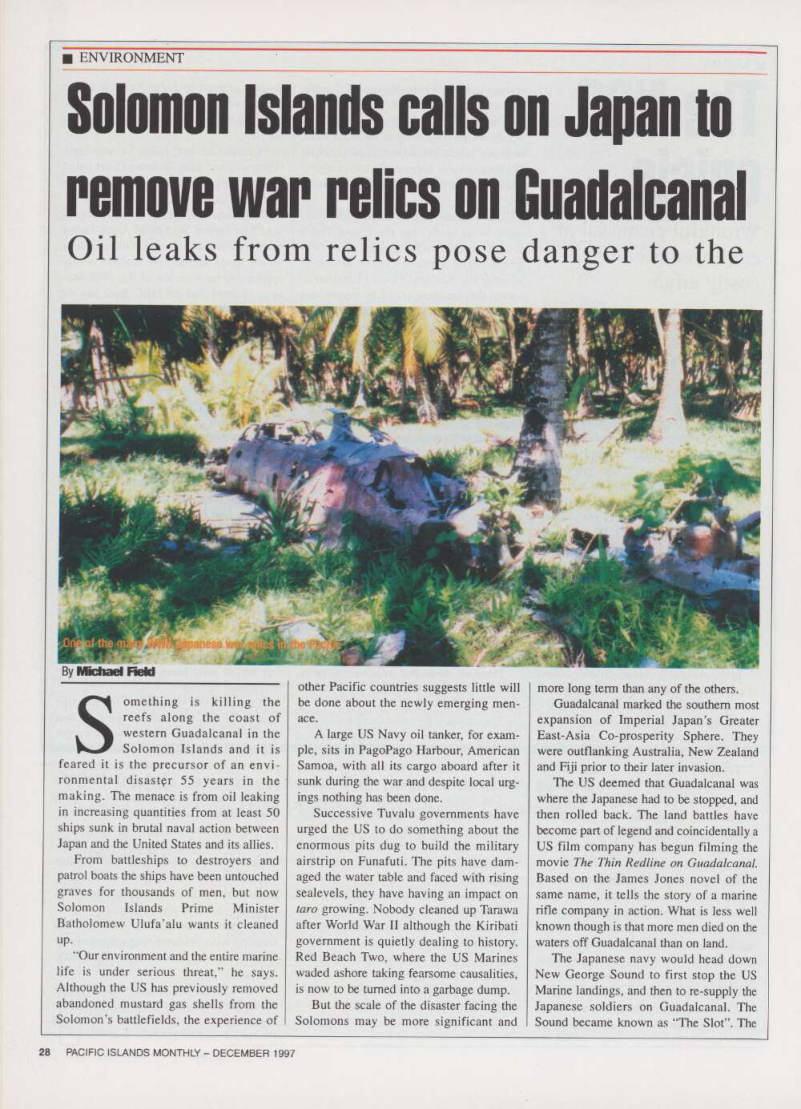
Solomon Islands calls on Japan to remove war relics on Guadalcanal Oil leaks from relics pose danger to the
Something is killing the
reefs along the coast of western Guadalcanal in the Solomon Islands and it is feared it is the precursor of an envi ronmental disaster 55 years in the making. The menace is from oil leaking in increasing quantities from at least 50 ships sunk in brutal naval action between Japan and the United States and its allies.
From battleships to destroyers and patrol boats the ships have been untouched graves for thousands of men, but now Solomon Islands Prime Minister Batholomew Ulufa’alu wants it cleaned up.
“Our environment and the entire marine life is under serious threat,” he says.
Although the US has previously removed abandoned mustard gas shells from the Solomon’s battlefields, the experience of
other Pacific countries suggests little will be done about the newly emerging men ace.
A large US Navy oil tanker, for exam ple, sits in PagoPago Harbour, American Samoa, with all its cargo aboard after it sunk during the war and despite local urg ings nothing has been done.
Successive Tuvalu governments have urged the US to do something about the enormous pits dug to build the military airstrip on Funafuti. The pits have dam aged the water table and faced with rising sealevels, they have having an impact on taro growing. Nobody cleaned up Tarawa after World War II although the Kiribati government is quietly dealing to history.
Red Beach Two, where the US Marines waded ashore taking fearsome causalities, is now to be turned into a garbage dump.
But the scale of the disaster facing the Solomons may be more significant and
more long term than any of the others.
Guadalcanal marked the southern most expansion of Imperial Japan’s Greater
East-Asia Co-prosperity Sphere. They
were outflanking Australia, New Zealand and Fiji prior to their later invasion.
The US deemed that Guadalcanal was where the Japanese had to be stopped, and then rolled back. The land battles have become part of legend and coincidentally a US film company has begun filming the movie The Thin Redline on Guadalcanal.
Based on the James Jones novel of the same name, it tells the story of a marine rifle company in action. What is less well known though is that more men died on the waters off Guadalcanal than on land.
The Japanese navy would head down New George Sound to first stop the US Marine landings, and then to re-supply the Japanese soldiers on Guadalcanal. The Sound became known as “The Slot”. The
“Tokyo Express ” as the ships became known, terminated their missions in Iron Bottom Sound, a vast placid sea of water between Guadalcanal and the Florida Islands. Entry to the Sounds is dominated by the volcanic Savo Island.
The Battle of Savo Island on August 9, 1942, between Savo and Cape Esperance, was one of the most humiliating defeats in US Navy history. Four heavy ships were lost, including USS Quincy and the Australian heavy cruiser Canberra. The Japanese got away undamaged.
American revenge came in the two bat tles collectively known as the Battle of Guadalcanal between November 12 and 15, 1942. The Japanese lost an aircraft car rier, Kinugasa. Also lost was the Japanese battleship Kirishima which ended up upside down on the sea floor following one of the last battleship-to-battleship encounters ever to take place.
When it was all over both sides had each lost 24 combatant hips, as well as dozens of patrol boats, auxiliaries and transports.
The affair stirs deep American emotion and their celebrated naval historian has written of it that Guadalcanal is not a name
but an emotion. “Tactically, Guadalcanal was a profitable lesson book for the US navy, army and marine corps.
Strategically, it stopped the enemy in his many-taloned reach for the antipodes ...
The jagged cone of Savo Island, forever brooding over the once blood-thickened waters of Iron Bottom Sound, stands as a perpetual monument to the men and ships who here rolled back the enemy tide.”
In 1992, American oceanographer Robert Ballard mounted a multi-million dollar exploration of Iron Bottom Sound.
He made his name with his discovery of the wreck of Titanic. He located 13 of the wrecks in the deep sound which is swept with strong currents.
“We found wrecks in remarkably good shape, given the beating they took, and wrecks blasted into pieces almost beyond recognition,” he writes in his book The Lost Ships of Guadalcanal. He said the Iron Bottom Sound was as chaotic and confused as the battles themselves.
“No one has turned the graveyard into a well-manicured park, or etched inscrip tions on its gravestones. But it is a quiet and contemplative place.” That will change if the new Solomon’s government
gets its way. Minister of State Alfred Sasako told PIM the reefs were dying around western Guadalcanal and the prob lem was spreading towards the Russell Islands.
“We can’t pinpoint it to anything else, there is no industry there, and so believe it must be the ships,” he said. “We can’t sit and wait for anything more to happen, something has to be done.”
Ulufa’alu raised the issue initially in a letter to the Japanese government while he was in Tokyo for the Pacific Summit. He is also taking it up with the US. His govern ment could not handle it, although the country was facing an environmental dis aster of phenomenal proportions because nearly all the warships had begun oozing oil. Fish and marine life were beginning to die.
“It the biggest environmental threat my country will face and there is no way that we can handle such an emergency on our own,” he said. He did not want those responsible for the ships to act only after the disaster had become obvious. “I am therefore calling on the allies and Japanese government to start doing something before it is too late.” ■