Region faces security problem
p. 32 · Read in the full issue
Commonwealth
By Asha Chand
The smaller South Pacific nations face a more uncertain and unstable world than they did 10 years ago, says a book titled A Future for Small States - Overcoming Vulnerability.
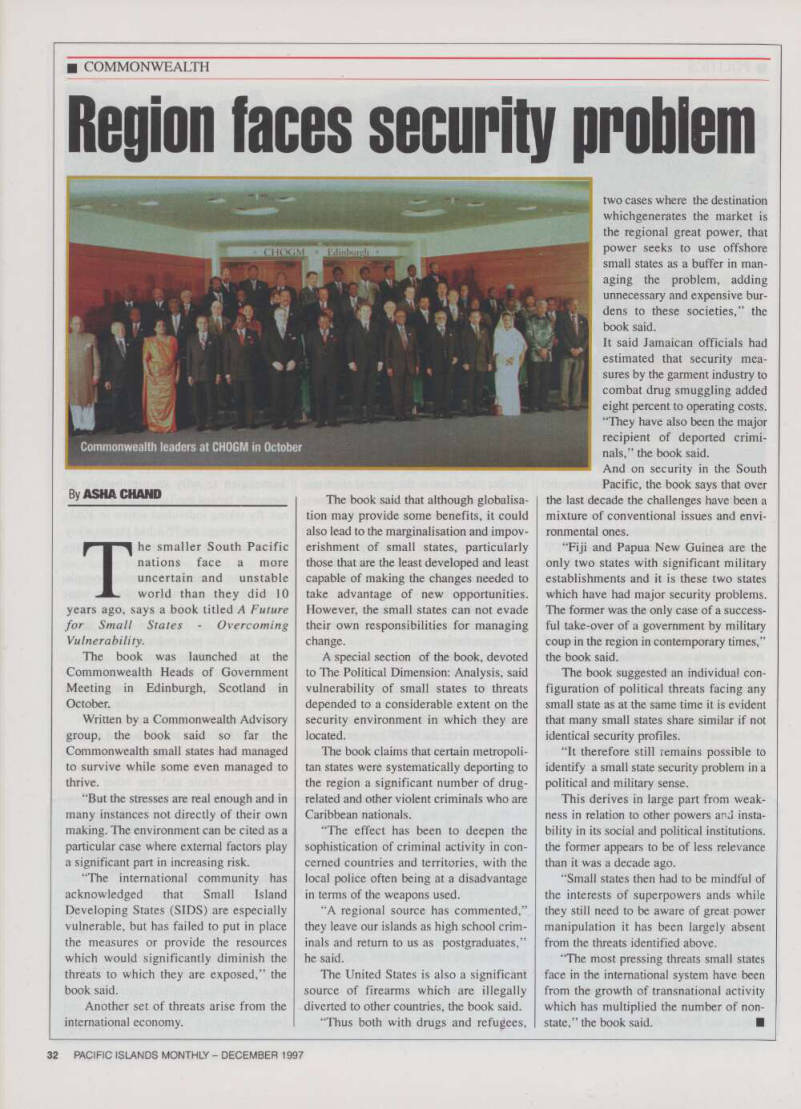
The book was launched at the Commonwealth Heads of Government Meeting in Edinburgh, Scotland in October.
Written by a Commonwealth Advisory group, the book said so far the Commonwealth small states had managed to survive while some even managed to thrive.
“But the stresses are real enough and in many instances not directly of their own making. The environment can be cited as a particular case where external factors play a significant part in increasing risk.
“The international community has acknowledged that Small Island Developing States (SIDS) are especially vulnerable, but has failed to put in place the measures or provide the resources which would significantly diminish the threats to which they are exposed,” the book said.
Another set of threats arise from the international economy.
The book said that although globalisa tion may provide some benefits, it could also lead to the marginalisation and impov erishment of small states, particularly those that are the least developed and least capable of making the changes needed to take advantage of new opportunities.
However, the small states can not evade their own responsibilities for managing change.
A special section of the book, devoted to The Political Dimension: Analysis, said vulnerability of small states to threats depended to a considerable extent on the security environment in which they are located.
The book claims that certain metropoli tan states were systematically deporting to the region a significant number of drug related and other violent criminals who are Caribbean nationals.
“The effect has been to deepen the sophistication of criminal activity in con cerned countries and territories, with the local police often being at a disadvantage in terms of the weapons used.
“A regional source has commented,” they leave our islands as high school crim inals and return to us as postgraduates,” he said.
The United States is also a significant source of firearms which are illegally diverted to other countries, the book said.
“Thus both with drugs and refugees,
two cases where the destination whichgenerates the market is the regional great power, that power seeks to use offshore small states as a buffer in man
aging the problem, adding
unnecessary and expensive bur dens to these societies,” the book said.
It said Jamaican officials had estimated that security mea sures by the garment industry to combat drug smuggling added eight percent to operating costs.
“They have also been the major recipient of deported crimi nals,” the book said.
And on security in the South Pacific, the book says that over
the last decade the challenges have been a mixture of conventional issues and envi ronmental ones.
“Fiji and Papua New Guinea are the only two states with significant military establishments and it is these two states which have had major security problems.
The former was the only case of a success ful take-over of a government by military coup in the region in contemporary times,” the book said.
The book suggested an individual con figuration of political threats facing any small state as at the same time it is evident that many small states share similar if not identical security profiles.
“It therefore still remains possible to identify a small state security problem in a political and military sense.
This derives in large part from weak ness in relation to other powers and insta bility in its social and political institutions, the former appears to be of less relevance than it was a decade ago.
“Small states then had to be mindful of the interests of superpowers ands while they still need to be aware of great power manipulation it has been largely absent from the threats identified above.
“The most pressing threats small states face in the international system have been from the growth of transnational activity which has multiplied the number of non state,” the book said. ■
Commonwealth leaders at CHOGM in October