Fish dreaming
pp. 51-52 · Read in the full issue
By Liz Thompson
Bangarra’s last work.
Ochres, drew on the rela tionship between Aboriginal peoples and the land, “exploring the mystical sig nificance of the substance of ochre, inspired by its spiritual and medicinal power”. The company’s new work, Fish, Bangarra tell us, “continues this story of the earth and the base power of the elements, taking the journey to the vast bodies of water”.
“As disparate, as diverse as Aboriginal identity itself, Fish celebrates the seas, the rivers, the swamps, and the wealth of life and mystery they contain.”
Stephen Page, artistic director of Bangarra and his brother, David, who is the company’s composer, have established their position as a leading creative force in contemporary dance in Australia. In 1993, Stephen received a Mo Award for Dancer Performer of the Year and, under his artis tic directorship, Bangarra was voted joint winner of the prestigious Sidney Myer Performing Arts Awards in 1993. He was also a recipient of a Young Australian Creative Fellowship in 1995. David has an equally impressive track record and, in 1995, the soundtrack for Ochres, on which he collaborated with Stephen and Bernadette Walong, was released as a CD and went on to win the 1995 Deadly Sounds Award for Best Soundtrack. In 1996, the soundtrack he produced for Alchemy, the first Australian Ballet piece choreographed by an indigenous artist, in this case his brother Stephen. This sound track won the 1996 Deadly Sounds Award for Best Soundtrack.
Both urban Aboriginal, born and raised in Brisbane, the Page brothers collaborate closely with Djakapurra Munyarryun.
Munyarryun works as both dancer and Bangarra's cultural designer. Born in Yirrkala, north-eastern Arnhem land, his life has been filled with traditional dance and ceremony. Despite his relatively young
age, he is looked upon and respected as an elder in his community. It is Munyarryun’s links with traditional culture that have been instrumental in enabling the compa ny to combine traditional dance and music with more contemporary influences so successfully.
This latest production is a tribute to the richness of his collaboration. Not only does it combine these influences beautiful ly, it also attempts, on a deeper level, to build bridges. The work draws together the work and influences of urban Aboriginal artists bom and raised in cities and that of traditional Aboriginal artists, bom and raised ‘out bush’ and Torres Strait Islander culture.
Fish is part of the Festival of the
Dreaming, which ran for three weeks in late September and early October in Sydney. Some of the visual art exhibitions which are a part of the festival will be open right through to the end of the year.
Fish is broken into three parts, “Swamp”, “Traps” and “Reef’.
Together, these pieces run for just
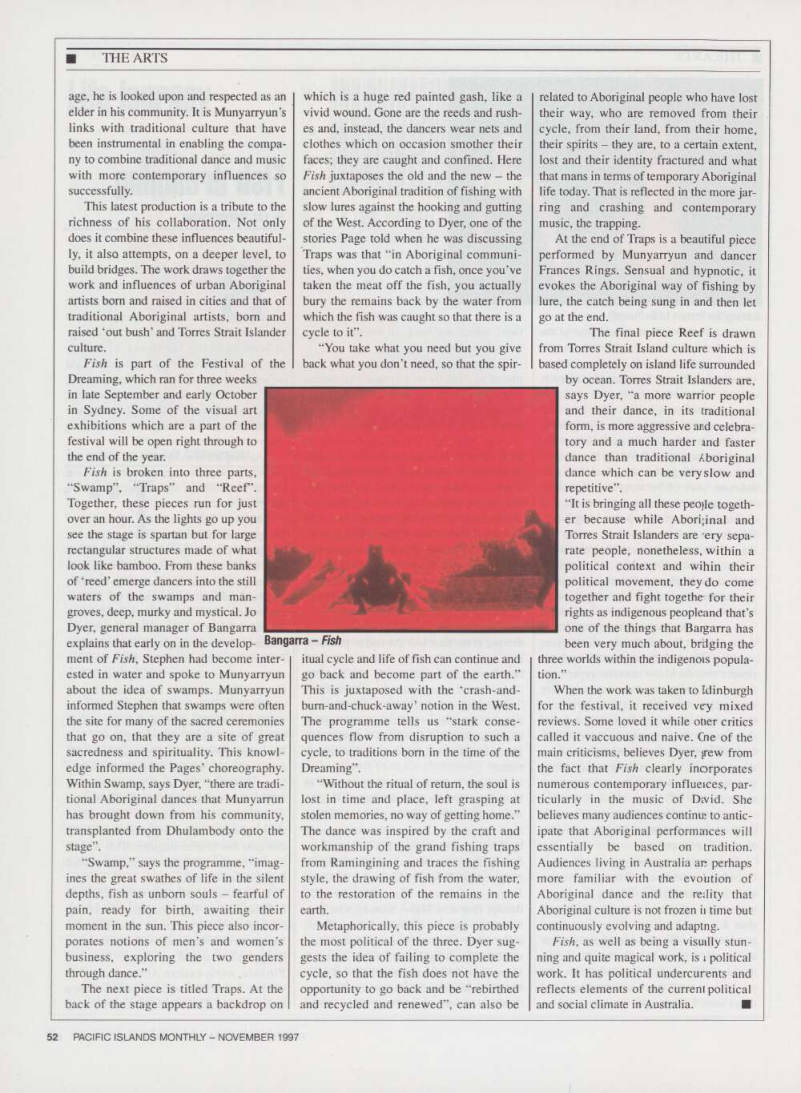
over an hour. As the lights go up you see the stage is spartan but for large rectangular structures made of what look like bamboo. From these banks of Teed’ emerge dancers into the still waters of the swamps and man groves, deep, murky and mystical. Jo Dyer, general manager of Bangarra explains that early on in the develop
ment of Fish, Stephen had become inter ested in water and spoke to Munyarryun about the idea of swamps. Munyarryun informed Stephen that swamps were often the site for many of the sacred ceremonies that go on, that they are a site of great sacredness and spirituality. This knowl
edge informed the Pages’ choreography.
Within Swamp, says Dyer, "there are tradi tional Aboriginal dances that Munyarrun has brought down from his community, transplanted from Dhulambody onto the stage”.
“Swamp,” says the programme, “imag ines the great swathes of life in the silent depths, fish as unborn souls - fearful of pain, ready for birth, awaiting their moment in the sun. This piece also incor porates notions of men’s and women’s business, exploring the two genders
through dance.”
The next piece is titled Traps. At the back of the stage appears a backdrop on
which is a huge red painted gash, like a vivid wound. Gone are the reeds and rush es and, instead, the dancers wear nets and clothes which on occasion smother their faces; they are caught and confined. Here Fish juxtaposes the old and the new - the ancient Aboriginal tradition of fishing with slow lures against the hooking and gutting of the West. According to Dyer, one of the stories Page told when he was discussing Traps was that “in Aboriginal communi ties, when you do catch a fish, once you’ve taken the meat off the fish, you actually bury the remains back by the water from which the fish was caught so that there is a cycle to it”.
“You take what you need but you give back what you don’t need, so that the spir-
itual cycle and life of fish can continue and go back and become part of the earth.”
This is juxtaposed with the ‘crash-and bum-and-chuck-away’ notion in the West.
The programme tells us “stark conse quences flow from disruption to such a cycle, to traditions bom in the time of the
Dreaming”.
“Without the ritual of return, the soul is lost in time and place, left grasping at stolen memories, no way of getting home.”
The dance was inspired by the craft and workmanship of the grand fishing traps from Ramingining and traces the fishing style, the drawing of fish from the water, to the restoration of the remains in the earth.
Metaphorically, this piece is probably the most political of the three. Dyer sug gests the idea of failing to complete the cycle, so that the fish does not have the opportunity to go back and be “rebirthed and recycled and renewed”, can also be
related to Aboriginal people who have lost their way, who are removed from their cycle, from their land, from their home, their spirits - they are, to a certain extent, lost and their identity fractured and what that mans in terms of temporary Aboriginal life today. That is reflected in the more jar ring and crashing and contemporary music, the trapping.
At the end of Traps is a beautiful piece performed by Munyarryun and dancer Frances Rings. Sensual and hypnotic, it evokes the Aboriginal way of fishing by lure, the catch being sung in and then let go at the end.
The final piece Reef is drawn from Torres Strait Island culture which is based completely on island life surrounded
by ocean. Torres Strait Islanders are, says Dyer, “a more warrior people and their dance, in its traditional form, is more aggressive and celebra tory and a much harder and faster dance than traditional Aboriginal dance which can be very slow and repetitive”.
“It is bringing all these peo)le togeth er because while Aboriginal and Torres Strait Islanders are cry sepa rate people, nonetheless, within a political context and wihin their political movement, they do come together and fight togethe- for their rights as indigenous peopleand that’s one of the things that Bargarra has been very much about, bridging the
three worlds within the indigenois popula tion.”
When the work was taken to Idinburgh for the festival, it received vey mixed reviews. Some loved it while oner critics called it vaccuous and naive. Cne of the main criticisms, believes Dyer, gew from the fact that Fish clearly inorporates numerous contemporary influeices, par ticularly in the music of Drvid. She believes many audiences continu; to antic ipate that Aboriginal performances will essentially be based on tradition.
Audiences living in Australia an perhaps more familiar with the evoution of Aboriginal dance and the redity that Aboriginal culture is not frozen ii time but continuously evolving and adaptng.
Fish, as well as being a visuilly stun ning and quite magical work, is j political work. It has political undercurents and reflects elements of the current political and social climate in Australia. ■
Bangarra - Fish