Life journey
pp. 50-51 · Read in the full issue
The Arts
not only Cheetham but undoubtedly in the lives of all ‘The Stolen Generation”.
Through an interesting combination of opera and story telling, Cheetham reveals her journey from, the programme tells us, “the confines of a strict, white Baptist upbringing into the mystery of her life as a Koori lesbian, where the fight goes on to find a place where you can be all that you are meant to be”.
In the play, she recounts her childhood, her younger years, learning music and being sexually abused by the music teach er, how she was, in her own words, “well and truly educated out of being Aboriginal”.
“I couldn’t identify as an Aboriginal. It wasn’t an option when I was growing up; there were no role models, there were no positive images, there seemed to be very little support from the community in gen eral towards images; there seemed to be very little support from the community in general towards a positive Aboriginal iden
tity.”
In this climate, she first met her mother when she was 21 years old and "didn't know how to deal with that, didn’t know how to relate”.
It wasn’t until Cheetham was 30 that she had what she calls an identity crisis, "so much so that I felt like my whole world was falling apart and I realised that I really needed to embrace my Aboriginality”.
“It was a very deep spiritual thing and I’d been suppressing it for so long. I could
/ / always knew I
was Aboriginal
but everyone M thought I’d get over it! Growing up in that kind of world started me on an exhausting search for a place to belong. I’ve never been satisfied with tolerance; nothing less than acceptance will do.
It took me 30 years to bring all the pieces together in order to write White Baptist Abba Fan. It’s my journey, and I’m still living it.”
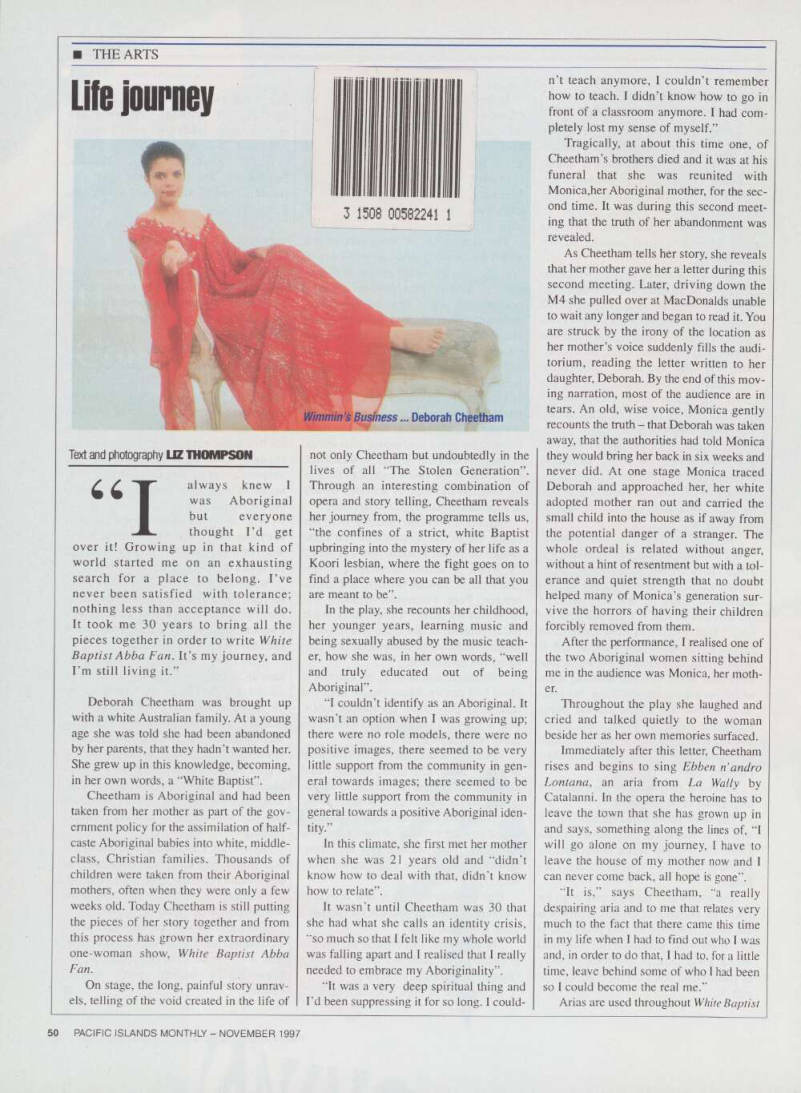
Deborah Cheetham was brought up with a white Australian family. At a young age she was told she had been abandoned by her parents, that they hadn’t wanted her.
She grew up in this knowledge, becoming, in her own words, a “White Baptist”.
Cheetham is Aboriginal and had been taken from her mother as part of the gov ernment policy for the assimilation of half caste Aboriginal babies into white, middle class, Christian families. Thousands of children were taken from their Aboriginal mothers, often when they were only a few weeks old. Today Cheetham is still putting the pieces of her story together and from this process has grown her extraordinary one-woman show, White Baptist Abba Fan.
On stage, the long, painful story unrav els, telling of the void created in the life of
rft teach anymore, I couldn’t remember how to teach. I didn’t know how to go in front of a classroom anymore. I had com pletely lost my sense of myself.”
Tragically, at about this time one, of Cheetham’s brothers died and it was at his funeral that she was reunited with Monica,her Aboriginal mother, for the sec ond time. It was during this second meet ing that the truth of her abandonment was revealed.
As Cheetham tells her story, she reveals that her mother gave her a letter during this second meeting. Later, driving down the M 4 she pulled over at MacDonalds unable to wait any longer and began to read it. You are struck by the irony of the location as her mother’s voice suddenly fills the audi torium, reading the letter written to her daughter, Deborah. By the end of this mov ing narration, most of the audience are in tears. An old, wise voice, Monica gently recounts the truth - that Deborah was taken away, that the authorities had told Monica they would bring her back in six weeks and never did. At one stage Monica traced Deborah and approached her, her white adopted mother ran out and carried the small child into the house as if away from the potential danger of a stranger. The whole ordeal is related without anger, without a hint of resentment but with a tol erance and quiet strength that no doubt helped many of Monica’s generation sur vive the horrors of having their children forcibly removed from them.
After the performance, I realised one of the two Aboriginal women sitting behind me in the audience was Monica, her moth er.
Throughout the play she laughed and cried and talked quietly to the woman beside her as her own memories surfaced.
Immediately after this letter, Cheetham rises and begins to sing Ebben n’andro Lontana, an aria from La Wally by Catalanni. In the opera the heroine has to leave the town that she has grown up in and says, something along the lines of, ”1 will go alone on my journey, 1 have to leave the house of my mother now and 1 can never come back, all hope is gone”.
"It is,” says Cheetham, "a really despairing aria and to me that relates very much to the fact that there came this time in my life when I had to find out who I was and, in order to do that, I had to, for a little time, leave behind some of who I had been so 1 could become the real me.”
Arias are used throughout White Baptist
Text and photography UZ THOMPSON
Wimmin’s Business ... Deborah Cheetham
Abban Fan to heighten the emotion of the moment.
By profession an opera singer, Cheetham believes, because the story is entirely autobiographical, the style is appropriate. Opera is, she says, “my lan guage, my repertoire, some people paint in oil, some in water colour, opera is my lan guage for expression”. Whilst for some it may seem strange, breaking from the soft, intimate voice of the storyteller speaking in English to what often seems the highly dramatic voice of the operate singer per forming in Italian, Cheetham points out that all the arias were carefully selected to reflect the mood of her story. “You can lis ten to different pieces of music and it alters your mood without your knowing it, what key it is in, what time it is in - it’s the same with opera. OK, you might not understand the words but, hopefully, the music gives you that sense of the moment. For those people who do know operatic repertoire, they would know that there are some very strong links texturally with the lyrics and the story. I’ve always been of the belief that opera is for everyone because it is so beautiful and you don’t need to know what the words are; music is there to say things that words can’t say, it’s the emotional res onance.”
In this way, the emotions and moods weaved through storytelling are height ened and developed.
The process of performing is, says Cheetham, cathartic. "Even now, even after just three nights of doing the play, 1 understand so much more about myself than 1 ever did before. There are some painful things, like the sexual abuse from the singing teacher - I’d never dealt with that until this week. Fd written it into the play but up until this week performing, 1 don't think I’d ever got into the emotion
that I was actually feel
ing.”
Each night people go backstage and tell her there are things that hap pened in the play that hap pened to them. “I’ve had adopted people come and say, T’m adopted and I really related to that’; I’ve had people that were sexu ally abused come and talk about that.” There is little doubt that, on some level, everybody in the audience
must relate; we have all been children, many have been mothers.
To be taken from you mother and placed in a family by a system that denied you your culture, the love of your parents and siblings must touch a chord in all who contemplate it. The grief of Monica which one can only begin to imagine is enough to both outrage and sadden any person with an ounce of compassion. But within it all there is humour, there is still laughter, and this, says Cheetham, is essential, “because if I hadn’t inherited my mum’s sense of humour, I don’t think I’d be talking to you today”. At one stage, when Cheetham was overcome with resentment towards her adopted family and spoke to Monica about it, she said, “Oh don’t blame your adoptive mother, that’s probably all she knew.”
Cheetham describes how they were driving at the time and she had to pull over in her car and take it in. “If she can forgive her after all that’s happened,” she thought, “I don’t need to hold onto this resentment.”
The play is not bitter, it is not divisive despite the tragic policies which have caused such suffering, within it there is for giveness and - not tolerance - but accep tance.
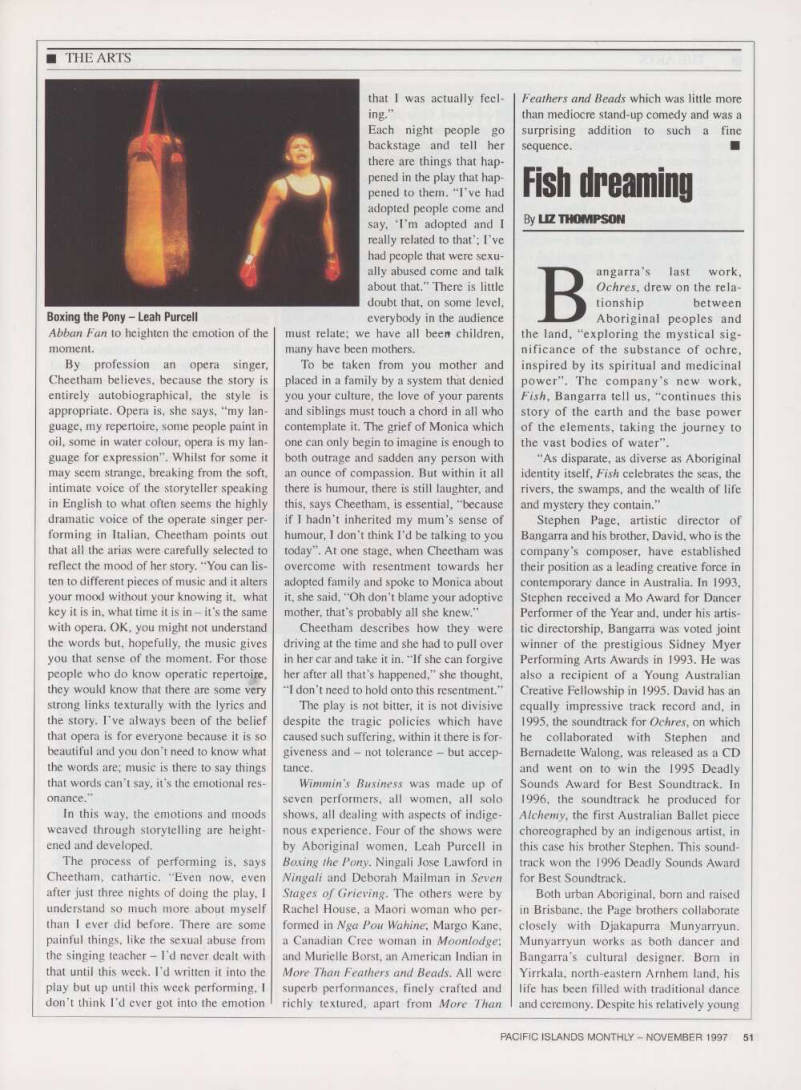
Wimmin’s Business was made up of seven performers, all women, all solo shows, all dealing with aspects of indige nous experience. Four of the shows were by Aboriginal women, Leah Purcell in Boxing the Pony. Ningali Jose Lawford in Ningali and Deborah Mailman in Seven Stages of Grieving. The others were by Rachel House, a Maori woman who per formed in Nga Pou Wahine; Margo Kane, a Canadian Cree woman in Moonlodge\ and Murielle Borst, an American Indian in More Than Feathers and Beads. All were superb performances, finely crafted and richly textured, apart from More Than
Feathers and Beads which was little more than mediocre stand-up comedy and was a surprising addition to such a fine sequence. ■
Boxing the Pony - Leah Purcell