Queen
pp. 48-49 · Read in the full issue
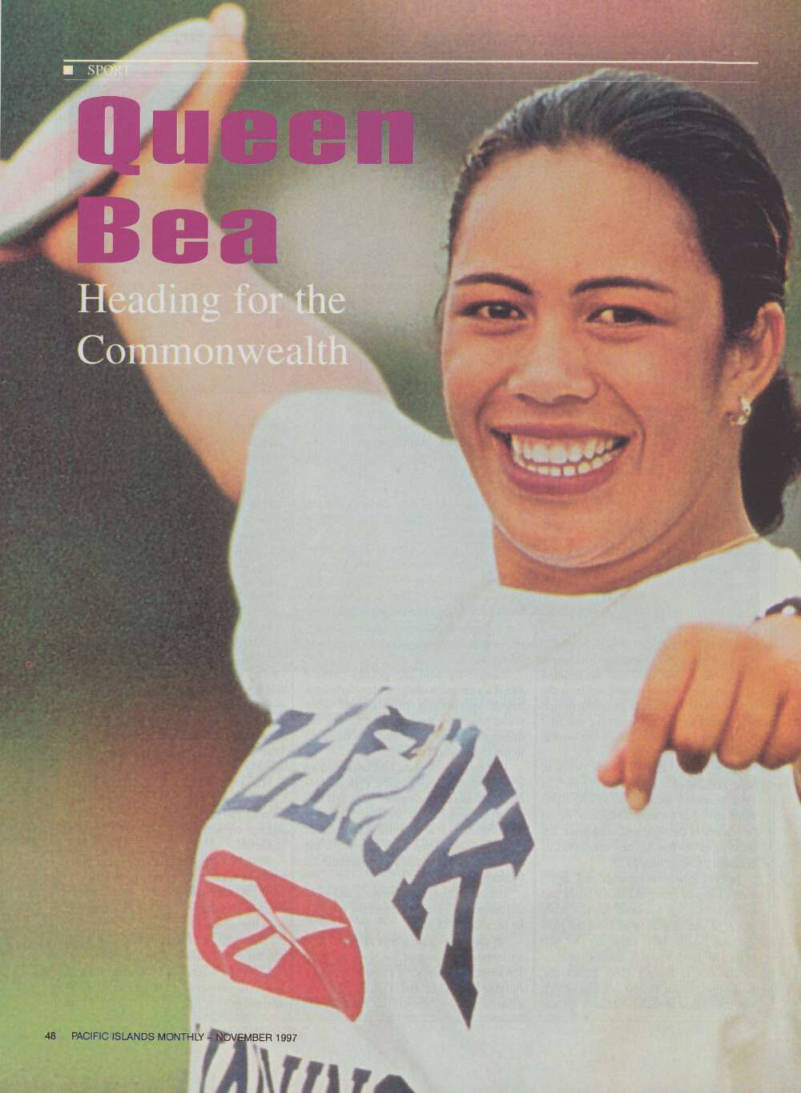
Bea
I■ A Mk: ’Ji %. ~'W^'
WR ■ * n .
By Atama Ragan Ivatu
Samoan discus thrower Beatrice Faumuina added her name to Pacific island sport’s roll of honour when claiming the gold medal at the recent World Athletics Championships in Athens. However, she almost gave her many admirers heart attacks in the process.
Faumuina produced foul throws for the initial two of the three attempts permitted each competitor in the qualifying round and prompted memories of the previous year’s Olympics in Atlanta, when she was eliminated at the earliest stage; being over awed by the occasion. Thankfully, Faumuina’s nerve held this time and she hurled the discus 64.58 metres - two metres beyond the qualifying mark and the second best length of the evening.
Her temperament was again tested two days later during the finals. Faumuina overbalanced in the follow through of the opening effort and the second was also judged a foul, although she felt the latter to
be legitimate.
“It was an excellent one,” she contends.
“I felt comfortable with my technique and I didn’t think my foot went outside the cir cle as the officials claimed. I contemplated arguing with them, but realised I would be the only one to lose if I did and kept my cool.” That discounted fling appeared to exceed 63 metres in length and would, if judged valid, have ensured Faumuina four more shots in the final and breathing space as she went about consolidating her posi tion. Instead, she found herself being required to conjure up a long - and legal throw in order to remain in the competition and avoid a repeat of her Atlanta embar rassment.
Faumuina responded to the challenge with a fling of 66.82 metres.
This more than ensured her survival - it won a gold medal. For the remainder of the event, she and the seven other finalists strived to heave their spheres further. They failed.
The victory may herald a long reign for Faumuina as queen of the discus. She was the youngest finalist by two years and, at 22, could well dominate for the next decade a discipline in which the majority of participants don’t hit their peaks until past 30.
Belorussian Ellina Zvereva, the World Championships silver medallist, is 36. If she does exert a stranglehold, there will be hardly any complaints. Used to top-level discus throwing as the almost sole domain of Eastern Europeans, the emergence of the Samoan was greeted with delight by ath letics fans, officials and media personnel alike.
Her motioning of the hands as she willed the winning throw on with cries of “go, fly” and her silent prayer of thanks when it landed, provided the champi onships with one of their most enduring memories. Over 90 congratulatory faxes awaited Faumuina at her hotel as she returned from the triumph and they were still being received on the evening she left for home.
Faumuina’s mother, Roini, had every justification to be supremely proud as she saw her daughter sparkle in both the stadi um and the press conference afterwards.
Making her only trip beyond New Zealand, Roini was in the Greek capital to witness the triumph and happily provided details of a quintessential rags-to-riches story.
Faumuina was bom and has lived her entire life in the upretentious Auckland suburb of Mount Roskill. She was raised by Roini, a second generation New Zealander of Samoan heritage, and grand mother, Pepe Faumuina. Beatrice has never met her father. “I learnt early in life the importance of discipline and respect,”
Beatrice reflected in Athens soon after cap turing her gold medal.
“We were, and remain, an extremely close-knit family. Many people believed that, as an only child, I would be spoilt.
But, whenever I stepped out of line, I cer tainly became aware of it.”
Roini then added: “My mother did actu ally spoil Beatrice at times, but she could also give her a good old-fashioned tongue lashing when it was required. And, on the rare occasions Beatrice did misbehave, 1 would provide a couple of slaps across the backside. That was rarely necessary, though, and she gave us no major prob lems.”
One of Beatrice’s very few regrets is that Pepe was unable to see her accomplish glory in Athens.
She died early in 1996 (on the day her granddaughter qualified for that year's Olympics) of a kidney disease.
At the time of Pepe’s death, Beatrice’s
career was gaining momentum under the coaching of former Commonwealth Games gold medallist and currently Auckland mayor, Les Mills. Eleven months earlier, Miriam Stanley, Faumuina’s original mentor, had also passed away and Mills agreed to step into Stanley’s shoes.
“Coaching Beatrice is my hobby,” Mills says today. “Other people play golf to relax, I coach Beatrice.”
Although Mills is not in a position to devote as many hours to Faumuina as the coaches of rival athletes spend alongside their charges, his input has been invalu able.
“Les has been the single most important factor in Beatrice’s advancement,” the manager of the New Zealand athletics team, Dave Norris claims. “He changed the emphasis of her training to weights follow ing the loss of Miriam. Les got her training for five hours each day and increased her strength work by a huge degree. The weights he has got her on have to be wit nessed to be believed and we are now see ing the results of those.”
With Mills’ strict routine, Faumuina augmented her weight by 18 kilograms much of it muscle - last year and now tips the scales at 116 kilograms.
When asked to explain the secret of her success, Faumuina replies earnestly: “I lis ten to my coach and am committed to what I want to achieve. I focus hard on my goals and strive hard to realise them.”
Male Pacific island sportsmen already have an abundance of admirable role mod els and now their sisters too have an exam ple they can look up to and endeavour to emulate. And, it appears likely Faumuina will provide numerous inspirational moments for them in the future. As well as a gold medal, she returned from Athens clutching a cheque for SUS6O,OOO. In addi tion, the New Zealand Sports Foundation has just announced it will increase her funding.
As a result, Faumuina is now a full-time athlete and, hopefully, this will enable her to maintain her edge against the other top 10 leading women’s discus throwers, whose sport is also their occupation.
Her sights are now set upon next year's Commonwealth Games in Malaysia. After that, it will be the 2000 Olympics and, per haps, Pacific islands sports’ greatest moment. ■