Bale battles on
pp. 46-47 · Read in the full issue
Sport
By Atama Raganivatu
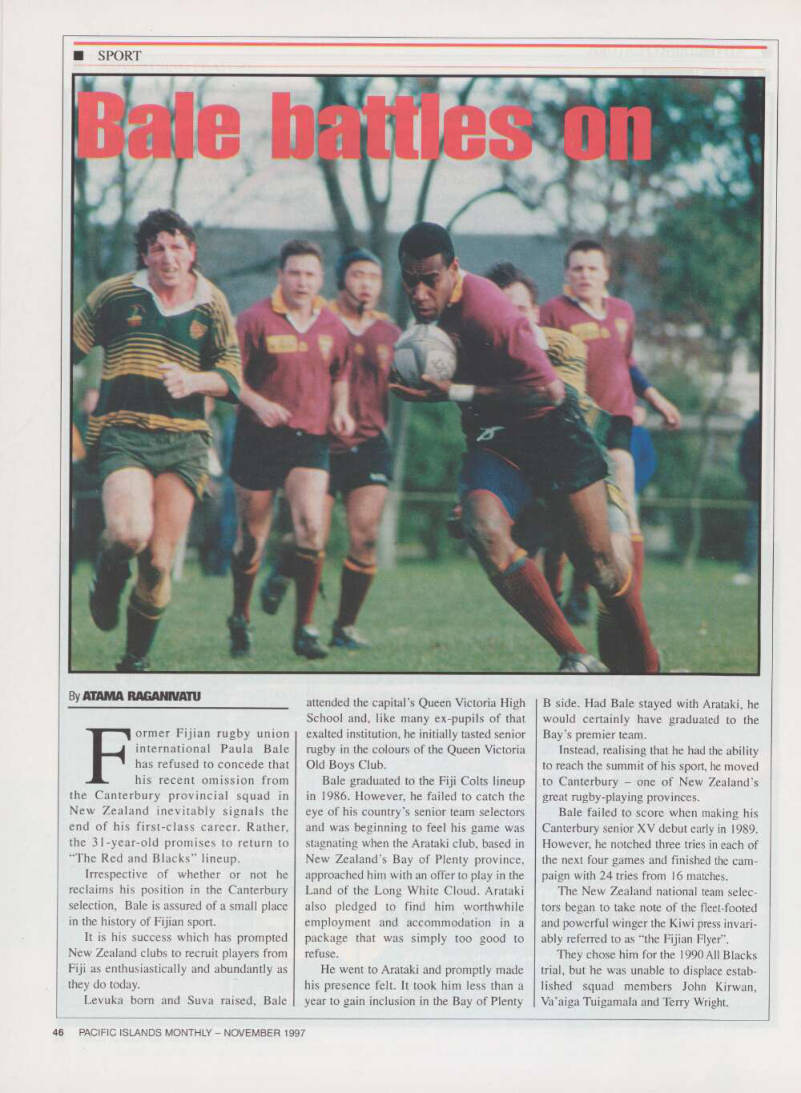
Former Fijian rugby union international Paula Bale has refused to concede that his recent omission from the Canterbury provincial squad in New Zealand inevitably signals the end of his first-class career. Rather, the 31 -year-old promises to return to “The Red and Blacks” lineup.
Irrespective of whether or not he reclaims his position in the Canterbury selection, Bale is assured of a small place in the history of Fijian sport.
It is his success which has prompted New Zealand clubs to recruit players from Fiji as enthusiastically and abundantly as they do today.
Levuka born and Suva raised, Bale
attended the capital’s Queen Victoria High School and, like many ex-pupils of that exalted institution, he initially tasted senior rugby in the colours of the Queen Victoria Old Boys Club.
Bale graduated to the Fiji Colts lineup in 1986. However, he failed to catch the eye of his country’s senior team selectors and was beginning to feel his game was stagnating when the Arataki club, based in New Zealand’s Bay of Plenty province, approached him with an offer to play in the Land of the Long White Cloud. Arataki also pledged to find him worthwhile employment and accommodation in a package that was simply too good to refuse.
He went to Arataki and promptly made his presence felt. It took him less than a year to gain inclusion in the Bay of Plenty
B side. Had Bale stayed with Arataki, he would certainly have graduated to the Bay’s premier team.
Instead, realising that he had the ability to reach the summit of his sport, he moved to Canterbury - one of New Zealand’s great rugby-playing provinces.
Bale failed to score when making his Canterbury senior XV debut early in 1989.
However, he notched three tries in each of the next four games and finished the cam paign with 24 tries from 16 matches.
The New Zealand national team selec tors began to take note of the fleet-footed and powerful winger the Kiwi press invari ably referred to as “the Fijian Flyer”.
They chose him for the 1990 All Blacks trial, but he was unable to displace estab lished squad members John Kirwan, Va’aiga Tuigamala and Terry Wright.
He had better luck in sevens rugby.
After helping Canterbury win the 1990 National Sevens Tournament, Bale was called up for the New Zealand side which travelled to Hong Kong that year and was beaten 22-10 in the final of the incompara ble Cathay Pacific-sponsored competition
by Fiji.
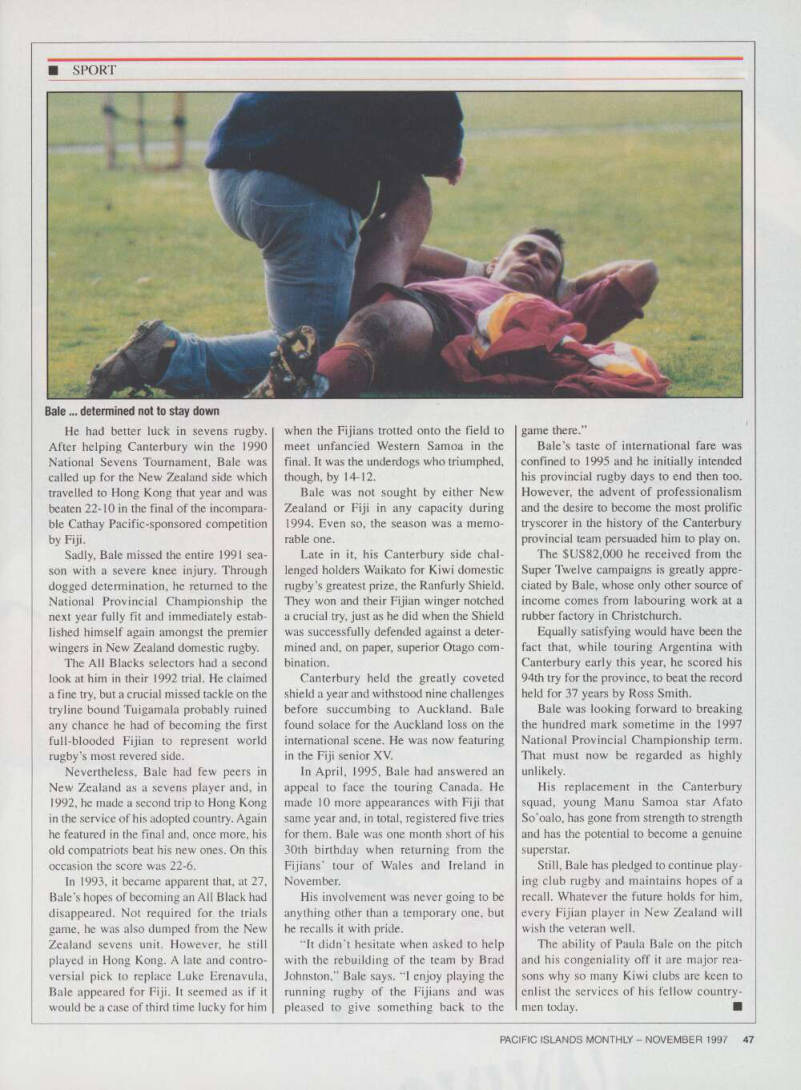
Sadly, Bale missed the entire 1991 sea son with a severe knee injury. Through dogged determination, he returned to the National Provincial Championship the next year fully fit and immediately estab lished himself again amongst the premier wingers in New Zealand domestic rugby.
The All Blacks selectors had a second look at him in their 1992 trial. He claimed a fine try, but a crucial missed tackle on the tryline bound Tuigamala probably ruined any chance he had of becoming the first full-blooded Fijian to represent world rugby’s most revered side.
Nevertheless, Bale had few peers in New Zealand as a sevens player and, in 1992, he made a second trip to Hong Kong in the service of his adopted country. Again he featured in the final and, once more, his old compatriots beat his new ones. On this occasion the score was 22-6.
In 1993, it became apparent that, at 27, Bale’s hopes of becoming an All Black had disappeared. Not required for the trials game, he was also dumped from the New Zealand sevens unit. However, he still played in Hong Kong. A late and contro versial pick to replace Luke Erenavula, Bale appeared for Fiji. It seemed as if it would be a case of third time lucky for him
when the Fijians trotted onto the field to meet unfancied Western Samoa in the final. It was the underdogs who triumphed, though, by 14-12.
Bale was not sought by either New Zealand or Fiji in any capacity during 1994. Even so, the season was a memo rable one.
Fate in it, his Canterbury side chal lenged holders Waikato for Kiwi domestic rugby’s greatest prize, the Ranfurly Shield.
They won and their Fijian winger notched a crucial try, just as he did when the Shield was successfully defended against a deter mined and, on paper, superior Otago com bination.
Canterbury held the greatly coveted shield a year and withstood nine challenges before succumbing to Auckland. Bale found solace for the Auckland loss on the international scene. He was now featuring in the Fiji senior XV.
In April, 1995, Bale had answered an appeal to face the touring Canada. He made 10 more appearances with Fiji that same year and, in total, registered five tries for them. Bale was one month short of his 30th birthday when returning from the Fijians’ tour of Wales and Ireland in November.
His involvement was never going to be anything other than a temporary one, but he recalls it with pride. ”It didn't hesitate when asked to help with the rebuilding of the team by Brad Johnston,” Bale says. “I enjoy playing the running rugby of the Fijians and was pleased to give something back to the
game there.”
Bale’s taste of international fare was confined to 1995 and he initially intended his provincial rugby days to end then too.
However, the advent of professionalism and the desire to become the most prolific tryscorer in the history of the Canterbury provincial team persuaded him to play on.
The SUSB2,OOO he received from the Super Twelve campaigns is greatly appre ciated by Bale, whose only other source of income comes from labouring work at a rubber factory in Christchurch.
Equally satisfying would have been the fact that, while touring Argentina with Canterbury early this year, he scored his 94th try for the province, to beat the record held for 37 years by Ross Smith.
Bale was looking forward to breaking the hundred mark sometime in the 1997 National Provincial Championship term.
That must now be regarded as highly unlikely.
His replacement in the Canterbury squad, young Manu Samoa star Afato So’oalo, has gone from strength to strength and has the potential to become a genuine superstar.
Still, Bale has pledged to continue play ing club rugby and maintains hopes of a recall. Whatever the future holds for him, every Fijian player in New Zealand will wish the veteran well.
The ability of Paula Bale on the pitch and his congeniality off it are major rea sons why so many Kiwi clubs are keen to enlist the services of his fellow country men today. ■
Bale determined not to stay down