Nuclear reactions
pp. 19-20 · Read in the full issue
Special Reports
By Maniuannan Naidu
Feeling very much the mis understood victims of mis information, the producers (France and the UK) and consumers (Japan) of nuclear fuel organised what was called the “Evidence Information Tour”.
Invitations were extended to aca demics and journalists from the South Pacific, South Africa South America, the Caribbean, UK and US to partici pate in a “visual and hands-on pro ject” about the nuclear fuel industry, said Jean-Claude Guais, vice-presi dent of COGEMA Inc.
The programme, organised by COGE MA (France), British Nuclear Fuels (UK) and Overseas Reprocessing Committee (Japan), included guided tours of nuclear reprocessing plants and shipment facilities in the UK and France as well as formal and informal discussions with academics (sym pathetic to the nuclear-energy cause) and representatives of the nuclear industry.
Breaking years of a silence synony mous with the industry, the producers and transporters of nuclear fuel wanted to con
vey their side of the story and were ready to answer any questions. In a major public relations exercise designed to rival the efforts of environmental lobbyists - partic ularly, Greenpeace - they hoped to dispel at least some of the myths and quash some of the hysteria that went with the word “nuclear”.
But before discussing the pros and cons of nuclear fuel from a South Pacific per spective, it is important to look at how the region fits into the picture.
Nuclear power accounts for about 17 per cent of the world’s electric energy and about 30 per cent of Japan’s. With scarce energy sources of its own, Japan promotes the recycling of nuclear fuel as an alterna tive to oil and a means of securing a more reliable energy source.
Essentially, nuclear recycling involves dissolving the spent fuel in nitric acid, after which the uranium and plutonium (which constitutes 97 per cent of the fuel) is sepa rated from the solution and then from each other. The separated plutonium and urani um can be used to produce fresh uranium or Mixed Oxide (MOX) fuel. The three per cent waste is dried to powder, mixed with glass-forming materials, melted and
poured into stainless steel flasks where it solidifies.
The recycled fuel and vitrified waste are returned to the country of origin. The shipments between between France and Japan are carried out by PNTL (Pacific Nuclear Transport Limited), the sharehold ers of which are BNFL (62.5 per cent), COGEM A (12.5 per cent) and Japanese utilities (25 per cent).
It is during the transport of spent fuel from Japan to French nuclear facilities and the transport back to Japan of recycled fuel and vitrified waste - that the South Pacific enters the scene, lying as it does en route of the shipment. The major protests against nuclear trans-shipment are based on the possibility of an accident (as remote as the nuclear companies would have them believe the chances for this are) and the consequences on the region.
Protest surrounding the industry is also based on the premise that the use of pluto nium as a nuclear fuel source increases the potential for proliferation of nuclear weapons. But W Reed Johnson, Emeritus Professor of Nuclear Physics, University of Virginia, in his paper (The Clinton Administration’s No-plutonium-use Policy: Should It Be Scrapped?) argues against this. Referring to the “threat to world secu rity posed by the large amounts of weapons-grade plutonium left in the for mer Soviet Union”, Johnson argues that “this material, formed into plutonium oxide and mixed with uranium oxide can be burned as a fuel...and virtually destroyed as a weapons material”.
One journalist on the Evidence Tour highlighted security risks and offered the scenario of a nuclear shipment being hijacked by terrorists. The terrorist sce nario may not be so far-fetched a possibil ity. There have been three bomb threats directed at BNFL operations in the past three years, the most recent in December last year. BNFL is, of course, quick to state that this represents a smalt percentage of the UK total and that it has security mea sures in place to deal with such incidents. ”We follow a detailed set of procedures, compiled in conjunction with the UK secu rity services and other police authorities, as well as the Atomic Energy Authority Constabulary, which deal with how we handle the credibility of such threats,” says Gavin Carter, BNFL's international trans port coordinator. “We also have procedures to check ships prior to each voyage which,
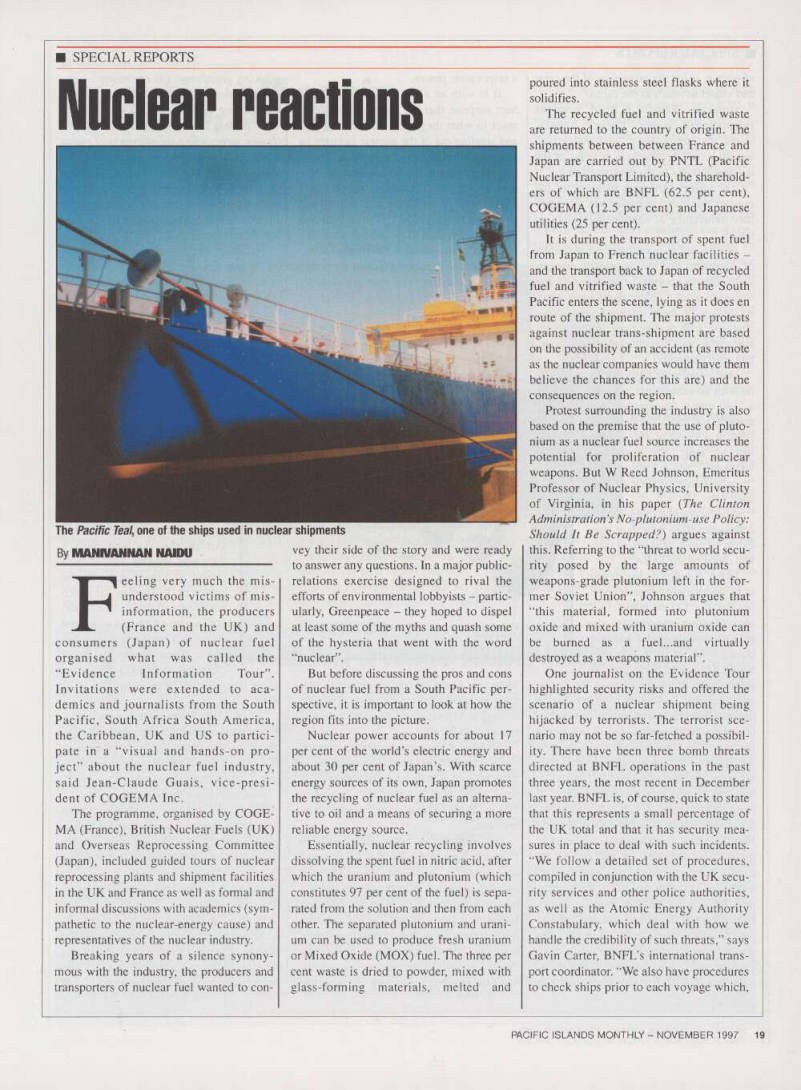
The Pacific Teal, one of the ships used in nuclear shipments
of course, is for the protection of the crew and vessel as much as the cargo.”
Ironically, Richard R Rawl, from the International Atomic Energy Agency, states that the fuel is “self-protective” against would-be hijackers in terms of the dangers it poses to those exposed to it.
The terrorist threat is also one of the reasons nuclear companies use to justify their reluctance at announcing shipment routes.
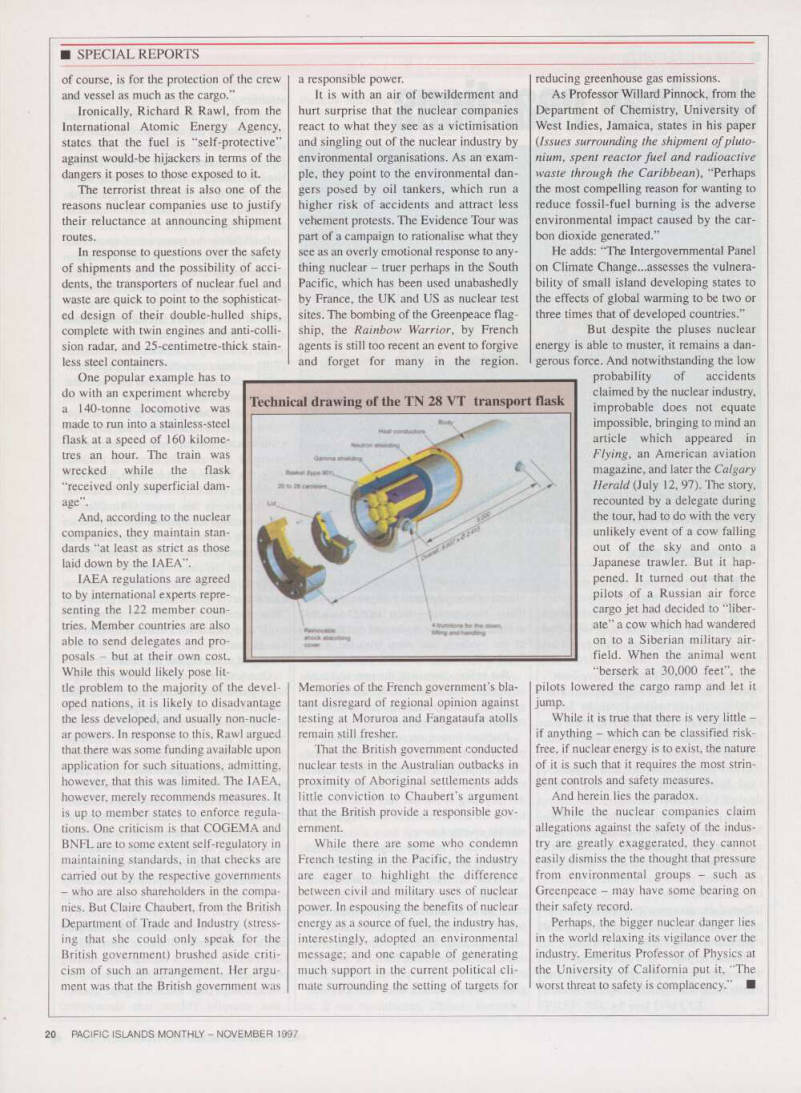
In response to questions over the safety of shipments and the possibility of acci dents, the transporters of nuclear fuel and waste are quick to point to the sophisticat ed design of their double-hulled ships, complete with twin engines and anti-colli sion radar, and 25-centimetre-thick stain less steel containers.
One popular example has to do with an experiment whereby a 140-tonne locomotive was made to run into a stainless-steel flask at a speed of 160 kilome tres an hour. The train was wrecked while the flask “received only superficial dam age”.
And, according to the nuclear companies, they maintain stan dards “at least as strict as those laid down by the lAEA”. lAEA regulations are agreed to by international experts repre senting the 122 member coun tries. Member countries are also able to send delegates and pro posals - but at their own cost.
While this would likely pose lit
tie problem to the majority of the devel oped nations, it is likely to disadvantage the less developed, and usually non-nucle ar powers. In response to this, Rawl argued that there was some funding available upon application for such situations, admitting, however, that this was limited. The lAEA, however, merely recommends measures. It is up to member states to enforce regula tions. One criticism is that COGEMA and BNFL are to some extent self-regulatory in maintaining standards, in that checks are carried out by the respective governments - who are also shareholders in the compa nies. But Claire Chaubert, from the British Department of Trade and Industry (stress ing that she could only speak for the British government) brushed aside criti cism of such an arrangement. Her argu ment was that the British government was
a responsible power.
It is with an air of bewilderment and hurt surprise that the nuclear companies react to what they see as a victimisation and singling out of the nuclear industry by environmental organisations. As an exam ple, they point to the environmental dan gers posed by oil tankers, which run a higher risk of accidents and attract less vehement protests. The Evidence Tour was part of a campaign to rationalise what they see as an overly emotional response to any thing nuclear - truer perhaps in the South Pacific, which has been used unabashedly by France, the UK and US as nuclear test sites. The bombing of the Greenpeace flag ship, the Rainbow Warrior, by French agents is still too recent an event to forgive and forget for many in the region.
Memories of the French government’s bla tant disregard of regional opinion against testing at Moruroa and Fangataufa atolls remain still fresher.
That the British government conducted nuclear tests in the Australian outbacks in proximity of Aboriginal settlements adds little conviction to Chaubert's argument that the British provide a responsible gov ernment.
While there are some who condemn French testing in the Pacific, the industry are eager to highlight the difference between civil and military uses of nuclear power. In espousing the benefits of nuclear energy as a source of fuel, the industry has, interestingly, adopted an environmental message; and one capable of generating much support in the current political cli mate surrounding the setting of targets for
reducing greenhouse gas emissions.
As Professor Willard Pinnock, from the Department of Chemistry, University of West Indies, Jamaica, states in his paper (Issues surrounding the shipment of pluto nium, spent reactor fuel and radioactive waste through the Caribbean), “Perhaps the most compelling reason for wanting to reduce fossil-fuel burning is the adverse environmental impact caused by the car bon dioxide generated.”
He adds: “The Intergovernmental Panel on Climate Change...assesses the vulnera bility of small island developing states to the effects of global warming to be two or three times that of developed countries.”
But despite the pluses nuclear energy is able to muster, it remains a dan gerous force. And notwithstanding the low
probability of accidents claimed by the nuclear industry, improbable does not equate impossible, bringing to mind an article which appeared in Flying, an American aviation magazine, and later the Calgary Herald (July 12, 97). The story, recounted by a delegate during the tour, had to do with the very unlikely event of a cow falling out of the sky and onto a Japanese trawler. But it hap pened. It turned out that the pilots of a Russian air force cargo jet had decided to “liber ate” a cow which had wandered on to a Siberian military air field. When the animal went "berserk at 30,000 feet”, the
pilots lowered the cargo ramp and let it
jump.
While it is true that there is very little if anything - which can be classified risk free, if nuclear energy is to exist, the nature of it is such that it requires the most strin gent controls and safety measures.
And herein lies the paradox.
While the nuclear companies claim allegations against the safety of the indus try are greatly exaggerated, they cannot easily dismiss the the thought that pressure from environmental groups - such as Greenpeace - may have some bearing on their safety record.
Perhaps, the bigger nuclear danger lies in the world relaxing its vigilance over the industry. Emeritus Professor of Physics at the University of California put it, "The worst threat to safety is complacency.” ■
Technical drawing of the TN 28 VT transport flask