On again, off again
pp. 21-23 · Read in the full issue
Marshall Islands nuclear waste plan
Reports by GIFF JOHNSON
1 980 marked the first time 24 Marshall Island leaders pub
licly promoted the
idea of hazardous
waste storage on islands that were already contami nated from American nuclear tests. In the inter vening 17 years, a flurry of
proposals for municipal
garbage disposal, toxic
waste incineration, and high- and low-level nuclear waste storage have been bandied about in this north Pacific island group mostly by outside promoters court ing island leaders. Many of these same waste export schemes turned up else
where, too, including Tonga and Papua New Guinea.
But the latest Marshall Islands nuclear waste plan stands out among all others in the region because it appears to have the
greatest chance for success, in part because it is government backed, with the partici pation of a major American corporation.
Despite a ‘freeze’ on plans for a nuclear
waste feasibility study announced by President Imata Kabua in June, the Marshall Islands is still bound by a May 9 contract signed with B&W Nuclear Environmental Services Inc. That contract
remains a closely guarded secret in high government circles but, at the very least, it commits the government to a detailed fea sibility study of the plan to store low-level nuclear waste in the Marshalls. There is speculation that the freeze announcement notwithstanding, B &W officials continue to pursue the study and storage plan.
Government support for the project has - since the mid-May revelation that a con tract was signed with B&W - fueled an
unprecedented debate within the Marshall Islands. The first real debate on nuclear waste, it has divided the ruling government party of President Kabua, and sparked outspoken criti cism in the community.
Asian nuclear waste The Marshall Islands has targeted three Asian nations - Taiwan, South Korea and Japan -as the primary potential customers for a central Pacific nuclear waste
repository. The government hopes that the Taiwanese nuclear power industry will finance a feasibility study, estimated to cost between SUSIS and SUS2O million.
The start of a nuclear waste feasibility
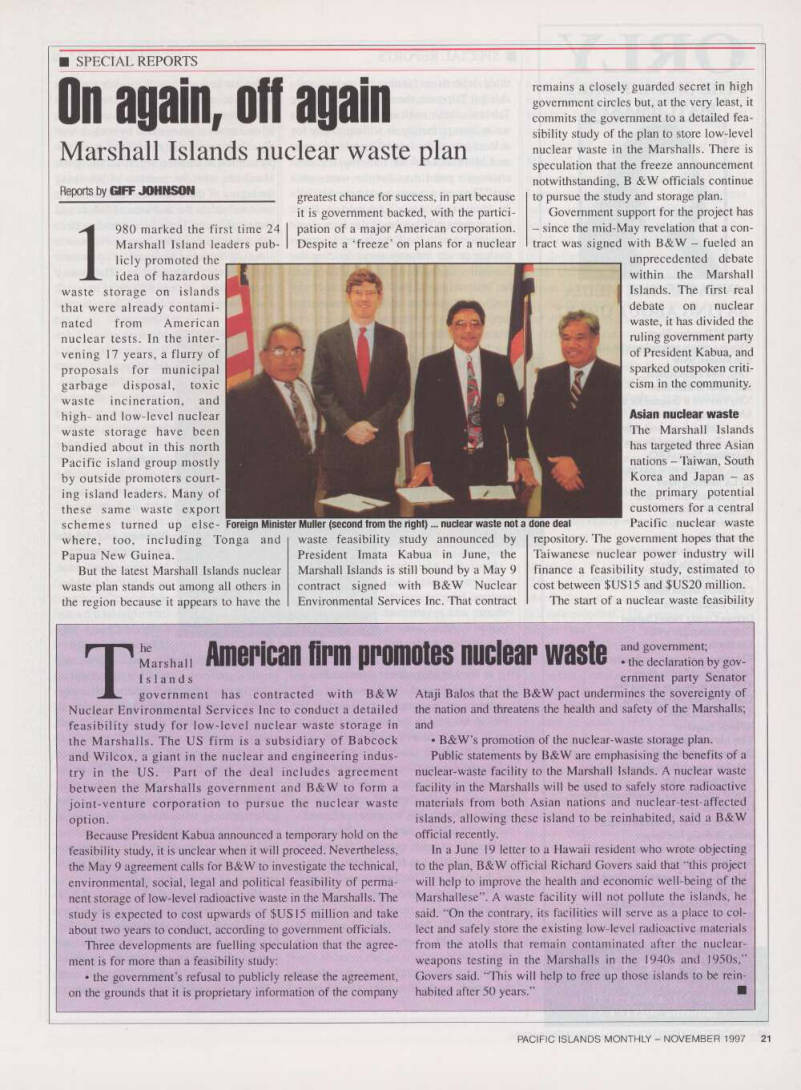
Foreign Minister Muller (second from the right)... nuclear waste not a done deal
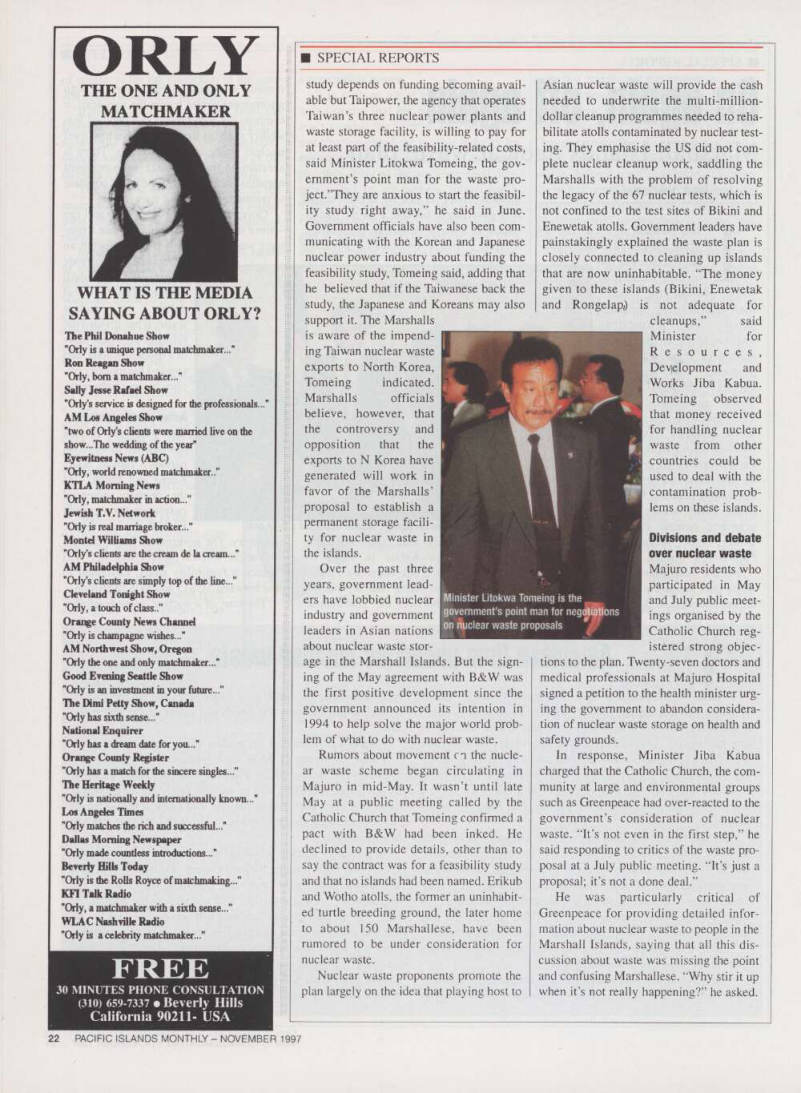
study depends on funding becoming avail able but Taipower, the agency that operates Taiwan’s three nuclear power plants and waste storage facility, is willing to pay for at least part of the feasibility-related costs, said Minister Litokwa Tomeing, the gov ernment’s point man for the waste pro ject.’They are anxious to start the feasibil ity study right away,” he said in June.
Government officials have also been com municating with the Korean and Japanese nuclear power industry about funding the feasibility study, Tomeing said, adding that he believed that if the Taiwanese back the study, the Japanese and Koreans may also
support it. The Marshalls is aware of the impend ing Taiwan nuclear waste exports to North Korea,
Tomeing indicated.
Marshalls officials believe, however, that the controversy and opposition that the exports to N Korea have generated will work in favor of the Marshalls’ proposal to establish a permanent storage facili ty for nuclear waste in the islands.
Over the past three years, government lead ers have lobbied nuclear industry and government leaders in Asian nations about nuclear waste stor
age in the Marshall Islands. But the sign ing of the May agreement with B&W was the first positive development since the government announced its intention in 1994 to help solve the major world prob lem of what to do with nuclear waste.
Rumors about movement cn the nucle ar waste scheme began circulating in Majuro in mid-May. It wasn’t until late May at a public meeting called by the Catholic Church that Tomeing confirmed a pact with B&W had been inked. He declined to provide details, other than to say the contract was for a feasibility study and that no islands had been named. Erikub and Wotho atolls, the former an uninhabit ed turtle breeding ground, the later home to about 150 Marshallese, have been rumored to be under consideration for nuclear waste.
Nuclear waste proponents promote the plan largely on the idea that playing host to
Asian nuclear waste will provide the cash needed to underwrite the multi-million dollar cleanup programmes needed to reha bilitate atolls contaminated by nuclear test ing. They emphasise the US did not com
plete nuclear cleanup work, saddling the
Marshalls with the problem of resolving the legacy of the 67 nuclear tests, which is not confined to the test sites of Bikini and Enewetak atolls. Government leaders have painstakingly explained the waste plan is closely connected to cleaning up islands that are now uninhabitable. “The money given to these islands (Bikini, Enewetak and Rongelap/) is not adequate for
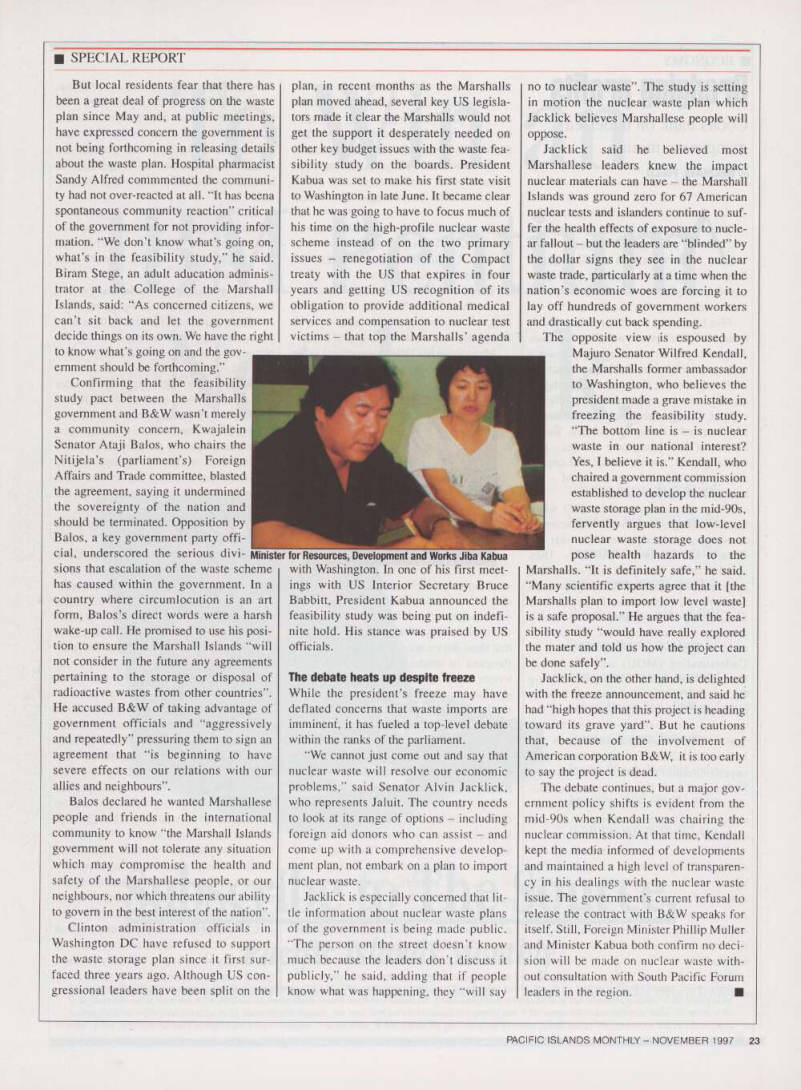
cleanups,” said Minister for Resources, Development and Works Jiba Kabua.
Tomeing observed that money received for handling nuclear waste from other countries could be used to deal with the contamination prob lems on these islands.
Divisions and debate over nuclear waste Majuro residents who participated in May and July public meet ings organised by the Catholic Church reg istered strong objec
tions to the plan. Twenty-seven doctors and medical professionals at Majuro Hospital signed a petition to the health minister urg ing the government to abandon considera tion of nuclear waste storage on health and safety grounds.
In response, Minister Jiba Kabua charged that the Catholic Church, the com munity at large and environmental groups such as Greenpeace had over-reacted to the government’s consideration of nuclear waste. “It’s not even in the first step,” he said responding to critics of the waste pro posal at a July public meeting. "It’s just a proposal; it’s not a done deal.”
He was particularly critical of Greenpeace for providing detailed infor mation about nuclear waste to people in the Marshall Islands, saying that all this dis cussion about waste was missing the point and confusing Marshallese. “Why stir it up when it’s not really happening?” he asked.
Minister Litokwa Tomeing is the government's point man for negotiations on nuclear waste proposals
But local residents fear that there has been a great deal of progress on the waste plan since May and, at public meetings, have expressed concern the government is not being forthcoming in releasing details
about the waste plan. Hospital pharmacist
Sandy Alfred commmented the communi ty had not over-reacted at all. “It has beena spontaneous community reaction” critical of the government for not providing infor mation. “We don’t know what’s going on, what’s in the feasibility study,” he said.
Biram Stege, an adult aducation adminis trator at the College of the Marshall Islands, said: “As concerned citizens, we can’t sit back and let the government decide things on its own. We have the right
to know what’s going on and the gov ernment should be forthcoming.”
Confirming that the feasibility study pact between the Marshalls government and B&W wasn’t merely a community concern, Kwajalein Senator Ataji Balos, who chairs the Nitijela’s (parliament’s) Foreign Affairs and Trade committee, blasted the agreement, saying it undermined the sovereignty of the nation and should be terminated. Opposition by Balos, a key government party offi cial, underscored the serious divi
sions that escalation of the waste scheme has caused within the government. In a country where circumlocution is an art form, Balos’s direct words were a harsh wake-up call. He promised to use his posi tion to ensure the Marshall Islands “will not consider in the future any agreements pertaining to the storage or disposal of radioactive wastes from other countries”.
He accused B&W of taking advantage of government officials and “aggressively and repeatedly” pressuring them to sign an agreement that “is beginning to have severe effects on our relations with our allies and neighbours”.
Balos declared he wanted Marshallese people and friends in the international community to know "the Marshall Islands government will not tolerate any situation which may compromise the health and safety of the Marshallese people, or our neighbours, nor which threatens our ability to govern in the best interest of the nation”.
Clinton administration officials in Washington DC have refused to support the waste storage plan since it first sur faced three years ago. Although US con gressional leaders have been split on the
plan, in recent months as the Marshalls plan moved ahead, several key US legisla tors made it clear the Marshalls would not get the support it desperately needed on other key budget issues with the waste fea sibility study on the boards. President Kabua was set to make his first state visit to Washington in late June. It became clear that he was going to have to focus much of his time on the high-profile nuclear waste scheme instead of on the two primary issues - renegotiation of the Compact treaty with the US that expires in four years and getting US recognition of its obligation to provide additional medical services and compensation to nuclear test victims - that top the Marshalls’ agenda
with Washington. In one of his first meet ings with US Interior Secretary Bruce Babbitt, President Kabua announced the feasibility study was being put on indefi nite hold. His stance was praised by US officials.
The debate heats up despite freeze While the president’s freeze may have deflated concerns that waste imports are imminent, it has fueled a top-level debate within the ranks of the parliament.
“We cannot just come out and say that nuclear waste will resolve our economic problems,” said Senator Alvin Jacklick, who represents Jaluit. The country needs to look at its range of options - including foreign aid donors who can assist - and come up with a comprehensive develop ment plan, not embark on a plan to import nuclear waste.
Jacklick is especially concerned that lit tle information about nuclear waste plans of the government is being made public.
“The person on the street doesn't know much because the leaders don't discuss it publicly,” he said, adding that if people know what was happening, they "will say
no to nuclear waste”. The study is setting in motion the nuclear waste plan which Jacklick believes Marshallese people will oppose.
Jacklick said he believed most Marshallese leaders knew the impact nuclear materials can have - the Marshall Islands was ground zero for 67 American nuclear tests and islanders continue to suf fer the health effects of exposure to nucle ar fallout - but the leaders are “blinded” by the dollar signs they see in the nuclear waste trade, particularly at a time when the nation’s economic woes are forcing it to lay off hundreds of government workers and drastically cut back spending.
The opposite view |is espoused by
Majuro Senator Wilfred Kendall, the Marshalls former ambassador to Washington, who believes the president made a grave mistake in freezing the feasibility study.
“The bottom line is - is nuclear waste in our national interest?
Yes, I believe it is.” Kendall, who chaired a government commission established to develop the nuclear waste storage plan in the mid-90s, fervently argues that low-level nuclear waste storage does not pose health hazards to the
Marshalls. “It is definitely safe,” he said.
“Many scientific experts agree that it [the Marshalls plan to import low level waste] is a safe proposal.” He argues that the fea sibility study “would have really explored the mater and told us how the project can be done safely”.
Jacklick, on the other hand, is delighted with the freeze announcement, and said he had “high hopes that this project is heading toward its grave yard”. But he cautions that, because of the involvement of American corporation B&W, it is too early to say the project is dead.
The debate continues, but a major gov ernment policy shifts is evident from the mid-90s when Kendall was chairing the nuclear commission. At that time, Kendall kept the media informed of developments and maintained a high level of transparen cy in his dealings with the nuclear waste issue. The government’s current refusal to release the contract with B&W speaks for itself. Still, Foreign Minister Phillip Muller and Minister Kabua both confirm no deci sion will be made on nuclear waste with out consultation with South Pacific Forum leaders in the region. ■
Minister for Resources, Development and Works Jiba Kabua