The greenhouse effect
pp. 17-18 · Read in the full issue
By Mahendra Kumar
The "greenhouse effect” is used to describe the increase in the Earth’s surface temperature above its normal effective emitting temperature. This is due to the pro cesses of absorption and emission by certain gases in the atmosphere of cer tain wavelengths of radiation.
The principles of the greenhouse effect have been understood for a very long time.
The topic of current interest is the
enhancement of this effect due to the increase in the concentration of gases such as carbon-dioxide, methane, nitrous oxide, halocarbons and other halo gentaed compounds. This has meant a shift in the equilibrium, resulting in a warming of the Earth and changes in the climate.
These changes are, to a large degree, attributed to human activities such as the use of fossil fuels, land-use change and agriculture. The changes are projected to change regional and global
climate and climate-related parameters such as temperature, precipitation, soil moisture and sea-levels.
The current status The Intergovernmental Panel on Climate Change (IPCC), jointly estab lished by the World Meteorological Organisation (WMO) and UNEP in 1988 has made detailed analyses on the science of climate change and the main findings can be summarised as follows: the increas ing levels of greenhouse gases (GHGs) for example, 0.4 per cent per year for car bon dioxide (CO2) -and their effect on enhancing the heating of the earth (2.5 Wm-2) are well established. A doubling of CO2 concentration would directly increase global temperatures by I.2°C. When feed back mechanisms are considered, a total heating of 1.5-4.5°C has been agreed to over the past 20 years.
It is also agreed the world has heated
0.3-O.6°C since 1860, but there is debate whether this can be attributed to an enhanced greenhouse effect. However, the IPCC stated that it was unlikely the heat ing was entirely natural. There is now a discernible effect of human activity. But how much the Earth will warm and the sea level rise in the future depends on many factors.
By 2100, the temperature is expected to increase by 1-4°C (I.7°C middle scenario) and global sea level by 13-94 cm (49cm middle scenario).
Unfortunately, at present, little can be
said with any certainty about regional scale changes, especially in the Pacific. A review of scientific information and understand ing in the Pacific regarding Climate Change and Sea Level Rise (CC & SLR) draws on information from a range of sources. They show that temperatures have been increasing by 0.1 °C per decade in the region and sea levels by 2mm/yr. There is also evidence that climate phenomena such as EL Nino and Southern Oscillation (ENSO) will have major influences in the, impact of CC & SLR. It is also recognised that the Pacific region plays an important role in understanding global climate change.
The Pacific Basin Modeling, scenario development and vulnerability assessments will play key roles in helping the Pacific respond to CC & SLR. Models currently suggest a dou bling of CO2 concentration will increase
sea-surface temperatures by I°C and increase rainfall intensity in the central equatorial Pacific. Although the second assessment of IPCC did not reveal a con sensus regarding tropical cyclones in a changed climate regime, recent research has indicated possible intensity increase of 10-20 per cent with a doubling of CO2.
The situation Pacific island countries are vulnerable to changes in atmospheric and oceanic conditions with a low capacity to respond.
Climate change and sea-level rise are recognised as two important environmen tal concerns for Pacific island nations and territories.
The issues were accorded high priority
as evidenced in the various South Pacific Forum com muniques (1992-1994).
For example, the following is extracted from the com munique of the 25th Forum, held in Brisbane in 1994: “The Forum reaffirmed that global warming and sea-level rise were among the most serious threats to the Pacific region and the survival of some island states. The Forum recog nised that existing com mitments in the Framework Convention on
Climate Change (FCCC) will not meet the ultimate objective of the Convention and called for early agreement on a process for negotiating one or more protocols to implement and elaborate the Convention so that reductions of Greenhouse gas emis sions are achieved. It called on Annex 1 Parties to the Framework Convention to meet their obligations and on all non-par ties to adhere to the Convention by the end of 1994. Annex 1 countries should ensure
that joint implementation complements
and does not replace action at home.
Priority should be given to activities in support of the Framework Convention's objectives, including both research and also those activities which will assist Forum countries to meet their Convention commitments. The Forum urged enhanced efforts to implement energy efficiency and the use of renewable energy sources.”
The high priority given to climate change strategies is further reflected in the
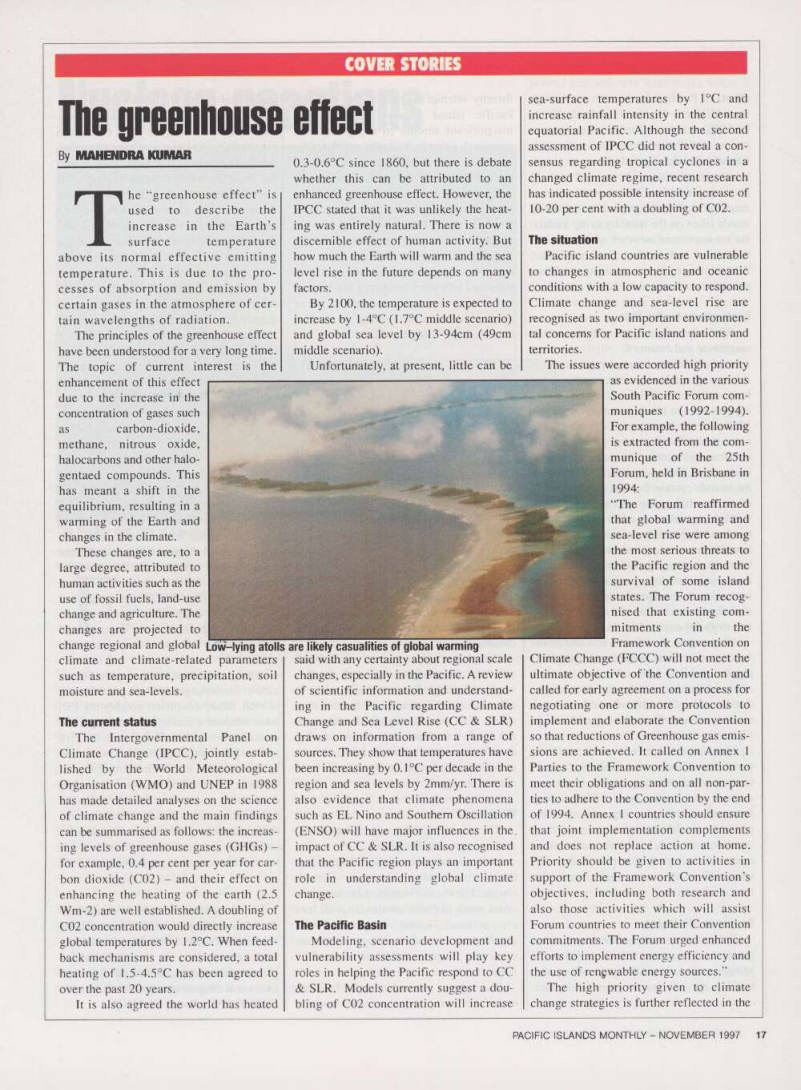
Low-lying atolls are likely casualties of global warming
efforts of Pacific island countries, through the Alliance of Small Island States (AOSIS), to obtain further commitments under the Framework Convention on Climate Change for reductions in green house gas emissions. It was not entirely surprising, therefore, that the recent Forum meeting at Rarotonga saw very strong stands taken on the issue by many leaders.
As an important member of the Forum, neighbour and leading trading partner, Australia’s position was a major disap pointment to many small island countries.
Implications for the PICs While there is continuing debate on the magnitude and extent of
changes in the different regions, it is clear that island nations, particu larly atolls and low islands are sus ceptible even to minor perturbations.
Moreover, the importance of coastal areas to the Pacific island peoples, cultures and economies cannot be overstated. The coastal areas of all the islands contain the vast majority of human habitation and areas of subsistence and commercial agricul tural and fisheries activities. In the last 20 years, many coastal areas have been heavily modified and intensively developed, significantly increasing their vulnerability to nat
ural climatic variability and extreme events and to global environmental changes.
On many of the islands, soil and fresh water resources are limited and agricultur al plant diversity is low. Most of the total cultivable land is used for subsistence pro duction. The diversity of coral reef and marine resources, on the other hand, is high.
The importance of coral reefs is paramount. Coral reef systems play a cen tral role in maintaining precious beach and coastal land levels against the eroding forces of storms and rising seas, and they provide essential resources in terms of con struction materials, habitat for marine fish eries and, through their natural beauty and species diversity, a central attraction for the tourist industry.
Response Strategies
These are normally of two main cate gories: mitigation and adpatation.
Mitigation activities attempt to reduce the buildup of greenhouse gases and other components that modify climates and
thereby attempt to reduce the changes.
Pacific island nations contribute an insignificant amount to the greenhouse gases and, either individually or collective ly, cannot have a significant effect on miti gation. However, as signatories to the the protocols of the United Nations Framework Convention on Climate Change (UNFCCC), many of the island countries are active in reporting and imple menting strategies. Many are also embarked on programmes such as increased efficiency of energy use in vari ous sectors such as transportation, use of altemative/renewable energy resources, energy conservation, afforestation, etc.
These so called ‘no regret’ measures will be helpful no matter what the magnitude of climate change.
Adaptation refers to activities which will help communities cope with changes resulting from global warming. It seeks to offset costs and increase benefits that may accrue from climate change. The measures can be diverse depending on the existing social, economic, cultural and environ mental conditions and the likely impacts of climate change.
What next?
There is a need for added impetus in addressing national, regional and international initiatives in tackling the various issues related to climate change. For Pacific islands, there are addi tional needs of public awareness at all lev els: political; social; religious. These should transcend into building endogenous capacities to understand and respond to issues.
There seems to be a somewhat indiffer ent, if not complacent, attitude towards
these vital issues of global warming, cli mate change and environemntal degrada tion. True, the issues are often clouded in uncertainity and too complex to under stand. Regretably, there is no time to wait for these issues to become crystal clear (and it is hardly likely to become so in the forseeable future) before embarking on firm plans and actions. Some of this atti tude may arise from the resilience of the people and their environment to withstand such calamities. What needs to be under stood though is that the environment’s abil ity to respond to these changes have been greatly reduced, due to man’s actvities. A new sense of purpose and urgency needs to
be demonstrated for the sake of fututre generations.
With only a couple of months to go before the Kyoto meeting of the Conference of Parties to be held in early December, there is surprisingly little debate on the relevant national and regional issues in the local/regional media. The media is happy to carry statements attributed to the Austarlian, American or Japanese positions, for example, but there seems little education about the proposal from AOSIS or how the regional governments intend to counter the very real threat from
groups like OPEC and individual countries like Australia which have indi cated their opposition to the imposition of any limits on the greenhouse gas emis sions.
An agreement on the setting up of spe cific emission targets at the Kyoto meeting is vital. Many countries, notably the EU, have adopted a reasonable and dignified stand in this matter. It behoves the rich nations like Australia, US and Japan to lead by example and not, as the current fear is, tie these to commitments from the poorer, developing countries. For the sake of future generations and indeed for planet Earth, countries need to rise above narrow, selfish economic interests and work towards the common good of humanity. ■ • Dr Mahendra Kumar is Associate Professor of Physics at the University of the South Pacific, Fiji, where he teaches and researches in environmental physics and energy. He has participated in several cliipate change activities with
Sprep, Escap And Unfccc.
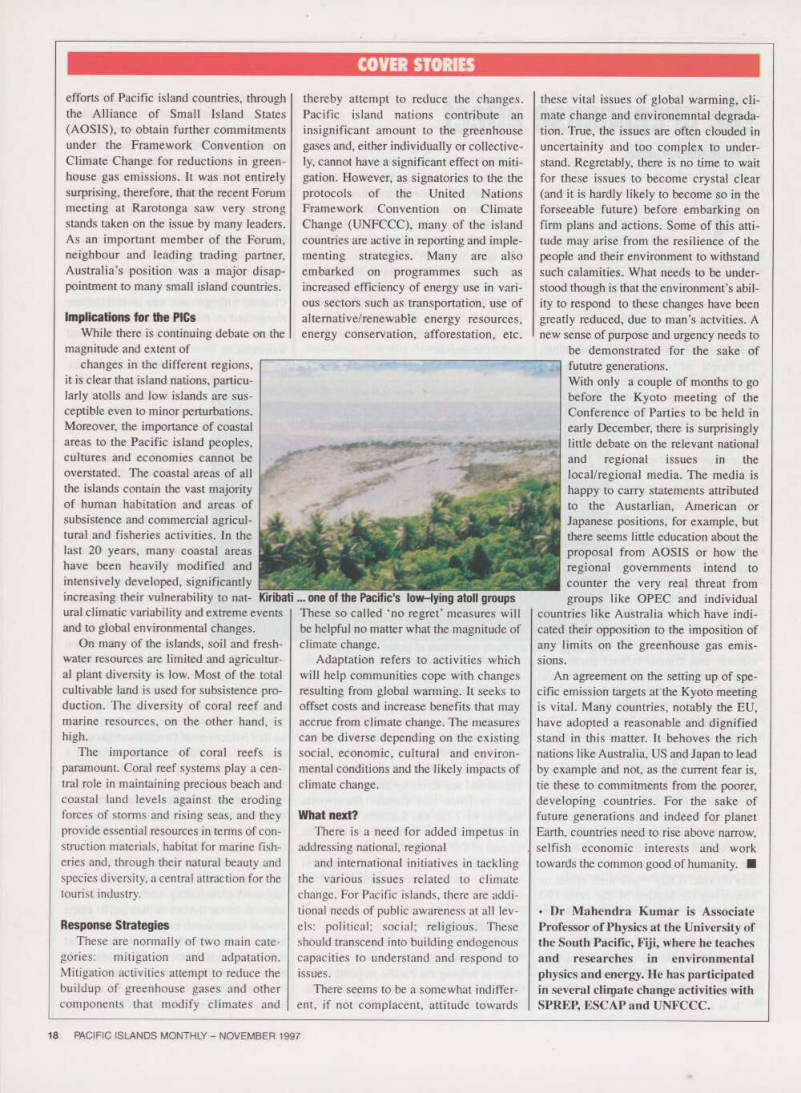
Kiribati ... one of the Pacific’s low-lying atoll groups