The other side of the story
pp. 15-16 · Read in the full issue
Australia’s policy on cli
mate change was a fias co - an ignominious failure, says the execu tive director of the Australia Institute, Dr Clive Hamilton.
Dr Hamilton, who is also a visiting fel low of the Public Policy Programme at Australian National University, said rather than ask how Australia got out of step with the international community, the Howard government had become more trenchant in defence of its position, even hinting that Australia should never have signed up to the Framework Convention on Climate Change (FCCC) and may withdraw if it did not get its way.
Dr Hamilton said Australia was advocating differentiation - the alloca tion of different targets for different countries on the basis of the economic costs of emission reduction.
“It argues that targets should be set so as to impose equal economic costs per capita for each country. Australia would, under this proposal, have more lenient targets than most other coun tries.”
He said there were many flaws in the Australian government’s position.
“The government has used the results of the MEGABARE model to support its belief that uniform targets would seriously damage the Australian economy.”
He added that a close look at the
study showed the impact of stabilising Australia’s emissions on the economy would, in fact, be extremely small, and used the example of ABARE & DFAT
1995, Abare 1997.
"This is despite the fact that the MEGABARE model is constructed in a way that tends to exaggerate the costs of greenhouse gas reduction measures by assuming that there are no "no-regrets’ energy-saving measures; that is, the absence of costless energy savings and assuming that emissions-abatement mea sures would induce no additional energy saving technological change.”
Dr Hamilton said most non-economists were puzzled, to say the least, when it was suggested that policies designed to reduce emissions sharply would not induce any
technological changes.
He said the absence of no-regrets mea sures arose from the assumption that the economy was operating on a production frontier and this reflected the ABARE belief that markets worked perfectly.
“Clearly, if there are no no-regrets mea sures to reduce emissions in the Australian economy then any emissions reductions required will come at a higher cost.
“It is worth noting that, while the gov ernment bases its international arguments on cost estimates that assume the absence of no-regrets reductions, the government’s domestic greenhouse strategy is built almost entirely on the existence of no regrets measures.”
He explained that welfare changes in
the MEGABARE model were measured by changes in annual per person real gross national expenditure (GNE).
The model results indicated that real GNE fell below the ‘business-as-usual’ path by amounts ranging from -0.27 per cent in 2000 to -0.49 per cent in 2020
(Abare & Dfat 1995).
He said it was important to recognise that this did not mean the growth rate of GNE was lower by these amounts, but that the absolute levels of real GNE are lower by these amounts.
He explained that one way of under standing the size of the costs predicted by MEGABARE was to compare them to income levels in the future.
“If the economy grows on average by 3.5 per cent then per capita incomes will
reach double their current levels around January 1, 2025. If Australia adheres to its international commitments and reduces its emissions then, according to the MEGABARE estimates, the doubling per capita incomes will have to wait until around March 1, 2025, a delay of two months.
“These MEGABARE results are very embarrassing for the government. It has thus resorted to distorting the figures to support its case.”
Dr Hamilton also highlighted flaws in Australia’s differentiation position saying Australia’s position was little understood even within policy circles.
“It is argued that since Australia is more heavily dependent on fossil fuels for domestic production and exports, imposing uniform targets would impose a higher economic cost on the country.”
Australia has put forward a num ber of indicators it says should be used to determine each country’s emission reduction target. These indicators would allow more lenient targets for countries which have high GDP growth; high pop ulation growth; high emissions per unit of GDP; export fossil fuels heavily and depend heavily on fos sil fuels to produce exports.
Dr Hamilton said it was not sur prising that the international com munity reacted so negatively to Australia’s proposal.
“It means that countries that have the highest emissions would be required to do the least to reduce them, while countries that have
done the most to reduce their emissions already would be required to do more.”
He said Australia’s position was wholly contrary to the polluter-pays principle that had been the basis of environmental policy in Australia and abroad for years.
On the effects of fossil fuel, he said the Australian position’s treatment of fossil fuel trade was especially perverse. As a result of targets, two types of economic costs would be imposed on Australia - the costs of meeting domestic emissions tar gets and the costs of losses in revenue from fossil fuel exports as other (developed) countries reduce their emissions.
"The effect of the Australian ’equal eco nomic cost’ proposal would be to make domestic targets in Australia even more lenient, as economic costs are increased if
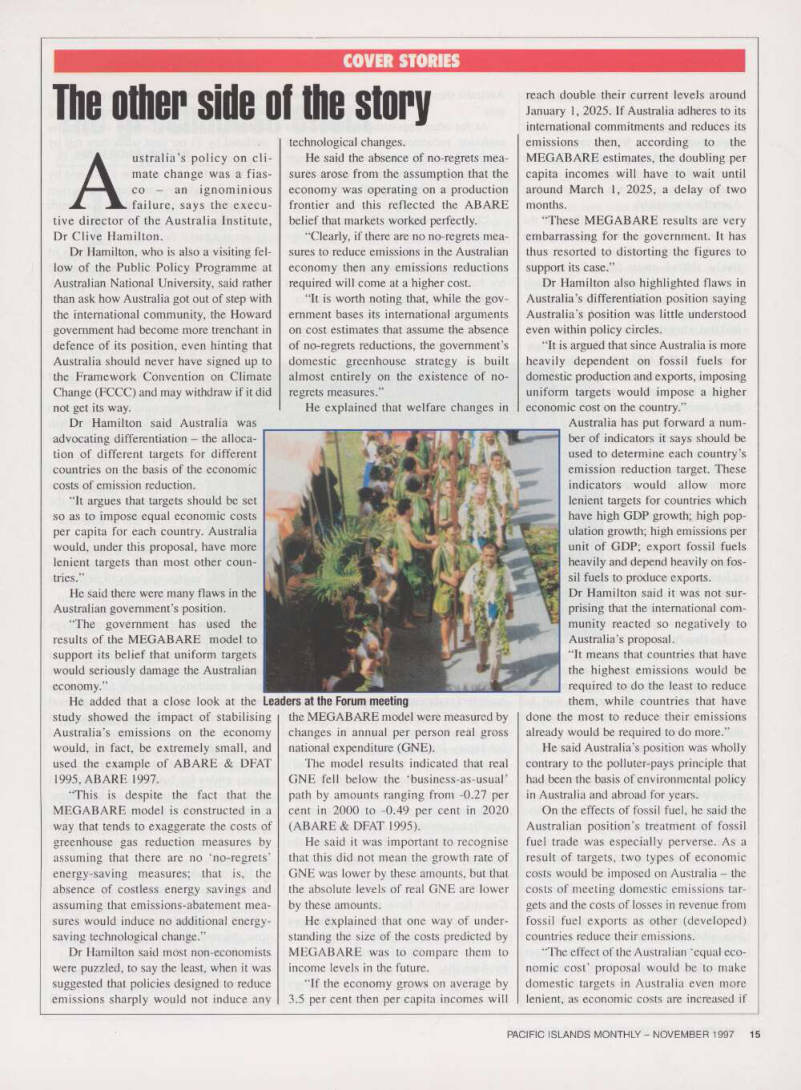
Leaders at the Forum meeting
other countries import less coal in order to reduce their own emissions.
“Under the Australian position, to offset lower coal exports, higher emissions in Australia would be permitted. Thus the more ambitious are the other countries’ greenhouse measures, the less demanding Australia’s would be.
“If it were adopted, the effect of the Australian position would be that as the rest of the industrialised world progres sively shifted away from fossil fuels, Australia would become ever more firmly entrenched as a carbon-dioxide emitter.”
As to high relative costs to Australia, he said that when the estimated costs of reduc ing emissions were as small as those esti
mated by MEGABARE then the relative costs become largely irrel evant. “Nevertheless, the reason that Australia appears to have rela tively high costs of abatement is that the modelling assumes away the existence of low-cost and no cost energy savings and because it assumes away technological progress.
“The government’s thinking and ABARE’s modelling assumes that Australia’s ‘comparative advan tage’ in fossil fuel-based industries is fixed and given. This reflects the rigid and short-term thinking about
Australia’s economic future which we have spent 20 years trying to escape from.”
Dr Hamilton said, however, that there needed to be a long-term view.
“In a decade or two, much more demanding greenhouse targets are likely and all industrialised countries will be faced with the need to turn decisively to alternative energy sources.”
On the role of population growth, he said the Australian position also sought higher emissions for Australia because of projected population growth. “Australia’s position is mired in contradictions. The government has been arguing that develop ing countries should be brought into any agreements to reduce emissions because they will be responsible for most of the emissions in the future due to their high rates of population and economic growth.
"So, according to the Australian posi tion, while high population and economic growth rates in developing countries are reasons for insisting that those countries be required to reduce their emissions, the same factors are used to argue that
Australia should be given more lenient tar gets.”
As for other opportunities for low-cost emission reductions, he said that for a country that needs to reduce its greenhouse gas emissions, heavy dependence on fossil fuels may be a blessing rather than a bur den.
“The key question is not so much whether the country consumes a large quantity of fossil fuels but how efficiently it consumes it. The more inefficient a coun try has been in the past, the easier and cheaper it will be to reduce consumption.
“This is precisely why Australia has supported the development of joint imple mentation, whereby Annex 1 countries can
claim emissions-reduction credits for pro jects that reduce emissions in non-Annex 1, especially developing countries, where it is believed there is more inefficiency in the combustion of fossil fuels.”
He said ABARE acknowledged the basic fact in the case of Japan in explaining why the MEGABARE model showed the costs of uniform targets would be very high for Japan. Japan experienced high costs because Japanese industries had already taken major steps to improve energy effi ciency and reduce fossil fuel use.
Further action to reduce emissions by significant amounts in Japan would imply further structural adjustment to the Japanese economy, carrying large costs
(Abare 1997:5).
"Of course, this fact cuts both ways.
Countries which have not already taken major steps to improve energy efficiency and reduce fossil fuel will find it relatively cheap to do so. This is precisely the case for Australia.
"Firstly, we have to compare the energy efficiency performance of Australia and
OECD countries over time. Over the peri od of 1970 to 1992, energy-related CO2 emissions per unit of output in Australia declined by 13 per cent while they fell by 36 per cent in the OECD.
“This difference may be explained by changes in industry structure rather than inefficiency of energy, but there is a wealth of evidence to suggest that inefficient ener gy use is a major factor.”
He quoted the most recent analysis of
Australia’s energy performance provided
by the International Energy Agency (lEA 1997).
The lEA notes: • over the past 10 years, energy con sumption in Australia has increased at the
rate of 2.1 per cent per annum, compared with the lEA average of 1.1 per cent; • the average ratio of energy use to output is significantly higher than in Europe and comparable with the
Usa;
• Australia ranks third among all lEA countries in fuel consumption per passenger car, with only the USA and Canada having more thirsty vehicles; • most energy consumed in Australia is fossil fuel and there fore ‘energy savings can reduce the level of CO2 emissions’; and
• energy is cheap in Australia because of its abundant supply of low-cost energy resources and low energy taxes.
The lEA concluded that “the results of the industrial energy audits, the absence of general mandatory standards for buildings and domestic appliances and the high level of fuel consumption by passenger cars all indicated that there was a great potential for improvements in energy efficiency”.
It recommended mandatory energy effi ciency codes for buildings and electrical appliances including air conditioning, stronger fuel efficiency targets for passen ger and commercial vehicles, high fuel taxes and improvements in interstate pub lic transport.
He concluded that in the absence of a sensible approach to reducing its emis sions, Australia would become locked into a fossil fuel-based economy at exactly the time the rest of the world starts to move away from those forms of energy.
He said if this view prevailed in gov ernment, them Australians would pay dear ly for it. ■
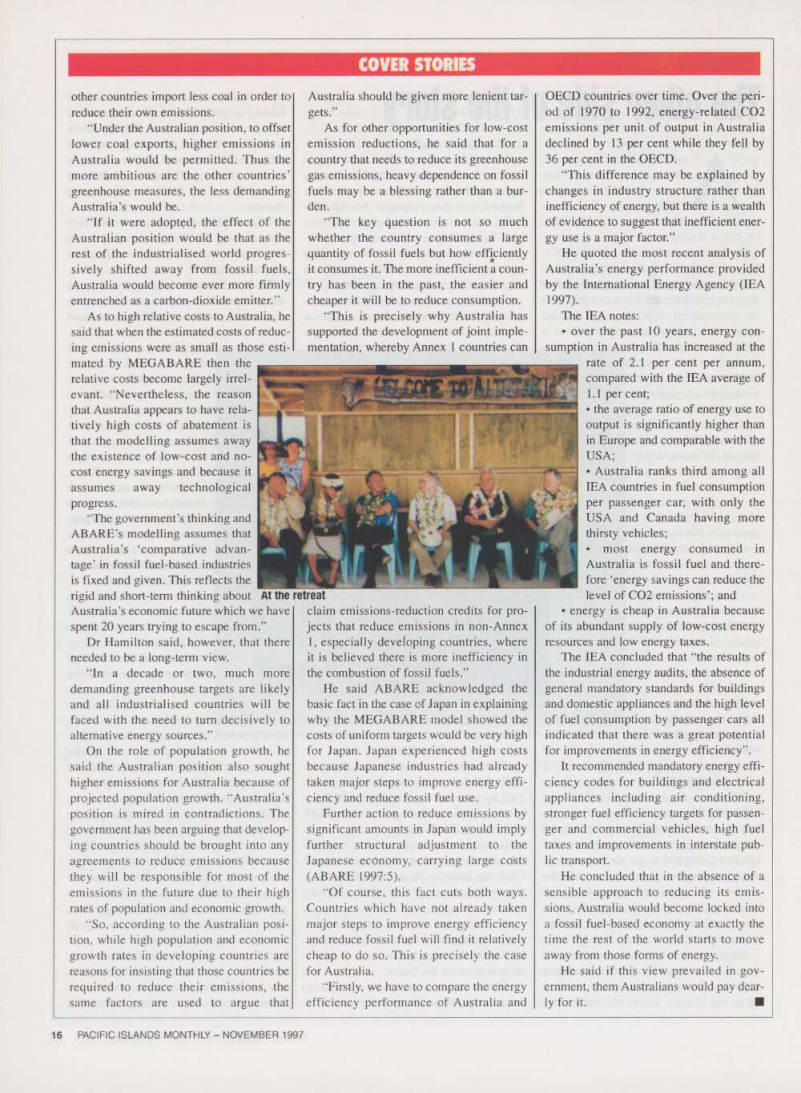
At the retreat