The Australian argument
pp. 13-14 · Read in the full issue
If the world is going to be able to deal with the threats to the whole globe from climate change even though countries don’t fully understand at this stage the nature of those threats, they are going to need to contain the growth of greenhouse gas emissions, says Australia’s deputy secretary for envi ronment Howard Bamsey.
He said Australia had a par ticular approach one which it shared with a number of other countries - in
the negotiations
toward future co operation.
“All the parties to the Framework Convention on Climate Change want to see a very good and very posi tive far-reaching outcome from the Kyoto meeting.
Certainly, Australia wants very much that but there are still some differ ences of views among the partici pants about just how to construct that framework for
continued cooperation.
“In order to try and resolve those dif ferences we, in Australia, and our counter parts in many other countries are now involved in this continuing set of discus sions from now till the end of the confer ence in Kyoto.
Bamsey said the negotiations that Australia was taking part in had very high stakes and that meant that all countries were approaching the issue very carefully, working very thoroughly, analysing the possibilities of different approaches.
"We, in Australia, have done an enor mous amount of research on the scientific area. Australian scientists have been
responsible for a great deal of the work which has contributed to international understanding of the particular effects of climate changes in the Southern Hemisphere. Scientific work is continuing right around the globe. Australian scien tists have been part of and are continuing within the intergovernmental panel of cli mate change work, which is the core of international scientific attempts to under-
stand the process of climate change and what its implications for the planet are.”
He said while taking environmental impacts into account, it was also important to leam about the economic effects. In an attempt to bring to the Australian public the results of some of the analyses - scien tific and especially economic - the Australian government published a book titled Australia and Climate Change Negotiations.
The government commissioned this book as a means of informing all Australians and to provide a vehicle for consultation on the issues being negotiated on climate change under the Berlin
Mandate. The government is seeking feed back to inform its consideration of these matters in advance of the Kyoto confer ence.
Bamsey said it was very clear that if the world was to meet the challenge of climate change in the 21 st century, there was going to have to be a global cooperation of the sort that really hadn’t been witnessed before.
“We are going to need the cooperation of all those countries around the globe which are significant emitters of green house gases to be able to deal with this problem. The Kyoto meeting is a very important one.
“It will be a real milestone on that very long road that lies ahead of us.
It’s important that the outcome of the meeting in Kyoto is as good as we all can make it so that it provides a very solid basis for cooperation that must follow. It must engage all countries which are significant emitters of greenhouse gases.
“The really fundamental point for Australia in the outcome is that we take into account the particular circum stances of the coun tries that will be par ticipating and mak ing commitments in Kyoto.
“We think it’s really very important that we are going to continue over many decades to cooperate internationally, that we have a very sound, very stable basis for this cooperation and it’s our view that we can create that sound and stable basis for future cooperation if, when we set targets for reductions, we take into account the economic structures, the economic pro files, the trading circumstances.
“If we look closely at the nature of the economies concerned, just as in any other agreement on economics, each country brings its own particular circumstances to the negotiating table. In the case of climate change, we believe that the only way in
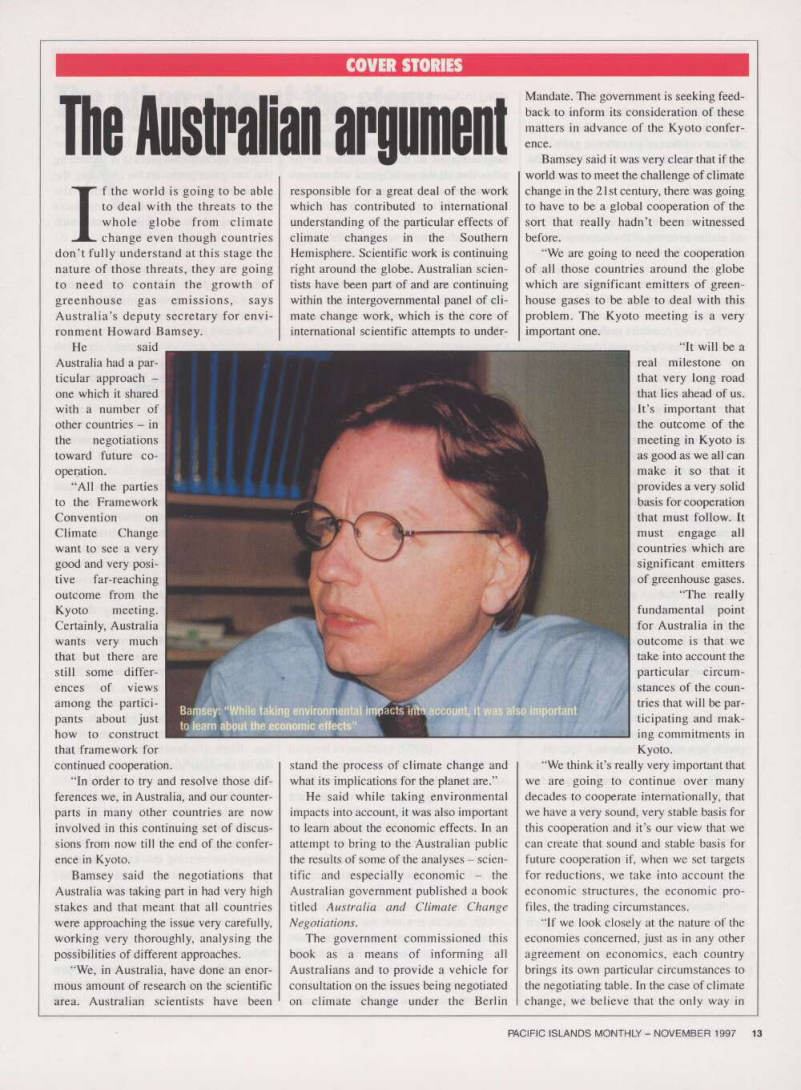
Bamsey: “While taking environmental impacts into account, it was also important to learn about the economic effects”
which we can ensure that in 15 to 20 years’ time we have a very stable regime, which is engaging all the countries which are sig nificant emitters of greenhouse gases, is to start now to take into account the particu lar differing circumstances of the various participants.
“It is very obvious that the economic differences among the participants really do matter in terms of the outcome that we can expect.
For some countries it will be relatively easy to demonstrate a reduction of a cer tain proportion of greenhouse gas emis sions by the 2110.
“For other countries in that period to do
that in the way their econo my is constructed and the way in which their economies spill into the global economy it would be much more difficult and much more expensive.”
He said Australia’s view was that it should look for an outcome from Kyoto which would see partici pants agreeing to make commitments in a way which would require about the same effort from each.
On how they would measure that effort, Bamsey said there were really only a few choices and Australia’s suggestion was to measure the eco nomic impact on the vari ous countries in meeting targets.
He said that although this might sound compli cated, in Australia’s view it
was much simpler in the long run to make sure they worked from what was agreed on as a fair basis than to try to cooperate over a long period in a system which some sig nificant members regarded as unfair.
The deputy secretary said it was true that some countries sought to downplay the significance of the work of the eco nomic analysis done in Australia.
"I don't think there has been any real disagreements from other countries which have done modelling studies about the general trends that show up in the mod elling that we have done.
"But if we take certain measures, we can expect certain effects and the mod
elling in Australia has looked very careful ly at what these effects will be. The approach to negotiations which differ from ours is that which would create uniform targets for all of the participants in the sense that all the participants will commit themselves to reducing greenhouse gas emissions by a given per cent, putting it
simply.”
He said Australia was prepared to play a full part in this challenge. “We under stand as much of the implications as any body does, we can see the potential threats especially to the low-lying states of the world; there are some of them in our region.
"We have been conscious right through our negotiations of the threats which lie ahead in our region and we have consulted throughout our negotiations with our col leagues and representatives of island coun tries and other small island states through out the world. We understand that there are very real threats ahead for the island coun tries, we also understand that there are very real threats to Australia.
"We don't yet know the detail of the regional impact of climate change - just what it will mean for patterns of rainfall, sea level rise, frequency of storms and extreme weather patterns.
"We do not know enough and our sci
entists are working with other scientists from around the globe to try to improve our understanding so that we can ready ourselves and adapt to the changes that are to come because this process is something that has great potential for changing the patterns of life.” He also said Australia was working with the small island states of the region on the negotiations which they were having on this issue.
The smaller island states were quite upset with Australia’s refusal to budge from its stand - at the South Pacific Forum - and saw themselves conceding to the region’s largest player.
“I wasn’t at the Forum [and it’s] not fair
, to comment on what might haie been said there. The communique demonstrates agreement among all the leaders there on the deep con cerns about the potential implications of climate change in this region and to smaller island states,” Bamsey said.
“We really do under stand in Australia what the risks are because we have been so closely involved in the science which has given us the understanding that we have of those risks.
I “We know that there are complexities in the science as well as in the economics and we do not yet know - in fact, nobody knows exactly what will happen, which is why it is very impor
tant to continue giving priority to this in the scientific work that we are doing.
"We in Australia do understand and do take into account fully the potential impacts on the smaller island states on cli mate change. We are prepared to play a full part in meeting this challenge along with all other countries in the world that produce significant emissions.”
He added Australia produced only a very small proportion of the world's green house gases - about 1.4 per cent.
"Whatever we do in Australia is not going to solve the problem. Whatever developed countries alone do is not going to solve the problem.” ■
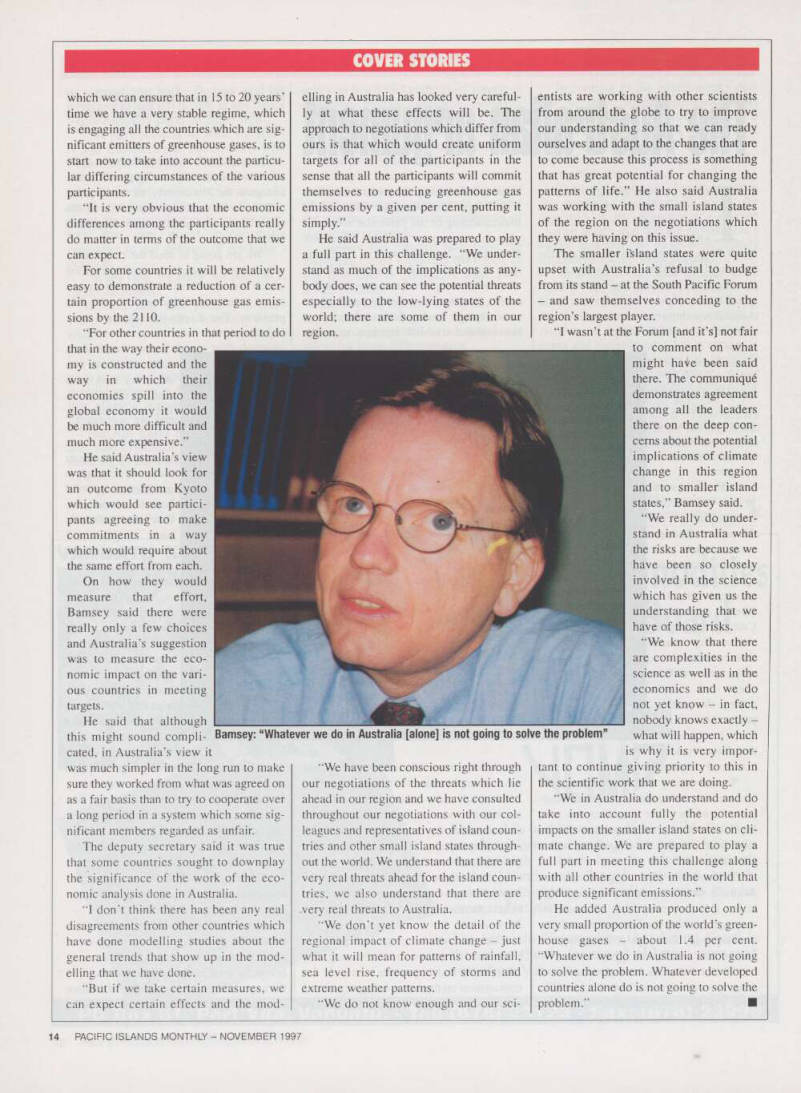
Bamsey: “Whatever we do in Australia [alone] is not going to solve the problem”