Thebig
pp. 11-12 · Read in the full issue

Cover Stories
Thebig retreat
The tides are rising and, slowly, low-lying coun tries are sinking. It is not happening at a rapid pace and will take time, but it will happen.
As these states go down, so will their sovereignty and, with it, the land the people of that country once called home.
These were the sentiments expressed by the Smaller Island States at the 28th South Pacific Forum meeting in Rarotonga, Cook Islands, in September when Australia refused to back down from its position on the emission of greenhouse gases.
This topic dominated the Forum agenda, with economic and trade issues given very little attention in comparison.
So intense was the discussion, Forum leaders could not decide at the end of the first day of the retreat what the Forum’s stand on the issue was.
In the past, the first day of the retreat has been when the wordings for the communique were finalised.
But this year, it was different.
When the leaders went on their retreat onboard the Royal New Zealand Air Force jet to Aitutaki, they were aware what Australia’s stand would be.
Australian Prime Minister John Howard had made it clear from day one that he was not going to agree to binding targets for greenhouse gas reduction
because at stake were millions of Australian jobs.
On the second day of the retreat, as media representatives waited at the local airport for the arrival of the leaders, word got around that the communique had still not been finalised.
What followed was an intense two hour session behind the closed doors of the airport’s VIP lounge, the end of which saw Forum island states giving in to Australia.
Tuvalu (one of the low-lying islands) PM Bikenibeu Paeniu, who had spent several intense hours negotiating the issue with Howard, pointed to Australia’s size and the aid it provided in the region as reasons why the island states gave in.
“Australia dominates us so much in this region. For once, we wuuld have liked to have got some respect,” he remarked.
Howard, on the other hand, was obvi ously elated.
While the decision took time to reach, it was not difficult to get there, Howard self-assuredly asserted.
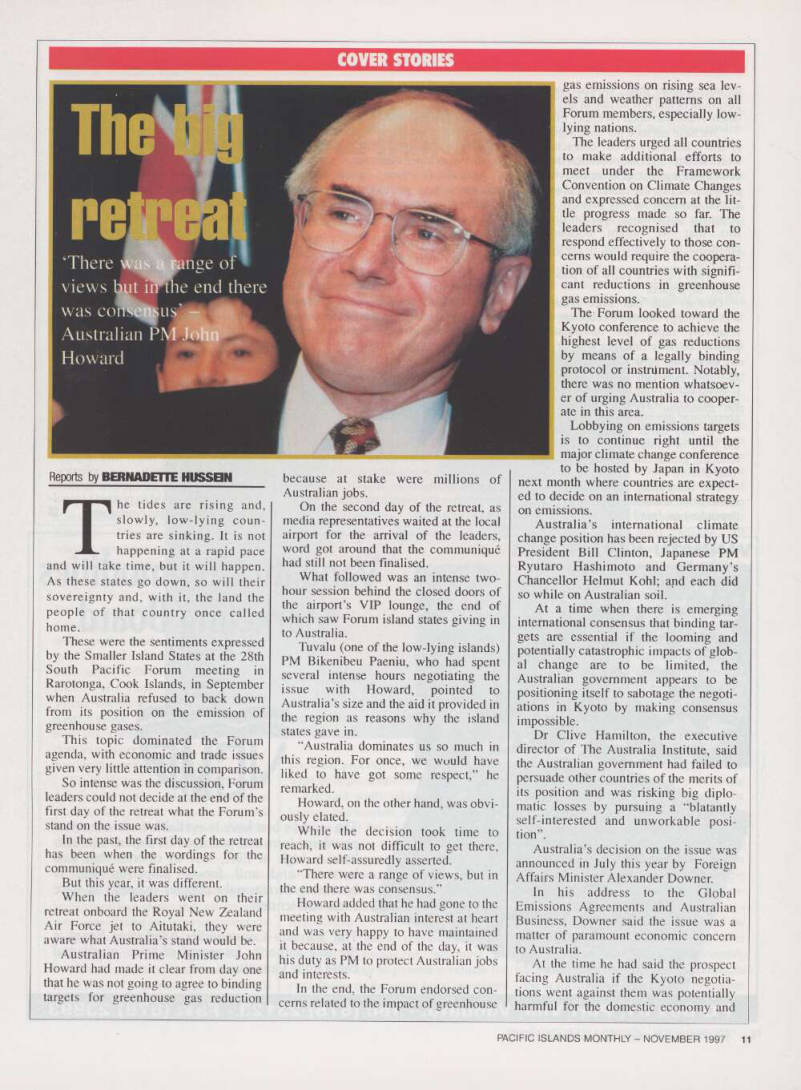
“There were a range of views, but in the end there was consensus.”
Howard added that he had gone to the meeting with Australian interest at heart and was very happy to have maintained it because, at the end of the day, it was his duty as PM to protect Australian jobs and interests.
In the end, the Forum endorsed con cerns related to the impact of greenhouse
gas emissions on rising sea lev els and weather patterns on all Forum members, especially low
lying nations.
The leaders urged all countries to make additional efforts to meet under the Framework Convention on Climate Changes and expressed concern at the lit tle progress made so far. The leaders recognised that to respond effectively to those con cerns would require the coopera tion of all countries with signifi cant reductions in greenhouse gas emissions.
The Forum looked toward the Kyoto conference to achieve the highest level of gas reductions
by means of a legally binding
protocol or instrument. Notably, there was no mention whatsoev er of urging Australia to cooper ate in this area.
Lobbying on emissions targets is to continue right until the
major climate change conference
to be hosted by Japan in Kyoto
next month where countries are expect ed to decide on an international strategy on emissions.
Australia’s international climate change position has been rejected by US President Bill Clinton, Japanese PM Ryutaro Hashimoto and Germany’s Chancellor Flelmut Kohl; and each did so while on Australian soil.
At a time when there is emerging international consensus that binding tar gets are essential if the looming and potentially catastrophic impacts of glob al change are to be limited, the Australian government appears to be positioning itself to sabotage the negoti ations in Kyoto by making consensus impossible.
Dr Clive Hamilton, the executive director of The Australia Institute, said the Australian government had failed to persuade other countries of the merits of its position and was risking big diplo matic losses by pursuing a “blatantly self-interested and unworkable posi tion”.
Australia’s decision on the issue was announced in July this year by Foreign Affairs Minister Alexander Downer.
In his address to the Global Emissions Agreements and Australian Business, Downer said the issue was a matter of paramount economic concern to Australia.
At the time he had said the prospect
facing Australia if the Kyoto negotia
tions went against them was potentially harmful for the domestic economy and
Reports by BERNADETTE HUSSEIN
‘There was a range of views hut none end there was consensus' Australian PM John Howard
its international trade. Downer said his government had left no one in any doubt where Australia stood on either front.
“We have pursued the issue vigorous ly and relentlessly in our contacts with world leaders and other decision makers,
sometimes against quite openly hostile
opposition. But the stakes for Australia are far too high for any of us to worry about the personal or political discom fort that we might occasionally encounter in our defence of Australia’s
position.
“In any case, we know our position is
right,” he argued.
Downer said that since Australia’s was an energy-intensive economy with a relatively rapid rate of population growth, its trade linkages with develop ing countries, particularly in East Asia, were strong and therefore the only target it could agree to in Kyoto would be one that allowed reasonable growth in its greenhouse gas emissions.
The Rio Earth Summit approached the issue of climate change in terms of reducing global emissions growth to the Year 2010.
The Australian government’s argu ment is that since Australia is so heavily dependent on fossil fuels for export and
relies on fossil fuel as the chief source of domestic energy, uniform emission reductions targets would be very costly and would impose a disproportionate economic burden on Australia compared to other developed countries.
Australia is arguing against binding
uniform targets, preferring the concept of differentiation which would consider the varying economic circurmstances of
developed countries.
Howard has rejected calls from the European Union for across-the-board 15 per cent cuts in emissions from 1990 levels by 2010.
He has also rejected a proposal from Japan for a self-imposed five per cent reduction and a global format that would allow for some differentiation.
Australia is using an economic model prepared by the Australian Bureau of Agricultural and Resource Economics (ABARE). ABARE estimates that any cuts in carbon-dioxide emissions will cost the Australian economy SAISO bil lion (SUSIOS billion) by 2020.
But 131 economists, including 16 professors of economics, said there were policies available to reduce Australia’s greenhouse gas emissions without harm ing the economy.
In contrast to the government’s pur suit of more lenient greenhouse gas reduction targets, the economists, in a joint statement, said that it was equitable and efficient for countries that have higher emissions per capita to reduce their emissions by more.
They said there was deep disquiet in the economics profession about the direction of the government’s climate
change policy and that the government’s
views appeared to have been unduly influenced by sectional interests.
As a result, Australia appears to be headed for diplomatic humiliation in Kyoto.
The economists recommended a number of policy measures including taxes and tradable emission permits.
They said a package of measures based on economic instruments would be effective at reducing emissions below any likely target agreed at Kyoto.
They added that, if implemented properly, there would be no additional unemployment as over time, investment would shift to less fossil-fuel-intensive sectors of the economy.
Australia is now on a public relations tour around the world to promote its pol icy on greenhouse gas emissions. ■