shadowbox
pp. 48-49 · Read in the full issue
Entertainment
The shadowbox Robyn Loan’s art imitates life
By Atama Raganivatu
The few feature films depicting Pacific Island people have invariably shown them living free of all stress in idyllic surroundings, with an abundance of nature’s gifts.
Of course, life for many Pacific Islanders, particularly those compelled by economic circumstances to leave their home countries, is very different and, at last, the film industry has reflected this through the recently released Australian presentation Idiot Box. The female lead in Idiot Box is Lani, a young working-class Samoan girl battling to maintain a mean ingful existence in the urban jungle of Sydney’s western suburbs.
There are thousands of Pacific Islanders in Auckland, Los Angeles and Honolulu, as well as Sydney, who will relate easily to Lani. Robyn Loau, the actress portraying her, certainly does.
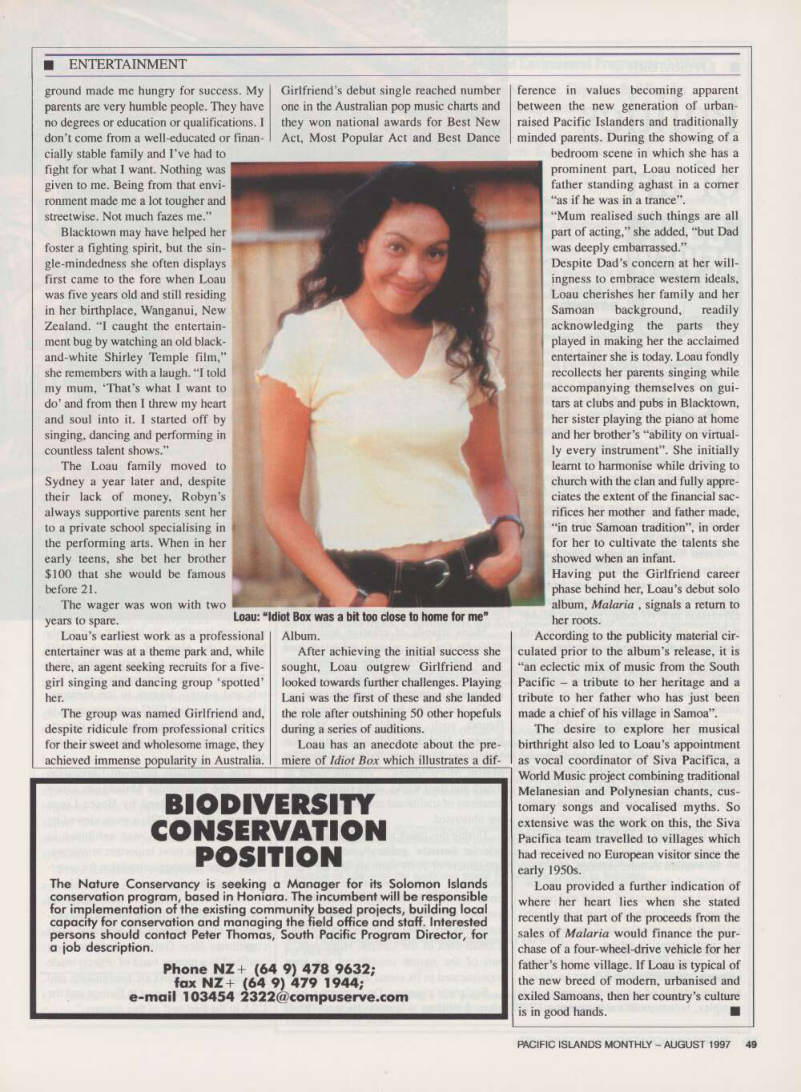
Loau, who has spent 19 years in Blacktown in the heart of Sydney’s ‘Wild West’, admits: “ Idiot Box was a bit too close to home for me, literally speaking.
Lani is caught in a dead-end existence and I could easily have slipped into a sim ilar lifestyle - which a lot of my friends have.”
As well as having witnessed at close quarters the social problems depicted in Idiot Box, Loau encountered the same racial taunts Lani faces in the movie. She was forced into leaving one school because of the intolerance of some class ‘mates’.
“I suffered a lot from racism in the 1980 s,” she says. “I copped a fair amount of it. It’s a lot better now, but it was amaz ing to discover just how narrow minded people could be.”
However, Loau believes that her Blacktown upbringing had a positive fac tor in moulding her character. “It made me harden up and go out and get the things I want,” she now reflects.
“Coming from a working-class back
ground made me hungry for success. My parents are very humble people. They have no degrees or education or qualifications. I don’t come from a well-educated or finan
cially stable family and I’ve had to fight for what I want. Nothing was given to me. Being from that envi ronment made me a lot tougher and I streetwise. Not much fazes me.”
Blacktown may have helped her foster a fighting spirit, but the sin
gle-mindedness she often displays
first came to the fore when Loau was five years old and still residing in her birthplace, Wanganui, New Zealand. “I caught the entertain ment bug by watching an old black
and-white Shirley Temple film,”
she remembers with a laugh. “I told my mum, ‘That’s what I want to do’ and from then I threw my heart and soul into it. I started off by singing, dancing and performing in countless talent shows.”
The Loau family moved to Sydney a year later and, despite their lack of money, Robyn’s always supportive parents sent her to a private school specialising in the performing arts. When in her early teens, she bet her brother $lOO that she would be famous before 21.
The wager was won with two years to spare.
Loau’s earliest work as a professional entertainer was at a theme park and, while there, an agent seeking recruits for a five girl singing and dancing group ‘spotted’ her.
The group was named Girlfriend and, despite ridicule from professional critics for their sweet and wholesome image, they achieved immense popularity in Australia.
Girlfriend’s debut single reached number one in the Australian pop music charts and they won national awards for Best New Act, Most Popular Act and Best Dance
Album.
After achieving the initial success she sought, Loau outgrew Girlfriend and looked towards further challenges. Playing Lani was the first of these and she landed the role after outshining 50 other hopefuls during a series of auditions.
Loau has an anecdote about the pre miere of Idiot Box which illustrates a dif
ference in values becoming apparent between the new generation of urban raised Pacific Islanders and traditionally minded parents. During the showing of a
bedroom scene in which she has a prominent part, Loau noticed her father standing aghast in a comer “as if he was in a trance”.
“Mum realised such things are all part of acting,” she added, “but Dad was deeply embarrassed.”
Despite Dad’s concern at her will ingness to embrace western ideals, Loau cherishes her family and her Samoan background, readily acknowledging the parts they played in making her the acclaimed entertainer she is today. Loau fondly recollects her parents singing while accompanying themselves on gui tars at clubs and pubs in Blacktown, her sister playing the piano at home and her brother’s “ability on virtual ly every instrument”. She initially learnt to harmonise while driving to church with the clan and fully appre ciates the extent of the financial sac rifices her mother and father made, “in true Samoan tradition”, in order for her to cultivate the talents she showed when an infant.
Having put the Girlfriend career phase behind her, Loau’s debut solo album. Malaria , signals a return to her roots.
According to the publicity material cir culated prior to the album’s release, it is “an eclectic mix of music from the South Pacific - a tribute to her heritage and a tribute to her father who has just been made a chief of his village in Samoa”.
The desire to explore her musical birthright also led to Loau’s appointment as vocal coordinator of Siva Pacifica, a World Music project combining traditional Melanesian and Polynesian chants, cus tomary songs and vocalised myths. So extensive was the work on this, the Siva Pacifica team travelled to villages which had received no European visitor since the
early 19505.
Loau provided a further indication of where her heart lies when she stated recently that part of the proceeds from the sales of Malaria would finance the pur chase of a four-wheel-drive vehicle for her father’s home village. If Loau is typical of the new breed of modem, urbanised and exiled Samoans, then her country’s culture is in good hands. ■
Loau: “Idiot Box was a bit too close to home for me”