nighty
pp. 47-48 · Read in the full issue
Sports
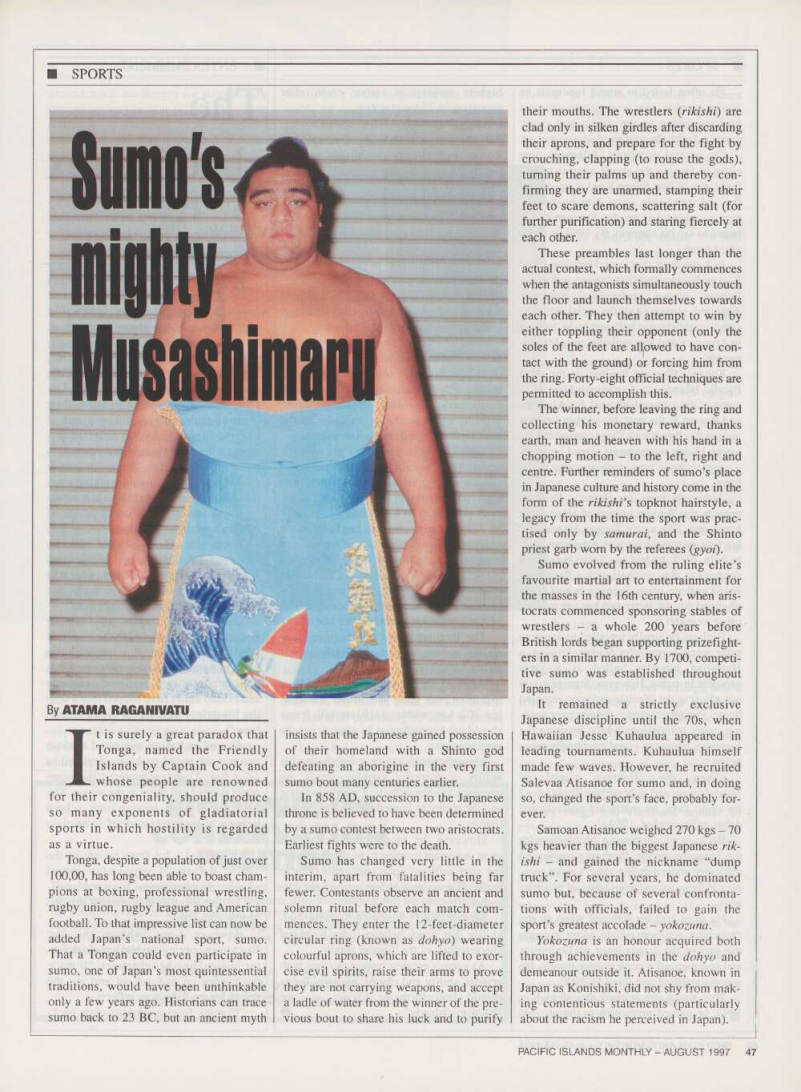
Sumo's nighty Musashimaru
By Atama Raganivatu
It is surely a great paradox that Tonga, named the Friendly Islands by Captain Cook and whose people are renowned for their congeniality, should produce so many exponents of gladiatorial sports in which hostility is regarded as a virtue.
Tonga, despite a population of just over 100,00, has long been able to boast cham pions at boxing, professional wrestling, rugby union, rugby league and American football. To that impressive list can now be added Japan’s national sport, sumo.
That a Tongan could even participate in sumo, one of Japan’s most quintessential traditions, would have been unthinkable only a few years ago. Historians can trace sumo back to 23 BC, but an ancient myth
insists that the Japanese gained possession of their homeland with a Shinto god defeating an aborigine in the very first sumo bout many centuries earlier.
In 858 AD, succession to the Japanese throne is believed to have been determined by a sumo contest between two aristocrats.
Earliest fights were to the death.
Sumo has changed very little in the interim, apart from fatalities being far fewer. Contestants observe an ancient and solemn ritual before each match com mences. They enter the 12-feet-diameter circular ring (known as dohyo) wearing colourful aprons, which are lifted to exor cise evil spirits, raise their arms to prove they are not carrying weapons, and accept a ladle of water from the winner of the pre vious bout to share his luck and to purify
their mouths. The wrestlers ( rikishi ) are clad only in silken girdles after discarding their aprons, and prepare for the fight by
crouching, clapping (to rouse the gods),
turning their palms up and thereby con firming they are unarmed, stamping their feet to scare demons, scattering salt (for further purification) and staring fiercely at each other.
These preambles last longer than the actual contest, which formally commences when the antagonists simultaneously touch the floor and launch themselves towards each other. They then attempt to win by either toppling their opponent (only the soles of the feet are allowed to have con tact with the ground) or forcing him from the ring. Forty-eight official techniques are permitted to accomplish this.
The winner, before leaving the ring and collecting his monetary reward, thanks earth, man and heaven with his hand in a chopping motion - to the left, right and centre. Further reminders of sumo’s place in Japanese culture and history come in the form of the rikishi’ s topknot hairstyle, a legacy from the time the sport was prac tised only by samurai, and the Shinto priest garb worn by the referees ( gyoi ).
Sumo evolved from the ruling elite’s favourite martial art to entertainment for the masses in the 16th century, when aris tocrats commenced sponsoring stables of wrestlers - a whole 200 years before British lords began supporting prizefight ers in a similar manner. By 1700, competi tive sumo was established throughout
Japan.
It remained a strictly exclusive Japanese discipline until the 70s, when Hawaiian Jesse Kuhaulua appeared in leading tournaments. Kuhaulua himself made few waves. However, he recruited Salevaa Atisanoe for sumo and, in doing so, changed the sport’s face, probably for ever.
Samoan Atisanoe weighed 270 kgs - 70 kgs heavier than the biggest Japanese rik ishi - and gained the nickname “dump truck”. For several years, he dominated sumo but, because of several confronta tions with officials, failed to gain the sport’s greatest accolade - yokozuna.
Yokozuna is an honour acquired both through achievements in the dohyo and demeanour outside it. Atisanoe, known in Japan as Konishiki, did not shy from mak ing contentious statements (particularly about the racism he perceived in Japan).
He often failed to attend functions he was required to, saw no reason to present a positive image to the media and rarely complied with the wishes of administrators.
On several occasions, Atisanoe came close to forcing the sports administrative body, the Nihon Sumo Kyokai, to confer the yokozuna title upon him by perfor mances alone before the Samoan’s size began to sap his strength. By 1993 he was a spent force.
In January of that year, Hawaiian Chad Rowan became the first foreign yokozuna.
Rowan, whose professional name is Akebono, possessed all the social skills the sumo establishment believed to be lacking in Atisamoe and few quibbled over his pro motion.
Tonga’s Fiemalu Penitani is the third Pacific Islander to distinguish himself in sumo. Often overshadowed by Atisanoe and Rowan in the past, his victory late last year in the President’s Cup - one of the six
major 15-day tournaments staged annually
- suggests he is now ready to come to the force.
Although born in Hawaii, Penitani regards the Tongan village of Houma his home and, like many Tongan Hawaiians, his first sporting love was American foot ball. In 1989, he had to choose between a contract to play football with a Pasadena based college or an opening in sumo. He plumped for the latter and has yet to have cause to regret it.
Penitani originally travelled to Japan to offer moral support for Nathan Strange, a Hawaiian wrestler hailed as a great prospect in sumo. However, Strange could not adjust to the lifestyle and soon returned
home. Penitani stayed - despite experienc
ing many tribulations whilst learning the
Japanese language - and eventually pros
pered.
Given the ‘fighting name’ of Musashimaru and dubbed “the Terminator” by sumo fans, he made his professional debut in September, 1989.
Because of continuing problems with the Japanese tongue, Penitani experienced difficulty understanding sumo’s more com plex techniques and even some of its easier ones.
He once lost his balance when in the crouching position rikishi adopt towards the end of the compulsory preliminaries and commenced a contest prematurely. He was disqualified and fined SUS9OO.
That was a rare setback though and, in 1994, he gained promotion to the second
highest ranking in sumo, ozeki, after appearing in 27 tournaments.
Only one man had achieved this sooner; Rowan required just 26. Penitani and Rowan had already established a great rivalry.
A year earlier, the Tongan ruined Akebono’s hopes of a rare 100 per cent record in a tournament at Fukuoka. He also defeated his Hawaiian adversary to win an unofficial competition in Honolulu, which offered SUSI million in prize money. At the season-closing Emperor’s Cup, though, Rowan took the title, leaving Musashimaru with second place and the consolation of being named Outstanding Performer.
July, 1994 saw Musashimaru win his first official tournament in Nagoya. A string of minor honours followed as he was named Shukunsho (Outstanding Performer), Ginosho (Best Technical Fighter) and Kantosho (Possessor of the Best Fighting Spirit) in various events.
Late last year, came his greatest tri umph. The Emperor’s Cup is regarded as sumo’s most prestigious tournament and the 1996 version will be remembered as the most exciting in its long history.
After the 16 contestants had fought each other once, five of them shared top position with 11 wins and four losses. This meant a play-off was required, in which Musashimaru won all his three bouts -
including a particularly satisfactory defeat
of Akebono - to claim the title.
The Terminator now has the prize every rikishi covets, yokozuna, firmly in his
sights.
Aged 25, he can expect to have at least two more peak years and, unlike Atisanoe, his 202 kgs within a 191 cm-tall frame should not betray him as he approaches the veteran stage.
Musashimaru’s major strengths are his agility, a powerful pushing attack, an upcompromising attitude, a whirlwind style and the ability to immediately seize the ini tiative.
However, he laughingly claims, his most important weapon to be the intimidat ing stare inflicted upon opponents prior to battle. “I practise it before every fight,” he insists.
Musashimaru’s humour reflects the ami ability that many believe to be a natural characteristic of the Tongan people.
As sumo’s greatest reward requires both athletic ability and charm, perhaps Tonga should henceforth be known as “the Yokozuna Islands”. ■