Pacific Islands

Monthly
•FORUM SEC ACCOUNTS POSE QUESTION ‘SECRET REPORT HITS RAW NERVE
August 1997
Ii I
UU3 mm Lv vhhob \im Cl L" Cl' Cl Ll
ißeildion in the Pacific - blessing or curse?
American Samoa USS2.SO; Australia ASS.SO; Cook Islands NZ$3; Fiji F 52.50 Vat incl; FS Micronesia US$3; Kiribati A 52.50; Nauru A 52.50; Niue NZ$3; Norfolk As 3; New Caledonia cpf2so; New Zealand NZ53,45 incl GST; Northern Marianas US$3; Papua New Guinea K 2.90; Palau US$3; Marshall Islands US$3; Solomon Islands As 3; French Polynesia cpf3oo; Tonga P 3; USA US$3; Vanuatu VT22O; Western Samoa T 5.50. These are recommended prices only.
Advertisements & other items, pp. 2-5 (1 item)
|L||| Telikom
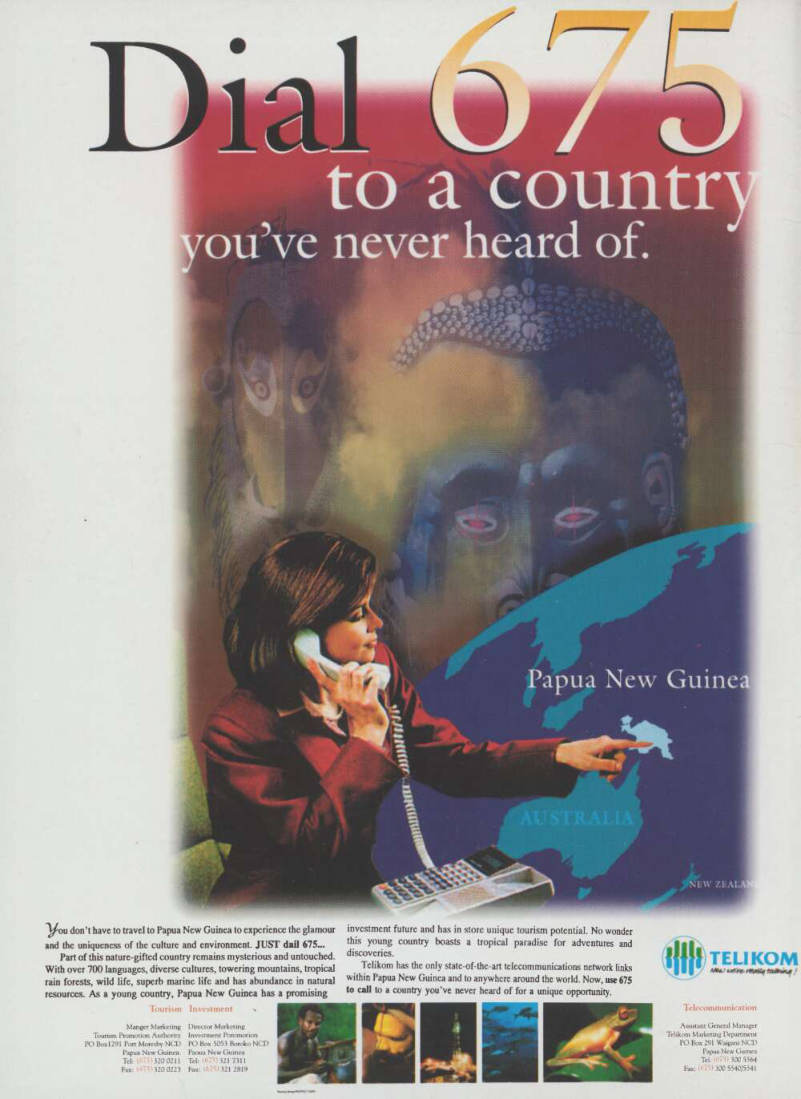
You don’t have to travel to Papua New Guinea to experience the glamour and the uniqueness of the culture and environment. JUST dail 675- Part of this nature-gifted country remains mysterious and untouched.
With over 700 languages, diverse cultures, towering mountains, tropical rain forests, wild life, superb marine life and has abundance in natural resources. As a young country, Papua New Guinea has a promising investment future and has in store unique tourism potential. No wonder this young country boasts a tropical paradise for adventures and discoveries.
Telikom has the only state-of-the-art telecommunications network links within Papua New Guinea and to anywhere around the world. Now, use 675 to call to a country you’ve never heard of for a unique opportunity.
Tourism Investment Manger Marketing Director Marketing Tourism Promotion Authority Investment Poromotion PO Box 1291 Port Moresby NCD PO Box 5053 Boroko NCD Papua New Guinea. Paoua New Guinea Tel: 1675)320 0211 Tel: (675)321 7311 Fax: (675)320 0223 Fax: (675)321 2819
|l||| TELIKOM
■\ IV § / ***' Mttto rmautf > Telecommunication Assistant General Manager Telikom Marketing Department PO Box 291 Waigani NCD Papua New Guinea Tel: (675) 300 5564 Fax: (675) 300 5540/5541
Island Distributors
Wonted For
"Island Soda"
N W i * '■: ?
V>- Lilli
Si. '' *>' 'ii ‘
Island Pineapple
Island Orange
Island Dew Island Cola
Tropical Soda
Grape
Lemon-Lime Strawberry Lei or full container shipments available.
For information on our competitively priced line of quality beverages, fax, phone or write us at: US Mainland: Aspen International, Inc. 1402-3rd Avenue, Suite 1024 Seattle, Washington 98101 Phone (206) 628-6151 Fax (206) 628-6421 Tahiti Distributor: Eico P.O. Box 184 Papeete - Tahiti Phone 421 660 Fax 429 838
ISLAND
SODA
Product of U.S.A. Island Soda is a registered trademark
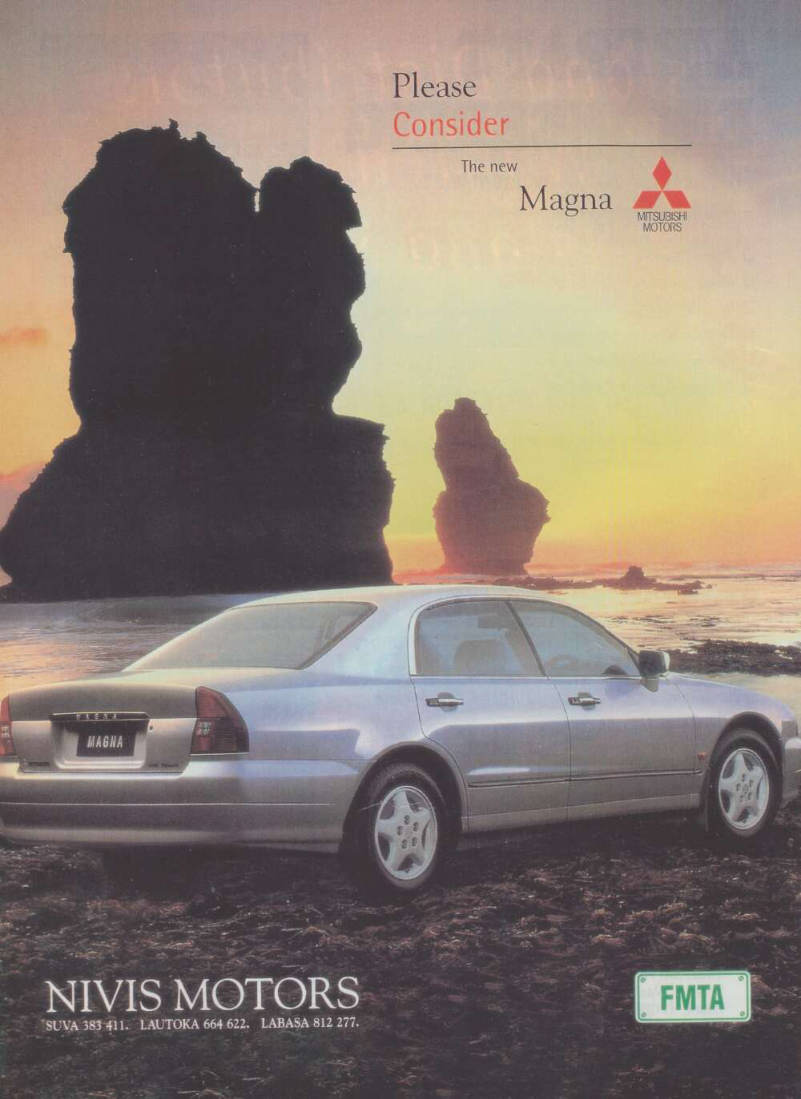
Please
Consider
The new
Magna
MITSUBISHI
MOTORS
|i||| f. ff jf » £«
FMTA
Fiji's first and only fully equipped
computer lab open for public
* « G
SOFTWARE
• MS OFFICE 97
• MS PUBLISHER
COREL WORD PERFECT
• LOTUS 123R5
• C++ FOR WINDOWS
AVAILABLE
• TURBO PASCAL
• FOX PRO
• DBASE S(WINDOWS)
• VISUAL BASIC 5.0
• AUTOCAD LT 13
Enquire about our courses in Microsoft certification, Novell CNA & CNE
MEMBERSHIP RATES
1 Month 3 Months School students Tertiary students Adults $20.00 $35.00 $35.00 $55.00 $95.00 $95.00
JOIN NOW!!
Call us now on 306 206 or visit us at 36 Cumming St., 2nd Floor of JB House, Opp. Pala Jewellers for more details.
ENQUIRE
ABOUT OUR
NTERNET
ERG HUES
Pacific Blands
Monthly
August 1997
Vol 67 No. 08
The News Magazine
August 1997
PUBLISHER: Alan Robinson EDITOR: Manivannan Naidu SENIOR WRITER: Bernadette Hussein
Correspondents:
Sally Andrew, Patrick Decloitre, Gift Johnson, Chris Peteru, Susan Prokop, Atama Raganivatu, Kalinga Seneviratne, Liz Thompson, Lili Tuwai, Sam Vulum, lan Williams COLUMNISTS: David Barber (Wellington), Jemima Garrett (Sydney), Debbie Singh (South Pacific Commission).
GRAPHIC ARTISTS: James Ranuku, Josefa Bola, Andrew Williams
Advertising Sales
Senior Regional Sales (South Pacific) Shabana Naaz Satish Kumar Tel (679) 304111, 303244, Fax (679) 303809.
Sydney, Canberra: Bob Hill Media Representation. Tel (61-2) 4164245, Fax (61-2) 4165064.
Brisbane: Jane Fewings Media and Advertising Associates Tel (61-7) 3378 4522, Fax (61-7) 3878 1071.
Adelaide: Hastwell Williamsons Representatives, Tel (61-8) 3799522, Fax (61-8) 3799735.
Melbourne: Brown Orr Fletcher Burrows (Aust) Pty Ltd.
Tel (61-3) 98265188, Fax (61-3) 98265644.
Auckland: McKay & Bowman, International Media Representatives Limited, Tel (64-9)4190561, Fax (64-9) 4192243.
Japan: Universal Media Corporation, Tokyo, Tel (3) 3266626741, Cable: UNI-MEDIA Tokyo, Fax (3) 32626742.
Pacific Islands Monthly was founded in 1930
(Usps 9522480).
A Fiji Times Limited production.
Cover prices are recommended retail only. Registered by Australia Post, Publication No. NBPI2IO. © Copyright Fiji Times Limited, 177 Victoria Parade, Suva, Fiji.
Tel (679) 304111, fax (679) 303809.
Pacific Islands Monthly is published monthly by Fiji Times Limited, a division of Nationwide News, 2 Holt Street, Surry Hills, Sydney, NSW 2010.
Send Address Changes To:
Pacific Islands Monthly POBox 1167 Suva, Fiji.
Typeset and printed by The Fiji Times Limited, 177 Victoria Parade, Suva, Fiji.
Layout and cover design by Josefa Bola
Inside
Cover stories: The Pacific is perhaps the largest Christian region outside Europe.
But two hundred years after the arrival of the first Christians, newer denominations continue to make appearances, meeting with much resistance and sometimes violence.
Just what is the role of religion in Pacific Island states?
In the name of God 18 Church appeal questioned From the pulpit 19 State versus religion Religion or scam? 20 Mormons in Samoa Prophets, predictions and the pope 22 Up in arms over God 24 Channeling in to God 2G
Editorial 7 Letters to the Editor 7 Briefs 11
Special Reports:
The Forum 14 Secretariat questioned over accounts Open secrets 18 Australian report hits raw nerve Conservation consensus 28 Too many fish in the sea 29 Arms and the man 30 Lawsuits plague Samoan daily 32 FSM media struggle 33 Flagging powers 34 Estate of war 35 Motoring feature 36 Tonga feature 43 Sumo's mighty Musashimaru 47 The shadowbox 48 Politics of art 50
Yachting:
The President's race 52 Mayday, mayday 53
Opinion:
Sad, but true 56 High acclaim follows Majuro fish meeting 57 Global warning for Howard 58
Page 14
Page 28
Page 47
of God

Editorial
In the name of God
At best, it is naive to argue a country will become a better place simply by virtue of it being declared a Christian state. At worst, it is reli
gious bullying.
The past month saw the passage
through parliament of Fiji’s
Constitution Amendment Bill. But, con troversially, it stopped short of declaring Fiji a Christian state - and rightly so. To reason that Christianity - in name - will improve the state of a nation lacks any
foresight, vision or logic.
Religion is too personal to legislate because it is based on interpretation rather than fact, faith rather than logic.
Just what exactly becoming a Christian state would entail is impossible to estab lish and one even its proponents seem unable to explain without contradiction.
The Methodist Reverend Tomasi Kanailagi, a strong advocate of bringing religion into politics, says a Christian state would run along general Christian principles and not those of any one denomination. And, he is quick to assure non-Christians, his is a religion of toler ance and acceptance with no threat to reli
gious freedom.
“We, as Christians,” he says, “have to give people the freedom to worship as
they want and whenever they want.”
But it is on justification of religion that a Mormon was nearly burnt at the stake in Western Samoa; that members of the Every Home sect have been discriminat ed against in several Fijian villages; and that places of worship are so frequently desecrated in Fiji.
Whether, as the Rev Kanailagi claims, Christianity does indeed value tolerance over conversion is arguable, but the rev erend is entitled to his interpretation of his religion. What is questionable and does little to credit the man or his convic tions is his self-contradiction.
The reverend describes as a problem the number of religious sects entering the Pacific. The reverend who - in the same interview - appears to be championing freedom of religion, it seems, has given new meaning to the miracle of speaking in tongues.
A similar view is shared by the presi dent of the Methodist Church in Fiji, the
Rev Dr Ilaitia Tuwere, who, ironical ly, has been an advocate of keeping state and religion separate.
From such parochial thinking comes intolerance, and from intoler
ance persecution.
While criticising acts of temple desecration, the Rev Kanailagi also attempts to explain them away as the venting of frustration. To even imply that declaring Fiji a Christian state would be the cure for such acts of religious terror ism could be construed as nothing less than blackmail.
If history has one lesson to teach about religion it is this: that, contrary to what the Rev Kanailagi says, Christianity - or any other religion for that matter - does not necessarily provide the “humanitarian grounds which can bring people togeth er”. The Middle East, Northern Ireland and India are proof of this.
Religion cannot even provide consen sus between observers of the sabbath on whether it should be a Saturday or a Sunday.
No one religion can be imposed as the absolute truth and be made to represent societies as a whole. Religion is not infal lible; it is too personal, too full of inter pretation and too contradictory. ■
• Cover Stories on page 18
Letters To The Editor
Independence and the accord
Dear Sir, I wish to contribute to Kalinga Seneviratne’s country report on New Caledonia (PIM May, 1997). Specific ref erences will be made on the implications of the Matignon Accord on the fight for independence in New Caledonia. I gather from the report that the main pillar of the accord is to ‘rebalance the economic scales’ in the country over a decade. It is hoped, therefore, that in late 1998, a vote of independence will be the end result.
However, events within that 10-year period dictate that the actual intention of the accord is not too obviously evident as such but carefully hidden within the signed agreement itself. Only thorough analysis and careful reading in between the lines of
the document will detect the impurities of the agreement. This suggests that the excuse for the accord to promote equitable economic balance between all races in New Caledonia is only a camouflage.
I wish to substantiate this claim.
Firstly, I am of the opinion that the establishment of FLNKS provinces in the Loyalty Islands and north of the main island were ploys to neutralise the FLNKS voice for independence. This was especial ly obvious in the French government’s resistance to provide a mining permit to Societe Miniere du Sud Pacifique (SMSP) - an FLNKS-aligned mining company.
It is also encouraging, especially for independence-minded citizens, to note that a portion of SMSP’s retained profit is redi rected to SOFINOR - which is by virtue a parent company of SMSP. In this connec
tion, I uphold the decision by SOFINOR to form Compagnie D’lnvestissements Touristiques (CIT) for tourism develop ment.
However, despite these positive initia tives, it is heartening to note that the pur chase of three big hotels in Noumea by CIT was not welcomed by Jacques Lafluer.
This was made worse by the fact that one of the hotels, Le Surf, housed the only casino in Noumea.
Secondly, I would suggest that Lafluer’s jealously and selfish attitude evi dent in his denial of equal business oppor tunities in the Rassemblement Pour Caledonie dans la Republique (RPCP)controlled South Province for CIT is a good enough reason against the stated and so-called aims of the Matignon Accord for balanced economic development.
This is to say that Lafluer’s actions were indicative of the fact that RPCR is against the rebalance of economic devel opment in the country.
In this regard, one can deduce that Lafluer’s particular reference to the issuance of restrictions on the opening hours of the casino is counter-supportive of the Matignon Accord principle.
Is this act not contradictory to the so called aim of ‘economic rebalance’ for all races?
Lastly, I am also sceptical of the gen uine spirit for the Cadres 400 programme.
The involvement of the government of France to educate New Caledonians on all subjects relating to French philosophies, principles, histories and theories in all France mainland universities and colleges can be seen as a means to brainwash the few educated indigenous citizens of the country.
To remain faithful to motherland is per haps the bottom line. To this end, I have no option but to equate Cadres 400 to the development of right-wing support for France.
RPCR, in other words, is the direct ben eficiary of the scheme.
On the worse side of the system is FLNKS’s inverse relationship to Cadres 400. On another level, I will proclaim from an observer’s point of view that the actual intentions of the Matignon Accord are to politically suppress the FLNKS’s cry for
independence.
The tactics applied were heavy migra tion of anti-independence supporters from mainland France to New Caledonia over a decade and a political fallacy of giving more autonomy to FLNKS in the provinces north of the mainland and the Loyalty Islands. As a matter of fact, France and PRCR are being successful in making fools
Of Flnks.
As a way out of this Matignon-tied web, FLNKS leadership is starting to talk of a South African-style option. The chances of power sharing, however, are doubtful at this stage.
Renee Sore, Honiara,
Solomon Islands.
Race debate or gutter fight?
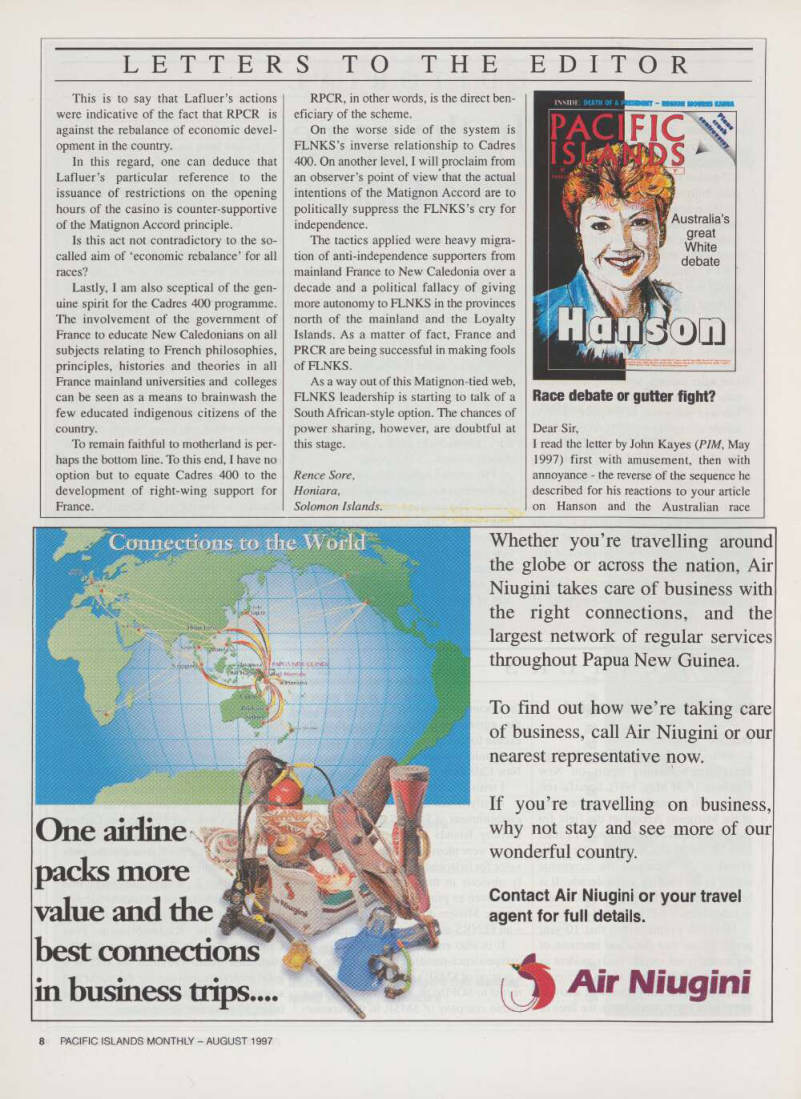
Dear Sir, I read the letter by John Kayes ( PIM , May 1997) first with amusement, then with annoyance - the reverse of the sequence he described for his reactions to your article on Hanson and the Australian race
“debate” as it is constantly and erroneous ly called. In fact, there has been little debate.
What is happening is a gutter fight because that is where it started and where it has, unfortunately, been left - even exac erbated - by the Australian government.
Kayes presented many of the slogans of the Hanson camp as facts.
Slogans depend on having the superfi cial appearance of fact and common sense,
while actually avoiding any critical analy
sis.
It should never be forgotten that Pauline Hanson’s entry into political life in 1996 and her being dropped from Liberal Party endorsement was not to do with multicul turalism. Standing in a seat with a large and visible Aboriginal population, which attracts the amount of racist attention that is (sadly) normal in Australia, she mounted a vicious, totally ill-informed and unwar ranted attack on them, claiming they were being feather-bedded by the system and should have to “do it tough” like other Australians.
Had she ever taken the trouble to read a little of the freely available information on this most consistently discriminated against and disadvantaged sector of Australia’s society, even she should have found the ludicrousness of her position untenable.
But that would suggest a respect for logic and a concern for truth, and those were not relevant - she saw a chance for a lot of votes from people just like her, and went for them. Got them, too.
The spin-offs of that attack continue, for it took the scab off a carbuncle on the backside of Australian society, a small but aggressive sector of the Australian commu nity that ever since has been pouring out racial intolerance, neo-colonialism and good old-fashioned bullying.
This resonates through the current Wik issue and the Liberal/National coalition’s attempts to find ways to convert Wik into wicked, to use it as a pretext to construct ‘legal’ devices to reverse the direction established by the Mabo decision and to dispossess the original, and already terri bly wronged, indigenous people of this land.
The prime minister’s Ten Point Plan is a real politician’s solution - he is trying to present it to each faction as something that delivers what they want. That is clearly impossible, and what the majority (not the
self-serving minority) of Australians have a right to expect from the leader of the country is that he not look for the political ly smartest and trickiest solution, but the solution that is moral and decent, that will allow Australians to walk tall in the inter
national community instead of being pari
ahs. The Aboriginal community is quite right to reject his plan, as a massive three shell trick.
It was recently pointed out by one observer that there has been an extraordi nary conjuring trick performed, whereby the Aboriginal land claimants are being represented as the opportunistic outsiders attempting to rob the wealthy pastoralists of their birthright and confident feelings of security.
Aren’t-the 50,000-year owners of the land entitled to even share those feelings of security? Apparently not. And let us be clear that the pastoralists we are speaking of are not battling farmers trying to grub out a living for the little wife and six kids on 20 barren acres.
The inclusion of immigrants in Hanson’s target range came after she was elected - I suspect to her own surprise and certainly to the surprise, and horror, of the many Australians who despise and totally reject her attack on Aboriginal people.
Buoyed and encouraged by this evi dence that there must be a lot more out there who were as keen to find hapless tar gets on whom to blame the ills of late 20th century economic woes, she homed in on the next most vulnerable group - again already victims of racism mistrust and intolerance - migrants. Her maiden speech in parliament identified migrants as the next group of “others” who should be brought into line.
It is to the government’s lasting shame that they did nothing to counter her attacks on Aborigines, nor initially her attacks on migrants (which must have sounded very familiar to John Howard, who had been mumbling about immigration for years, trying to find a way to curtail it without
committing political suicide).
It is interesting that the mood Hanson created has encouraged him to move to reduce immigration, despite his extraordi nary efforts to insist that the “credit” go to him.
But it took the government a full year to make the first utterances assuring the world it did not support the racism of Hanson, and that was only when they realised our
Asian neighbours were not taking kindly to people of their ethnicity being victimised and vilified in Australia, and were likely to direct their dollars (and ringgit and yen) away from Australia in response.
In other words, the government acted not morally as they should have the day after Hanson’s maiden speech in parlia ment but pragmatically - and the lack of passion in their statements has not gone unnoticed among the people whom they were supposed to appease, as the Asian press shows.
They are very used to politicians’ dou ble speak in their own countries; of course they recognise it even if it does have an Aussie accent. It is naive to imagine any one will believe that such attacks on “other” groups are justified by some cur rent crisis emerging in Australia.
They are as ancient as the human race, and are called tribalism. This is when groups isolate themselves, and those of a different colour or creed or geographical location are perceived as “the other” and are then blamed for everything because of their difference.
While tribes are prepared under certain circumstances to initiate others into their tribe, this involves a total recanting of all previous tribal allegiances. That is what has caused the conflicts in the long list of places Kayes mentions. It is hatred that causes wars, and it is hatred that Hanson has been peddling. Sadly, it finds as ready a street market as drugs do, and is far more dangerous.
People not speaking English don’t
cause bloodshed - only people’s hostility
toward them because they don’t speak English does. The tragedy in Yugoslavia was not because of a lack of integration.
What caused that awful bloodbath was the very insistence that people must be the same in every respect.
If Australians are unable to rise above that sort of animal instinct for savaging any animal that is different, Kayes would be right, and the future would probably involve bloodshed.
I don’t agree the only way to avoid this is to insist everyone become the same that’s just reiterating the base cause of the
problem.
I believe most Australians are now bet ter than that - indeed, for 20 years we have been showing the world that we were right up until March 1996.
The whole point of multiculturalism is
that societies can be textured of different components, each of which is sufficiently civilised to accord others the respect and dignity their heritage deserves, and be enriched themselves by doing so.
Integration was the policy of the Australian authorities responsible for the Lost Generations of Aboriginal children taken to be “integrated” into a “better way of life”. Kaye’s demand, that anyone who wants to share in what Australia has to offer has to give up their birthright and become pseudo-Anglo/Celtic, comes from the same blinkered thinking, the same “tribal initiation” instincts mentioned above.
As long as the ribe can control every one within its own sanctions, it will never have to expand its own traditions, question its own assumptions or values. Far easier all round, really - you can seen why it appeals if you are not too strong in the data-processing department or if you just
enjoy beating up on others who don’t, or can’t, comply.
I note Kayes’s reference to “my coun try” and “our” this and that. He, of course, has the right to do so, as a settled immi grant (or descendent of immigrants) in another people’s country, just as I am.
Perhaps he is, as I am, descended from immigrants who came here a lot longer ago than this present bunch from whom he reckons all the problems are coming. Ah, yes, if only they could be ‘good’ immi grants like our lot. The very earliest of “us”, and therefore best by such reasoning, were of course certainly all selected by the government of their day, and by pretty tough criteria, even though a lot of them couldn’t read or write, and though the skills for which they were selected seem to have been theft and murder.
Perhaps, after all, they “should never have been selected for migration” - I’m sure the Aborigines would have felt that.
Since they were the very first immi grants, surely they should have had the last say.
Finally, if all these “others” (which would certainly include me as I don’t want to be identified with Hanson or her ilk) were able to be brought into line, initiated into the tribe, Australia would be like one great big community of male and female Pauline Hansons.
Now there’s something to frighten the kiddies with when they won’t eat their broccoli. Or spaghetti. Or curry. Or satay.
Or taro. Or ...
Rod Ewins Tasmania,
Australia
Letters to the Editor should be addressed to: The Editor Pacific Islands Monthly PO 80x1167 Suva
Advertisements & other items, pp. 8-10 (3 items)
Letters To The Editor
8
PACIFIC ISLANDS MONTHLY - AUGUST 1997
packs more
: J ’■ "'sNa^ ■f ■ i % & \wJ |.,PJ iWWf”' ft '■ 1 .->. LU L / / JI >■': l/w >\.
One airline
value and the
best connections
in business trips...
; m K - i V"-' < ■ ’ / ■ :■ ■ H -••r. *#■ rres te J ■ - 1 m
Whether you’re travelling around
the globe or across the nation, Air Niugini takes care of business with the right connections, and the largest network of regular services throughout Papua New Guinea.
To find out how we’re taking care of business, call Air Niugini or our nearest representative now.
If you’re travelling on business, why not stay and see more of our wonderful country.
Contact Air Niugini or your travel agent for full details.
'% Air N,u 9^ " ,
TOUR VANUATU
A perfect holiday in Paradise starts at Tour Vanuatu -vfX m S v i' i sir v Tour Vanuatu are the premier tour operators of Vanuatu We can take you anywhere, be it at sea, on land or in the air, and we can show you the people, the ancient rituals and the nature of our beautiful islands.
You’ll find us in Port Vila next to the Post Office.
TOURftm
VANUATU
P.O. BOX 409, Port Vila, Vanuatu. Ph: (678) 22 733 Fax;(67B) 23 442
Letters To The Editor
10
PACIFIC ISLANDS MONTHLY - AUGUST 1997
Briefs

Ombudswoman files legal claim Vanuatu’s ombudswoman, Marie-Noelle Ferrieux-Patterson, in early July, decided to sue leaders in the supreme court to give effect to one of her latest recommendations on leaders’ “misconduct”. In a report pub lished in June here, Ferrieux-Patterson alleged 23 former MPs who lost their seats in 1988 because they didn’t attend parlia ment three consecutive times were later paid each V 1.5 million (SUS 13,200). She alleges that ministers in a former govern ment, including current Prime Minister Serge Vohor, former PM Maxime Carlot, former Finance Minister Willie Jimmy and then acting Finance Minister Paul Telukluk “illegally awarded themselves ex-gratia
compensation” with public funds.
The report recommends Jimmy and Carlot should not be reappointed “to any ministerial post or any position involving public money”, that Jimmy resign or be dismissed, and that all monies received by the 23 be reimbursed within three months.
Vohor’s office later said the report was
“just a piece of paper” and had no value until it had been proven correct by a court.
“My powers are limited - I’m an ombudsman, I make my rec
ommendations. Until a leadership code which creates special tribunals for leaders is passed, not much more can be done. It’s up to the people to decide at the next elec tions,” the ombudswoman said.
Over the past 12 montns, a leadership code bill prepared by the ombudswoman’s office was on the agenda of three parlia mentary sessions. Each time, it was with drawn.
Anti-mercenary moves Foreign Minister Alexander Downer has announced that Australia will join an inter
national convention aimed at banning mer cenaries, Pacnews reported last month.
The convention was opened for signa ture in 1990 but only 12 countries have so far signed it. It needs the signatures of 22 countries before it comes into force.
Western Samoa takes new name The Western Samoan legislative assem ble last month passed a constitutional amendment to remove Western from the country’s name. Only one Independent MP voted against the amendment which was approved by 41 MPs in the 49-seat parlia ment, Pacnews reported.
Thyroid tumours in Marshalls According to a preliminary study on the incidence of thyroid cancer in the Marshall Islands, there is a high number of thyroid tumours in the populations of Ebeye and Majuro, The South Sea Digest reported last month. “No conclusions are yet available
Ferrieux-Patterson
conceming the relationship between possi ble exposure to radiation and the diseases we observed,” the study said.
More than 6000 Marshallese who were alive during the nuclear tests of the 50s were checked from 1993-94 by doctors from the Tohoku Scool of Medicine in Sendai, Japan, which coordinated the sur vey with the Marshall Islands Nationwide Radiological Study.
The study found the prevalence of thy roid nodules was 28.9 per cent in partic pants who were alive at the time of the
1954 Bravo nuclear test.
Celebrations cancelled The Solomon Islands government can celled official independence day celebra tions because of cash-flow problems, according to a Pacnews report.
Secretary to the PM Fred Ganate said funds allocated for the celebrations would be used in sending the Solomon Islands contingent to the Mini South Pacific Games in Pago Pago, American Samoa, this month.
The Solomon Islands became indepen
dent on July 6, 1978.
Enter the dragon The small, but affluent Chinese communi ty in Vanuatu celebrated Hong Kong’s
return to China on June 30 with much rejoicing, traditional drums and a lion dance along Port Vila’s main street.
“We, the Chinese from all around the world, we’re happy. You can’t take away our feeling about our motherland, no mat ter where we are. And we hope one day, China will become a democratic country.
We believe China will have the common sense not to destroy the world’s third largest stock exchange. I don’t think China can afford that,” said Rene Ah Pow, a prominent businessman who was bom here, but whose parents fled China earlier this century.
The Chinese ambassador Liao Jincheng took the opportunity to see in this occasion “a good example for the smooth return of Macau to China as well as the resolution of the Taiwan issue”.
Vanuatu reforms A stringent plan of economic, social and political reforms was endorsed late June by Vanuatu’s leaders and community rep resentatives in a two-day ‘national sum mit’. In February, Vohor signed an agree ment with the Manila-based Asian Development Bank (which coordinates the programme) pledging to carry out the reform programme. Australia, France and New Zealand have sent experts to assist in the reform drafting.
The reform programme aims to boost Vanuatu’s finance, economy and adminis tration performances and reduce costs crip
pling its development.
The programme advocates private-sec
tor participation through privatisation of
those government services seen as not profitable.
Advertisements & other items, pp. 11-13 (1 item)
datec
When I grow up I want to be a customer.
What’s a customer?
“I don’t know but it sounds real important. My dad says the people at his office work all day to make customers happy. My dad works for Datec and he told me that when customers need something, everyone in the office tries to get it for them.”
“When I grow up I want to be a customer, then I will be real
important.”
datec
SUVA Tel: (679) 314411 or 314696.
Facsimile: (679) 300162.
Help Desk: 304239 NADI Tel: 720181 or 721228 Facsimile: (679) 720194 Computing From personal computing to large Mid-range systems.
Networking & Installation Software Development & Support Support The largest Service and support team in Fiji and the Pacific. Offering comprehensive support for hardware, software and telephony systems.
Telephony Solutions from single line users through to large corporations PABX’s Voice & Data Integration Services Leasing and Credit Solutions Consulting Year 2000 Accounting, Payroll Systems Outsourcing
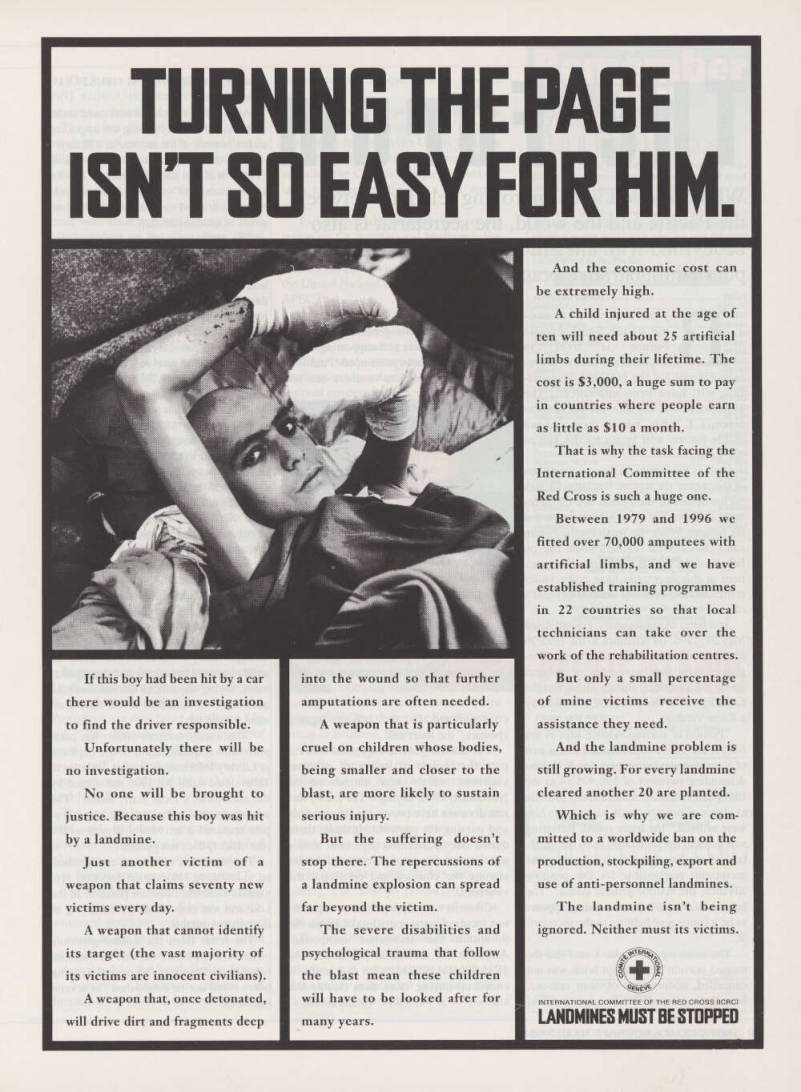
TURNING THE PAGE
ISN'T SO EASY FDR HIM.
m i mm ' .!
Pi ; i*-:- • i If this boy had been hit by a car there would be an investigation to find the driver responsible.
Unfortunately there will be no investigation.
No one will be brought to justice. Because this boy was hit by a landmine.
Just another victim of a weapon that claims seventy new victims every day.
A weapon that cannot identify its target (the vast majority of its victims are innocent civilians).
A weapon that, once detonated, will drive dirt and fragments deep into the wound so that further amputations are often needed.
A weapon that is particularly cruel on children whose bodies, being smaller and closer to the blast, are more likely to sustain serious injury.
But the suffering doesn’t stop there. The repercussions of a landmine explosion can spread far beyond the victim.
The severe disabilities and psychological trauma that follow the blast mean these children will have to be looked after for many years.
And the economic cost can be extremely high.
A child injured at the age of ten will need about 25 artificial limbs during their lifetime. The cost is $3,000, a huge sum to pay in countries where people earn as little as $lO a month.
That is why the task facing the International Committee of the Red Cross is such a huge one.
Between 1979 and 1996 we fitted over 70,000 amputees with artificial limbs, and we have established training programmes in 22 countries so that local technicians can take over the work of the rehabilitation centres.
But only a small percentage of mine victims receive the assistance they need.
And the landmine problem is still growing. For every landmine cleared another 20 are planted.
Which is why we are committed to a worldwide ban on the production, stockpiling, export and use of anti-personnel landmines.
The landmine isn’t being ignored. Neither must its victims. £7 bkT* + )l INTERNATIONAL COMMITTEE OF THE RED CROSS (ICRC)
LANDMINES MUST BE STOPPED
PIM staff win awards
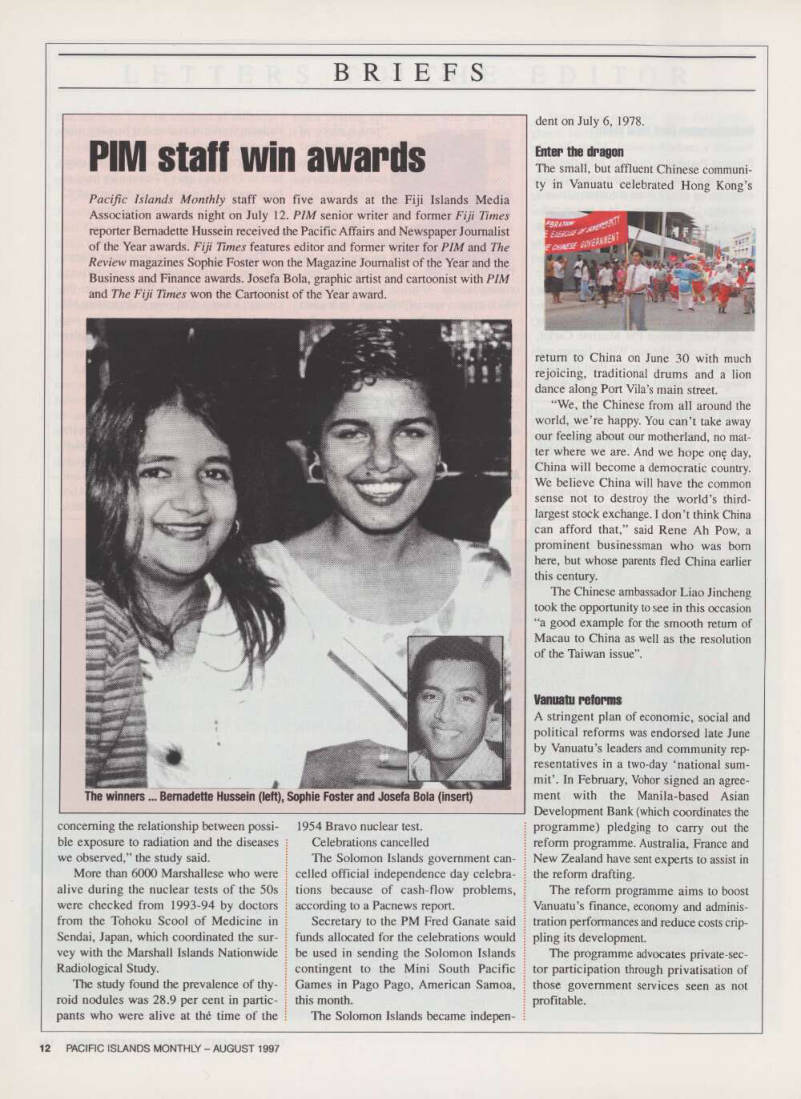
Pacific Islands Monthly staff won five awards at the Fiji Islands Media Association awards night on July 12. PIM senior writer and former Fiji Times reporter Bernadette Hussein received the Pacific Affairs and Newspaper Journalist of the Year awards. Fiji Times features editor and former writer for PIM and The Review magazines Sophie Foster won the Magazine Journalist of the Year and the Business and Finance awards. Josefa Bola, graphic artist and cartoonist with PIM and The Fiji Times won the Cartoonist of the Year award.
The winners...Bernadette Hussein (left), Sophie Foster and Josefa Bola (insert)
The Forum
While credited with improving relations between the Pacific and the world, the secretariat is also bedevilled with allegations of inconsistent and poor administrative practices
By the time the 28th sum mit of the South Pacific Forum is over in September, a new secre
tary-general for the regional organisa
tion will have been announced. The appointee will replace the incumbent leremia T Tabai, whose term as head of the Forum will be up by the end of the year.
And as the Forum focuses on the affairs of the region, the region, similarly, focuses on the affairs of the Forum and its secre tariat in Suva, Fiji - the achievements and the failures. While the South Pacific Forum can claim several feathers to its cap on behalf of the region, administrative prac tices at the secretariat have come under criticism from the Fiji auditor-general’s office.
In a letter to the secretary-general dated May 29, 1996, (in reference to the 1995/96 accounts of the secretariat) the auditor
general highlighted numerous inconsistent
and unfair practices, among which was the handling of the close to $lOO,OOO owed by a Karai Vunibau.
“Perusal of correspondence kept in the file for the above case revealed that a writ of summons was being served on K Vuibau demanding payment of $96,498.64 to the European Union or alternatively provide evidence of how the funds advanced to him were utilised,” the letter stated. Referring to a letter to the secretariat from the secre tary of the European Union holding the secretariat responsible for the pending advance, the auditor-general stated; “The balance of $96,498.64 outstanding appears to be a contingent liability to the secretari at.”
The auditor-general also found that the unused portion of a receipt book was not cancelled, adding “for obvious reasons, immediate action should be taken to cancel
these receipts”.
And, the auditor-general found that “payment vouchers and supporting docu ments were not always stamped ‘Paid’”.
“In several instances vouchers were not
countersigned by the officer signing
cheques,” the letter said.
The auditor-general expressed concern over the change to format of payment vouchers which was introduced in November, 1995, saying; “The [new] for mat does not have provisions for checking and passing for payment. Instead, these duties are performed by two senior accounts staff who are responsible for signing the cheques and certifying the vouchers.”
Concern was expressed over expendi ture incurred in the upgrading of House No 9 within the secretariat compound.
Although the secretariat put aside only $F35,000 ($U524,350) for this work, it ended up paying more than double the amount - $F74,774.81 ($U551,595) -
incurring a $F39,774.81 ($U527,445)
expenditure.
Appointment of casual staff came under
scrutiny, particularly during the upgrading
and relocation of the secretariat’s library.
The auditor-general’s office found: “There was no standard criteria for the
appointment of casuals. Employees
recruited in most cases appeared to be rel atives of established staff.”
The audit revealed the hiring of two consultants during the library’s upgrading
project. According to the auditor-general’s
letter, the two (believed to be locals from the University of the South Pacific library) were hired at SF9 (SUS6.2I) an hour, eight hours a week. They \yere to perform the task over 15 Saturdays. At this rate, each employee was to receive a taxable income of SFIOBO ($U5745.20) for working 120 hours, the letter said.
“Actual payment made to the first con sultant totalled $F7983 (SUSSS4O) for working 887 hours while the second one was paid $F1552.50 ($US1080) for work ing 172.5 hours. The payment made to the casual staff appears to be excessive and unjustified,” the auditor-general’s letter said. No formal contracts or letters of engagement were sighted by auditors and it was found neither consultant paid any tax to the Fiji government on the amounts they had received.
Not much later, the first consultant was recruited by the secretariat library as a library services officer and the officer is repaying the debt to the Fiji government through salary deductions. However, the auditor-general has questioned the appoint ment, saying the officer did not meet the qualifications specified in the advertise ment for the job.
“The library services officer has para professional qualification in the Diploma in Library/Information Studies,” a letter to Tabai dated April 30, 1996 and signed by the secretariat’s local staff, states. “The advertisement for the post she now occu
pies required a university degree which
[the officer] does not possess.”
The secretariat’s librarian, now promot ed to manager, Information Services, pre viously held the librarian position at the USP and was responsible for the hiring of the two consultants.
The letter from the auditor-general’s office further pointed out that the “reasons for engaging casuals after normal working hours could not be established” in several instances.
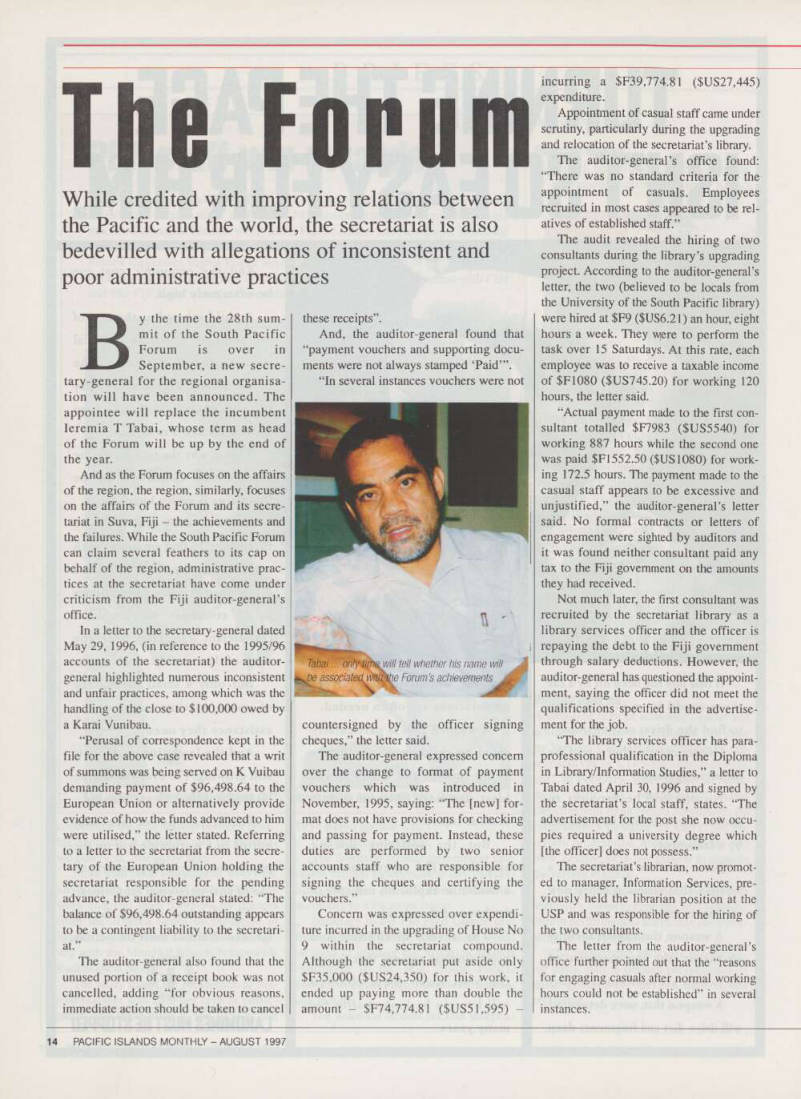
Tabai...only time, will tell whether his name will be associated with the Forum’s achievements
“The hours worked by them [casual staff] without any breaks appear to be excessive, unusual and unrealistic.”
The auditor-general expressed concern that despite an earlier letter (dated June 7, 1995) suggesting stock cards for each item in stock to monitor stock levels and peri odic checks, this had not been done. And, the letter pointed out, “entries in request forms were made in pencil instead of ink”.
In response to the allegations, Tabai wrote to the auditor-general’s office explaining steps being taken to address the issues.
Under payment vouchers, Tabai wrote: “It is a requirement of our system of inter nal control that vouchers are to be stamped ‘Paid’ to reduce the likelihood of double payment. Staff have been reminded of the need to comply with these formal proce dures.”
On upgrading House No 9, Tabai said the initial budget figure was based on the removal of the hill at the back of the house.
After this was done, he said, the architect recommended that the roof be lifted and a master bedroom be added upstairs to make the house habitable. The secretariat’s Reserve Fund would be used to pay for this overexpenditure and rent collected from the property would be used to repay the Reserve Fund.
On the question of the appointment of the library services officer, Tabai said he “reserves the right to make appointments based on his total understanding of the qualification and experience of a particular
applicant”.
In response to the appointment of casu al staff, Tabai said no procedures had exist ed in the secretariat at the time.
“Procedures are now being developed,” he said. “The decision on appointment of casual professional staff was made by senior staff who had no relationship to those persons,” Tabai said in his letter dated June 28.
The non-payment of provisional tax, Tabai said, had been omitted in error.
“However, the omission has been rectified and we are in the process of recovering the taxes from the two persons concerned.”
The only former head of state to occupy the prestigious post, the Kiribati accoun
tant-tumed-politician will have completed
six years at the helm of the Suva-based
regional organisation this year.
Appointed by the South Pacific Forum in Pohnpei, Federated States of Micronesia, in 1991, Tabai couldn’t have
wished for the appointment at a better time.
Globally, states began realigning in the face of the inevitable collapse of commu nism in the former Soviet Union. With the realignment in motion, the veneer of the so-called the Cold War began to peel off layer by layer, resulting in a new world order.
To Tabai’s credit, he has helped put the region on the international landscape. For instance, it was during his administration that the Forum obtained observer status at the United Nations General Assembly and
Apec.
It was also during his time that the
tedious, often time-consuming procedures
involved in securing European Union funding were somewhat streamlined, resulting in a speedier release of funds for regional projects in the South Pacific.
There was a vast improvement in media relations with the Forum. Until his time, the South Pacific Forum was a closed doors affair as far as media access to South Pacific leaders was concerned.
In the past six years, inaccessibility to leaders has become a thing of the past.
Only time will tell whether or not Tabai’s name will be associated with these achievements.
Asked by Pacific Islands Monthly whether he would be seeking another term as secretary-general, Tabai replied that the appointment of secretary-general was made by the Forum in closed session.
Fiji was badly embarrassed in 1994 when Tabai decided at the last minute that he wanted to stay on for a second term. Fiji had been lobbying strongly for the top regional spot for its foreign minister, Filipe Bole, prior to and during the South Pacific Forum in Brisbane, Australia.
Tabai’s reappointment, spearheaded by Australia, drew the ire of Fijian Prime Minister Sitiveni Rabuka who reportedly said the South Pacific Forum should con sider moving its secretariat away from Suva, and perhaps to outer space.
Bole is once again vying for the posi tion which carries a basic, tax-free salary of well over SFIIO,OOO ($U575,900), free
housing, car, SF6OOO (SUS4I7O)-a-year
representational allowance as well as first class air travel.
The position also carries an education allowance of SF6OOO (SUS4I7O) a year per child for up to three children and a maid, whose salary is included in the secretari at’s annual regular budget. ■
Advertisements & other items, p. 15 (1 item)
Pacific Blands
Remember
000 There are times in your life when you feel your friends have been missing out on something good.
Now's your chance to do something about it and share with them one of the good things you have.
Buy your friend a subscription to Pacific Islands Monthly and let him or her join you and thousands of other people world wide who arc kept informed of the latest political, social and cultural changes taking place in the Pacific.
SUBSCRIPTIONS
American Samoa US$45 Australia... „...A542.00 Canada US$45 Cook Islands— AUSS46
FIJI F 526.40
French Polynesia US$45 Guam US$45 Hawaii US$45 Japan US$45 Kiribati.. AUSS46 Marshall/Micronesia US$4O Nauru AUSS42 New Caledonia US$32 New Zealand NZ$55 Niue AUSS46 Norfolk island AUSS42 Northern Marianas/Palau US$4O Papua New Guinea AUSS4S Solomon Islands AUS $46 Tonga AOS$46 Tuvalu AUSS46 United Kingdom Stg Pound2B US Mainland US$45 Vanuatu AUSS4S Western Samoa , WS$6O Elsewhere AUSS63 Payment to Pacific Islands Monthly: Subscriptions Dept. o*o Box tK7, Sum. FIR, Direct airmail rates on application.
Telephone: 304111 Fax: 303809.
Direct airmail rates include the cost of airspeeding to alt destinations set out as above.
PACIFIC BLANDS
Please send my friend Pacific Islands Monthly lor one year (12 issues). > enclose my cheque for $ (made payable to Pacific Islands Monthly) or debit $ to my: Vlsacard Q Mastercard t Card No: I Expiry Date
NAME
SIGNATURE.
ADDRESS
CITY.
COUNTRY
J
Open secrets
Special Report
Australian report on
Pacific may be too
close to the bone
A secret document report edly prepared by Australia’s foreign affairs and treasury staff to brief finance minister Peter Costello on the South Pacific may have left Australia with a lot more than it bargained for. Australia’s inter national reputation has already been damaged by its recent stance on reducing Greenhouse gas emissions (see Page 58) and Pauline Hanson’s racist remarks {PIM Feb, 1997). The 93-page document - labelled AUS TEO (Australian Eyes Only) - risks
further alienating Australia, with its frank commentaries on the economic status of island countries, personal habits of leaders and by accusing Malaysian logging companies of cor ruption and New Zealand of undercut ting Australia in the region. The report, left lunattended on a table at the June Pacific economic ministers’
meeting in Cairns, was picked up by a Reuters journalist.
The paper divides
island states into six groups - with headlines such as “Melanesian may hem”, “Imprudent Micronesians” and “Bottom of the heap”.
“Mismanagament is hurting, with the Solomon Islands, Nauru and the Cook Islands on the brink of insolvency,” the report says. “Pacific leaders will continue
to flirt with easy solutions...especially quick-fix, easy-money schemes and over exploitation of natural resources,” the report says. “[Sir Geoffrey] Henry has taken the Cook Islands to the brink of eco nomic catastrophe but his position as prime minister is secure for the time being.
“Henry is articulate and hard working, but he is boastful and vain - heaving spent
heavily on grandiose monuments.”
It alleges corrupt dealings between Malaysian logging companies and certain members of the Solomon Islands parlia ment. One politician, it says, is known in the business community as “Mister Ten Percent”. The government, it claims, is
"Henry is articulate and hard working but boastful and vain"
preoccupied with
averting a financial collapse rather than embarking on a
reform programme, laying the blame on prime minister Solomon Mamaloni, who is seen as an obstacle to change.
PNG is criticised for government cor ruption and dragging its feet on abuses in the forest industry because of politicians’
personal interests.
Interestingly, the yardstick most com monly used in analyses is island leaders’ attitudes towards Australia and colonial ism. For example, the paper says former finance minister Chris Haiveta is “combat ive towards Australia and may prove diffi cult to deal with at the FEMM [Forum Economic Ministers’ Meeting]”.
“He has gone along with [Sir Julius] Chan’s efforts to cultivate the Malaysians in trying to reduce PNG’s dependence on Australia.”
Haiveta is "combative towards Australia and may prove difficult...at the FEMM"
Vanuatu’s commerce minister Barak Sope is assessed on the basis of his “unhappy school days in Australia and uni versity Marxism in Suva [which] drew Sope to the anti-colonial cause”. Part of the financial “mess” the country is in is attributed to Sope, who is remembered for his role in the 1996 SUS 100-million letters of guarantee scam which nearly brought down the government (see PIM September, 1996). And the report is cyni cal of Vanuatu’s commitment to the Asian Development Bank-crafted reform pro gramme because of “ingrained bad habits”. Sope is married to “a poet with anti-colonialist views”, the paper contin ues, observing that “despite his resent ments, he visits Sydney often for business
reasons”. Fiji’s finance minister Berenado Vunibobo is similarly accused of not wholeheartedly embracing Australian pres ence in the region. “In spite of his good understanding of Australia (he was educat
ed in Queensland), Vunibobo can react sharply if he senses he is being patron
ised.
“Temperamentally volatile, he is still given to Third World posturing against Western colonialism,” the paper observes.
“He has supported Fiji’s moves for closer ties with Malaysia as a counter to Australia.”
One of the personalities to emerge rela tively unscathed is Aokuso Pavihi, Niue’s minister for national planning and econom
ic development. He is seen as hard-work ing, competent with a reputation for hon esty. The report notes that Pavihi “will probably follow Australia’s lead and the majority view” at the economic ministers’ meeting, perhaps one of his more endear
ing qualities.
The paper is perhaps less contentious for the bleak economic picture it paints of the region and the self-serving interests at the heart of Australia’s concerns in the Pacific as it is for the untempered remarks
on politicians’ personal lives. It describes, quite unabashedly, their drinking habits
(whether they become belligerent or mel low when drunk), personal traits, family crises and even religious habits. As far as Australia’s ‘self-serving’ policies go, it would be unrealistic to expect Australia to work from purely altruistic motives.
And, in much of its assessment of the region’s economic state, the report, it must be admitted, only reiterates what is already known. Vanuatu’s ombudswoman has
repeatedly spoken of corruption and mis
management in the island nation. It is no surprise to read that Vunibobo “is strug gling to bail out the stricken National Bank of Fiji”, the country’s biggest financial scandal.
“Nauru has never denied that it is going through a period of economic difficulty like any number of other countries,” a press statement issued by the Nauru consulate general in Melbourne, Australia, said.
Some of the allegations might be true, was the response from a spokesman for Mamaloni. The Solomons’ grievance is that Australia didn’t addressed the criti cisms through diplomatic channels, an AAP report said.
While the document is able to sum up most island countries on their economic status, New Zealand proves to be more
Sope is married to " a poet with anti-colonialist views"
complex with its “mix of cooperation
and competition
with Australia”. The
paper speaks of NZ being increasingly
dependent on Australia in both economic relations and defence, adding that NZ politicians were content to let Australia take the lead in Pacific affairs rather than risk their own popularity in the region.
“On occasion they have even undercut Australia, especially in the Solomons where they have been reluctant to take on Mamaloni over forestry,” the report says.
“Old habits die hard and many politicians and officials...like to believe that New Zealand, because of its smaller size, links to Polynesia and Maori and islander popu lation, is part of the Pacific in a way that Australia is not.”
But, according to the report, the finan cial crisis in the Cook Islands has seen NZ “moderating its tendency to indulge islanders”.
The other stumbling block is Deputy PM Winston Peters, whom it describes as
Vunibobo " has supported...closer ties with Malaysia"
an “opportunist”
and “loose canon” yet to shake off his reputation for lazi
ness, inattention to detail and erratic behaviour. The paper Iclaims that, while
Methodist by upbringing, Peters “enjoys
late hours in nightclubs”. Perhaps his sav ing grace is that he “has lived in and is well disposed to Australia” and that he “wel comes Australian investment, especially to balance Asian capital”.
There has been speculation that the paper will be the talk of the South Pacific Forum meeting in the Cook Islands and that Australian PM John Howard will have quite a bit of explaining to do - that is, of course, if he attends. (Word had it, until now at least, that Deputy PM Tim Fischer would be attending the September meet
ing.)
While most island leaders have been openly critical of the report, both NZ PM Jim Bolger and Peters, who bore the brunt of the report’s criticism of NZ, have tended to downplay the matter. Peters dismissed the comments as merely the opinion of an “ignorant bureaucrat”.
“They reflect a personal judgment that
sometimes demonstrates complete igno
rance of political facts and contain extraor dinary assertions which would be of embarrassment to a host nation.”
Strong criticism has come from Australia’s opposition party and the same can probably be expected from Malaysia, which Australia views as a direct threat to its interests in the Pacific.
According to acting opposition leader
Gareth Evans, there were suggestions that, contrary to earlier reports, the document was not the work of a junior official in for eign affairs but that of some fairly senior officials in the prime minister’s depart ment.
“And I can assure you that this will take a very long time to be forgiven, if at all, right round the region,” he said. ■
Advertisements & other items, p. 16 (1 item)
Program Coordinator
Pacific Islands Association of
Non Government Organisations (PIANGO)
PIANGO is a regional network of NGOs covering all Pacific islands states and territories, Australia and Aotearoa/New Zealand. PIANGO aims to eenable Pacific NGOs to more effectively promote and advance the interests and well being of their people.
PIANGO is’ currently establishing a Fiji-based regional secretariat and seeks to appoint a Coordinator to support the development and implementation of PIANGO's programs; act as a focal point for communication and liaison between member NGOs and other key agencies in the region; and to manage the day to day functions of the secretariat.
The successful applicant will share PIANGO's commitment to the role of the community sector in Pacific Island development. They are expected to have high level managerial and people skills, with a minimum of 5 years experience in senior positions mthe NGO sector.
Ability to communicate in both English and French, or a proven aptitude to leam these skills quickly, is essential. Remuneration will be negotiated commensurate with the experience and qualifications of the successful applicant. Accommodation will not be provided as part of the package.
Applicants should contact PIANGO at the number below for a detailed job description and selection criteria. Applications, including CV and three referees, should be sent to the address below by 31 August, 1997.
PIANGO Secretariat Establishment Project PO Box 1045 Port Vila Vanuatu Ph/fax 678 22 283
Doubletake
Second report found
As Pacific Islands Monthly went to press, the Australian federal govern ment found itself in the embarrassing position of having to deal with emer gence of a second classified document.
The report - also marked AUSTEO
(Australian Eyes Only) - was similarly
discovered on a table by a journalist (this time from AAP).
The document was prepared for bilateral meetings held by Treasurer Peter Costello the day after the FEMM and set out a strategy to coerce New Zealand into increasing defence spend ing at the expense of social pro grammes.
While there have been attempts to dismiss comments in the earlier report as not those of the government, the sec ond report proves to be a lot trickier.
According to the 39-page document, cabinet had agreed in February that all Australian ministers were to pursue a whole-of-govemment approach in their relations with NZ counterparts.
Costello was to use the bilateral talks with Winston Peters to encourage NZ to maintain its defence spending. “Your meeting with Peters could be influen tial in swaying him (and the NZ Treasury) in favour of Australia’s con cerns,” the paper said. The paper was also critical of island nations selling special investor passports. ■
In the name of God
Cover Stories
In the name of God Questions arise over Australian church appeal for Fiji’s cyclone victims
By Bernadette Hussein
million - for property damage alone.
“After discussions within our office, we felt that, given the information we had, it was not unreasonable to use the words ‘with damage to property, crops and fruit trees estimated to be as high as $lOO mil lion’,” said the Reverend Fitzgerald, whose signature appeared in the Partners maga zine appeal.
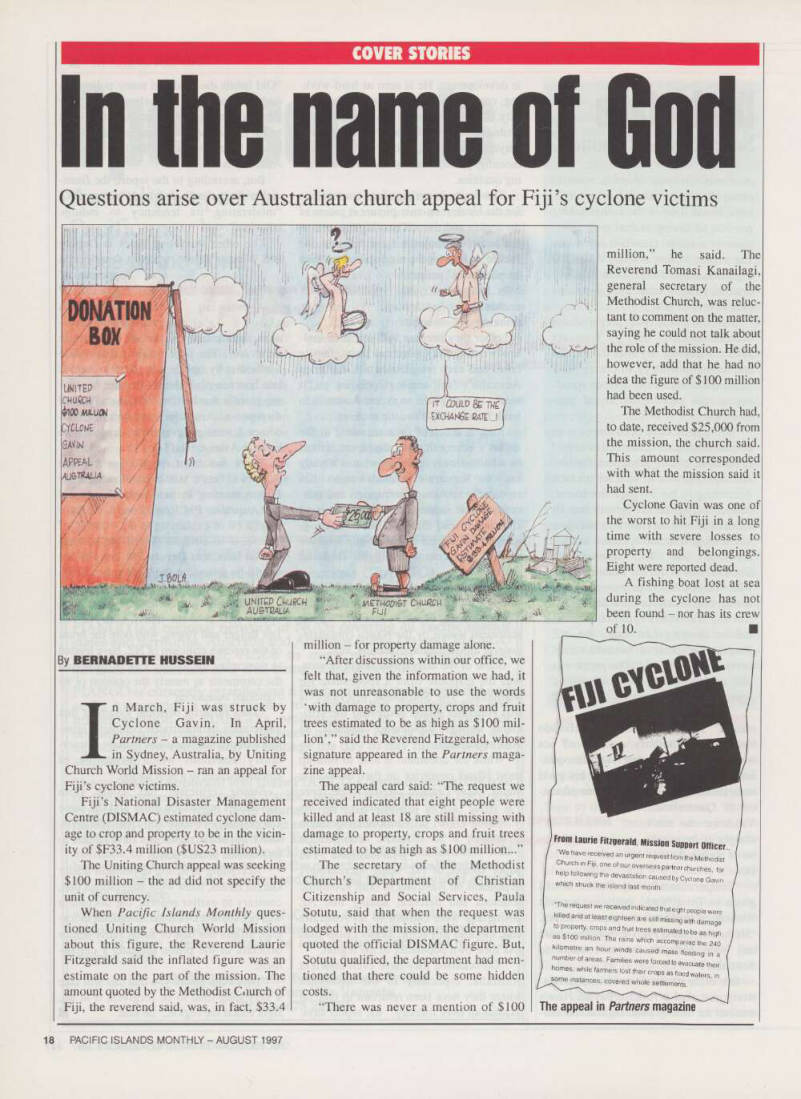
The appeal card said: “The request we received indicated that eight people were killed and at least 18 are still missing with damage to property, crops and fruit trees estimated to be as high as $lOO million...”
The secretary of the Methodist Church’s Department of Christian Citizenship and Social Services, Paula Sotutu, said that when the request was lodged with the mission, the department quoted the official DISMAC figure. But, Sotutu qualified, the department had men tioned that there could be some hidden costs.
“There was never a mention of $lOO
In March, Fiji was struck by
Cyclone Gavin. In April,
Partners - a magazine published in Sydney, Australia, by Uniting Church World Mission - ran an appeal for Fiji’s cyclone victims.
Fiji’s National Disaster Management Centre (DISMAC) estimated cyclone dam age to crop and property to be in the vicin ity of $F33.4 million (SUS 23 million).
The Uniting Church appeal was seeking $lOO million - the ad did not specify the unit of currency.
When Pacific Islands Monthly ques tioned Uniting Church World Mission about this figure, the Reverend Laurie Fitzgerald said the inflated figure was an estimate on the part of the mission. The amount quoted by the Methodist Cnurch of Fiji, the reverend said, was, in fact, $33.4
million,” he said. The Reverend Tomasi Kanailagi, general secretary of the Methodist Church, was reluc tant to comment on the matter, saying he could not talk about the role of the mission. He did, however, add that he had no idea the figure of $ 100 million had been used.
The Methodist Church had, to date, received $25,000 from the mission, the church said.
This amount corresponded with what the mission said it had sent.
Cyclone Gavin was one of the worst to hit Fiji in a long time with severe losses to property and belongings.
Eight were reported dead.
A fishing boat lost at sea during the cyclone has not been found - nor has its crew of 10. ■
The appeal in Partners magazine
From the pulpit
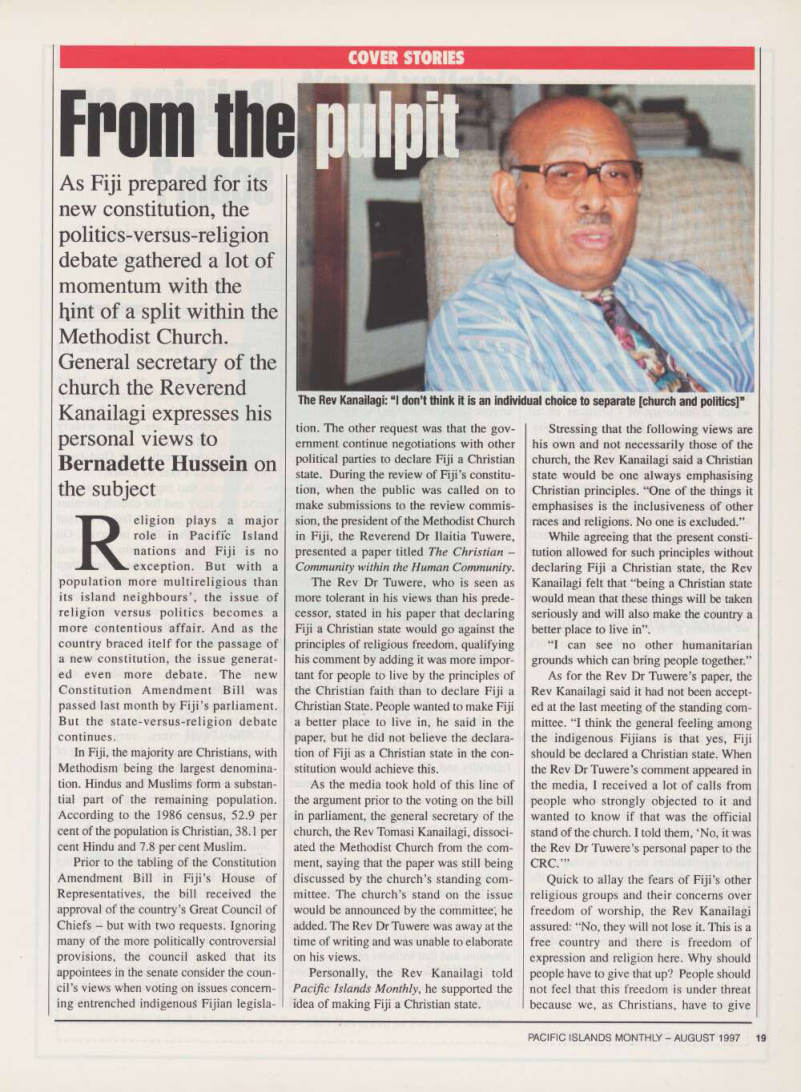
As Fiji prepared for its
new constitution, the
politics-versus-religion
debate gathered a lot of
momentum with the
hint of a split within the
Methodist Church.
General secretary of the
church the Reverend
Kanailagi expresses his
personal views to
Bernadette Hussein on
the subject
Religion plays a major role in Pacific Island nations and Fiji is no exception. But with a population more multireligious than its island neighbours’, the issue of religion versus politics becomes a more contentious affair. And as the country braced itelf for the passage of a new constitution, the issue generat ed even more debate. The new Constitution Amendment Bill was passed last month by Fiji’s parliament.
But the state-versus-religion debate continues.
In Fiji, the majority are Christians, with Methodism being the largest denomina tion. Hindus and Muslims form a substan tial part of the remaining population.
According to the 1986 census, 52.9 per cent of the population is Christian, 38.1 per cent Hindu and 7.8 per cent Muslim.
Prior to the tabling of the Constitution Amendment Bill in Fiji’s House of Representatives, the bill received the approval of the country’s Great Council of Chiefs - but with two requests. Ignoring many of the more politically controversial provisions, the council asked that its appointees in the senate consider the coun cil’s views when voting on issues concern ing entrenched indigenous Fijian legisla-
tion. The other request was that the gov ernment continue negotiations with other political parties to declare Fiji a Christian state. During the review of Fiji’s constitu tion, when the public was called on to make submissions to the review commis sion, the president of the Methodist Church in Fiji, the Reverend Dr Ilaitia Tuwere, presented a paper titled The Christian - Community within the Human Community.
The Rev Dr Tuwere, who is seen as more tolerant in his views than his prede cessor, stated in his paper that declaring Fiji a Christian state would go against the principles of religious freedom, qualifying his comment by adding it was more impor tant for people to live by the principles of the Christian faith than to declare Fiji a Christian State. People wanted to make Fiji a better place to live in, he said in the paper, but he did not believe the declara tion of Fiji as a Christian state in the con stitution would achieve this.
As the media took hold of this line of the argument prior to the voting on the bill in parliament, the general secretary of the church, the Rev Tomasi Kanailagi, dissoci ated the Methodist Church from the com ment, saying that the paper was still being discussed by the church’s standing com mittee. The church’s stand on the issue would be announced by the committee; he added. The Rev Dr Tuwere was away at the time of writing and was unable to elaborate on his views.
Personally, the Rev Kanailagi told Pacific Islands Monthly, he supported the idea of making Fiji a Christian state.
Stressing that the following views are his own and not necessarily those of the church, the Rev Kanailagi said a Christian state would be one always emphasising Christian principles. “One of the things it emphasises is the inclusiveness of other races and religions. No one is excluded.”
While agreeing that the present consti tution allowed for such principles without declaring Fiji a Christian state, the Rev Kanailagi felt that “being a Christian state would mean that these things will be taken seriously and will also make the country a better place to live in”.
“I can see no other humanitarian grounds which can bring people together.”
As for the Rev Dr Tuwere’s paper, the Rev Kanailagi said it had not been accept ed at the last meeting of the standing com mittee. “I think the general feeling among the indigenous Fijians is that yes, Fiji should be declared a Christian state. When the Rev Dr Tuwere’s comment appeared in the media, I received a lot of calls from people who strongly objected to it and wanted to know if that was the official stand of the church. I told them, ‘No, it was the Rev Dr Tuwere’s personal paper to the
Crc.’”
Quick to allay the fears of Fiji’s other religious groups and their concerns over freedom of worship, the Rev Kanailagi assured: “No, they will not lose it. This is a free country and there is freedom of expression and religion here. Why should people have to give that up? People should not feel that this freedom is under threat because we, as Christians, have to give
The Rev Kanailagi: “I don’t think it is an individual choice to separate [church and politics]”
people the freedom to worship as they want and whenever they want. Even after the country is declared a Christian state, I am sure there will be no pressure on them.”
Last year saw the lifting of the Sunday ban in Fiji which had been imposed - with varying degrees of force - since the 1987 military coups. The ban was put in place after a call from the Methodist Church in Fiji, which had at its helm at the time the more right-wing Rev Manasa Lasaro. The ban was opposed by many church members at the time but the motion was passed by the House of Representatives and the Senate.
According to the Rev Kanailagi, the Sunday ban issue no longer figures in the equation. “You see, there are some Christians who want to impose this ban but there are many who are against it. We have a body called the Fiji Council of Churches which is made up of Christians of all denominations. It is the stand of this coun cil that there not be a Sunday ban. People should realise that things like the Sunday ban will not happen just because one group feels it should. If the majority think that it is not such a good idea, then that’s how it should be. Once Fiji is declared a Christian state, it will run according to general Christian principles and not principles of one denomination. It will be based on inter denominational or general Christian beliefs. The Methodist Church is the largest Christian denomination in the country but we still have great respect for other denom inations and religions. We have to work hand in hand with them to make the coun try a better place.”
But he expressed his concern over the number of religious sects he said were coming into the Pacific.
“The problem is that governments are allowing these sects to come in. They tell people that their church will send people overseas for training or studies or will help them out financially. Human nature is such that when they are shown things like this, they turn towards it. Everybody wants the best in life and when they see and hear of such opportunities they turn in that direc tion. I think this is the trend in most Pacific Islands. These things are caused by Western influences.
“You see, our people, the Pacific peo ple, do not have enough resources and any opportunity they see of getting [more], they go for it.” But he dismissed suggestions that there could be more breakaway groups in the future.
“No, I don’t think so. You see the main stream churches are getting stronger. They are providing better education and training facilities to help their members.”
But religious tolerance is not necessari ly one of Fiji’s stronger suits.
Desecration of holy sites is being
reported with alarming regularity, with
Hindu temples being the prime target for vandals and arsonists.
One incident last year, saw a man destroy a Hindu temple and then com mence to sit on the spot and recite verses from the Bible. When arrested, he explained he was following instructions from God. But the Rev Kanailagi sees the declaration of Fiji as a Christian state as the cure for such goings-on. “People who are doing this are frustrated and do this as a way to show their feelings... I’m not saying it’s OK. What they are doing is wrong and anyone who does things like this deserves to be severely punished.”
But the crux of the controversy is whether religion and politics should mix.
The Rev Kanailagi thinks they should.
“As a citizen of a country, you should be involved in politics because politics affects every citizen. I don’t believe that religion and politics have their own places.
If the two are separated, the country will not function well. They are closely linked.
“Religion is the conscience of the state.
The two have their role to play - in some cases separate. But if the state is wrong, then the church has every right to come in and speak directly to the state.
“Politics is very important to every per son, and so is religion. These two interests are in one person. Why should they be sep arated? They play different roles in the same human being. I have my political and religious roles. They are both important and I think I should play both these roles faithfully and diligently. If I fail in one of these areas, then I am not a good human being.”
Does this mean taking politics into church? “Yes,” he replies. “I can stand at the pulpit and talk politics,” he said, dis missing concerns that the church may not be the right forum to talk politics. “Why isn’t [the church not the right forum to talk politics]? That is what many people say but that is not what the Bible says. The Bible says God’s word is for every man in every situation, and that includes politics.
“I don’t think it is an individual choice to separate the two. It is a responsibility to keep the two together.” ■
Religion or
scam?
Resentments aside, the Mormons are here to stay
Story and pictures by CHRIS PETERU
Despite having one of
their members almost burnt at the stake recently, the Church of Jesus Christ of Latter Day Saints whose members are more widely known as Mormons - has acquired influence and numbers in God-fear ing Samoa at a rate of knots.
In March, that rapid progress almost came to a fiery end for church member Lupe Lio, a 33-year-old father of four from Samalaeulu village in Savaii. On orders from the village council, Lio was accosted by men from the village then tied to a stake to be burnt alive. His offence was failing to adhere to the coun cil’s decision concerning building a Mormon chapel in the village. The coun cil was holding onto a tradition that only Congregational and Catholic churches could have parishes in Samalaeulu, said the Reverend Palemia Reupena, the Congregational priest who pleaded for hours to eventually save Lio’s life.
“They were very, very angry. I preached to them about Jesus teaching of forgiveness. There was still mercy in their hearts and they accepted our plea.”
Controversy is nothing new to the Mormons, since they were founded in 1830 by New York farm labourer Joseph Smith, known as the prophet; its founding doctrine an assumption that Christianity needed to be restored from its wayward ness care of new revelations. According to Smith, those revelations first came to him from the angel Moroni in 1820. He was 14. Although illiterate, divine inspi ration allowed Smith to translate “by the gift and the power of God” golden plates buried in a hillside that were published into the Book of Mormon, one of four
scriptures used by the church. In 1844 Smith and his brother, Hyrum, acquired martyrdom when they were assassinated while in an Illinois jail on charges of trea son and conspiracy.
Today rich, savvy and global, Mormonism shows no signs of slowing the conveyor belt of Samoan converts coming into the fold. Based in Salt Lake City, Utah, in northern United States, Mormons
are, according to their own figures, the fastest-growing religion in Samoa, the Pacific and the planet.
The 1995-96 Deseret News Church Almanac surveys (1993) show one out of every four Samoan from an estimated 202,000 citizens is an LDS member.
Outside of the US, that marks the second
highest per-ratio membership from a glob
al flock of almost 9,924,436 adherents.
The highest ratio belongs to the staunchly Methodist Kingdom of Tonga where one out of every three people is purported to be an LDS member.
President of the Samoan Methodist church the Rev Faletoese Auvaa is not sur prised. “It appears to me that the LDS is growing faster than the Methodists.” The census indicated an annual growth rate of nine per cent for the LDS versus six per cent for the Methodists. Whatever the numbers game, the end result for Mormons is going to be the same, says Viliamu Mafue director of the Youth fOor Christ ministry.
“Everybody who joins the Mormon church, they’ll go to hell, they will never go to heaven,” says the one-time gang member. “The only thing I have for them is love and caring because they are under a great deception.”
Since Joseph H Dean, the first official Mormon missionary, rowed onto the shores of Tutuila (now American Samoa) with his wife, Florence, in June, 1888, the distinctive LDS churches have now become part of the landscape in even the most remote villages.
Much of that success can be attributed to vigorous missionary work that has proven the cornerstone of skyrocketing membership, with a pool of close to 45,000 missionaries constantly on the road globally. Currently in both Samoas, 134 missionaries are serving a full-time two year stint. Locally, it may creat some bad vibes from mainstream churches who are seeing more empty pews each Sunday.
In terms of assets, the religion once chided by Samoans as the “poor Mormons” could now be said to be rolling in it. Church assets in Samoa are now worth in excess of SUSSO million, raised in part by a single 10 per cent salary con tribution from members, called a tithe.
Backing that up is virtually unlimited cash flow brought in by the church in Utah, where some astute business operations (including shares in soda giant Coca-Cola) helped pave the way for funding new
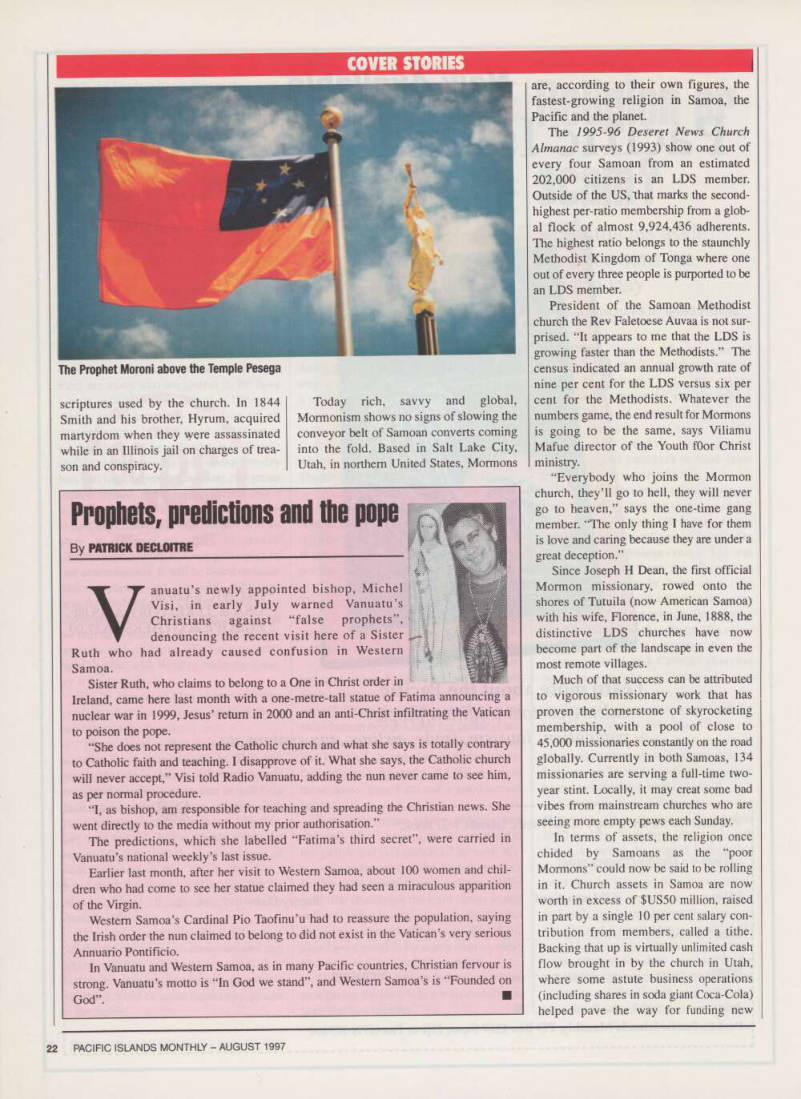
The Prophet Moroni above the Temple Pesega
churches and facilities in developing coun tries.
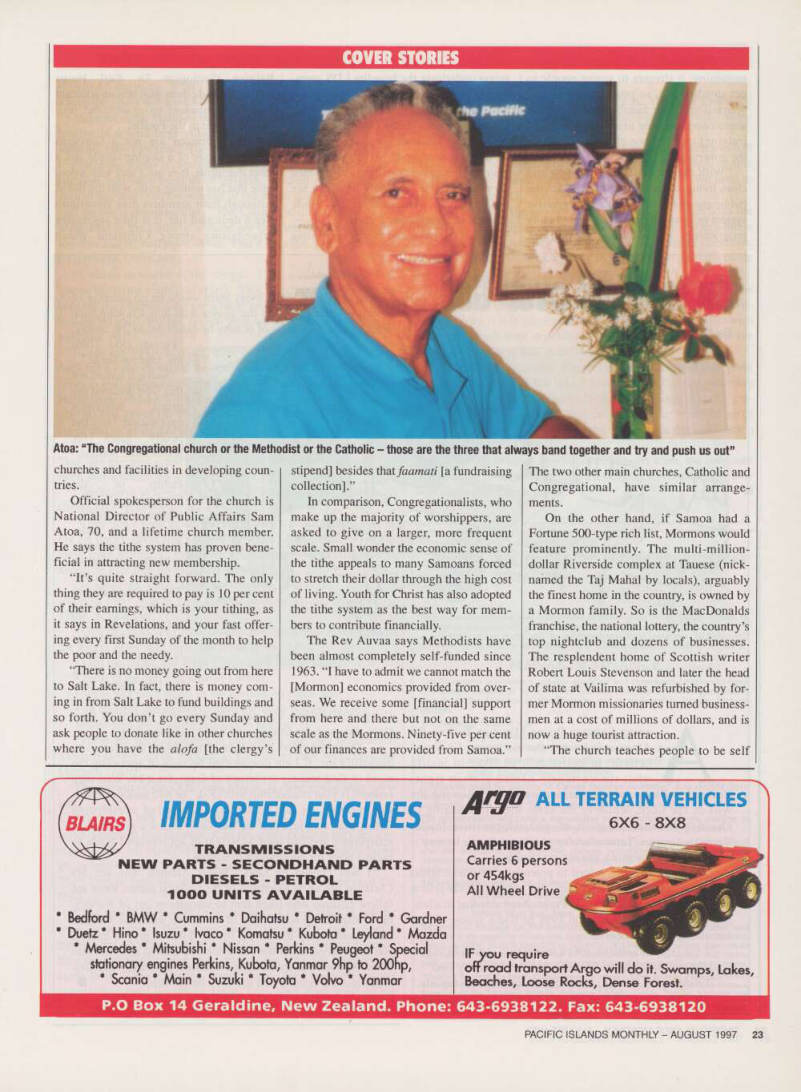
Official spokesperson for the church is National Director of Public Affairs Sam Atoa, 70, and a lifetime church member.
He says the tithe system has proven bene ficial in attracting new membership.
“It’s quite straight forward. The only thing they are required to pay is 10 per cent of their earnings, which is your tithing, as it says in Revelations, and your fast offer ing every first Sunday of the month to help the poor and the needy.
“There is no money going out from here to Salt Lake. In fact, there is money com ing in from Salt Lake to fund buildings and so forth. You don’t go every Sunday and ask people to donate like in other churches where you have the alofa [the clergy’s
stipend] besides that faamati [a fundraising collection].”
In comparison, Congregationalists, who make up the majority of worshippers, are asked to give on a larger, more frequent scale. Small wonder the economic sense of the tithe appeals to many Samoans forced to stretch their dollar through the high cost of living. Youth for Christ has also adopted the tithe system as the best way for mem bers to contribute financially.
The Rev Auvaa says Methodists have been almost completely self-funded since 1963. “I have to admit we cannot match the [Mormon] economics provided from over seas. We receive some [financial] support from here and there but not on the same scale as the Mormons. Ninety-five per cent of our finances are provided from Samoa.”
The two other main churches, Catholic and Congregational, have similar arrange ments.
On the other hand, if Samoa had a Fortune 500-type rich list, Mormons would feature prominently. The multi-million dollar Riverside complex at Tauese (nick named the Taj Mahal by locals), arguably the finest home in the country, is owned by a Mormon family. So is the MacDonalds franchise, the national lottery, the country’s top nightclub and dozens of businesses.
The resplendent home of Scottish writer Robert Louis Stevenson and later the head of state at Vailima was refurbished by for mer Mormon missionaries turned business men at a cost of millions of dollars, and is now a huge tourist attraction.
“The church teaches people to be self
Atoa: “The Congregational church or the Methodist or the Catholic-those are the three that always band together and try and push us out”
sustaining; it stresses to young people to get an education, so you can take care of yourself and your family. That’s why the church does not want to see its members... [relying] on someone else, or relying on
the government.”
“With the emphasis on education and clean living, top sports facilities which the public use at no charge plus a progressive system of spiritual, social, and community programmes which caters for every age
group underlines the benefits LDS mem bers enjoy,” says Atoa.
“I think it’s because of the programmes.
In other churches, I don’t think they have programmes like that. They all go together on Sunday, everybody has the same pro gramme, the preacher will preach and then they all go home. The only time you see little children participate is on White Sunday, and that’s once a year.”
Yet all this has failed to impress visiting
Belgian theologian Dr Karl Heinz Kuhlmann and others who remain adamant Mormons represent an unwelcome reli gious element in the Pacific.
“The Mormons are not a Christian church. In spite of a shining facade and a strict discipline, they are a sect with a doc trine that has nothing to do with the Bible.
Although their members may sometimes live a dedicated life, it is their aggressive proseltyising among Christians which
should be despised. With lots of foreign money, they harvest where they have not sowed.”
More recently, Mormon missionaries were banned from prose lytising in several large villages by the councils, for reasons that were not fully explained. The action left the Mormons crying foul.
“Here our motto is ‘Samoa is founded on God’ and, in the con stitution, you have freedom of religion, freedom of speech, free dom of worship. You know some of our matai and village councils still do not understand that... The Congregational church or the Methodist or the Catholic - those are the three that always band together and try and push us out. That’s not right, that’s not in the constitution,” says Atoa.
“I blame too some of the clergy... They will start something, maybe say to the council of chiefs, ‘Hey, our church is going down because the Mormons are preaching, and so forth.’ We don’t force anyone [to join]. We just preach what we have and if they decide, well that’s it.”
Responds YFCs Mafue: “This is a Christian nation already declared by the constitution. We shouldn’t have allowed them to come in but, unfortunately, they are in.” The Mormons are no dif ferent from Jehovah’s Witnesses or the Baha’i in their inconsistent beliefs. The job of the Christian churches is to preach the differ ences and to let the people know.
“I don’t hate the [Mormon] people. I love the Mormon people.
They are our aunts, uncles and cousins. Unfortunately, some of them join without any knowledge.”
“We believe in God, the holy ghost, why are we not considered Christians?” asks Atoa.
“They don’t want to see our missionaries going around knock ing on doors, preaching the gospel and so forth. What’s to stop them from setting up their own missionaries - they can go and knock on Mormon doors if they want to.”
On studying some Mormon doctrine, it becomes clear that some of their beliefs vary greatly from orthodox Christianity.
These include that; • God emerged in a physical form and had sexual relations with the Virgin Mary who then conceived Jesus Christ; • God the father and Jesus Christ are both physical beings; • Jesus is the spirit brother of Lucifer; • Jesus had three wives in his lifetime on earth; and • all humans can evolve to have the same powers as God.
Mafue says the doctrine equates to heresy.
“There are some doctrines in the church that they never teach Samoan people about because if they do so they will leave the Mormon church.”
The growth of the LDS, says Mafue, is more social than spiri tual.
“There is a lack of knowledge there. They don’t really under stand. They just join because of all the sport, because they are lov ing and they are caring. They never understand. You know, some go by influence not by knowledge. Our people are all in the ears.
They love to hear the pastor preaching, but they never read the Bible.
“The reason they have to be stopped is their Jesus is not the same as our Jesus. Their gospel is not the same as our gospel. I believe the mainline churches should stop them coming because they are not bringing the same gospel, they are not bringing the same faith. They have the wrong faith, they have the wrong gospel, they have the wrong Jesus. They have done good on the social side, but where we have to draw the line is the gospel they
are preaching.”
For all the Mormon get-ahead, neither the Youth for Christ nor the Methodists see the growth of the LDS as a threat to main stream churches.
“Never. I believe Christianity and the Christian church will still rule. There is no threat. There is a deceiving spirit behind that church. And we cannot accept that on our front door. We need to find the truth about it,” says Mafue.
“Is it affecting the growth of the Methodists?” questions the Rev Auvaa. “Maybe so, but this should not be regarded as a threat to an established church. It’s exciting because it raises questions.
Are our programmes working? Are they helping to meet the needs of our members?
“We must acknowledge the growth of these other new religious groups, and be thankful the gospel has become part of that wit nessing. Why is this particular denomination growing faster than our own? I think it all depends on how people look at it. But the important thing is to stay positive about it.”
Tonga’s King Taufaahau Tupou IV has for the past few years refused to renew any LDS land leases. But like the stake-burning incident at Samalaeulu village. Mormons have long held that per secution and misunderstanding is part of the restoration of Christian truth and authority by “the only true and living church upon the earth.” Their own.
God-fearing religion or elaborate religious scam, the only sure factor for the moment is the Church of Jesus Christ of Latter Day Saints is here for the long haul. ■
Advertisements & other items, p. 21 (1 item)
Pacific Islands Yearßook
Now Available
17th Edition
% % Va Knee —* i
AUD k
>39 oo i
Ivvi
PLUS POSTAGE*
* PACIFIC SAIO.OO
* USA & TERRITORY A 515.00
* EUROPE & OTHERS $A17.00
Learn more about the Pacific
- culture/custom tradition/people
- population , tourism , trade, airlines , to system etc Yes, send me the latest copy of the Pacific Islands Year Book. □ Here is a cheque/money order □ Visa □ Master Card Expiry Date Card Number Name Signature Address Post to: Pacific Islands Monthly, PO Box 1167 Suva, Fiji or Fax (679) 307460
Prophets, predictions and the pope
By Patrick Decloitre
Vanuatu’s newly appointed bishop, Michel Visi, in early July warned Vanuatu’s
Christians against “false prophets”,
denouncing the recent visit here of a Sister Ruth who had already caused confusion in Western Samoa.
Sister Ruth, who claims to belong to a One in Christ order in
Ireland, came here last month with a one-metre-tall statue of Fatima announcing a nuclear war in 1999, Jesus’ return in 2000 and an anti-Christ infiltrating the Vatican to poison the pope.
“She does not represent the Catholic church and what she says is totally contrary to Catholic faith and teaching. I disapprove of it. What she says, the Catholic church will never accept,” Visi told Radio Vanuatu, adding the nun never came to see him, as per normal procedure.
“I, as bishop, am responsible for teaching and spreading the Christian news. She went directly to the media without my prior authorisation.”
The predictions, which she labelled “Fatima’s third secret”, were carried in Vanuatu’s national weekly’s last issue.
Earlier last month, after her visit to Western Samoa, about 100 women and chil dren who had come to see her statue claimed they had seen a miraculous apparition of the Virgin.
Western Samoa’s Cardinal Pio Taofinu’u had to reassure the population, saying the Irish order the nun claimed to belong to did not exist in the Vatican’s very serious Annuario Pontificio.
In Vanuatu and Western Samoa, as in many Pacific countries, Christian fervour is strong. Vanuatu’s motto is “In God we stand”, and Western Samoa’s is “Founded on God”. ■
Advertisements & other items, p. 23 (1 item)
Imported Engines
BLAIRS
TRANSMISSIONS
NEW PARTS - SECONDHAND PARTS
DIESELS - PETROL
1000 UNITS AVAILABLE
Bedford * BMW * Cummins * Daihatsu * Detroit * Ford * Gardner Duefz * Hino * Isuzu * Ivaco * Komatsu * Kubota * Leyland * Mazda * Mercedes * Mitsubishi * Nissan * Perkins * Peugeot * Special stationary engines Perkins, Kubota, Yanmar 9hp to 200np, * Scania * Main * Suzuki * Toyota * Volvo * Yanmar
firga all terrain vehicles
6X6 - BXB
AMPHIBIOUS
Carries 6 persons or 454kgs All Wheel Drive IF you require oft road transport Argo will do it. Swamps, Lakes, Beaches, Loose Rocks, Dense Forest.
P.O Box 14 Geraldine, New Zealand. Phone: 643-6938122. Fax: 643-6938120
Up In arms oven God
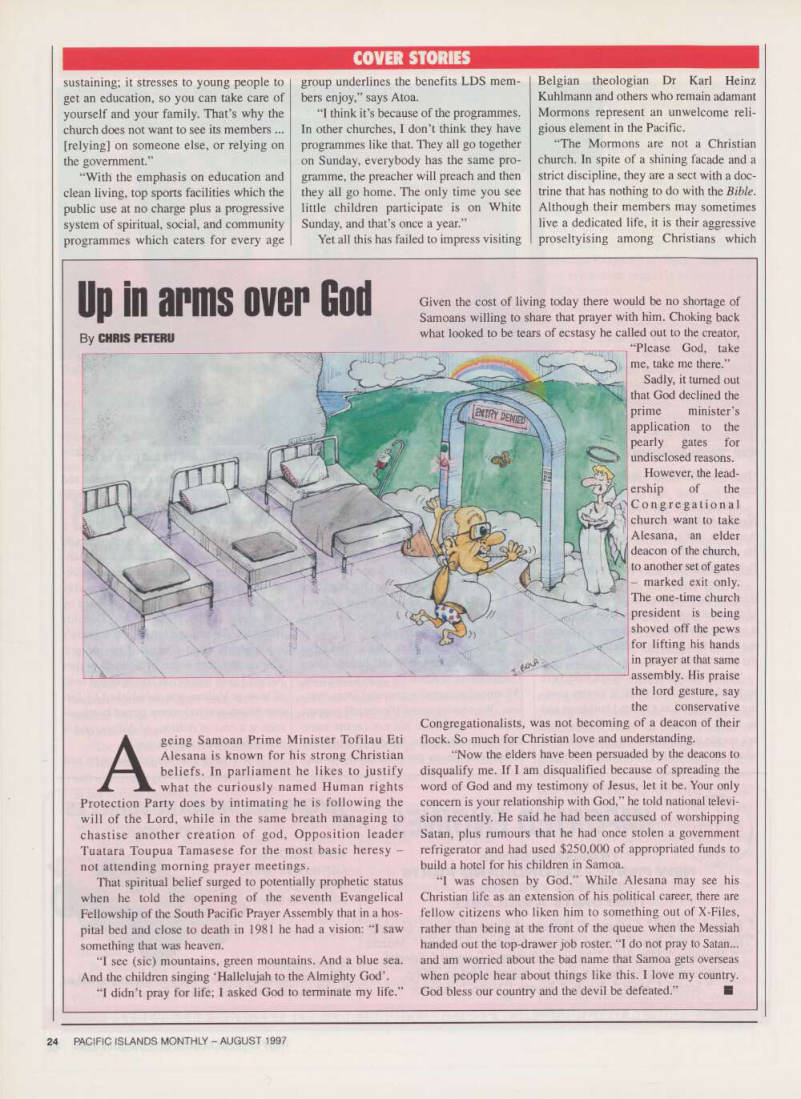
By Chris Peteru
Ageing Samoan Prime Minister Tofilau Eti Alesana is known for his strong Christian beliefs. In parliament he likes to justify what the curiously named Human rights Protection Party does by intimating he is following the will of the Lord, while in the same breath managing to chastise another creation of god, Opposition leader Tuatara Toupua Tamasese for the most basic heresy not attending morning prayer meetings.
That spiritual belief surged to potentially prophetic status when he told the opening of the seventh Evangelical Fellowship of the South Pacific Prayer Assembly that in a hos pital bed and close to death in 1981 he had a vision: “I saw something that was heaven.
“I see (sic) mountains, green mountains. And a blue sea.
And the children singing ‘Hallelujah to the Almighty God’.
“I didn’t pray for life; I asked God to terminate my life.”
Given the cost of living today there would be no shortage of Samoans willing to share that prayer with him. Choking back what looked to be tears of ecstasy he called out to the creator,
“Please God, take me, take me there.”
Sadly, it turned out that God declined the prime minister’s application to the pearly gates for undisclosed reasons.
However, the lead ership of the Congregational church want to take Alesana, an elder deacon of the church, to another set of gates - marked exit only.
The one-time church president is being shoved off the pews for lifting his hands in prayer at that same assembly. His praise the lord gesture, say the conservative
Congregationalists, was not becoming of a deacon of their flock. So much for Christian love and understanding.
“Now the elders have been persuaded by the deacons to disqualify me. If I am disqualified because of spreading the word of God and my testimony of Jesus, let it be. Your only concern is your relationship with God,” he told national televi sion recently. He said he had been accused of worshipping Satan, plus rumours that he had once stolen a government refrigerator and had used $250,000 of appropriated funds to build a hotel for his children in Samoa.
“I was chosen by God.” While Alesana may see his Christian life as an extension of his political career, there are fellow citizens who liken him to something out of X-Files, rather than being at the front of the queue when the Messiah handed out the top-drawer job roster. “I do not pray to Satan... and am worried about the bad name that Samoa gets overseas when people hear about things like this. I love my country.
God bless our country and the devil be defeated.” B
Advertisements & other items, p. 25 (1 item)
Suva, Fiji
m
SOUTH PACIFIC FORUM SECRETARIAT
The Forum Secretariat was established in 1972 by the South Pacific Forum to encourage economic and political co-operation between its member countries*, and between those states and the more industrialised countries. To help fulfil the aims of the Forum Secretariat, the following position needs to be filled:
MANAGER FINANCE
The Secretariat is seeking a suitably qualified and experienced person to work as Manager Finance in its Corporate Services Division. The Manager Finance reports to the Director of the Division and is responsible for the Finance Section.
The Manager Finance will: prepare financial reports and analysis; prepare Secretariat's Work Program and budget; monitor cash flow and funding requirements; and advise funds management policy Applicants must be citizens of Forum member countries* and should have tertiary qualifications and at least ten years experience in the finance field, preferably in the Pacific. Travel in the region may be required.
The appointment will carry a competitive remuneration package, starting at approximately FJD6O 200, depending on qualifications and experience.
There are generous establishment and education allowances and free medical and life insurance. For non Fiji citizens remuneration may be tax free.
Appointments are normally for three years, with the option to renew for a further three years.
All applications should be addressed to: The Secretary General Forum Secretariat Private Mail Bag, Suva, FIJI Information Package on the position is available from the Secretariat and applicants are urged to obtain one. Inquiries should be addressed to Mr Aklesh Nand, on (679) 312600 Extn 207 or fax (679) 301366. Applications close on 29 August 1997 and should contain full information on education and career background, addresses and telephone numbers of three employment referees. ’Member States of the South Pacific Forum: Australia, Cook Islands, Federated States of Micronesia, Fiji, Kiribati, Nauru, New Zealand, Niue, Palau, Papua New Guinea, Republic of the Marshall Islands, Solomon Islands, Tonga, Tuvalu, Vanuatu and Western Samoa. 113856*4
Channeling In to find
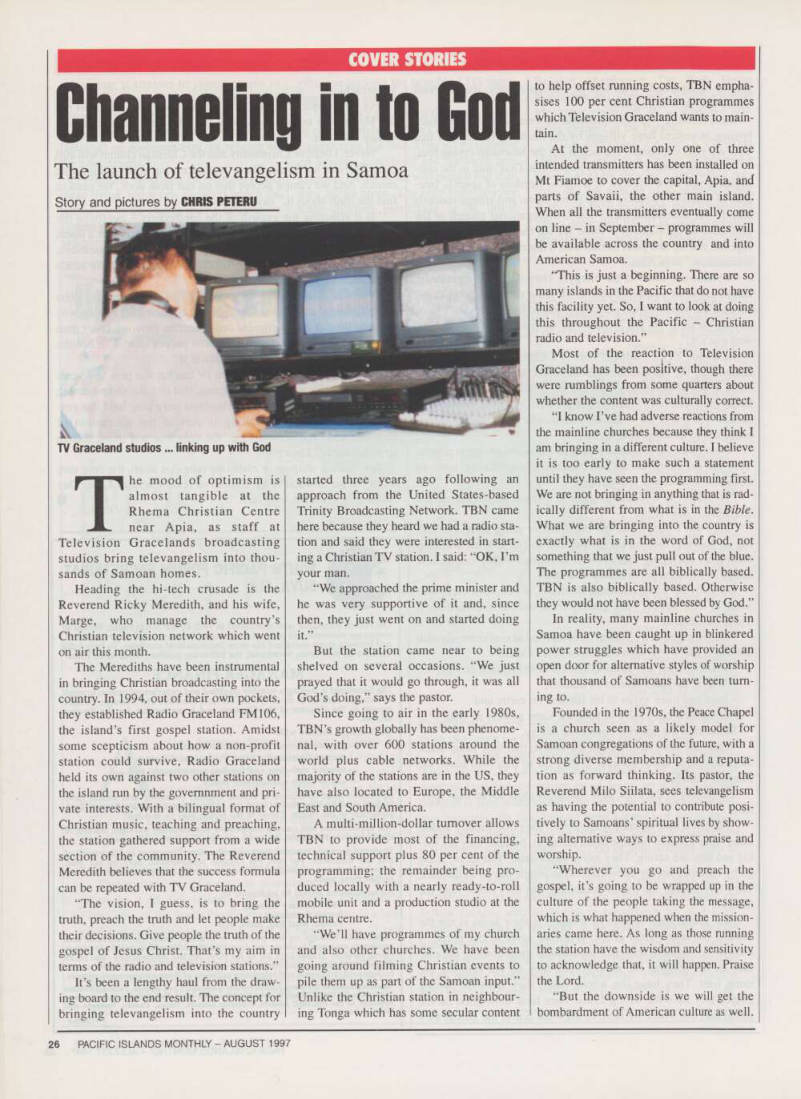

The launch of televangelism in Samoa
Story and pictures by CHRIS PETERU
The mood of optimism is almost tangible at the Rhema Christian Centre near Apia, as staff at Television Gracelands broadcasting studios bring televangelism into thou sands of Samoan homes.
Heading the hi-tech crusade is the Reverend Ricky Meredith, and his wife.
Marge, who manage the country’s Christian television network which went on air this month.
The Merediths have been instrumental in bringing Christian broadcasting into the country. In 1994, out of their own pockets, they established Radio Graceland EM 106, the island’s first gospel station. Amidst some scepticism about how a non-profit station could survive, Radio Graceland held its own against two other stations on the island run by the govemnment and pri vate interests. With a bilingual format of Christian music, teaching and preaching, the station gathered support from a wide section of the community. The Reverend Meredith believes that the success formula can be repeated with TV Graceland.
“The vision, I guess, is to bring the truth, preach the truth and let people make their decisions. Give people the truth of the gospel of Jesus Christ. That’s my aim in terms of the radio and television stations.”
It’s been a lengthy haul from the draw ing board to the end result. The concept for bringing televangelism into the country
started three years ago following an approach from the United States-based Trinity Broadcasting Network. TBN came here because they heard we had a radio sta tion and said they were interested in start ing a Christian TV station. I said: “OK, I’m your man.
“We approached the prime minister and he was very supportive of it and, since then, they just went on and started doing it.”
But the station came near to being shelved on several occasions. “We just prayed that it would go through, it was all God’s doing,” says the pastor.
Since going to air in the early 1980 s, TBN’s growth globally has been phenome nal, with over 600 stations around the world plus cable networks. While the majority of the stations are in the US, they have also located to Europe, the Middle East and South America.
A multi-million-dollar turnover allows TBN to provide most of the financing, technical support plus 80 per cent of the programming; the remainder being pro duced locally with a nearly ready-to-roll mobile unit and a production studio at the Rhema centre.
“We’ll have programmes of my church and also other churches. We have been going around filming Christian events to pile them up as part of the Samoan input.”
Unlike the Christian station in neighbour ing Tonga which has some secular content
to help offset running costs, TBN empha sises 100 per cent Christian programmes which Television Graceland wants to main tain.
At the moment, only one of three intended transmitters has been installed on Mt Fiamoe to cover the capital, Apia, and parts of Savaii, the other main island.
When all the transmitters eventually come on line - in September - programmes will be available across the country and into American Samoa.
“This is just a beginning. There are so many islands in the Pacific that do not have this facility yet. So, I want to look at doing this throughout the Pacific - Christian radio and television.”
Most of the reaction to Television Graceland has been positive, though there were rumblings from some quarters about whether the content was culturally correct.
“I know I’ve had adverse reactions from the mainline churches because they think I am bringing in a different culture. I believe it is too early to make such a statement until they have seen the programming first.
We are not bringing in anything that is rad ically different from what is in the Bible.
What we are bringing into the country is exactly what is in the word of God, not something that we just pull out of the blue.
The programmes are all biblically based.
TBN is also biblically based. Otherwise they would not have been blessed by God.”
In reality, many mainline churches in Samoa have been caught up in blinkered power struggles which have provided an open door for alternative styles of worship that thousand of Samoans have been turn
ing to.
Founded in the 19705, the Peace Chapel is a church seen as a likely model for Samoan congregations of the future, with a strong diverse membership and a reputa tion as forward thinking. Its pastor, the Reverend Milo Siilata, sees televangelism as having the potential to contribute posi tively to Samoans’ spiritual lives by show ing alternative ways to express praise and worship.
“Wherever you go and preach the gospel, it’s going to be wrapped up in the culture of the people taking the message, which is what happened when the mission aries came here. As long as those running the station have the wisdom and sensitivity to acknowledge that, it will happen. Praise the Lord.
“But the downside is we will get the bombardment of American culture as well.
TV Graceland studios...linking up with God
The prosperity theology that many American Christian programmes espouse [they say that every Christian must be a millionaire and if you are not there’s some thing wrong with your life] has to be put into context.
“If these people look well off on TV, it’s another cultural thing again because, in America, for you to be on TV again, you have to look like a million dollars, but it can really project a false image to think that we all have to wear three-piece suits and we all have to drive around in Mercedes.
“That could confuse a lot of people and bring about a lot of self-condemnation because if I’m a Christian [in Samoa], how come God gives another Christian a four wheel and here I am catching the bus? So, you end up with all this confusion.
“But I think our people are ready - no doubt about it. And I thank the Lord for what’s happening in Samoa. I think it’s an issue the mainline churches will have to deal with because it is here to stay.
“Of course, there has been a lot of abuse in televangelism. But you can’t crit icise the whole body of Christ because of the actions of a few,” says the Rev Siilata.
The movement lost credibility when
several leading lights faltered - prominent
televangelists such as the Rev Jimmy
Swaggart was photographed cavorting
with prostitutes, and Jim and Tammy Baker were accused of million-dollar tax evasion which landed Jim Baker a jail sen tence.
Bom-again Christian Greg Vaafusuaga
says the prosperity message pushed by American televangelism could backfire in a developing nation. “If it’s led by the Holy Spirit, it will be instructive, if not it will be destructive. It’s like watching rugby there are some games you want to watch and some games you want to tape over.”
In an industry where the advertising dollar is king, the new station will not be focusing on ratings or advertising strate gies but rely on goodwill and providence from above to pay the overheads.
Televise Samoa will continue to screen nightly 20-minute prayer services in Samoan during peak-time viewing and several hours of live church broadcasts every Sunday evening.
“We are completely different from what Televise Samoa is putting over and what cable is putting over. As I said, those are
secular programmes and we are doing Christian programming which is an alter native for people to make a choice on what they want to view. There is a freedom of choice there because right now people only have TVS and the video shops.”
With so many non-mainstream beliefs
who collectively are making major
inroads into numbers attending the tradi tional churches in Samoa, TV Graceland will not be used as platform for cult bash ing, says the Rev Meredith. TVS has fre quently broadcast local and overseas pro grammes featuring the Church of Jesus Christ of Latter Day Saints services and events and the Bahai Faith.
“I’m not concerned about cults coming here. I’m concerned about Christians not getting off there backsides and doing what God told them to do. That’s my concern to motivate Christians, the ones called in God’s name to get out and preach the Gospel because the Gospel brings truth and life. It’s not going against the cults that bring truth and life, it’s preaching and dis tributing the truth - there’s a big differ ence. All I can say is this is just the begin ning of what God is going to do in this country.” ■
Advertisements & other items, p. 27 (1 item)
Second Hand Containers
WHERE AND WHEN YOU WANT THEM IN THE PACIFIC If you need a flexible and safe storage space we have the ideal solution for you. Our second h< provide instant secure storage. Guar to be wind and waterproof these cor are ideal for both temporary and lonj term storage in Pacific conditions.
We can deliver to any island in the Pacific within a month and our rates have got to be the lowest you will find. All you need to do is tell us how many you want.
CONTACT:
PASCALE MARCONNEX, BP 4757 NOUMEA, NEW CALEDONIA TEL: (687) 28 7450. FAX: (687) 26 3248
Conservation consensus
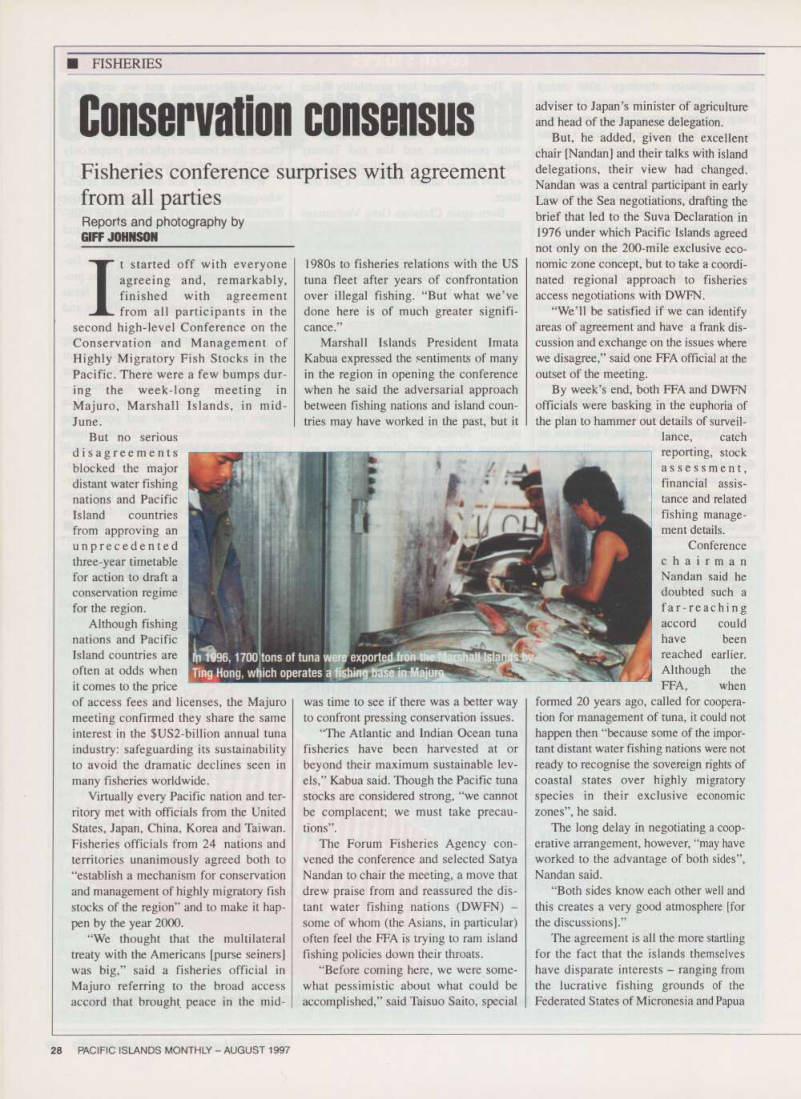
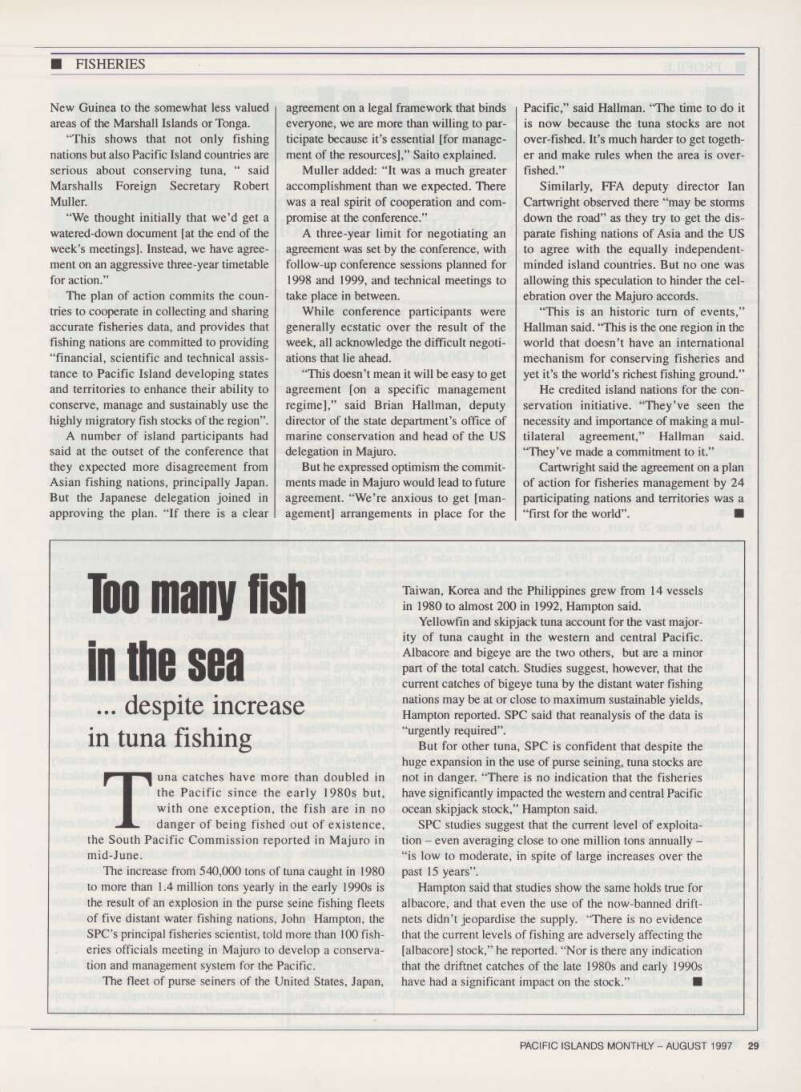
Fisheries
Fisheries conference surprises with agreement from all parties
Reports and photography by
Giff Johnson
It started off with everyone
agreeing and, remarkably,
finished with agreement from all participants in the second high-level Conference on the Conservation and Management of Highly Migratory Fish Stocks in the Pacific. There were a few bumps dur ing the week-long meeting in Majuro, Marshall Islands, in mid- June.
But no serious disagreements blocked the major distant water fishing nations and Pacific Island countries from approving an unprecedented
three-year timetable
for action to draft a
conservation regime
for the region.
Although fishing
nations and Pacific Island countries are often at odds when it comes to the price
of access fees and licenses, the Majuro meeting confirmed they share the same interest in the SUS2-billion annual tuna industry: safeguarding its sustainability to avoid the dramatic declines seen in many fisheries worldwide.
Virtually every Pacific nation and ter ritory met with officials from the United States, Japan, China, Korea and Taiwan.
Fisheries officials from 24 nations and territories unanimously agreed both to “establish a mechanism for conservation and management of highly migratory fish stocks of the region” and to make it hap pen by the year 2000.
“We thought that the multilateral treaty with the Americans [purse seiners] was big,” said a fisheries official in Majuro referring to the broad access accord that brought peace in the mid
1980 s to fisheries relations with the US tuna fleet after years of confrontation over illegal fishing. “But what we’ve done here is of much greater signifi cance.”
Marshall Islands President Imata Kabua expressed the sentiments of many in the region in opening the conference when he said the adversarial approach between fishing nations and island coun tries may have worked in the past, but it
was time to see if there was a better way to confront pressing conservation issues.
“The Atlantic and Indian Ocean tuna fisheries have been harvested at or beyond their maximum sustainable lev els,” Kabua said. Though the Pacific tuna stocks are considered strong, “we cannot be complacent; we must take precau tions”.
The Forum Fisheries Agency con vened the conference and selected Satya Nandan to chair the meeting, a move that drew praise from and reassured the dis tant water fishing nations (DWFN) some of whom (the Asians, in particular) often feel the FFA is trying to ram island fishing policies down their throats.
“Before coming here, we were some what pessimistic about what could be accomplished,” said Taisuo Saito, special
adviser to Japan’s minister of agriculture and head of the Japanese delegation.
But, he added, given the excellent chair [Nandan] and their talks with island delegations, their view had changed.
Nandan was a central participant in early Law of the Sea negotiations, drafting the brief that led to the Suva Declaration in 1976 under which Pacific Islands agreed not only on the 200-mile exclusive eco nomic zone concept, but to take a coordi nated regional approach to fisheries access negotiations with DWFN.
“WeTl be satisfied if we can identify areas of agreement and have a frank dis cussion and exchange on the issues where we disagree,” said one FFA official at the outset of the meeting.
By week’s end, both FFA and DWFN officials were basking in the euphoria of the plan to hammer out details of surveil
lance, catch
reporting, stock
assessment, financial assis tance and related fishing manage ment details.
Conference chairman Nandan said he doubted such a
far-reaching
accord could have been reached earlier.
Although the FFA, when
formed 20 years ago, called for coopera tion for management of tuna, it could not happen then “because some of the impor tant distant water fishing nations were not ready to recognise the sovereign rights of coastal states over highly migratory species in their exclusive economic zones”, he said.
The long delay in negotiating a coop erative arrangement, however, “may have worked to the advantage of both sides”, Nandan said.
“Both sides know each other well and this creates a very good atmosphere [for the discussions].”
The agreement is all the more startling for the fact that the islands themselves have disparate interests - ranging from the lucrative fishing grounds of the Federated States of Micronesia and Papua
In 1996, 1700 tons of tuna were exported fron the Marshall Islands by Ting Hong, which operates a fishing base in Majuro
New Guinea to the somewhat less valued areas of the Marshall Islands or Tonga.
“This shows that not only fishing nations but also Pacific Island countries are serious about conserving tuna, “ said
Marshalls Foreign Secretary Robert
Muller.
“We thought initially that we’d get a watered-down document [at the end of the week’s meetings]. Instead, we have agree ment on an aggressive three-year timetable for action.”
The plan of action commits the coun tries to cooperate in collecting and sharing accurate fisheries data, and provides that fishing nations are committed to providing “financial, scientific and technical assis tance to Pacific Island developing states and territories to enhance their ability to conserve, manage and sustainably use the highly migratory fish stocks of the region”.
A number of island participants had said at the outset of the conference that they expected more disagreement from Asian fishing nations, principally Japan.
But the Japanese delegation joined in
approving the plan. “If there is a clear
agreement on a legal framework that binds everyone, we are more than willing to par ticipate because it’s essential [for manage ment of the resources],” Saito explained.
Muller added: “It was a much greater accomplishment than we expected. There was a real spirit of cooperation and com promise at the conference.”
A three-year limit for negotiating an agreement was set by the conference, with follow-up conference sessions planned for 1998 and 1999, and technical meetings to take place in between.
While conference participants were generally ecstatic over the result of the week, all acknowledge the difficult negoti ations that lie ahead.
“This doesn’t mean it will be easy to get agreement [on a specific management regime],” said Brian Hallman, deputy director of the state department’s office of marine conservation and head of the US delegation in Majuro.
But he expressed optimism the commit ments made in Majuro would lead to future agreement. “We’re anxious to get [man agement] arrangements in place for the
Pacific,” said Hallman. “The time to do it is now because the tuna stocks are not over-fished. It’s much harder to get togeth er and make rules when the area is over fished.”
Similarly, FFA deputy director lan Cartwright observed there “may be storms down the road” as they try to get the dis parate fishing nations of Asia and the US to agree with the equally independent minded island countries. But no one was allowing this speculation to hinder the cel ebration over the Majuro accords.
“This is an historic turn of events,”
Hallman said. “This is the one region in the world that doesn’t have an international mechanism for conserving fisheries and yet it’s the world’s richest fishing ground.”
He credited island nations for the con servation initiative. “They’ve seen the necessity and importance of making a mul tilateral agreement,” Hallman said.
“They’ve made a commitment to it.”
Cartwright said the agreement on a plan of action for fisheries management by 24 participating nations and territories was a “first for the world”. ■
Too many fish
in the sea ...despite increase in tuna fishing
Tuna catches have more than doubled in the Pacific since the early 1980 s but, with one exception, the fish are in no danger of being fished out of existence, the South Pacific Commission reported in Majuro in mid-June.
The increase from 540,000 tons of tuna caught in 1980 to more than 1.4 million tons yearly in the early 1990 s is the result of an explosion in the purse seine fishing fleets of five distant water fishing nations, John Hampton, the SPC’s principal fisheries scientist, told more than 100 fish eries officials meeting in Majuro to develop a conserva tion and management system for the Pacific.
The fleet of purse seiners of the United States, Japan,
Taiwan, Korea and the Philippines grew from 14 vessels in 1980 to almost 200 in 1992, Hampton said.
Yellowfin and skipjack tuna account for the vast major ity of tuna caught in the western and central Pacific.
Albacore and bigeye are the two others, but are a minor part of the total catch. Studies suggest, however, that the current catches of bigeye tuna by the distant water fishing nations may be at or close to maximum sustainable yields, Hampton reported. SPC said that reanalysis of the data is
“urgently required”.
But for other tuna, SPC is confident that despite the huge expansion in the use of purse seining, tuna stocks are not in danger. “There is no indication that the fisheries have significantly impacted the western and central Pacific ocean skipjack stock,” Hampton said.
SPC studies suggest that the current level of exploita tion - even averaging close to one million tons annually - “is low to moderate, in spite of large increases over the past 15 years”.
Hampton said that studies show the same holds true for albacore, and that even the use of the now-banned drift nets didn’t jeopardise the supply. “There is no evidence that the current levels of fishing are adversely affecting the [albacore] stock,” he reported. “Nor is there any indication that the driftnet catches of the late 1980 s and early 1990 s have had a significant impact on the stock.” ■
Arms and the man
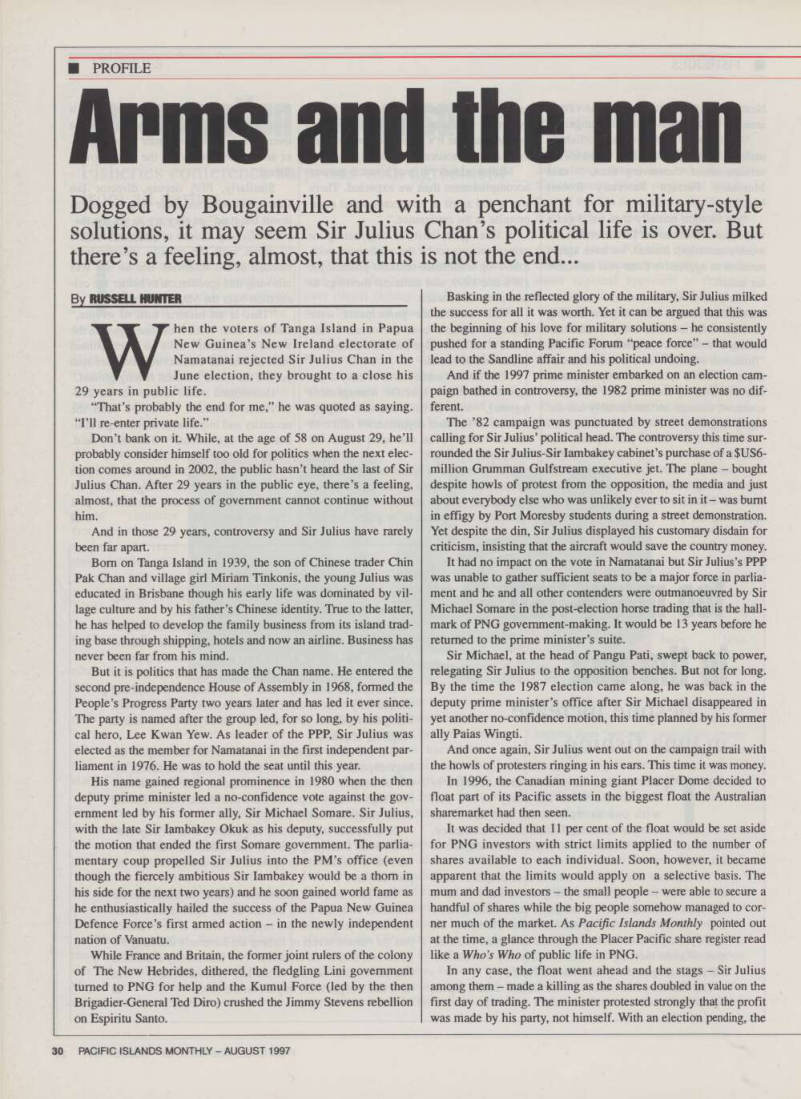
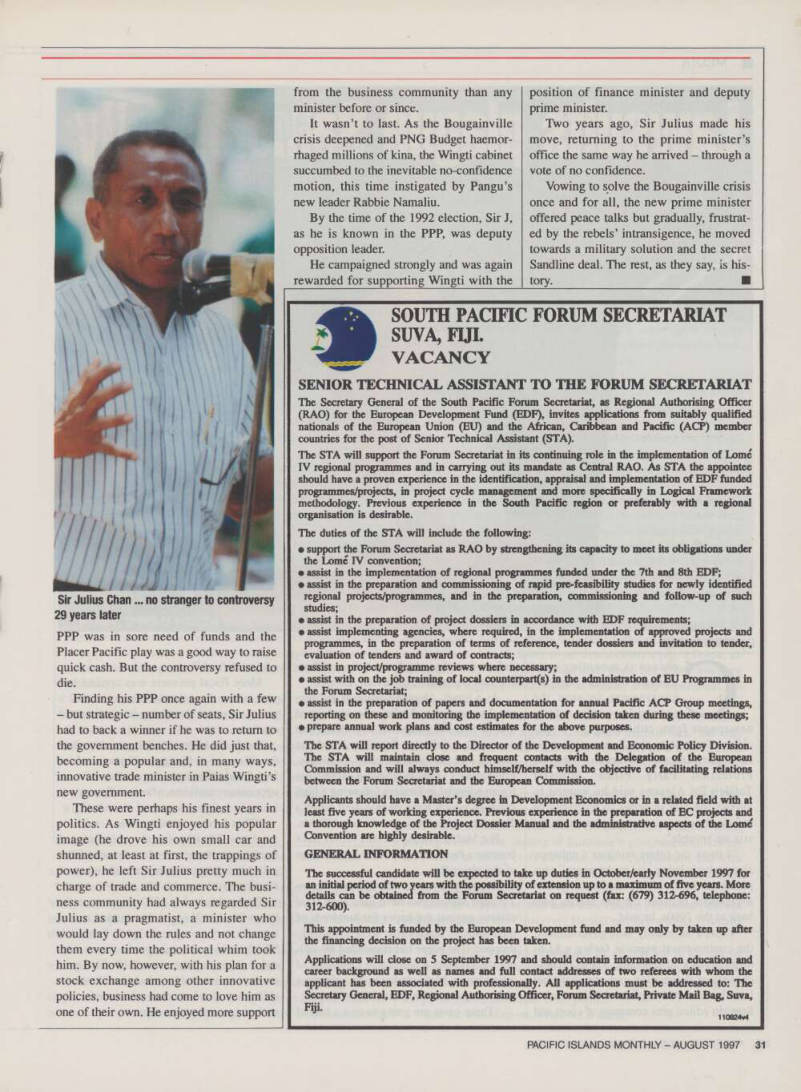
Profile
Dogged by Bougainville and with a penchant for military-style solutions, it may seem Sir Julius Chan’s political life is over. But there’s a feeling, almost, that this is not the end...
By Russell Hunter
When the voters of Tanga Island in Papua New Guinea’s New Ireland electorate of Namatanai rejected Sir Julius Chan in the June election, they brought to a close his 29 years in public life.
“That’s probably the end for me,” he was quoted as saying.
“I’ll re-enter private life.”
Don’t bank on it. While, at the age of 58 on August 29, he’ll probably consider himself too old for politics when the next elec tion comes around in 2002, the public hasn’t heard the last of Sir Julius Chan. After 29 years in the public eye, there’s a feeling, almost, that the process of government cannot continue without him.
And in those 29 years, controversy and Sir Julius have rarely been far apart.
Bom on Tanga Island in 1939, the son of Chinese trader Chin Pak Chan and village girl Miriam Tinkonis, the young Julius was educated in Brisbane though his early life was dominated by vil lage culture and by his father’s Chinese identity. True to the latter, he has helped to develop the family business from its island trad ing base through shipping, hotels and now an airline. Business has never been far from his mind.
But it is politics that has made the Chan name. He entered the second pre-independence House of Assembly in 1968, formed the People’s Progress Party two years later and has led it ever since.
The party is named after the group led, for so long, by his politi cal hero, Lee Kwan Yew. As leader of the PPP, Sir Julius was elected as the member for Namatanai in the first independent par liament in 1976. He was to hold the seat until this year.
His name gained regional prominence in 1980 when the then deputy prime minister led a no-confidence vote against the gov ernment led by his former ally. Sir Michael Somare. Sir Julius, with the late Sir lambakey Okuk as his deputy, successfully put the motion that ended the first Somare government. The parlia mentary coup propelled Sir Julius into the PM’s office (even though the fiercely ambitious Sir lambakey would be a thorn in his side for the next two years) and he soon gained world fame as he enthusiastically hailed the success of the Papua New Guinea Defence Force’s first armed action - in the newly independent nation of Vanuatu.
While France and Britain, the former joint rulers of the colony of The New Hebrides, dithered, the fledgling Lini government turned to PNG for help and the Kumul Force (led by the then Brigadier-General Ted Diro) crushed the Jimmy Stevens rebellion on Espiritu Santo.
Basking in the reflected glory of the military. Sir Julius milked the success for all it was worth. Yet it can be argued that this was the beginning of his love for military solutions - he consistently pushed for a standing Pacific Forum “peace force” - that would lead to the Sandline affair and his political undoing.
And if the 1997 prime minister embarked on an election cam paign bathed in controversy, the 1982 prime minister was no dif ferent.
The ’B2 campaign was punctuated by street demonstrations calling for Sir Julius’ political head. The controversy this time sur rounded the Sir Julius-Sir lambakey cabinet’s purchase of a SUS million Grumman Gulfstream executive jet. The plane - bought despite howls of protest from the opposition, the media and just about everybody else who was unlikely ever to sit in it - was burnt in effigy by Port Moresby students during a street demonstration.
Yet despite the din. Sir Julius displayed his customary disdain for criticism, insisting that the aircraft would save the country money.
It had no impact on the vote in Namatanai but Sir Julius’s PPP was unable to gather sufficient seats to be a major force in parlia ment and he and all other contenders were outmanoeuvred by Sir Michael Somare in the post-election horse trading that is the hall mark of PNG government-making. It would be 13 years before he returned to the prime minister’s suite.
Sir Michael, at the head of Pangu Pati, swept back to power, relegating Sir Julius to the opposition benches. But not for long.
By the time the 1987 election came along, he was back in the deputy prime minister’s office after Sir Michael disappeared in yet another no-confidence motion, this time planned by his former ally Paias Wingti.
And once again, Sir Julius went out on the campaign trail with the howls of protesters ringing in his ears. This time it was money.
In 1996, the Canadian mining giant Placer Dome decided to float part of its Pacific assets in the biggest float the Australian sharemarket had then seen.
It was decided that 11 per cent of the float would be set aside for PNG investors with strict limits applied to the number of shares available to each individual. Soon, however, it became apparent that the limits would apply on a selective basis. The mum and dad investors - the small people - were able to secure a handful of shares while the big people somehow managed to cor ner much of the market. As Pacific Islands Monthly pointed out at the time, a glance through the Placer Pacific share register read like a Who’s Who of public life in PNG.
In any case, the float went ahead and the stags - Sir Julius among them - made a killing as the shares doubled in value on the first day of trading. The minister protested strongly that the profit was made by his party, not himself. With an election pending, the
PPP was in sore need of funds and the Placer Pacific play was a good way to raise quick cash. But the controversy refused to die.
Finding his PPP once again with a few - but strategic - number of seats, Sir Julius had to back a winner if he was to return to the government benches. He did just that, becoming a popular and, in many ways, innovative trade minister in Paias Wingti’s new government.
These were perhaps his finest years in
politics. As Wingti enjoyed his popular
image (he drove his own small car and shunned, at least at first, the trappings of power), he left Sir Julius pretty much in charge of trade and commerce. The busi ness community had always regarded Sir Julius as a pragmatist, a minister who would lay down the rules and not change them every time the political whim took him. By now, however, with his plan for a stock exchange among other innovative policies, business had come to love him as one of their own. He enjoyed more support
from the business community than any minister before or since.
It wasn’t to last. As the Bougainville crisis deepened and PNG Budget haemor rhaged millions of kina, the Wingti cabinet succumbed to the inevitable no-confidence
motion, this time instigated by Pangu’s
new leader Rabbie Namaliu.
By the time of the 1992 election, Sir J, as he is known in the PPP, was deputy opposition leader.
He campaigned strongly and was again
rewarded for supporting Wingti with the
position of finance minister and deputy
prime minister.
Two years ago. Sir Julius made his move, returning to the prime minister’s office the same way he arrived - through a vote of no confidence.
Vowing to solve the Bougainville crisis once and for all, the new prime minister offered peace talks but gradually, frustrat ed by the rebels’ intransigence, he moved towards a military solution and the secret Sandline deal. The rest, as they say, is his tory. ■
Sir Julius Chan...no stranger to controversy 29 years later
Advertisements & other items, p. 31 (1 item)
Suva, Fiji.
9
SOUTH PACIFIC FORUM SECRETARIAT
VACANCY
SENIOR TECHNICAL ASSISTANT TO THE FORUM SECRETARIAT The Secretary General of the South Pacific Forum Secretariat, as Regional Authorising Officer (RAO) for the European Development Fund (EDF), invites applications from suitably qualified nationals of the European Union (EU) and the African, Caribbean and Pacific (ACP) member countries for the post of Senior Technical Assistant (STA).
The STA will support the Forum Secretariat in its continuing role in the implementation of Lome IV regional programmes and in carrying out its mandate as Central RAO. As STA the appointee should have a proven experience in the identification, appraisal and implementation of EDF funded programmes/projects, in project cycle management and more specifically in Logical Framework methodology. Previous experience in the South Pacific region or preferably with a regional organisation is desirable.
The duties of the STA will include the following: • support the Forum Secretariat as RAO by strengthening its capacity to meet its obligations under the Lome IV convention; • assist in the implementation of regional programmes funded under the 7th and Bth EDF; • assist in the preparation and commissioning of rapid pre-feasibility studies for newly identified regional projects/programmes, and in the preparation, commissioning and follow-up of such studies; • assist in the preparation of project dossiers in accordance with EDF requirements; • assist implementing agencies, where required, in the implementation of approved projects and programmes, in the preparation of terms of reference, tender dossiers and invitation to tender, evaluation of tenders and award of contracts; • assist in project/programme reviews where necessary; • assist with on the job training of local counterparts) in the administration of EU Programmes in the Forum Secretariat; • assist in the preparation of papers and documentation for annual Pacific ACP Group meetings, reporting on these and monitoring the implementation of decision taken during these meetings; • prepare annual work plans and cost estimates for the above purposes.
The STA will report direcdy to the Director of the Development and Economic Policy Division.
The STA will maintain close and frequent contacts with the Delegation of the European Commission and will always conduct himself/herself with the objective of facilitating relations between the Forum Secretariat and the European Commission.
Applicants should have a Master’s degree in Development Economics or in a related field with at least five years of working experience. Previous experience in the preparation of EC projects and a thorough knowledge of the Project Dossier Manual and the administrative aspects of the Lome Convention are highly desirable.
GENERAL INFORMATION
The successful candidate will be expected to take up duties in October/early November 1997 for an initial period of two years with the possibility of extension up to a maximum of five years. More details can be obtained from the Forum Secretariat on request (fax: (679) 312-696, telephone: 312-600).
This appointment is funded by the European Development fund and may only by taken up after the financing decision on the project has been taken.
Applications will close on 5 September 1997 and should contain information on education and career background as well as names and frill contact addresses of two referees with whom the applicant has been associated with professionally. All applications must be addressed to: The Secretary General, EDF, Regional Authorising Officer, Forum Secretariat, Private Mail Bag, Suva, Fiji. 110624x4
Lawsuits plague Samoan daily
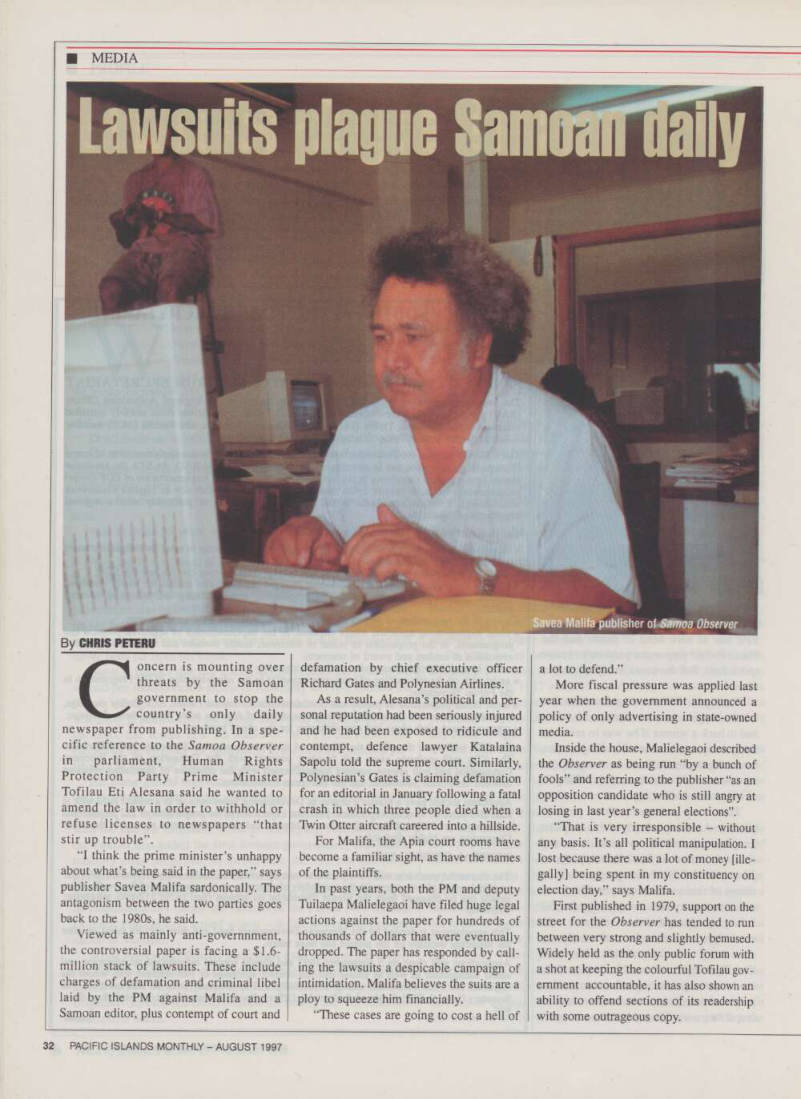
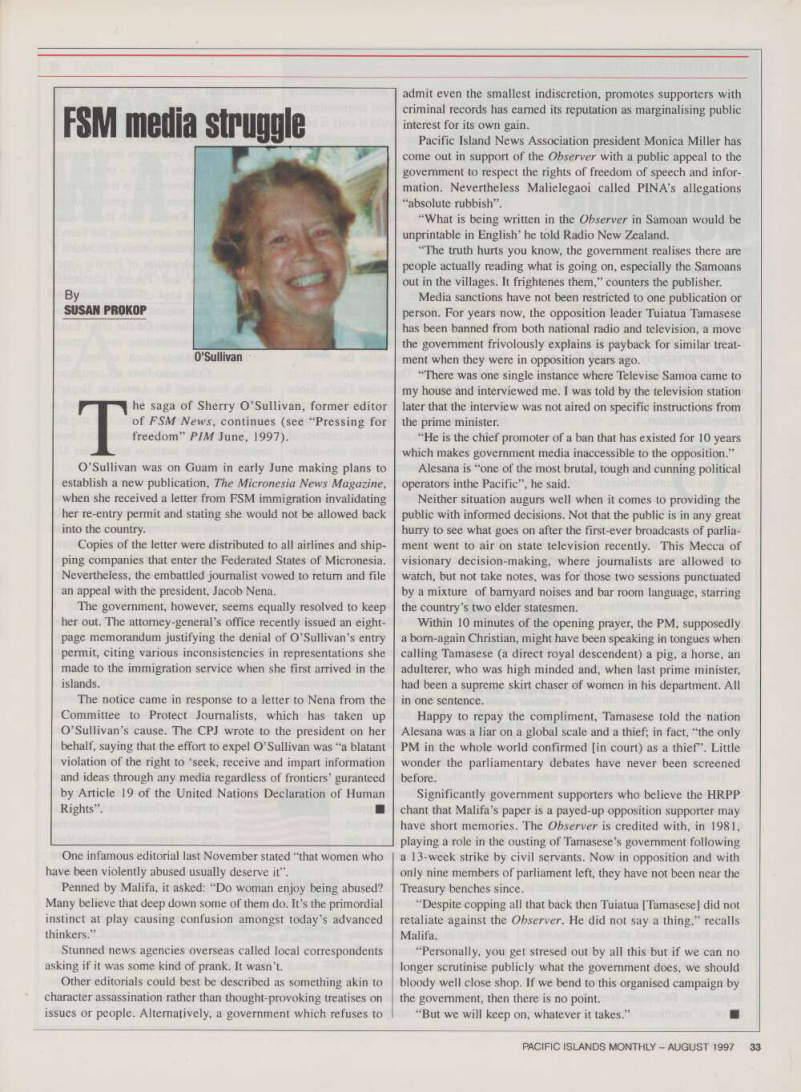
Media
By Chris Peteru
Concern is mounting over threats by the Samoan government to stop the country’s only daily newspaper from publishing. In a spe cific reference to the Samoa Observer in parliament, Human Rights Protection Party Prime Minister Tofilau Eti Alesana said he wanted to amend the law in order to withhold or refuse licenses to newspapers “that stir up trouble”.
“I think the prime minister’s unhappy about what’s being said in the paper,” says publisher Savea Malifa sardonically. The antagonism between the two parties goes back to the 1980 s, he said.
Viewed as mainly anti-governnment, the controversial paper is facing a $ 1.6million stack of lawsuits. These include charges of defamation and criminal libel laid by the PM against Malifa and a Samoan editor, plus contempt of court and
defamation by chief executive officer Richard Gates and Polynesian Airlines.
As a result, Alesana’s political and per sonal reputation had been seriously injured and he had been exposed to ridicule and contempt, defence lawyer Katalaina Sapolu told the supreme court. Similarly, Polynesian’s Gates is claiming defamation for an editorial in January following a fatal crash in which three people died when a Twin Otter aircraft careered into a hillside.
For Malifa, the Apia court rooms have become a familiar sight, as have the names of the plaintiffs.
In past years, both the PM and deputy Tuilaepa Malielegaoi have filed huge legal actions against the paper for hundreds of thousands of dollars that were eventually dropped. The paper has responded by call ing the lawsuits a despicable campaign of intimidation. Malifa believes the suits are a ploy to squeeze him financially.
“These cases are going to cost a hell of
a lot to defend.”
More fiscal pressure was applied last year when the government announced a
policy of only advertising in state-owned
media.
Inside the house, Malielegaoi described the Observer as being run “by a bunch of fools” and referring to the publisher “as an opposition candidate who is still angry at losing in last year’s general elections”.
“That is very irresponsible - without any basis. It’s all political manipulation. I lost because there was a lot of money [ille gally] being spent in my constituency on election day,” says Malifa.
First published in 1979, support on the street for the Observer has tended to run between very strong and slightly bemused.
Widely held as the only public forum with a shot at keeping the colourful Tofilau gov ernment accountable, it has also shown an ability to offend sections of its readership with some outrageous copy.
Savea Malifa publisher of Samoa Observer
One infamous editorial last November stated “that women who have been violently abused usually deserve it”.
Penned by Malifa, it asked: “Do woman enjoy being abused?
Many believe that deep down some of them do. It’s the primordial instinct at play causing confusion amongst today’s advanced thinkers.”
Stunned news agencies overseas called local correspondents asking if it was some kind of prank. It wasn’t.
Other editorials could best be described as something akin to character assassination rather than thought-provoking treatises on issues or people. Alternatively, a government which refuses to
admit even the smallest indiscretion, promotes supporters with criminal records has earned its reputation as marginalising public interest for its own gain.
Pacific Island News Association president Monica Miller has come out in support of the Observer with a public appeal to the government to respect the rights of freedom of speech and infor mation. Nevertheless Malielegaoi called PINA’s allegations “absolute rubbish”.
“What is being written in the Observer in Samoan would be unprintable in English’ he told Radio New Zealand.
“The truth hurts you know, the government realises there are people actually reading what is going on, especially the Samoans out in the villages. It frightenes them,” counters the publisher.
Media sanctions have not been restricted to one publication or person. For years now, the opposition leader Tuiatua Tamasese has been banned from both national radio and television, a move the government frivolously explains is payback for similar treat ment when they were in opposition years ago.
“There was one single instance where Televise Samoa came to my house and interviewed me. I was told by the television station later that the interview was not aired on specific instructions from the prime minister.
“He is the chief promoter of a ban that has existed for 10 years which makes government media inaccessible to the opposition.”
Alesana is “one of the most brutal, tough and cunning political operators inthe Pacific”, he said.
Neither situation augurs well when it comes to providing the public with informed decisions. Not that the public is in any great hurry to see what goes on after the first-ever broadcasts of parlia ment went to air on state television recently. This Mecca of visionary decision-making, where journalists are allowed to watch, but not take notes, was for those two sessions punctuated by a mixture of barnyard noises and bar room language, starring the country’s two elder statesmen.
Within 10 minutes of the opening prayer, the PM, supposedly a bom-again Christian, might have been speaking in tongues when calling Tamasese (a direct royal descendent) a pig, a horse, an adulterer, who was high minded and, when last prime minister, had been a supreme skirt chaser of women in his department. All in one sentence.
Happy to repay the compliment, Tamasese told the nation Alesana was a liar on a global scale and a thief; in fact, “the only PM in the whole world confirmed [in court) as a thief’. Little wonder the parliamentary debates have never been screened before.
Significantly government supporters who believe the HRPP chant that Malifa’s paper is a payed-up opposition supporter may have short memories. The Observer is credited with, in 1981, playing a role in the ousting of Tamasese’s government following a 13-week strike by civil servants. Now in opposition and with only nine members of parliament left, they have not been near the Treasury benches since.
“Despite copping all that back then Tuiatua [Tamasese] did not retaliate against the Observer. He did not say a thing,” recalls Malifa.
“Personally, you get stresed out by all this but if we can no longer scrutinise publicly what the government does, we should bloody well close shop. If we bend to this organised campaign by the government, then there is no point.
“But we will keep on, whatever it takes.” ■
FSM media struggle
By
Susan Prokop
The saga of Sherry O’Sullivan, former editor of FSM News, continues (see “Pressing for freedom” PIM June, 1997).
O’Sullivan was on Guam in early June making plans to establish a new publication, The Micronesia News Magazine, when she received a letter from FSM immigration invalidating her re-entry permit and stating she would not be allowed back into the country.
Copies of the letter were distributed to all airlines and ship ping companies that enter the Federated States of Micronesia.
Nevertheless, the embattled journalist vowed to return and file an appeal with the president, Jacob Nena.
The government, however, seems equally resolved to keep her out. The attorney-general’s office recently issued an eight page memorandum justifying the denial of O’Sullivan’s entry permit, citing various inconsistencies in representations she made to the immigration service when she first arrived in the islands.
The notice came in response to a letter to Nena from the Committee to Protect Journalists, which has taken up O’Sullivan’s cause. The CPJ wrote to the president on her behalf, saying that the effort to expel O’Sullivan was “a blatant violation of the right to ‘seek, receive and impart information and ideas through any media regardless of frontiers’ guranteed by Article 19 of the United Nations Declaration of Human
Rights”. ■
O’Sullivan
Flagging
Decolonisation
Flagging powers
By Ian Williams
There’s a lot about the United Nations that drives the US Congress to baying distraction its very existence for one thing.
But surprisingly enough for an ex-British colony, one thing that excites them even more is the UN Special Committee on Decolonisation.
Of course, one part of that dislike could be that the committee regularly hears petitioners and reports from American Samoa, the US Virgin Islands, Guam and Puerto Rico.
In particular, the idea of having region al seminars that pay expenses for represen
tatives from the non-self-govem ing territories reduces some American representatives to paroxysms of rage. With the usual deference of UN bureau crats to Washington, the UN commissioned a special investi gation into the costs of last year’s seminar, held in the Caribbean. This year, the com mittee’s response was to decide to hold a seminar on decolonisa tion in the Pacific next year.
The committee has played a big role in decolonisation in the Pacific but its mem bers all too often give ammunition to their opponents by having dual standards. For example, it is big on self-determination but only when it produces politically acceptable results. So, the Falkand Islanders’ own views are of no account in comparison with the 160-year-old legal claim of Argentina.
On the other hand, the view of the 60 or so people on Pitcairn, who have not expressed the slightest interest in changing their present position, are of paramount importance. Of course, it is easier to beat up on a ‘traditional’ colonial country like
Britain, even though London would dearly like to shuffle off its final responsibilities in most parts of the world if only it could thrust independence on its remaining terri tories.
Apart from a general disre gard of the possibility that south ern countries could also be colo nialist, there is a reluctance to tweak the beard of powerful neighbours. Last year, for exam ple, PNG Ambassador Utula Utuoc Samona, who is also chairman of the committee, caused a stir by declaring that “the presence of the armed forces of Indonesia is a very positive factor for efforts to raise the well-being of the Timorese peo
pie”, while on a visit to East Timor. Since many petitioners and governments consid er that one of the Indonesian army’s achievements was to lower the number of living Timorese by one-third, this under standably raised some controversy.
The ambassador invoked the theologi cal subtleties of diplomacy to explain this away, claiming that he was speaking on behalf of Port Moresby rather than in his chairman’s capacity. This year, petitioners agreed that, in fact, he was very fair and
supportive to pro-East- Timorese petitioners in the face of a barrage of Indonesian protests. One of the petitioners.
Professor Roger Clark of International Law at Rutgers commented, however, that two-thirds of committee mem bers themselves were absent during the East Timorese issue, in contrast, for example, with the relatively full turnout for the Falkland
Islands. He also supported the continuation of the committee in the face of perennial pres sure to disband it, usually from the colonial powers put in the dock there. “The demise of the committee would quell the East Timor issue at the UN,” he said, adding that he wished the Pacific had been more forthright in getting, for exam ple, the other French Pacific
territories enlisted. Ironically, PNG was a major mover in getting New Caledonia inscribed on the list of colonised territo ries. There is little doubt that the continued
intemational exposure of the Kanak case in the committee has helped move Paris to a more reasonable position. Discussion on New Caledonia has been held over until
next year when the Matignon accords click in - or not.
However, it is instructive to compare the progress made by the Kanaks with the relative silence surrounding the French Polynesian territories which a combination of Pacific inac tion and French adroitness have kept off the agenda. No one wanted to upset Paris on this issue. On the other hand, the committee now attracts members such as Iran and Cuba who have no compunc
tion in tweaking the American Eagle’s feathers. The issue of Guam has had a steadily higher profile in the UN and the US Congress, as the Chamorros have been comparing their position with other US Pacific territories.
Apart from self-determination, a major issue is the preservation of traditional property rights of Chamorros, especially over the vast areas currently in use by the US military. Laura Torres-Souder, repre senting the governor of Guam, lamented the time taken by successive US adminis trations to move on the territory’s propos als for regularising its status as a Commonwealth. In particular, she pointed out that US immigration laws in force had allowed an influx of 10,000 immigrants with permanent status. She did not say it but, clearly, the example of New Caledonia shows the dangers of a colonial power allowing the indigenous inhabitants to be swamped by newcomers. Her compatriot, Mark Forbes, the majority leader of the
Guam legislature was even more
forthright. The legislature and
the governor were elected by the people of Guam, but their deci sion could be overridden by the US government, and while they could send a “congressman” to Washington, he had no voting rights there. When the Pacific seminar does take place next year, there is little doubt there will be a vociferous Chamorro presence, regardless of
Washington’s displeasure.
It will be interesting to see whether rep resentatives from the uninscribed French territories are allowed a voice. ■
UK: It is easier to beat up on a 'traditional’ colonial country like Britain, even though London would dearly like to shuffle off its final responsi bilities in most parts of the world
France: It is instructive to compare the progress made by the Kanaks with the rela tive silence surrounding French Polynesian territories, which a combination of Pacific inaction and French adroitness have kept off the agenda
US: Apart from self-determi nation, a major issue is the preservation of traditional property rights of Chamorros, especially over the vast areas in use by the US military
Estate of
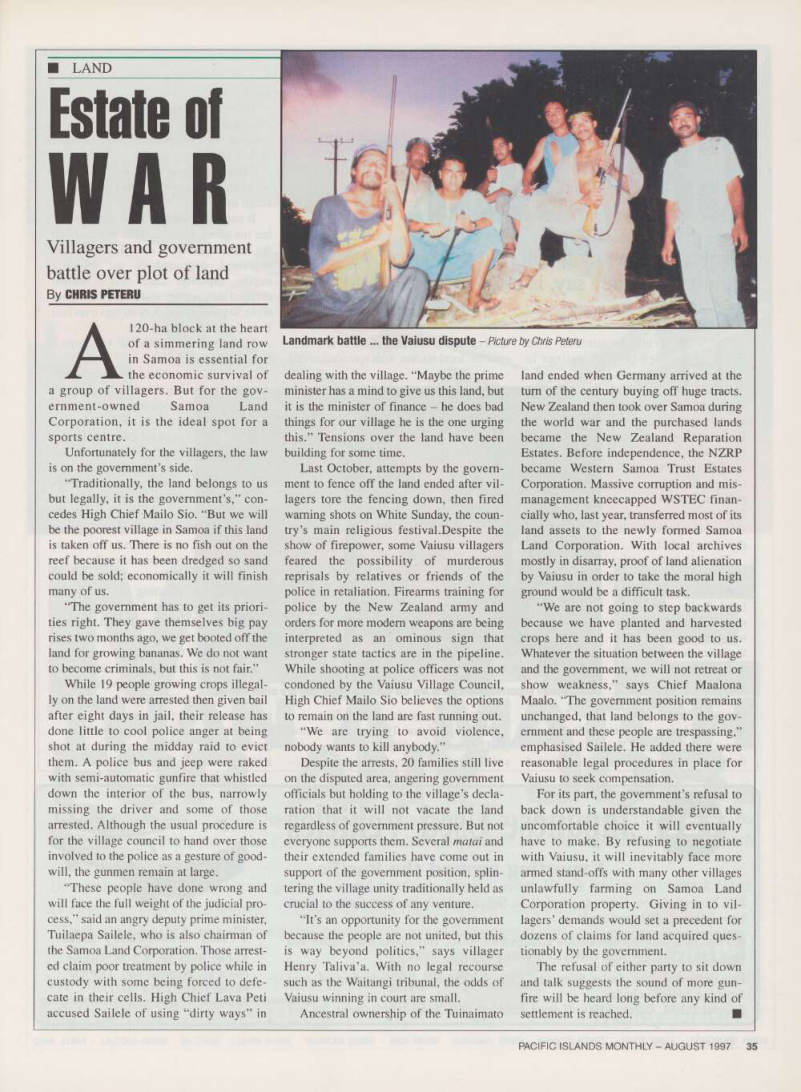
Land
War
Villagers and government battle over plot of land
By Chris Peteru
A 120-ha block at the heart of a simmering land row in Samoa is essential for the economic survival of a group of villagers. But for the gov ernment-owned Samoa Land Corporation, it is the ideal spot for a sports centre.
Unfortunately for the villagers, the law is on the government’s side.
“Traditionally, the land belongs to us but legally, it is the government’s,” con cedes High Chief Mailo Sio. “But we will be the poorest village in Samoa if this land is taken off us. There is no fish out on the reef because it has been dredged so sand could be sold; economically it will finish many of us.
“The government has to get its priori ties right. They gave themselves big pay rises two months ago, we get booted off the land for growing bananas. We do not want to become criminals, but this is not fair.”
While 19 people growing crops illegal ly on the land were arrested then given bail after eight days in jail, their release has done little to cool police anger at being shot at during the midday raid to evict them. A police bus and jeep were raked with semi-automatic gunfire that whistled down the interior of the bus, narrowly missing the driver and some of those arrested. Although the usual procedure is for the village council to hand over those involved to the police as a gesture of good will, the gunmen remain at large.
“These people have done wrong and will face the full weight of the judicial pro cess,” said an angry deputy prime minister, Tuilaepa Sailele, who is also chairman of the Samoa Land Corporation. Those arrest ed claim poor treatment by police while in custody with some being forced to defe cate in their cells. High Chief Lava Peti accused Sailele of using “dirty ways” in
dealing with the village. “Maybe the prime minister has a mind to give us this land, but it is the minister of finance - he does bad things for our village he is the one urging this.” Tensions over the land have been building for some time.
Last October, attempts by the govern ment to fence off the land ended after vil lagers tore the fencing down, then fired warning shots on White Sunday, the coun try’s main religious festival. Despite the show of firepower, some Vaiusu villagers feared the possibility of murderous reprisals by relatives or friends of the police in retaliation. Firearms training for police by the New Zealand army and orders for more modem weapons are being interpreted as an ominous sign that stronger state tactics are in the pipeline.
While shooting at police officers was not condoned by the Vaiusu Village Council, High Chief Mailo Sio believes the options to remain on the land are fast running out.
“We are trying to avoid violence, nobody wants to kill anybody.”
Despite the arrests, 20 families still live on the disputed area, angering government officials but holding to the village’s decla ration that it will not vacate the land regardless of government pressure. But not everyone supports them. Several matai and their extended families have come out in support of the government position, splin tering the village unity traditionally held as crucial to the success of any venture.
“It’s an opportunity for the government because the people are not united, but this
is way beyond politics,” says villager
Henry Taliva’a. With no legal recourse such as the Waitangi tribunal, the odds of Vaiusu winning in court are small.
Ancestral ownership of the Tuinaimato
land ended when Germany arrived at the turn of the century buying off huge tracts.
New Zealand then took over Samoa during the world war and the purchased lands became the New Zealand Reparation Estates. Before independence, the NZRP became Western Samoa Trust Estates Corporation. Massive corruption and mis management kneecapped WSTEC finan cially who, last year, transferred most of its land assets to the newly formed Samoa Land Corporation. With local archives mostly in disarray, proof of land alienation by Vaiusu in order to take the moral high ground would be a difficult task.
“We are not going to step backwards because we have planted and harvested crops here and it has been good to us.
Whatever the situation between the village and the government, we will not retreat or show weakness,” says Chief Maalona Maalo. “The government position remains unchanged, that land belongs to the gov ernment and these people are trespassing,” emphasised Sailele. He added there were reasonable legal procedures in place for Vaiusu to seek compensation.
For its part, the government’s refusal to back down is understandable given the uncomfortable choice it will eventually have to make. By refusing to negotiate with Vaiusu, it will inevitably face more armed stand-offs with many other villages unlawfully farming on Samoa Land Corporation property. Giving in to vil lagers’ demands would set a precedent for dozens of claims for land acquired ques tionably by the government.
The refusal of either party to sit down and talk suggests the sound of more gun fire will be heard long before any kind of settlement is reached. ■
Landmark battle...the Vaiusu dispute- Picture by Chris Peteru
Car wars
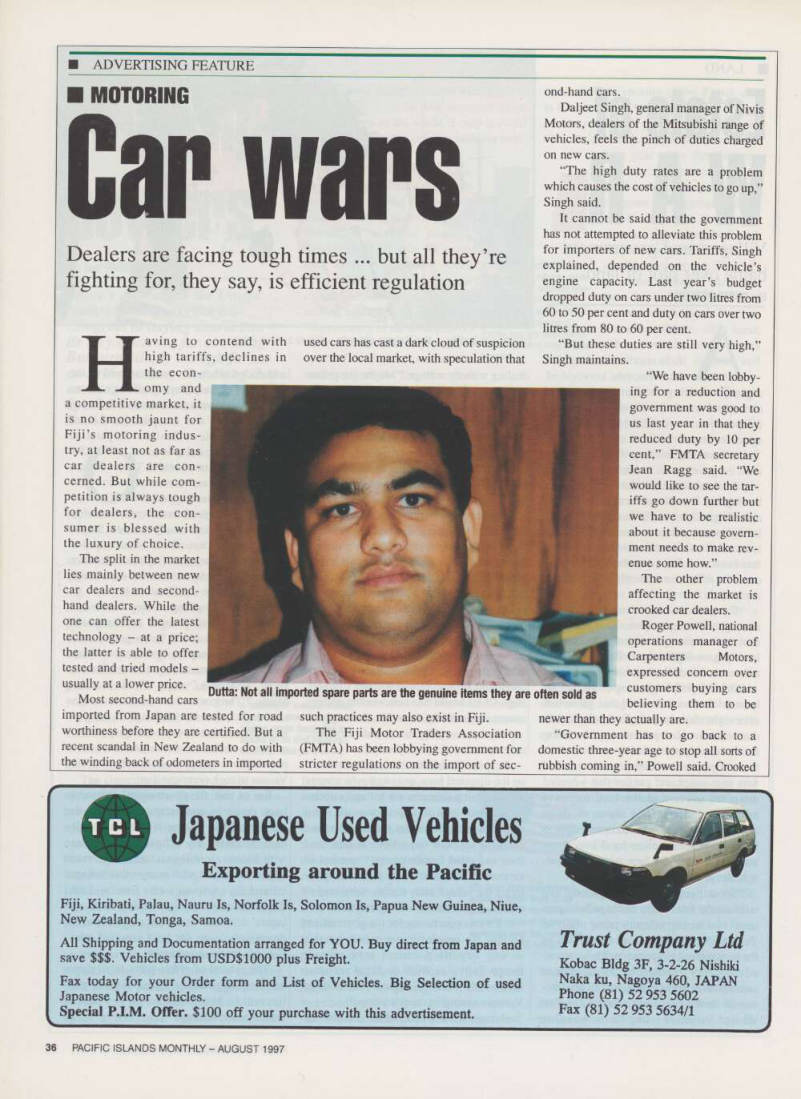



Advertising Feature
Motoring
Dealers are facing tough times...but all they’re fighting for, they say, is efficient regulation
Having to contend with high tariffs, declines in the econ omy and
a competitive market, it is no smooth jaunt for
Fiji’s motoring indus
try, at least not as far as car dealers are con cerned. But while com petition is always tough for dealers, the con sumer is blessed with the luxury of choice.
The split in the market lies mainly between new car dealers and second hand dealers. While the one can offer the latest technology - at a price; the latter is able to offer tested and tried models usually at a lower price.
Most second-hand cars
imported from Japan are tested for road worthiness before they are certified. But a recent scandal in New Zealand to do with the winding back of odometers in imported
used cars has cast a dark cloud of suspicion over the local market, with speculation that
such practices may also exist in Fiji.
The Fiji Motor Traders Association (FMTA) has been lobbying government for stricter regulations on the import of sec
ond-hand cars.
Daljeet Singh, general manager of Nivis Motors, dealers of the Mitsubishi range of vehicles, feels the pinch of duties charged on new cars.
“The high duty rates are a problem which causes the cost of vehicles to go up,”
Singh said.
It cannot be said that the government has not attempted to alleviate this problem for importers of new cars. Tariffs, Singh explained, depended on the vehicle’s engine capacity. Last year’s budget dropped duty on cars under two litres from 60 to 50 per cent and duty on cars over two litres from 80 to 60 per cent.
“But these duties are still very high,”
Singh maintains.
“We have been lobby ing for a reduction and government was good to us last year in that they reduced duty by 10 per cent,” FMTA secretary Jean Ragg said. “We would like to see the tar iffs go down further but we have to be realistic about it because govern ment needs to make rev enue some how.”
The other problem affecting the market is crooked car dealers.
Roger Powell, national operations manager of Carpenters Motors, expressed concern over customers buying cars believing them to be
newer than they actually are.
“Government has to go back to a domestic three-year age to stop all sorts of rubbish coming in,” Powell said. Crooked
Dutta: Not all imported spare parts are the genuine items they are often sold as
dealers are also having an impaict on the spare-parts market. According tco Unique Motor Spares company director Victor Dutta, not all imported spare parts? were the genuine items they were often solid as, and proved to be more trouble than tlhey were worth. “Yes, they are cheap all iright and more people can afford them.” Blut in the long run, they work out to be more expen sive because they have a shorter life than genuine parts do and, in many cases, last only a few months, he says.
“The importation of these parts hasn’t really killed business but has slowed it down a great deal. Usually what happens is that people buy these parts the first few times but when they realise it is costing them more, they come to us.”
He said he did not see the need for a complete ban on such parts but called on government to have in place some sort of rules and regulations which would control the type and life of parts brought in.
“What happens is that when a consumer with a second-hand car has problems with his car, he realises he needs parts which are sometimes not available from where he bought his car. So what he does is go to genuine dealers expecting them to have the necessary parts, and what happens in some cases is that the dealers don’t have the parts these people are looking for because they don’t bring in the particular model of car,” Ragg said.
“So here the consumer gets annoyed; one - because his dealer doesn’t have the part, and two - because his vehicle can’t be used until the parts are changed.”
Ragg is a strong advocate of the use of number plates to differentiate between new and used cars.
“What is happening right now is that whatever vehicles are brought into the country are being given brand new number plates - these include second-hand and reconditioned cars.
“When this happens, there is no way the customer can identify which car is new and which is not.
“It’s a matter of letting the public know that they have to be aware of what they are purchasing with respect to second-hand vehicles.
“We want separate number plates for second-hand cars. There was a time when these cars were given number plates begin ning with ‘D’ and ‘E’.”
However, this saw much protest from second-hand dealers, who believed the move was discriminatory. The matter land
Ragg: "What we want to do is make [the consumer] aware of What is available"
ed in court and was ruled in favour of sec ond-hand dealers.
“In the new legislation, the traffic bill,
which is still to be passed, there are recommendations which state that to be a bona fide operator dealers must have a showroom, suitable workshop, proper
panel shop, proper block
and tackle (for lifting engines out of the car) and [adhere to safety regula tions],” Ragg said.
“There will also be a grading system - A, B, C.”
To qualify as an A, the dealer would need to have the whole setup, B would mean the dealer has the showroom plus workshop and C would mean the
dealer has just a showroom, Ragg said.
“And, of course, they must have spare
parts.”
Ragg said the FMTA was waiting for the bill to be legislated and said it had been 18 months since being presented to gov ernment.
“The point to keep in mind is that we are not against second-hand cars.” The FMTA’s opposition, she said, had to do
with the difficulty of maintaining such cars.
The association has recommended that government not allow the import of vehi cles more than three years old. “That would mean a reasonably new vehicle is coming into the country.”
As for allegations of odometers being turned back, “I don’t know how this prob lem could ever be solved but what I feel is
that these meters should be sealed - which means when a mechanic checks the engine he would be able tell whether someone has tam pered with it or not,” Ragg suggests.
Powell agrees that the high numbers of cars being brought into the country increased competition and allowed more people to own cars. But the point, he said, was that there should be better screening of the types of vehicles brought in. Singh agrees. Only with proper rules and regulations would there be proper con
trol, he said.
Ragg sums it up by saying: “We know we can’t stop the consumer from buying what he wants. But what we can do is make him aware of what is available in the market and why they should be more care ful when buying such cars.” ■
Singh: “The high duty rates are a problem”
Advertisements & other items, pp. 36-39 (2 items)
A Japanese Used Vehicles
Exporting around the Pacific
Fiji, Kiribati, Palau, Nauru Is, Norfolk Is, Solomon Is, Papua New Guinea, Niue, New Zealand, Tonga, Samoa.
All Shipping and Documentation arranged for YOU. Buy direct from Japan and save sss. Vehicles from USDSIOOO plus Freight.
Fax today for your Order form and List of Vehicles. Big Selection of used Japanese Motor vehicles.
Special P.I.M. Offer. $lOO off your purchase with this advertisement.
Trust Company Ltd
Kobac Bldg 3F, 3-2-26 Nishiki Naka ku, Nagoya 460, JAPAN Phone (81) 52 953 5602 Fax (81) 52 953 5634/1
1
THAN A MATCH
FDR ANY JOB.
The new Nissan D 22. It’s Built Tough to take the Rough Stuff. When it comes to getting the job done, you can’t go wrong with the impressive specifications and outstanding performance that make it More than a Match for anything you throw at it.
Undaunted by the ruggest terrain or the roughest condition, this is a Work Horse that loves to Work Hard.
Whatever the job, or the challenge...choose the Pickup that’s Powered to Get it Done.
The new Nissan D 22. ..experience it at a Carpenters Motors showroom near you.
We built our business on Trust.
CARPENTERS MOTORS
fs
NISSAN
Quality Driven.
SUVA 313644 LAUTOKA 661655 BA 674200 LABASA 811522 SIGATOKA 500553 NADI 700166 SAVUSAVU 850274 NAUSORI 479203 TAVUA 680574 SOMOSOMO 880296
IS YOUR VEHICLE’S CM. JOINT GIVING YOU PROBLEMS?
THEN HAVE IT REBUILT PROFESSIONALLY WITH WARRANTY BY
ESKAY RECONDITIONING LTD
Fteconglftlonfng with Integrity A Quality WE NOW REPAIR AND REBUILD WITH WARRANTY:
• C.V. JOINTS • BALL
• PITMAN ARMS
|INTS • TIE ROD END
IENTRELINKS • .
STEERING RACI
ENDS 9
dßm
:kk.. e
DRAG UNKS • IDLER ARMS
lOL ARMS • KING PINS
etc In fact we can restore any type joint and bushings (Ball & Socket type joint or any dosed type joint) on Heavy equipment, Industrial equipment, Farm machinery, Fork Lifts, Earthmoving equipment, Mill machinery ... etc.
WE ALSO DO THERMOPLASTIC WELDING
• BUMPER BARS • GRILLES • HEADLAMP BODIES • BATTERIES • DISTRIBUTOR CAPS • RADIATOR TANKS « ANY POLYURETHANE MATERIAL
• ANY POLYPROPYLENE MATERIAL ... etc
MODERN TECHNOLOGY AND STATE OF THE
ART REPAIR & REBUILD EQUIPMENT AND
MACHINERY NOW INSTALLED
OVERSEAS TRAINED AND EXPERIENCED
TECHNICIANS WITH CERTIFICATION
• ONE YEAR ON 20,000 Km UNBEATABLE WRITTEN
WARRANTY ON ALL JOBS
• RESTORES PARTS TO FACTORY TOLERANCE &
KEEPS THEM THERE
• IMPROVES TYRE MILAGE, HANDLING & DRIVEABILITY
• LICENSED SOLE DISTRIBUTORSHIP & EXCLUSIVE
FRANCHISE IN FIJI
YOU NO LONGER HAVE TO BUY THE EXPENSIVE
COMPLETE LOWER SUSPENSION PLATE JUST
BECAUSE YOUR LOWER BALL JOINT IS WORN OUT.
SIMPLY GET IT REBUILT
A We look forward for enquiries from anywhere in
the Pacific.
For all your motoring problems
MOTORS (FIJI) LTD
x Motor Vehicle Repairers & Auto Bod/ Fabricators Tel : 383200 / 383204 Fax : (679)370328 Email : eskaymotors @ is.com.fi
AUTO CITY CENTRE
GRANTHAM RD., RAIWAQA,
SUVA, FIJI
POBox 14671 Suva
FIJI
7 z TM 111 r ==P-
DA I NT
ENQUIRIES WELCOMED
N.S.W. 2168
X.
■ Advertising Feature
Leading the unleaded


In keeping with the environ mentally friendly practices, the world is coming under increasing pressures to imple ment and, in an effort to control air pollution in the island country, Fiji has marked the end of the century as the end for leaded fuel.
All cars on Fiji roads are expected to run on unleaded petrol by 1999.
And Shell Fiji Limited has already taken steps towards preparing the market in this important transition. Early last month, the multinational company launched Shell Formula unleaded fuel.
Sefa Nawadra, the company’s health, safety and environment manager, said the introduction of unleaded fuel into the Fijian market showed the country was moving along with current world trends.
What is it?
Shell Formula is simply a grade of petrol produced with no lead-based addi tives as compared to super or leaded petrol.
The technology behind the production of unleaded fuel does not require lead for refining purposes.
Lead is a neurotoxin capable of poison ing brain cells, with children and babies at most risk, affecting IQ development in children - dangerously.
Nawadra said that by the end of 1999
all fuel brought into the country would have to be unleaded and all cars brought in have to have catalytic converters in order for them to be able to run on this fuel.
“But this shouldn’t worry drivers as the vast majority of cars that are running on Fiji roads were designed to run on lead free petrol,” he said.
“The cars which come here are Japanese and Japan has been using unlead ed fuel since 1972.
But because they have to send cars to Fiji, they have to change parts inside the
converters to make them suitable to the Fiji market.”
Lead-free petrol was quite simply bet ter for cars, people and the environment, he said.
The catalytic converter The catalytic converter “looks like a small muffler which helps to change the harmful gases which can be emitted by a vehicle to become less harmful gases”,
Nawadra explained.
“The inside of a catalytic converter is made of a honeycomb structure inside which are raw metals. These are randomly arranged.
“The fuel has oxides of nitrogen, car bon monoxide and hydrocarbons.
“When these gases go through the con verter [they are hot gases], they react with the rare metals and come out as carbon dioxide, water and nitrogen.
“These are all naturally occurring ele ments.”
And the reason leaded fuel could not be used in this process was because lead reacted with raw metals and did not come out as gas - which would cause the vehi cles to have problems.
There are many other advantages to using lead-free fuel, Nawadra adds.
The advantages One is that fuel consumption will improve if unleaded fuel is used.
“Fuel consumption is likely to improve even more in models with fuel injectors.”
While many countries around the world have been using lead-free fuel for over 15 years, Fiji is the first independent island nation to use it.
And, with its introduction to Fiji, the fuel will soon be available in Tonga and Niue where Fiji supplies fuel.
But, Nawadra cautioned, cars which take diesel cannot use unleaded fuel.
Unleaded fuel is already being sold at
Shell outlets throughout Fiji.
The other advantages of moving towards unleaded fuel, Nawadra says, are: • it improves car performance; • it improves mileage; • oil will not be polluted by lead deposits; • reduction in lead levels in the air; • cleaner engines; • cheaper import of fuel; • cheaper import of cars; • wider variety of cars; and • lower maintenance costs. ■
Advertisements & other items, pp. 40-42 (1 item)
Catalytic Converter
3sn CO HO Ceramic honeycomb impregnated with precious metals.
UNIQUE MOTOR SPARES is a widely recognised symbol of reliability, quality and service and is your guarantee of our commitment to you, our customer. * * N ir & m «• •r.u // m
UNIQUE MOTOR SPARES LIMITED
82 RATU MARA ROAD, SAMABULA
P. O. BOX 3654, SAMABULA, SUVA, FIJI.
PHONE: 384911, 384559. MOBILE: 994233 FAX: (679) 370145
Shell rOitmvLA S
Fiji’s first Lead-Free Petrol
For improved car performance & mileage, lower maintenance costs and cleaner environment, make the switch to Shell Formula today.
I««S 111 fl ■■■l !!■■! tm* nan ill ■ ■ :■!
fit
«m n :
IlilJ)
* f H
IOTEL
When in The Kingdom of Tonga
Stay at ■ The International Dateline Hotel Seventy-six airconditioned rooms with all amenities over-looking sparkling Nuku’alofa Harbour make the International Dateline Hotel the perfect retreat for complete relaxation.
Delicious international and local cuisine at our licensed a-la-carte restaurant, exotic cocktails at our two bars, floor shows, private guest lounge, open air dancing terrace, swimming pool, variety shop and duty free shopping, baby sitting on request, everything you could want for a relaxing holiday in the sun.
Major upgrading and expansion is planned for late 1997 and 1998. And for those of you here on business we offer two conference rooms, business centre, international direct dial telephones, telex and facsimile services, daily laundry and drycleaning services and a safety deposit facility to make life a little more convenient when you’re doing business away from home.
INTERNATIONAL
DATELINE HOTEL
PO Box 39 Nuku’alofa
KINGDOM OF TONG A
Tel: +676 23411 Fax: +676 23410
Steel magnolias
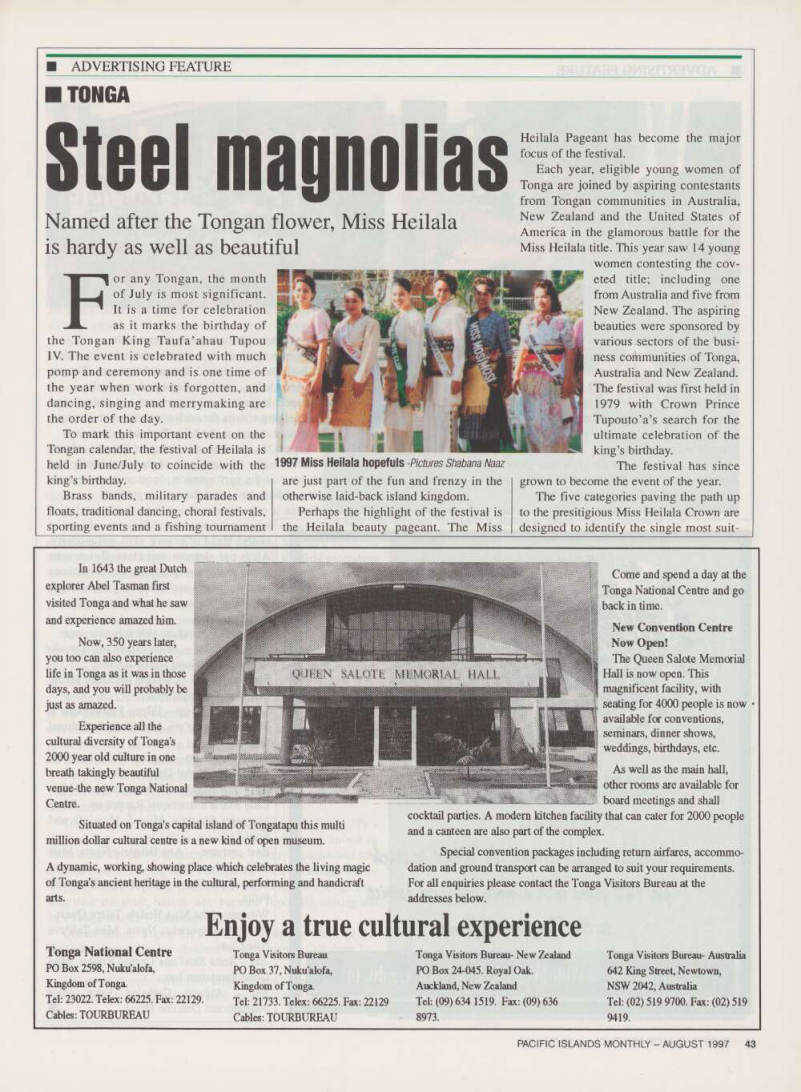
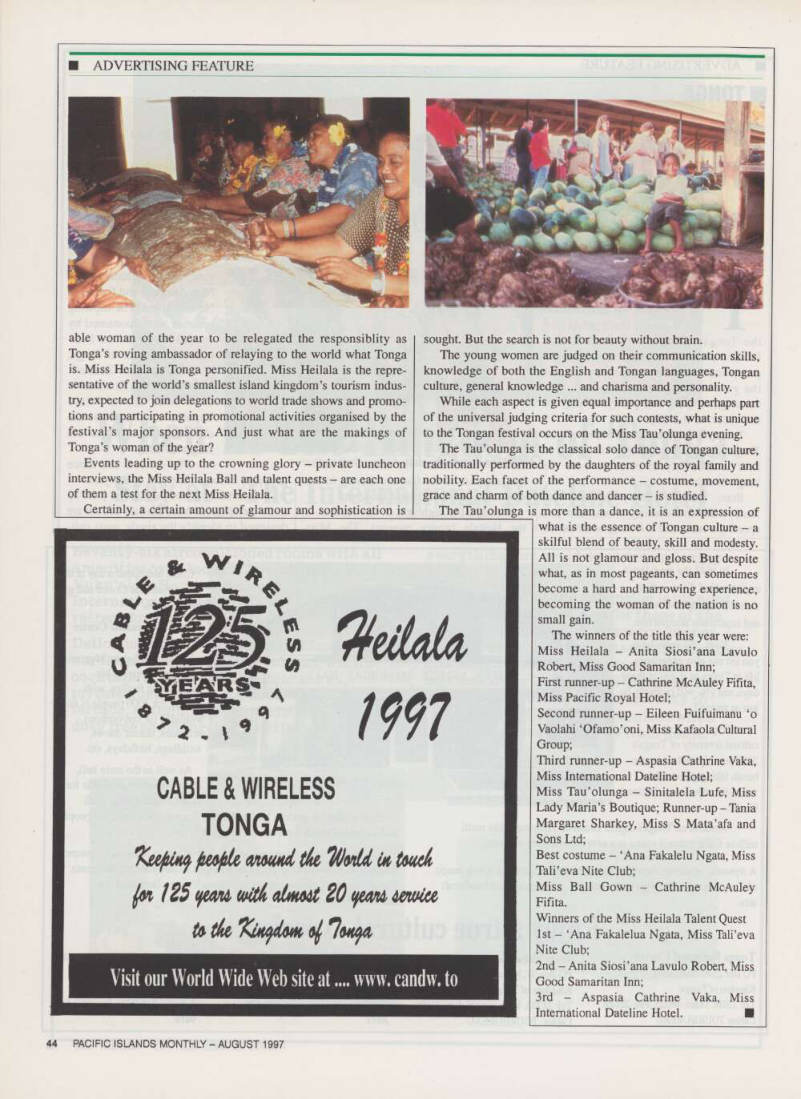
Tonga
Named after the Tongan flower, Miss Heilala is hardy as well as beautiful
For any Tongan, the month of July is most significant.
It is a time for celebration as it marks the birthday of the Tongan King Taufa’ahau Tupou IV. The event is celebrated with much pomp and ceremony and is one time of the year when work is forgotten, and
dancing, singing and merrymaking are
the order of the day.
To mark this important event on the Tongan calendar, the festival of Heilala is held in June/July to coincide with the king’s birthday.
Brass bands, military parades and floats, traditional dancing, choral festivals, sporting events and a fishing tournament
are just part of the fun and frenzy in the otherwise laid-back island kingdom.
Perhaps the highlight of the festival is the Heilala beauty pageant. The Miss
Heilala Pageant has become the major focus of the festival.
Each year, eligible young women of
Tonga are joined by aspiring contestants
from Tongan communities in Australia, New Zealand and the United States of America in the glamorous battle for the Miss Heilala title. This year saw 14 young
women contesting the cov eted title; including one from Australia and five from New Zealand. The aspiring beauties were sponsored by various sectors of the busi ness cofnmunities of Tonga, Australia and New Zealand.
The festival was first held in 1979 with Crown Prince Tupouto’a’s search for the ultimate celebration of the
king’s birthday.
The festival has since
grown to become the event of the year.
The five categories paving the path up to the presitigious Miss Heilala Crown are designed to identify the single most suit-
1997 Miss Heilala hopefuls -Pictures Shabana Naaz
able woman of the year to be relegated the responsiblity as Tonga’s roving ambassador of relaying to the world what Tonga is. Miss Heilala is Tonga personified. Miss Heilala is the repre sentative of the world’s smallest island kingdom’s tourism indus try, expected to join delegations to world trade shows and promo tions and participating in promotional activities organised by the festival’s major sponsors. And just what are the makings of Tonga’s woman of the year?
Events leading up to the crowning glory - private luncheon interviews, the Miss Heilala Ball and talent quests - are each one of them a test for the next Miss Heilala.
Certainly, a certain amount of glamour and sophistication is
sought. But the search is not for beauty without brain.
The young women are judged on their communication skills, knowledge of both the English and Tongan languages, Tongan culture, general knowledge ... and charisma and personality.
While each aspect is given equal importance and perhaps part of the universal judging criteria for such contests, what is unique to the Tongan festival occurs on the Miss Tau’olunga evening.
The Tau’olunga is the classical solo dance of Tongan culture, traditionally performed by the daughters of the royal family and nobility. Each facet of the performance - costume, movement, grace and charm of both dance and dancer - is studied.
The Tau’olunga is more than a dance, it is an expression of
what is the essence of Tongan culture - a skilful blend of beauty, skill and modesty.
All is not glamour and gloss. But despite what, as in most pageants, can sometimes become a hard and harrowing experience, becoming the woman of the nation is no
small gain.
The winners of the title this year were: Miss Heilala - Anita Siosi’ana Lavulo Robert, Miss Good Samaritan Inn; First runner-up - Cathrine McAuley Fifita, Miss Pacific Royal Hotel; Second runner-up - Eileen Fuifuimanu ‘o Vaolahi ‘Ofamo’oni, Miss Kafaola Cultural Group; Third runner-up - Aspasia Cathrine Vaka, Miss International Dateline Hotel; Miss Tau’olunga - Sinitalela Lufe, Miss Lady Maria’s Boutique; Runner-up - Tania Margaret Sharkey, Miss S Mata’afa and Sons Ltd; Best costume - ‘Ana Fakalelu Ngata, Miss Tali’eva Nile Club; Miss Ball Gown - Cathrine McAuley Fifita.
Winners of the Miss Heilala Talent Quest Ist - ‘Ana Fakalelua Ngata, Miss Tali’eva Kite Club; 2nd - Anita Siosi’ana Lavulo Robert, Miss Good Samaritan Inn; 3rd - Aspasia Cathrine Vaka, Miss International Dateline Hotel. ■
Advertisements & other items, pp. 43-44 (1 item)
Enjoy a true cultural experience
In 1643 the great Dutch explorer Abel Tasman first visited Tonga and what he saw and experience amazed him.
Now, 350 years later, you too can also experience life in Tonga as it was in those days, and you will probably be just as amazed.
Experience all the cultural diversity of Tonga's 2000 year old culture in one breath takingly beautiful venue-the new Tonga National Centre.
Situated on Tonga's capital island of Tongatapu this multi million dollar cultural centre is a new kind of open museum.
A dynamic, working, showing place which celebrates the living magic of Tonga's ancient heritage in the cultural, performing and handicraft arts.
Come and spend a day at the Tonga National Centre and go back in time.
New Convention Centre Now Open!
The Queen Salote Memorial Hall is now open. This magnificent facility, with seating for 4000 people is now available for conventions, seminars, dinner shows, weddings, birthdays, etc.
As well as the main hall, other rooms are available for board meetings and shall cocktail parties. A modern kitchen facility that can cater for 2000 people and a canteen are also part of the complex.
Special convention packages including return airfares, accommodation and ground transport can be arranged to suit your requirements.
For all enquiries please contact the Tonga Visitors Bureau at the addresses below. win umm. MiNomAi
HAI
Enjoy a true cultural experience
Tonga National Centre Tonga Visitors Bureau Tonga Visitors Bureau- New Zealand PO Box 2598, Nukualofa, PO Box 37, Nukualofa, PO Box 24-045. Royal Oak.
Kingdom of Tonga. Kingdom of Tonga. Auckland, New Zealand Tel: 23022. Telex: 66225. Fax: 22129. Tel: 21733. Telex: 66225. Fax; 22129 Tel: (09) 634 1519. Fax: (09) 636 Cables: TOURBUREAU Cables: TOURBUREAU 8973.
Tonga Visitors Bureau- Australia 642 King Street, Newtown, NSW 2042, Australia Tel: (02)519 9700. Fax: (02)519 9419.
4 <> V <* « is < V) =-5? M 0
YiEA'RS* a
tyi/dak
mi
CABLE & WIRELESS
TONGA
fu«pU <wmd TVnU in toad h&i 125 (ftm tutth aimit 26 yem imia to tk %Hf(m 7 Visit our World Wide Web site at... wvvw. candw. to
The era of King Tupou IV
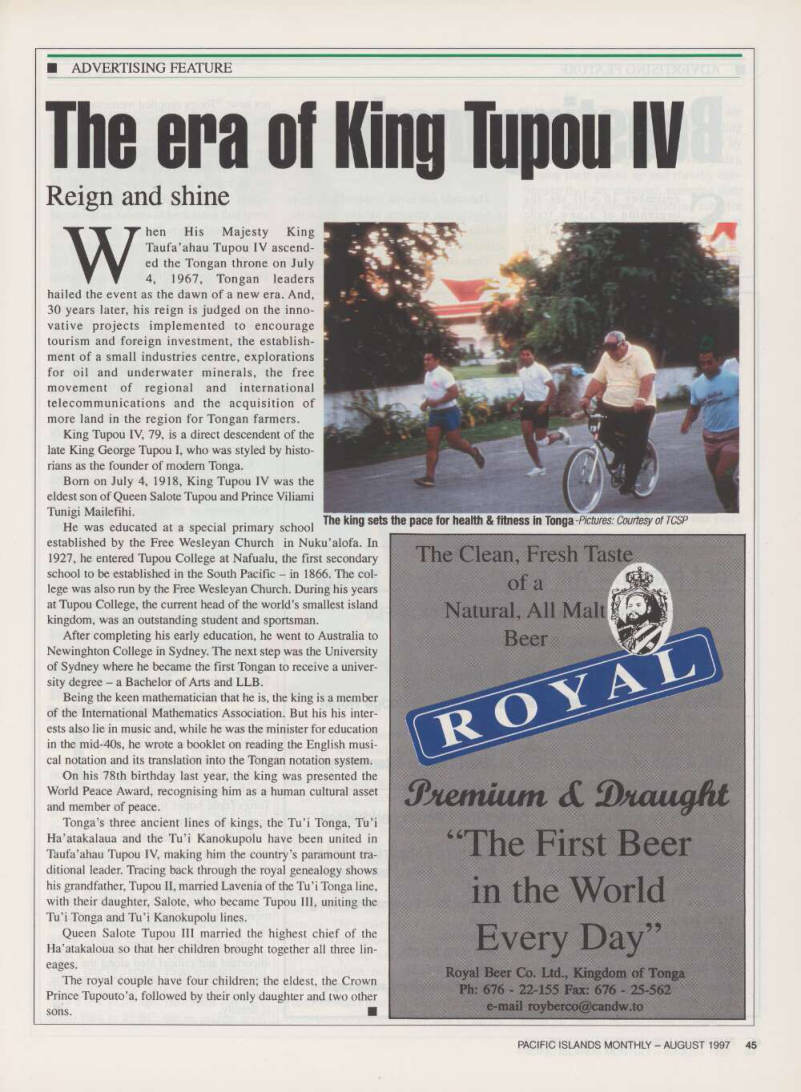
Reign and shine
When His Majesty King
Taufa’ahau Tupou IV ascend ed the Tongan throne on July 4, 1967, Tongan leaders hailed the event as the dawn of a new era. And, 30 years later, his reign is judged on the inno vative projects implemented to encourage tourism and foreign investment, the establish ment of a small industries centre, explorations for oil and underwater minerals, the free movement of regional and international telecommunications and the acquisition of more land in the region for Tongan farmers.
King Tupou IV, 79, is a direct descendent of the late King George Tupou I, who was styled by histo rians as the founder of modem Tonga.
Bom on July 4, 1918, King Tupou IV was the eldest son of Queen Salote Tupou and Prince Viliami Tunigi Mailefihi.
He was educated at a special primary school
established by the Free Wesleyan Church in Nuku’alofa. In 1927, he entered Tupou College at Nafualu, the first secondary school to be established in the South Pacific - in 1866. The col lege was also run by the Free Wesleyan Church. During his years at Tupou College, the current head of the world’s smallest island kingdom, was an outstanding student and sportsman.
After completing his early education, he went to Australia to Newinghton College in Sydney. The next step was the University of Sydney where he became the first Tongan to receive a univer sity degree - a Bachelor of Arts and LLB.
Being the keen mathematician that he is, the king is a member of the International Mathematics Association. But his his inter ests also lie in music and, while he was the minister for education in the mid-40s, he wrote a booklet on reading the English musi cal notation and its translation into the Tongan notation system.
On his 78th birthday last year, the king was presented the World Peace Award, recognising him as a human cultural asset and member of peace.
Tonga’s three ancient lines of kings, the Tu’i Tonga, Tu’i Ha’atakalaua and the Tu’i Kanokupolu have been united in Taufa’ahau Tupou IV, making him the country’s paramount tra ditional leader. Tracing back through the royal genealogy shows his grandfather, Tupou 11, married Lavenia of the Tu’i Tonga line, with their daughter, Salote, who became Tupou 111, uniting the Tu’i Tonga and Tu’i Kanokupolu lines.
Queen Salote Tupou 111 married the highest chief of the Ha’atakaloua so that her children brought together all three lin eages.
The royal couple have four children; the eldest, the Crown Prince Tupouto’a, followed by their only daughter and two other sons. ■
The king sets the pace for health & fitness in Tonga -Pictures: Courtesy of TCSP
Advertisements & other items, p. 45 (1 item)
JWemium <C
The Clean, Fresh Taste of a Natural, All Malt Beer O &
The First Beer
in the World
a* 99 Royal Beer Co. Ltd., Kingdom of Tonga Ph: 676 - 22-155 Fax: 676 - 25-562 e-mail [email protected]
Boosting trade
September 16 will see the beginning of a new trade era with the opening of the Tonga/Fiji Trade and Tourism Fair in Suva, Fiji.
The trade fair is the result of two years of negotiation between the two countries, leading to the Tonga/Fiji bilateral trade agreement.
Trade between the two island nations is
not new: “Tonga supplied mercenarry wari ors to warring Fijian chiefs amd even through ancient rituals, such as reserving the daughter of the Tui Tonga for marriage to the Tui Lakeba as she was conisidered too sacred for marriage to any Tomgan. In return, Tonga obtained sandalwcood for scent and great double canoes as thie wood was not available in Tonga” (Siers 1990).
The trade fair is being organiised by Tonga Trade with assistance from the Fiji Trade and Investment Board and I Forum Secretariat.
Tonga Trade was officially inaugurated
on January 16 as a division of the Ministry of Labour, Commerce and Industries.
Tonga Trade was established to {promote and facilitate the export of Tongain prod ucts. The organisation is funded I by the government of Tonga and the: Asian Development Bank and has a staff of five, including two overseas advisers, Garth Atkinson and Nicholas Freeland.
Recent experience with exports of bananas, vegetables and squash led to the realisation that Tonga was in a very vulner able position as an exporter of agricultural products and subject to a boom-and-bust approach.
The principal goal of Tonga Trade is to identify markets which are appropriate to Tonga’s productive capacity and to devel op an environment which encourages pri vate-sector investment in export industries.
Its establishment is an important and critical step along the pathway towards trade independence and the ability of Tonga to shape its own economic destiny.
In the past, geographic isolation and weak market signals have been cited as the major reasons for Tonga’s inability to establish itself in markets and maintain market positions.
By providing up-to-date information which can be readily disseminated, Tonga Trade hopes to provide the private sector with a competitive advantage.
Tonga has an advantage over larger, more industrialised countries in that it is very easy and cost effective to spread information in Tonga.
Its size also means it is able to react more quickly to market changes than larg er.
The establishment of Tonga Trade is an important and critical step along the path way towards trade independence and the ability of Tonga to shape its own econom ic destiny. ■
Advertisements & other items, p. 46 (2 items)
■ Advertising Feature
“Get Fresh - The Royal Taste Of Tonga”
MINISTRY OF LABOUR. COMMERCE, TRADE & INDUSTRIES
GOVERNMENT OF TONGA
“GET FRESH - THE ROYAL TASTE OF TONGA” proudly announce the first TONGA-FIJI
TRADE & TOURISM FAIR
scheduled to be held on 15th & 16th of September 1997 at SUVA (Travelodge Hotel) and 18th & 19th of September 1997 at NADI (Tanoa International) For more information please contact the following addresses:
TONGATRADE
Ministry of Labour, Commerce & Industries PO Box 110 Nukualofa Kingdom of Tonga Fax: (676) 25 410/23 887 Tel: (676) 25 483/23 688 email: [email protected]
FIJI TRADE & INVESTMENT BOARD
3rd Floor Civic House Townhall Road PO Box 2303 Government Building Suva Fiji Islands Fax: (679) 301783 Tel: (679) 315988 email: [email protected] 101049*6
nighty
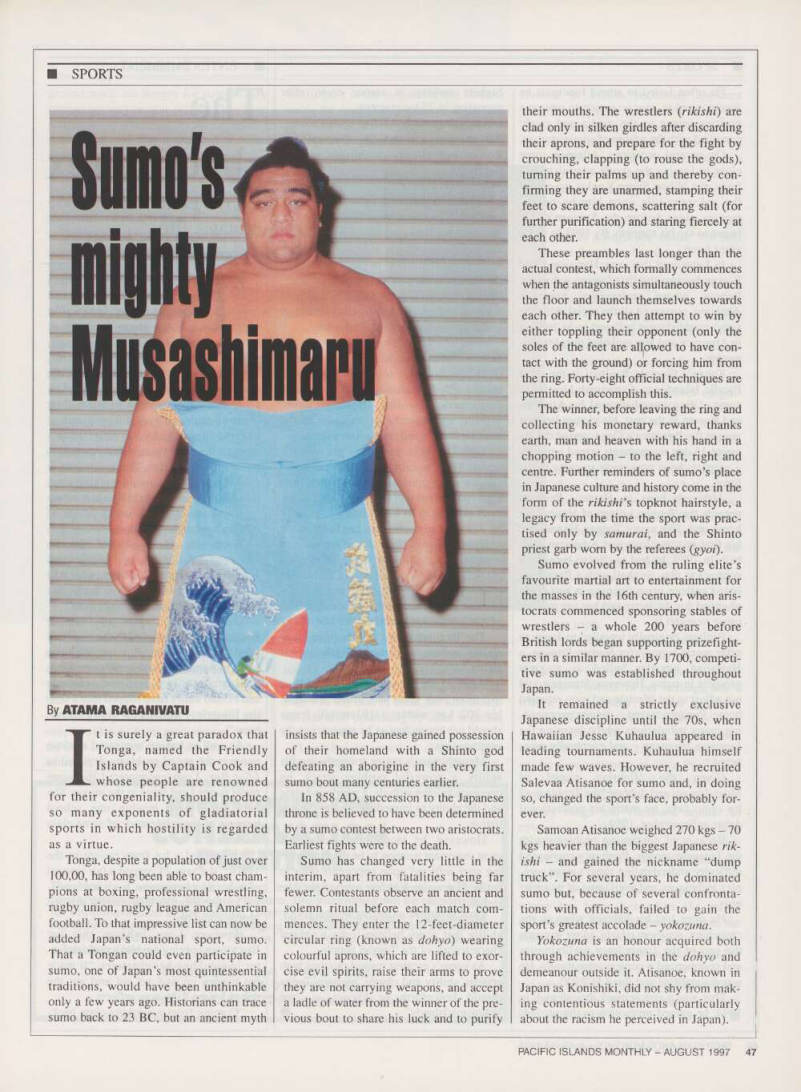
Sports
Sumo's nighty Musashimaru
By Atama Raganivatu
It is surely a great paradox that Tonga, named the Friendly Islands by Captain Cook and whose people are renowned for their congeniality, should produce so many exponents of gladiatorial sports in which hostility is regarded as a virtue.
Tonga, despite a population of just over 100,00, has long been able to boast cham pions at boxing, professional wrestling, rugby union, rugby league and American football. To that impressive list can now be added Japan’s national sport, sumo.
That a Tongan could even participate in sumo, one of Japan’s most quintessential traditions, would have been unthinkable only a few years ago. Historians can trace sumo back to 23 BC, but an ancient myth
insists that the Japanese gained possession of their homeland with a Shinto god defeating an aborigine in the very first sumo bout many centuries earlier.
In 858 AD, succession to the Japanese throne is believed to have been determined by a sumo contest between two aristocrats.
Earliest fights were to the death.
Sumo has changed very little in the interim, apart from fatalities being far fewer. Contestants observe an ancient and solemn ritual before each match com mences. They enter the 12-feet-diameter circular ring (known as dohyo) wearing colourful aprons, which are lifted to exor cise evil spirits, raise their arms to prove they are not carrying weapons, and accept a ladle of water from the winner of the pre vious bout to share his luck and to purify
their mouths. The wrestlers ( rikishi ) are clad only in silken girdles after discarding their aprons, and prepare for the fight by
crouching, clapping (to rouse the gods),
turning their palms up and thereby con firming they are unarmed, stamping their feet to scare demons, scattering salt (for further purification) and staring fiercely at each other.
These preambles last longer than the actual contest, which formally commences when the antagonists simultaneously touch the floor and launch themselves towards each other. They then attempt to win by either toppling their opponent (only the soles of the feet are allowed to have con tact with the ground) or forcing him from the ring. Forty-eight official techniques are permitted to accomplish this.
The winner, before leaving the ring and collecting his monetary reward, thanks earth, man and heaven with his hand in a chopping motion - to the left, right and centre. Further reminders of sumo’s place in Japanese culture and history come in the form of the rikishi’ s topknot hairstyle, a legacy from the time the sport was prac tised only by samurai, and the Shinto priest garb worn by the referees ( gyoi ).
Sumo evolved from the ruling elite’s favourite martial art to entertainment for the masses in the 16th century, when aris tocrats commenced sponsoring stables of wrestlers - a whole 200 years before British lords began supporting prizefight ers in a similar manner. By 1700, competi tive sumo was established throughout
Japan.
It remained a strictly exclusive Japanese discipline until the 70s, when Hawaiian Jesse Kuhaulua appeared in leading tournaments. Kuhaulua himself made few waves. However, he recruited Salevaa Atisanoe for sumo and, in doing so, changed the sport’s face, probably for ever.
Samoan Atisanoe weighed 270 kgs - 70 kgs heavier than the biggest Japanese rik ishi - and gained the nickname “dump truck”. For several years, he dominated sumo but, because of several confronta tions with officials, failed to gain the sport’s greatest accolade - yokozuna.
Yokozuna is an honour acquired both through achievements in the dohyo and demeanour outside it. Atisanoe, known in Japan as Konishiki, did not shy from mak ing contentious statements (particularly about the racism he perceived in Japan).
He often failed to attend functions he was required to, saw no reason to present a positive image to the media and rarely complied with the wishes of administrators.
On several occasions, Atisanoe came close to forcing the sports administrative body, the Nihon Sumo Kyokai, to confer the yokozuna title upon him by perfor mances alone before the Samoan’s size began to sap his strength. By 1993 he was a spent force.
In January of that year, Hawaiian Chad Rowan became the first foreign yokozuna.
Rowan, whose professional name is Akebono, possessed all the social skills the sumo establishment believed to be lacking in Atisamoe and few quibbled over his pro motion.
Tonga’s Fiemalu Penitani is the third Pacific Islander to distinguish himself in sumo. Often overshadowed by Atisanoe and Rowan in the past, his victory late last year in the President’s Cup - one of the six
major 15-day tournaments staged annually
- suggests he is now ready to come to the force.
Although born in Hawaii, Penitani regards the Tongan village of Houma his home and, like many Tongan Hawaiians, his first sporting love was American foot ball. In 1989, he had to choose between a contract to play football with a Pasadena based college or an opening in sumo. He plumped for the latter and has yet to have cause to regret it.
Penitani originally travelled to Japan to offer moral support for Nathan Strange, a Hawaiian wrestler hailed as a great prospect in sumo. However, Strange could not adjust to the lifestyle and soon returned
home. Penitani stayed - despite experienc
ing many tribulations whilst learning the
Japanese language - and eventually pros
pered.
Given the ‘fighting name’ of Musashimaru and dubbed “the Terminator” by sumo fans, he made his professional debut in September, 1989.
Because of continuing problems with the Japanese tongue, Penitani experienced difficulty understanding sumo’s more com plex techniques and even some of its easier ones.
He once lost his balance when in the crouching position rikishi adopt towards the end of the compulsory preliminaries and commenced a contest prematurely. He was disqualified and fined SUS9OO.
That was a rare setback though and, in 1994, he gained promotion to the second
highest ranking in sumo, ozeki, after appearing in 27 tournaments.
Only one man had achieved this sooner; Rowan required just 26. Penitani and Rowan had already established a great rivalry.
A year earlier, the Tongan ruined Akebono’s hopes of a rare 100 per cent record in a tournament at Fukuoka. He also defeated his Hawaiian adversary to win an unofficial competition in Honolulu, which offered SUSI million in prize money. At the season-closing Emperor’s Cup, though, Rowan took the title, leaving Musashimaru with second place and the consolation of being named Outstanding Performer.
July, 1994 saw Musashimaru win his first official tournament in Nagoya. A string of minor honours followed as he was named Shukunsho (Outstanding Performer), Ginosho (Best Technical Fighter) and Kantosho (Possessor of the Best Fighting Spirit) in various events.
Late last year, came his greatest tri umph. The Emperor’s Cup is regarded as sumo’s most prestigious tournament and the 1996 version will be remembered as the most exciting in its long history.
After the 16 contestants had fought each other once, five of them shared top position with 11 wins and four losses. This meant a play-off was required, in which Musashimaru won all his three bouts -
including a particularly satisfactory defeat
of Akebono - to claim the title.
The Terminator now has the prize every rikishi covets, yokozuna, firmly in his
sights.
Aged 25, he can expect to have at least two more peak years and, unlike Atisanoe, his 202 kgs within a 191 cm-tall frame should not betray him as he approaches the veteran stage.
Musashimaru’s major strengths are his agility, a powerful pushing attack, an upcompromising attitude, a whirlwind style and the ability to immediately seize the ini tiative.
However, he laughingly claims, his most important weapon to be the intimidat ing stare inflicted upon opponents prior to battle. “I practise it before every fight,” he insists.
Musashimaru’s humour reflects the ami ability that many believe to be a natural characteristic of the Tongan people.
As sumo’s greatest reward requires both athletic ability and charm, perhaps Tonga should henceforth be known as “the Yokozuna Islands”. ■
shadowbox

Entertainment
The shadowbox Robyn Loan’s art imitates life
By Atama Raganivatu
The few feature films depicting Pacific Island people have invariably shown them living free of all stress in idyllic surroundings, with an abundance of nature’s gifts.
Of course, life for many Pacific Islanders, particularly those compelled by economic circumstances to leave their home countries, is very different and, at last, the film industry has reflected this through the recently released Australian presentation Idiot Box. The female lead in Idiot Box is Lani, a young working-class Samoan girl battling to maintain a mean ingful existence in the urban jungle of Sydney’s western suburbs.
There are thousands of Pacific Islanders in Auckland, Los Angeles and Honolulu, as well as Sydney, who will relate easily to Lani. Robyn Loau, the actress portraying her, certainly does.
Loau, who has spent 19 years in Blacktown in the heart of Sydney’s ‘Wild West’, admits: “ Idiot Box was a bit too close to home for me, literally speaking.
Lani is caught in a dead-end existence and I could easily have slipped into a sim ilar lifestyle - which a lot of my friends have.”
As well as having witnessed at close quarters the social problems depicted in Idiot Box, Loau encountered the same racial taunts Lani faces in the movie. She was forced into leaving one school because of the intolerance of some class ‘mates’.
“I suffered a lot from racism in the 1980 s,” she says. “I copped a fair amount of it. It’s a lot better now, but it was amaz ing to discover just how narrow minded people could be.”
However, Loau believes that her Blacktown upbringing had a positive fac tor in moulding her character. “It made me harden up and go out and get the things I want,” she now reflects.
“Coming from a working-class back
ground made me hungry for success. My parents are very humble people. They have no degrees or education or qualifications. I don’t come from a well-educated or finan
cially stable family and I’ve had to fight for what I want. Nothing was given to me. Being from that envi ronment made me a lot tougher and I streetwise. Not much fazes me.”
Blacktown may have helped her foster a fighting spirit, but the sin
gle-mindedness she often displays
first came to the fore when Loau was five years old and still residing in her birthplace, Wanganui, New Zealand. “I caught the entertain ment bug by watching an old black
and-white Shirley Temple film,”
she remembers with a laugh. “I told my mum, ‘That’s what I want to do’ and from then I threw my heart and soul into it. I started off by singing, dancing and performing in countless talent shows.”
The Loau family moved to Sydney a year later and, despite their lack of money, Robyn’s always supportive parents sent her to a private school specialising in the performing arts. When in her early teens, she bet her brother $lOO that she would be famous before 21.
The wager was won with two years to spare.
Loau’s earliest work as a professional entertainer was at a theme park and, while there, an agent seeking recruits for a five girl singing and dancing group ‘spotted’ her.
The group was named Girlfriend and, despite ridicule from professional critics for their sweet and wholesome image, they achieved immense popularity in Australia.
Girlfriend’s debut single reached number one in the Australian pop music charts and they won national awards for Best New Act, Most Popular Act and Best Dance
Album.
After achieving the initial success she sought, Loau outgrew Girlfriend and looked towards further challenges. Playing Lani was the first of these and she landed the role after outshining 50 other hopefuls during a series of auditions.
Loau has an anecdote about the pre miere of Idiot Box which illustrates a dif
ference in values becoming apparent between the new generation of urban raised Pacific Islanders and traditionally minded parents. During the showing of a
bedroom scene in which she has a prominent part, Loau noticed her father standing aghast in a comer “as if he was in a trance”.
“Mum realised such things are all part of acting,” she added, “but Dad was deeply embarrassed.”
Despite Dad’s concern at her will ingness to embrace western ideals, Loau cherishes her family and her Samoan background, readily acknowledging the parts they played in making her the acclaimed entertainer she is today. Loau fondly recollects her parents singing while accompanying themselves on gui tars at clubs and pubs in Blacktown, her sister playing the piano at home and her brother’s “ability on virtual ly every instrument”. She initially learnt to harmonise while driving to church with the clan and fully appre ciates the extent of the financial sac rifices her mother and father made, “in true Samoan tradition”, in order for her to cultivate the talents she showed when an infant.
Having put the Girlfriend career phase behind her, Loau’s debut solo album. Malaria , signals a return to her roots.
According to the publicity material cir culated prior to the album’s release, it is “an eclectic mix of music from the South Pacific - a tribute to her heritage and a tribute to her father who has just been made a chief of his village in Samoa”.
The desire to explore her musical birthright also led to Loau’s appointment as vocal coordinator of Siva Pacifica, a World Music project combining traditional Melanesian and Polynesian chants, cus tomary songs and vocalised myths. So extensive was the work on this, the Siva Pacifica team travelled to villages which had received no European visitor since the
early 19505.
Loau provided a further indication of where her heart lies when she stated recently that part of the proceeds from the sales of Malaria would finance the pur chase of a four-wheel-drive vehicle for her father’s home village. If Loau is typical of the new breed of modem, urbanised and exiled Samoans, then her country’s culture is in good hands. ■
Loau: “Idiot Box was a bit too close to home for me”
Advertisements & other items, p. 49 (1 item)
Conservation
BIODIVERSITY
POSITION
The Nature Conservancy is seeking a Manager for its Solomon Islands conservation program, based in Honiara. The incumbent will be responsible for implementation of the existing community based projects, building local capacity for conservation and managing the field office and staff. Interested persons should contact Peter Thomas, South Pacific Program Director, for a job description.
Phone NZ+ (64 9) 478 9632; fax NZ+ (64 9) 479 1944; e-mail 103454 [email protected]
Politics
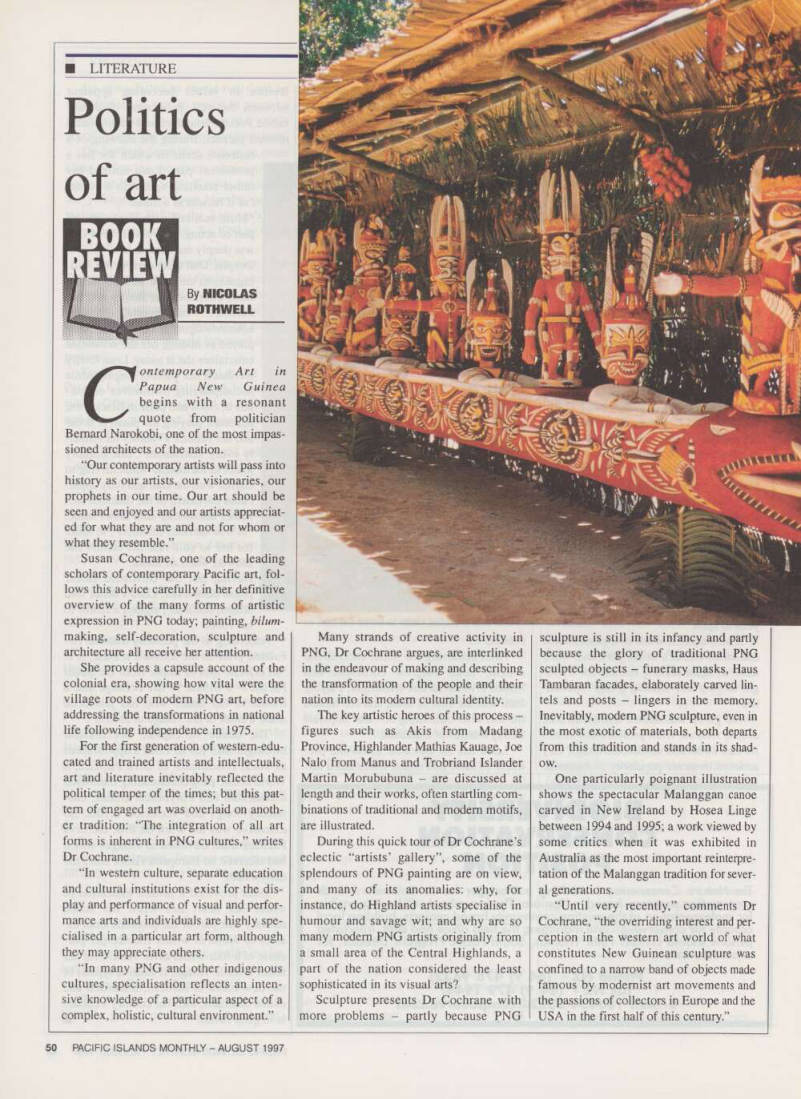
Literature
Politics of art
By Nicolas
Rothwell
Contemporary Art in Papua New Guinea begins with a resonant quote from politician Bernard Narokobi, one of the most impas sioned architects of the nation.
“Our contemporary artists will pass into history as our artists, our visionaries, our prophets in our time. Our art should be seen and enjoyed and our artists appreciat ed for what they are and not for whom or what they resemble.”
Susan Cochrane, one of the leading scholars of contemporary Pacific art, fol lows this advice carefully in her definitive overview of the many forms of artistic expression in PNG today; painting, bilum making, self-decoration, sculpture and architecture all receive her attention.
She provides a capsule account of the colonial era, showing how vital were the village roots of modem PNG art, before addressing the transformations in national life following independence in 1975.
For the first generation of western-edu cated and trained artists and intellectuals, art and literature inevitably reflected the political temper of the times; but this pat tern of engaged art was overlaid on anoth er tradition: “The integration of all art forms is inherent in PNG cultures,” writes Dr Cochrane.
“In western culture, separate education and cultural institutions exist for the dis play and performance of visual and perfor mance arts and individuals are highly spe cialised in a particular art form, although they may appreciate others.
“In many PNG and other indigenous cultures, specialisation reflects an inten sive knowledge of a particular aspect of a complex, holistic, cultural environment.”
Many strands of creative activity in PNG, Dr Cochrane argues, are interlinked in the endeavour of making and describing the transformation of the people and their nation into its modem cultural identity.
The key artistic heroes of this process figures such as Akis from Madang Province, Highlander Mathias Kauage, Joe Nalo from Manus and Trobriand Islander Martin Morububuna - are discussed at length and their works, often startling com binations of traditional and modem motifs, are illustrated.
During this quick tour of Dr Cochrane’s eclectic “artists’ gallery”, some of the splendours of PNG painting are on view, and many of its anomalies: why, for instance, do Highland artists specialise in humour and savage wit; and why are so many modem PNG artists originally from a small area of the Central Highlands, a part of the nation considered the least sophisticated in its visual arts?
Sculpture presents Dr Cochrane with more problems - partly because PNG
sculpture is still in its infancy and partly because the glory of traditional PNG sculpted objects - funerary masks, Haus Tambaran facades, elaborately carved lin tels and posts - lingers in the memory.
Inevitably, modem PNG sculpture, even in the most exotic of materials, both departs from this tradition and stands in its shad ow.
One particularly poignant illustration
shows the spectacular Malanggan canoe carved in New Ireland by Hosea Linge between 1994 and 1995; a work viewed by some critics when it was exhibited in Australia as the most important reinterpre tation of the Malanggan tradition for sever
al generations.
“Until very recently,” comments Dr Cochrane, “the overriding interest and per ception in the western art world of what constitutes New Guinean sculpture was confined to a narrow band of objects made famous by modernist art movements and the passions of collectors in Europe and the USA in the first half of this century.”
Today, however, she reports, “western scholarship and art appreciation” is open to a broader interpretation of what consti tutes sculpture in PNG; the fluid spirit birds made from welded steel by Gickmai Kundun, for example, or Tom Deko’s Dynamite Rocker of steel and scrap metal.
Ceremonial dance and bilum- weaving receive proper attention as female art forms and carriers of a new idea of nation al identity: a “neo-traditional symbol” of PNG unity. Perhaps the most spectacular exploration of this theme to date, though, is the Parliament House in Port Moresby, a collective artistic and architectural enterprise that exemplifies “the philoso
phy of merging heritage with modernisa
tion” - a physical representation of cultur
al policy.
In a striking pendant to Dr Cochrane’s survey from the outside, a closing chapter written by Michael Mel, a teacher of expressive arts bom in the western Highlands, narrates from the inside the experience of the art of bilas - self-deco ration.
The meaning of bilas in the contempo rary world may have changed, but the art survives, and “to impose and maintain the claim that one meaning is richer, more original than the bastardised version is a dangerous enterprise”.
In his detailed account, Mel describes the change within as he puts on his finery for a ceremonial performance: “I felt flighty, free and loose. I felt as if I had given way to a new skin in place of an old one... I sensed a lightness and at the same time an elaborateness.”
Mel’s story forms a striking and ele gant ending for an important survey of a new stage in the drama of PNG art.
Yet, Dr Cochrane’s overview, for all her intimacy with the subject and the country, at times assumes the reader’s agreement with its judgments, where it might be better to persuade. Many of the artists whose works she discusses are modernist in temper, and political in approach.
They deliberately dispense with the age-old beauty and splendour of tradition al PNG art.
This is a striking and impressive stance, but it is also one that needs advo cates. ■
• Contemporary Art in Papua New Guinea by Susan Cochrane, published by Craftsman House, Sydney, SABO.OO.
Advertisements & other items, p. 51 (1 item)
Environmental Management
South Pacific Regional Environment Programme (SPREP)
VACANCY: Project Manager, Capacity Building for
Applications are invited for the position of Project Manager, Capacity Building for Environmental Management with the South Pacific Regional Environment Programme (SPREP) in Apia, Western Samoa.
Post Description The Project Manager will be responsible for regional coordination, management, and monitoring of the project to achieve the project goal and objectives as set out in the project logframe. The Project Manager will initially be responsible for managing and coordinating regional inputs into the preparatory phase of the project and, on completion of this phase, will also manage and coordinate the project implementation phase, subject to approval and agreement of the Project Document between SPREP and the UNDP and also subject to satisfactory performance by the Project Manager during the preparatory phase. The Project Manager will be responsible to the Director of SPREP, through the Head, Environmental Education, Information and Capacity-building Division. He/she will work in close consultation with the governments of participating countries and with the Resident Representatives of the UNDP Regional Offices in Apia and Suva.
In relation to the planning, management and budgeting activities, the Project Manager will be expected to perform the following duties during the preparatory assistance phase: 1. Coordinate project activities at the regional level as set out in the project logframe. During the preparatory assistance phase these will include organising input into a regional meeting to consult with participating countries, facilitating the formation of national coordinating bodies in participating countries, and organising a regional workshop for national project coordinators. 2. Provide advice and peer support to national coordinators and national coordinating bodies in participating countries as required. 3. Assist national coordinators and national coordinating bodies in preparing in-country monitoring strategies. 4. Coordinate project activities at the regional level with programmes and projects of regional organisations and donor agencies. 5. Prepare (with assistance if required) a project design document that includes the contributions from all participating countries. 6. Monitor, analyse and report to UNDP on progress towards achieving the goal and objectives of the project as set out in the logframe, identifying risks and constraints, and recommending solutions to improve the effectiveness, coordination and sustainability of the project. 7. Other related activities as directed, from time to time, by the Head, Environmental Education, Information and Capacity-building Division and the SPREP Director.
Desired Qualifications and Experience Candidates must have appropriate tertiary qualifications preferably with post-graduate qualifications related to environmental management and policy from a recognised institution and experience within the Pacific island region, in environment and development issues. Other essential requirements are: proven management experience; good communication skills in managing international projects and staff; the ability to manage the work of consultants; the ability to work with inter-disciplinary and multi-cultural teams; ability to prepare report proposals to deadlines often under difficult circumstances; fluency in spoken and written English; knowledge of other Pacific Island language(s) would be advantageous. The role suits a team player who is able to motivate and lead staff. Applicants must be nationals of a SPREP member country.
Appointment will be at either Project Officer or Advisor level of SPREP’s authorised salary scales for contract staff, depending on the successful applicants’ qualifications and experience. The package will include annual return airfares for appointee and dependents, a housing subsidy and other benefits.
SPREP remuneration may be tax-free depending upon circumstances. The appointment will be for six months initially, with renewal for a further 2 and a half years subject to approval and agreement of the Project Document and depending upon the officer’s performance during the first term.
Applications Applications should be accompanied by curriculum vitae containing full personal and professional details, information on qualifications and experience for the position, previous appointments, current position and salary, names, addresses and telephone and/or fax contact numbers of three persons associated with the applicant professionally and who would be prepared to provide testimonials. An indication of how soon the applicants would be available should be indicated.
Closing Date: 07 September 1997.
Applications should be addressed to: The Director South Pacific Regional Environmental Programme (SPREP) PO Box 240 Telephone: (685) 21929
APIA Fax: (685) 20231
Western Samoa E-mail: [email protected]// Conditions Further information, including a full post description and details of remuneration and terms and conditions of appointment is available from the SPREP Administration Officer, Telephone (685) 21929.
The President's race
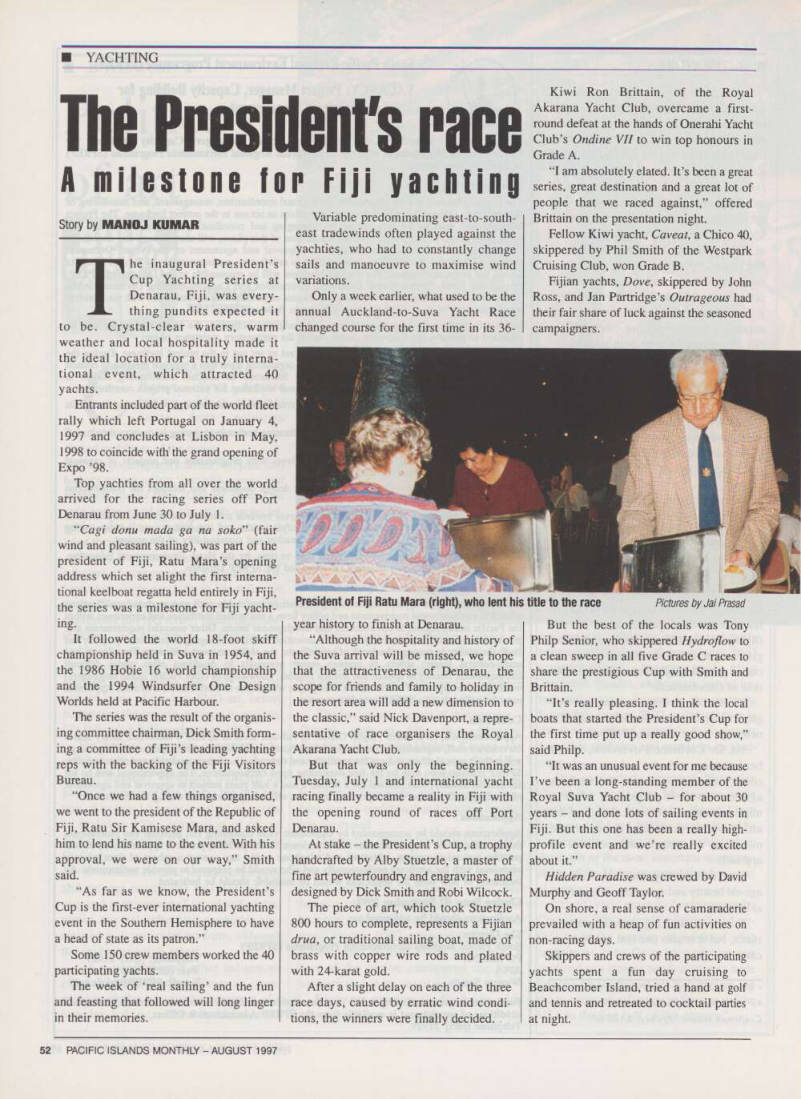
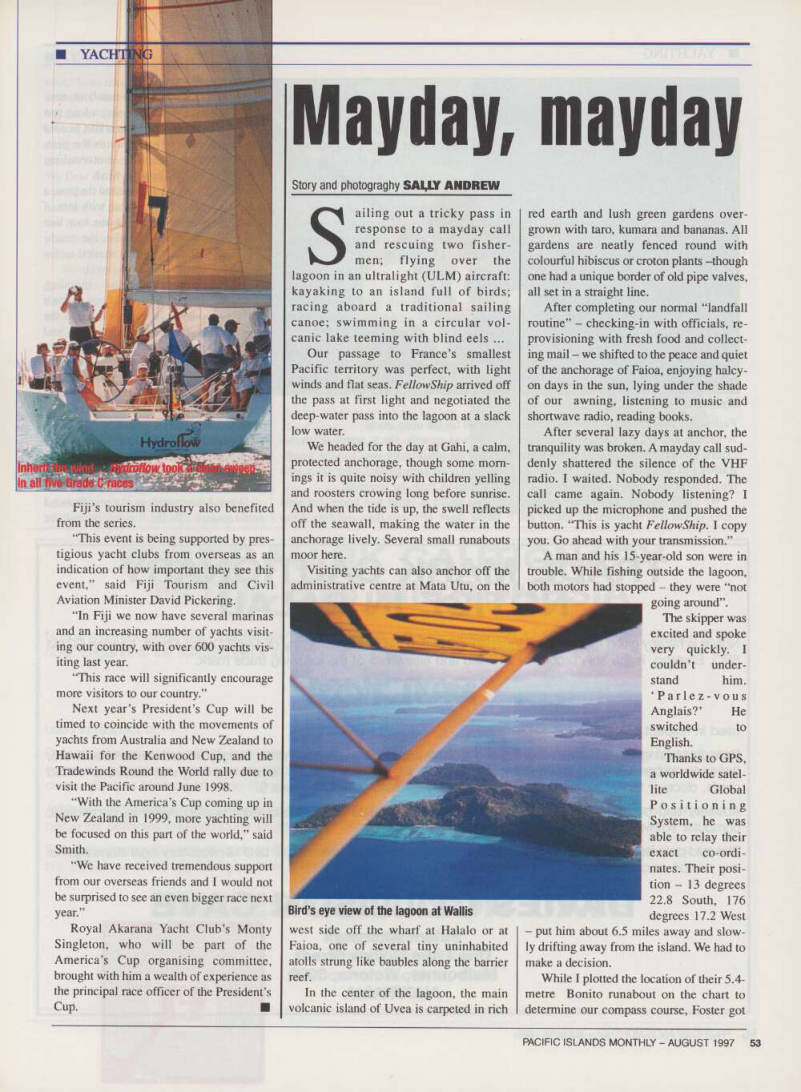
Yachting
The President's race A milestone for Fiji yachting
Story by MANOJ KUMAR
The inaugural President’s
Cup Yachting series at Denarau, Fiji, was every thing pundits expected it to be. Crystal-clear waters, warm weather and local hospitality made it the ideal location for a truly interna tional event, which attracted 40 yachts.
Entrants included part of the world fleet rally which left Portugal on January 4, 1997 and concludes at Lisbon in May, 1998 to coincide with the grand opening of Expo ’9B.
Top yachties from all over the world arrived for the racing series off Port Denarau from June 30 to July 1.
“Cagi donu mada ga na soko" (fair wind and pleasant sailing), was part of the president of Fiji, Ratu Mara’s opening address which set alight the first interna tional keelboat regatta held entirely in Fiji, the series was a milestone for Fiji yacht
ing.
It followed the world 18-foot skiff championship held in Suva in 1954, and the 1986 Hobie 16 world championship and the 1994 Windsurfer One Design Worlds held at Pacific Harbour.
The series was the result of the organis ing committee chairman, Dick Smith form ing a committee of Fiji’s leading yachting reps with the backing of the Fiji Visitors Bureau.
“Once we had a few things organised, we went to the president of the Republic of Fiji, Ratu Sir Kamisese Mara, and asked him to lend his name to the event. With his approval, we were on our way,” Smith said.
“As far as we know, the President’s Cup is the first-ever international yachting event in the Southern Hemisphere to have a head of state as its patron.”
Some 150 crew members worked the 40 participating yachts.
The week of ‘real sailing’ and the fun and feasting that followed will long linger in their memories.
Variable predominating east-to-south east tradewinds often played against the yachties, who had to constantly change sails and manoeuvre to maximise wind variations.
Only a week earlier, what used to be the annual Auckland-to-Suva Yacht Race changed course for the first time in its 36-
year history to finish at Denarau.
“Although the hospitality and history of the Suva arrival will be missed, we hope that the attractiveness of Denarau, the scope for friends and family to holiday in the resort area will add a new dimension to the classic,” said Nick Davenport, a repre sentative of race organisers the Royal Akarana Yacht Club.
But that was only the beginning.
Tuesday, July 1 and international yacht racing finally became a reality in Fiji with the opening round of races off Port Denarau.
At stake - the President’s Cup, a trophy handcrafted by Alby Stuetzle, a master of fine art pewterfoundry and engravings, and designed by Dick Smith and Robi Wilcock.
The piece of art, which took Stuetzle 800 hours to complete, represents a Fijian drua, or traditional sailing boat, made of brass with copper wire rods and plated with 24-karat gold.
After a slight delay on each of the three race days, caused by erratic wind condi tions, the winners were finally decided.
Kiwi Ron Brittain, of the Royal Akarana Yacht Club, overcame a first round defeat at the hands of Onerahi Yacht Club’s Ondine VII to win top honours in Grade A.
“I am absolutely elated. It’s been a great series, great destination and a great lot of people that we raced against,” offered Brittain on the presentation night.
Fellow Kiwi yacht, Caveat, a Chico 40, skippered by Phil Smith of the Westpark Cruising Club, won Grade B.
Fijian yachts, Dove, skippered by John Ross, and Jan Partridge’s Outrageous had their fair share of luck against the seasoned campaigners.
But the best of the locals was Tony Philp Senior, who skippered Hydroflow to a clean sweep in all five Grade C races to share the prestigious Cup with Smith and Brittain.
“It’s really pleasing. I think the local boats that started the President’s Cup for the first time put up a really good show,”
said Philp.
“It was an unusual event for me because I’ve been a long-standing member of the Royal Suva Yacht Club - for about 30 years - and done lots of sailing events in Fiji. But this one has been a really high profile event and we’re really excited about it.”
Hidden Paradise was crewed by David Murphy and Geoff Taylor.
On shore, a real sense of camaraderie prevailed with a heap of fun activities on
non-racing days.
Skippers and crews of the participating yachts spent a fun day cruising to Beachcomber Island, tried a hand at golf and tennis and retreated to cocktail parties
at night.
President of Fiji Ratu Mara (right), who lent his title to the race Pictures by Jai Prasad
Fiji’s tourism industry also benefited from the series.
“This event is being supported by pres tigious yacht clubs from overseas as an indication of how important they see this event,” said Fiji Tourism and Civil Aviation Minister David Pickering.
“In Fiji we now have several marinas and an increasing number of yachts visit ing our country, with over 600 yachts vis iting last year.
“This race will significantly encourage more visitors to our country.”
Next year’s President’s Cup will be timed to coincide with the movements of yachts from Australia and New Zealand to Hawaii for the Kenwood Cup, and the Tradewinds Round the World rally due to visit the Pacific around June 1998.
“With the America’s Cup coming up in New Zealand in 1999, more yachting will be focused on this part of the world,” said Smith.
“We have received tremendous support from our overseas friends and I would not be surprised to see an even bigger race next year.”
Royal Akarana Yacht Club’s Monty Singleton, who will be part of the
America’s Cup organising committee,
brought with him a wealth of experience as the principal race officer of the President’s
Cup. ■
Inherit the wind ... Hydroflow took a clean sweep in all five Grade C races
Mayday, mayday
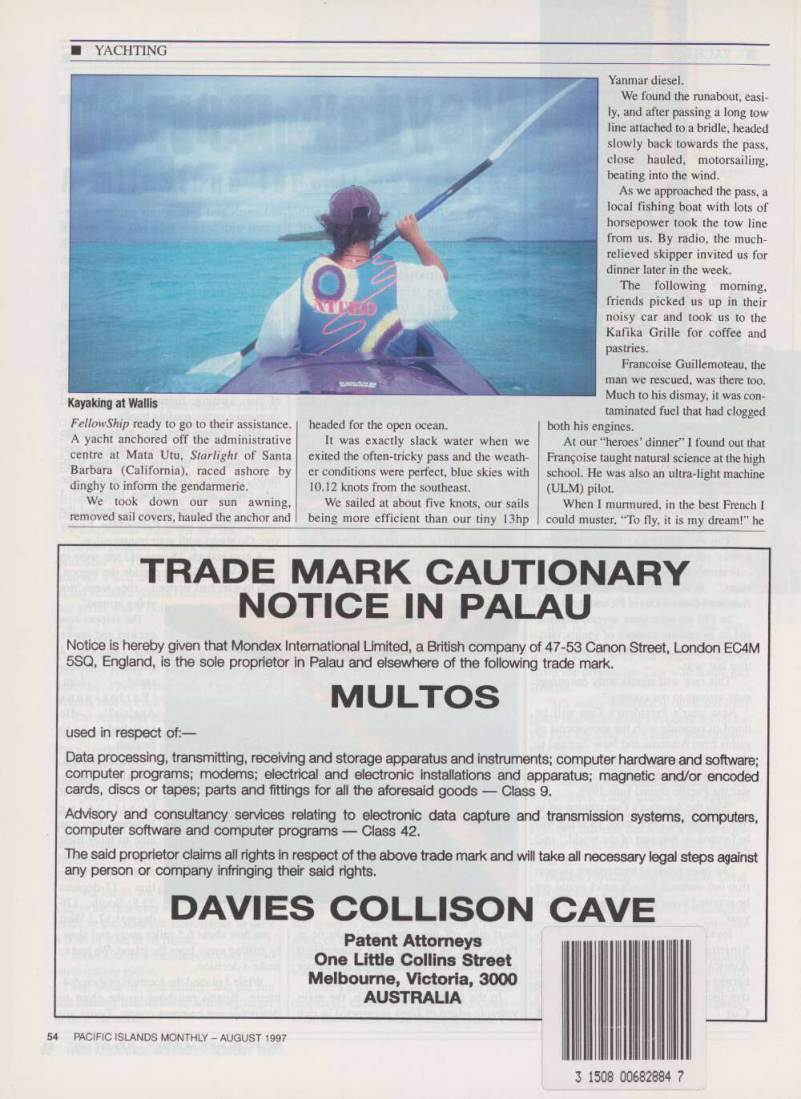
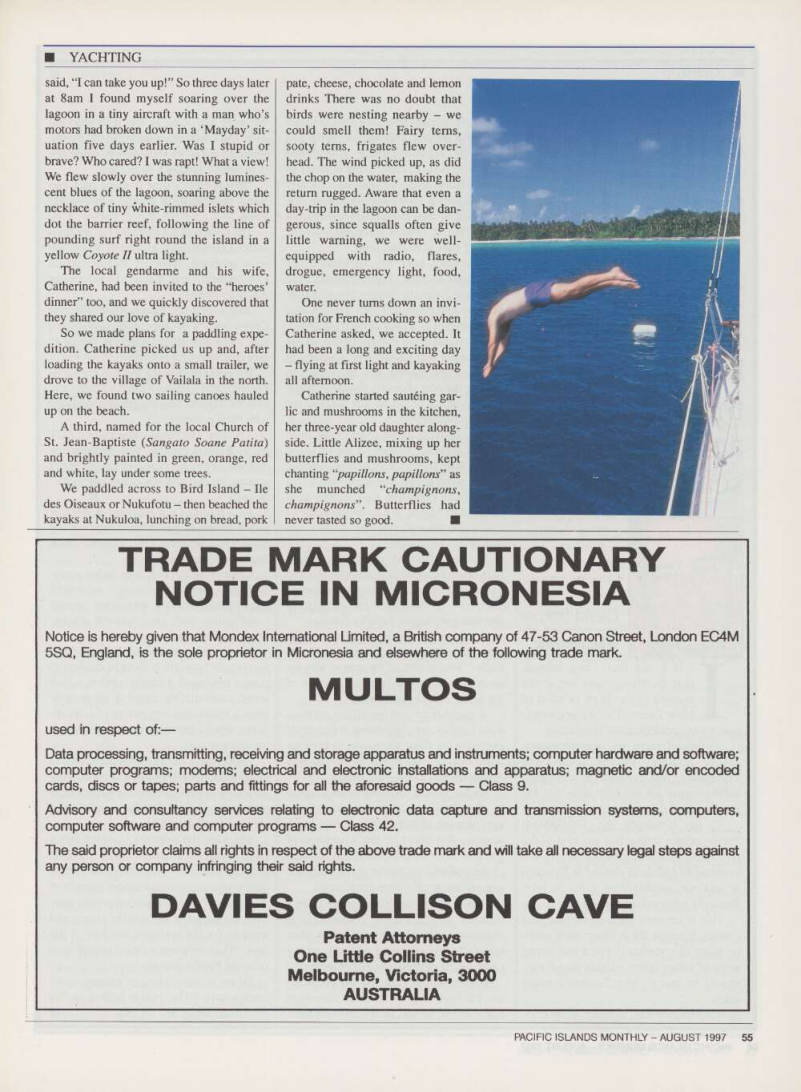
Story and photograghy SALLY ANDREW
Sailing out a tricky pass in response to a mayday call and rescuing two fisher men; flying over the lagoon in an ultralight (ULM) aircraft: kayaking to an island full of birds; racing aboard a traditional sailing canoe; swimming in a circular vol canic lake teeming with blind eels ...
Our passage to France’s smallest Pacific territory was perfect, with light winds and flat seas. Fellowship arrived off the pass at first light and negotiated the deep-water pass into the lagoon at a slack low water.
We headed for the day at Gahi, a calm, protected anchorage, though some morn ings it is quite noisy with children yelling and roosters crowing long before sunrise.
And when the tide is up, the swell reflects off the seawall, making the water in the anchorage lively. Several small runabouts moor here.
Visiting yachts can also anchor off the administrative centre at Mata Utu, on the
west side off the wharf at Halalo or at Faioa, one of several tiny uninhabited atolls strung like baubles along the barrier reef.
In the center of the lagoon, the main volcanic island of Uvea is carpeted in rich
red earth and lush green gardens over grown with taro, kumara and bananas. All gardens are neatly fenced round with colourful hibiscus or croton plants -though one had a unique border of old pipe valves, all set in a straight line.
After completing our normal “landfall routine” - checking-in with officials, re provisioning with fresh food and collect ing mail - we shifted to the peace and quiet of the anchorage of Faioa, enjoying halcy on days in the sun, lying under the shade of our awning, listening to music and shortwave radio, reading books.
After several lazy days at anchor, the tranquility was broken. A mayday call sud denly shattered the silence of the VHF radio. I waited. Nobody responded. The call came again. Nobody listening? I picked up the microphone and pushed the button. “This is yacht Fellowship. I copy you. Go ahead with your transmission.”
A man and his 15-year-old son were in trouble. While fishing outside the lagoon, both motors had stopped - they were “not
going around”.
The skipper was excited and spoke very quickly. I couldn’t under stand him. ‘Parlez-vous Anglais?’ He switched to English.
Thanks to GPS, a worldwide satel lite Global
Positioning
System, he was able to relay their exact co-ordi nates. Their posi tion - 13 degrees 22.8 South, 176 degrees 17.2 West
- put him about 6.5 miles away and slow ly drifting away from the island. We had to make a decision.
While I plotted the location of their 5.4metre Bonito runabout on the chart to determine our compass course, Foster got
Bird’s eye view of the lagoon at Wallis
Fellowship ready to go to their assistance.
A yacht anchored off the administrative centre at Mata Utu, Starlight of Santa Barbara (California), raced ashore by dinghy to inform the gendarmerie.
We took down our sun awning, removed sail covers, hauled the anchor and
headed for the open ocean.
It was exactly slack water when we exited the often-tricky pass and the weath er conditions were perfect, blue skies with 10.12 knots from the southeast.
We sailed at about five knots, our sails being more efficient than our tiny 13hp
Yanmar diesel.
We found the runabout, easi ly, and after passing a long tow line attached to a bridle, headed slowly back towards the pass, close hauled, motorsailin'g, beating into the wind.
As we approached the pass, a local fishing boat with lots of horsepower took the tow line from us. By radio, the much relieved skipper invited us for dinner later in the week.
The following morning,
friends picked us up in their noisy car and took us to the Kafika Grille for coffee and
pastries.
Francoise Guillemoteau, the man we rescued, was there too.
Much to his dismay, it was con taminated fuel that had clogged
both his engines.
At our “heroes’ dinner” I found out that Fran9oise taught natural science at the high school. He was also an ultra-light machine (ULM) pilot.
When I murmured, in the best French I could muster, “To fly, it is my dream!” he
Kayaking at Wallis
said, “I can take you up!” So three days later at Sam I found myself soaring over the lagoon in a tiny aircraft with a man who’s motors had broken down in a ‘Mayday’ sit uation five days earlier. Was I stupid or brave? Who cared? I was rapt! What a view!
We flew slowly over the stunning lumines cent blues of the lagoon, soaring above the necklace of tiny white-rimmed islets which dot the barrier reef, following the line of pounding surf right round the island in a yellow Coyote II ultra light.
The local gendarme and his wife, Catherine, had been invited to the “heroes’ dinner” too, and we quickly discovered that they shared our love of kayaking.
So we made plans for a paddling expe dition. Catherine picked us up and, after loading the kayaks onto a small trailer, we drove to the village of Vailala in the north.
Here, we found two sailing canoes hauled up on the beach.
A third, named for the local Church of St. Jean-Baptiste {Sangato Soane Patita ) and brightly painted in green, orange, red and white, lay under some trees.
We paddled across to Bird Island - He des Oiseaux or Nukufotu - then beached the kayaks at Nukuloa, lunching on bread, pork
pate, cheese, chocolate and lemon drinks There was no doubt that birds were nesting nearby - we could smell them! Fairy terns, sooty terns, frigates flew over head. The wind picked up, as did the chop on the water, making the return rugged. Aware that even a day-trip in the lagoon can be dan gerous, since squalls often give little warning, we were well equipped with radio, flares, drogue, emergency light, food, water.
One never turns down an invi tation for French cooking so when Catherine asked, we accepted. It had been a long and exciting day - flying at first light and kayaking all afternoon.
Catherine started sauteing gar lic and mushrooms in the kitchen, her three-year old daughter along side. Little Alizee, mixing up her butterflies and mushrooms, kept chanting “ papillons , papillaris” as she munched “ champignons , champignons”. Butterflies had never tasted so good. ■
Advertisements & other items, pp. 54-55 (1 item)
Notice In Palau
TRADE MARK CAUTIONARY
Notice is hereby given that Mondex International Limited, a British company of 47-53 Canon Street, London EC4M SSQ, England, is the sole proprietor in Palau and elsewhere of the following trade mark.
MULTOS
used in respect of: — Data processing, transmitting, receiving and storage apparatus and instruments: computer hardware and software; computer programs; modems; electrical and electronic installations and apparatus; magnetic and/or encoded cards, discs or tapes; parts and fittings for all the aforesaid goods Class 9.
Advisory and consultancy services relating to electronic data capture and transmission systems, computers, computer software and computer programs Class 42.
The said proprietor claims all rights in respect of the above trade mark and will take all necessary legal steps against any person or company infringing their said rights.
DAVIES COLLISON CAVE
Patent Attorneys One Little Collins Street Melbourne, Victoria, 3000
AUSTRALIA
TRADE MARK CAUTIONARY
NOTICE IN MICRONESIA
Notice is hereby given that Mondex International Limited, a British company of 47-53 Canon Street, London EC4M SSQ, England, is the sole proprietor in Micronesia and elsewhere of the following trade mark.
MULTOS
used in respect of: — Data processing, transmitting, receiving and storage apparatus and instruments: computer hardware and software; computer programs; modems; electrical and electronic installations and apparatus: magnetic and/or encoded cards, discs or tapes; parts and fittings for all the aforesaid goods Class 9.
Advisory and consultancy services relating to electronic data capture and transmission systems, computers, computer software and computer programs Class 42.
The said proprietor claims all rights in respect of the above trade mark and will take all necessary legal steps against any person or company infringing their said rights.
DAVIES COLLISON CAVE
Patent Attorneys One Little Collins Street Melbourne, Victoria, 3000
AUSTRALIA
Sad, but
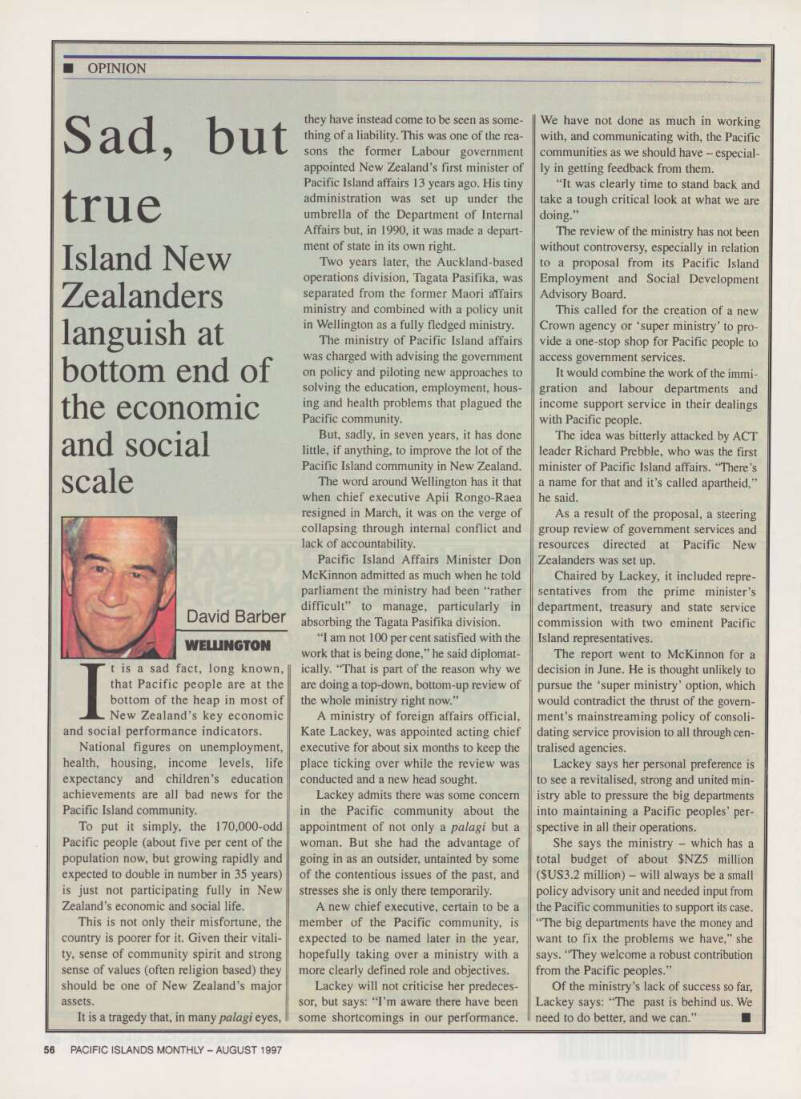
Opinion
true Island New Zealanders languish at bottom end of the economic and social scale
David Barber
Wellington
It is a sad fact, long known, that Pacific people are at the bottom of the heap in most of New Zealand’s key economic and social performance indicators.
National figures on unemployment, health, housing, income levels, life expectancy and children’s education achievements are all bad news for the Pacific Island community.
To put it simply, the 170,000-odd Pacific people (about five per cent of the population now, but growing rapidly and expected to double in number in 35 years) is just not participating fully in New Zealand’s economic and social life.
This is not only their misfortune, the country is poorer for it. Given their vitali ty, sense of community spirit and strong sense of values (often religion based) they should be one of New Zealand’s major assets.
It is a tragedy that, in many palagi eyes, I
they have instead come to be seen as some thing of a liability. This was one of the rea sons the former Labour government appointed New Zealand’s first minister of Pacific Island affairs 13 years ago. His tiny administration was set up under the umbrella of the Department of Internal Affairs but, in 1990, it was made a depart ment of state in its own right.
Two years later, the Auckland-based operations division, Tagata Pasifika, was separated from the former Maori affairs ministry and combined with a policy unit in Wellington as a fully fledged ministry.
The ministry of Pacific Island affairs was charged with advising the government on policy and piloting new approaches to solving the education, employment, hous ing and health problems that plagued the Pacific community.
But, sadly, in seven years, it has done little, if anything, to improve the lot of the Pacific Island community in New Zealand.
The word around Wellington has it that when chief executive Apii Rongo-Raea resigned in March, it was on the verge of collapsing through internal conflict and lack of accountability.
Pacific Island Affairs Minister Don McKinnon admitted as much when he told parliament the ministry had been “rather difficult” to manage, particularly in absorbing the Tagata Pasifika division.
“I am not 100 per cent satisfied with the work that is being done,” he said diplomat ically. “That is part of the reason why we are doing a top-down, bottom-up review of the whole ministry right now.”
A ministry of foreign affairs official, Kate Lackey, was appointed acting chief executive for about six months to keep the place ticking over while the review was conducted and a new head sought.
Lackey admits there was some concern in the Pacific community about the appointment of not only a palagi but a woman. But she had the advantage of going in as an outsider, untainted by some of the contentious issues of the past, and stresses she is only there temporarily.
A new chief executive, certain to be a member of the Pacific community, is expected to be named later in the year, hopefully taking over a ministry with a more clearly defined role and objectives.
Lackey will not criticise her predeces sor, but says: “I’m aware there have been some shortcomings in our performance.
We have not done as much in working with, and communicating with, the Pacific communities as we should have - especial ly in getting feedback from them.
“It was clearly time to stand back and take a tough critical look at what we are
doing.”
The review of the ministry has not been without controversy, especially in relation to a proposal from its Pacific Island Employment and Social Development Advisory Board.
This called for the creation of a new Crown agency or ‘super ministry’ to pro vide a one-stop shop for Pacific people to access government services.
It would combine the work of the immi gration and labour departments and income support service in their dealings with Pacific people.
The idea was bitterly attacked by ACT leader Richard Prebble, who was the first minister of Pacific Island affairs. “There’s a name for that and it’s called apartheid,” he said.
As a result of the proposal, a steering group review of government services and resources directed at Pacific New Zealanders was set up.
Chaired by Lackey, it included repre sentatives from the prime minister’s department, treasury and state service commission with two eminent Pacific Island representatives.
The report went to McKinnon for a decision in June. He is thought unlikely to pursue the ‘super ministry’ option, which would contradict the thrust of the govern ment’s mainstreaming policy of consoli dating service provision to all through cen tralised agencies.
Lackey says her personal preference is to see a revitalised, strong and united min istry able to pressure the big departments into maintaining a Pacific peoples’ per spective in all their operations.
She says the ministry - which has a total budget of about SNZS million (SUS 3.2 million) - will always be a small policy advisory unit and needed input from the Pacific communities to support its case.
“The big departments have the money and want to fix the problems we have,” she says. “They welcome a robust contribution from the Pacific peoples.”
Of the ministry’s lack of success so far, Lackey says: “The past is behind us. We need to do better, and we can.” ■
Majuro fish meeting
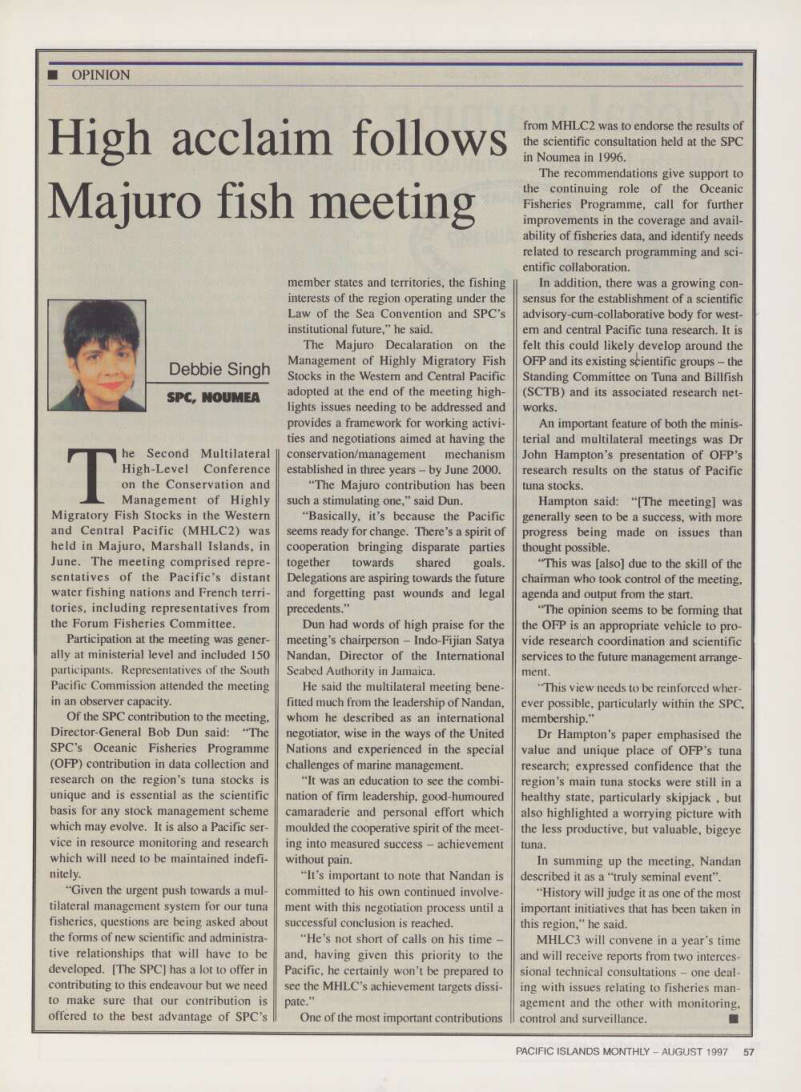
High acclaim follows Majuro fish meeting
Debbie Singh
Spc, Noumea
The Second Multilateral
High-Level Conference
on the Conservation and Management of Highly Migratory Fish Stocks in the Western and Central Pacific (MHLC2) was held in Majuro, Marshall Islands, in June. The meeting comprised repre sentatives of the Pacific’s distant water fishing nations and French terri
tories, including representatives from
the Forum Fisheries Committee.
Participation at the meeting was gener ally at ministerial level and included 150 participants. Representatives of the South Pacific Commission attended the meeting in an observer capacity.
Of the SPC contribution to the meeting, Director-General Bob Dun said: “The SPC’s Oceanic Fisheries Programme (OFP) contribution in data collection and research on the region’s tuna stocks is unique and is essential as the scientific basis for any stock management scheme which may evolve. It is also a Pacific ser vice in resource monitoring and research which will need to be maintained indefi
nitely.
“Given the urgent push towards a mul tilateral management system for our tuna fisheries, questions are being asked about the forms of new scientific and administra tive relationships that will have to be developed. [The SPC] has a lot to offer in contributing to this endeavour but we need to make sure that our contribution is offered to the best advantage of SPC’s
member states and territories, the fishing interests of the region operating under the Law of the Sea Convention and SPC’s institutional future,” he said.
The Majuro Decalaration on the Management of Highly Migratory Fish Stocks in the Western and Central Pacific adopted at the end of the meeting high lights issues needing to be addressed and provides a framework for working activi ties and negotiations aimed at having the
conservation/management mechanism
established in three years - by June 2000.
“The Majuro contribution has been such a stimulating one,” said Dun.
“Basically, it’s because the Pacific seems ready for change. There’s a spirit of cooperation bringing disparate parties together towards shared goals.
Delegations are aspiring towards the future and forgetting past wounds and legal precedents.”
Dun had words of high praise for the meeting’s chairperson - Indo-Fijian Satya Nandan, Director of the International Seabed Authority in Jamaica.
He said the multilateral meeting bene fitted much from the leadership of Nandan, whom he described as an international negotiator, wise in the ways of the United Nations and experienced in the special challenges of marine management.
“It was an education to see the combi nation of firm leadership, good-humoured camaraderie and personal effort which moulded the cooperative spirit of the meet ing into measured success - achievement without pain.
“It’s important to note that Nandan is committed to his own continued involve ment with this negotiation process until a successful conclusion is reached.
“He’s not short of calls on his time and, having given this priority to the Pacific, he certainly won’t be prepared to see the MHLC’s achievement targets dissi pate.”
One of the most important contributions
from MHLC2 was to endorse the results of the scientific consultation held at the SPC in Noumea in 1996.
The recommendations give support to the continuing role of the Oceanic Fisheries Programme, call for further improvements in the coverage and avail ability of fisheries data, and identify needs related to research programming and sci entific collaboration.
In addition, there was a growing con sensus for the establishment of a scientific advisory-cum-collaborative body for west ern and central Pacific tuna research. It is felt this could likely develop around the OFP and its existing scientific groups - the Standing Committee on Tuna and Billfish (SCTB) and its associated research net works.
An important feature of both the minis terial and multilateral meetings was Dr John Hampton’s presentation of OFP’s research results on the status of Pacific tuna stocks.
Hampton said: “[The meeting] was generally seen to be a success, with more progress being made on issues than
thought possible.
“This was [also] due to the skill of the chairman who took control of the meeting, agenda and output from the start.
“The opinion seems to be forming that the OFP is an appropriate vehicle to pro vide research coordination and scientific services to the future management arrange ment.
"This view needs to be reinforced wher ever possible, particularly within the SPC. membership.”
Dr Hampton’s paper emphasised the value and unique place of OFP’s tuna research; expressed confidence that the region’s main tuna stocks were still in a healthy state, particularly skipjack , but
also highlighted a worrying picture with
the less productive, but valuable, bigeye tuna.
In summing up the meeting, Nandan described it as a “truly seminal event”.
“History will judge it as one of the most important initiatives that has been taken in this region,” he said.
MHLC3 will convene in a year’s time and will receive reports from two interces sional technical consultations - one deal ing with issues relating to fisheries man agement and the other with monitoring, control and surveillance. ■
Global warning for Howard
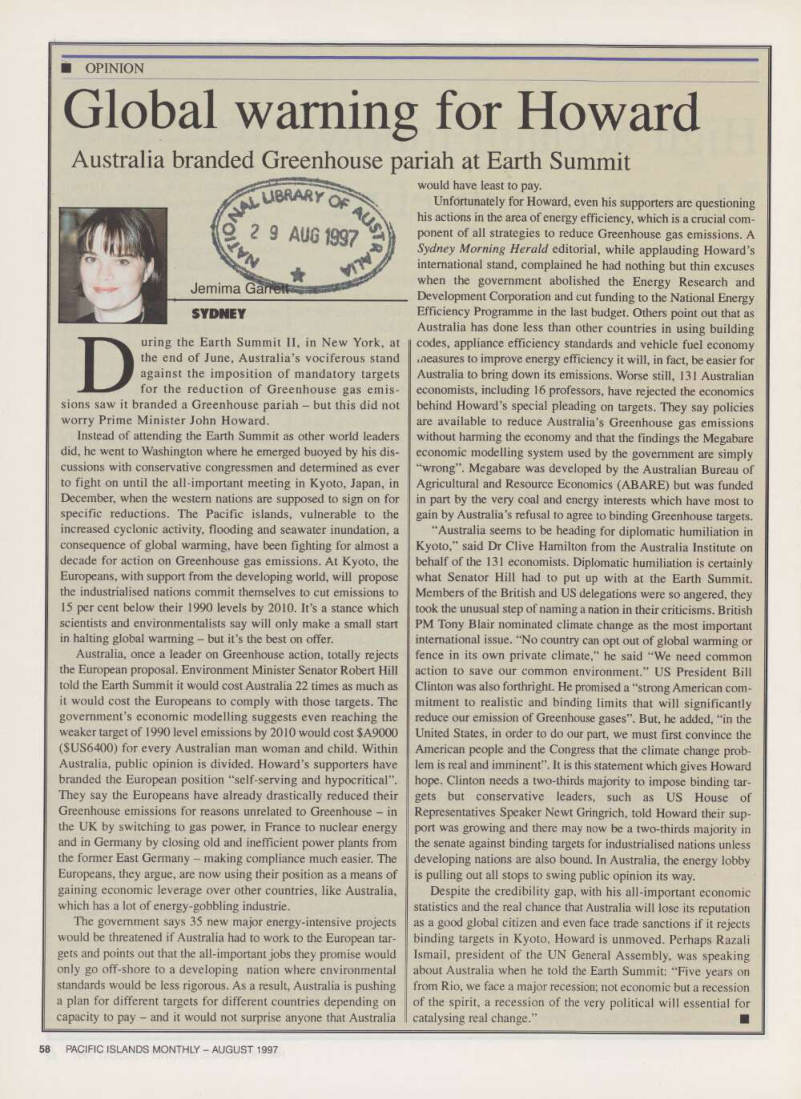
Australia branded Greenhouse pariah at Earth Summit
Jemima
Sydney
During the Earth Summit 11, in New York, at the end of June, Australia’s vociferous stand against the imposition of mandatory targets for the reduction of Greenhouse gas emis sions saw it branded a Greenhouse pariah - but this did not worry Prime Minister John Howard.
Instead of attending the Earth Summit as other world leaders did, he went to Washington where he emerged buoyed by his dis cussions with conservative congressmen and determined as ever to fight on until the all-important meeting in Kyoto, Japan, in December, when the western nations are supposed to sign on for specific reductions. The Pacific islands, vulnerable to the increased cyclonic activity, flooding and seawater inundation, a consequence of global warming, have been fighting for almost a decade for action on Greenhouse gas emissions. At Kyoto, the Europeans, with support from the developing world, will propose the industrialised nations commit themselves to cut emissions to 15 per cent below their 1990 levels by 2010. It’s a stance which scientists and environmentalists say will only make a small start in halting global warming - but it’s the best on offer.
Australia, once a leader on Greenhouse action, totally rejects the European proposal. Environment Minister Senator Robert Hill told the Earth Summit it would cost Australia 22 times as much as it would cost the Europeans to comply with those targets. The government’s economic modelling suggests even reaching the weaker target of 1990 level emissions by 2010 would cost SA9OOO (SUS64OO) for every Australian man woman and child. Within Australia, public opinion is divided. Howard’s supporters have branded the European position “self-serving and hypocritical”.
They say the Europeans have already drastically reduced their Greenhouse emissions for reasons unrelated to Greenhouse - in the UK by switching to gas power, in France to nuclear energy and in Germany by closing old and inefficient power plants from the former East Germany - making compliance much easier. The Europeans, they argue, are now using their position as a means of gaining economic leverage over other countries, like Australia, which has a lot of energy-gobbling industrie.
The government says 35 new major energy-intensive projects would be threatened if Australia had to work to the European tar gets and points out that the all-important jobs they promise would only go off-shore to a developing nation where environmental standards would be less rigorous. As a result, Australia is pushing a plan for different targets for different countries depending on capacity to pay - and it would not surprise anyone that Australia
would have least to pay.
Unfortunately for Howard, even his supporters are questioning his actions in the area of energy efficiency, which is a crucial com ponent of all strategies to reduce Greenhouse gas emissions. A Sydney Morning Herald editorial, while applauding Howard’s international stand, complained he had nothing but thin excuses when the government abolished the Energy Research and Development Corporation and cut funding to the National Energy Efficiency Programme in the last budget. Others point out that as Australia has done less than other countries in using building codes, appliance efficiency standards and vehicle fuel economy measures to improve energy efficiency it will, in fact, be easier for Australia to bring down its emissions. Worse still, 131 Australian economists, including 16 professors, have rejected the economics behind Howard’s special pleading on targets. They say policies are available to reduce Australia’s Greenhouse gas emissions without harming the economy and that the findings the Megabare economic modelling system used by the government are simply “wrong”. Megabare was developed by the Australian Bureau of Agricultural and Resource Economics (ABARE) but was funded in part by the very coal and energy interests which have most to gain by Australia’s refusal to agree to binding Greenhouse targets.
“Australia seems to be heading for diplomatic humiliation in Kyoto,” said Dr Clive Hamilton from the Australia Institute on behalf of the 131 economists. Diplomatic humiliation is certainly what Senator Hill had to put up with at the Earth Summit.
Members of the British and US delegations were so angered, they took the unusual step of naming a nation in their criticisms. British PM Tony Blair nominated climate change as the most important international issue. “No country can opt out of global warming or fence in its own private climate,” he said “We need common action to save our common environment.” US President Bill Clinton was also forthright. He promised a “strong American com mitment to realistic and binding limits that will significantly reduce our emission of Greenhouse gases”. But, he added, “in the United States, in order to do our part, we must first convince the American people and the Congress that the climate change prob lem is real and imminent”. It is this statement which gives Howard hope. Clinton needs a two-thirds majority to impose binding tar gets but conservative leaders, such as US House of Representatives Speaker Newt Gringrich, told Howard their sup port was growing and there may now be a two-thirds majority in the senate against binding targets for industrialised nations unless developing nations are also bound. In Australia, the energy lobby is pulling out all stops to swing public opinion its way.
Despite the credibility gap, with his all-important economic statistics and the real chance that Australia will lose its reputation as a good global citizen and even face trade sanctions if it rejects binding targets in Kyoto, Howard is unmoved. Perhaps Razali Ismail, president of the UN General Assembly, was speaking about Australia when he told the Earth Summit; “Five years on from Rio, we face a major recession; not economic but a recession of the spirit, a recession of the very political will essential for
catalysing real change.” ■
Advertisements & other items, pp. 59-60 (1 item)
Grand Pacific’s
cc
founders saw
their future.”
AS BRIGHT AS EVER.
This year, we're celebrating an event that should please our clients and our agents alike.
Our 40th Anniversary.
Four decades ago, the founders of Grand Pacific Life set out to create a life insurance
company designed to safeguard and serve
people in the Pacific. Today, through pioneering efforts and 40 years of steady growth, Grand Pacific Life has over $3.8 billion of life insurance in force. Which represents the trust of many thousands of people, ones whom
we've helped secure the financial indepen-
dence and peace of mind they've worked so
hard to achieve.
Our founders' spirit and vision continues
in reaching out with new ideas to other nations in the Pacific. Our steadfast dedication to our clients and agents has made history these last 40 years. The decades ahead look equally
exciting and full of promise.
o
Grand Pacific Life Insurance, Ltd.
3UA 8 5 J?|
American Samoa Mark Solofa Pacific Insurance & Finance, Inc.
Mark Solofa, GA Phone: 684-699-5796 Western Samoa Mark Solofa Pacific Insurance & Finance, Inc.
Mark Solofa, GA Phone: 685-24059 Chuuk State. Federated States of Micronesia Pacific Basin Insurance & General Services, Inc.
Kachutosy Paulus, GA Phone:69l-330-2606 Actouka Executive Insurance Underwriters Maridell Actouka Phone: 691-320-5331 Guam Great National Insurance Underwriters, Inc.
Domie Bumagat Jr., GA Phone: 671-646-5736 Pacific Financial Corporation Eduardo Camacho, GA Phone: 671-646-1990 Takagi & Associates Pamela Cruz, Life Manager Phone: 671-475-4373 Marshall Islands Marshalls Insurance Agency Jerry Kramer, GA Phone: 692-625-3366 Saipan Pacific Basin Insurance Underwriters, Inc.
Mary Ann Milne, GA Phone: 670-234-7861 Pacifica Insurance Underwriters, Inc.
Norman Tenorio, GA Phone: 670-234-6267 Takagi & Associates Laurie Sturges, Branch Mgr.
Phone: 670-322-8117 Tonga Peseti Ma'afu Insurance & Finance, Ltd.
Peseti Ma'afu, GA Phone: 676-24-777 A member of the Finance Factors Family
Kl Pot a.
rmr\ r
q\9
PPIO
SHELs/ELS
isaaiS^ l * ,iS:r *~. :',T*S S!> >
LAND CRUISER
-£i
LAND CRUISER
oj /A\ ir^lnri ■ y \ Some of the specs may vary according to market specifications.
Heavy duty beauties - Toyota Land Cruiser and Land Cruiser PRADO Land Cruiser’s got a reputation for go anywhere toughness, with style and ability to take you there in total comfort, on road or off.
Its luxury matches most expensive sedans. And it has more space than many large passenger cars. With impeccable fit and finish.
And graceful, elegant form.
Land Cruiser PRADO inherits these traditions, and all Toyota’s 4x4 know-how for great performance off road and passenger car comfort on the highway, and stylish beauty everywhere it goes.
What you can’t see is also important. Tough frames. Suspensions built to take you as far off road as you want to go, in comfort. Your choice of powerful petrol or diesel engines. And bodies thoroughly protected from rust.
Land Cruiser and Land Cruiser PRADO - two champions, on and off the road.
TOYOTA
DISTRIBUTORS/DEALERS
NORFOLK ISLAND HORRY'S PIT LTD. PH 22114 SOLOMI )N ISLANDS ELA MOTORS PH .40314
VANUATU ASCO MOTORS PH 22341
COOK ISIANDS PACIFIC MOTORS LTD. PH 20700
KIRIBATI TARAWA MOTORS PH 21090
PAPUA NEW GUINEA, ELA MOTORS PH 3229400
TAHITI NIPPON AUTOMOTO PH 429819
WESTERN SAMOA ASCO MOTORS PH 208(H)
FIJI
NEW CALEDONIA.
TONGA
...ASCO MOTORS
...S.I.A.P.
...ASCO MOTORS
AMERICAN SAMOA* ASCO MOTORS
(*PRADO is not being handled.) PH 384888 PH 275562 PH 23500 PH 633-4281