Politics
pp. 50-51 · Read in the full issue
Literature
Politics of art
By Nicolas
Rothwell
Contemporary Art in Papua New Guinea begins with a resonant quote from politician Bernard Narokobi, one of the most impas sioned architects of the nation.
“Our contemporary artists will pass into history as our artists, our visionaries, our prophets in our time. Our art should be seen and enjoyed and our artists appreciat ed for what they are and not for whom or what they resemble.”
Susan Cochrane, one of the leading scholars of contemporary Pacific art, fol lows this advice carefully in her definitive overview of the many forms of artistic expression in PNG today; painting, bilum making, self-decoration, sculpture and architecture all receive her attention.
She provides a capsule account of the colonial era, showing how vital were the village roots of modem PNG art, before addressing the transformations in national life following independence in 1975.
For the first generation of western-edu cated and trained artists and intellectuals, art and literature inevitably reflected the political temper of the times; but this pat tern of engaged art was overlaid on anoth er tradition: “The integration of all art forms is inherent in PNG cultures,” writes Dr Cochrane.
“In western culture, separate education and cultural institutions exist for the dis play and performance of visual and perfor mance arts and individuals are highly spe cialised in a particular art form, although they may appreciate others.
“In many PNG and other indigenous cultures, specialisation reflects an inten sive knowledge of a particular aspect of a complex, holistic, cultural environment.”
Many strands of creative activity in PNG, Dr Cochrane argues, are interlinked in the endeavour of making and describing the transformation of the people and their nation into its modem cultural identity.
The key artistic heroes of this process figures such as Akis from Madang Province, Highlander Mathias Kauage, Joe Nalo from Manus and Trobriand Islander Martin Morububuna - are discussed at length and their works, often startling com binations of traditional and modem motifs, are illustrated.
During this quick tour of Dr Cochrane’s eclectic “artists’ gallery”, some of the splendours of PNG painting are on view, and many of its anomalies: why, for instance, do Highland artists specialise in humour and savage wit; and why are so many modem PNG artists originally from a small area of the Central Highlands, a part of the nation considered the least sophisticated in its visual arts?
Sculpture presents Dr Cochrane with more problems - partly because PNG
sculpture is still in its infancy and partly because the glory of traditional PNG sculpted objects - funerary masks, Haus Tambaran facades, elaborately carved lin tels and posts - lingers in the memory.
Inevitably, modem PNG sculpture, even in the most exotic of materials, both departs from this tradition and stands in its shad ow.
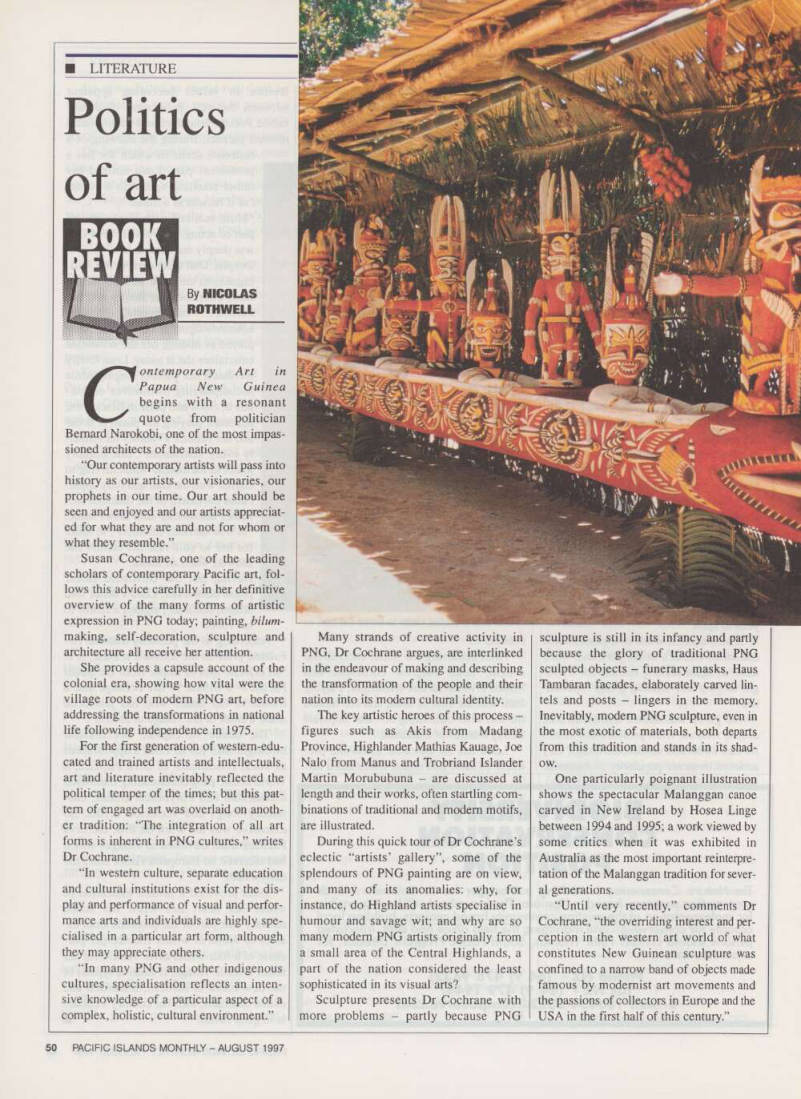
One particularly poignant illustration
shows the spectacular Malanggan canoe carved in New Ireland by Hosea Linge between 1994 and 1995; a work viewed by some critics when it was exhibited in Australia as the most important reinterpre tation of the Malanggan tradition for sever
al generations.
“Until very recently,” comments Dr Cochrane, “the overriding interest and per ception in the western art world of what constitutes New Guinean sculpture was confined to a narrow band of objects made famous by modernist art movements and the passions of collectors in Europe and the USA in the first half of this century.”
Today, however, she reports, “western scholarship and art appreciation” is open to a broader interpretation of what consti tutes sculpture in PNG; the fluid spirit birds made from welded steel by Gickmai Kundun, for example, or Tom Deko’s Dynamite Rocker of steel and scrap metal.
Ceremonial dance and bilum- weaving receive proper attention as female art forms and carriers of a new idea of nation al identity: a “neo-traditional symbol” of PNG unity. Perhaps the most spectacular exploration of this theme to date, though, is the Parliament House in Port Moresby, a collective artistic and architectural enterprise that exemplifies “the philoso
phy of merging heritage with modernisa
tion” - a physical representation of cultur
al policy.
In a striking pendant to Dr Cochrane’s survey from the outside, a closing chapter written by Michael Mel, a teacher of expressive arts bom in the western Highlands, narrates from the inside the experience of the art of bilas - self-deco ration.
The meaning of bilas in the contempo rary world may have changed, but the art survives, and “to impose and maintain the claim that one meaning is richer, more original than the bastardised version is a dangerous enterprise”.
In his detailed account, Mel describes the change within as he puts on his finery for a ceremonial performance: “I felt flighty, free and loose. I felt as if I had given way to a new skin in place of an old one... I sensed a lightness and at the same time an elaborateness.”
Mel’s story forms a striking and ele gant ending for an important survey of a new stage in the drama of PNG art.
Yet, Dr Cochrane’s overview, for all her intimacy with the subject and the country, at times assumes the reader’s agreement with its judgments, where it might be better to persuade. Many of the artists whose works she discusses are modernist in temper, and political in approach.
They deliberately dispense with the age-old beauty and splendour of tradition al PNG art.
This is a striking and impressive stance, but it is also one that needs advo cates. ■
• Contemporary Art in Papua New Guinea by Susan Cochrane, published by Craftsman House, Sydney, SABO.OO.