Car wars
pp. 36-39 · Read in the full issue
Advertising Feature
Motoring
Dealers are facing tough times...but all they’re fighting for, they say, is efficient regulation
Having to contend with high tariffs, declines in the econ omy and
a competitive market, it is no smooth jaunt for
Fiji’s motoring indus
try, at least not as far as car dealers are con cerned. But while com petition is always tough for dealers, the con sumer is blessed with the luxury of choice.
The split in the market lies mainly between new car dealers and second hand dealers. While the one can offer the latest technology - at a price; the latter is able to offer tested and tried models usually at a lower price.
Most second-hand cars
imported from Japan are tested for road worthiness before they are certified. But a recent scandal in New Zealand to do with the winding back of odometers in imported
used cars has cast a dark cloud of suspicion over the local market, with speculation that
such practices may also exist in Fiji.
The Fiji Motor Traders Association (FMTA) has been lobbying government for stricter regulations on the import of sec
ond-hand cars.
Daljeet Singh, general manager of Nivis Motors, dealers of the Mitsubishi range of vehicles, feels the pinch of duties charged on new cars.
“The high duty rates are a problem which causes the cost of vehicles to go up,”
Singh said.
It cannot be said that the government has not attempted to alleviate this problem for importers of new cars. Tariffs, Singh explained, depended on the vehicle’s engine capacity. Last year’s budget dropped duty on cars under two litres from 60 to 50 per cent and duty on cars over two litres from 80 to 60 per cent.
“But these duties are still very high,”
Singh maintains.
“We have been lobby ing for a reduction and government was good to us last year in that they reduced duty by 10 per cent,” FMTA secretary Jean Ragg said. “We would like to see the tar iffs go down further but we have to be realistic about it because govern ment needs to make rev enue some how.”
The other problem affecting the market is crooked car dealers.
Roger Powell, national operations manager of Carpenters Motors, expressed concern over customers buying cars believing them to be
newer than they actually are.
“Government has to go back to a domestic three-year age to stop all sorts of rubbish coming in,” Powell said. Crooked
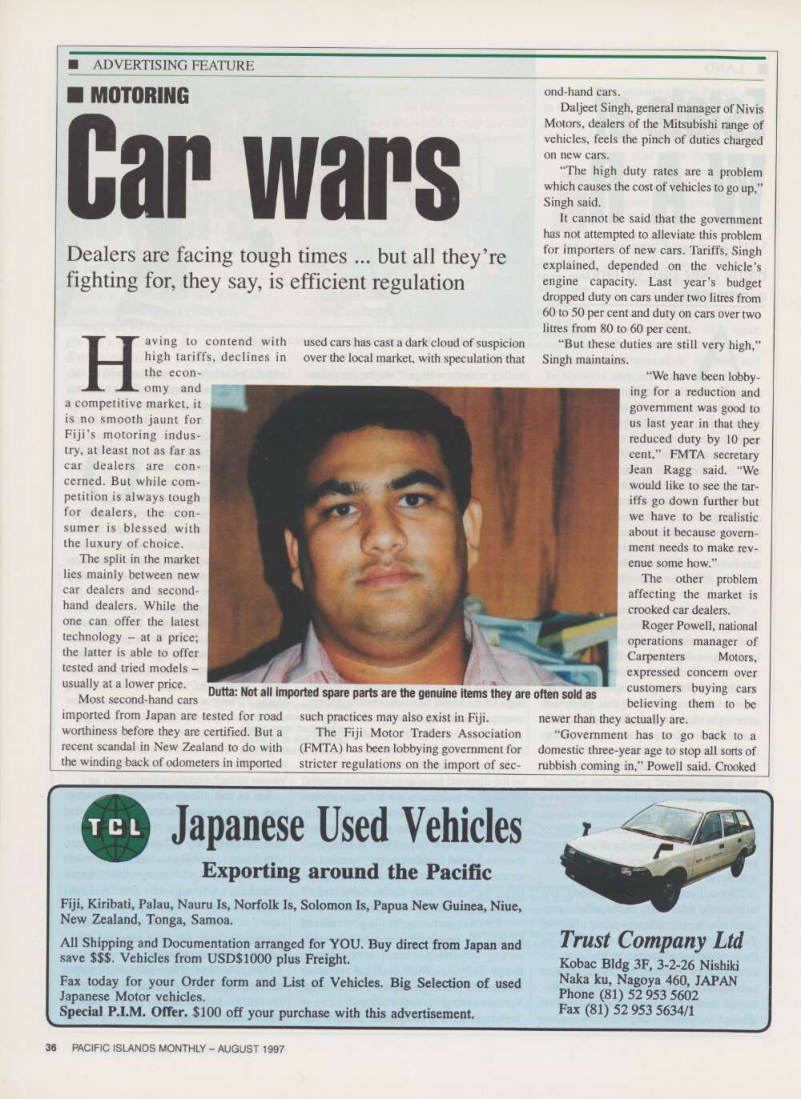
Dutta: Not all imported spare parts are the genuine items they are often sold as
dealers are also having an impaict on the spare-parts market. According tco Unique Motor Spares company director Victor Dutta, not all imported spare parts? were the genuine items they were often solid as, and proved to be more trouble than tlhey were worth. “Yes, they are cheap all iright and more people can afford them.” Blut in the long run, they work out to be more expen sive because they have a shorter life than genuine parts do and, in many cases, last only a few months, he says.
“The importation of these parts hasn’t really killed business but has slowed it down a great deal. Usually what happens is that people buy these parts the first few times but when they realise it is costing them more, they come to us.”
He said he did not see the need for a complete ban on such parts but called on government to have in place some sort of rules and regulations which would control the type and life of parts brought in.
“What happens is that when a consumer with a second-hand car has problems with his car, he realises he needs parts which are sometimes not available from where he bought his car. So what he does is go to genuine dealers expecting them to have the necessary parts, and what happens in some cases is that the dealers don’t have the parts these people are looking for because they don’t bring in the particular model of car,” Ragg said.
“So here the consumer gets annoyed; one - because his dealer doesn’t have the part, and two - because his vehicle can’t be used until the parts are changed.”
Ragg is a strong advocate of the use of number plates to differentiate between new and used cars.
“What is happening right now is that whatever vehicles are brought into the country are being given brand new number plates - these include second-hand and reconditioned cars.
“When this happens, there is no way the customer can identify which car is new and which is not.
“It’s a matter of letting the public know that they have to be aware of what they are purchasing with respect to second-hand vehicles.
“We want separate number plates for second-hand cars. There was a time when these cars were given number plates begin ning with ‘D’ and ‘E’.”
However, this saw much protest from second-hand dealers, who believed the move was discriminatory. The matter land
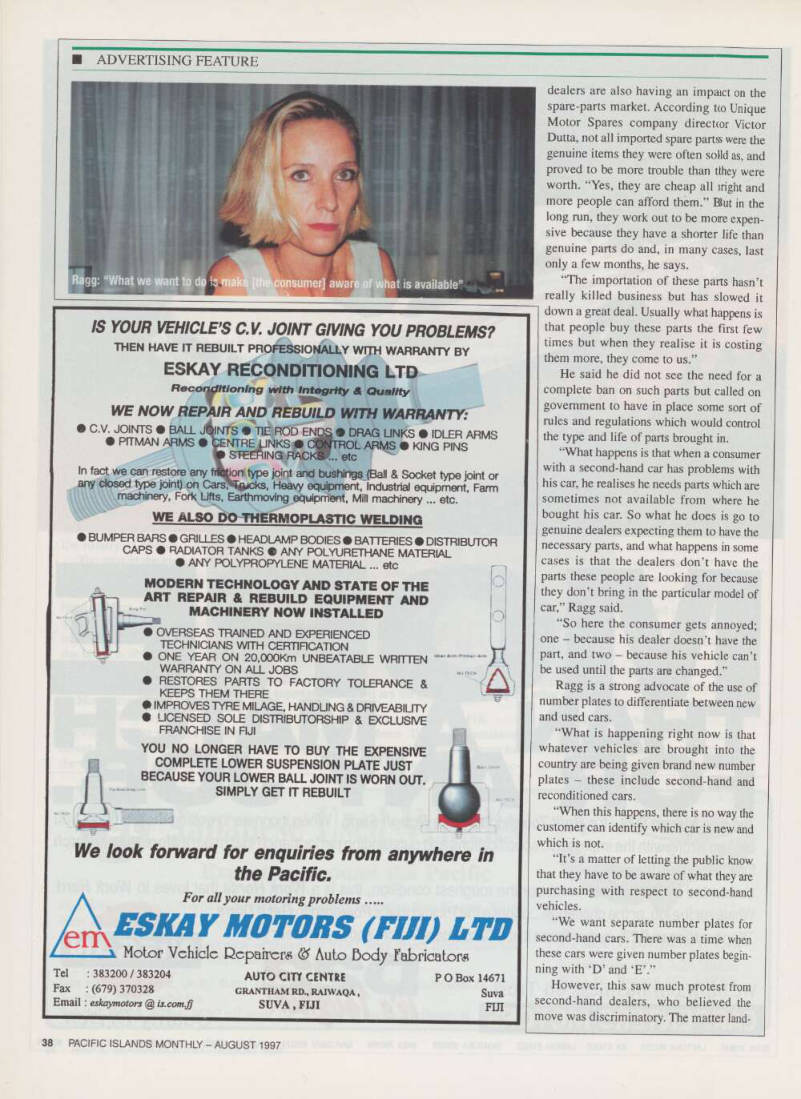
Ragg: "What we want to do is make [the consumer] aware of What is available"
ed in court and was ruled in favour of sec ond-hand dealers.
“In the new legislation, the traffic bill,
which is still to be passed, there are recommendations which state that to be a bona fide operator dealers must have a showroom, suitable workshop, proper
panel shop, proper block
and tackle (for lifting engines out of the car) and [adhere to safety regula tions],” Ragg said.
“There will also be a grading system - A, B, C.”
To qualify as an A, the dealer would need to have the whole setup, B would mean the dealer has the showroom plus workshop and C would mean the
dealer has just a showroom, Ragg said.
“And, of course, they must have spare
parts.”
Ragg said the FMTA was waiting for the bill to be legislated and said it had been 18 months since being presented to gov ernment.
“The point to keep in mind is that we are not against second-hand cars.” The FMTA’s opposition, she said, had to do
with the difficulty of maintaining such cars.
The association has recommended that government not allow the import of vehi cles more than three years old. “That would mean a reasonably new vehicle is coming into the country.”
As for allegations of odometers being turned back, “I don’t know how this prob lem could ever be solved but what I feel is
that these meters should be sealed - which means when a mechanic checks the engine he would be able tell whether someone has tam pered with it or not,” Ragg suggests.
Powell agrees that the high numbers of cars being brought into the country increased competition and allowed more people to own cars. But the point, he said, was that there should be better screening of the types of vehicles brought in. Singh agrees. Only with proper rules and regulations would there be proper con
trol, he said.
Ragg sums it up by saying: “We know we can’t stop the consumer from buying what he wants. But what we can do is make him aware of what is available in the market and why they should be more care ful when buying such cars.” ■
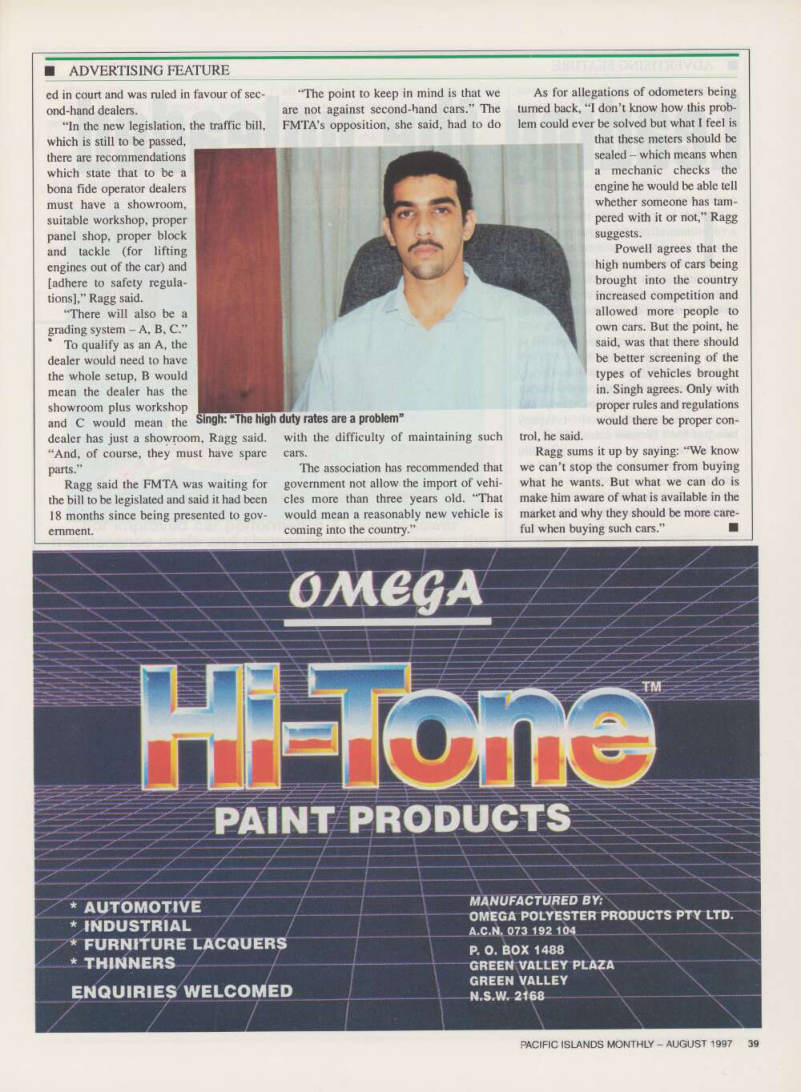
Singh: “The high duty rates are a problem”