Leading the unleaded
pp. 40-41 · Read in the full issue
In keeping with the environ mentally friendly practices, the world is coming under increasing pressures to imple ment and, in an effort to control air pollution in the island country, Fiji has marked the end of the century as the end for leaded fuel.
All cars on Fiji roads are expected to run on unleaded petrol by 1999.
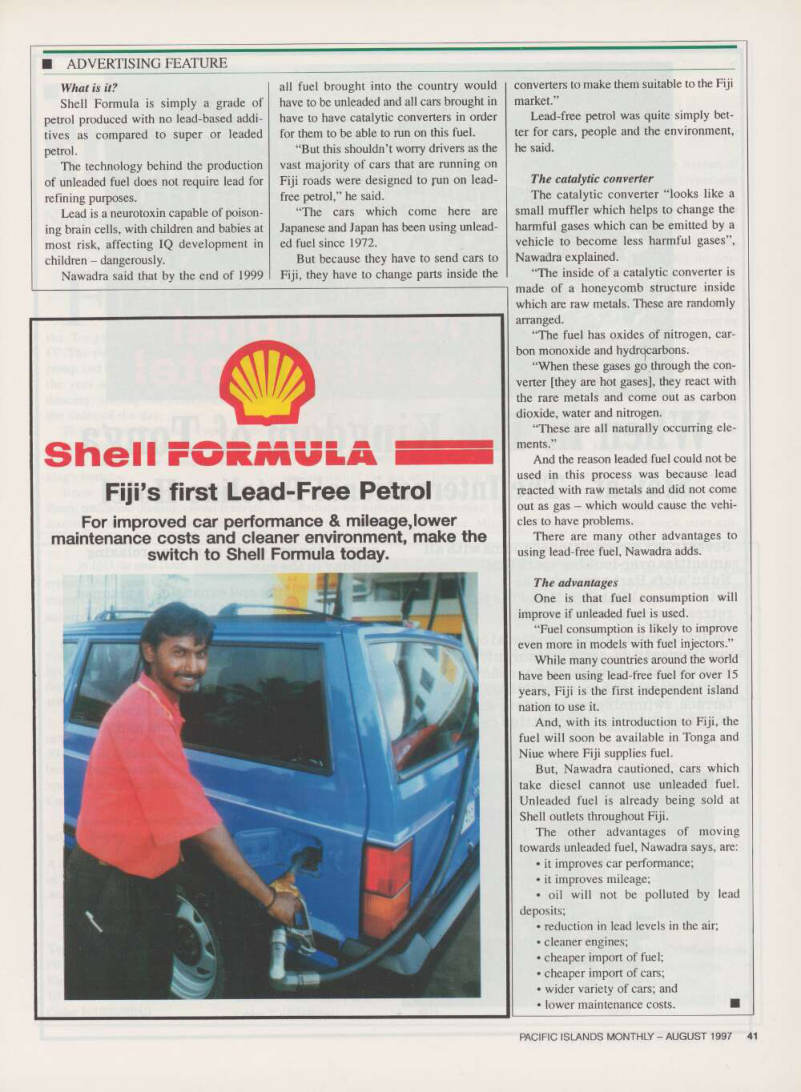
And Shell Fiji Limited has already taken steps towards preparing the market in this important transition. Early last month, the multinational company launched Shell Formula unleaded fuel.
Sefa Nawadra, the company’s health, safety and environment manager, said the introduction of unleaded fuel into the Fijian market showed the country was moving along with current world trends.
What is it?
Shell Formula is simply a grade of petrol produced with no lead-based addi tives as compared to super or leaded petrol.
The technology behind the production of unleaded fuel does not require lead for refining purposes.
Lead is a neurotoxin capable of poison ing brain cells, with children and babies at most risk, affecting IQ development in children - dangerously.
Nawadra said that by the end of 1999
all fuel brought into the country would have to be unleaded and all cars brought in have to have catalytic converters in order for them to be able to run on this fuel.
“But this shouldn’t worry drivers as the vast majority of cars that are running on Fiji roads were designed to run on lead free petrol,” he said.
“The cars which come here are Japanese and Japan has been using unlead ed fuel since 1972.
But because they have to send cars to Fiji, they have to change parts inside the
converters to make them suitable to the Fiji market.”
Lead-free petrol was quite simply bet ter for cars, people and the environment, he said.
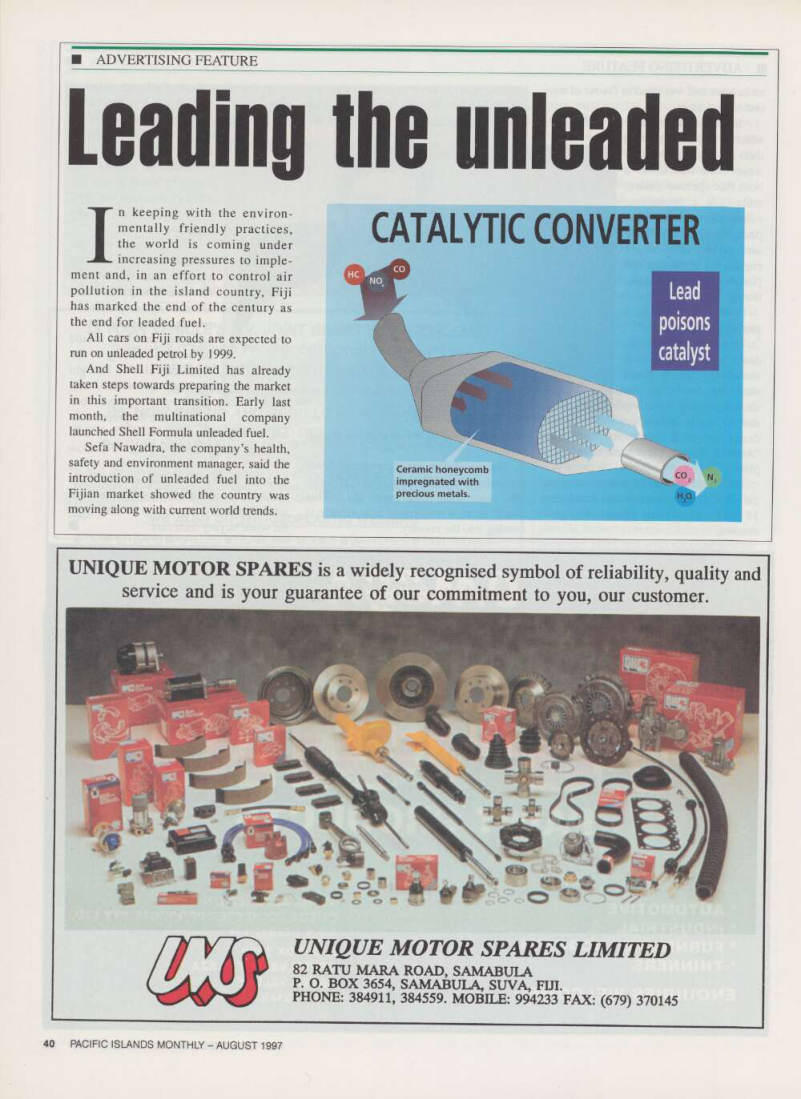
The catalytic converter The catalytic converter “looks like a small muffler which helps to change the harmful gases which can be emitted by a vehicle to become less harmful gases”,
Nawadra explained.
“The inside of a catalytic converter is made of a honeycomb structure inside which are raw metals. These are randomly arranged.
“The fuel has oxides of nitrogen, car bon monoxide and hydrocarbons.
“When these gases go through the con verter [they are hot gases], they react with the rare metals and come out as carbon dioxide, water and nitrogen.
“These are all naturally occurring ele ments.”
And the reason leaded fuel could not be used in this process was because lead reacted with raw metals and did not come out as gas - which would cause the vehi cles to have problems.
There are many other advantages to using lead-free fuel, Nawadra adds.
The advantages One is that fuel consumption will improve if unleaded fuel is used.
“Fuel consumption is likely to improve even more in models with fuel injectors.”
While many countries around the world have been using lead-free fuel for over 15 years, Fiji is the first independent island nation to use it.
And, with its introduction to Fiji, the fuel will soon be available in Tonga and Niue where Fiji supplies fuel.
But, Nawadra cautioned, cars which take diesel cannot use unleaded fuel.
Unleaded fuel is already being sold at
Shell outlets throughout Fiji.
The other advantages of moving towards unleaded fuel, Nawadra says, are: • it improves car performance; • it improves mileage; • oil will not be polluted by lead deposits; • reduction in lead levels in the air; • cleaner engines; • cheaper import of fuel; • cheaper import of cars; • wider variety of cars; and • lower maintenance costs. ■