Estate of
p. 35 · Read in the full issue
Land
War
Villagers and government battle over plot of land
By Chris Peteru
A 120-ha block at the heart of a simmering land row in Samoa is essential for the economic survival of a group of villagers. But for the gov ernment-owned Samoa Land Corporation, it is the ideal spot for a sports centre.
Unfortunately for the villagers, the law is on the government’s side.
“Traditionally, the land belongs to us but legally, it is the government’s,” con cedes High Chief Mailo Sio. “But we will be the poorest village in Samoa if this land is taken off us. There is no fish out on the reef because it has been dredged so sand could be sold; economically it will finish many of us.
“The government has to get its priori ties right. They gave themselves big pay rises two months ago, we get booted off the land for growing bananas. We do not want to become criminals, but this is not fair.”
While 19 people growing crops illegal ly on the land were arrested then given bail after eight days in jail, their release has done little to cool police anger at being shot at during the midday raid to evict them. A police bus and jeep were raked with semi-automatic gunfire that whistled down the interior of the bus, narrowly missing the driver and some of those arrested. Although the usual procedure is for the village council to hand over those involved to the police as a gesture of good will, the gunmen remain at large.
“These people have done wrong and will face the full weight of the judicial pro cess,” said an angry deputy prime minister, Tuilaepa Sailele, who is also chairman of the Samoa Land Corporation. Those arrest ed claim poor treatment by police while in custody with some being forced to defe cate in their cells. High Chief Lava Peti accused Sailele of using “dirty ways” in
dealing with the village. “Maybe the prime minister has a mind to give us this land, but it is the minister of finance - he does bad things for our village he is the one urging this.” Tensions over the land have been building for some time.
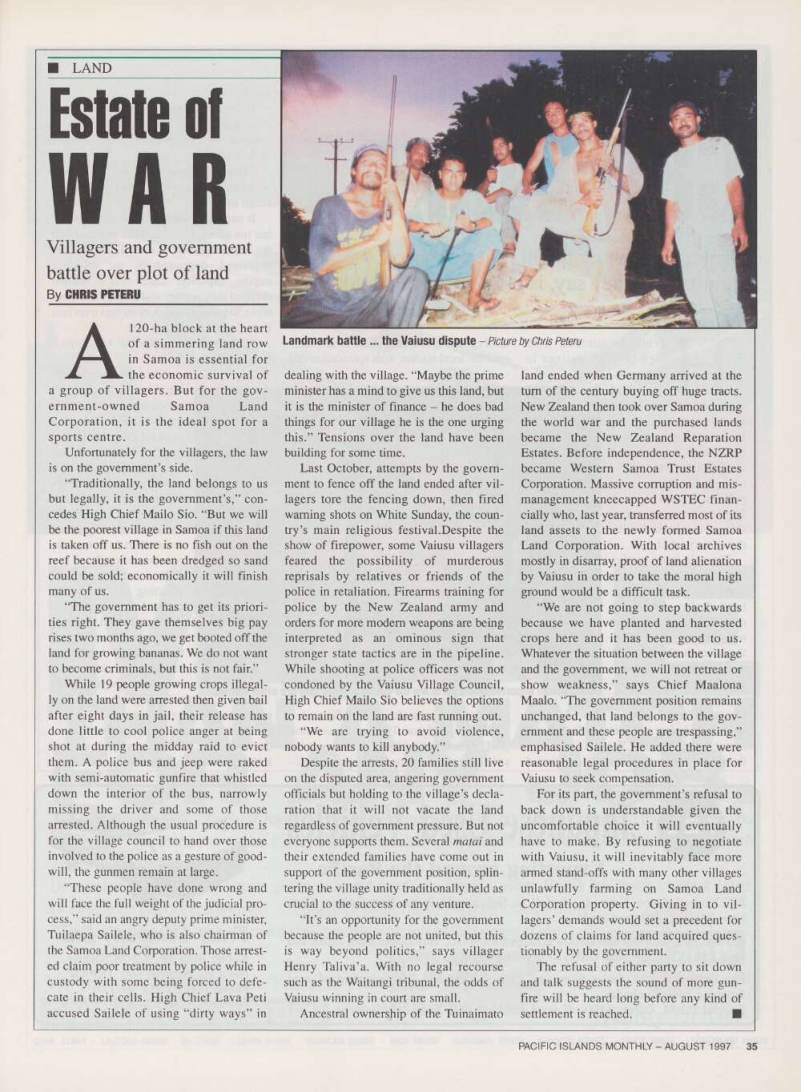
Last October, attempts by the govern ment to fence off the land ended after vil lagers tore the fencing down, then fired warning shots on White Sunday, the coun try’s main religious festival. Despite the show of firepower, some Vaiusu villagers feared the possibility of murderous reprisals by relatives or friends of the police in retaliation. Firearms training for police by the New Zealand army and orders for more modem weapons are being interpreted as an ominous sign that stronger state tactics are in the pipeline.
While shooting at police officers was not condoned by the Vaiusu Village Council, High Chief Mailo Sio believes the options to remain on the land are fast running out.
“We are trying to avoid violence, nobody wants to kill anybody.”
Despite the arrests, 20 families still live on the disputed area, angering government officials but holding to the village’s decla ration that it will not vacate the land regardless of government pressure. But not everyone supports them. Several matai and their extended families have come out in support of the government position, splin tering the village unity traditionally held as crucial to the success of any venture.
“It’s an opportunity for the government because the people are not united, but this
is way beyond politics,” says villager
Henry Taliva’a. With no legal recourse such as the Waitangi tribunal, the odds of Vaiusu winning in court are small.
Ancestral ownership of the Tuinaimato
land ended when Germany arrived at the turn of the century buying off huge tracts.
New Zealand then took over Samoa during the world war and the purchased lands became the New Zealand Reparation Estates. Before independence, the NZRP became Western Samoa Trust Estates Corporation. Massive corruption and mis management kneecapped WSTEC finan cially who, last year, transferred most of its land assets to the newly formed Samoa Land Corporation. With local archives mostly in disarray, proof of land alienation by Vaiusu in order to take the moral high ground would be a difficult task.
“We are not going to step backwards because we have planted and harvested crops here and it has been good to us.
Whatever the situation between the village and the government, we will not retreat or show weakness,” says Chief Maalona Maalo. “The government position remains unchanged, that land belongs to the gov ernment and these people are trespassing,” emphasised Sailele. He added there were reasonable legal procedures in place for Vaiusu to seek compensation.
For its part, the government’s refusal to back down is understandable given the uncomfortable choice it will eventually have to make. By refusing to negotiate with Vaiusu, it will inevitably face more armed stand-offs with many other villages unlawfully farming on Samoa Land Corporation property. Giving in to vil lagers’ demands would set a precedent for dozens of claims for land acquired ques tionably by the government.
The refusal of either party to sit down and talk suggests the sound of more gun fire will be heard long before any kind of settlement is reached. ■
Landmark battle...the Vaiusu dispute- Picture by Chris Peteru