The meeting point
pp. 49-50 · Read in the full issue
Culture
The meeting point An impressive documentation of European and island encounters
By Liz Thompson
Tucked away in the heart of Sydney University sits the Macleay Museum.
Climbing two flights of
stairs, you reach the small, dark muse um stuffed full of animals and arte facts and, at it’s centre, the Island Encounters exhibition.
The collection draws on a diverse col lection of Pacific artefacts - gathered in the Torres Strait Islands, Papua New Guinea,
Solomon Islands, Samoa, Caroline Islands and Kiribati - during the second half of the 19th century.
As you enter the display, one of the first things you see is a superb tapa dress from Samoa hanging on a wall. The dress is made of bark cloth and plant dyes with hibiscus plaiting on the sleeves and pandanus strips on the neck line and hem. Blue and yellow dyes are used in the pandanus decoration and red on the rest of the dress; the motifs are applied by hand or stencil.
The dress was found inside a rolled-up shaggy mat in the museum in the early 1980 s.
An inscription written on the mat reads, “From Mataafa to d’Alpuget”.
Mataafa was a Samoan chief and Jean Albert Gustave d’Alpuget was a commer cial customs agent operating throughout the Pacific region from the 1880 s. The mat is said to be of a type associated with the taupo or high-bom village virgin and was used to prove the virginity of the taupo when she was married. It is not known whether there is a connection between the dress and the mat in which it was wrapped.
The style of the dress itself, with large
puffed sleeves and ruffles, suggests outside influences. Information in the exhibition speculates that probably missionaries led to the changes in the style of clothing worn by Samoan women.
The dress was given by Blanche d’Alpuget, who donated her father’s col lection of Pacific Island artefacts to the University of Sydney’s Anthropology department in 1936. However, most of the exhibition is made up of pieces from the William John Macleay collection. Macleay ammassed more than 2000 indigenous arte facts from Australia and the Pacific between 1874 and 1891.
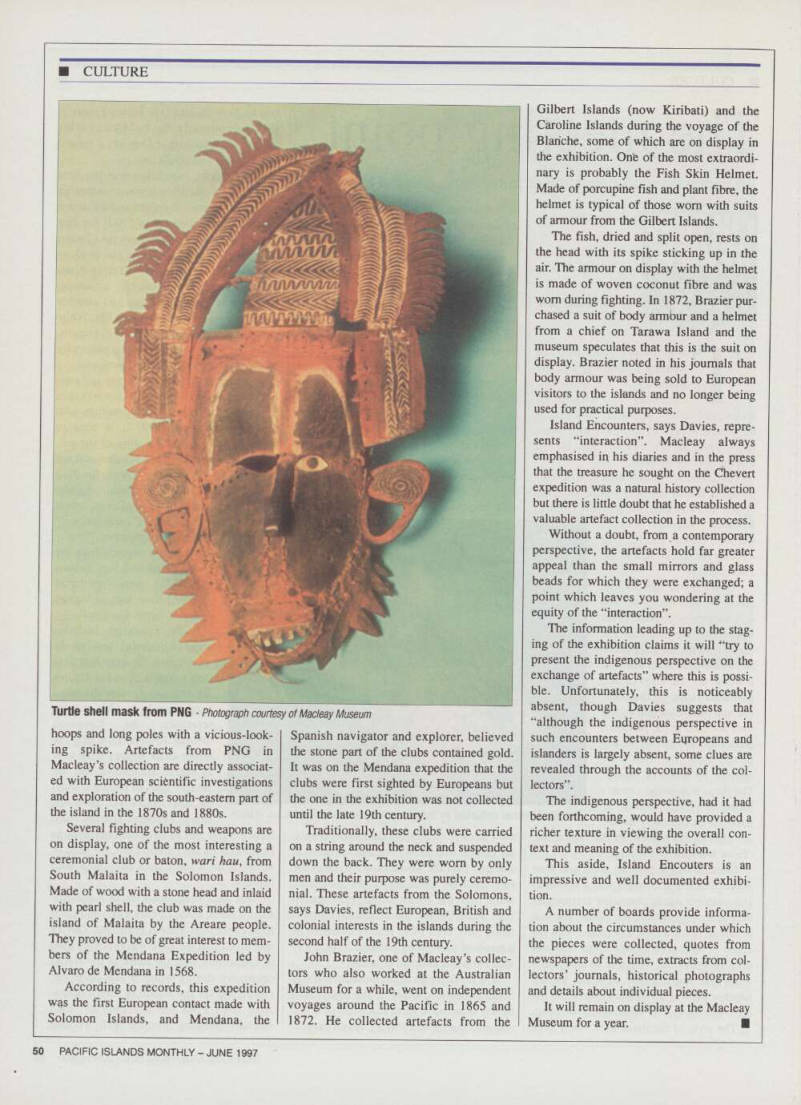
The exhibition is comprehensive. One of the rarest pieces is an incredible turtle shell mask, the face of which is built onto the rounded shell of a turtle and decorated with pearl shell eyes with a beeswax cen-
tre. Pieces of turtle shell used as decoration are tied on with plant fibre and red ochre is smeared over the whole mask. Some of the rare material, particularly the mourning skirts from the Torres Straits, may, specu lates Susie Davies, the exhibition co-ordi nator, have been more readily available as a result of missionary pressure to do away with certain traditional customs.
The mask is part of the museum’s Torres Strait collection, which is the oldest held by any museum in Australia. Most of it was
acquired during Macleay’s Chevert expedi
tion to New Guinea (via Torres Strait) in 1875 and collected either by Macleay or his cousin. Captain Arthur Onslow, a retired naval officer and politician.
The Chevert expedition was the first Australian scientific mission to a foreign country and aimed to collect and document the natural environment of PNG. For five months, collecting parties from the Chevert made trips ashore at stopping places along the east coast of Australia, Torres Strait Islands and New Guinea, amassing, according to Macleay, a “vast and valuable collection” of animal and plant life. While they did this, they traded tobacco, biscuits, beads and tools with indigenous people for ornaments, masks, bowls and weapons.
Apparently, this exchange was not real ly in the interest of collecting, but was seen as a way of developing relationships with the communities visited. It is hard to believe, looking at the quality of the col lection, that at some point Macleay did not become interested in the objects for their own sake. In fact, he obtained artefacts from other naturalists, explorers, naval
officers, ships’ captains, mis sionaries and planters.
Some of the artefacts from the New Ireland and New Britain in PNG were probably obtained from natural history collector James Cockerell.
The exhibition includes some wonderful and rarely seen chalk figures. Just less than a foot high, these figures are said to represent deceased ancestors. In a 19th-century reference, the Reverend George Browne tells that the larger chalk figures were kept in sacred enclosures and the smaller ones in people’s hous es. Also from PNG, are tradi
tional Malagan figures from
New Ireland and an extraordinary Papuan Hombill from the Papuan Gulf, the head of which is on a short stick decorated with feathers.
This stick was found inside a conical shaped mask made of bark cloth and plant fibre dyed with natural pigments. Davies speculates that the stick was probably used in connection with the mask in the Hamo ceremony, during which a new door was contructed for the evaro, or men’s house.
Also from PNG are a couple of ‘man catchers’ hanging from the wall, wooden
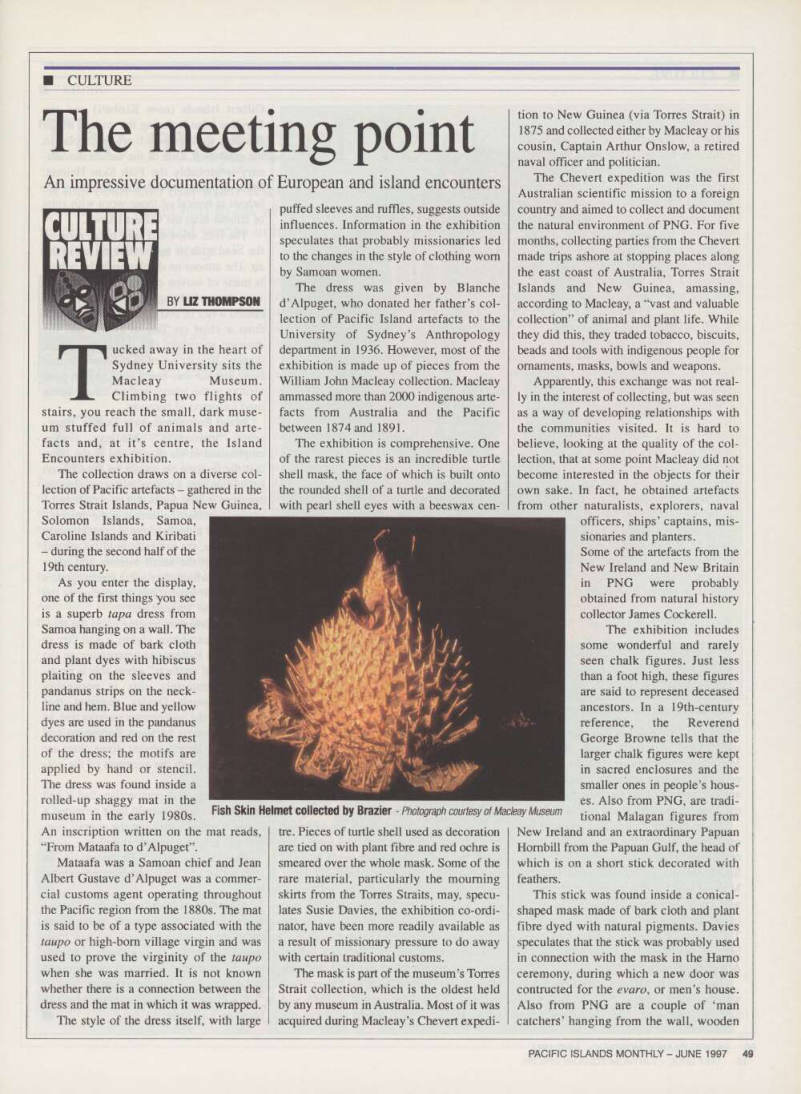
Fish Skin Helmet collected by Brazier - Photograph courtesy of Macleay Museum
hoops and long poles with a vicious-look ing spike. Artefacts from PNG in Macleay’s collection are directly associat ed with European scientific investigations and exploration of the south-eastern part of the island in the 1870 s and 1880 s.
Several fighting clubs and weapons are on display, one of the most interesting a ceremonial club or baton, wari hau, from South Malaita in the Solomon Islands.
Made of wood with a stone head and inlaid with pearl shell, the club was made on the island of Malaita by the Areare people.
They proved to be of great interest to mem bers of the Mendana Expedition led by Alvaro de Mendana in 1568.
According to records, this expedition was the first European contact made with Solomon Islands, and Mendana, the
Spanish navigator and explorer, believed the stone part of the clubs contained gold.
It was on the Mendana expedition that the clubs were first sighted by Europeans but the one in the exhibition was not collected until the late 19th century.
Traditionally, these clubs were carried on a string around the neck and suspended down the back. They were worn by only men and their purpose was purely ceremo nial. These artefacts from the Solomons, says Davies, reflect European, British and colonial interests in the islands during the second half of the 19th century.
John Brazier, one of Macleay’s collec tors who also worked at the Australian Museum for a while, went on independent voyages around the Pacific in 1865 and 1872. He collected artefacts from the
Gilbert Islands (now Kiribati) and the Caroline Islands during the voyage of the Blanche, some of which are on display in the exhibition. One of the most extraordi nary is probably the Fish Skin Helmet.
Made of porcupine fish and plant fibre, the helmet is typical of those worn with suits of armour from the Gilbert Islands.
The fish, dried and split open, rests on the head with its spike sticking up in the air. The armour on display with the helmet is made of woven coconut fibre and was worn during fighting. In 1872, Brazier pur chased a suit of body armbur and a helmet from a chief on Tarawa Island and the museum speculates that this is the suit on display. Brazier noted in his journals that body armour was being sold to European visitors to the islands and no longer being used for practical purposes.
Island Encounters, says Davies, repre sents “interaction”. Macleay always emphasised ip his diaries and in the press that the treasure he sought on the Chevert expedition was a natural history collection but there is little doubt that he established a valuable artefact collection in the process.
Without a doubt, from a contemporary perspective, the artefacts hold far greater appeal than the small mirrors and glass beads for which they were exchanged; a point which leaves you wondering at the equity of the “interaction”.
The information leading up to the stag ing of the exhibition claims it will “try to present the indigenous perspective on the exchange of artefacts” where this is possi ble. Unfortunately, this is noticeably absent, though Davies suggests that “although the indigenous perspective in such encounters between Europeans and islanders is largely absent, some clues are revealed through the accounts of the col lectors”.
The indigenous perspective, had it had been forthcoming, would have provided a richer texture in viewing the overall con text and meaning of the exhibition.
This aside, Island Encouters is an impressive and well documented exhibi tion.
A number of boards provide informa tion about the circumstances under which the pieces were collected, quotes from newspapers of the time, extracts from col lectors’ journals, historical photographs and details about individual pieces.
It will remain on display at the Macleay Museum for a year. ■
Turtle shell mask from PNG - Photograph courtesy of Macleay Museum