The magic of Telek
pp. 51-52 · Read in the full issue
Music
“It has been said that when Telek was a child he was given a special buai [betel nut] to eat which has enabled him to receive village-based stories in his dreams that provide the inspiration for his songs...”
Story and photography by
Liz Thompson
George Telek is a quietly spoken and gentle man from a village near Rabaul in New Britain, Papua New Guinea. Most people know of his home as the place that was flat tened by a volcano but, fortunately, his own village suryived the devastating effects of the eruption.
In PNG, Telek has been a well recog nised musician for'TS years, a local rock star. He was recently quoted in The Australian lamenting the fact that he was no longer able to walk about freely on the
road: “People say, ‘lt’s George Telek’ and everybody looks at you and you can’t do anything because you are so popular. I like it for selling cassettes but to walk around it’s a bit much.”
But now his fame is spreading to for eign shores. Ever since his first highly suc cessful collaboration with Australian band Not Drowning Waving, out of which grew the highly acclaimed album Tabaran, Telek has become an international name. He fol lowed his collaboration on Tabaran with appearances at The Big Day Out with Not
Drowning Waving in Sydney;
Womadelaide ‘92 and ‘97 in Adelaide; and Sing Sing, a cross-cultural music collabo ration which took place between Aboriginal, Torres Strait Islanders, Papua New Guineans and members of Not
Drowning Waving.
Now Telek has become the first Papua New Guinean to release a solo CD - which has received rave reviews. Telek’s musical
career began when he became a singer in a local village group in Rabaul, The Moab Stringband. He later formed the Jolly
Rogers Stringband, named after a popular
tavern in Rabaul, and, according to his press release, it was around this time that he became interested in electric bands.
In his village he collected empty tin cans, lined them up and began to teach himself percussion. Telek went on to form the Kagan Devils, named after a Japanese company that not only employed him, but also bought him a drum kit.
He later joined another popular Papua New Guinean band The Unbelievers Revival. It was during this time that he wrote and recorded his first song called Talaigu, which, became extremely popular in Papua New Guinea and which features on the Telek album.
Telek is probably best known for his band Painim Wok (a pidgin term which means literally “to find work”). Painim Wok was recorded by Greg Seeto of Pacific Gold Studios who also recorded the Tabaran album. The recording sold out as Painim Wok became hugely popular.
By this time Telek was writing an enor mous amount of material and went on to produce five solo albums quickly becom ing one of the most well known musicians in the country.
The self-titled Telek album recently
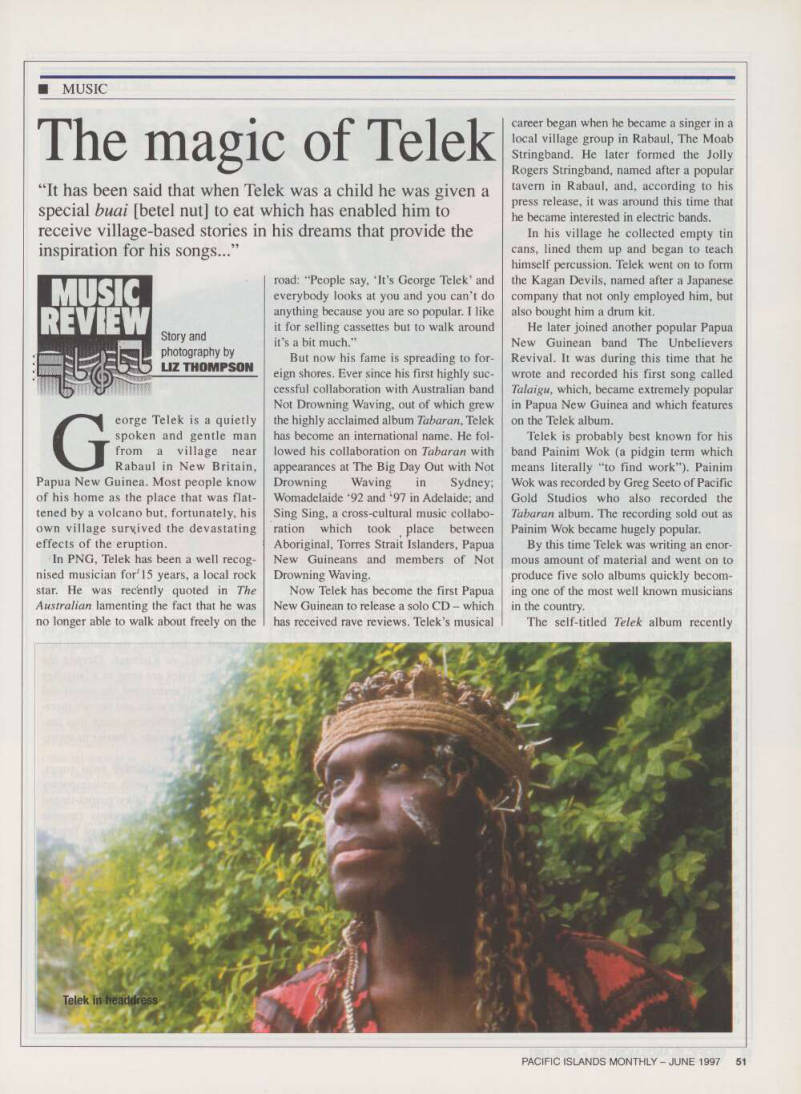
Telek in headdress
released by Origin is a project instigated by former Not Drowning Waving member David Bridie who produced the album with
John Phillips.
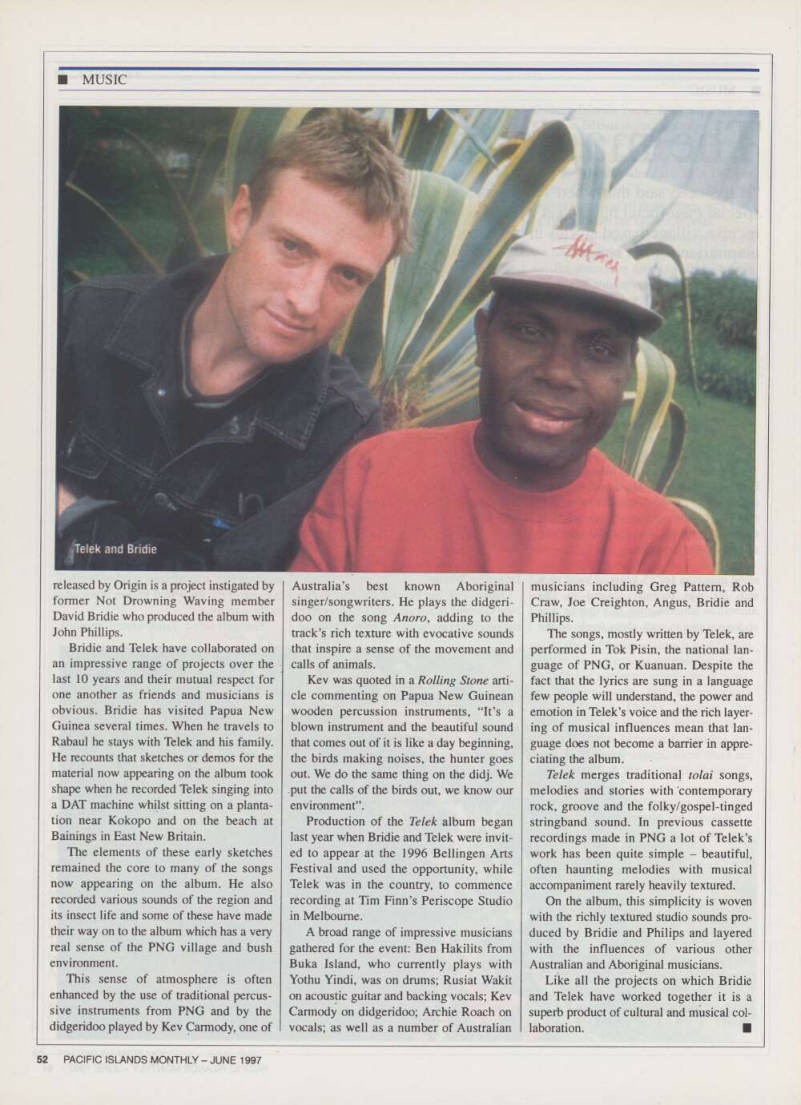
Bridie and Telek have collaborated on an impressive range of projects over the last 10 years and their mutual respect for one another as friends and musicians is obvious. Bridie has visited Papua New Guinea several times. When he travels to Rabaul he stays with Telek and his family.
He recounts that sketches or demos for the material now appearing on the album took shape when he recorded Telek singing into a DAT machine whilst sitting on a planta tion near Kokopo and on the beach at Bainings in East New Britain.
The elements of these early sketches remained the core to many of the songs now appearing on the album. He also recorded various sounds of the region and its insect life and some of these have made their way on to the album which has a very real sense of the PNG village and bush environment.
This sense of atmosphere is often enhanced by the use of traditional percus sive instruments from PNG and by the didgeridoo played by Kev Carmody, one of
Australia’s best known Aboriginal singer/songwriters. He plays the didgeri doo on the song Anoro, adding to the track’s rich texture with evocative sounds that inspire a sense of the movement and calls of animals.
Kev was quoted in a Rolling Stone arti cle commenting on Papua New Guinean wooden percussion instruments, “It’s a blown instrument and the beautiful sound that comes out of it is like a day beginning, the birds making noises, the hunter goes out. We do the same thing on the didj. We put the calls of the birds out, we know our environment”.
Production of the Telek album began last year when Bridie and Telek were invit ed to appear at the 1996 Bellingen Arts Festival and used the opportunity, while Telek was in the country, to commence recording at Tim Finn’s Periscope Studio in Melbourne.
A broad range of impressive musicians gathered for the event: Ben Hakilits from Buka Island, who currently plays with Yothu Yindi, was on drums; Rusiat Wakit on acoustic guitar and backing vocals; Kev Carmody on didgeridoo; Archie Roach on vocals; as well as a number of Australian
musicians including Greg Pattern, Rob Craw, Joe Creighton, Angus, Bridie and
Phillips.
The songs, mostly written by Telek, are performed in Tok Pisin, the national lan guage of PNG, or Kuanuan. Despite the fact that the lyrics are sung in a language few people will understand, the power and emotion in Telek’s voice and the rich layer ing of musical influences mean that lan guage does not become a barrier in appre ciating the album.
Telek merges traditional tolai songs, melodies and stories with contemporary rock, groove and the folky/gospel-tinged stringband sound. In previous cassette recordings made in PNG a lot of Telek’s work has been quite simple - beautiful, often haunting melodies with musical
accompaniment rarely heavily textured.
On the album, this simplicity is woven with the richly textured studio sounds pro duced by Bridie and Philips and layered with the influences of various other Australian and Aboriginal musicians.
Like all the projects on which Bridie and Telek have worked together it is a superb product of cultural and musical col laboration. ■
Telek and Bridie