Pacific


Islands
Monthly
Letter to ministry alleges drug dealing, nepotism and corruption
June 1997
Exclusive
American Samoa USS2.SO: Australia ASS.SO. Cook islands NZS3: Fiji F 52.50 Vat'inch FS .Micronesia USS 3: Kiribati’ A 52.50; tMauru.AS2,so: Niue NZS3: Norfolk ASS' New Caledonia cpf2so New Zealand NZ53.45 mcl GST, Northern Mananas USS 3: Papua New Guinea K 2.90: Palau USS 3; Marshall islands USS 3: Solomon Islands AS3' French Polynesia cpfSOO: Tonga P 3: USA USS3:.Vanuatu VT22O: Western Samoa T 5.50 These are recommended prices only
Layout and design by James Ranuku. Cover picture by Arin Chandra
Advertisements & other items, pp. 2-4 (2 items)
Telikom
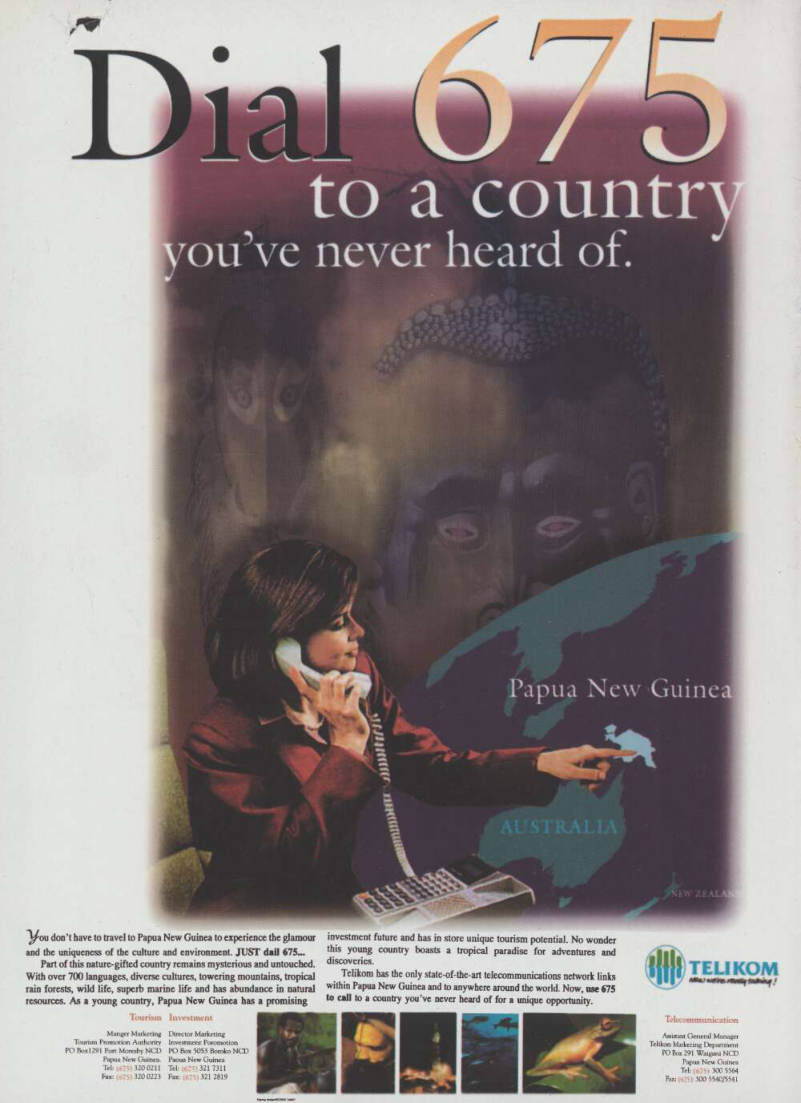
don’t have to travel to Papua New Guinea to experience the glamour and the uniqueness of the culture and environment. JUST dail 675 Part of this nature-gifted country remains mysterious and untouched.
With over 700 languages, diverse cultures, towering mountains, tropical rain forests, wild life, superb marine life and has abundance in natural resources. As a young country, Papua New Guinea has a promising investment future and has in store unique tourism potential. No wonder this young country boasts a tropical paradise for adventures and discoveries.
Telikom has the only state-of-the-art telecommunications network links within Papua New Guinea and to anywhere around the world. Now, use 675 to call to a country you’ve never heard of for a unique opportunity.
TELIKOM
Tourism Investment Manger Marketing Director Marketing Tourism Promotion Authority Investment Poromotion PO Box 1291 Port Moresby NCD PO Box 5053 Boroko NCD Papua New Guinea. Paoua New Guinea Tel: i67>)320 0211 Tel: (675)321 7311 Fax: »675> 320 0223 Fax: 1675) 321 2819
wamrsam
Telecommunication Assistant General Manager Telikom Marketing Department PO Box 291 Waigani NCD Papua New Guinea Tel: (675) 300 5564 Fax: (675 ) 300 5540/5541
Island Distributors
Wanted For
Island Soda
v ; * V ; - t m S»;*
SLAK'D
INEAPPIi
tJ s oj o/X » / V ! ■*. „• S
Island pineaple
Island Orange
Island Dew Island Cola
Tropical Soda
Grape
Lemon-Lime
Strawberry
Lei or full container shipments available.
For information on our competitively priced line of quality beverages, fax, phone or write us at: US Mainland: Aspen International, Inc. 1402-3rd Avenue, Suite 1024 Seattle, Washington 98101 Phone (206) 628-6151 Fax (206) 628-6421 Tahiti Distributor: Eico P.O. Box 184 Papeete - Tahiti Phone 421 660 Fax 429 838 Product of U.S.A. Island Soda is a registered trademark
Pacific
ISLANDS
MONTHLY
VOL 67 No. 06
THE NEWS MAGAZINE
JUNE 1997
Inside
Editorial 5 Letters to the Editor 6 Briefs 9
Special Report:
Mercenaries and mining 11 Investigations into PNG’s Sandline scandal find link with Fiji’s Emperor Mines Mine ready to negotiate 13 Haiveta reveals PNG govt plans for takeover at Sandline inquiry
Cover Stories:
Fiji's prison scandal 14 Investigations begin into allegations of drug dealing, nepotism and corruption Customs corruption 18 Inquiry begins into charges of bribery Scaring away the investors 19 The impact of Vanuatu’s financial scam on offshore investment Caught napping 22 Govt bulldozes through with legislation on chief auditor’s term Beyond 2000 25 Can the Saab carry Air Marshalls into the new century?
Campaign cash for more independence 28 Creepies and crawlies 31 The problem of the Giant African Snail NZ's Island MPs' early impacts 34 Pressing lor freedom 38 FSM editor faces deportation Westerm Samoa independence feature 37
Sports:
Beatrice to break another barrier? 44 Vidiri waits 48 Culture Review 49 The meeting point Music Review 51 The magic of Telek Book Review 53 Misfits, magic and mementoes Yachting 55 On our way to Poverty Bay
Opinion:
Simmering relations 57 Aussie foreign secretary visits the SPC 58
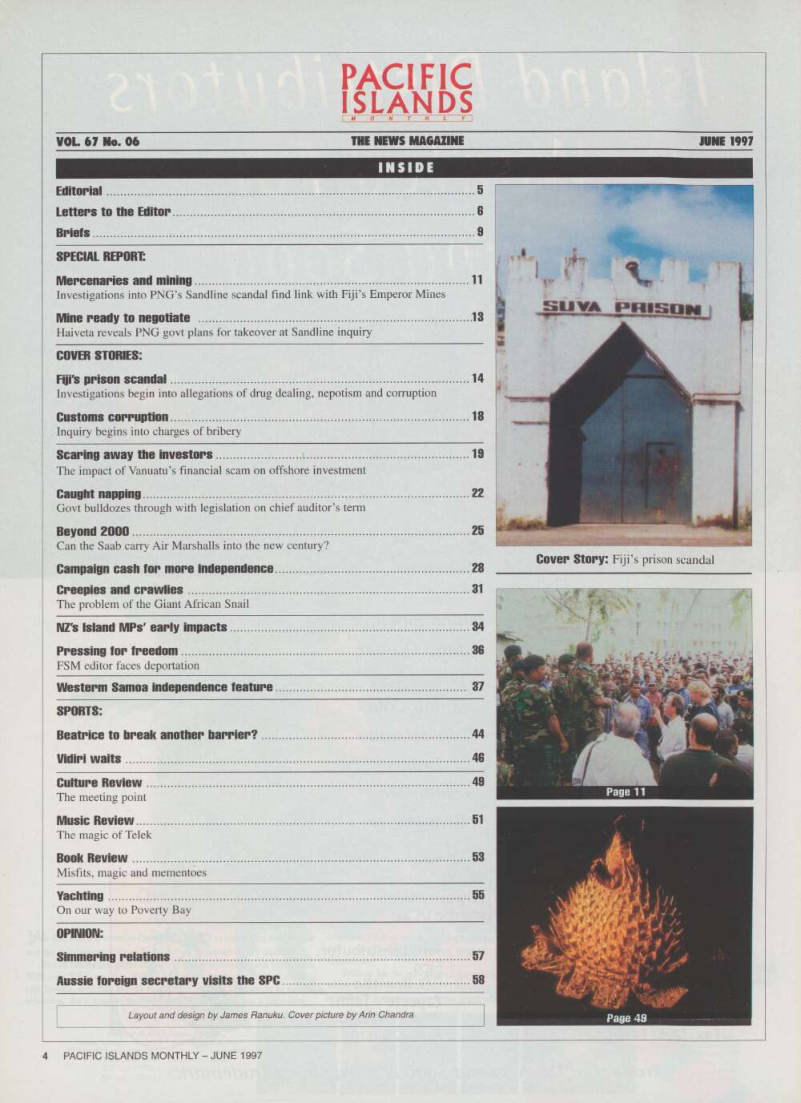
Page 11
Page 49
Cover Story: Fiji’s prison scandal
PUBLISHER: Alan Robinson EDITOR: Manivannan Naidu SENIOR WRITER: Bernadette Hussein
Correspondents:
Sally Andrew, Patrick Decloitre, David North, Chris Peteru, Atama Raganivatu, Kalinga Seneviratne, Liz Thompson, Lili Tuwai, Sam Vulum, lan Williams COLUMNISTS: David Barber (Wellington), Jemima Garrett (Sydney), Debbie Singh (South Pacific Commission).
GRAPHIC ARTISTS: James Ranuku, Josefa Bola, Andrew Williams
Advertising Sales
Senior Regional Sales (South Pacific) Shailendra Kumar Shabana Naaz Tel (679) 304111,303244, Fax (679) 303809.
Sydney, Canberra: Bob Hill Media Representation, Tel (61-2) 4164245, Fax (61-2) 4165064.
Brisbane: Jane Fewings Media and Advertising Associates Tel (61-7)3378 4522, Fax (61-7) 3878 1071.
Adelaide; Hastwell Williamsons Representatives, Tel (61-8) 3799522, Fax (61-8) 3799735.
Melbourne: Brown Orr Fletcher Burrows (Aust) Pty Ltd.
Tel (61-3) 98265188, Fax (61-3) 98265644.
Auckland: McKay & Bowman, International Media Representatives Limited, Tel (64-9)4190561, Fax (64-9) 4192243.
Japan: Universal Media Corporation, Tokyo, Tel (3) 3266626741, Cable: UNI-MEDIA Tokyo, Fax (3) 32626742.
Pacific Islands Monthly was founded in 1930
(Usps 9522480).
A Fiji Times Limited production.
Cover prices are recommended retail only. Registered by Australia Post, Publication No. NBPI2IO. © Copyright Fiji Times Limited, 177 Victoria Parade, Suva, Fiji.
Tel (679) 304111, fax (679) 303809.
Pacific Islands Monthly is published monthly by Fiji Times Limited, a division of Nationwide News, 2 Holt Street, Surry Hills, Sydney, NSW 2010.
Send Address Changes To:
Pacific Islands Monthly PO Box 1167 Suva, Fiji.
Typeset and printed by The Fiji Times Limited, 177 Victoria Parade, Suva, Fiji.
Nipping corruption
Editorial
Nipping corruption in the bud
Three months ago.
Pacific Islands
Monthly highlighted
allegations of vio lence, corruption and drug dealing at Papua New Guinea’s Bomana jail (“Crime and Punishment”
March, 1997).
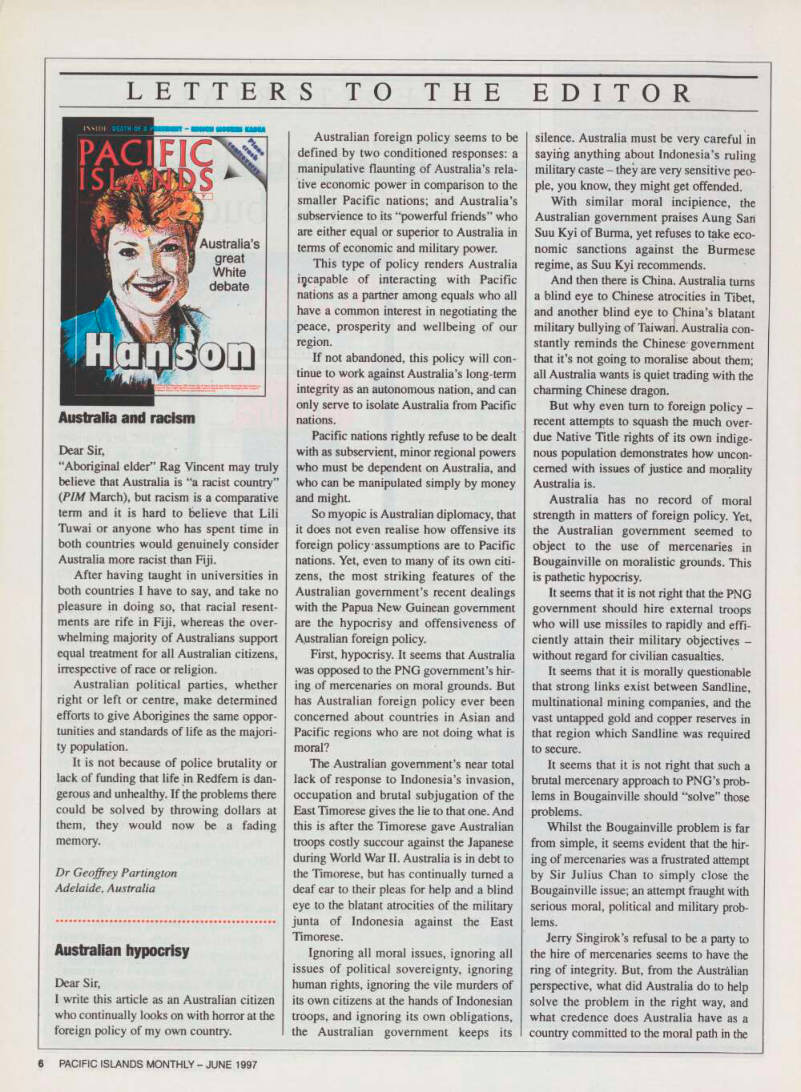
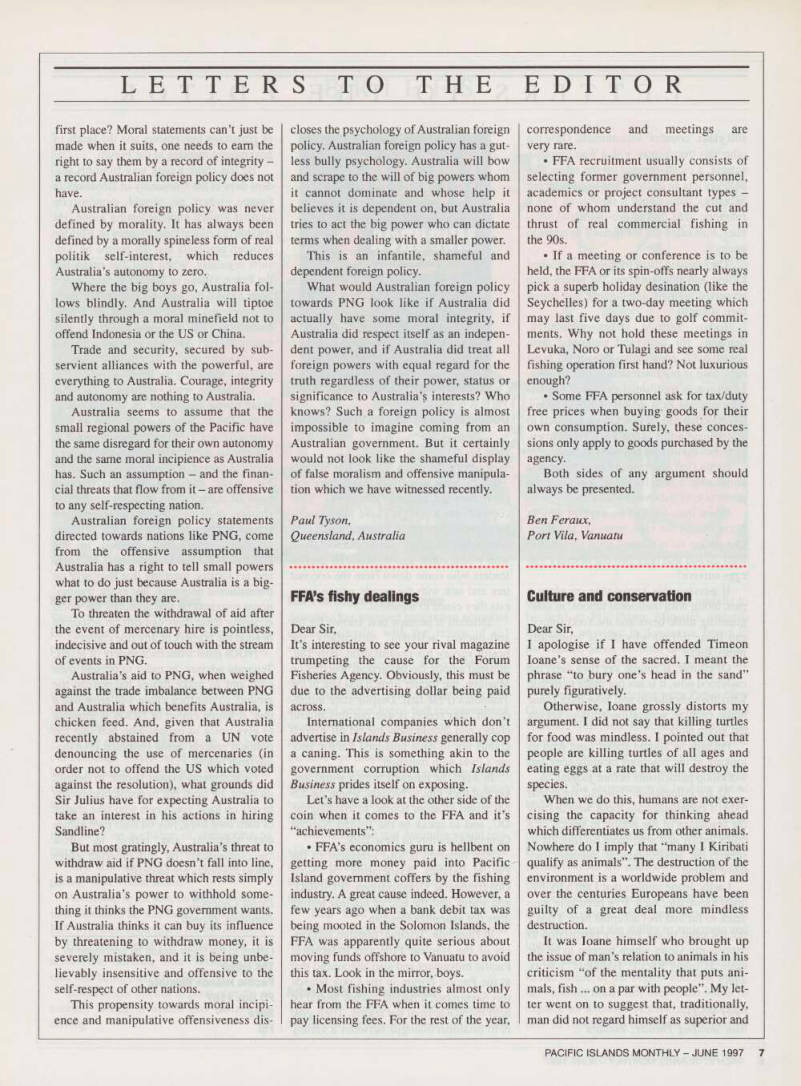
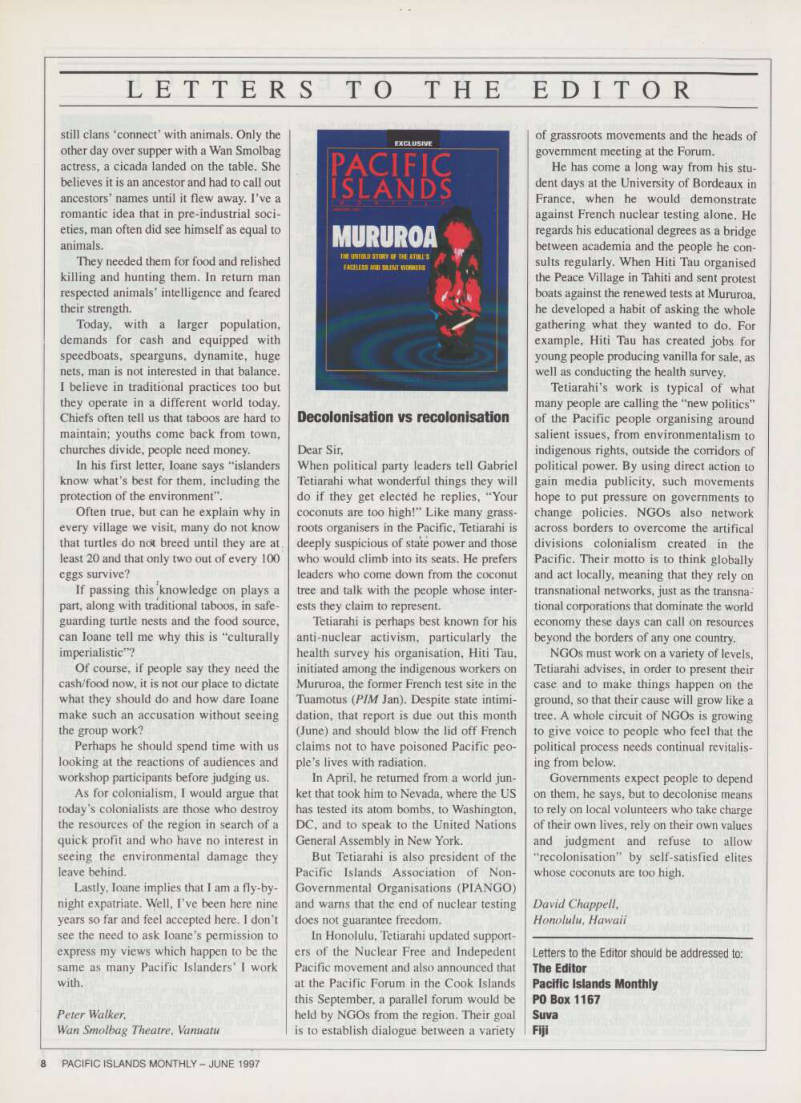
Now, it appears that Suva Prison, in Fiji’s capital, is in a similar situation highlighted in a letter mysteriously sent to the permanent secre tary for home affairs.
Fiji is, of course,
no stranger to corruption; the National Bank of Fiji scandal is enough to put to rest any debate on that.
But allegations of prison corruption, which come fast on the heels of a commis sion of inquiry into fishy goings on in the Customs Department, cannot be taken lightly.
Certainly, it can be argued, corruption exists in every department, country and region in the world.
Fiji’s commissioner of prisons, Aisea Taoka, states as much when he says nepo tism is rife the country over.
But, as Taoka also admits, this is no jus tification.
The Prisons Department is part of the nation’s law and order system. And every effort must be made to ensure that the enforcers of law and order are above reproach. Else, what hope is there for a nation?
Just why are the region’s people so sus ceptible to petty bribes? One senior cus toms officer admitted to taking a mere
Sfsooo.
Could it have anything to do with the generally low pay structure in the South Pacific?
According to one Customs officer, offi cers in Fiji are earning between SFSOOO and SFBOOO annually.
Fiji’s permanent secertary for labour, Anare Jale, claims there may be reasons other than low wages behind civil servants accepting bribes, and points his finger at
“greediness”.
However, it cannot be disputed that there is more temptation to “greed” in a country where the levels of pay do not live up to the high costs of living A Senate Select Committee report on
Fiji’s police force last year found that a number of police officers were on the poverty line.
A series of prison breakouts last year saw a huge public outcry in the country leading to the replacement of then commis sioner of prisons, Apolosi Vosanibola, with Taoka.
This is not the first time that the coun try’s Prisons Department has come into the spotlight of controversy.
Allegations of prison rape, highlighted last year, have still not been proven or dis proven. True, an investigation was carried out.
But the last the public heard, files of the investigation were being shuffled between the office of the director of public prosecu tions and the police.
The file now sits with the police, the DPP’s office says.
It is all very well to conduct one inquiry after another into allegations of shady deal ings, which seem to be cropping up all over the country with alarming regularity.
However, it is equally important to take the necessary measures to “nip” corruption “in the bud”, to use Taoka’s own phrase.
And, as the concerned letter writer says, “drastic actions are urgently needed”. ■
• Cover stories on page 14
Letters To The Editor
Australia and racism
Dear Sir, “Aboriginal elder” Rag Vincent may truly believe that Australia is “a racist country” (PIM March), but racism is a comparative term and it is hard to believe that Lili Tuwai or anyone who has spent time in both countries would genuinely consider Australia more racist than Fiji.
After having taught in universities in both countries I have to say, and take no pleasure in doing so, that racial resent ments are rife in Fiji, whereas the over whelming majority of Australians support equal treatment for all Australian citizens, irrespective of race or religion.
Australian political parties, whether right or left or centre, make determined efforts to give Aborigines the same oppor tunities and standards of life as the majori ty population.
It is not because of police brutality or lack of funding that life in Redfem is dan gerous and unhealthy. If the problems there could be solved by throwing dollars at them, they would now be a fading memory.
Dr Geoffrey Partington
Adelaide, Australia
Australian hypocrisy
Dear Sir, I write this article as an Australian citizen who continually looks on with horror at the foreign policy of my own country.
Australian foreign policy seems to be defined by two conditioned responses: a manipulative flaunting of Australia’s rela tive economic power in comparison to the smaller Pacific nations; and Australia’s subservience to its “powerful friends” who are either equal or superior to Australia in terms of economic and military power.
This type of policy renders Australia incapable of interacting with Pacific nations as a partner among equals who all have a common interest in negotiating the peace, prosperity and wellbeing of our region.
If not abandoned, this policy will con tinue to work against Australia’s long-term integrity as an autonomous nation, and can only serve to isolate Australia from Pacific nations.
Pacific nations rightly refuse to be dealt with as subservient, minor regional powers who must be dependent on Australia, and who can be manipulated simply by money and might.
So myopic is Australian diplomacy, that it does not even realise how offensive its foreign policy assumptions are to Pacific nations. Yet, even to many of its own citi zens, the most striking features of the Australian government’s recent dealings with the Papua New Guinean government are the hypocrisy and offensiveness of Australian foreign policy.
First, hypocrisy. It seems that Australia was opposed to the PNG government’s hir ing of mercenaries on moral grounds. But has Australian foreign policy ever been concerned about countries in Asian and Pacific regions who are not doing what is moral?
The Australian government’s near total lack of response to Indonesia’s invasion, occupation and brutal subjugation of the East Timorese gives the lie to that one. And this is after the Timorese gave Australian troops costly succour against the Japanese during World War 11. Australia is in debt to the Timorese, but has continually turned a deaf ear to their pleas for help and a blind eye to the blatant atrocities of the military junta of Indonesia against the East Timorese.
Ignoring all moral issues, ignoring all issues of political sovereignty, ignoring human rights, ignoring the vile murders of its own citizens at the hands of Indonesian troops, and ignoring its own obligations, the Australian government keeps its
silence. Australia must be very careful in saying anything about Indonesia’s ruling military caste - they are very sensitive peo ple, you know, they might get offended.
With similar moral incipience, the Australian government praises Aung Sari Suu Kyi of Burma, yet refuses to take eco nomic sanctions against the Burmese regime, as Suu Kyi recommends.
And then there is China. Australia turns a blind eye to Chinese atrocities in Tibet, and another blind eye to China’s blatant military bullying of Taiwanl. Australia con stantly reminds the Chinese government that it’s not going to moralise about them; all Australia wants is quiet trading with the charming Chinese dragon.
But why even turn to foreign policy recent attempts to squash the much over due Native Title rights of its own indige nous population demonstrates how uncon cerned with issues of justice and morality Australia is.
Australia has no record of moral strength in matters of foreign policy. Yet, the Australian government seemed to object to the use of mercenaries in Bougainville on moralistic grounds. This is pathetic hypocrisy.
It seems that it is not right that the PNG government should hire external troops who will use missiles to rapidly and effi ciently attain their military objectives without regard for civilian casualties.
It seems that it is morally questionable that strong links exist between Sandline, multinational mining companies, and the vast untapped gold and copper reserves in that region which Sandline was required to secure.
It seems that it is not right that such a brutal mercenary approach to PNG’s prob lems in Bougainville should “solve” those problems.
Whilst the Bougainville problem is far from simple, it seems evident that the hir ing of mercenaries was a frustrated attempt by Sir Julius Chan to simply close the Bougainville issue; an attempt fraught with serious moral, political and military prob lems.
Jerry Srngirok’s refusal to be a party to the hire of mercenaries seems to have the ring of integrity. But, from the Australian perspective, what did Australia do to help solve the problem in the right way, and what credence does Australia have as a country committed to the moral path in the
first place? Moral statements can’t just be made when it suits, one needs to earn the right to say them by a record of integrity a record Australian foreign policy does not have.
Australian foreign policy was never defined by morality. It has always been defined by a morally spineless form of real politik self-interest, which reduces Australia’s autonomy to zero.
Where the big boys go, Australia fol lows blindly. And Australia will tiptoe silently through a moral minefield not to offend Indonesia or the US or China.
Trade and security, secured by sub servient alliances with the powerful, are everything to Australia. Courage, integrity and autonomy are nothing to Australia.
Australia seems to assume that the small regional powers of the Pacific have the same disregard for their own autonomy and the same moral incipience as Australia has. Such an assumption - and the finan cial threats that flow from it - are offensive to any self-respecting nation.
Australian foreign policy statements directed towards nations like PNG, come from the offensive assumption that Australia has a right to tell small powers what to do just because Australia is a big ger power than they are.
To threaten the withdrawal of aid after the event of mercenary hire is pointless, indecisive and out of touch with the stream of events in PNG.
Australia’s aid to PNG, when weighed against the trade imbalance between PNG and Australia which benefits Australia, is chicken feed. And, given that Australia recently abstained from a UN vote denouncing the use of mercenaries (in order not to offend the US which voted against the resolution), what grounds did Sir Julius have for expecting Australia to take an interest in his actions in hiring Sandline?
But most gratingly, Australia’s threat to withdraw aid if PNG doesn’t fall into line, is a manipulative threat which rests simply on Australia’s power to withhold some thing it thinks the PNG government wants.
If Australia thinks it can buy its influence by threatening to withdraw money, it is severely mistaken, and it is being unbe lievably insensitive and offensive to the self-respect of other nations.
This propensity towards moral incipi ence and manipulative offensiveness dis
closes the psychology of Australian foreign policy. Australian foreign policy has a gut less bully psychology. Australia will bow and scrape to the will of big powers whom it cannot dominate and whose help it believes it is dependent on, but Australia tries to act the big power who can dictate terms when dealing with a smaller power.
This is an infantile, shameful and dependent foreign policy.
What would Australian foreign policy towards PNG look like if Australia did actually have some moral integrity, if Australia did respect itself as an indepen dent power, and if Australia did treat all foreign powers with equal regard for the truth regardless of their power, status or significance to Australia’s interests? Who knows? Such, a foreign policy is almost
impossible to imagine coming from an
Australian government. But it certainly would not look like the shameful display of false moralism and offensive manipula tion which we have witnessed recently.
Paul Tyson,
Queensland, Australia
correspondence and meetings are very rare. • FFA recruitment usually consists of
selecting former government personnel,
academics or project consultant types none of whom understand the cut and thrust of real commercial fishing in the 90s. • If a meeting or conference is to be held, the FFA or its spin-offs nearly always pick a superb holiday desination (like the
Seychelles) for a two-day meeting which
may last five days due to golf commit ments. Why not hold these meetings in Levuka, Noro or Tulagi and see some real fishing operation first hand? Not luxurious
enough?
• Some FFA personnel ask for tax/duty free prices when buying goods for their own consumption. Surely, these conces sions only apply to goods purchased by the agency.
Both sides of any argument should always be presented.
Ben Feraux,
Port Vila, Vanuatu
FFA’s fishy dealings
Dear Sir, It’s interesting to see your rival magazine trumpeting the cause for the Forum Fisheries Agency. Obviously, this must be due to the advertising dollar being paid across.
International companies which don’t advertise in Islands Business generally cop a caning. This is something akin to the government corruption which Islands Business prides itself on exposing.
Let’s have a look at the other side of the coin when it comes to the FFA and it’s “achievements”: • FFA’s economics guru is hellbent on getting more money paid into Pacific Island government coffers by the fishing industry. A great cause indeed. However, a few years ago when a bank debit tax was being mooted in the Solomon Islands, the FFA was apparently quite serious about moving funds offshore to Vanuatu to avoid this tax. Look in the mirror, boys. • Most fishing industries almost only hear from the FFA when it comes time to pay licensing fees. For the rest of the year,
Culture and conservation
Dear Sir, I apologise if I have offended Timeon loane’s sense of the sacred. I meant the phrase “to bury one’s head in the sand”
purely figuratively.
Otherwise, loane grossly distorts my argument. I did not say that killing turtles for food was mindless. I pointed out that people are killing turtles of all ages and eating eggs at a rate that will destroy the
species.
When we do this, humans are not exer
cising the capacity for thinking ahead
which differentiates us from other animals.
Nowhere do I imply that “many I Kiribati qualify as animals”. The destruction of the environment is a worldwide problem and over the centuries Europeans have been guilty of a great deal more mindless destruction.
It was loane himself who brought up the issue of man’s relation to animals in his criticism “of the mentality that puts ani mals, fish ... on a par with people”. My let ter went on to suggest that, traditionally, man did not regard himself as superior and
still clans ‘connect’ with animals. Only the other day over supper with a Wan Smolbag actress, a cicada landed on the table. She believes it is an ancestor and had to call out ancestors’ names until it flew away. I’ve a romantic idea that in pre-industrial soci eties, man often did see himself as equal to animals.
They needed them for food and relished killing and hunting them. In return man respected animals’ intelligence and feared
their strength.
Today, with a larger population, demands for cash and equipped with speedboats, spearguns, dynamite, huge nets, man is not interested in that balance.
I believe in traditional practices too but they operate in a different world today.
Chiefs often tell us that taboos are hard to maintain; youths come back from town, churches divide, people need money.
In his first letter, loane says “islanders know what’s best for them, including the protection of the environment”.
Often true, but can he explain why in every village we visit, many do not know that turtles do no* breed until they are at least 20 and that only two out of every 100 eggs survive?
If passing this knowledge on plays a part, along with traditional taboos, in safe guarding turtle nests and the food source, can loane tell me why this is “culturally imperialistic”?
Of course, if people say they need the cash/food now, it is not our place to dictate what they should do and how dare loane make such an accusation without seeing the group work?
Perhaps he should spend time with us looking at the reactions of audiences and workshop participants before judging us.
As for colonialism, I would argue that today’s colonialists are those who destroy the resources of the region in search of a quick profit and who have no interest in seeing the environmental damage they leave behind.
Lastly, loane implies that I am a fly-by night expatriate. Well, I’ve been here nine years so far and feel accepted here. I don’t see the need to ask loane’s permission to express my views which happen to be the same as many Pacific Islanders’ I work with.
Peter Walker,
Wan Smolbag Theatre, Vanuatu
Advertisements & other items, p. 7 (1 item)
Letters To The Editor
Decolonisation vs recolonisation
Dear Sir, When political party leaders tell Gabriel Tetiarahi what wonderful things they will do if they get elected he replies, “Your coconuts are too high!” Like many grass roots organisers in the Pacific, Tetiarahi is deeply suspicious of state power and those who would climb into its seats. He prefers leaders who come down from the coconut tree and talk with the people whose inter ests they claim to represent.
Tetiarahi is perhaps best known for his anti-nuclear activism, particularly the health survey his organisation, Hiti Tau, initiated among the indigenous workers on Mururoa, the former French test site in the Tuamotus ( PIM Jan). Despite state intimi dation, that report is due out this month (June) and should blow the lid off French claims not to have poisoned Pacific peo ple’s lives with radiation.
In April, he returned from a world jun ket that took him to Nevada, where the US has tested its atom bombs, to Washington, DC, and to speak to the United Nations General Assembly in New York.
But Tetiarahi is also president of the Pacific Islands Association of Non- Governmental Organisations (PIANGO) and warns that the end of nuclear testing does not guarantee freedom.
In Honolulu, Tetiarahi updated support ers of the Nuclear Free and Indepedent Pacific movement and also announced that at the Pacific Forum in the Cook Islands this September, a parallel forum would be held by NGOs from the region. Their goal is to establish dialogue between a variety
of grassroots movements and the heads of government meeting at the Forum.
He has come a long way from his stu dent days at the University of Bordeaux in France, when he would demonstrate against French nuclear testing alone. He regards his educational degrees as a bridge between academia and the people he con sults regularly. When Hiti Tau organised the Peace Village in Tahiti and sent protest boats against the renewed tests at Mururoa, he developed a habit of asking the whole gathering what they wanted to do. For example, Hiti Tau has created jobs for young people producing vanilla for sale, as well as conducting the health survey.
Tetiarahi’s work is typical of what many people are calling the “new politics” of the Pacific people organising around salient issues, from environmentalism to indigenous rights, outside the corridors of political power. By using direct action to gain media publicity, such movements hope to put pressure on governments to change policies. NGOs also network across borders to overcome the artifical divisions colonialism created in the Pacific. Their motto is to think globally and act locally, meaning that they rely on transnational networks, just as the transna tional corporations that dominate the world economy these days can call on resources beyond the borders of any one country.
NGOs must work on a variety of levels, Tetiarahi advises, in order to present their case and to make things happen on the ground, so that their cause will grow like a tree. A whole circuit of NGOs is growing to give voice to people who feel that the political process needs continual revitalis ing from below.
Governments expect people to depend on them, he says, but to decolonise means to rely on local volunteers who take charge of their own lives, rely on their own values and judgment and refuse to allow “recolonisation” by self-satisfied elites whose coconuts are too high.
David Chappell,
Honolulu, Hawaii
Letters to the Editor should be addressed to: The Editor Pacific Islands Monthly PO Box 1167 Suva Fiji
Advertisements & other items, p. 8 (1 item)
Letters To The Editor
Briefs
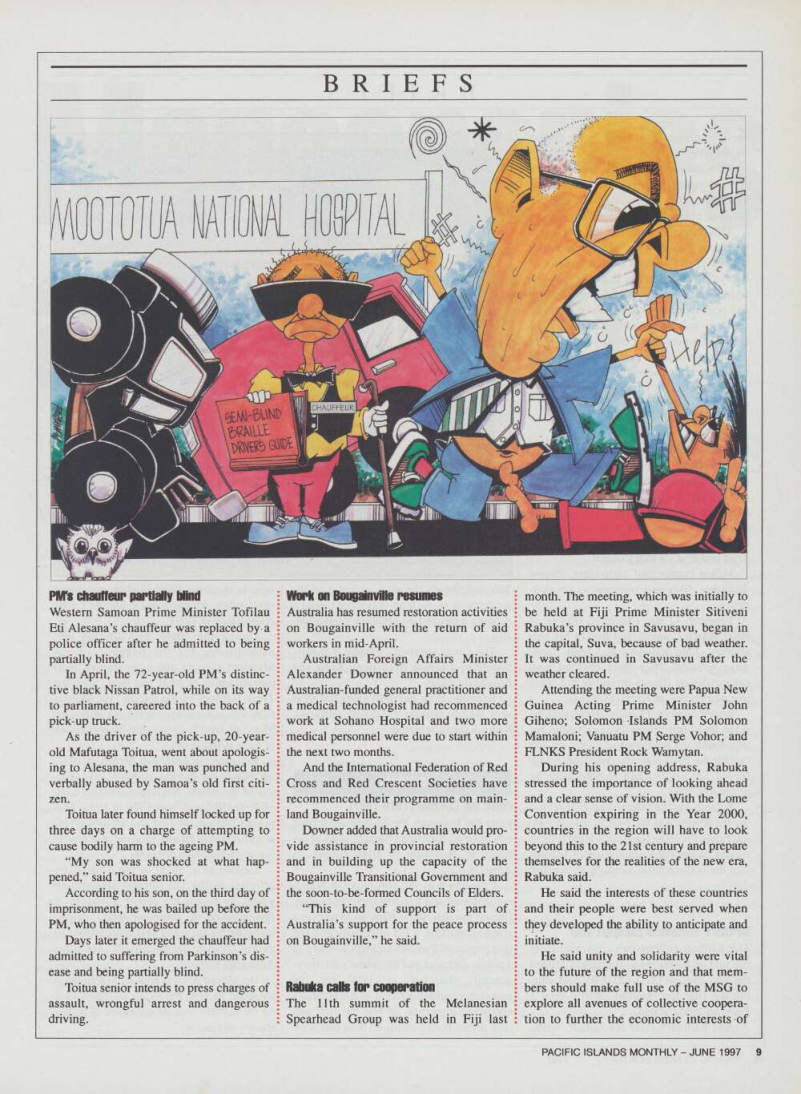
FRITs chauffeur partially Hind Western Samoan Prime Minister Tofilau Eti Alesana’s chauffeur was replaced by a police officer after he admitted to being partially blind.
In April, the 72-year-old PM’s distinc tive black Nissan Patrol, while on its way to parliament, careered into the back of a pick-up truck.
As the driver of the pick-up, 20-year old Mafutaga Toitua, went about apologis ing to Alesana, the man was punched and verbally abused by Samoa’s old first citi zen.
Toitua later found himself locked up for three days on a charge of attempting to cause bodily harm to the ageing PM.
“My son was shocked at what hap pened,” said Toitua senior.
According to his son, on the third day of imprisonment, he was bailed up before the PM, who then apologised for the accident.
Days later it emerged the chauffeur had admitted to suffering from Parkinson’s dis ease and being partially blind.
Toitua senior intends to press charges of assault, wrongful arrest and dangerous
driving.
Work on Bougainville resumes Australia has resumed restoration activities on Bougainville with the return of aid workers in mid-April.
Australian Foreign Affairs Minister Alexander Downer announced that an
Australian-funded general practitioner and
a medical technologist had recommenced work at Sohano Hospital and two more medical personnel were due to start within the next two months.
And the International Federation of Red Cross and Red Crescent Societies have recommenced their programme on main
land Bougainville.
Downer added that Australia would pro vide assistance in provincial restoration and in building up the capacity of the Bougainville Transitional Government and the soon-to-be-formed Councils of Elders.
“This kind of support is part of Australia’s support for the peace process on Bougainville,” he said.
Rabuka calls for cooperation The 11th summit of the Melanesian Spearhead Group was held in Fiji last
month. The meeting, which was initially to be held at Fiji Prime Minister Sitiveni Rabuka’s province in Savusavu, began in the capital, Suva, because of bad weather.
It was continued in Savusavu after the weather cleared.
Attending the meeting were Papua New
Guinea Acting Prime Minister John Giheno; Solomon Islands PM Solomon Mamaloni; Vanuatu PM Serge Vohor; and FLNKS President Rock Wamytan.
During his opening address, Rabuka stressed the importance of looking ahead and a clear sense of vision. With the Lome Convention expiring in the Year 2000, countries in the region will have to look beyond this to the 21st century and prepare themselves for the realities of the new era, Rabuka said.
He said the interests of these countries and their people were best served when they developed the ability to anticipate and initiate.
He said unity and solidarity were vital to the future of the region and that mem bers should make full use of the MSG to explore all avenues of collective coopera tion to further the economic interests of
these countries - both within the region
and beyond.
He added that the region, with its natu ral and unexplored potential resources, have been and will continue to be of inter est to its more advanced neighbours.
This made it vital for the region to
develop and explore practical and mutually
beneficial cooperation among itself in as many different areas as possible, he said, adding that everyone should work together and pool their commercial and diplomatic resources in order to ensure that we get bet ter deals in the interest of its people.
“We can look for avenues for increased trade between ourselves and at how we can help each other in improving our terms of trade with other countries,” he said.
PNG police raids NGO offices The Pacific Concerns Resource Centre (PCRC) has condemned the early-moming police raid of three NGO offices in Port Moresby last month. The offices raided belonged to Individual and Community Rights Advocacy Forum (ICRAF), PNG Trust and PNG Watch Council.
Police confiscated computers, floppy diskettes, files and overseas correspon dence.
Jonathan O’ata, executive officer of PNG Watch Council, and two of his col leagues, John Kawowo and, John Napo, were arrested. They were charged with organising an illegal assembly but were released on bail of Kl5O (SUSII4).
Lopeti Senituli, PCRC director, said the three had been primarily responsible for organising the soldiers and public protest outside the PNG National Assembly which forced Sir Julius Chan to step aside as
prime minister.
Senituli said he believed another reason for the arrests was the NGOs’ role in rais ing funds for Jerry Singirok’s legal bills to appear before the Commission of Inquiry into the controversial Sandline mercenary deal.
Kiribati's successful passport sale The Kiribati government’s revenue from the sale of passports to foreigners topped the SAI-million ($US700,000) mark dur ing the first four months of this year, a Pacnews report stated.
And Kiribati’s chief accountant, Teriba
Tabe, attributed the sales increase to the recognition of such an investment, which is being promoted by agencies internation ally.
The Green passports scheme is mainly bought by Chinese from Hong Kong and mainland China.
Revenue from passport sales last year was SAI.S million (SUSI.OS million).
Radio Kiribati reported.
Obituary
Peter Tali Coleman (1919-1997) Peter Tali Coleman, the 78-year-old former governor of American Samoa, died at his home in Honolulu of liver cancer on April 28.
Coleman was the son of a US Navy enlisted man and a native Samoan mother.
He was the first native Samoan to receive a law degree from a US university and the first person of Samoan ancestry to serve as a public defender and the island’s attorney general. Selected in 1956 by the Eisenhower administration as the federally appointed governor, he was the first and only native-born Samoan to hold that posi
tion. In that role, he chaired the territorial convention which created Samoa’s first constitution in 1960.
During the 1960 s and 70s, he was administrator for the Republic of the Marshall Islands and later deputy high commissioner of what was then called the Trust Territory of the Pacific. He was the first US citizen to receive an honorary Marshall Islands citizenship by special act of their parliament.
Returning to American Samoa in 1977, he became the first poularly elected gover nor of the island, holding that office from 1978 to 1985 and from 1989 to 1993. This made Coleman the first and only individu al in American history to serve as a gover nor in each of five decades.
Lauded as a “giant of the islands” by officials in the US Interior Department where he began his career, Coleman is remembered as someone who “helped
bring democracy and self-government to
many island jurisdictions, not just American Samoa”.
He played a vital role as Washington loosened its ties, and as the islanders took on the burdens and opportunities of partic
ipatory democracy”.
PIM loses
North
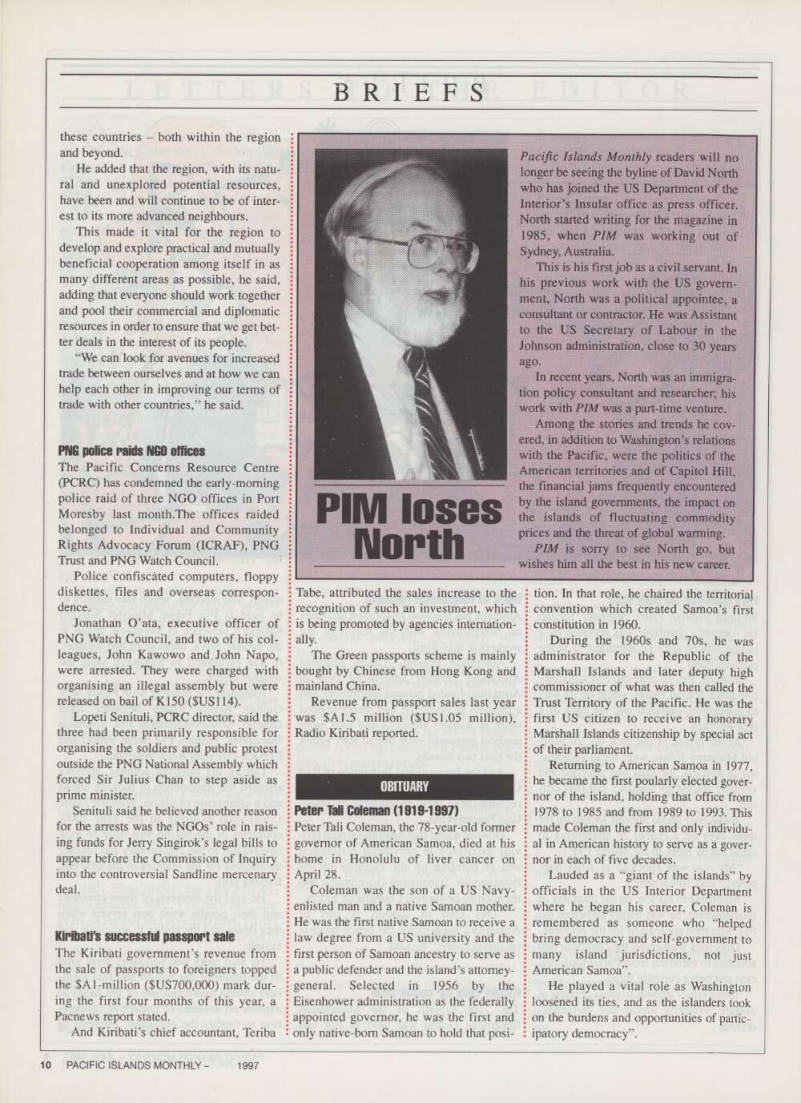
Pacific Islands Monthly readers will no longer be seeing the byline of David North who has joined the US Department of the Interior’s Insular office as press officer.
North started writing for the magazine in 1985, when PIM was working out of
Sydney, Australia.
This is his first job as a civil servant. In his previous work with the US govern ment, North was a political appointee, a consultant or contractor. He was Assistant to the US Secretary of Labour in the Johnson administration, close to 30 years ago.
In recent years, North was an immigra tion policy consultant and researcher; his work with PIM was a part-time venture.
Among the stories and trends he cov ered, in addition to Washington’s relations with the Pacific, were the politics of the American territories and of Capitol Hill, the financial jams frequently encountered by the island governments, the impact on the islands of fluctuating commodity prices and the threat of global warming.
PIM is sorry to see North go, but wishes him all the best in his new career.
Advertisements & other items, p. 10 (1 item)
Briefs
and mining
Special Report
Mercenaries and mining
Investigations into PNG’s Sandline scandal find link with Fiji’s Emperor Mines
By Alfred Sasako
Until March this year, little was known in the South Pacific about mercenaries - how these soldiers of fortune operate, who is behind them and the dodgy government deals from which they might make their millions. But the aborted attempt by Sir Julius Chan of Papua New Guinea to engage Sandline mercenaries on Bougainville has lifted the lid off their wheelings and dealings.
What has emerged is a tangled web of interconnections involving individuals, politicians, mining companies, soldiers of fortune and get-rich-quick schemes in the world of mining.
An investigation by Australia’s Radio National in a programme called Background Briefing has uncovered the tangled web of often complex interconnections. And some of these companies have links much closer to home than many have realised.
It is important to note that there is nothing legally wrong with these interconnections or with the fact that people in the mining industry have interests in many ventures, according to Background Briefing.
“The danger and the fascination with it all is that the risks - polit ical, military, geological - and the corruption and dodgy deals with dodgy governments are not seen as obstacles to business,” it said. In this case, one man’s name stands out - with links to mining compa nies, including Emperor Gold Mines in western Fiji - in a “tangled and complex web of companies and associations”.
That man, according to Background Briefing, is a Robert Friedland who owns a SA9-million ($F6.9-million) home in the Sydney suburb of Point Piper.
But who is he and who are the people around him? Friedland is a Canadian citizen and Australian resident whose corporate empire spans nearly the whole globe with offices in Australia, Canada and
Singapore.
In the mining industry, Friedland is nicknamed and known to some people in the industry as “Toxic Bob” because, in 1989, his gold mine in Summitville, in the United States, was found to be “one of the 10 most toxic sites in the USA”.
The US taxpayer has so far had to pay well over SUSIOO million in the ongoing clean up. The flamboyant mining entrepreneur is yet to make his contribution. And to this day, the US Justice Department is chasing “Toxic Bob” for a reported US$l5O million to help clean up the Summitville site.
Friedland has been active in the mining industry since the 1980 s.
In 1996, he made SUS6OO million when he sold his claim to the world’s richest nickel deposit in Voisey Bay in Labrador, Canada.
In recent years, Friedland has recruited the best and the brightest from the world’s big mining and investment houses, including those from the Hong Kong office of Jardine Fleming Bank.
Incidentally, Jardine Fleming is the firm Sir Julius approached to manage PNG’s proposed buy-out of RTZZ-CRA’s stake in the Panguna Copper mine on Bougainville.
One of the top executives Friedland has on his management team at Ivanhoe Capital (Friedland’s private company) is an Australian mining engineer by the name of Gordon Toil, a former mining exec utive with RTZ. Ivanhoe Capital is based in Singapore.
Today, Toll is the executive vice-president of Indochina Goldfields, a company listed on the Sydney Stock Exchange with investments in Burma, Vietnam and Fiji.
Toll is also chairman of another company called Australian Bulk Minerals. All these companies are connected to Friedland, accord
ing to Background Briefing.
But there’s more.
During investigations. Background Briefing discovered that Diamondworks, an associate company of Friedland’s, bought Branch Energy last year. Branch Energy is the mining company most closely associated with Executive Outcomes, Sandline International and Colonel Tim Spicer - the brain behind PNG’s
SUS36-million aborted mercenary deal.
In a controversial report prepared for Carson Gold (now Diamondworks), there is an interesting reference to the hotly denied closeness between mining and mercenaries. The report, prepared at the time Spicer and others were discussing the PNG deal, states that “both Sierra Leone and Angola have been under the duress of civil war, but peace has been achieved largely through military assistance provided by Executive Outcomes, Branch Energy’s parent company, to the governments of these countries”.
It is a controversial statement because it says what has always been denied: that Executive Outcomes, the mercenary company, owns Branch Energy. Hereon, the tangled and complex web of com panies and associations deepens. Records at the Vancouver Stock Exchange show that Diamondworks is listed there as a company.
Last October, Tim Spicer of 535 King’s Road, London, was granted 10,000 options to buy shares in Diamondworks. Spicer’s London address is also the address for Sandline International and Branch Energy. The granting of stock options to Spicer and other mining and mercenary employees was done under a section of the Securities Act of British Columbia, Canada.
It states that “certain persons who although in form are indepen dent contractors, in substance are employees”.
“It seems [that] when Branch Energy wanted to raise finance to expand, they headed for Canada, where they made contact with
Robert Friedland,” Background Briefing stated. Whiat do those behind mining companies closely associated with mercenaries look for as they scout around for opportunities, especially iin the Asia- Pacific region? What is their aim and when do they make their swoop?
Edward Hood, a director of Emperor Mines in Fiji and president of Indochina Goldfields, provides some insight for us in a corporate video.
Flood explained: “As a fund manager in San Fracisco, we looked at mining opportunities around the world [and] the Emperor Mine is the classic type of opportunity you are looking for.
“You are looking for a mine that is undervalued in terms of its comparable companies, it is undervalued in terms of the resource base that exists at the time, and it is undervalued in terms of what its future production is going to be. And the Emperor Mine fits that bill in all cases. It is a mine that has a growing production, it has pro jector costs which will be coming down, but it has a tremendous resource base to be able to grow from.”
It seems they had these areas were well covered when the Vatukoula mine began operations. And, according to Background Briefing, Indochina Goldfields told its shareholders in the Sydney Stock Exchange last December that its aim was to “create a large and growing presence in the Asia-Pacific and to become a major low-cost copper producer.” ■
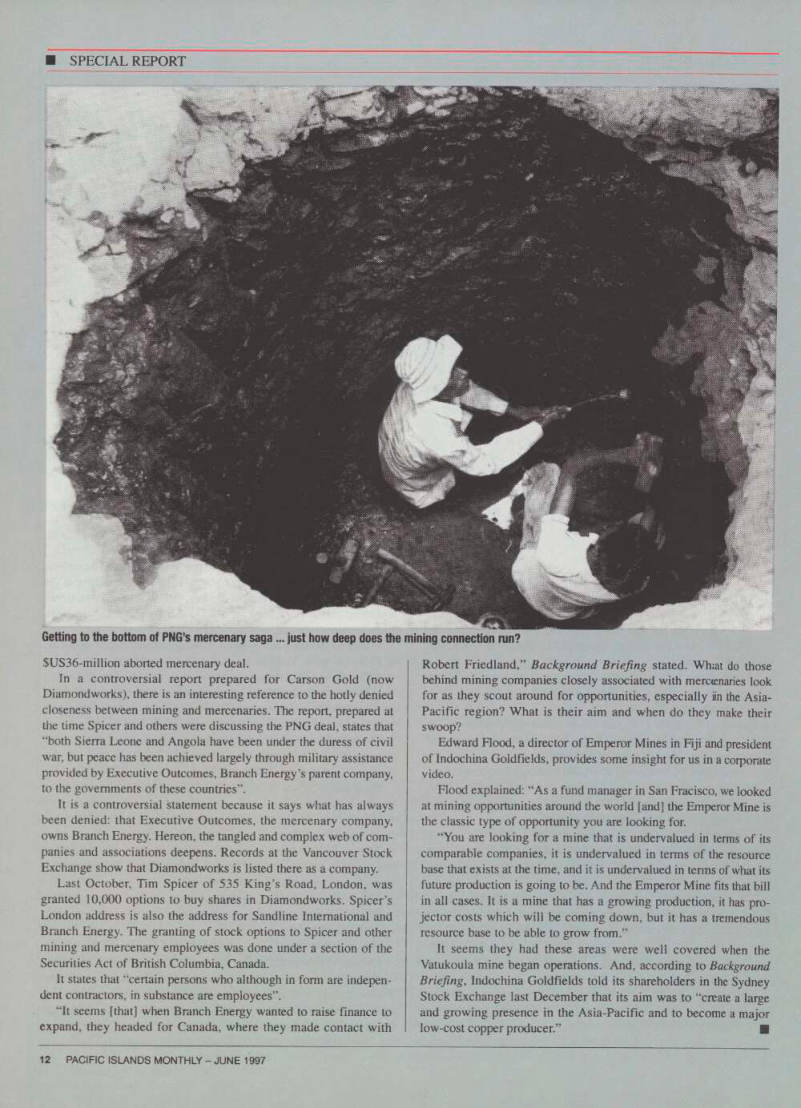
Getting to the bottom of PNG’s mercenary saga...just how deep does the mining connection run?
Mine ready
to negotiate Haiveta reveals government plans for takeover at Sandline inquiry
By Sam Vulum
Bougainville Copper Limited, the developer of the controversial Panguna copper mine in the North Solomons Province has finally indicated that is prepared to listen to landowners’ demands for greater participation in the operations of the world’s second-largest open-pit copper mine. This comes nine years after millions of kina’s worth of destruction and the loss of hundreds of lives.
“Greater landowners’ participation,” was briefly discussed at the 24th annual general meeting of BCL in the Papua New Guinea cap ital, Port Moresby, on April 29. Answering questions by a principal Panguna mine landowner, Sevenrinus Ampoai, at the meeting, BCL chairman David Karpin said the Bougainville mine agreement would be reviewed to include equity for the Panguna landowners.
“There will be changes to the Bougainville Agreement. Equity will be a relevant matter to future discussions on the agreement,” Karpin said.
Ampoai reminded the BCL chairman and members of the board of directors that the agreement was not equitable to Panguna landowners because it was negotiated and signed by the national government and CRA Ltd. BCL’s 1996 annual report shows that the company has set aside K 15.9 million (SUSIO million) for compen sation payments to landowners for the period 1990 to 1996.
According to the report, the amount is being held in an interest bearing account.
Government plans were revealed during the Commission of Inquiry into the engagement of Sandline mercenaries. Chris Haiveta, former PNG deputy prime minister, told the inquiry the government
had planned “Operation Oyster” to recapture Panguna mine and “Operation Valentine” to acquire CRA’s interest in the mine.
He said the involvement of two controversial entities in the Sandline deal - Rupert McGowan and Jardine Fleming Inc - was to advise the government to give Panguna and Bougainville landown ers “a better deal”.
Haiveta said the government would give at least 20 per cent equi ty in BCL if it succeeded in acquiring CRA’s 53.6 per cent control ling interest. He told the inquiry the government wanted to increase its current stake in BCL by buying out CRA’s controlling interest. It would then be in a position to give Bougainvillians “20 or 25 per cent” equity, at no cost, as part of the resolution to the nine-year Bougainville crisis. He said he had hired Jardine Flemming Inc as financial broker for the acquisition. Jardine acted as financial advis er in the successful Orogen Mining Ltd float. “The government has [a] 19.1 per cent [stake] at the moment and we hope that by buying 53.6 per cent we would have a total control of 72.7 per cent,” he said. “That would give up, say, 20 to 25 per cent that we would give to the landowners, the North Solomons provincial government and the people of Bougainville.”
The revelations, however, fell short of touching on earlier reports that heavy share trading and a sudden increase in prices in Bougainville copper shares occurred before the government’s mer cenary deal was exposed. The BCL chairman confirmed the trading and indicated that investigations were continuing. The Australian government wrote to the Australian Stock Exchange (ASX) in early March seeking information on who bought more than one million shares in BCL just before news broke of the mercenary plan.
It was suggested that the share trading involved members of the PNG government, but no names were mentioned. More than one million shares in BCL were purchased for around 60 cents each on February 14, 18 and 19. The ASX traced the trades to Brisbane based firm Morgan Stockbroking, a co-manager of the Orogen Minerals float last year.
The Panguna mine was closed on May 15, 1989, by disgruntled landowners over lack of adequate benefits from mining operations.
The landowners had demanded from the government and BCL, a hefty KlO-billion ($U56.95-billion) compensation for environmen tal damage. Militant landowners later took up arms and shut down the mine as well as government services to Bougainville.
Meanwhile, in his supplementary statement to shareholders, Karpin renewed BCL’s commitment to resume mining operations, subject to economic viability and when conditions permitted on war tom Bougainville. Karpin reiterated that BCL had not been able to assess the condition of the mine since 1990.
“It should be noted that economic viability of any future opera tions will depend on a number of factors which cannot be accurate ly predicted this time, including the cost of recommissioning, likely future operating cost, government and community requirements, the copper/gold market and the economic outlook at the time,” he said.
“It is not possible at present to determine when this might be achieved or determine the degree of damage and deterioration to assests which might have occurred during the period of suspen sion.”
Since its inception in 1972 until cessation of operations in 1989, the mine produced concentrate containing three million tonnes of copper, 306 tonnes of gold and 784 tonnes of silver.
The production had a .value of K 5.2 billion (SUS 3.6 billion) which represented 44 per cent of PNG’s exports in that period.
Contributions to the national government in the form of taxes, duties
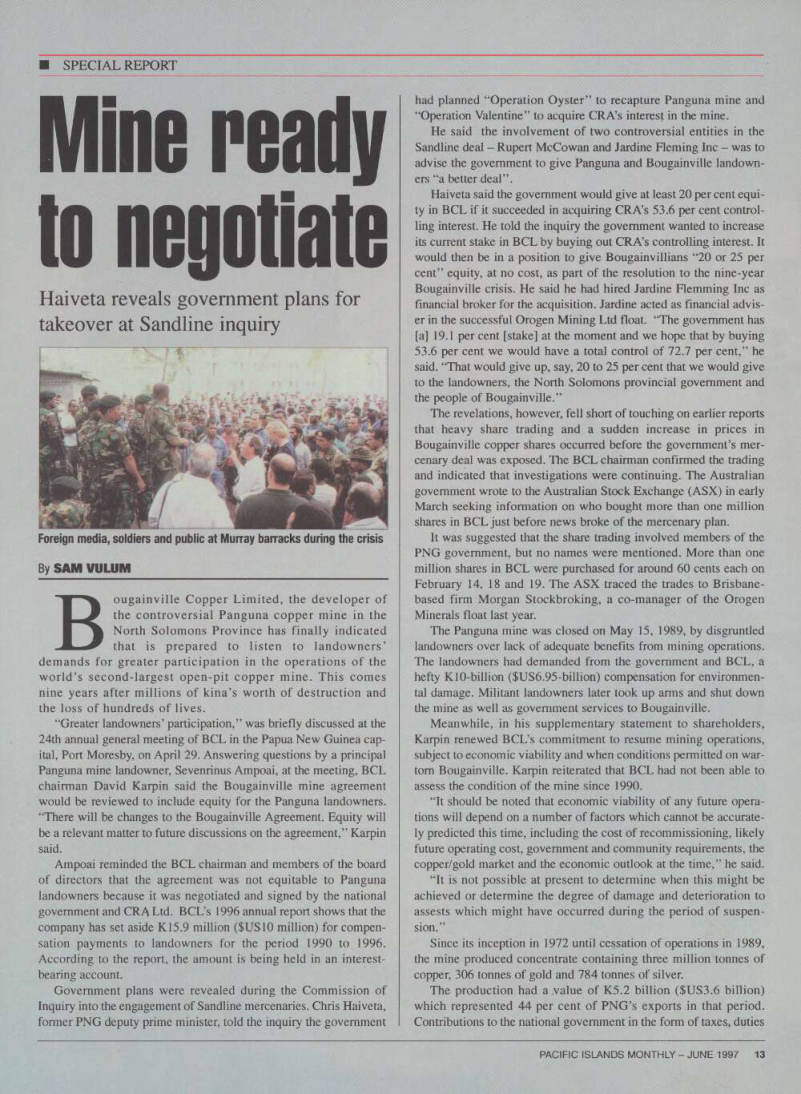
Foreign media, soldiers and public at Murray barracks during the crisis
Fiji's prison

Cover Stories
Exclusive
scandal
Investigations begin into allegations of drug dealing, nepotism and corruption behind Suva’s prison walls
By Bernadette Hussein
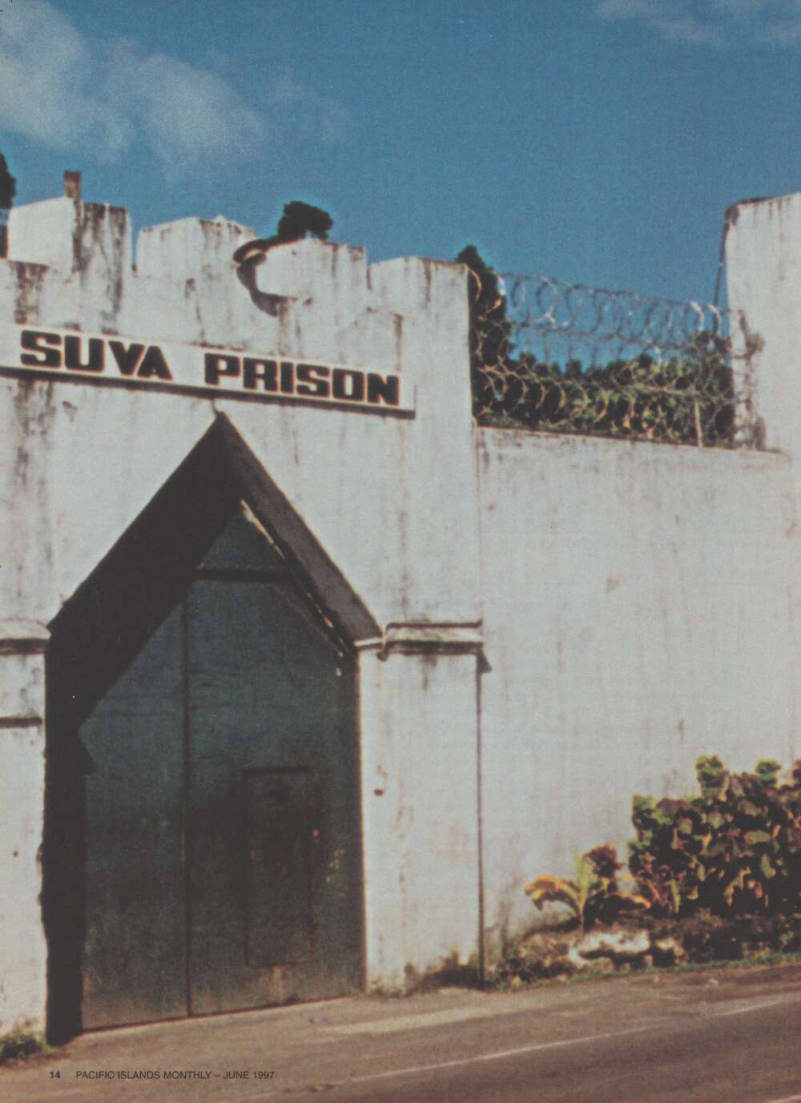
Fiji, which is at present trying to deal with allegations of corruption within its Customs Department (See page 18), must also contend with a prison scandal. Investigations by Pacific Islands Monthly have uncovered allegations of drug dealing, nepotism, abuse of office and cover-up of information at Suva Prison, in the country’s
capital.
A letter, dated April 4, 1997, and signed simply “Prison Intelligence Unit”, was sent to Fiji’s perma nent secretary for home affairs, Apisolome Tudreu.
The letter made serious allegations against the prison and did not stop short of naming names. It claimed bribery was rife, that there was a lack of discipline among prison officers and that prisoners moved freely around the security bay with no control over their movements to the visiting area.
Tudreu passed the letter on to the commissioner of prisons, Aisea Taoka, who, admitting to the prison’s drug problem, told PIM that investigations into the allegations had started. The investigating officers are from outside Suva Prison and are expected to inter view both officers and prisoners.
The anonymous letter writer said it was of the utmost urgency that Tudreu be informed of the situa tion at Suva Prison because things were escalating to a very “dangerous level”.
“Drug dealing among prisoners is common.
Prisoners are in possession of very large sums of money inside the prison to buy drugs and sell to oth
ers,” the letter stated. “Very recently, the Emergency Control Unit had to dig out a supply of drugs buried with a large sum of money from outside the jail.”
“Yes, there is a certain amount of drugs being found among prisoners and appropriate disciplinary actions have been taken against them,” Taoka con firmed.
But how do the drugs find their way in? Are visi tor security checks not thorough enough?
“Oh no, we still have security checks and these are quite thorough,” Taoka replied. But, over the years, the visitors have developed a system whereby they are able to smuggle these drugs in.
“It happens. It is the culture of prisons in the coun try - contraband items get in. We are still trying to find out how, as gifts and other parcels brought in - as well as the visitors - are checked.”
According to the letter, drugs were exchanged in the visiting area - where supervision of prisoners’ movements was lax. But Taoka is quick to deny this, saying the close proximity of officers to prisoners would not allow this.
On being asked why the problem was allowed to continue, Taoka replied: “I agree that it has to stop especially in a place of law and order but then that is the perfect situation we are talking about. These are the places that people least expect these sorts of things to happen but, yes, they are happening.
“A lot of things happen in prisons which we hear of and try to nip in the bud.” Taoka would not elabo rate on what these “things” were, but added that the problems were many.
“As for prisoners who are caught in possession of
drugs - they are reported to the police who charge them. These sentences often run consecutively with their time in prison sometimes they are added on.”
The letter goes on to claim that a pris oner who presented a superintendent with a tabua (whale’s tooth - highly valued in indigenous Fijian culture) and a bundle of fish, was soon after released on extramural duties.
The superintendent was also accused of nepotism, which the letter said was a major problem in the department. The letter claimed relatives of the superintendent were considered for promotions over deserving officers. Taoka, who said he was looking into this matter, qualified his state ment by adding that nepotism existed “in
all organisations”.
“There are businesses which employ family members to work for them. That is nepotism to the core. In a country as small as Fiji, most companies are run by families and everyone is related to the next person and, in some cases, it is unavoidable.”
He said nepotism occurred in govern ment departments as well as the private sector. When asked if its prevalence was its
justification, Taoka replied: “No, it’s not OK. We are related to people in one way or another and everybody needs to work but we should try to get the best people into the system. “People should not come in just because they are related to us.
“[But] first we have to find out if it is happening and, if it is, then we have to solve this problem in a diplomatic way.”
The letter alleges that one of the offi cers (who is a relative of the superinten dent in question) “was transferred from
another island to Suva because of house breaking, criminal trespass and attempted rape”.
“He was arrested and charged and he has already appeared in court. Early this year, the same officer was in charge of a cemetery work party when a newly issued lawnmower went missing.”
This officer was also reported to have grievously wounded a prisoner with a file in Suva, the letter continues, alleging that the police investigating officer who was
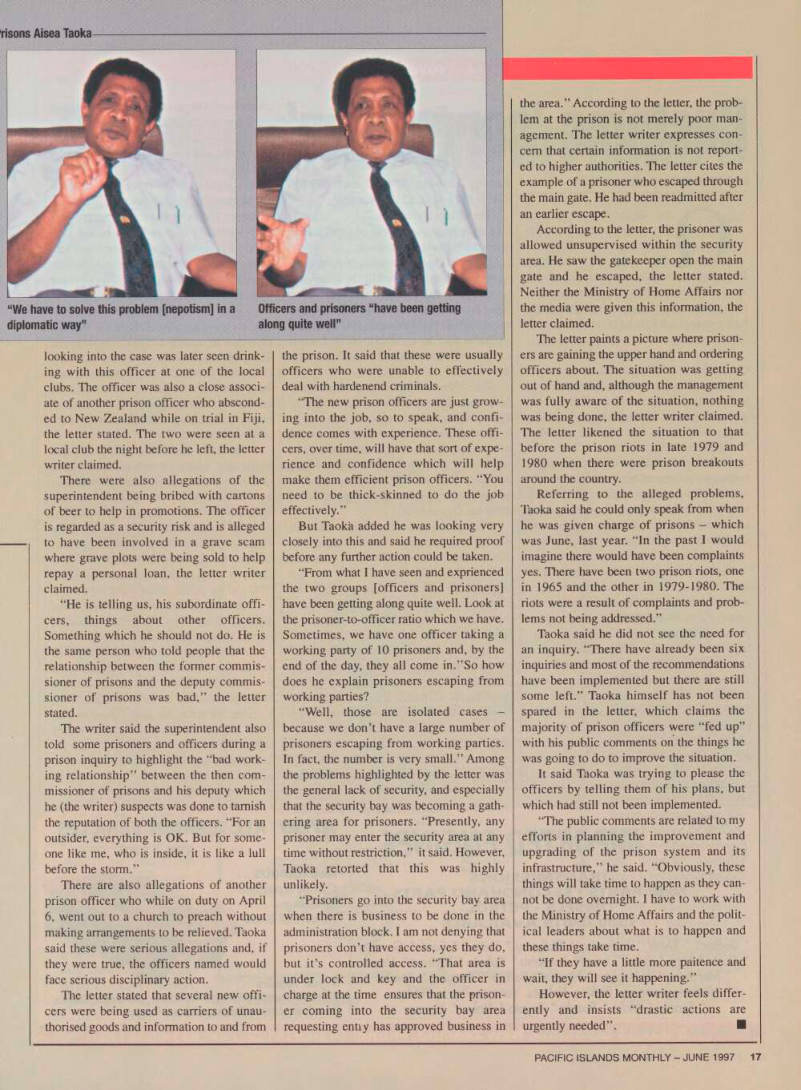
“Yes, there is a certain amount of drugs being found”
Commissioner
“A lot of things happen in prison”
looking into the case was later seen drink ing with this officer at one of the local clubs. The officer was also a close associ ate of another prison officer who abscond ed to New Zealand while on trial in Fiji, the letter stated. The two were seen at a local club the night before he left, the letter writer claimed.
There were also allegations of the superintendent being bribed with cartons of beer to help in promotions. The officer is regarded as a security risk and is alleged to have been involved in a grave scam where grave plots were being sold to help repay a personal loan, the letter writer claimed.
“He is telling us, his subordinate offi cers, things about other officers.
Something which he should not do. He is the same person who told people that the relationship between the former commis sioner of prisons and the deputy commis sioner of prisons was bad,” the letter stated.
The writer said the superintendent also told some prisoners and officers during a prison inquiry to highlight the “bad work ing relationship” between the then com missioner of prisons and his deputy which he (the writer) suspects was done to tarnish the reputation of both the officers. “For an outsider, everything is OK. But for some one like me, who is inside, it is like a lull before the storm.”
There are also allegations of another prison officer who while on duty on April 6, went out to a church to preach without making arrangements to be relieved. Taoka said these were serious allegations and, if they were true, the officers named would face serious disciplinary action.
The letter stated that several new offi cers were being used as carriers of unau thorised goods and information to and from
the prison. It said that these were usually officers who were unable to effectively deal with hardenend criminals.
“The new prison officers are just grow ing into the job, so to speak, and confi dence comes with experience. These offi cers, over time, will have that sort of expe rience and confidence which will help make them efficient prison officers. “You need to be thick-skinned to do the job
effectively.”
But Taoka added he was looking very closely into this and said he required proof before any further action could be taken.
“From what I have seen and exprienced the two groups [officers and prisoners] have been getting along quite well. Look at the prisoner-to-officer ratio which we have.
Sometimes, we have one officer taking a working party of 10 prisoners and, by the end of the day, they all come in.”So how
does he explain prisoners escaping from
working parties?
“Well, those are isolated cases because we don’t have a large number of
prisoners escaping from working parties.
In fact, the number is very small.” Among the problems highlighted by the letter was the general lack of security, and especially that the security bay was becoming a gath ering area for prisoners. “Presently, any prisoner may enter the security area at any time without restriction,” it said. However, Taoka retorted that this was highly
unlikely.
“Prisoners go into the security bay area when there is business to be done in the administration block. I am not denying that prisoners don’t have access, yes they do, but it’s controlled access. “That area is under lock and key and the officer in charge at the time ensures that the prison er coming into the security bay area requesting entiy has approved business in
the area.” According to the letter, the prob lem at the prison is not merely poor man agement. The letter writer expresses con cern that certain information is not report ed to higher authorities. The letter cites the example of a prisoner who escaped through the main gate. He had been readmitted after an earlier escape.
According to the letter, the prisoner was allowed unsupervised within the security area. He saw the gatekeeper open the main gate and he escaped, the letter stated.
Neither the Ministry of Home Affairs nor the media were given this information, the letter claimed.
The letter paints a picture where prison ers are gaining the upper hand and ordering officers about. The situation was getting out of hand and, although the management was fully aware of the situation, nothing was being done, the letter writer claimed.
The letter likened the situation to that before the prison riots in late 1979 and 1980 when there were prison breakouts around the country.
Referring to the alleged problems, Taoka said he could only speak from when he was given charge of prisons - which was June, last year. “In the past I would imagine there would have been complaints yes. There have been two prison riots, one in 1965 and the other in 1979-1980. The riots were a result of complaints and prob lems not being addressed.”
Taoka said he did not see the need for an inquiry. “There have already been six inquiries and most of the recommendations have been implemented but there are still some left.” Taoka himself has not been spared in the letter, which claims the majority of prison officers were “fed up” with his public comments on the things he was going to do to improve the situation.
It said Taoka was trying to please the officers by telling them of his plans, but which had still not been implemented.
“The public comments are related to my efforts in planning the improvement and upgrading of the prison system and its infrastructure,” he said. “Obviously, these things will take time to happen as they can not be done overnight. I have to work with the Ministry of Home Affairs and the polit ical leaders about what is to happen and these things take time.
“If they have a little more paitence and wait, they will see it happening.”
However, the letter writer feels differ ently and insists “drastic actions are urgently needed”. ■
Prisons Aisea Taoka
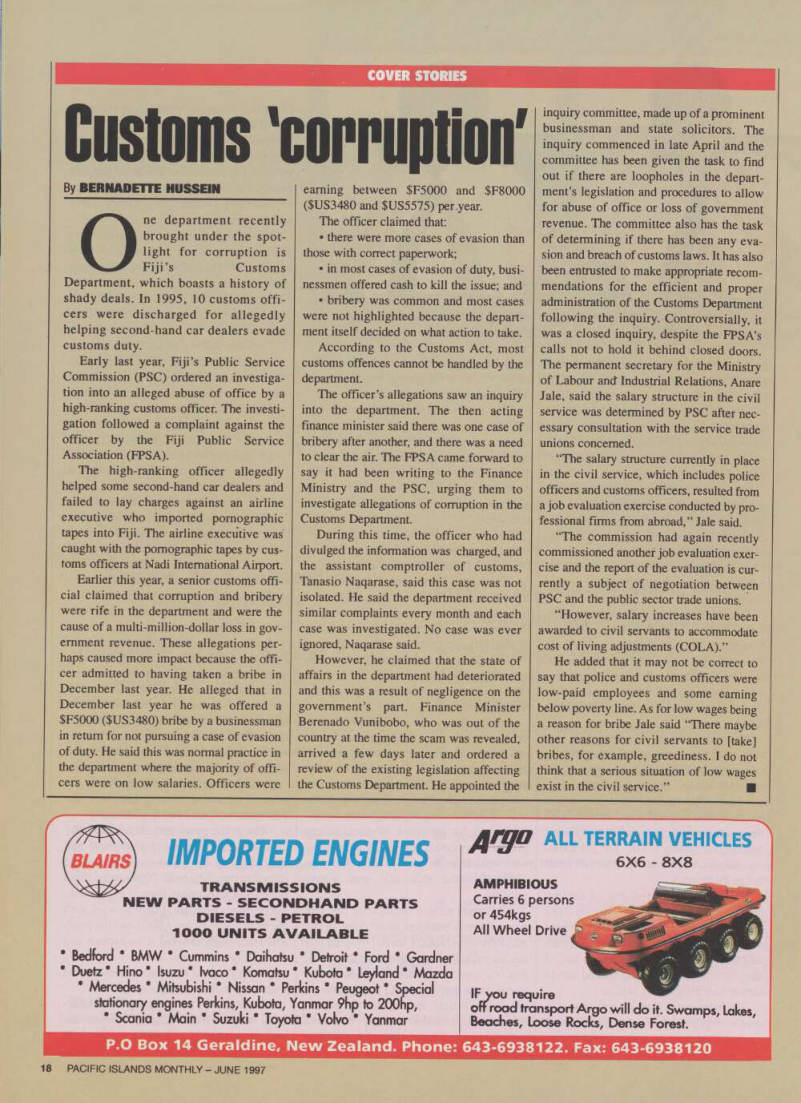
“We have to solve this problem [nepotism] in a diplomatic way”
Officers and prisoners “have been getting along quite well”
Advertisements & other items, p. 16 (1 item)
Com Io
Expand Your Subscriber
Cable Capacity
with
DigiGain m - 2 and DigiGain ™ - 4
Digital Pair Gain Systems
Features • Up to 4 voice/data/fax channels (mixed) over a single twisted copper pair. • CO equipment mounts in 19” rack. • Remote terminals designed for pole, wall or underground mounting. • Remote power feeding from CO end no separate power source required. • Automatic recovery from fault shutdown. • Supports both decadic and tone dialling. • Subscriber can be up to 15km from the CO (exchange) (depending on cable gauge).
Designed and manufactured in Australia email: [email protected] For additional information visit our' 10 COM DC Power Systems For
Telecommunications Applications .
• From 25 amps to 7,000 amps • Flexible, compact, modular • High reliability and quality • Sophisticated intelligent monitoring and control • Suitable for multiple applications, telephone exchange, transmission equipment, mobile base stations, PABX, etc. • Remote monitoring facility • Strong design and research capability • Equipment is used in more than 25 countries worldwide • System design and installation service site shown below, or write/fax/email to:
COM IO
H*ad Onks Units R4-R8 Regents Park Estate Cnr Park Rd and Princes Rd East Regents Park New South Wales 2143 Australia Tel: -t-61-2-9722 3310 Fax: +6l-2-9722 3344 Internet: http://www.exicom.oz.au [or http://www.comlO.com.au]
Customs 'corruption'
By Bernadette Hussein
One department recently
brought under the spot light for corruption is Fiji’s Customs Department, which boasts a history of shady deals. In 1995, 10 customs offi cers were discharged for allegedly helping second-hand car dealers evade customs duty.
Early last year, Fiji’s Public Service Commission (PSC) ordered an investiga tion into an alleged abuse of office by a high-ranking customs officer. The investi gation followed a complaint against the officer by the Fiji Public Service Association (FPSA).
The high-ranking officer allegedly helped some second-hand car dealers and failed to lay charges against an airline executive who imported pornographic tapes into Fiji. The airline executive was caught with the pornographic tapes by cus toms officers at Nadi International Airport.
Earlier this year, a senior customs offi cial claimed that corruption and bribery were rife in the department and were the cause of a multi-million-dollar loss in gov ernment revenue. These allegations per haps caused more impact because the offi cer admitted to having taken a bribe in December last year. He alleged that in December last year he was offered a SFSOOO ($1183480) bribe by a businessman in return for not pursuing a case of evasion of duty. He said this was normal practice in the department where the majority of offi cers were on low salaries. Officers were
earning between SFSOOO and SFBOOO ($1183480 and $U55575) per .year.
The officer claimed that: • there were more cases of evasion than those with correct paperwork; • in most cases of evasion of duty, busi nessmen offered cash to kill the issue; and • bribery was common and most cases were not highlighted because the depart ment itself decided on what action to take.
According to the Customs Act, most customs offences cannot be handled by the
department.
The officer’s allegations saw an inquiry into the department. The then acting finance minister said there was one case of bribery after another, and there was a need to clear the air. The FPSA came forward to say it had been writing to the Finance Ministry and the PSC, urging them to investigate allegations of corruption in the
Customs Department.
During this time, the officer who had divulged the information was charged, and the assistant comptroller of customs, Tanasio Naqarase, said this case was not isolated. He said the department received similar complaints every month and each case was investigated. No case was ever ignored, Naqarase said.
However, he claimed that the state of affairs in the department had deteriorated and this was a result of negligence on the government’s part. Finance Minister Berenado Vunibobo, who was out of the country at the time the scam was revealed, arrived a few days later and ordered a
review of the existing legislation affecting
the Customs Department. He appointed the
inquiry committee, made up of a prominent businessman and state solicitors. The inquiry commenced in late April and the committee has been given the task to find out if there are loopholes in the depart ment’s legislation and procedures to allow for abuse of office or loss of government revenue. The committee also has the task of determining if there has been any eva sion and breach of customs laws. It has also been entrusted to make appropriate recom mendations for the efficient and proper administration of the Customs Department
following the inquiry. Controversially, it
was a closed inquiry, despite the FPSA’s calls not to hold it behind closed doors.
The permanent secretary for the Ministry of Labour and Industrial Relations, Anare Jale, said the salary structure in the civil service was determined by PSC after nec essary consultation with the service trade unions concerned.
“The salary structure currently in place in the civil service, which includes police officers and customs officers, resulted from a job evaluation exercise conducted by pro fessional firms from abroad,” Jale said.
“The commission had again recently commissioned another job evaluation exer cise and the report of the evaluation is cur rently a subject of negotiation between PSC and the public sector trade unions.
“However, salary increases have been awarded to civil servants to accommodate cost of living adjustments (COLA).”
He added that it may not be correct to say that police and customs officers were low-paid employees and some earning below poverty line. As for low wages being a reason for bribe Jale said “There maybe other reasons for civil servants to [take] bribes, for example, greediness. I do not think that a serious situation of low wages exist in the civil service.” ■
Advertisements & other items, p. 18 (1 item)
Imported Engines
BLAIRS
TRANSMISSIONS
NEW PARTS - SECONDHAND PARTS
DIESELS - PETROL
1000 UNITS AVAILABLE
Bedford * BMW * Cummins * Daihatsu * Detroit * Ford * Gardner Duetz * Hina * Isuzu * Ivaco * Komatsu * Kubota * Leyland * Mazda * Mercedes * Mitsubishi * Nissan * Perkins * Peugeot * Special stationary engines Perkins, Kubota, Yanmar 9hp to 200 hp, * Scania * Main * Suzuki * Toyota * Volvo * Yanmar
ALL TERRAIN VEHICLES
6X6 - BXB
AMPHIBIOUS
Carries 6 persons or 454kgs All Wheel Drive IF you require offroad transport Argo will do it. Swamps, Lakes, Beaches, Loose Rocks, Dense Forest.
P.O Box 14 Geraldine, New Zealand. Phone: 643-6938122. Fax: 643-6938120
Scaring away the investors
Economy
Reports By Kalinga Senevirante
Port Vila
For small island economies in the Pacific, the develop ment of off-shore banking centres could become an important foreign exchange earner. In recent years, Vanuatu has shown that it could bring in a substantial income to the national economy. But, last year’s “Letters of Guarantee” finan cial scan involving the Reserve Bank has sent a shiver through the spine of Vanuatu’s off-shore banking sector.
Port Vila’s “financial centre” - a codec
tion of foreign banks, trust companies, accountancy and law firms - is one of the well established off shore banking centres in the region, which brings in about SUS 4.4 million a year to the economy. In addition, it provides employment to over 300 local people and the 60 or so expatriate staff and families who bring more money into the economy.
The income created by this industry makes up a substantial amount for the country when you consid er the fact that the total export income of Vanuatu in 1995 was SUS2B.3 mil lion.
The financial scandal last year, which was, how ever, unconnected to the off-shore banking sector, has made the industry ner vous. "It has certainly had a negative impact on peo
ple thinking about invest
ing in Vanuatu because there was uncertainty about whether this gov ernment understands what they are doing,” Thomas Bayer, executive chairman of Pacific International
Trust Company told Pacific Islands Monthly.
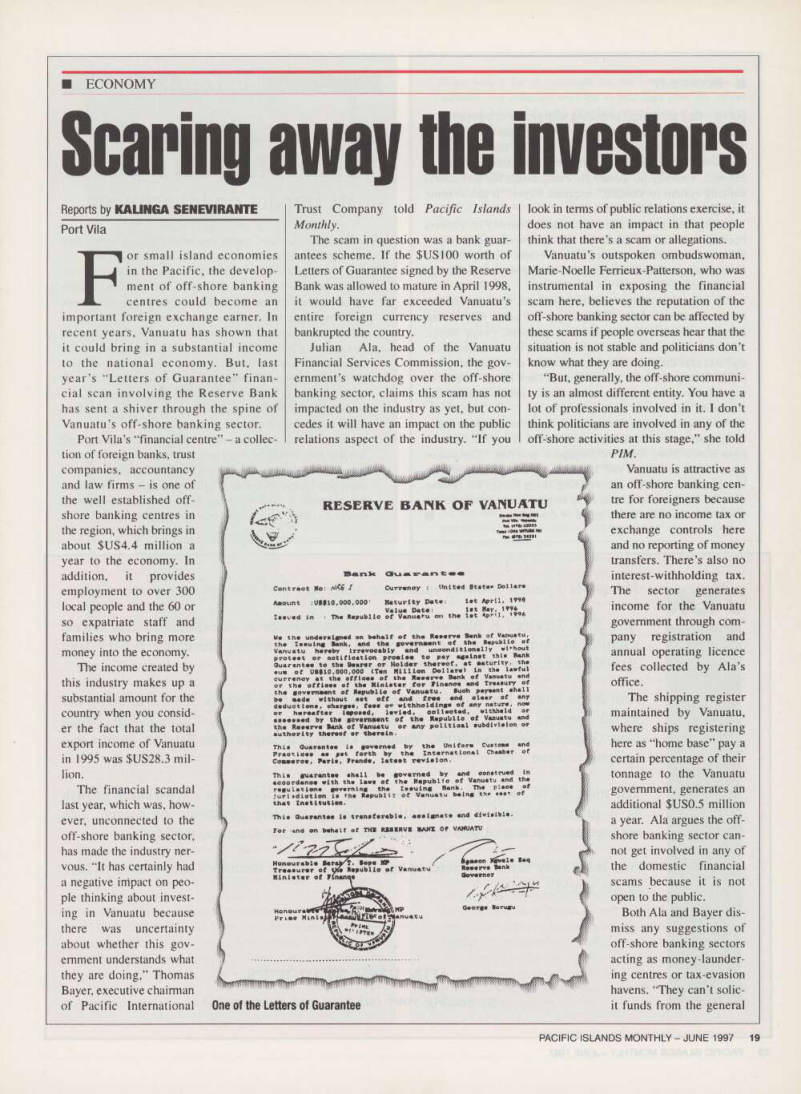
The scam in question was a bank guar antees scheme. If the SUSIOO worth of Letters of Guarantee signed by the Reserve Bank was allowed to mature in April 1998, it would have far exceeded Vanuatu’s entire foreign currency reserves and bankrupted the country.
Julian Ala, head of the Vanuatu Financial Services Commission, the gov ernment’s watchdog over the off-shore banking sector, claims this scam has not impacted on the industry as yet, but con cedes it will have an impact on the public relations aspect of the industry. “If you
look in terms of public relations exercise, it does not have an impact in that people think that there’s a scam or allegations.
Vanuatu’s outspoken ombudswoman, Marie-Noelle Ferrieux-Patterson, who was instrumental in exposing the financial scam here, believes the reputation of the off-shore banking sector can be affected by these scams if people overseas hear that the situation is not stable and politicians don’t know what they are doing.
“But, generally, the off-shore communi ty is an almost different entity. You have a lot of professionals involved in it. I don’t think politicians are involved in any of the off-shore activities at this stage,” she told
Pim.
Vanuatu is attractive as an off-shore banking cen tre for foreigners because there are no income tax or exchange controls here and no reporting of money transfers. There’s also no interest-withholding tax.
The sector generates income for the Vanuatu government through com pany registration and annual operating licence fees collected by Ala’s office.
The shipping register maintained by Vanuatu, where ships registering here as “home base” pay a certain percentage of their tonnage to the Vanuatu government, generates an additional SUSO.S million a year. Ala argues the off shore banking sector can not get involved in any of the domestic financial scams because it is not open to the public.
Both Ala and Bayer dis miss any suggestions of off-shore banking sectors acting as money-launder ing centres or tax-evasion havens. “They can’t solic it funds from the general
One of the Letters of Guarantee
public - they are limited to dealing with groups of companies or individuals associated with the bank,” Ala points out.
“Money is laundered when it enters the banking system.
That’s the point of laundering. It doesn’t get laundered later or before... Virtually no money [in cash] enters the [off-shore] bahking system in Vanuatu,” explains Bayer. “It has to come through another bank overseas.
“Drug dealers won’t cart a suitcase of money to Vanuatu because none of the banks in Vanuatu would take notes.”
Because notes are not accepted here, overseas companies trans ferring their profits to Vanuatu banks will have to do so through their banking system.
But any of the interest paid on those funds once they’re here are not taxed in Vanuatu. “Whether you pay tax or not, on your interest received here, is not our problem,” says Bayer.
“Whether you declare it or not is a problem in your home coun try.” Ala says they have never been accused of helping people in neighbouring countries to avoid taxes back home. “We work very closely with law enforcement officials in New Zealand and Australia,” he says.
Vanuatu is facing stiff competition from new off-shore finan cial centres opened in Malaysia and Guam, as well as from the older ones in Hong Kong and Singapore, says Ala. “Companies from China, Indonesia and Malaysia have been coming here slowly,” he adds. “We are targeting Hong Kong. We believe with the handover to China, there might be an opening to get some of the business which might be coming out.” ■
Ferrieux-Patterson discusses
Interview
Ferrieux-Patterson discusses Vanuatu’s financial scam and its impact on investment
PIM: The recent financial scams you have exposed, would they have an impact on the off-shore banking sector here?
FP: My report at the time indicated that there were some con cerns about the reputation of Vanuatu. I think there's still the same concern to see political people signing documents involving big amounts of money and not taking the appro priate steps to check and follow their own financial rules that can create a bad image overseas. This also concerns the heavy commitment a government can take in terms of over seas debts. Overseas indebtedness is alwdys a concern. A country could collapse - like what happened in the Cook Islands. They suddenly realised they owed more than they could repay and all systems suffer.
As far as the off-shore financial centres are concerned, I still see that they would be more generally affected by the repu tation. If people hear that the situation is not stable, the politi cians don't know what they are doing, it might be a concern.
But generally the off-shore community is almost a different entity. You have a lot of professionals involved in it. I don't
think politicians are involved in any of the off-shore acitivities at this stage. Accountancy, banks and trust companies already have their own reputations. I think they would main tain themselves with their own clients.
PIM; If these scams have had an impact on the image of Vanuatu, how would you see the government playing a role in clearing up Vanuatu's name?
FP: They did; they proceeded quite effectively. Once they made a mistake, there was a bit of political turmoil following that.
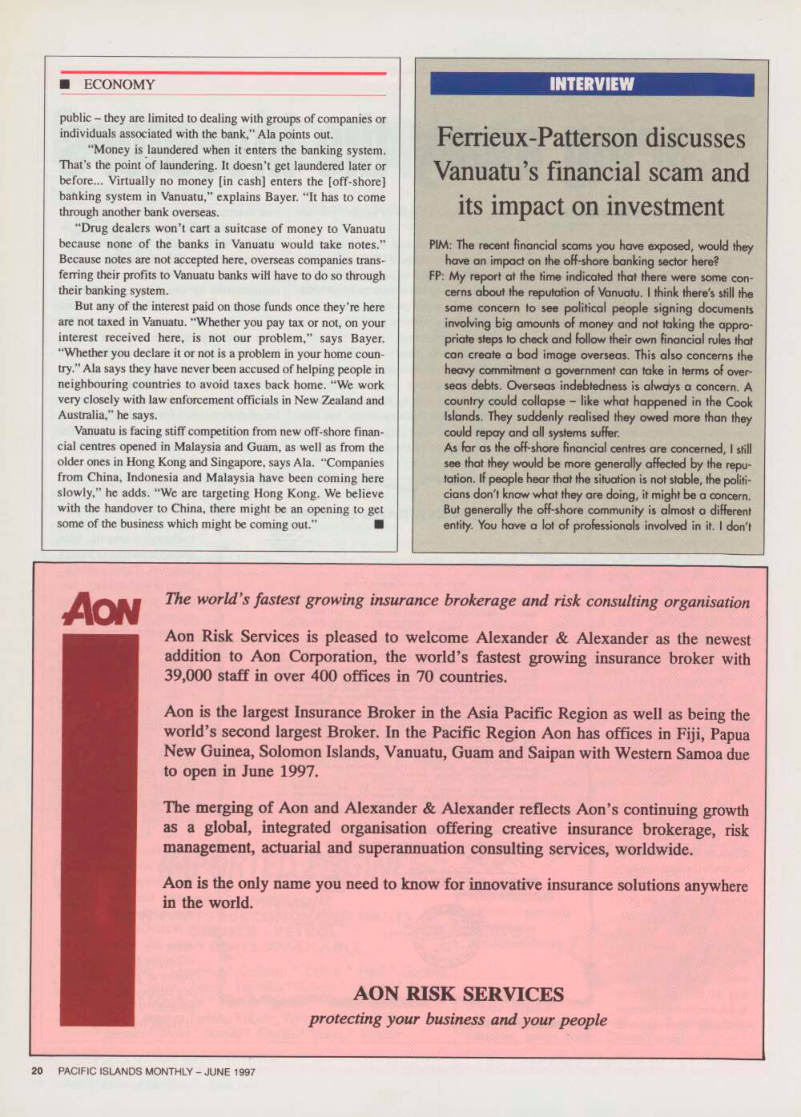
The main person involved is not involved in the politcal world anymore. Barak Sope has been removed. The prime minister at the time started to take steps and initiated court action against the people he saw as responsible for this scam. So, they have taken steps and the fact that an Australian citizen ... was prosecuted I think is a signal to others in the region who think that Vanuatu is gullible.
PIM: In recent years, we have seen conmen trying to con a num ber of governments in the region in similar scams and politi cians getting caught in it, willingly sometimes. From the inves tigations done by you here, do you think there's a warning or lesson to be learned by other politicians in how not to get caught by these scams?
FP: I think so. Actually, the message went through at that time.
There was a lot of coverage for the bank guarantees in Vanuatu. The message went far. A few days after my report came out, I heard that the Marshall Islands was trying to sort out something similar to that, in bigger amounts... Cook Islands has suffered from it before. We had a similar case before but not of such potential. The publicity which followed has made the point. I met colleagues from Africa at a world conference not long ago and everybody was aware of it, even in those countries. They were interested in the work I have done in that subject matter, because in Africa, too, they are faced with similar cases. Recently, there was a meeting of the reserve banks in the United States and that came out as a subject of discussion between all the governors of banks in the world. So, it is being talked about and that's the best way to ensure it will not happen again - by being talked about.
PIM: When your report first came out, I believe you were attacked by many politicians for saying what you said. But now the politicians have come around to accepting it. Do you think this would have been the case in any other country, where the politics may not have been perhaps as democratic or open as here?
FP: Don't forget, in Vanuatu the post of ombudsman was filled only two-and-a-half years ago. It has been in the constitution since 1980, but nothing was done until 1994. So, my role came as a shock, and it was more a shock because the gov ernment added in my responsibility the leadership code. So, they themselves put themselves in a position where I could look at the leadership code as indicated in the constitution.
So, the reaction we got in July when the report and the bank guarantees came out was ... that they were very surprised at the publicity that it got.
It was mandatory (in the constitution) that I had to make my reports public. I think that mesage was passed and they had not realised that it was in the constitution and I couldn't keep it a secret. Furthermore, my experience and the knowledge of the banking world was that there was no way I could keep it secret. Keeping it secret was making it more dangerous. The only way to deflate it and avoid negotiation of these guaran tees was for the fact to be known.
PIM: Since you are employed by the government, do you think a local person, if he or she was employed in the same position, would have been able to do the same thing?
FP: I'm not employed by the government. I mean the govern ment is the agent of the people of Vanuatu and this way pro vides the budget for the office. I'm an employee of the Republic of Vanuatu. My appointment is made by the presi dent and the government is not involved in my appointment.
My independece is guranteed both by the constitution, the act and by the contract. I think it's quite secure about my position.
I'm appointed for five years and to change this you have to have a very serious case of misconduct on my part.
Certainly, I've got an easier job than most local people, because I'm not part of the wontok system. That's certainly an advantage as far as my job is concerned. I was appointed by the president, so that must be indicative of what their wish was. Their wish was to have someone who would have the freedom of independence in their own system. So that's the only thing I can answer. Are there are people with the abili ty? Yes, there are people with ability. Many politicians think I'm handling it in a harder way and only time will tell, when the next person comes. ■
Barak Sope...removed from political world
Advertisements & other items, p. 20 (1 item)
Aon
The world's fastest growing insurance brokerage and risk consulting organisation Aon Risk Services is pleased to welcome Alexander & Alexander as the newest addition to Aon Corporation, the world’s fastest growing insurance broker with 39,000 staff in over 400 offices in 70 countries.
Aon is the largest Insurance Broker in the Asia Pacific Region as well as being the world’s second largest Broker. In the Pacific Region Aon has offices in Fiji, Papua New Guinea, Solomon Islands, Vanuatu, Guam and Saipan with Western Samoa due to open in June 1997.
The merging of Aon and Alexander & Alexander reflects Aon’s continuing growth as a global, integrated organisation offering creative insurance brokerage, risk management, actuarial and superannuation consulting services, worldwide.
Aon is the only name you need to know for innovative insurance solutions anywhere in the world.
AON RISK SERVICES
protecting your business and your people
Caught napping
Legislation
Govt bulldozes through with legislation on chief auditor’s term while Opposition researches
By Chris Peteru
Saying you were in the library while legislation crucial to Western Samoa’s financial well being is about to be voted on is a good reason not to take any interest, except if you’re the Opposition leader.
It wasn’t as if Samoa National Development Party boss Tuiatua Tupua Tamasese hadn’t been given enough notice.
Debate on the motion to amend Article 97 of the island state’s constitution had been
raging for a month or so in parliament, and for several months at every bar and kava bowl in the country. The guts of it meant slashing the chief auditor’s term from until age 60 into a three-year contract.
In 1995 Controller and Chief Auditor Su’a Rimoni Ah Chong was suspended for tabling a report alleging big-time govern ment corruption. Despite a government appointed Commission of Inquiry negating key aspects of the report, it failed to allevi ate public cynicism over the issues raised, more so when none of the inquiry’s recom mendations to the government to guard
against further abuses were acted on. The proposed amendment marked the first time government had brought constitutional change because of action taken by the audit office.
How the likelihood of something this important could be overtaken by an over due book fine is hard to understand. As it turned out Tamasese had actually gone in to get some last-minute research on the amendment itself, which wasn’t a bad idea, even if his modus operandi was.
Anti-amendment supporters and the Samoa Civil Liberties Organisation were more concerned about the chief auditor los ing its pivotal role as independent watch dog (the acting chief auditor now is the wife of the deputy speaker) and instead becoming a rubber stamp for the govern ment.
The Human Rights Protection Party (now in a fourth consecutive term of office) faces a chronic debt problem now close on $4OO million dollars and rising. It could easily be a lot more considering that audits of a number of government departments, including Treasury, have not been made public for at least five years. Clear regula tions under the Public Monies Act says Treasury is required to table audited finan cial accounts to the public regularly.
“They are collecting taxes and using taxes without accountability. For the ast 15 years, governments have never conplied with their constitutional and statutory obli gations. As a people we do not knov how our taxes are being used,” says Tony Pereira, president of Western Samoa ’s Civil Liberties Organisation. The Western Samoa Chartered Accountants Society has \oiced concern over the lack of good accointing ethics. Treasury accounts 1981-88 were lumped together and tabled in 1992 The Accounts for 1989 were not tabled until five years later.
“We have been sworn to secrecy,” said a Treasury employee “But I can tell you there are accounts which have been written off completely, just forgotten about, because apart from a very few departments there are no accurate records so it is still easy to do.”
What Finance Minister Tuilaepa Malielegaoi, who holds a masters degree in commerce, and a talent for politics as per formance art, did tell two reporters in December 1995 was that Treasury audits were not publicly available because they “are being computerised”.
No other announcements have been
Tony Pereira...“We don’t know how our taxes are being used”
made since, although late last year the audit office promised to audit and update most government departments by the end of this year.
“Although the minister has in the past referred to himself as an auditor or gives the impression that he is an auditor, and therefore some measure of credibility is attached to his explanations in parliament, he is a non-practising accountant,” says the chief auditor.
Malielegaoi was unavailable to com ment as he was on government business overseas.
For its part, the Opposition seemed reluctant to highlight aspects of the finan cial bungling, leaving it open to sugges tions it carried out some funky accounting of its own when it last sat on the Treasury benches. A salient reminder during Tamasese’s last prime ministership is how from 1979-81 there were massive basic food shortages, forcing Samoans to queue Russian-style for goods in near empty stores.
Twenty-five submissions to a parlia mentary bills committee, gave the whole constitution amendment idea the thumbs down. An excerpt from the committee’s report said, “It was evident from the views that any proposed amendment to the con stitution is inappropriate.” Other submis sions called for a referendum as a more accurate forum to gauge public feeling.
Supreme court proceedings brought by the chief auditor against the prime minister over the report are continuing, although the PM repeatedly denies he has been served notice of any charges being made against him.
Given the backgrounds of the individu als, the two parties, and the political cordite in the air, it was hardly surprising parliamentary broadcasts became more popular on the radio than requests for songs by nerdy Swedish popsters Abba (Waterloo , Dancing Queen) who have managed to keep Western Samoa in a musical time warp, long after their wel
come break-up.
Back in parliament, the government, noting Tamasese’s vacant chair, suspended
standing orders and charged through the
second reading of the amendment bill in just under 15 minutes. Like the opposition, the HRPP MPs had expected a day of fren zied, tough debate. Instead, the remaining opposition members sat silent, like rabbits frozen in the lights of a very big truck bear
ing down on them at alarming speed. It was the kind of silence that could have remind ed listeners around the country of a library, where no doubt some of the opposition wished they were with their missing lead er. No one even tried to hold the fort, which was surprising but not unexplainable.
Without the eloquent Tamasese rhetoric, the opposition frequently turns out sound ing unconvincing. The government, in con trast, just sounds too good to be true.
Even the opposition number two hit
man, outspoken independent Le Tagaloa
Pita, was invisible. A former cabinet minis ter, his reputation in the debating chamber can be summed up in one word: Aayyaaahhh. But right then, he wasn’t there either. Nor was he at the library look ing for something to talk about.
Although both men eventually made it for the third reading vote, the government had slammed the door shut. The last ses sion day, parliament had adjourned while debating a Customs Amendment Act.
Normally, discussion on the last bill dis cussed, resumes immediately the next ses sion.
“I assumed as did Tagaloa that the [finance] minister would continue on Wednesday,” said Tamasese. pointing to
parliamentary convention and Tuesday’s
agenda paper. Assumptions aside, a politi cian with four election losses against the same people, should have been able to come up with better strategies on how the HRPP operates, than thinking if he was late to parliament the government was not going to try and stitch the opposition up.
Ageing Prime Minister Alesana, who nowadays invokes God’s name with the enthusiasm with which the Mormon church proclaims “the church is true” to anyone within earshot, was in no such doubt about what his mission was that morning. Thanking God for the beautiful day, he launched into a brief history of the constitution. Basically, it amounted to something like, “Out of the way man, there’s a constitutional amendment coming through.” He then moved the constitution al amendment bill be put to the vote.
Alesana also reassured the public the amendment was in the best interests of the nation, and that suspended auditor Ah Chong was free to reapply for the chief auditor’s office. “Whoever is involved in this job should be free from political inter ference, he need not be afraid to carry out his duties even if he is appointed for a
three-year term,” said Alesana.
Holding the required two-thirds majori
ty in the house, it came down 36-11 in the government’s favour. The Opposition later claimed that the vote had been sprung on them. Of course, it had. In fact, they’ve been sprung, rolled over, and tossed up in the air so many times now, they could ride a bull market in carnival ride futures.
“It was a strategy employed by the gov ernment in order to silence debate,” oppo sition member Te’a Peato told local tabloid papers. What a revelation.
“Predictable,” was the chief auditor’s only response. What is also becoming pre dictable is a duopoly of power between Alesana, and deputy Malielegaoi, who, as a result of the decision, is free to roam carte blanche through Western Samoa’s main bank vault, say critics. Of course, the invitation for Ah Chong to reapply for the chief auditor’s job could be damage con trol by Alesana, given the lousy publicity the report caused locally and abroad.
If the chief auditor is reinstated, it will be surprising if he is allowed to even audit his own pay check, such is the trust level between the HRPP leadership and the longest suspended government employee in history.
This is not the first time the HRPP has fiddled with the constitution since the 1962
independence. Earlier, universal suffrage
was introduced, allowing those over 21 to vote for the first time during the 1991 elec tions. Soon after, the term of government office was extended from three to five years. Civil Liberties president Pereira: “Do we need a minister of finance, one with a Masters degree in Commerce?”
“I suppose I have a fair bit to learn about the nature of politics, I had thought that some members of the HRPP would consider this not as a partisan party matter, but more a conscience matter. But I am sur
prised”
The punchline to a joke over the chief auditor’s term being reduced to three years goes: “So there will be enough time to audit all the accounts for 1993.”
What level of professionalism will be applied to the job by the next chief auditor, given the amount of bungy jumping the government did over Ah Chong’s report, will be interesting. Ethics and accountabil ity though could still be as hard to find as accurate Treasury accounts for public inspection, and the protection of human rights this Alesana administration built its
Advertisements & other items, pp. 23-24 (2 items)
Pacific Islands Yearßook
Now Available
17th Edition
PA CI
i Mi Price
AUD
00
PLUS POSTAGE*
* PACIFIC SAIO.OO
* USA & TERRITORY A 515.00
* EUROPE & OTHERS $A17.00
Learn more about the Pacific
culture!custom tradition!people
population, tourism, trade, airlines, tax system etc. i i Yes, send me the latest copy of the Pacific Islands Year Book.
I □ Here is a cheque/money order 1 □ Visa □ Master Card I Card Number , Name Signature ...
I Address Post to: Pacific Islands Monthly, PO Box 1167 Suva, Fiji or Fax (679) 307460 I -X Expiry Date 1 J
■ Legislation
Beyond
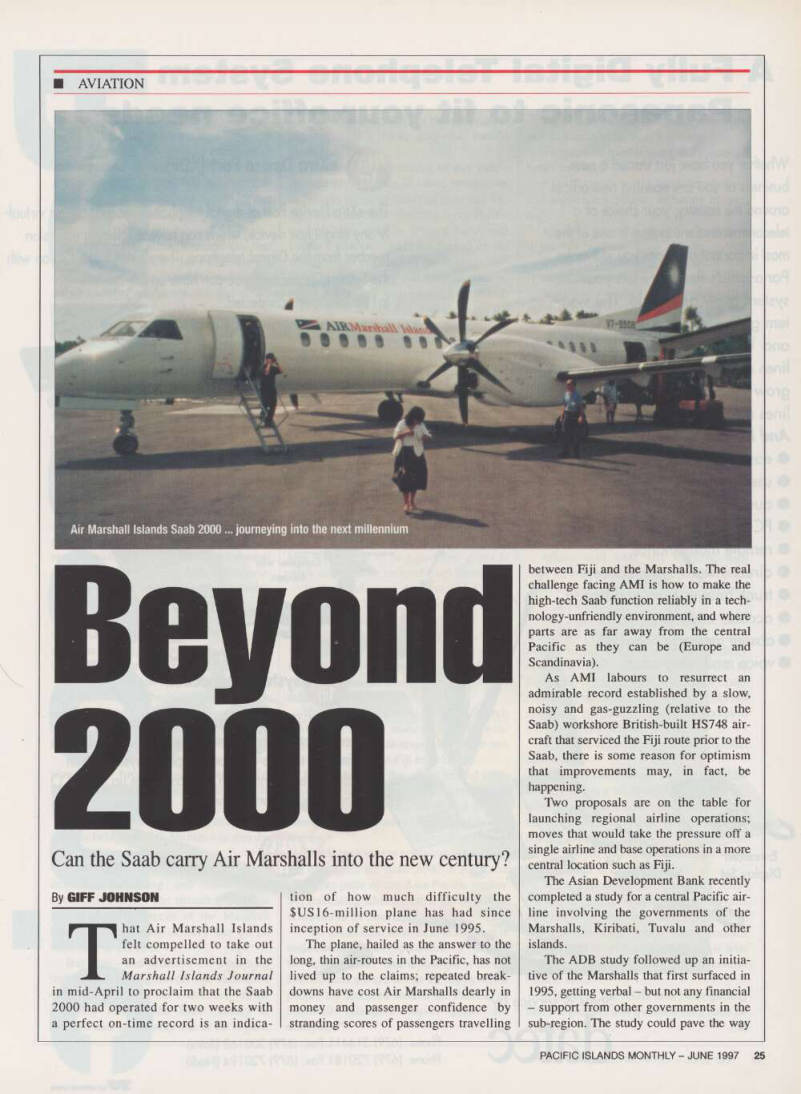

Aviation
Beyond 2000 Can the Saab carry Air Marshalls into the new century?
By Giff Johnson
That Air Marshall Islands felt compelled to take out an advertisement in the Marshall Islands Journal in mid-April to proclaim that the Saab 2000 had operated for two weeks with a perfect on-time record is an indica
tion of how much difficulty the SUSI6-million plane has had since inception of service in June 1995.
The plane, hailed as the answer to the long, thin air-routes in the Pacific, has not lived up to the claims; repeated break downs have cost Air Marshalls dearly in money and passenger confidence by stranding scores of passengers travelling
between Fiji and the Marshalls. The real challenge facing AMI is how to make the high-tech Saab function reliably in a tech nology-unfriendly environment, and where parts are as far away from the central Pacific as they can be (Europe and Scandinavia).
As AMI labours to resurrect an admirable record established by a slow, noisy and gas-guzzling (relative to the Saab) workshore British-built HS74B air craft that serviced the Fiji route prior to the Saab, there is some reason for optimism that improvements may, in fact, be
happening.
Two proposals are on the table for
launching regional airline operations;
moves that would take the pressure off a single airline and base operations in a more central location such as Fiji.
The Asian Development Bank recently completed a study for a central Pacific air line involving the governments of the Marshalls, Kiribati, Tuvalu and other islands.
The ADB study followed up an initia tive of the Marshalls that first surfaced in 1995, getting verbal - but not any financial - support from other governments in the sub-region. The study could pave the way
Air Marshall Islands Saab 2000...journeying into the next millennium
for ADB financing of a sub-regional gov ernment airline utilising the Saab.
Saab itself is proposing a commercial airline plan to operate the Saab 2000 from a Fiji base. Saab officials believe that improved maintenance and servicing that could be had from a major airline operation would increase the reliability of the Saab.
There are two other developments that spell improvement for AMl’s international operations and should help to restore not only passenger confidence, but that of air lines in the region that AMI would like to be selling air time to for the Saab - Air Vanuatu is the only South Pacific airline that has used the Saab regularly since last year for a weekly Nadi-Port Vila run.
The ADB recently injected SUS 2 mil lion of a SUS 4 million loan to AMI, which the airline is using for building a hangar suitable for servicing the Saab and other large planes and for engineering training and spare parts.
AMI has never had a facility large enough for the Saab, and AMI mechanics are frequently seen on the tarmac carrying out maintenance under plastic tarps in the pouring rain or the blistering sun with salt spray enveloping them; this is the normal environment in which the Saab 2000, a vir tually entirely computer-driven aircraft, must operate.
The other development of significance is that AMI has made the sound decison to retain its HS74B, after more than a year of unsuccessfully attempting to sell it.
The plane may be based in Fiji and used on a lease/charter basis by other airlines; but by keeping it, AMI maintains an essen tial backup for the Saab and the Fiji- Marshalls route.
Since AMI is the only carrier that ser vices these four nations in the central Pacific, the backup is crucial to reliable operations.
But the big question that has to be asked - and is being asked in Majuro - is; can the Saab 2000 work out here?
Saab 2000’s Australia-based vice-presi dent for marketing and sales, Peter Greensmith, says, “The aircraft is the right one to meet the needs of the Marshall Islands into the next century but we do need time to prove it.”
But time - and patience - is something that AMI is running out of. The Saab 2000 owned by AMI was the 17th to roll off the assembly line at the Saab factory in Sweden and, as the only one in the region,
it’s fair to say that AMI has been the guinea pig for Saab’s foray into • the Pacific market.
And since the beginning of this year particularly since an ill-timed breakdown in January stranded heads of state and for eign ministers from virtually every Pacific country who were in Majuro for Amata Kabua’s funeral - AMI has turned up the volume of its criticism of the Saab.
Saab officials say that improved main tenance, coupled with basing the mainte nance operation in Fiji, can cut days off delivery time for parts from Europe, and will improve the operations - one reason that AMI negotiated a deal late last year to have major maintenance done at Air Pacific in Nadi.
But government officials in Majuro say that the expectation that the Saab would get better with improved maintenance is a pre diction that has turned out to be “a mirage”.
“There have been quite an amazing number of breakdowns in the last year.”
And AMI general manager Randy Hanna observed that despite a SUS3-mil lion spare-parts package provided by Saab, just about every time the plane has a prob lem it turns out to be a part that is not in stock and must be ordered from Europe.
In late February, however, the Saab went through its first C-check, the 3000hour FAA-required overhaul.
While in the hangar for the C-check, Saab and AMI engineers installed a series of what Hanna described as “non-mandato ry improvements that will assist the plane’s
reliability”.
If the improved service in late March into April is any indication, the twin engine, 50-seater has responded to the ser vicing it received in Fiji in February.
It appears, too, that some heated criti cism of the Saab by AMI and government officials in Majuro has stimulated greater efforts on Saab’s part to improve the Saab’s service.
The Scandinavian company is attempt ing to market the Saab 2000 in Australia and other parts of the Asia-Pacific region.
So, stabilising AMl’s Saab 2000 operation is crucial to its marketing success.
“We are as keen as anyone to fix what is
undoubtedly a problem,” Saab’s
Greensmith said. “Our reputation is on the line too and we are not at all happy when people are stranded around the Pacific, or Marshall Islanders’ travel plans are
disrupted.”
He believes that three things must hap pen to improve the Saab’s service: • improving maintenance skills through
better training;
• investing in better facilities, tooling
and support equipment, including hangar;
and • getting a second aircraft in operation
to provide back-up.
When the Marshalls government initial ly negotiated the deal with Saab in the early 1990 s - while the 2000 was still a drawing-board concept - it signed a deal to buy two Saabs, with an option to purchase two more.
The Marshalls bought the first SUS 16million Saab, but the second one, to have been delivered in mid-96, has been leased to another airline for operations because
the Marshalls, facing increasing fundng
cutbacks, couldn’t pay for the second one; after the experience with the first, it’s doubtful that the Marshalls government and AMI would want to take the risk of buying a second one - another reason the sub-regional idea makes sense, since so many other countries gain the benefit of the service AMI is currently providing.
Hanna said AMI was working with Saab to develop a long-term plan for Saab 2000 maintenance, and that Saab had been very helpful in this.
But a related issue to whether the Saab is the right plane is simply this: can a small airline in an isolated area successfully operate a single plane that, because it is so high-tech, requires extreme levels of main tenance precision and computer-driven diagnostic capabilities, and quick access to a ready supply of spare parts?
Which leads back to the sub-regional airline idea.
For AMI has proven one thing beyond doubt: there is a steady and increasing vol ume of passenger and (especially) cargo business to and from Fiji, Tuvalu, Kiribati, and the Marshalls.
Air service that can be stabilised has a ready market in this sub-region.
The question - given that many coun tries have their own ideas abut air service, and are somewhat less than enthusiastic about airline coopreration when it comes time to anti-up with some money - is who will finance air cooperation in the central Pacific area?
With both the ADB and Saab getting into the picture, that question may soon be answered. ■
Advertisements & other items, pp. 26-27 (2 items)
datec
A Fully Digital Telephone System from
Panasonic to fit your office need
Whether you have just started a new business or you are opening new offices around the country, your choice of a telecommunications system is one of the most important decisions you will make.
Panasonic's flexibility lets your system grow as you do. The system grows from 8 external and 16 extensions to 12 e lines and 32 extensions, grow even further to 24 lines and 128 extensions.
And look at all these fea • ease of growth • user friendly • dual port usage^ • PC-based programming • remote maidfhance • direct inwdra system access • trunk answer from any station • account code entry • absent message capability • voice mail integration eXtra Device Port (XDP) The eXtra Device Port of digital telephones accommodates virtue ly any single-line device, which can have a different exlpsion number froip the Digital telephone. Therefore, in conjunction wii the System Connection, you can have up w
Two KX-TD J'232
i I .v_/ Display Enhanced Display Set Speakerphone i Set Set ■€?'ss3 DSS Consol connected.
Single line Telephone Answering System Cordless Phone Facsimile Machine Terminal Computer with Modem 'S&.gQ;
KX-T7235
Enhanced display Set
System Connection
can be connected together to form a doubles in size, then so candour telephone system. With the System Connection, you can have up to 24 CO lines and 64 extensions.
Monitor Set Sales & service by:
datec
Phone: (679) 314411 Fax: (679) 300162 (Suva) Phone: (679) 720181 Fax: (679) 720194 (Nadi)
' THE NETWORK NHOO2
■ Aviation
Campaign cash for more independence
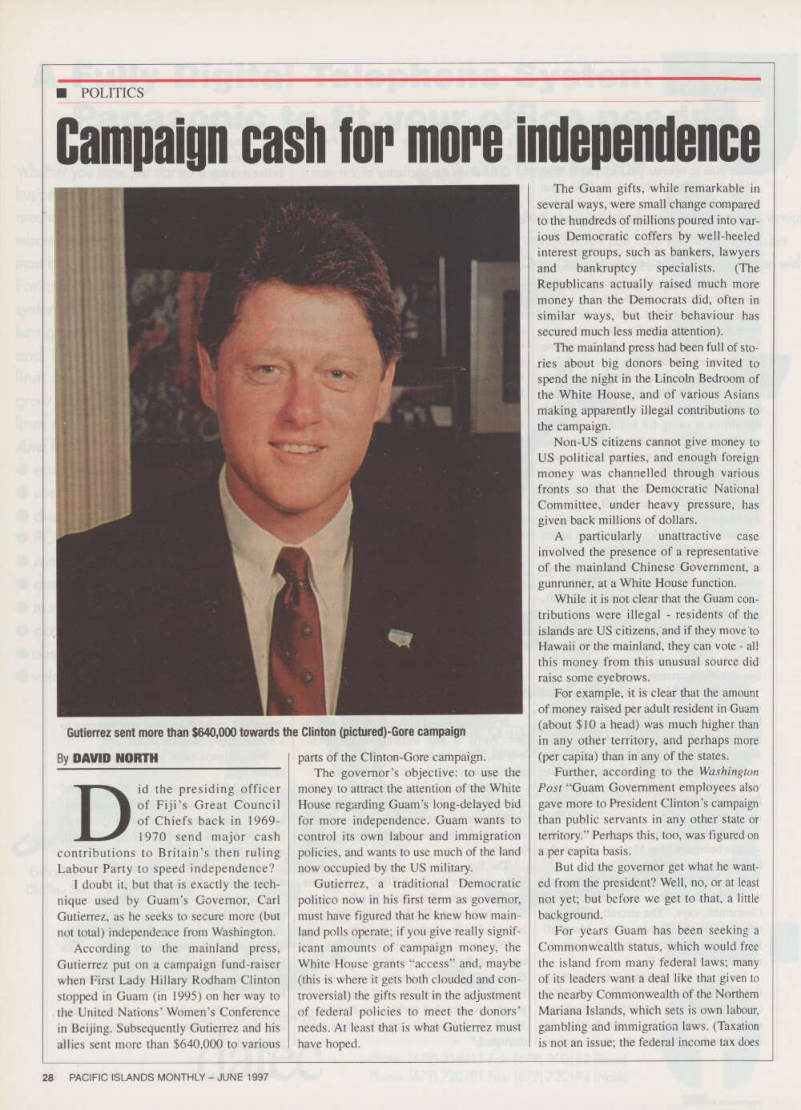

Politics
By David North
Did the presiding officer of Fiji’s Great Council of Chiefs back in 1969- 1970 send major cash contributions to Britain’s then ruling Labour Party to speed independence?
I doubt it, but that is exactly the tech nique used by Guam’s Governor, Carl Gutierrez, as he seeks to secure more (but not total) independence from Washington.
According to the mainland press, Gutierrez put on a campaign fund-raiser when First Lady Hillary Rodham Clinton stopped in Guam (in 1995) on her way to the United Nations’ Women’s Conference in Beijing. Subsequently Gutierrez and his allies sent more than $640,000 to various
parts of the Clinton-Gore campaign.
The governor’s objective: to use the money to attract the attention of the White House regarding Guam’s long-delayed bid for more independence. Guam wants to control its own labour and immigration policies, and wants to use much of the land now occupied by the US military.
Gutierrez, a traditional Democratic politico now in his first term as governor, must have figured that he knew how main land polls operate; if you give really signif icant amounts of campaign money, the White House grants “access” and, maybe (this is where it gets both clouded and con troversial) the gifts result in the adjustment of federal policies to meet the donors’ needs. At least that is what Gutierrez must have hoped.
The Guam gifts, while remarkable in several ways, were small change compared to the hundreds of millions poured into var ious Democratic coffers by well-heeled interest groups, such as bankers, lawyers and bankruptcy specialists. (The Republicans actually raised much more money than the Democrats did, often in similar ways, but their behaviour has secured much less media attention).
The mainland press had been full of sto ries about big donors being invited to spend the night in the Lincoln Bedroom of the White House, and of various Asians making apparently illegal contributions to
the campaign.
Non-US citizens cannot give money to US political parties, and enough foreign money was channelled through various fronts so that the Democratic National Committee, under heavy pressure, has given back millions of dollars.
A particularly unattractive case involved the presence of a representative of the mainland Chinese Government, a gunrunner, at a White House function.
While it is not clear that the Guam con tributions were illegal - residents of the islands are US citizens, and if they move'to Hawaii or the mainland, they can vote - all this money from this unusual source did raise some eyebrows.
For example, it is clear that the amount of money raised per adult resident in Guam (about $lO a head) was much higher than in any other territory, and perhaps more (per capita) than in any of the states.
Further, according to the Washington Post “Guam Government employees also gave more to President Clinton’s campaign than public servants in any other state or territory.” Perhaps this, too, was figured on a per capita basis.
But did the governor get what he want ed from the president? Well, no, or at least not yet; but before we get to that, a little
background.
For years Guam has been seeking a Commonwealth status, which would free the island from many federal laws; many of its leaders want a deal like that given to the nearby Commonwealth of the Northern Mariana Islands, which sets is own labour, gambling and immigration laws. (Taxation is not an issue; the federal income tax does
Gutierrez sent more than $640,000 towards the Clinton (pictured)-Gore campaign
not apply to any of the US flag territories; there are local income taxes, but the money stays on island).
There is nothing in the US constitution, or even tradition, providing a mutually agreeable way for a territory to evolve into something other than a state (as both Alaska and Hawaii opted to do).
So each time a territory wants more freedom, a new mechanism must be estab lished. (The Brits on the other hand, in the decades after World War 11, worked out an almost mass-production system for spin ning colonies into independent nations.) Guam set up a Commonwealth Commission, and conducted some quite
specific referenda on specific provisions.
Later the Territorial Legislature passed the draft agreement, and the governor signed it, taking the whole process very seriously.
Successive mainland governments have been less interested in the process, and wary of some of the provisions.
Were Guam to seek independence, rather than continued existence in associa tion with the US, these provisions would be less troublesome to Washington.
But three elements have given both the Bush and the Clinton Administrations
problems:
1. The Commonwealth Act established a special political status for Chamorros, allowing only such persons to vote on any eventual decision to seek independence.
Washington, with its own black-white con troversies, does not want to give any class of people more rights than others on the basis of race.
While Guam has cleverly blurred the issue ... saying, in effect, that Chamorros are people who lived on the island in 1950 and their descendants (thus defining away thousands of mainlanders and post-1950 immigrants) - Washington does not like this notion. 2. Immigration regulation. The US. (like Australia and New Zealand) has a
welcoming immigration policy and a rela
tively easy naturalisation process; on the whole these three nations’ policies are based on an egalitarian tradition.
The Chamorros of CNMI, however, have opted for a two-caste society; native born Chamorros on top, and tens of thou sands of guest workers (who can not become CNMI citizens) on the bottom.
Many US policymakers worry that Guam, given its druthers, would adopt a CNMl like immigration system.
3. Labour regulation. Guam is covered by the US minimum wage and by mainland labour laws; CNMI has its own minimum wage, a fraction of the $5.15 an hour going into effect on Guam and the mainland on October 1. Again, some US officials worry that Guam would adopt a CNMI-type set of labour standards, in which Asian tempo rary workers would word for below-pover ty wages.
These are major, gut-level policy issues,
and it is no wonder that Washington has been leery of Guam’s proposals. Rather than seeking to modify Guam’s position on these three matters, the Governor decided he would go the political route - flood the Democratic National Committee with unexpected money from his island, and hope that Clinton would order his under lings to give Guam’s leaders what they want.
Meanwhile Gutierrez’s underlings were enlisted in the cause, and the Pacific Daily News, working within the US tradition of reporting campaign contributions, ran a partial list of the Guam donors, most of whom were identified by title and most of whom gave an even $lOOO. One ex-Guam journalist, looking over the list, wondered how so many $30,000-to-$50,000-a-year officials had scared up the $lOOO.
“Did some of them only give their names, and not their money?” He said to me. He was alluding to the practice among some of the Asian donors to the campaign, of funnelling overseas money through American names when reporting contribu tions.
While there is no firm answer to that question, yet, there is an interim answer to the earlier question - did the President give the governor what he wanted on the issue of Commonwealth Status?
Maybe such a move was in the works, but when the story on major campaign con tributions from Guam hit the front pages it was only a day or two before the White House announced that it was still studying the Guam issue, and it had not changed its
policies.
Earlier there had been stories that the administration posture had changed. The Washington Post quoted a couple of name less officials who said that their agencies’ posture on Guam had shifted, at the direc tion of the “political people” after the cam paign money arrived. Another story was that the latest working paper circulated by Washington’s Guam Commonwealth
Negotiator, John Garamendi, was said to contain some elements favourable to Guam.
“Maybe Garamendi is saying something a little different, but that’s not Department of Interior policy yet, much less that of the White House, or of the Congress,” I was told by a reliable source.
Garamendi, an active Democrat, per haps was, in fact, making a difference on this matter. He is the latest of half a dozen senior officials to hold the thankless, part time post of Commonwealth Negotiator,
nominally a presidential appointment, but
usually the choice of the Interior Secretary.
Garamendi, as Deputy Secretary of Interior, is the highest ranking of the string of negotiators, and brings to the post a self confidence based on, among other things, his record of having won a competitive state-wide election in California, America’s most-populous state. (After service in the state senate, he became California’s first elected insurance commissioner, a post he gave up in a losing race for the governor ship.) He may well be willing to go further than his frustrated predecessors as negotia tor, in the hopes of breaking the deadlock between the islands and the mainland.
But at the moment, the governor’s efforts to buy “access” may have backfired on him and on his island.
Meanwhile, two other US flag territo ries in the Pacific, both with complex rela tions with Washington, are taking quite dif ferent approaches. There is the CNMI pos ture, and then there is that of American Samoa.
CNMI’s embattledgovemor, a nominal Democrat, is Froilan Tenorio; while no champion of Saipan’s notorious sweat shops in the garment industry, he is adamant that CNMI must maintain its con trol of labour and immigration matters.
Various Congressmen, on the right and left, have threatened to place CNMI back under Washington’s control on these matters, and Tenorio, up for re-election this November, wants to defeat these efforts.
His strategy: invite conservative mem bers of the Congress of the US, their staff members, and other opinion-makers to visit Saipan, at CNMI expense, to play golf and swim (during the Washington winter) and to take a very carefully-controlled look at the conditions of the temporary workers on the islands. (There are more temporary workers than permanent residents of the islands- a situation which exists nowhere
else under the American flag, and is prob ably something for the Guinness Book of Records). If CNMI were a hotel - or a gar ment factory, for that matter - it would be illegal to pay the (considerable) expenses involved in flying Congressmen and staff to the islands, but under the ethics rules of the US Congress, CNMI is treated like a state or local government, so there is no legal problem, although some segments of the media have expressed outrage. (CNMI is said to have spent more than $1 million on these trips and other PR measures).
One of the visitors, Doug Bandow of the far-right, Washington-based Cato Institute, called CNMI a “remarkable lab oratory of liberty,” according to the Post.
A Department of Interior official replied to the paper; “there are still widespread abuses of overseas contract workers in the CNMI.” This was a refer ence to the garment factories that continue to produce goods marked “made in the US” which are then shipped to the main land without paying customs fees or being counted against quotas. The raw materials, the workers, and many of the factory own ers all come from outside the US, but the garments are assembled on Saipan.
Most of the tours of the island include visits to clothing factories owned by Willie Tan, who was fined $9 million by US authorities for widespread violation of the local minimum wage law. Tan is a major figure in CNMI politics. Recently 20 of his workers, saying that they had not been paid even the minimal CNMI mini mum wage, reported that Tan’s foremen had threatened them with deportation if they reported their wage problems to the government While the governor of Guam tries to secure more independence for his island (with cash) and while the Governor of CNMI tries (with junkets) to preserve Saipan’s freedom of action, there is no such effort underway in American Samoa, where all concerned appear content with Washington’s light supervision and heavy subsidies.
One institution which benefits from both is the territorial senate, a governmen tal body which is, in effect, American Samoa’s Great Council Of Chiefs. Only chiefs ( matai ) can serve, and only matai vote in the elections. And, to the best of my knowledge, the chiefs do not raise money for any off-island elections, neither in the US nor in the UK. ■
Advertisements & other items, p. 30 (1 item)
Sowmon Iiands
THE
Welcomes Your Investment
w 40 FaC
S*SS»
■ I The Solomon Islands over 100 islands and 27,000 square kilometres of rainforests,
mountains, lagoons and picture-perfect
coral beaches set in the heart of Melanesia.
Independent since 1978, the Solomon Islands have a democratic constitution of national and provincial government.
Solomon Islanders are a lively and healthy collection of 370,000 law-abiding and cheerful Pacific islanders whose diverse culture (over 87 languages) has blended with the modern technological world.
The islands enjoy a free and active press and radio (with television coming soon); and high-technology satellite communications links (including ISD telephone, telex and facsimile facilities) which link the islands both domestically
SOLOMON
ISLANDS
Vv
VANUATU
NEW
CALEDONIA
AUSTRALIA
NEW
ZEALAND
and internationally.
In addition regular, scheduled sea and air transport links can connect you with any place in the world from our central location in the South-West Pacific.
The Solomon Islands seeks and welcomes investment from genuine private commercial investors interested in
manufacturing, commercial agriculture,
timber processing, fisheries, electronics, electrical engineering, tourism and hotels, mining, food processing, textile and garment manufacturing or one of the many other opportunities available.
For more information please contact: The Secretary, Foreign Investment Board, Ministry of Commerce, Industries & Employment PO Box G 26, Honiara, Solomon Islands. Telephone: (677) 23015 or (677) 21928. Facsimile: (677) 21 651.
Creepies and
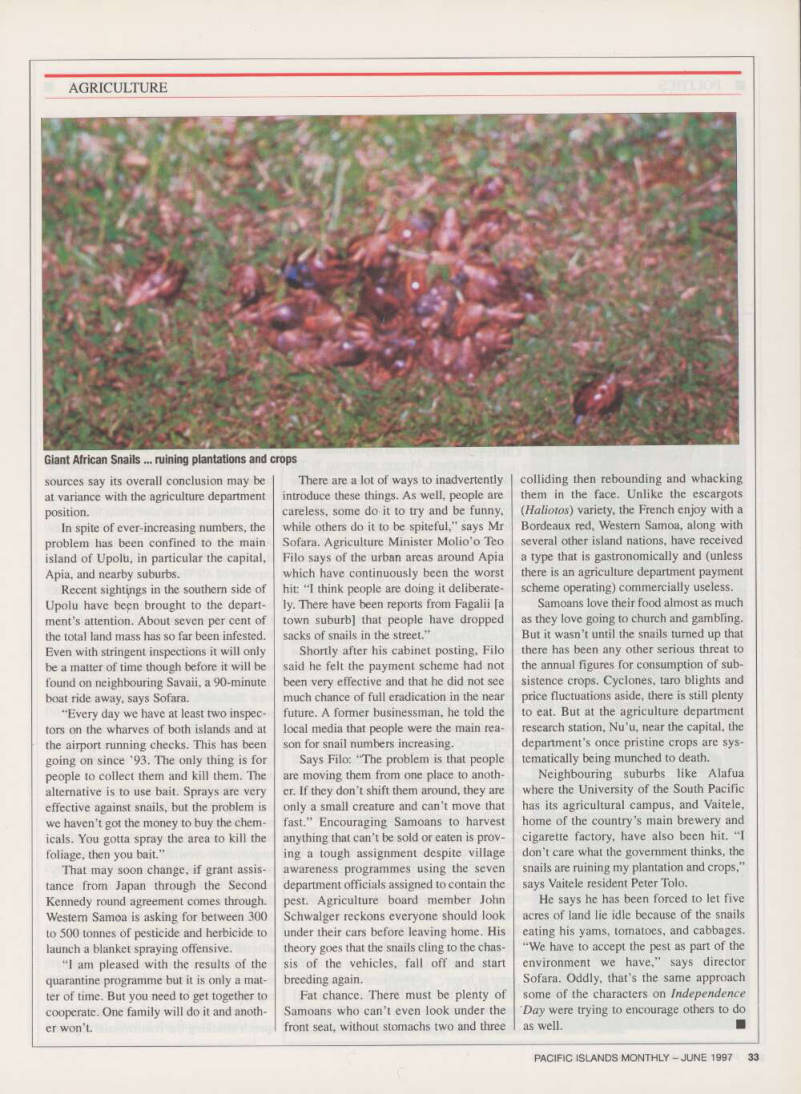
Agriculture
Creepies and crawlies The problem of the Giant African Snail
By Chris Peteru
Anybody who has seen the Giant African Snail (Achantina Fulica) sliding around a plantation or garden may sense this member of the gastropod (liter
ally meaning Belly booted animal)
family is a serious contender for most unwanted mollusc on the plan et. As Western Samoans are discov ering, this pest is big, ugly and look
ing to relocate permanently.
If ever there was a bunch of people wondering if the aliens in the movie.
Independence Day, were based broadly on what they’ve been battling since 1993, it’s the agricultural department staff. The military equivalent is called a full scale invasion. So how did things get to the situation where parts of the coun try now look like a Giant African Snail convention centre?
The arrival of the snail could not have come at a worse time for the struggling agricultural sector. Produce prices, due in part to the introduction of a 10 per cent goods and services tax, were doing cartwheels locally. Cyclones had tom the heart out of the taro industry that brought in more than SUS 4 million in overseas earnings and, to top it off, a taro blight eventually destroyed any taro not being exported, which was most of it. Fruit fly had been around for a long time already.
Farmers were a despondent lot, one sign being the scores of rural villagers playing cricket on weekdays, instead of tending plantations as their farming instincts had told them to for genera tions. Looking to reverse the trend, the
agriculture department initiated a cash bonus scheme to rev up productivity and morale. However, that eventually came under a cloud, and was eventually shelved when scams began to emerge involving farmers being paid for non
existent plantations by agriculture offi
cers, and other pyramid-game-type rip offs. The agriculture minister, Misa Telefoni Retzlaff, a lawyer, farmer, and millionaire publicly stated that we wouldn’t see the results of all the pro ductivity from the bonus scheme for five years. He can bet on it.
By then, the initial wave of snails had spread, after arriving from Apia wharf via container, allegedly from neighbour ing American Samoa, which had also been fingered by customs officials here for causing the taro blight.
With the failure of quarantine officers to do their job, agriculture minister Retzlaff tried an intensive spray pro gramme to napalm them. It was only par tially successful as some families, for reasons possibly explained later on, refused to have their plantations sprayed.
Urgency was needed but despite the tremendous efforts of some villages and officials it didn’t really happen.
Because nine times out of 10, a state of urgency for state officials is often responded to down the power line as a call for no urgency. And getting state employees to operate with urgency is like asking the finance minister how much money Polynesian Airlines has cost the taxpayer in the last four years.
Neither question is likely to draw a response in the near future. So, the years rolled by with plenty of publicity, but never enough cash to buy the chemicals to see the snails off, says government.
Not that the African Snail
was in danger of being wiped
out in a hurry. It is hermaphroditic, (self breeding) and can lay hundreds of eggs in a sitting. Nocturnal by nature, hardy and able to grow up to
eight inches (20 centimetres)
long, it is custom made for the humid Pacific Island climate.
And if it rains, hey, it just makes it easier to slide around.
The diet is a hundred per cent organic, including all kinds of crops, and plant materials.
Then a single 40-watt light bulb went on in the Brains Trust of the agriculture depart ment: pay people a set amount per kilo to collect snails. If it had been a rap song they would have called it Bonus Scheme, it’s the Bomb and gone triple platinum. Farmers and citizens alike were to go on a national track down the snail campaign, to knock one over for their country and their bank accounts.
The message went out and
the hunt began with the enthusiasm Samoans usually reserve for collecting telegraphic transfers at the Bank, of Western Samoa. Buckets of snails began turning up at the Ag department. Followed by tens of thousands more. It was amazing.
Television and newspapers ran stories of Buffalo Bill proportions as snail bounty hunters talked about the merits of sea water over boiling water to finish the pest off.
For a time it looked like the island had licked the problem the island way, that the
2842 sq kilometres of land, housing 57 people per square kilometre, would be saved. All this could have had a happy end ing'until reports of snail breeding with at least the same skill level as the snail geno cide programme started to emerge.
The only thing that made triple plat inum sales then were snail numbers and public hysteria levels. The payment scheme had clearly blown up in the hands of its creators, who may have realised at that point that money can buy a lot of
things but it can’t guarantee good honest service.
Department director Tuisugaletaua Aveau Sofara, however, believes stories of snail breeding were unfound ed, and called the payment scheme a success. “Well, there was a lot of comments about [snail] breeding, but I don’t believe it. I’ve yet to see any real evidence of it. There was a lot of talk. There was just a lot of snails ground.
“It does eat crops but if there are better choices around it does not eat crops but will go for better choices around.
If there is none and there is taro there then they will eat that.”
He downplayed the poten tial of the pest of create havoc on local agriculture. “It’s very early to gauge its effect on exports and subsistence farm crops. It doesn’t appear to be a real threat to exports and produce.
“African snails are a pest,
a serious pest, and whatever limited resources we were given to work with, we tried our best.” But it was unlikely another pay-for-snails programme would be initiat ed. Towards the end of year, the Food and Agriculture Organisation, who have a sub regional office here, sent in their expert.
“He did surveys, wrote a report but most of the things he recommended we were
already doing.”
The report is due to be released shortly, says FAO director Dr Vili Fuavao. Reliable
Sofara...“We tried our best”
sources say its overall conclusion may be at variance with the agriculture department position.
In spite of ever-increasing numbers, the problem has been confined to the main island of Upolti, in particular the capital, Apia, and nearby suburbs.
Recent sightings in the southern side of Upolu have been brought to the depart ment’s attention. About seven per cent of the total land mass has so far been infested.
Even with stringent inspections it will only be a matter of time though before it will be found on neighbouring Savaii, a 90-minute boat ride away, says Sofara.
“Every day we have at least two inspec tors on the wharves of both islands and at the airport running checks. This has been going on since ’93. The only thing is for people to collect them and kill them. The alternative is to use bait. Sprays are very effective against snails, but the problem is we haven’t got the money to buy the chem icals. You gotta spray the area to kill the foliage, then you bait.”
That may soon change, if grant assis tance from Japan through the Second Kennedy round agreement comes through.
Western Samoa is asking for between 300 to 500 tonnes of pesticide and herbicide to launch a blanket spraying offensive.
“I am pleased with the results of the quarantine programme but it is only a mat ter of time. But you need to get together to cooperate. One family will do it and anoth er won’t.
There are a lot of ways to inadvertently introduce these things. As well, people are careless, some do it to try and be funny, while others do it to be spiteful,” says Mr Sofara. Agriculture Minister Molio’o Teo Filo says of the urban areas around Apia which have continuously been the worst hit: “I think people are doing it deliberate ly. There have been reports from Fagalii [a town suburb] that people have dropped sacks of snails in the street.”
Shortly after his cabinet posting, Filo said he felt the payment scheme had not been very effective and that he did not see much chance of full eradication in the near future. A former businessman, he told the local media that people were the main rea son for snail numbers increasing.
Says Filo; “The problem is that people are moving them from one place to anoth er. If they don’t shift them around, they are only a small creature and can’t move that fast.” Encouraging Samoans to harvest anything that can’t be sold or eaten is prov ing a tough assignment despite village awareness programmes using the seven department officials assigned to contain the pest. Agriculture board member John Schwalger reckons everyone should look under their cars before leaving home. His theory goes that the snails cling to the chas sis of the vehicles, fall off and start
breeding again.
Fat chance. There must be plenty of Samoans who can’t even look under the front seat, without stomachs two and three
colliding then rebounding and whacking them in the face. Unlike the escargots (Haliotos) variety, the French enjoy with a Bordeaux red, Western Samoa, along with several other island nations, have received a type that is gastronomically and (unless there is an agriculture department payment scheme operating) commercially useless.
Samoans love their food almost as much as they love going to church and gambling.
But it wasn’t until the snails turned up that there has been any other serious threat to the annual figures for consumption of sub sistence crops. Cyclones, taro blights and price fluctuations aside, there is still plenty to eat. But at the agriculture department research station, Nu’u, near the capital, the department’s once pristine crops are sys tematically being munched to death.
Neighbouring suburbs like Alafua where the University of the South Pacific has its agricultural campus, and Vaitele, home of the country’s main brewery and cigarette factory, have also been hit. “I don’t care what the government thinks, the snails are ruining my plantation and crops,” says Vaitele resident Peter Tolo.
He says he has been forced to let five acres of land lie idle because of the snails eating his yams, tomatoes, and cabbages.
“We have to accept the pest as part of the environment we have,” says director Sofara. Oddly, that’s the same approach some of the characters on Independence Day were trying to encourage others to do as well. ■
Giant African Snails...ruining plantations and crops
Advertisements & other items, pp. 31-33 (4 items)
■ Politics
■ Economy
Trust Company Ltd
USED JAPANESE VEHICLES
SPECIAL OFFER
TOYOTA, NISSAN CARS, WITH AUTOMATIC TRANSMISSION
FROM ONLY $lOOO.OO US DOLLARS EACH PLUS FREIGHT.
ALL SHIPPING AND DOCUMENTATION ARRANGED.
BUY DIRECT FROM JAPAN AND SAVE.
r
“CONTACT”
Trust Company Ltd
KOBAC BID 3F 3-2-26 NISHIKI,
NAKAU NAGOYA, 460 JAPAN.
PHONE: (81) 52 953-5602
FAX (81) 52 953-5634
Agriculture
NZ's Island MPs' early impacts
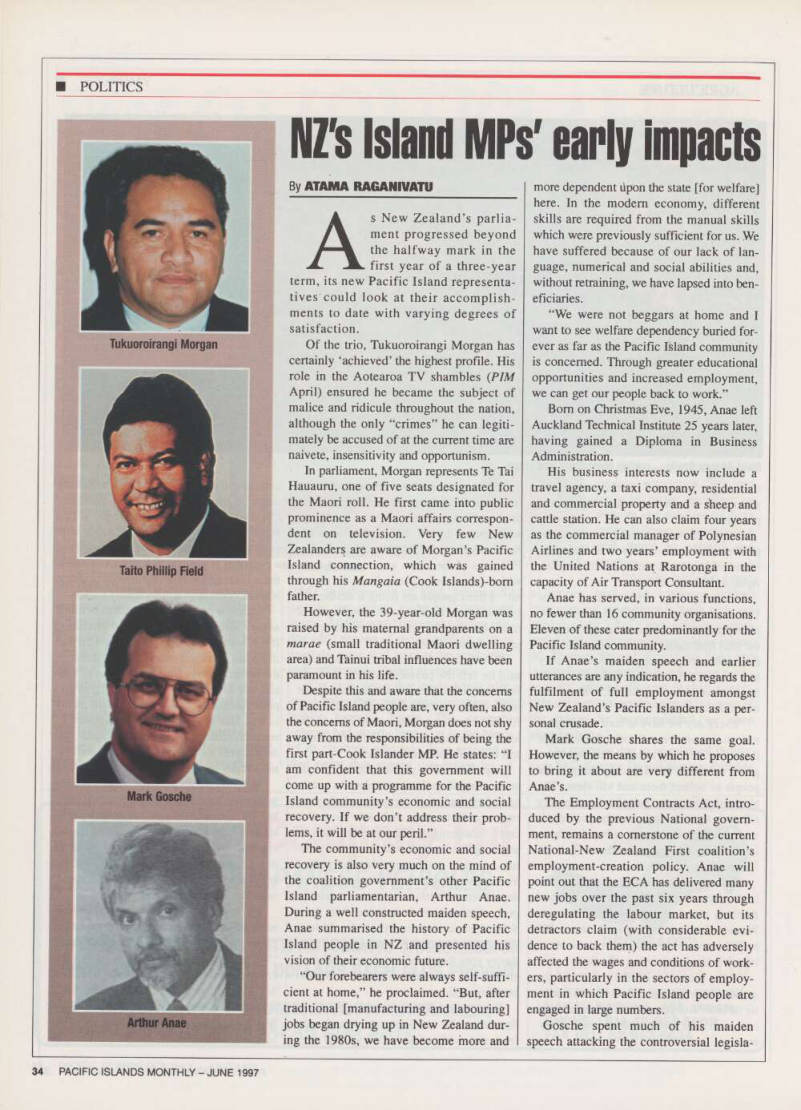
By Atama Raganivatu
As New Zealand’s parlia ment progressed beyond the halfway mark in the first year of a three-year term, its new Pacific Island representa tives could look at their accomplish ments to date with varying degrees of satisfaction.
Of the trio, Tukuoroirangi Morgan has certainly ‘achieved’ the highest profile. His role in the Aotearoa TV shambles (PIM April) ensured he became the subject of malice and ridicule throughout the nation, although the only “crimes” he can legiti mately be accused of at the current time are naivete, insensitivity and opportunism.
In parliament, Morgan represents Te Tai Hauauru, one of five seats designated for the Maori roll. He first came into public prominence as a Maori affairs correspon dent on television. Very few New Zealanders are aware of Morgan’s Pacific Island connection, which was gained through his Mangaia (Cook Islands)-bom father.
However, the 39-year-old Morgan was raised by his maternal grandparents on a marae (small traditional Maori dwelling area) and Tainui tribal influences have been paramount in his life.
Despite this and aware that the concerns of Pacific Island people are, very often, also the concerns of Maori, Morgan does not shy away from the responsibilities of being the first part-Cook Islander MP. He states: “I am confident that this government will come up with a programme for the Pacific Island community’s economic and social recovery. If we don’t address their prob lems, it will be at our peril.”
The community’s economic and social recovery is also very much on the mind of the coalition government’s other Pacific Island parliamentarian, Arthur Anae.
During a well constructed maiden speech, Anae summarised the history of Pacific Island people in NZ and presented his vision of their economic future.
“Our forebearers were always self-suffi cient at home,” he proclaimed. “But, after traditional [manufacturing and labouring] jobs began drying up in New Zealand dur ing the 1980 s, we have become more and
more dependent upon the state [for welfare] here. In the modem economy, different skills are required from the manual skills which were previously sufficient for us. We have suffered because of our lack of lan guage, numerical and social abilities and, without retraining, we have lapsed into ben eficiaries.
“We were not beggars at home and I want to see welfare dependency buried for ever as far as the Pacific ikland community is concerned. Through greater educational
opportunities and increased employment,
we can get our people back to work.”
Bom on Christmas Eve, 1945, Anae left Auckland Technical Institute 25 years later,
having gained a Diploma in Business
Administration.
His business interests now include a travel agency, a taxi company, residential and commercial property and a sheep and cattle station. He can also claim four years as the commercial manager of Polynesian Airlines and two years’ employment with the United Nations at Rarotonga in the capacity of Air Transport Consultant.
Anae has served, in various functions, no fewer than 16 community organisations.
Eleven of these cater predominantly for the Pacific Island community.
If Anae’s maiden speech and earlier utterances are any indication, he regards the fulfilment of full employment amongst New Zealand’s Pacific Islanders as a per sonal crusade.
Mark Gosche shares the same goal.
However, the means by which he proposes to bring it about are very different from Anae’s.
The Employment Contracts Act, intro duced by the previous National govern ment, remains a cornerstone of the current National-New Zealand First coalition’s
employment-creation policy. Anae will
point out that the ECA has delivered many new jobs over the past six years through deregulating the labour market, but its detractors claim (with considerable evi dence to back them) the act has adversely affected the wages and conditions of work ers, particularly in the sectors of employ ment in which Pacific Island people are engaged in large numbers.
Gosche spent much of his maiden
speech attacking the controversial legisla
Tukuoroirangi Morgan
Taito Phillip Field
Mark Gosche
Arthur Anae
tion, stating: “Working people have produced much of this country’s wealth. Yet, this fact has been ignored by our leaders who treat workers as just another commodity in the market place or, even worse, as an enemy to be van
quished. During my term in parliament,
I intend to campaign to get rid of the Employment Contracts Act.”
Exactly how Gosche’s Labour Party
can maintain job growth, having dis
posed of the ECA, it must be said, remains a matter for conjecture.
Just as Anae is very much a product of the free market and commerce, Gosche boasts a conventional socialist pedigree. For most of his 41 years, he has been actively involved in the trade union movement and served as a full time official with the Service Workers’
Union since 1981 before entering par liament. His earliest jobs include jour nalist, freezing worker, student teacher, hotel worker and groundsman.
The differences in backgrounds and philosophies between Anae and Gosche do not augur well for the hope, com monly expressed immediately after they were elected, that the four Pacific Island MPs would form a lobby group and work together for the welfare of
their community.
Taito Phillip Field, who must now be regarded as the “elder statesman” of the New Zealand Pacific Islands politi cal scene despite being a comparative ly youthful 44 and with only one full term in parliament under his belt, con firmed: “I have seen little evidence of any great will for us to work together so far.
“Having four members in the house is very significant but we must use it for effective representation and deliv ery to meet the needs of our communi ty. I am still hopeful we can co-operate
together.”
Education is one obvious area of common ground for the quartet. All agree it is an essential ingredient in the betterment of Pacific Islanders.
But, here again, there may be con flict between Gosche’s desire to estab lish Samoan-language nests for
preschoolers (amongst his greatest
regrets, he says, is being unable to speak the language of his father) and the importance Anae places upon assimilation. Even if the four do man
age to form an informal grouping, there is not a great deal these still inexperienced backbenchers can attain at the current time.
But each has acquired a place on one or more of the all-important select committees and that is a sign they will be considered for more influential positions in the future.
Anae has been appointed to the Maori Affairs, Social Services and Regulations Review committees; Morgan also features on the Maori Affairs Committee, as well as the
Health Committee; Field gained a seat on the Social Services Committee too, and Gosche will doubtless make his presence felt on the Government Administration Committee.
New Zealand’s Pacific Islanders would be unrealistic to believe that the presence of Morgan, Gosche, Field and Anae in parlia ment will immediately enhance their lives.
However, having four voices in the corri dors of power must be regarded as a very
positive development. ■
Advertisements & other items, p. 35 (1 item)
South Pacific Forum Secretariat
SUVA, FIJI
VACANCY
The Forum Secretariat was established in 1972 by the South Pacific Forum to encourage economic and political co-operation between its member countries*, and between those states and the more industrialised countries.
The position of Secretary General of the South Pacific Forum Secretariat will become vacant towards the end of January 1998 and applications for appointment by the members of the Forum are invited from suitably qualified and experienced people. Under the guidance of the Secretary General, the Secretariat provides services to the Forum and undertakes political, trade and economic activities, regional in nature and complementary to the activities of member governments.
The Secretariat provides important linkages with countries and international organisations within and outside the region on behalf of Forum members. These linkages include with the United Nations, the Commonwealth Secretariat through the Post Forum Dialogue, extra regional countries and organisations including APEC, ASEAN, and the EU and with regional organisations of the South Pacific Organisations Coordinating Committee (SPOCC). The Secretariat also has an important role in regional donor coordination.
The Secretary General is accountable to the South Pacific Forum and is required to carry out directives and mandates from Forum Heads of Government on a wide range of matters affecting the political and economic development and security of the region. The incumbent is also the Chief Executive Officer of the Secretariat based in Suva, Fiji.
The Secretary General will: be responsible for the effective management of the Forum Secretariat; service the South Pacific Forum, the Forum Officials Committee (FOC) and such other councils, committes, or working groups that may be established by the Forum or the FOC; conduct and chair meetings of the South Pacific Organisations Coordinating Committee; implement directives and mandates from the Forum or FOC; and effectively represent the interests of the Forum member countries*.
Applicants must demonstrate proven and substantial experience in regional affairs at the highest level, as well as the executive ability required to manage the Secretariat and its programmes.
This is the most senior position in the Forum's network of regional organisations and only those with the required high-level background and experience need apply. The appointment will carry a competitive remuneration package, totalling approximately FJD 131,000 together with generous establishment and education allowances, representational allowance and free medical and life insurance. For non Fiji citizens remuneration may be tax free in Forum member countries*. Appointments are normally for three years, with the option to renew for a further three years. This appointment will be made by the 28th South Pacific Forum in September 1997.
Applications close on 31st July, 1997 and should be addressed to: His Excellency Mr Imata Kabua, MP President of the Republic of the Marshall Islands and Chairman of the South Pacific Forum Office of the President Majuro
REPUBLIC OF THE MARSHALL ISLANDS
SECRETARY GENERAL
"Member States of the South Pacific Forum: Australia, Cook Islands, Federated States of Micronesia, Fiji, Kiribati, Nauru, New Zealand, Niue, Palau, Papua New Guinea, Republic of the Marshall Islands, Solomon Islands, Tonga, Tuvalu, Vanuatu and Western Samoa.
Pressing for freedom
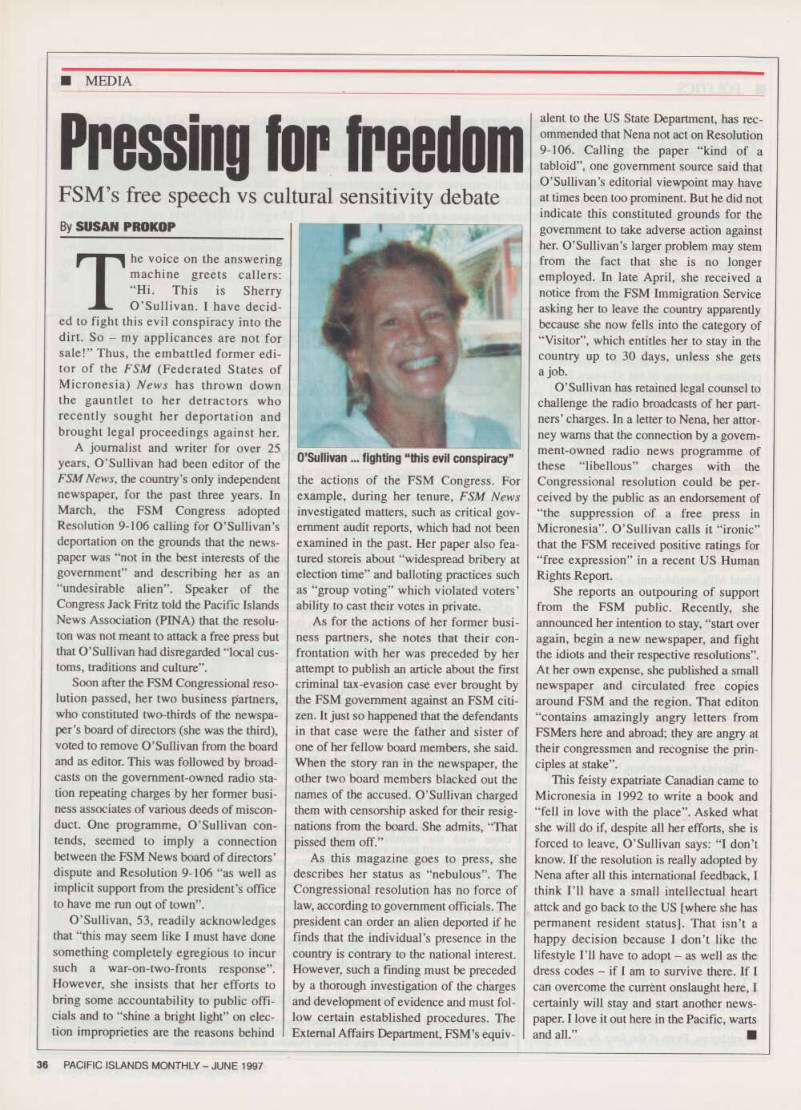
Media
Pressing for freedom FSM’s free speech vs cultural sensitivity debate
By Susan Prokop
The voice on the answering machine greets callers: “Hi. This is Sherry O’Sullivan. I have decid ed to fight this evil conspiracy into the dirt. So - my applicances are not for sale!” Thus, the embattled former edi tor of the FSM (Federated States of Micronesia) News has thrown down the gauntlet to her detractors who
recently sought her deportation and
brought legal proceedings against her.
A journalist and writer for over 25 years, O’Sullivan had been editor of the FSM News, the country’s only independent newspaper, for the past three years. In March, the FSM Congress adopted Resolution 9-106 calling for O’Sullivan’s deportation on the grounds that the news paper was “not in the best interests of the government” and describing her as an “undesirable alien”. Speaker of the Congress Jack Fritz told the Pacific Islands News Association (PINA) that the resolu ton was not meant to attack a free press but that O’Sullivan had disregarded “local cus toms, traditions and culture”.
Soon after the FSM Congressional reso lution passed, her two business partners, who constituted two-thirds of the newspa per’s board of directors (she was the third), voted to remove O’Sullivan from the board and as editor. This was followed by broad casts on the government-owned radio sta tion repeating charges by her former busi ness associates of various deeds of miscon duct. One programme, O’Sullivan con tends, seemed to imply a connection between the FSM News board of directors’ dispute and Resolution 9-106 “as well as implicit support from the president’s office to have me run out of town”.
O’Sullivan, 53, readily acknowledges that “this may seem like I must have done
something completely egregious to incur
such a war-on-two-fronts response”.
However, she insists that her efforts to
bring some accountability to public offi
cials and to “shine a bright light” on elec tion improprieties are the reasons behind
the actions of the FSM Congress. For example, during her tenure, FSM News investigated matters, such as critical gov ernment audit reports, which had not been examined in the past. Her paper also fea tured storeis about “widespread bribery at election time” and balloting practices such as “group voting” which violated voters’ ability to cast their votes in private.
As for the actions of her former busi ness partners, she notes that their con frontation with her was preceded by her attempt to publish an article about the first criminal tax-evasion case ever brought by the FSM government against an FSM citi zen. It just so happened that the defendants in that case were the father and sister of one of her fellow board members, she said.
When the story ran in the newspaper, the other two board members blacked out the names of the accused. O’Sullivan charged them with censorship asked for their resig nations from the board. She admits, “That pissed them off.”
As this magazine goes to press, she describes her status as “nebulous”. The Congressional resolution has no force of law, according to government officials. The president can order an alien deported if he finds that the individual’s presence in the country is contrary to the national interest.
However, such a finding must be preceded by a thorough investigation of the charges and development of evidence and must fol low certain established procedures. The External Affairs Department, FSM’s equiv
alent to the US State Department, has rec ommended that Nena not act on Resolution 9-106. Calling the paper “kind of a tabloid”, one government source said that O’Sullivan’s editorial viewpoint may have at times been too prominent. But he did not indicate this constituted grounds for the government to take adverse action against her. O’Sullivan’s larger problem may stem from the fact that she is no longer employed. In late April, she received a notice from the FSM Immigration Service asking her to leave the country apparently because she now fells into the category of “Visitor”, which entitles her to stay in the country up to 30 days, unless she gets
a job.
O’Sullivan has retained legal counsel to challenge the radio broadcasts of her part ners’ charges. In a letter to Nena, her attor ney warns that the connection by a govern ment-owned radio news programme of these “libellous” charges with the Congressional resolution could be per ceived by the public as an endorsement of “the suppression of a free press in Micronesia”. O’Sullivan calls it “ironic” that the FSM received positive ratings for “free expression” in a recent US Human
Rights Report.
She reports an outpouring of support from the FSM public. Recently, she announced her intention to stay, “start over again, begin a new newspaper, and fight the idiots and their respective resolutions”.
At her own expense, she published a small newspaper and circulated free copies around FSM and the region. That editon “contains amazingly angry letters from FSMers here and abroad; they are angry at their congressmen and recognise the prin ciples at stake”.
This feisty expatriate Canadian came to Micronesia in 1992 to write a book and “fell in love with the place”. Asked what she will do if, despite all her efforts, she is forced to leave, O’Sullivan says: “I don’t know. If the resolution is really adopted by Nena after all this international feedback, I think I’ll have a small intellectual heart attck and go back to the US [where she has permanent resident status]. That isn’t a happy decision because I don’t like the lifestyle I’ll have to adopt - as well as the dress codes - if I am to survive there. If I can overcome the current onslaught here, I certainly will stay and start another news paper. I love it out here in the Pacific, warts and all.” ■
O’Sullivan...fighting “this evil conspiracy”
speaking...
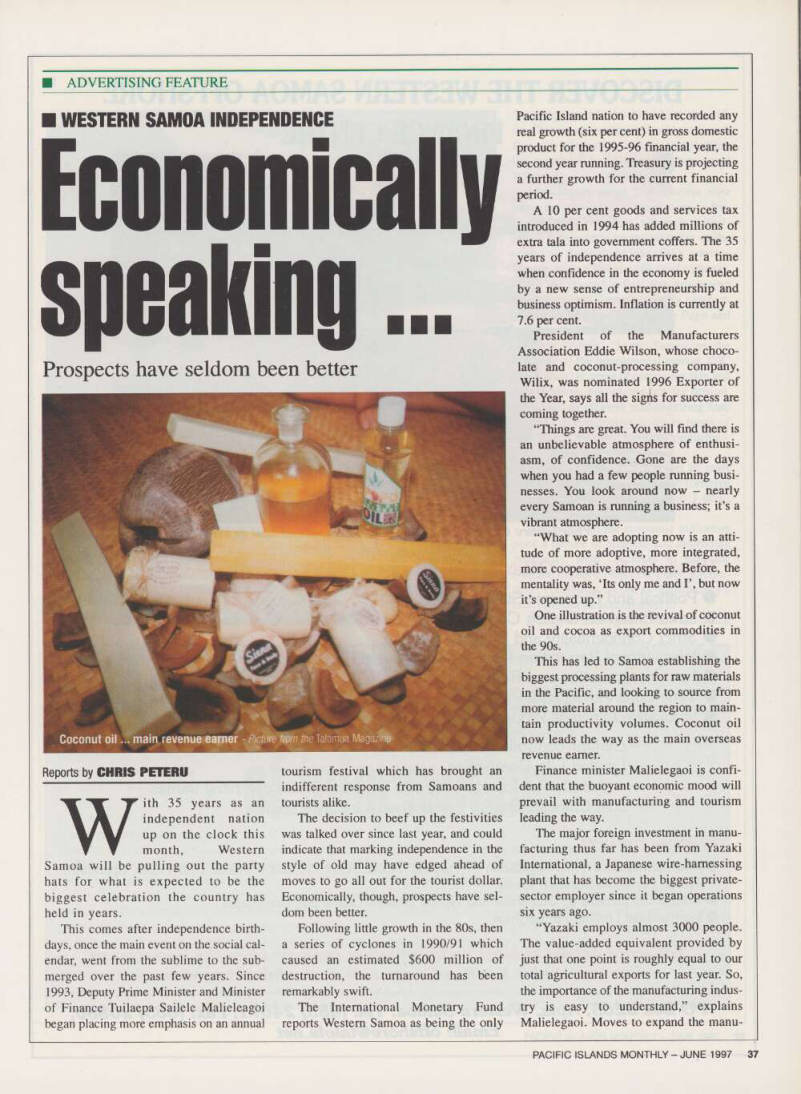

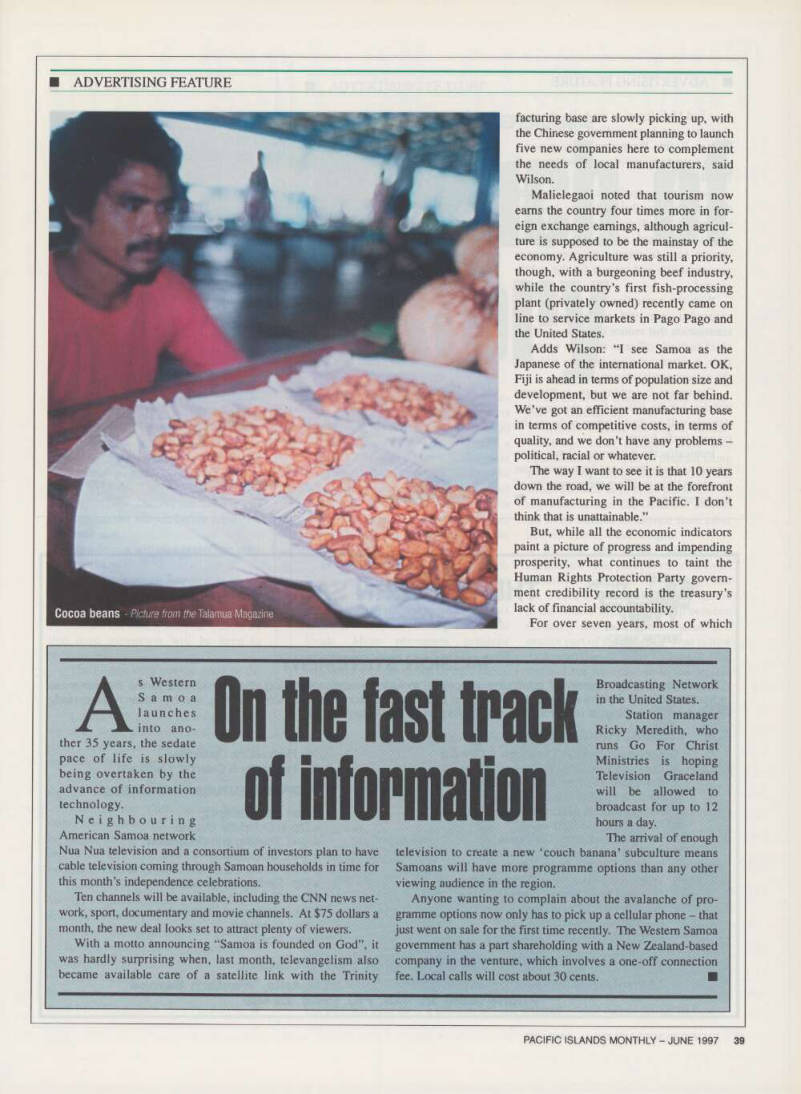
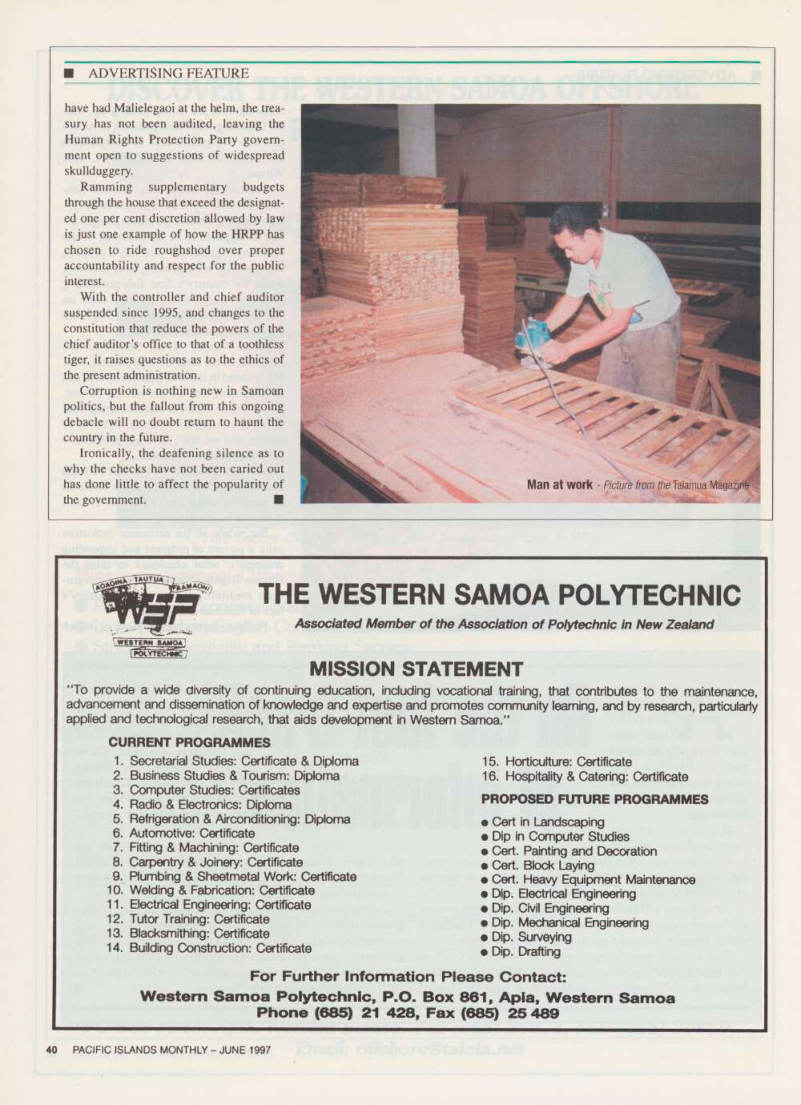
Advertising Feature
Western Samoa Independence
Economically speaking...
Prospects have seldom been better
Reports by CHRIS PETERU
With 35 years as an independent nation up on the clock this month. Western Samoa will be pulling out the party hats for what is expected to be the biggest celebration the country has held in years.
This comes after independence birth days, once the main event on the social cal endar, went from the sublime to the sub merged over the past few years. Since 1993, Deputy Prime Minister and Minister of Finance Tuilaepa Sailele Malieleagoi began placing more emphasis on an annual
tourism festival which has brought an indifferent response from Samoans and tourists alike.
The decision to beef up the festivities was talked over since last year, and could indicate that marking independence in the style of old may have edged ahead of moves to go all out for the tourist dollar.
Economically, though, prospects have sel dom been better.
Following little growth in the 80s, then a series of cyclones in 1990/91 which caused an estimated $6OO million of destruction, the turnaround has been
remarkably swift.
The International Monetary Fund reports Western Samoa as being the only
Pacific Island nation to have recorded any real growth (six per cent) in gross domestic product for the 1995-96 financial year, the second year running. Treasury is projecting a further growth for the current financial
period.
A 10 per cent goods and services tax introduced in 1994 has added millions of extra tala into government coffers. The 35 years of independence arrives at a time when confidence in the economy is fueled by a new sense of entrepreneurship and business optimism. Inflation is currently at 7.6 per cent.
President of the Manufacturers Association Eddie Wilson, whose choco late and coconut-processing company, Wilix, was nominated 1996 Exporter of the Year, says all the signs for success are
coming together.
“Things are great. You will find there is an unbelievable atmosphere of enthusi asm, of confidence. Gone are the days when you had a few people running busi nesses. You look around now - nearly every Samoan is running a business; it’s a
vibrant atmosphere.
“What we are adopting now is an atti tude of more adoptive, more integrated, more cooperative atmosphere. Before, the mentality was, ‘lts only me and I’, but now
it’s opened up.”
One illustration is the revival of coconut oil and cocoa as export commodities in the 90s.
This has led to Samoa establishing the
biggest processing plants for raw materials
in the Pacific, and looking to source from more material around the region to main tain productivity volumes. Coconut oil now leads the way as the main overseas revenue earner.
Finance minister Malielegaoi is confi dent that the buoyant economic mood will prevail with manufacturing and tourism leading the way.
The major foreign investment in manu facturing thus far has been from Yazaki
International, a Japanese wire-hamessing
plant that has become the biggest private sector employer since it began operations six years ago.
“Yazaki employs almost 3000 people.
The value-added equivalent provided by just that one point is roughly equal to our total agricultural exports for last year. So, the importance of the manufacturing indus try is easy to understand,” explains Malielegaoi. Moves to expand the manu-
Coconut oil...main revenue earner - Picture from the Talamua Magazine
factoring base are slowly picking up, with the Chinese government planning to launch five new companies here to complement the needs of local manufacturers, said Wilson.
Malielegaoi noted that tourism now earns the country four times more in for
eign exchange earnings, although agricul
ture is supposed to be the mainstay of the economy. Agriculture was still a priority,
though, with a burgeoning beef industry,
while the country’s first fish-processing
plant (privately owned) recently came on
line to service markets in Pago Pago and the United States.
Adds Wilson: “I see Samoa as the Japanese of the international market. OK, Fiji is ahead in terms of population size and development, but we are not far behind.
We’ve got an efficient manufacturing base in terms of competitive costs, in terms of quality, and we don’t have any problems political, racial or whatever.
The way I want to see it is that 10 years down the road, we will be at the forefront of manufacturing in the Pacific. I don’t think that is unattainable.”
But, while all the economic indicators paint a picture of progress and impending prosperity, what continues to taint the Human Rights Protection Party govern ment credibility record is the treasury’s lack of financial accountability.
For over seven years, most of which
Cocoa beans - Picture from the Talamua Magazine
have had Malielegaoi at the helm, the trea sury has not been audited, leaving the Human Rights Protection Party govern ment open to suggestions of widespread skullduggery.
Ramming supplementary budgets through the house that exceed the designat ed one per cent discretion allowed by law is just one example of how the HRPP has chosen to ride roughshod over proper accountability and respect for the public interest.
With the controller and chief auditor suspended since 1995, and changes to the constitution that reduce the powers of the chief auditor’s office to that of a toothless tiger, it raises questions as to the ethics of the present administration.
Corruption is nothing new in Samoan politics, but the fallout from this ongoing debacle will no doubt return to haunt the country in the future.
Ironically, the deafening silence as to why the checks have not been caried out has done little to affect the popularity of the government. ■
Man at work - Picture from the Talamua Magazine
Advertisements & other items, p. 38 (1 item)
Discover The Western Samoa Offshore
FINANCE CENTRE
.■M Your Secure Offshore Haven at the Crossroads of East & West Western Samoa Offers: • Political and Economic Stability • Laws Based on English Common Law • Strict Confidentiality and Banking Secrecy. • International Reputation for a Well Regulated Regime. • Low Incorporation and Renewal fees. • Time Zone Advantage allowing incorporation of companies yesterday. • Innovative Offshore Products creditor controlled companies Limited Life Companies registration of foreign language companies and company names dual Chinese/English certificates of incorporation.
Projected For 1997 • New International Trust Legislation Purpose Trusts, Asset Protection Trusts, Unit Trusts, Spendthrift Trusts, Perpetual Duration Trusts, • Companies Limited by Guarantee and Hybrid (Shares/Guarantee) Companies • International Limited Partnerships For more details request an information package from the Registrar of International & Foreign Companies at the following address: PO Box 3265 , Apia , Western Samoa. Tel: (685) 24071 , Fax: (685) 20880 , Email: [email protected]
On the fast track
of information
As Western
Samoa launches into ano ther 35 years, the sedate pace of life is slowly being overtaken by the advance of information technology.
Neighbouring
American Samoa network
Nua Nua television and a consortium of investors plan to have cable television coming through Samoan households in time for this month’s independence celebrations.
Ten channels will be available, including the CNN news net work, sport, documentary and movie channels. At $75 dollars a month, the new deal looks set to attract plenty of viewers.
With a motto announcing “Samoa is founded on God”, it was hardly surprising when, last month, televangelism also became available care of a satellite link with the Trinity
Broadcasting Network
in the United States.
Station manager Ricky Meredith, who runs Go For Christ Ministries is hoping Television Graceland will be allowed to broadcast for up to 12 hours a day.
The arrival of enough
television to create a new ‘couch banana’ subculture means Samoans will have more programme options than any other viewing audience in the region.
Anyone wanting to complain about the avalanche of pro gramme options now only has to pick up a cellular phone - that just went on sale for the first time recently. The Western Samoa government has a part shareholding with a New Zealand-based company in the venture, which involves a one-off connection fee. Local calls will cost about 30 cents. ■
Advertisements & other items, pp. 39-40 (2 items)
■ Advertising Feature
The Western Samoa Polytechnic
TAUTUA -
P
WESTERN SAMOA
POi-TTECHMC
THE WESTERN SAMOA POLYTECHNIC
Associated Member of the Association of Polytechnic in New Zealand
MISSION STATEMENT
"To provide a wide diversity of continuing education, including vocational training, that contributes to the maintenance, advancement and dissemination of knowledge and expertise and promotes community learning, and by research, particularly applied and technological research, that aids development in Western Samoa.”
CURRENT PROGRAMMES
1. Secretarial Studies: Certificate & Diploma 2. Business Studies & Tourism: Diploma 3. Computer Studies: Certificates 4. Radio & Electronics: Diploma 5. Refrigeration & Airconditioning: Diploma 6. Automotive: Certificate 7. Fitting & Machining: Certificate 8. Carpentry & Joinery: Certificate 9. Plumbing & Sheetmetal Work; Certificate 10. Welding & Fabrication; Certificate 11. Electrical Engineering: Certificate 12. Tutor Training: Certificate 13. Blacksmithing: Certificate 14. Building Construction: Certificate 15. Horticulture: Certificate 16. Hospitality & Catering: Certificate
PROPOSED FUTURE PROGRAMMES
• Cert in Landscaping • Dip in Computer Studies • Cert. Painting and Decoration • Cert. Block Laying • Cert. Heavy Equipment Maintenance • Dip. Electrical Engineering • Dip. Civil Engineering • Dip. Mechanical Engineering • Dip. Surveying • Dip. Drafting For Further Information Please Contact: Western Samoa Polytechnic, P.O. Box 861, Apia, Western Samoa Phone (685) 21 428, Fax (685) 25 489
of rugby
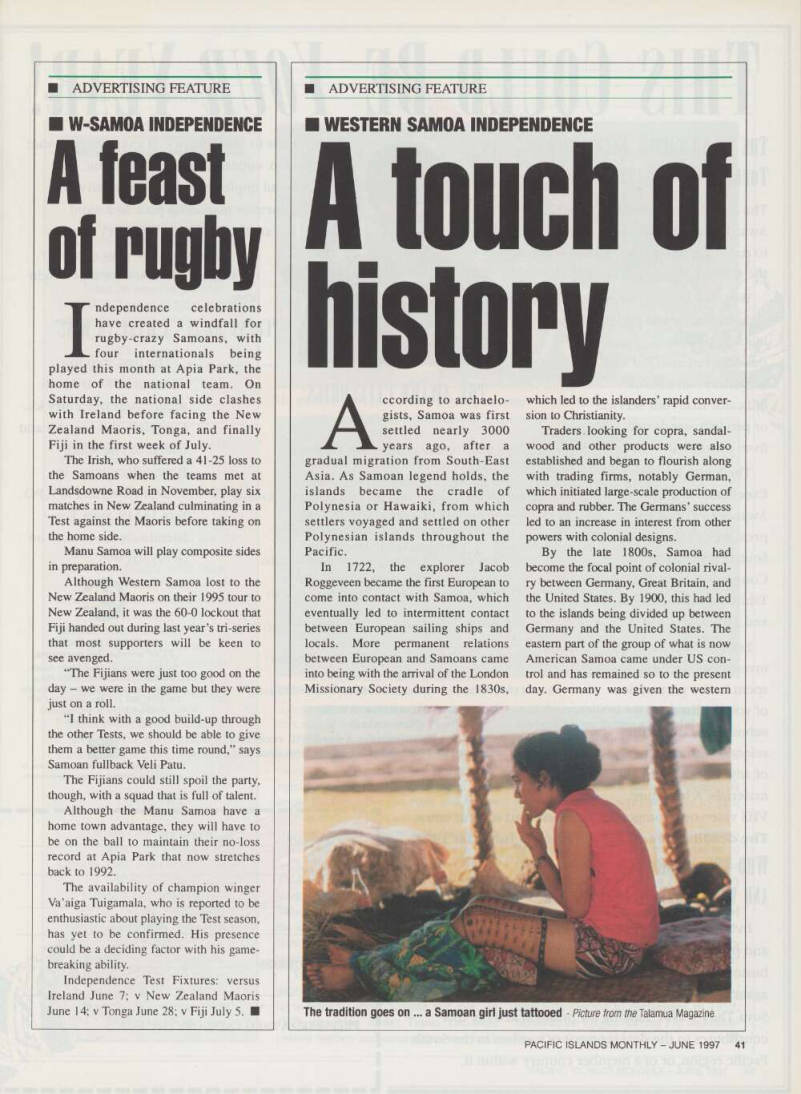
W-Samoa Independence
A feast of rugby
Independence celebrations
have created a windfall for rugby-crazy Samoans, with four internationals being played this month at Apia Park, the home of the national team. On Saturday, the national side clashes with Ireland before facing the New Zealand Maoris, Tonga, and finally Fiji in the first week of July.
The Irish, who suffered a 41-25 loss to the Samoans when the teams met at Landsdowne Road in November, play six matches in New Zealand culminating in a Test against the Maoris before taking on the home side.
Manu Samoa will play composite sides in preparation.
Although Western Samoa lost to the New Zealand Maoris on their 1995 tour to New Zealand, it was the 60-0 lockout that Fiji handed out during last year’s tri-series that most supporters will be keen to see avenged.
“The Fijians were just too good on the day - we were in the game but they were just on a roll.
“I think with a good build-up through the other Tests, we should be able to give them a better game this time round,” says Samoan fullback Veli Patu.
The Fijians could still spoil the party, though, with a squad that is full of talent.
Although the Manu Samoa have a home town advantage, they will have to be on the ball to maintain their no-loss record at Apia Park that now stretches back to 1992.
The availability of champion winger Va’aiga Tuigamala, who is reported to be enthusiastic about playing the Test season, has yet to be confirmed. His presence could be a deciding factor with his game breaking ability.
Independence Test Fixtures: versus Ireland June 7; v New Zealand Maoris June 14; v Tonga June 28; v Fiji July 5. ■
history


Western Samoa Independence
A touch of history
According to archaelo gists, Samoa was first settled nearly 3000 years ago, after a gradual migration from South-East Asia. As Samoan legend holds, the islands became the cradle of Polynesia or Hawaiki, from which settlers voyaged and settled on other Polynesian islands throughout the Pacific.
In 1722, the explorer Jacob Roggeveen became the first European to come into contact with Samoa, which eventually led to intermittent contact between European sailing ships and locals. More permanent relations between European and Samoans came into being with the arrival of the London Missionary Society during the 1830 s,
which led to the islanders’ rapid conver sion to Christianity.
Traders looking for copra, sandal wood and other products were also established and began to flourish along with trading firms, notably German, which initiated large-scale production of copra and rubber. The Germans’ success led to an increase in interest from other powers with colonial designs.
By the late 1800 s, Samoa had become the focal point of colonial rival ry between Germany, Great Britain, and the United States. By 1900, this had led to the islands being divided up between Germany and the United States. The eastern part of the group of what is now American Samoa came under US con trol and has remained so to the present day. Germany was given the western
The tradition goes on...a Samoan girl just tattooed -Picture from the Talamua Magazine
islands, while Britain was givem territorial concessions elsewhere in the Pacific.
Although somewhat austere in their governing of the western islands, under the Germans, huge tracts of lands were con verted into commercial enterprises. The country’s first effective road and bridge system was put in place and an efficient communications system with the outside world was established.
At the outbreak of World War One in 1914, a New Zealand force of 1400 soldiers landed to claim what was then German Samoa, the first country to be won over by the allied forces. But, as with the Germans, Samoans found the New Zealand adminis trators difficult to live with.
This led to the formation of the Mau, a national movement that became instrumen tal in bringing about Samoan self-rule. In 1929, the Mau leader Tupua Tamasese (whose nephew and namesake is now lead
er of the opposition) was murdered by New Zealand troops during a peaceful demon stration through Apia.
Tamasese’s death and the election of a more enlightened Labour government towards the issue of Sajnoan nationalism allowed moves toward self-rule to gain momentum.
On January 1, 1962, Western Samoa became the first Pacific Island nation to become an independent state. Celebrations have for years been held in June because the weather is meant to be better.
Since then, a combination of Westminster-style government fused with some traditional elements has set the stage for 13 successive governments and four prime ministers.
Prime Minister Tofilau Eti Alesana, who was first elected to parliament in 1959, becomes the longest-serving PM and mem ber of parliament in history. ■
The tradition goes on...a kava-drinking ceremony - Picture from the Talamua Magazine
Traditional Samoan house - Picture from the Talamua Magazine
Advertisements & other items, pp. 42-43 (1 item)
This Could Hi Ill 111 Tear!
THE SOUTH PACIFIC EXCELLENT! h'.
TOURISM AWAKUSI997, , 7 '
/ ' ' * • ’ j V The South Pacific Excellence in Tourism Awards were introduced by theTCSFOn 1995 to Recognise and promote excellence in industry in the region. you have 'the permanent W siare the prestigious Awards
oar
itibhal material and inery - an instant that your service «Kor product stands out from the crowd. tO'
THE AWARD CATEGORIES:
The South Pacific Excellence in Tourism Awards 1997 will be presented at the inaugural South Pacific Tourism Conference to be held in Tahiti on October 23rd and 24th.
Entry is free. Your only investment is a little time spent in the preparation of your written submission, and in the selection and production of any supporting materials. A brochure, VHS video or photographs may form part of your entry.
The deadline for all submissions is July 31st 1997.
WHO THE JCDGES ARE,
AID WHAT THEY’RE LOOKII FOR.
In 1995, our panel of judges included an ambassador and prominent names drawn from the South Pacific business and religious communities. The 1997 panel will again comprise people of this calibre, who are based in Suva. They will be looking for business activity that contributes to the development of tourism in the South Pacific region, or of a member country within it.
• DE LUXE ACCOMMODATION AWARD.
(New Award)
• STANDARD ACCOMMODATION AWARD.
(1995 winner: Hideaway Resort, Fiji)
• BUDGET ACCOMMODATION AWARD.
(1995 winner: Samoan Outrigger Hotel, Western Samoa)
• TOURIST TRANSPORTATION AWARD.
(1995 winner:Tourist Transportation Fiji)
• PHOTOGRAPHY AWARD.*
(1995 winner: John Nagive, Solomon Islands)
• INBOUND TOUR OPERATORS AWARD.
(1995 winner: Rosie The Travel Service, Fiji)
• ECOTOURISM AWARD.
(1995 winner: Koroyanitu National Park, Fiji)
•HERITAGE CULTURAL AWARD.
(1995 winner: Cook Islands Cultural Village)
• INTERNATIONAL AIRLINES AWARD.
(1995 winner: Polynesian Airlines, Western Samoa)
• DOMESTIC AIRLINES AWARD.
(New Award) * The winner of the Photography Award will receive a product prize worth $5OO from Kodak Australasia Ltd.
They’ll want to see evidence of extreme customer satisfaction, outstanding initiative or the successful implementation of a worthwhile business or marketing plan. In a word, Excellence. If you think they may be looking for you, and your company, we suggest you reach for a pen right now.
II ■ I WAIT TO wir
The first step to winning an Award is to secure your free entry kit.
Complete this request and mail it to The South Pacific Excellence in Tourism Awards 1997, PO Box 13119, Suva, Fiji Islands. Or fax it to us on (679) 301 995. 2 tourism council
OF THE SOUTH PACIFIC
TCSP works for everyone.
Tourism Council of The South Pacific, PO Box 13119, Level 3, FNPF Place, 343-359 Victoria Parade, Suva, Fiji Islands.
Tel: (679) 304 177. Fax : (679) 301 995.
Internet: http://www.tcsp.com E-Mail: spice ©is.com.fj TCSP extends its thanks to the European Union for providing the financial support for these awards. r I I I I I I I
YOUR NAME:
POSITION:
N s,
COMPANY:
POSTAL ADDRESS:
* i \« PREFERRED AWARD CATEGORY (see list): ? /
FACT BOX
PROFILE
Area: 2394 sq km.
Population: 165,000.
Population density: 57 per sq km.
Language: Samoan/English.
Life expectancy at birth: 67.8 years.
Adult literacy: 98 per cent (a UNESCO report in 1994 suggested that real literacy levels were significantly below those indicated in
official figures).
Human development Index rating: 0.700 (88th out of 174).
POLITICS
System of government: a unicameral constitutional democracy, with strong traditional elements.
The current Head of State is one of four paramount chiefs, and holds the office for life. Thereafter, the Legislative Assembly will elect the Head of State for five-year terms.
There are 49 seats in the House.
Government holds 36.
Universal franchise was introduced in 1991. In order to be a parliamentary candidate, one has to hold a matai (chief) title.
The minimum voting age is 21.
Head of State: Malietoa Tanumafilii 11. Prime Minister; Tofilau Eti Alesana.
Main political parties: Human Rights Political Party (HRPP), Samoa National Development Party
(SNDP).
ECONOMY
Annual GDP per capita: approx SWS2OOO.
Growth Rate: 6 per cent, the target for 1996-97 is 7 per cent.
Inflation rate (end 1996): 7.6 per cent and fluctuating.
Government budget (projected for 1996-97): Revenue $W5288.4 million; Expenditure $W5312.7 million.
Deficit $W524.3 million.
Accumulated Government debt SWS3B9 million.
Beatrice to
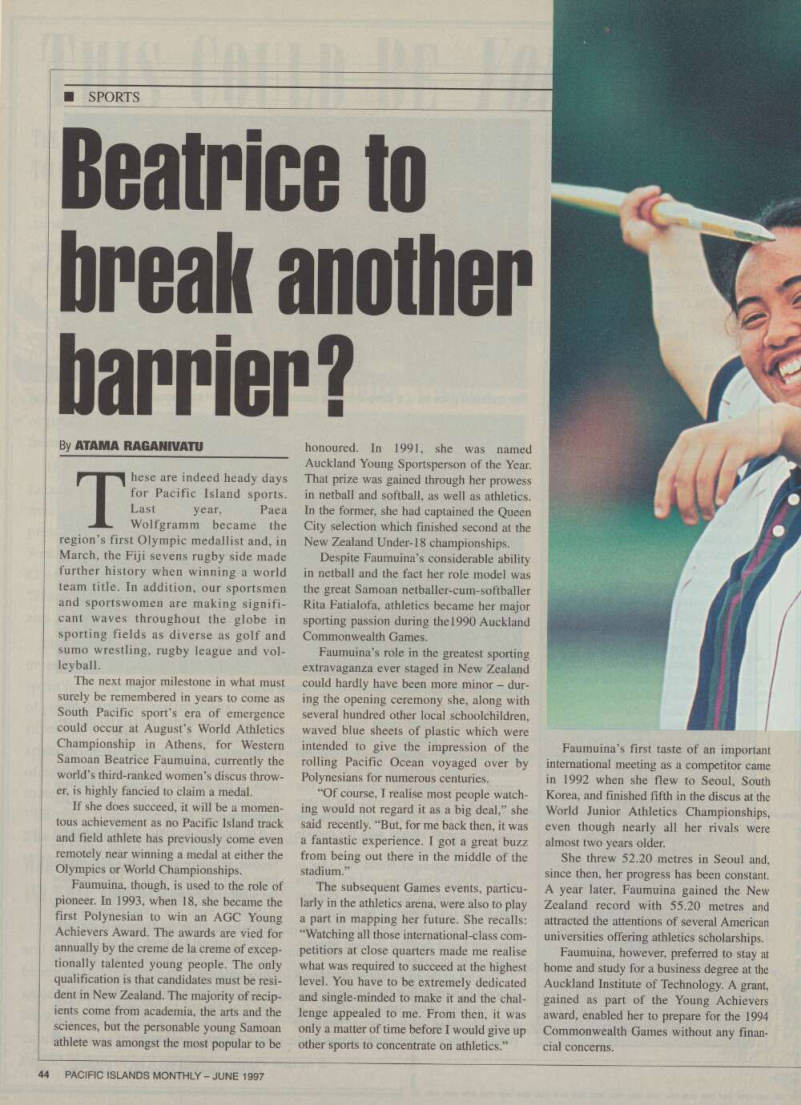
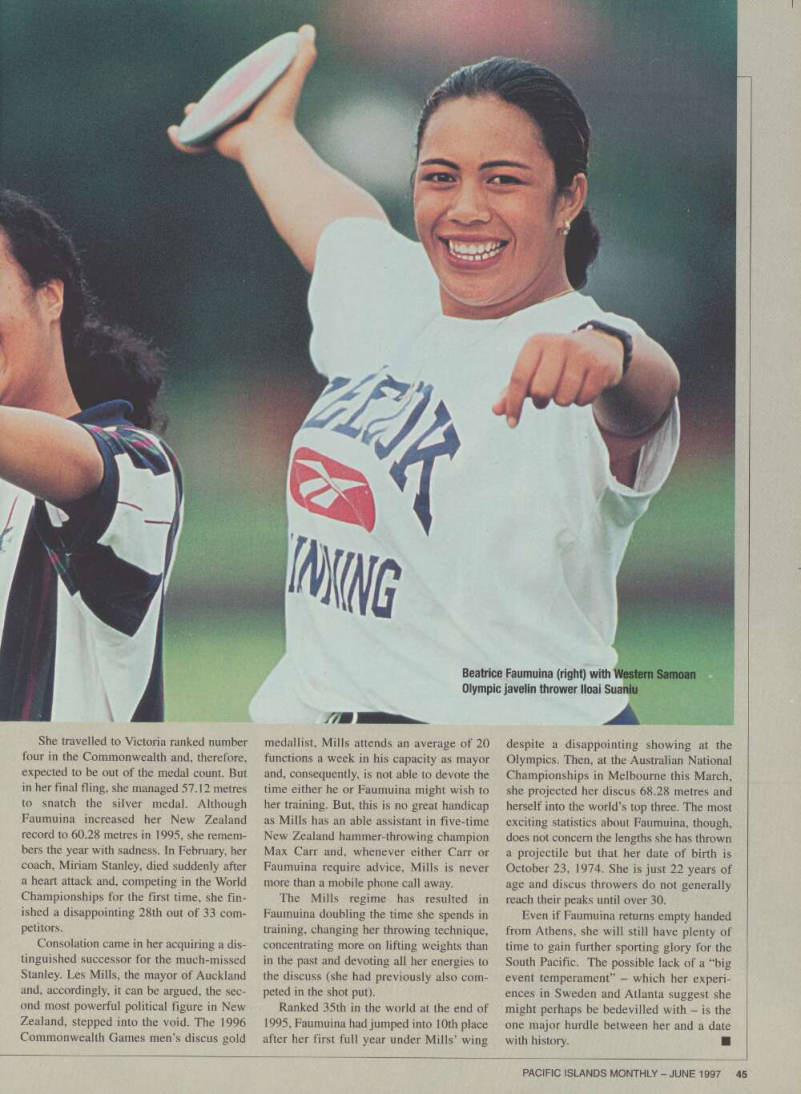
Sports
Beatrice to break another barrier?
By Atama Raganivatu
These are indeed heady days
for Pacific Island sports.
Last year, Paea Wolfgramm became the region’s first Olympic medallist and, in March, the Fiji sevens rugby side made further history when winning a world team title. In addition, our sportsmen and sportswomen are making signifi cant waves throughout the globe in sporting fields as diverse as golf and sumo wrestling, rugby league and vol leyball.
The next major milestone in what must surely be remembered in years to come as South Pacific sport’s era of emergence could occur at August’s World Athletics Championship in Athens, for Western Samoan Beatrice Faumuina, currently the world’s third-ranked women’s discus throw er, is highly fancied to claim a medal.
If she does succeed, it will be a momen tous achievement as no Pacific Island track and field athlete has previously come even remotely near winning a medal at either the
Olympics or World Championships.
Faumuina, though, is used to the role of pioneer. In 1993, when 18, she became the first Polynesian to win an AGC Young Achievers Award. The awards are vied for annually by the creme de la creme of excep tionally talented young people. The only qualification is that candidates must be resi dent in New Zealand. The majority of recip ients come from academia, the arts and the sciences, but the personable young Samoan athlete was amongst the most popular to be
honoured. In 1991, she was named Auckland Young Sportsperson of the Year.
That prize was gained through her prowess in netball and softball, as well as athletics.
In the former, she had captained the Queen City selection which finished second at the New Zealand Under-18 championships.
Despite Faumuina’s considerable ability in netball and the fact her role model was the great Samoan netballer-cum-softballer Rita Fatialofa, athletics became her major sporting passion during the 1990 Auckland Commonwealth Games.
Faumuina’s role in the greatest sporting extravaganza ever staged in New Zealand could hardly have been more minor - dur ing the opening ceremony she, along with several hundred other local schoolchildren, waved blue sheets of plastic which were intended to give the impression of the rolling Pacific Ocean voyaged over by Polynesians for numerous centuries.
“Of course, I realise most people watch ing would not regard it as a big deal,” she said recently. “But, for me back then, it was a fantastic experience. I got a great buzz from being out there in the middle of the stadium.”
The subsequent Games events, particu larly in the athletics arena, were also to play a part in mapping her future. She recalls: “Watching all those international-class com petitiors at close quarters made me realise what was required to succeed at the highest level. You have to be extremely dedicated and single-minded to make it and the chal lenge appealed to me. From then, it was only a matter of time before I would give up other sports to concentrate on athletics.”
Faumuina’s first taste of an important international meeting as a competitor came in 1992 when she flew to Seoul, South Korea, and finished fifth in the discus at the World Junior Athletics Championships, even though nearly all her rivals were almost two years older.
She threw 52.20 metres in Seoul and, since then, her progress has been constant.
A year later, Faumuina gained the New Zealand record with 55.20 metres and attracted the attentions of several American universities offering athletics scholarships.
Faumuina, however, preferred to stay at home and study for a business degree at the Auckland Institute of Technology. A grant, gained as part of the Young Achievers award, enabled her to prepare for the 1994 Commonwealth Games without any finan cial concerns.
She travelled to Victoria ranked number four in the Commonwealth and, therefore, expected to be out of the medal count. But in her final fling, she managed 57.12 metres to snatch the silver medal. Although Faumuina increased her New Zealand record to 60.28 metres in 1995, she remem bers the year with sadness. In February, her coach, Miriam Stanley, died suddenly after a heart attack and, competing in the World Championships for the first time, she fin ished a disappointing 28th out of 33 com petitors.
Consolation came in her acquiring a dis tinguished successor for the much-missed Stanley. Les Mills, the mayor of Auckland and, accordingly, it can be argued, the sec ond most powerful political figure in New Zealand, stepped into the void. The 1996 Commonwealth Games men’s discus gold
medallist, Mills attends an average of 20 functions a week in his capacity as mayor and, consequently, is not able to devote the time either he or Faumuina might wish to her training. But, this is no great handicap as Mills has an able assistant in five-time
New Zealand hammer-throwing champion
Max Carr and, whenever either Carr or Faumuina require advice. Mills is never more than a mobile phone call away.
The Mills regime has resulted in Faumuina doubling the time she spends in
training, changing her throwing technique,
concentrating more on lifting weights than
in the past and devoting all her energies to the discuss (she had previously also com peted in the shot put).
Ranked 35th in the world at the end of 1995, Faumuina had jumped into 10th place after her first full year under Mills’ wing
despite a disappointing showing at the Olympics. Then, at the Australian National Championships in Melbourne this March, she projected her discus 68.28 metres and herself into the world’s top three. The most exciting statistics about Faumuina, though, does not concern the lengths she has thrown a projectile but that her date of birth is October 23, 1974. She is just 22 years of age and discus throwers do not generally reach their peaks until over 30.
Even if Faumuina returns empty handed from Athens, she will still have plenty of time to gain further sporting glory for the South Pacific. The possible lack of a “big event temperament” - which her experi ences in Sweden and Atlanta suggest she might perhaps be bedevilled with - is the one major hurdle between her and a date with history. ■
Beatrice Faumuina (right) with Western Samoan Olympic javelin thrower lloai Suaniu
Advertisements & other items, pp. 46-48 (1 item)
Page 46
Vidiri Waits
By ATAMA RAGANIVATU
Jonah Lomu’s chronic kidney condition, which threatens to curtail the career of the world’s most famous rugby player, may well prompt an appeal to the International Rugby Board for a reduction in the three-year stand down period from international rugby imposed upon Joeli Vidiri in 1995 when he turned his back on Fiji in the hope of greater glory with New Zealand.
Minus Lomu, the All Blacks find them selves short in world-class wingers and Vidiri’s recruitment would prevent any possibility of this becoming an Achilles heel. The New Zealand Rugby Football Union are believed to be reluctant to directly mount a formal appeal with the
IRB. However, media reports suggest them to be in favour of him challenging the ruling as a private individual.
When Vidiri’s manager, Rod Ketels, was approached for comment on the mat ter, he stated: “Nothing has been ruled out and I’ll be sitting down with Joeli and seeking his thoughts. Obviously, he wants to play for the All Blacks at the earliest
feasible opportunity.”
As soon as Vidiri does play for the All Blacks and establishes himself on the international scene - and, such is his tal ent, most knowledgeable observers now believe this to be little more than a for mality - it will complete a true rags-to riches story. The son of a taro farmer, Vidiri was bom in the Nausori Highlands and, like many other males from that area, spent much of his youth at the Mosi Rugby Union Club, when not attending
The waiting game...but at 23, Vidiri has time on his side
Queen Victoria High School. But he only gained notice on the national scene after moving to Nadi and securing a place in its senior representative selection.
Vidiri made his international debut at the 1994 Hong Kong Sevens, immediately before touring Japan and New Zealand with the Fiji senior XV. He played enig matically during the latter expedition, but a superb try in the ‘test’ against New Zealand Maori gave an indication of the Fijian flyer’s true ability. 1994 also saw Vidiri’s “big break”. In June, compatriot Luke Erenavula reluctant ly decided to depart from New Zealand rugby union and embark upon a career in Australian rugby league. To compensate his Kiwi club, he promised to recruit a player who would be capable of adequate ly replacing him. That player was Joeli Vidiri.
Within a few months, Vidiri had not only confirmed himself as an able substi tute with the Pukekohe club, he also inher ited Erenavula’s places in the Counties provincial team and New Zealand’s side at the Hong Kong Sevens.
Vidiri played in four of New Zealand’s five games in the Crown Colony including, ironically, the final victory over Fiji.
Shortly afterwards, he reverted back to his native country and appeared in a test against Canada. That, though, proved to be his last outing in the white jersey.
Upon returning to Pukekohe, Vidiri declared himself unavailable for further duty with Fiji and stated his intention to represent New Zealand, as they offered greater opportunities for worldwide emi nence and financial reward. The decision was a decidedly risky one.
Eligibility rules decreed that he would be on the international sidelines until 1998 - and there was absolutely no guarantee of the All Black selectors showing interest in him then. Vidiri’s numerous critics of the time hastily dismissed his All Black chances. The Fijian’s handling and tack ling, they claimed, were far too suspect. It took just over a year, during which time his skills were being constantly honed, for all the sceptics to be silenced.
Throughout the 1995 New Zealand domestic season, Vidiri and his fellow winger, Lomu, created havoc together as Counties reached their first-ever National Provincial Championship semi-final.
Following this, the All Black selectors named him amongst their reserves for the
tour to Italy and France, before being reminded of the IRB’s eligibility rules.
The 1996 campaign opened with anoth er successful sojourn to Hong Kong and then Vidiri proved conclusively that he is a player of true world class with a series of
scintillating performances in the Super 12.
He scored 10 tries in seven games (only South African James Small grabbed more) and created numerous others whilst tor menting some of the Southern Hemisphere’s premier teams. His role in helping Auckland Blues take the inaugural title was acknowledged with the Ford Rugby Super 12 Player of the Year acco lade.
Suddenly, Vidiri was the flavour of the month and amongst his many newly won admirers were officials from the Canberra
Raiders and Sydney Bulldogs rugby league
clubs. They offered him contracts each believed to be worth SUS 106,000 a year.
However, Vidiri turned these down and reiterated his determination to become an All Black.
He had overshadowed the mighty Lomu during the Super 12 and continued to eclipse him as their Counties side qualified for a first-ever NPC final. Selection for the New Zealand Barbarians side, which defeated the full England national combi nation last November, confirmed Vidiri’s status within Kiwi rugby union.
At Twickenham he looked every inch a true international star. Vidiri will be only 23 on May 2 this year and, even if he has to wait until 1998 to don the All Blacks jer sey, time is now certainly on his side.
After their exploits in 1996, New Zealand are the early favourites for the next World Cup to be staged in Wales two years from now. The odds against a Fijian being involved in the trophy-winning side then are short. ■
Jonah Lomu...resting from kidney injury
The meeting point
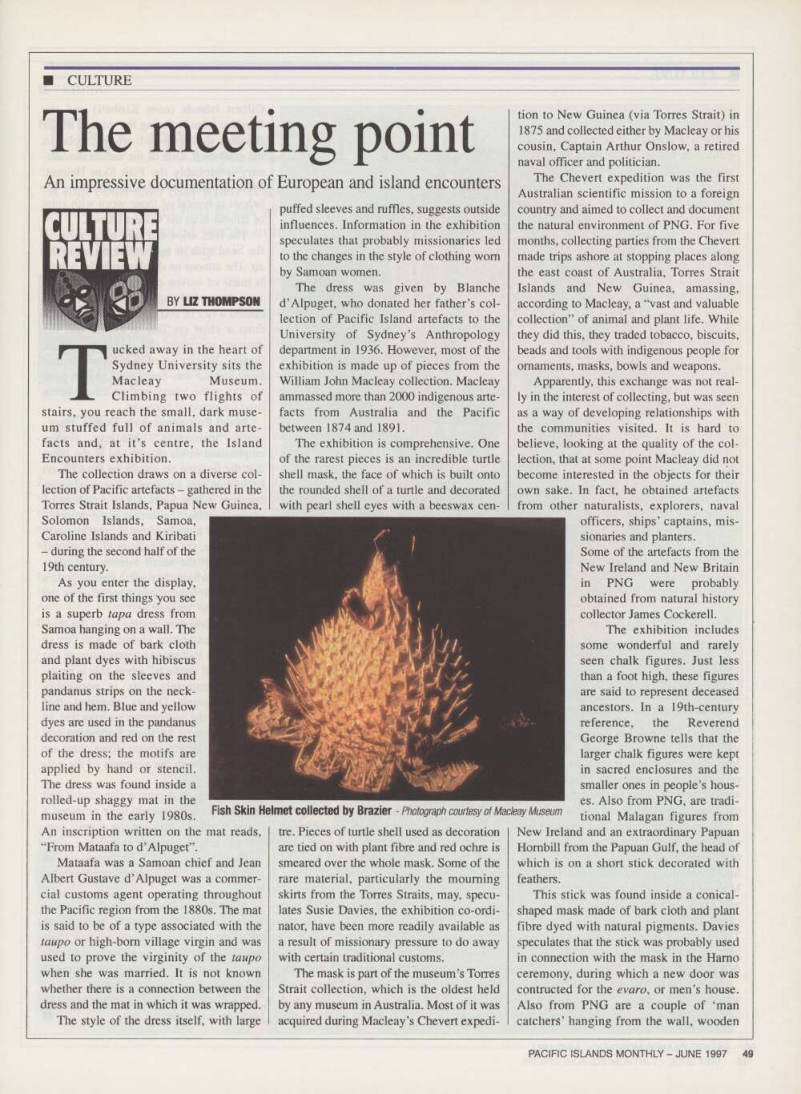
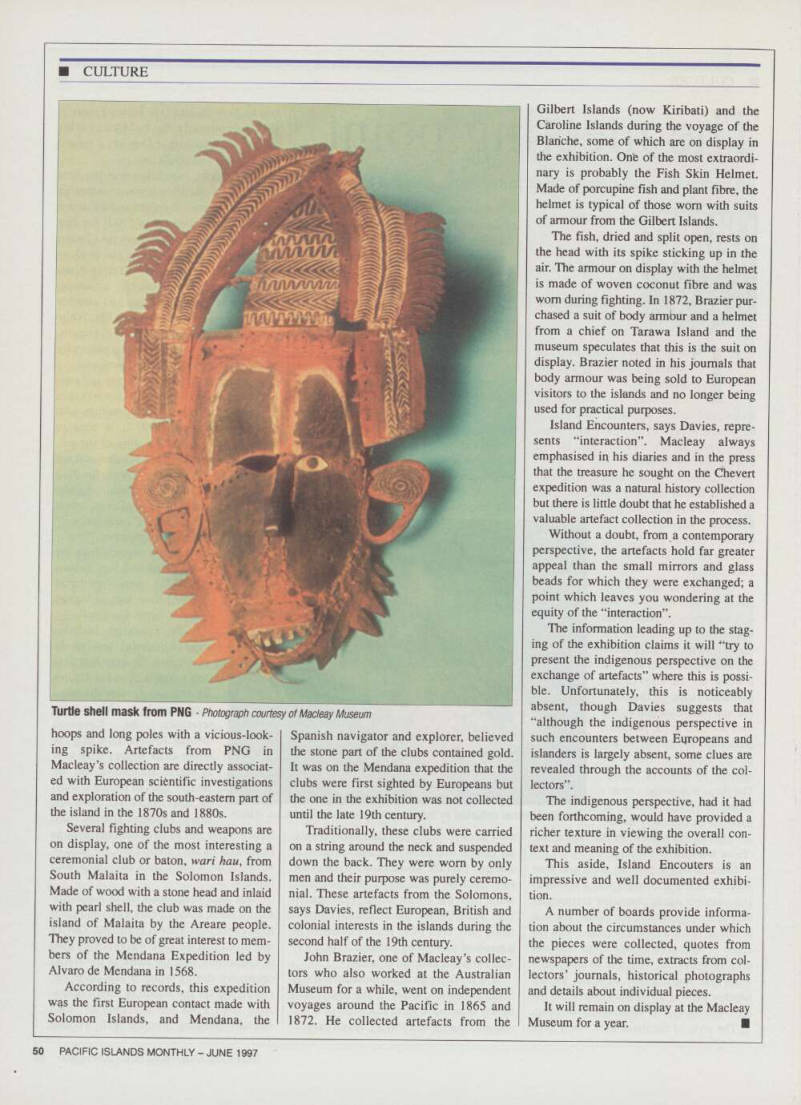
Culture
The meeting point An impressive documentation of European and island encounters
By Liz Thompson
Tucked away in the heart of Sydney University sits the Macleay Museum.
Climbing two flights of
stairs, you reach the small, dark muse um stuffed full of animals and arte facts and, at it’s centre, the Island Encounters exhibition.
The collection draws on a diverse col lection of Pacific artefacts - gathered in the Torres Strait Islands, Papua New Guinea,
Solomon Islands, Samoa, Caroline Islands and Kiribati - during the second half of the 19th century.
As you enter the display, one of the first things you see is a superb tapa dress from Samoa hanging on a wall. The dress is made of bark cloth and plant dyes with hibiscus plaiting on the sleeves and pandanus strips on the neck line and hem. Blue and yellow dyes are used in the pandanus decoration and red on the rest of the dress; the motifs are applied by hand or stencil.
The dress was found inside a rolled-up shaggy mat in the museum in the early 1980 s.
An inscription written on the mat reads, “From Mataafa to d’Alpuget”.
Mataafa was a Samoan chief and Jean Albert Gustave d’Alpuget was a commer cial customs agent operating throughout the Pacific region from the 1880 s. The mat is said to be of a type associated with the taupo or high-bom village virgin and was used to prove the virginity of the taupo when she was married. It is not known whether there is a connection between the dress and the mat in which it was wrapped.
The style of the dress itself, with large
puffed sleeves and ruffles, suggests outside influences. Information in the exhibition speculates that probably missionaries led to the changes in the style of clothing worn by Samoan women.
The dress was given by Blanche d’Alpuget, who donated her father’s col lection of Pacific Island artefacts to the University of Sydney’s Anthropology department in 1936. However, most of the exhibition is made up of pieces from the William John Macleay collection. Macleay ammassed more than 2000 indigenous arte facts from Australia and the Pacific between 1874 and 1891.
The exhibition is comprehensive. One of the rarest pieces is an incredible turtle shell mask, the face of which is built onto the rounded shell of a turtle and decorated with pearl shell eyes with a beeswax cen-
tre. Pieces of turtle shell used as decoration are tied on with plant fibre and red ochre is smeared over the whole mask. Some of the rare material, particularly the mourning skirts from the Torres Straits, may, specu lates Susie Davies, the exhibition co-ordi nator, have been more readily available as a result of missionary pressure to do away with certain traditional customs.
The mask is part of the museum’s Torres Strait collection, which is the oldest held by any museum in Australia. Most of it was
acquired during Macleay’s Chevert expedi
tion to New Guinea (via Torres Strait) in 1875 and collected either by Macleay or his cousin. Captain Arthur Onslow, a retired naval officer and politician.
The Chevert expedition was the first Australian scientific mission to a foreign country and aimed to collect and document the natural environment of PNG. For five months, collecting parties from the Chevert made trips ashore at stopping places along the east coast of Australia, Torres Strait Islands and New Guinea, amassing, according to Macleay, a “vast and valuable collection” of animal and plant life. While they did this, they traded tobacco, biscuits, beads and tools with indigenous people for ornaments, masks, bowls and weapons.
Apparently, this exchange was not real ly in the interest of collecting, but was seen as a way of developing relationships with the communities visited. It is hard to believe, looking at the quality of the col lection, that at some point Macleay did not become interested in the objects for their own sake. In fact, he obtained artefacts from other naturalists, explorers, naval
officers, ships’ captains, mis sionaries and planters.
Some of the artefacts from the New Ireland and New Britain in PNG were probably obtained from natural history collector James Cockerell.
The exhibition includes some wonderful and rarely seen chalk figures. Just less than a foot high, these figures are said to represent deceased ancestors. In a 19th-century reference, the Reverend George Browne tells that the larger chalk figures were kept in sacred enclosures and the smaller ones in people’s hous es. Also from PNG, are tradi
tional Malagan figures from
New Ireland and an extraordinary Papuan Hombill from the Papuan Gulf, the head of which is on a short stick decorated with feathers.
This stick was found inside a conical shaped mask made of bark cloth and plant fibre dyed with natural pigments. Davies speculates that the stick was probably used in connection with the mask in the Hamo ceremony, during which a new door was contructed for the evaro, or men’s house.
Also from PNG are a couple of ‘man catchers’ hanging from the wall, wooden
Fish Skin Helmet collected by Brazier - Photograph courtesy of Macleay Museum
hoops and long poles with a vicious-look ing spike. Artefacts from PNG in Macleay’s collection are directly associat ed with European scientific investigations and exploration of the south-eastern part of the island in the 1870 s and 1880 s.
Several fighting clubs and weapons are on display, one of the most interesting a ceremonial club or baton, wari hau, from South Malaita in the Solomon Islands.
Made of wood with a stone head and inlaid with pearl shell, the club was made on the island of Malaita by the Areare people.
They proved to be of great interest to mem bers of the Mendana Expedition led by Alvaro de Mendana in 1568.
According to records, this expedition was the first European contact made with Solomon Islands, and Mendana, the
Spanish navigator and explorer, believed the stone part of the clubs contained gold.
It was on the Mendana expedition that the clubs were first sighted by Europeans but the one in the exhibition was not collected until the late 19th century.
Traditionally, these clubs were carried on a string around the neck and suspended down the back. They were worn by only men and their purpose was purely ceremo nial. These artefacts from the Solomons, says Davies, reflect European, British and colonial interests in the islands during the second half of the 19th century.
John Brazier, one of Macleay’s collec tors who also worked at the Australian Museum for a while, went on independent voyages around the Pacific in 1865 and 1872. He collected artefacts from the
Gilbert Islands (now Kiribati) and the Caroline Islands during the voyage of the Blanche, some of which are on display in the exhibition. One of the most extraordi nary is probably the Fish Skin Helmet.
Made of porcupine fish and plant fibre, the helmet is typical of those worn with suits of armour from the Gilbert Islands.
The fish, dried and split open, rests on the head with its spike sticking up in the air. The armour on display with the helmet is made of woven coconut fibre and was worn during fighting. In 1872, Brazier pur chased a suit of body armbur and a helmet from a chief on Tarawa Island and the museum speculates that this is the suit on display. Brazier noted in his journals that body armour was being sold to European visitors to the islands and no longer being used for practical purposes.
Island Encounters, says Davies, repre sents “interaction”. Macleay always emphasised ip his diaries and in the press that the treasure he sought on the Chevert expedition was a natural history collection but there is little doubt that he established a valuable artefact collection in the process.
Without a doubt, from a contemporary perspective, the artefacts hold far greater appeal than the small mirrors and glass beads for which they were exchanged; a point which leaves you wondering at the equity of the “interaction”.
The information leading up to the stag ing of the exhibition claims it will “try to present the indigenous perspective on the exchange of artefacts” where this is possi ble. Unfortunately, this is noticeably absent, though Davies suggests that “although the indigenous perspective in such encounters between Europeans and islanders is largely absent, some clues are revealed through the accounts of the col lectors”.
The indigenous perspective, had it had been forthcoming, would have provided a richer texture in viewing the overall con text and meaning of the exhibition.
This aside, Island Encouters is an impressive and well documented exhibi tion.
A number of boards provide informa tion about the circumstances under which the pieces were collected, quotes from newspapers of the time, extracts from col lectors’ journals, historical photographs and details about individual pieces.
It will remain on display at the Macleay Museum for a year. ■
Turtle shell mask from PNG - Photograph courtesy of Macleay Museum
The magic of Telek
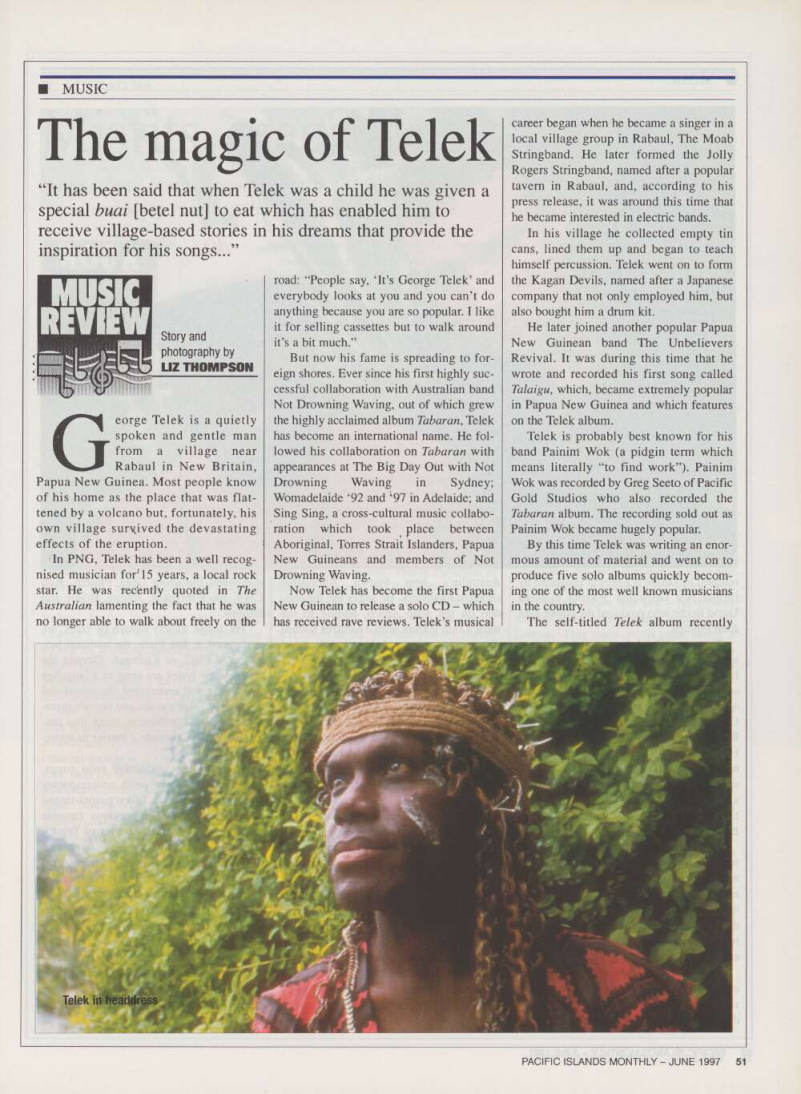
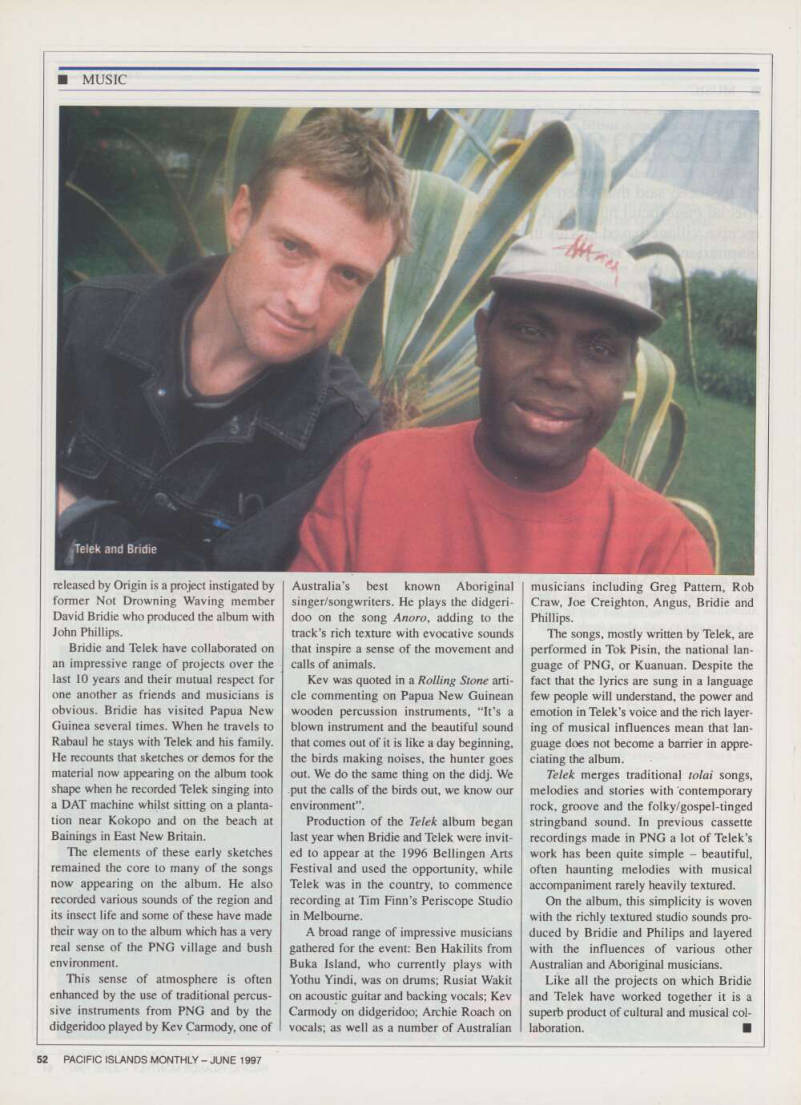
Music
“It has been said that when Telek was a child he was given a special buai [betel nut] to eat which has enabled him to receive village-based stories in his dreams that provide the inspiration for his songs...”
Story and photography by
Liz Thompson
George Telek is a quietly spoken and gentle man from a village near Rabaul in New Britain, Papua New Guinea. Most people know of his home as the place that was flat tened by a volcano but, fortunately, his own village suryived the devastating effects of the eruption.
In PNG, Telek has been a well recog nised musician for'TS years, a local rock star. He was recently quoted in The Australian lamenting the fact that he was no longer able to walk about freely on the
road: “People say, ‘lt’s George Telek’ and everybody looks at you and you can’t do anything because you are so popular. I like it for selling cassettes but to walk around it’s a bit much.”
But now his fame is spreading to for eign shores. Ever since his first highly suc cessful collaboration with Australian band Not Drowning Waving, out of which grew the highly acclaimed album Tabaran, Telek has become an international name. He fol lowed his collaboration on Tabaran with appearances at The Big Day Out with Not
Drowning Waving in Sydney;
Womadelaide ‘92 and ‘97 in Adelaide; and Sing Sing, a cross-cultural music collabo ration which took place between Aboriginal, Torres Strait Islanders, Papua New Guineans and members of Not
Drowning Waving.
Now Telek has become the first Papua New Guinean to release a solo CD - which has received rave reviews. Telek’s musical
career began when he became a singer in a local village group in Rabaul, The Moab Stringband. He later formed the Jolly
Rogers Stringband, named after a popular
tavern in Rabaul, and, according to his press release, it was around this time that he became interested in electric bands.
In his village he collected empty tin cans, lined them up and began to teach himself percussion. Telek went on to form the Kagan Devils, named after a Japanese company that not only employed him, but also bought him a drum kit.
He later joined another popular Papua New Guinean band The Unbelievers Revival. It was during this time that he wrote and recorded his first song called Talaigu, which, became extremely popular in Papua New Guinea and which features on the Telek album.
Telek is probably best known for his band Painim Wok (a pidgin term which means literally “to find work”). Painim Wok was recorded by Greg Seeto of Pacific Gold Studios who also recorded the Tabaran album. The recording sold out as Painim Wok became hugely popular.
By this time Telek was writing an enor mous amount of material and went on to produce five solo albums quickly becom ing one of the most well known musicians in the country.
The self-titled Telek album recently
Telek in headdress
released by Origin is a project instigated by former Not Drowning Waving member David Bridie who produced the album with
John Phillips.
Bridie and Telek have collaborated on an impressive range of projects over the last 10 years and their mutual respect for one another as friends and musicians is obvious. Bridie has visited Papua New Guinea several times. When he travels to Rabaul he stays with Telek and his family.
He recounts that sketches or demos for the material now appearing on the album took shape when he recorded Telek singing into a DAT machine whilst sitting on a planta tion near Kokopo and on the beach at Bainings in East New Britain.
The elements of these early sketches remained the core to many of the songs now appearing on the album. He also recorded various sounds of the region and its insect life and some of these have made their way on to the album which has a very real sense of the PNG village and bush environment.
This sense of atmosphere is often enhanced by the use of traditional percus sive instruments from PNG and by the didgeridoo played by Kev Carmody, one of
Australia’s best known Aboriginal singer/songwriters. He plays the didgeri doo on the song Anoro, adding to the track’s rich texture with evocative sounds that inspire a sense of the movement and calls of animals.
Kev was quoted in a Rolling Stone arti cle commenting on Papua New Guinean wooden percussion instruments, “It’s a blown instrument and the beautiful sound that comes out of it is like a day beginning, the birds making noises, the hunter goes out. We do the same thing on the didj. We put the calls of the birds out, we know our environment”.
Production of the Telek album began last year when Bridie and Telek were invit ed to appear at the 1996 Bellingen Arts Festival and used the opportunity, while Telek was in the country, to commence recording at Tim Finn’s Periscope Studio in Melbourne.
A broad range of impressive musicians gathered for the event: Ben Hakilits from Buka Island, who currently plays with Yothu Yindi, was on drums; Rusiat Wakit on acoustic guitar and backing vocals; Kev Carmody on didgeridoo; Archie Roach on vocals; as well as a number of Australian
musicians including Greg Pattern, Rob Craw, Joe Creighton, Angus, Bridie and
Phillips.
The songs, mostly written by Telek, are performed in Tok Pisin, the national lan guage of PNG, or Kuanuan. Despite the fact that the lyrics are sung in a language few people will understand, the power and emotion in Telek’s voice and the rich layer ing of musical influences mean that lan guage does not become a barrier in appre ciating the album.
Telek merges traditional tolai songs, melodies and stories with contemporary rock, groove and the folky/gospel-tinged stringband sound. In previous cassette recordings made in PNG a lot of Telek’s work has been quite simple - beautiful, often haunting melodies with musical
accompaniment rarely heavily textured.
On the album, this simplicity is woven with the richly textured studio sounds pro duced by Bridie and Philips and layered with the influences of various other Australian and Aboriginal musicians.
Like all the projects on which Bridie and Telek have worked together it is a superb product of cultural and musical col laboration. ■
Telek and Bridie
Misfits, magic and mementoes
Literature
Sinners and Sandalwood is a tribute to the strange terrain of inter-racial understanding
By Nicolas
Rothwell
Last testimony from a van ished, near-forgotten world; obscure master piece by an unkown author; sentimental memoir, recpatur ing in age the bloom of youthful romance; tribute to the strange terrain of inter-racial understanding - Sinners and Sandlwood, a slim volume just published in Australia, is all of these things, and more, in 100 concise pages.
Subtitled “Tales of the Old Pacific”, and bearing the unmistakable influence of those master tale-tellers of the ocean - Robert Louis Stevenson and Joseph Conrad - this is the lightly fictionalised record of a young sandalwood trader’s impressions of the New Hebrides archipelago - today’s Vanuatu - in the far off condominium years of the late 20s.
The author, Frederick George Short, bom in Britain in 1910, raised in India and New Zealand, “rebelled against the staid colonial society of the time, and at 17, he took ship for the tropical paradise of his adolescent dreams” - armed with little more than a volume of Shakespeare.
Sinners and Sandalwood consists of six loosely linked short stories, enclosed by a pair of lilting poems. The first, “Coral Colours”, has this lovely line which could stand as epigraph to the whole work; “Read while you may, for even now it van ishes away, that moment bright, and in the end all coral colours turn to white.”
Loss, the anticipation of death, sombre fate, the recollection of a disappearing age - these are the themes of this record, both amateurish and profound, both subtle and colonial in tone. There are passages of short story writing and construction here
that rival the masters of the form; there are moments of profound emotional response to the spell of the Pacific. Sometimes, the old planter’s brand of humour comes to the fore: “One of the delightful things about island people is their endless capacity of negotiation,” declares the narrator of one of these stories.
But what gives Sinners and Sandalwood its peculiar force is the author’s tilt on life - unusual, perhaps, among White men in the New Hebrides, but not as unusual as we may tend retro spectively to imagine. This is a book about the clash of two cultures and value sys tems, and their mutual facination. Short’s central characters are distinctly prone to falling in love with native women. They are prone, also, to adventures in the New :Hebridian supernatural - sorcerers and bird-women and witches stalk these pages, and the magic works. This is the realm of the blue horizon, the Bums Philp steamer and the catalogue from Sydney, where cen tre-stage is held by larger-than-life charac ters, such as the libertine planter Jimmy Ruby, soft-hearted and philosphically curi ous, or the lovelorn English remittance man, Lethbridge. “The island provided a last refuge for many a queer fellow on whom a more sophisticated society would have frowned,” says the teller of one espe cially apocalyptic story, “The Dugong’s Skull”, which explores the intriguing ques tion of the dugong’s emotional conduct, as well as laying out the cerebral Lethbridge’s surprisingly modern theory of reality as composed of vibrations.
Throughout these pages, an open, keen response to native culture is on display, coupled with a consuming love for the nature of the islands: “Oh blessed isles, Oh blessed Melanesia, black, beautiful dream er, living the last umbilical dream,” exclaims one character in the midst of a celebratory feast - hardly a deep comment but, again, not quite what one might expect to find in a record of this particular time.
Here, too, can be found all the ennui and dislocation of plantation life: “When we were drunk enough to think soberly,”
says one offhand narrator. A bluff planter (who appears in several guises through these stories) is moved to offer, in one of the tales, this comment that encapsulates a way of life, “When you’ve lived here as long as as I have, you’ll accept the facts
and forget about explanations.”
The last of the pieces is “The Beachcomber’s Story”, a highly Conradian tale, which suggests both a prior reading of Heart of Darkness and extensive contact with the idealistic, intellectual anthropolo gists who began visiting the New Hebrides at the start of this century.
The Beachcomber, young Stephen Aisles, disembarks at Vila Harbour and heads for a remote plantation posting as company overseer. Intuitive, sensitive, he responds to the world around him by plunging too deeply into it, goes ‘native’, vanishes for an age, and experiences an inevitable psychological crack-up. Living with his adoptive tribe, he witnesses a can nibal feast, is half unhinged and heads back to Vila. There, outcast, shunned by White men, he drifts into mental chaos and succumbs to the siren call of union with the sea, the moon, the sky - he drowns himself in the calm, enticing waters of the harbour. This story is, in some sense, a self-portrait; the author’s memorial to an aspect of his own character, remembered down the decades - a life set in a new per spective in the echoing arcade of time.
Short, after a strikingly adventure-filled career, and several reinventions of himself, lives today on Australia’s Gold Coast, where for some years his main preoccupa tion has been nurturing many hundreds of native trees to create a haven for birds. In the wake of his New Hebridean days as plant manager and sandalwood trader on Santo, there have been episodes of New Zealand farmwork and university, World War II service in Greece and Egypt, tramp ing and camping across Australia, Himalayan treks and tiger-sightings; even a return to Santo and meetings there with old Melanesian friends - but those are other fascinating stories, and ones we can only hope this late-discovered raconteur will, in the fullness of time, tell us. ■
• Published 1997 by Jomaru Press, North Leura 2780, NSW. Australia. $A24.95
Advertisements & other items, p. 54 (1 item)
Trig’s 9{um6er One setting spirits ideadCy sized, priced
SOUTH PACIFIC FORUM SECRETARIAT
SUVA, FIJI.
VACANCY
cstabUsbeci in 1972 by the South Pacific Forum to encourage economic and political co-operation between its member countries*, and between those states and the more industrialised countries. To help fulfil the aims of the Forum Secretariat the following position needs to be filled:
POLITICAL ISSUES ADVISER
The Secretauriat is seeking a suitably qualified and experienced person as Political Issues Adviser in its Political and International Affairs Division. The Political Issues Adviser will work closely with the Director of the Division in handling a range of Forum political issues including security, political development and governance. o The Political Issues Adviser will: • provide timely and high quality policy advice to Forum member* countries; • coordinate the organisation of the annual Forum Leaders' meeting and other regional meetings as required; • prepare meeting papers, briefs, reports and speeches; • effectively represent the Forum's interests at regional and other meetings.
Applicants must be citizens of Forum member countries* and should have an advanced degree and at least seven years experience working on Pphtical issues relevant to Forum members*. Applicants should have well developed analytical and report writing skills together with a flair for writing speeches on a range of issues. Extensive travel throughout the region will be required The appointment wiU carry a competitive remuneration package, starting at approximately FJD6I,OOO, depending on qualifications and experience. For non-Fiji citizens this should be tax-free in Forum member countries*. There are generous establishment and education allowances and free medical and insurance coverage. Appointments are normally for three years, with the option to renew for a further three years. r Applications should be addressed to: The Secretaiy General South Pacific Forum Secretariat Private Mail Bag Suva, FIJI.
P f, c^ a ? e x ( ? n t j ie Position is available from the Secretariat and applicants are urged to obtain one. Inquiries should be addressed to Mr AWesh Nand on telephone (679) 312-600 Extn 207 or fax (679) 305-573. Applications close on 16 June T 997 and should contain full information on education and career background, names, addresses and telephone numbers of at least three referees with whom the applicant has been associated professionally. oflfaSSfi We^iam^] 0 ' Fi * Nauru, N - Niue, Palau, Papua New Guinea, Republic
PACIFIC ISLAND LIQUOR DISTRIBUTORS
WANTED
for
GOLD CUP PRODUCT RANGE
& BARDINET NEGRITA RHUM
Trig’s 9{um6er One setting spirits ideadCy sized, priced and b[ended for the Pacific IsCand martlet.
For more information please contact:
FAIRDEAL LIQUORS
Sales & Marketing Department P.O. Box 4207, Boroko, N.C.D Papua New Guinea Tel: (675) 325 8925 (Fax: (675) 325 0061. 3 1508 00553368 7
On our way to Poverty Bay
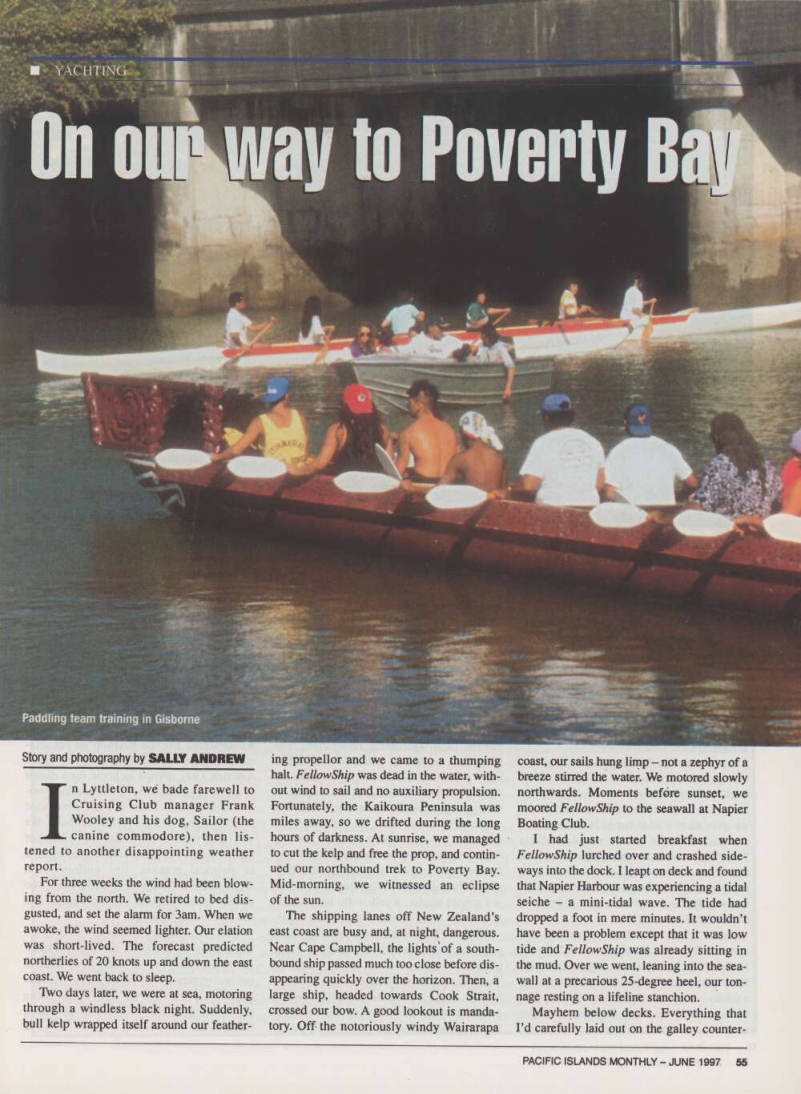
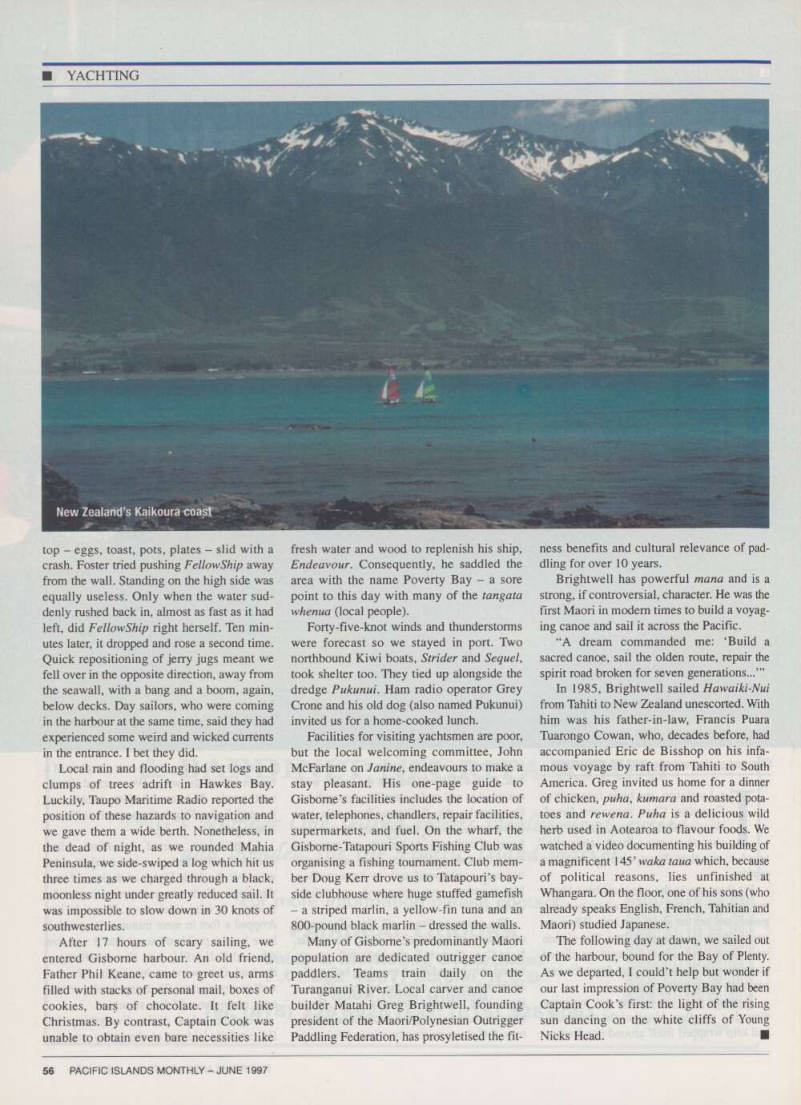
Yachting
Story and photography by SALLY ANDREW
In Lyttleton, we bade farewell to Cruising Club manager Frank Wooley and his dog. Sailor (the canine commodore), then lis tened to another disappointing weather report.
For three weeks the wind had been blow ing from the north. We retired to bed dis gusted, and set the alarm for Sam. When we awoke, the wind seemed lighter. Our elation was short-lived. The forecast predicted northerlies of 20 knots up and down the east coast. We went back to sleep.
Two days later, we were at sea, motoring through a windless black night. Suddenly, bull kelp wrapped itself around our feather
ing propellor and we came to a thumping halt. Fellowship was dead in the water, with out wind to sail and no auxiliary propulsion.
Fortunately, the Kaikoura Peninsula was miles away, so we drifted during the long hours of darkness. At sunrise, we managed to cut the kelp and free the prop, and contin ued our northbound trek to Poverty Bay.
Mid-moming, we witnessed an eclipse of the sun.
The shipping lanes off New Zealand’s east coast are busy and, at night, dangerous.
Near Cape Campbell, the lights'of a south bound ship passed much too close before dis appearing quickly over the horizon. Then, a large ship, headed towards Cook Strait, crossed our bow. A good lookout is manda
tory. Off the notoriously windy Wairarapa
coast, our sails hung limp - not a zephyr of a breeze stirred the water. We motored slowly northwards. Moments before sunset, we moored Fellowship to the seawall at Napier Boating Club.
I had just started breakfast when Fellowship lurched over and crashed side ways into the dock. I leapt on deck and found that Napier Harbour was experiencing a tidal seiche - a mini-tidal wave. The tide had dropped a foot in mere minutes. It wouldn’t have been a problem except that it was low tide and Fellowship was already sitting in the mud. Over we went, leaning into the sea wall at a precarious 25-degree heel, our ton nage resting on a lifeline stanchion.
Mayhem below decks. Everything that I’d carefully laid out on the galley counter-
Paddling team training in Gisborne
top - eggs, toast, pots, plates - slid with a crash. Foster tried pushing Fellowship away from the wall. Standing on the high side was equally useless. Only when the water sud denly rushed back in, almost as fast as it had left, did Fellowship right herself. Ten min utes later, it dropped and rose a second time.
Quick repositioning of jerry jugs meant we fell over in the opposite direction, away from the seawall, with a bang and a boom, again, below decks. Day sailors, who were coming in the harbour at the same time, said they had experienced some weird and wicked currents in the entrance. I bet they did.
Local rain and flooding had set logs and clumps of trees adrift in Hawkes Bay.
Luckily, Taupo Maritime Radio reported the position of these hazards to navigation and we gave them a wide berth. Nonetheless, in the dead of night, as we rounded Mahia Peninsula, we side-swiped a log which hit us three times as we charged through a black, moonless night under greatly reduced sail. It was impossible to slow down in 30 knots of southwesterlies.
After 17 hours of scary sailing, we entered Gisborne harbour. An old friend, Father Phil Keane, came to greet us, arms filled with stacks of personal mail, boxes of cookies, bars of chocolate. It felt like Christmas. By contrast, Captain Cook was unable to obtain even bare necessities like
fresh water and wood to replenish his ship, Endeavour. Consequently, he saddled the area with the name Poverty Bay - a sore point to this day with many of the tangata whenua (local people).
Forty-five-knot winds and thunderstorms were forecast so we stayed in port. Two northbound Kiwi boats, Strider and Sequel, took shelter too. They tied up alongside the dredge Pukunui. Ham radio operator Grey Crone and his old dog (also named Pukunui) invited us for a home-cooked lunch.
Facilities for visiting yachtsmen are poor, but the local welcoming committee, John McFarlane on Janine, endeavours to make a stay pleasant. His one-page guide to Gisborne’s facilities includes the location of water, telephones, chandlers, repair facilities, supermarkets, and fuel. On the wharf, the
Gisbome-Tatapouri Sports Fishing Club was
organising a fishing tournament. Club mem ber Doug Kerr drove us to Tatapouri’s bay side clubhouse where huge stuffed gamefish - a striped marlin, a yellow-fin tuna and an 800-pound black marlin - dressed the walls.
Many of Gisborne’s predominantly Maori population are dedicated outrigger canoe paddlers. Teams train daily on the Turanganui River. Local carver and canoe builder Matahi Greg Brightwell, founding
president of the Maori/Polynesian Outrigger
Paddling Federation, has prosyletised the fit
ness benefits and cultural relevance of pad dling for over 10 years.
Brightwell has powerful mana and is a strong, if controversial, character. He was the first Maori in modem times to build a voyag ing canoe and sail it across the Pacific.
“A dream commanded me: ‘Build a sacred canoe, sail the olden route, repair the spirit road broken for seven generations...’”
In 1985, Brightwell sailed Hawaiki-Nui from Tahiti to New Zealand unescorted. With him was his father-in-law, Francis Puara Tuarongo Cowan, who, decades before, had accompanied Eric de Bisshop on his infa mous voyage by raft from Tahiti to South America. Greg invited us home for a dinner of chicken, puha, kumara and roasted pota toes and rewena. Puha is a delicious wild herb used in Aotearoa to flavour foods. We watched a video documenting his building of a magnificent 145’ waka taua which, because of political reasons, lies unfinished at Whangara. On the floor, one of his sons (who already speaks English, French, Tahitian and Maori) studied Japanese.
The following day at dawn, we sailed out of the harbour, bound for the Bay of Plenty.
As we departed, I could’t help but wonder if our last impression of Poverty Bay had been Captain Cook’s first: the light of the rising sun dancing on the white cliffs of Young Nicks Head. ■
New Zealand’s Kaikoura coast
Advertisements & other items, p. 56 (1 item)
■ Yachting
Simmering
Opinion
Simmering relations
Will higher Maori representation in parliament bridge the racial divide?
It is inevitable that relations between New Zealand’s indigenous Maori race and the Pakeha population are a dominant continuing theme in this country and I make no apology for returning to the subject. It is, after all, an issue impossible to ignore when you reflect on the following recent news events: • a judge rules that Maori do not need the licence to fish for trout in the nation’s rivers that everybody else must buy or face
prosecution.
• a Maori sub-tribe resuses to pay a council’s fees for dog licences because it says dogs are a taonga, or treasure; • the Ministry of Maori Development says disparities between the standards of living of Maori and Pakeha threaten social order in the nation’s cities; • a Maori member of parliament says the Treaty of Waitangi is more important than the Ten Commandments; • a Pakeha launches a petition for a referendum on replacing the treaty with a constitution guaranteeing equal rights for all New Zealanders; and • a Maori takes a sledge hammer to the America’s Cup yacht ing trophy, accusing the government of “illegal occupation of
our country”.
That little medley was guaranteed to get the race relations pot simmering and it surely did. As former Labour Prime Minister Mike Moore said; “New Zealand is tinder dry at the moment.
One bright spark in the wrong place could ignite passions and unleash anger that has been suppressed for generations. For the fist time in my life, I fear for the future of our country.”
Now, Moore is a passionate man, with a passionate love of New Zealand and has been known to go over the top when talk ing about his country. But any thinking person must agree with his statement that race relations and Treaty of Waitangi matters are the “defining issue” of our age. “We could get everything right in economic terms, but if we fail here we fail everywhere,” he says. Many people thought the scene was set for a rapid
improvement in the situation when 15 Maori MPs were elected to the new parliament last year, giving them representation roughly proportionate to their share of the population for the first time. With an appropriate voice on the nation’s leading marae, Winston Peters’ emergence as the deputy prime minister and a powerful say in government through coalition partner New Zealand First’s clean sweep of the Maori seats, things were look
ing up.
With Maori at last given their rightful place in governing the nation, there was scope for the true partnership both sides yearned for in the interests of mutual development and racial harmony. All it needed was goodwill and common sense from both parties. Sadly, this has not proved forthcoming. Some Maori MPs have not helped their cause. Tukuoroirangi Morgan’s $9O boxer shorts purchase {PIM, April 1997) only compounded red neck Pakeha suspicions that Maori leaders loved to ride on a tax payer-funded gravy train and helped kill a Maori-languague TV channel. Labour MP Tariana Turia’s maiden speech depiction of non-Maori New Zealanders as tauiwi - or foreigners - and sub sequent statement that the Treaty of Waitangi was more impor tant than the Ten Commandments, the Magna Carta and the United Nations charter only alienated even those Pakeha sympa thetic to Maori rights. The judge who interpreted the treaty to rule that, in some circumstances, Maori did not need a licence to fish for trout didn’t help matters. His ruling was very qualified, limiting the right to fish without a licence to a small number of Maori from a particular hapu or iwi, which has traditional author ity over a river fishery, providing conservation issues are taken into account.
The main purpose must be to provide for the fisher’s own family or marae. Nevertheless, Moore said, the ruling was “just plain wrong, stupid, dangerous and inflammatory”, asking how it could be policed. Little wonder then that the Pakeha man’s sug gestion of a referendum on replacing the Treaty of Waitangi with a constitution for all New Zealanders attracted widespread sup port. Denying his proposal was anti-Maori, Mark Whyte said: “There is a lot of racial divisiveness in our country and the root cause of a lot of it lies in the treaty. We’re a long way on from 1840 and I think we need a different set of rules to live under so that all decent people who want to make New Zealand their home can do so without favour or discrimination.” Under the law, he has 12 months to collect the signatures of 10 per cent of enrolled voters who can demand a national referendum. Its outcome would not be binding on parliament but would assuredly spark a very bitter and divisive campaign - the very thing the country does not need.
As Moore says, a referendum would be passed because there are more non-Maori voters than Maori - but it wouldn’t solve anything. “It will simply feed the radicals who can then claim with justification that the legitimate needs of Maori are being dismissed.” The government is planning to provide funds in this month’s Budget for four new Maori commissions on health, edu cation, employment and economic development to remove dis parities such as Maori people being almost three times as likely as non-Maori to be unemployed. Maori, are looking to their New Zealand First MPs and ministers to live up to their promises.
Veteran Maori Council chairman Sir Graham Latimer has already warned that if they .do not perform, a new Maori politi cal party should be set up to challenge them. ■
David Barber
Wellington
Aussie foreign
Opinion
Aussie foreign secretary visits the SPC
Australian Secretary for Foreign Affairs and Trade Philip Flood paid a four-day visit to Noumea in April to meet with French and New Caledonian representatives and dis cuss, amongst other things, Australia’s involvement in the Pacific Islands region.
The visit. Flood’s first to New Caledonia, also saw him spend ing a day at the South Pacific Commission to visit programmes and discuss Australia’s involvement with the organisation. The secretary, who was accompanied by his wife, allocated part of the afternoon to address SPC staff, discuss the purpose of his visit and answer questions on Australia’s link with the organisa tion, funding and Australian involvement in issues of media interest.
Flood said Australia had what he called “an abiding interest” in promoting regional economic stability and growth. Australia’s aid to the South Pacific from 1996 to 1997 was over $5OO mil lion (including its $5O million in defence co-operation to Papua New Guinea). Flood said this allocation held steady despite strin gent budgetary pressures.
Australia currently contributes over 35 per cent to the SPC core budget. But whether or not this percentage will decrease following the organisation’s annual conference in Canberra in October this year remains to be seen.
Flood would not comment on the topic, saying it was a mat ter to be decided in Canberra. However, he indicated that the question of whether it was “healthy” for his country to contribute such a large percentage would definitely arise at the Canberra talks.
Flood maintained his country’s commitment to the SPC and confirmed that Australia expected to provide over $7 million to the organisation in 1996-1997, substantially complemented by
extra-budgetary funding.
He said, in providing assistance to the Pacific, the SPC offered several advantages for Australia, particularly because its membership includes the full run of Pacific Island countries and territories and because of its ability to meet the specific needs of the region. “The SPC is establishing itself as a model for others
to follow through a process of reform and sharper concentration of effort,” he said. “We take our membership and support for these organisations very seriously and, consequently, we have worked hard to ensure they are cost effective and contribute effectively to the regional process of economic reform and devel opment. “An important principle is that a dollar not well spent in one area is lost to other priority programmes. Organisations can not be all things to all people and choices have to be made about prioritisation.”
Flood said the SPC’s fisheries programme topped the list of Australia’s funding priority areas to the organisation, stating: “The effective and sustainable management of fisheries resources is of central concern to the long-term wellbeing of many island countries. “Given that many Pacific Island coun tries are relatively resource poor, Australia considers that sus tainable management of the fisheries resource is a vital means of achieving sustainable economic development in the region.”
Flood also named the SPC health sector as a priority area in Australia’s aid programme to the region and said Australian assistance had a strong focus on primary and preventive care and
building local capacities.
He said his government was keen to see the revised AusAID/United Nations Development Programme (UNDP)funded Pacific Islands Forest and Trees Support Programme deliver real outcomes in terms of improved commercial logging practices and better overall forest management.
He also highlighted the importance of the SPC’s socio-eco nomic programme which constitutes statistics, demography, cul ture, women and youth. In addition, the organisation’s Community Education Training Centre (CETC) in Suva has also received extra-budgetary Australian funding.
Following his address. Flood answered questions from SPC staff on topics which inlcuded the “closure” of some of the ser vices of the Australian Broadcasting Commission (ABC), the Bougainville crisis in terms of Australia’s “special relationship” with Papua New Guinea, Australia’s trade with the islands in terms of the replacement of the SPARTECA agreement and the influence of money power by large donors.
On the subject of Radio Australia and the decision not to shut down the service after weeks of speculation and uncertainty, the secretary said Radio Australia was run as an independent entity by the ABC and its future funding levels would be announced during the May budget.
Flood did not comment on SPARTECA, saying the agreement was being studied in Canberra.
On the possibility of the United Kingdom returning as an SPC member, Flood said he could not comment because it was a mat ter for the UK to determine.
However, SPC Director-General Bob Dun says the return of the UK to the SPC would be a great vote of confidence in the Pacific in light of its historical ties to Britain.
“Membership of the SPC is a very cost-effective way of con tributing to development in the Pacific Islands,” he said.
Australia’s consul-general in New Caledonia, Graeme Wilson, said his country was prepared to take a “fairly positive” view of new membership provided it was “cost effective”.
“For instance, Chile has, in the past, expressed an interest in joining the organisation and, no doubt, this interest will continue given Chile’s commitment to the Pacific region,” he said. ■
Debbie Singh
Spc, Noumea
Advertisements & other items, pp. 59-60 (1 item)
life Insurance is a Shell
4 grows
protects
customized
rare
portable
natural
Every shell is tailored to its And shells are “portable” to environment. Each one of our their owners. With the help of policies is customized; yours your Grand Pacific agent, will be perfectly suited to your policy easily keeps up you. with you.
Within a shell’s protection, For more information on there’s future safety and security, security much as nature In somewhat the same way, intended, call your Grand Grand Pacific Life Insurance Pacific Life representative, helps protect your family’s us provide a protective financial security. s he!l for you.
Many shells are a rarity.
You’re respected as a rare individual because there is only one of you. ©
Grand Pacific Life Insurance, Ltd.
A member of the Finance Factors Family 1164 Bishop Street, sth Floor • Honolulu, HI 96813 • Phone: (808) 548-3333 • Fax: (808) 548-5122 What nature does to protect the inhabitants of the ocean, Grand Pacific Life Insurance does for the people of the Islands.
Just as the shell grows with its occupant, our insurance grows in value as an investment in your life.
N 9)9
2-.? pi PRC4Fic_
Box PP)
2. SHELVES
driP »*» R ■v . *4* 'C~ .'■■■*.mmr - •<•:-■ .-x-' - ; m m% IS • . ,:t! r-s ■ ,- . * - - - 5 S^>-e^.C!'
LAND CRUISER
teda* B ** - ***. J *r A ■ •*••*■
'«JSS3S«
, . ' ■*-<#£'l<6 >''M A Some of the specs may vary according to market specifications.
Heavy duty beauties - Toyota Land Cruiser and Land Cruiser PRADO Land Cruiser’s got a reputation for go anywhere toughness, with style and ability to take you there in total comfort, on road or off.
Its luxury matches most expensive sedans. And it has more space than many large passenger cars. With impeccable fit and finish.
And graceful, elegant form.
Land Cruiser PRADO inherits these traditions, and all Toyota’s 4x4 know-how for great performance off road and passenger car comfort on the highway, and stylish beauty everywhere it goes.
What you can’t see is also important. Tough frames. Suspensions built to take you as far off road as you want to go, in comfort. Your choice of powerful petrol or diesel engines. And bodies thoroughly protected from rust.
Land Cruiser and Land Cruiser PRADO - two champions, on and off the road.
DISTRIBUTORS / DEALERS
NORFOLK ISLAND BORRY’S PTV LTD, PH 22114
SOLOMON ISLANDS ELA MOTORS PH 30314
VANUATU ,ASCO MOTORS PH 22341
COOK ISLANDS PACIFIC MOTORS LTD. PH 20796
®> TOYOTA
KIRIBATI TARAWA MOTORS PH 21090
PAPUA NEW GUINEA...ELA MOTORS PH 3229400
TAHITI NIPPON AUTOMOTO PH 429819
WESTERN SAMOA. .ASCO MOTORS PH 20800
FIJI ASCO MOTORS PH 384888
NEW CALEDONIA S.l AP. PH 275562
TONGA. .ASCO MOTORS PH 23500
AMERICAN SAMOA* ASCO MOTORS PH 633-4281
(*PRADO is not being handled.)