Beatrice to
pp. 44-45 · Read in the full issue
Sports
Beatrice to break another barrier?
By Atama Raganivatu
These are indeed heady days
for Pacific Island sports.
Last year, Paea Wolfgramm became the region’s first Olympic medallist and, in March, the Fiji sevens rugby side made further history when winning a world team title. In addition, our sportsmen and sportswomen are making signifi cant waves throughout the globe in sporting fields as diverse as golf and sumo wrestling, rugby league and vol leyball.
The next major milestone in what must surely be remembered in years to come as South Pacific sport’s era of emergence could occur at August’s World Athletics Championship in Athens, for Western Samoan Beatrice Faumuina, currently the world’s third-ranked women’s discus throw er, is highly fancied to claim a medal.
If she does succeed, it will be a momen tous achievement as no Pacific Island track and field athlete has previously come even remotely near winning a medal at either the
Olympics or World Championships.
Faumuina, though, is used to the role of pioneer. In 1993, when 18, she became the first Polynesian to win an AGC Young Achievers Award. The awards are vied for annually by the creme de la creme of excep tionally talented young people. The only qualification is that candidates must be resi dent in New Zealand. The majority of recip ients come from academia, the arts and the sciences, but the personable young Samoan athlete was amongst the most popular to be
honoured. In 1991, she was named Auckland Young Sportsperson of the Year.
That prize was gained through her prowess in netball and softball, as well as athletics.
In the former, she had captained the Queen City selection which finished second at the New Zealand Under-18 championships.
Despite Faumuina’s considerable ability in netball and the fact her role model was the great Samoan netballer-cum-softballer Rita Fatialofa, athletics became her major sporting passion during the 1990 Auckland Commonwealth Games.
Faumuina’s role in the greatest sporting extravaganza ever staged in New Zealand could hardly have been more minor - dur ing the opening ceremony she, along with several hundred other local schoolchildren, waved blue sheets of plastic which were intended to give the impression of the rolling Pacific Ocean voyaged over by Polynesians for numerous centuries.
“Of course, I realise most people watch ing would not regard it as a big deal,” she said recently. “But, for me back then, it was a fantastic experience. I got a great buzz from being out there in the middle of the stadium.”
The subsequent Games events, particu larly in the athletics arena, were also to play a part in mapping her future. She recalls: “Watching all those international-class com petitiors at close quarters made me realise what was required to succeed at the highest level. You have to be extremely dedicated and single-minded to make it and the chal lenge appealed to me. From then, it was only a matter of time before I would give up other sports to concentrate on athletics.”
Faumuina’s first taste of an important international meeting as a competitor came in 1992 when she flew to Seoul, South Korea, and finished fifth in the discus at the World Junior Athletics Championships, even though nearly all her rivals were almost two years older.
She threw 52.20 metres in Seoul and, since then, her progress has been constant.
A year later, Faumuina gained the New Zealand record with 55.20 metres and attracted the attentions of several American universities offering athletics scholarships.
Faumuina, however, preferred to stay at home and study for a business degree at the Auckland Institute of Technology. A grant, gained as part of the Young Achievers award, enabled her to prepare for the 1994 Commonwealth Games without any finan cial concerns.
She travelled to Victoria ranked number four in the Commonwealth and, therefore, expected to be out of the medal count. But in her final fling, she managed 57.12 metres to snatch the silver medal. Although Faumuina increased her New Zealand record to 60.28 metres in 1995, she remem bers the year with sadness. In February, her coach, Miriam Stanley, died suddenly after a heart attack and, competing in the World Championships for the first time, she fin ished a disappointing 28th out of 33 com petitors.
Consolation came in her acquiring a dis tinguished successor for the much-missed Stanley. Les Mills, the mayor of Auckland and, accordingly, it can be argued, the sec ond most powerful political figure in New Zealand, stepped into the void. The 1996 Commonwealth Games men’s discus gold
medallist, Mills attends an average of 20 functions a week in his capacity as mayor and, consequently, is not able to devote the time either he or Faumuina might wish to her training. But, this is no great handicap as Mills has an able assistant in five-time
New Zealand hammer-throwing champion
Max Carr and, whenever either Carr or Faumuina require advice. Mills is never more than a mobile phone call away.
The Mills regime has resulted in Faumuina doubling the time she spends in
training, changing her throwing technique,
concentrating more on lifting weights than
in the past and devoting all her energies to the discuss (she had previously also com peted in the shot put).
Ranked 35th in the world at the end of 1995, Faumuina had jumped into 10th place after her first full year under Mills’ wing
despite a disappointing showing at the Olympics. Then, at the Australian National Championships in Melbourne this March, she projected her discus 68.28 metres and herself into the world’s top three. The most exciting statistics about Faumuina, though, does not concern the lengths she has thrown a projectile but that her date of birth is October 23, 1974. She is just 22 years of age and discus throwers do not generally reach their peaks until over 30.
Even if Faumuina returns empty handed from Athens, she will still have plenty of time to gain further sporting glory for the South Pacific. The possible lack of a “big event temperament” - which her experi ences in Sweden and Atlanta suggest she might perhaps be bedevilled with - is the one major hurdle between her and a date with history. ■
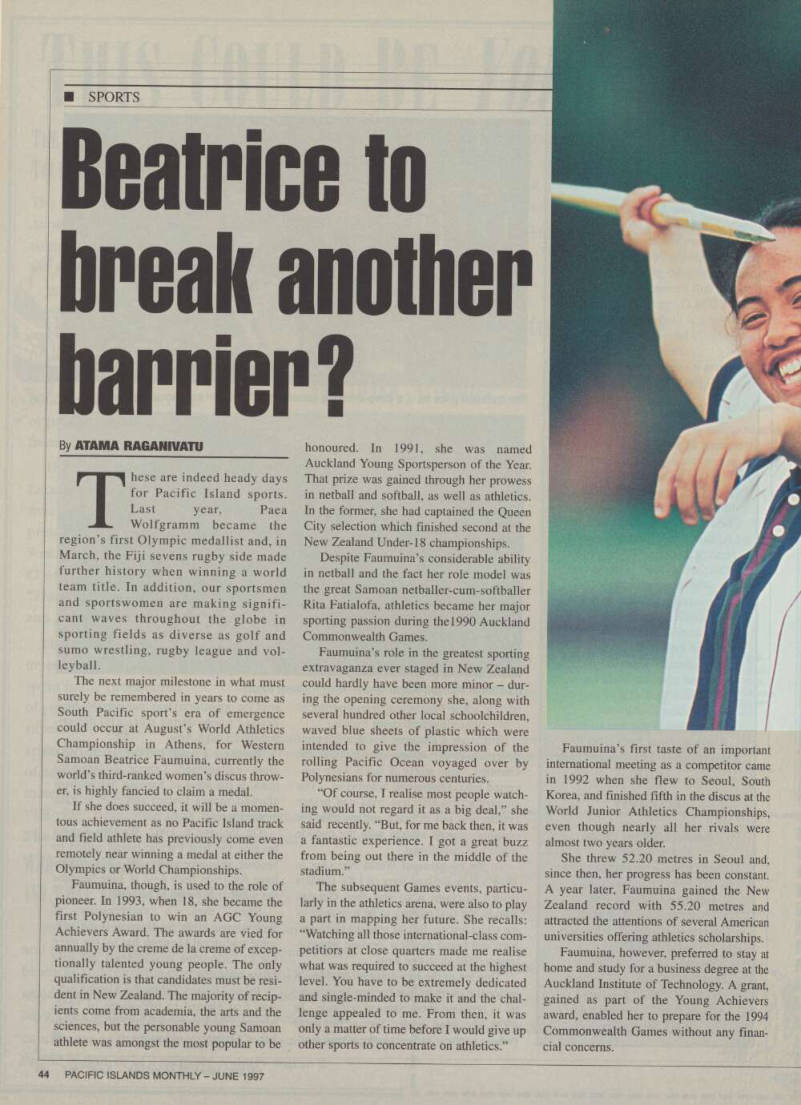
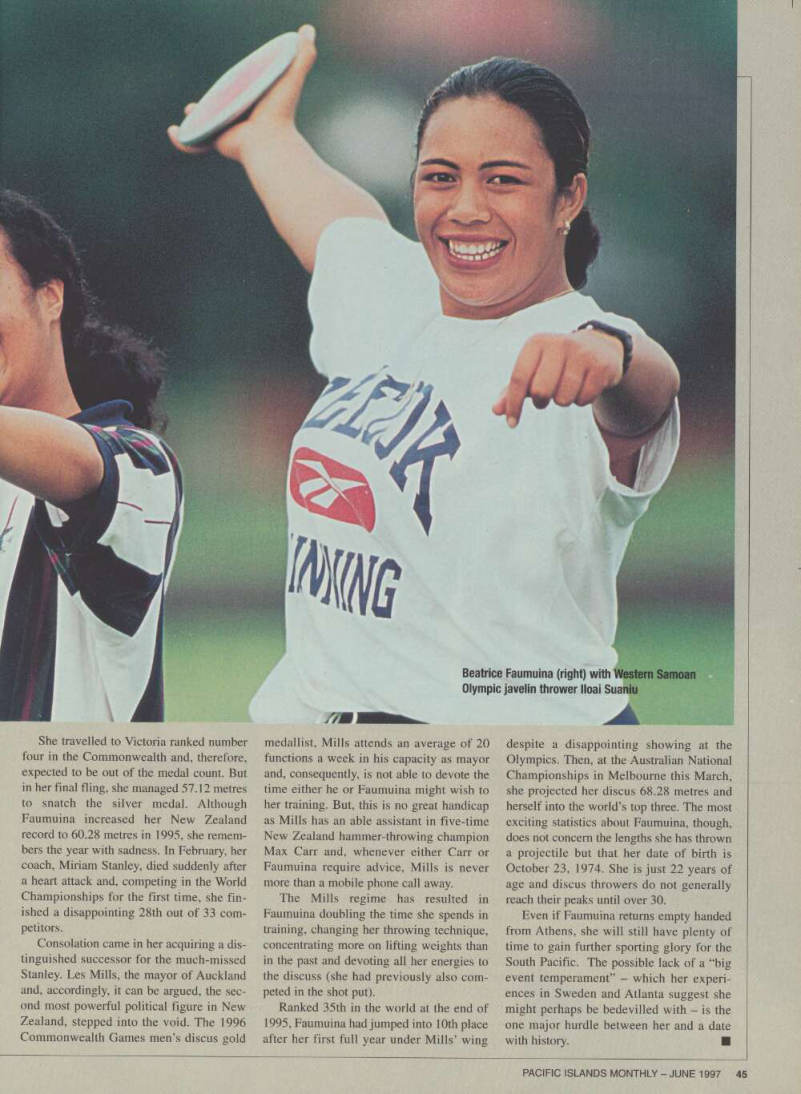
Beatrice Faumuina (right) with Western Samoan Olympic javelin thrower lloai Suaniu