Pressing for freedom
p. 36 · Read in the full issue
Media
Pressing for freedom FSM’s free speech vs cultural sensitivity debate
By Susan Prokop
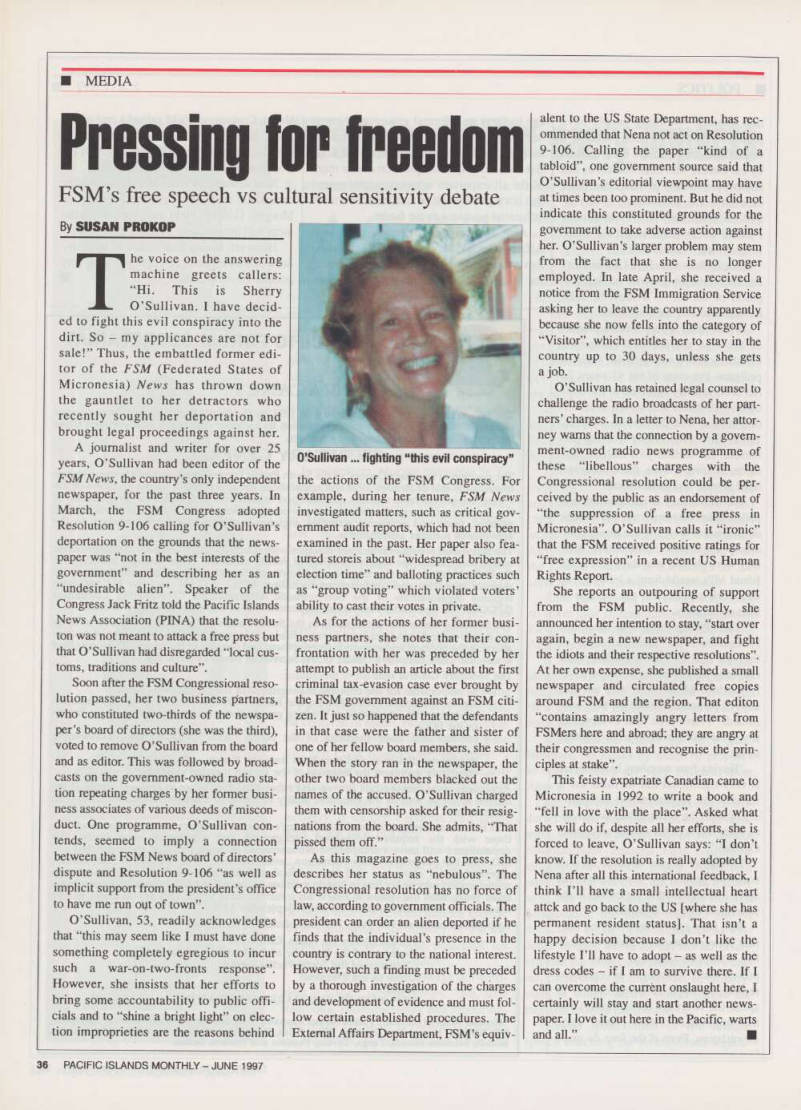
The voice on the answering machine greets callers: “Hi. This is Sherry O’Sullivan. I have decid ed to fight this evil conspiracy into the dirt. So - my applicances are not for sale!” Thus, the embattled former edi tor of the FSM (Federated States of Micronesia) News has thrown down the gauntlet to her detractors who
recently sought her deportation and
brought legal proceedings against her.
A journalist and writer for over 25 years, O’Sullivan had been editor of the FSM News, the country’s only independent newspaper, for the past three years. In March, the FSM Congress adopted Resolution 9-106 calling for O’Sullivan’s deportation on the grounds that the news paper was “not in the best interests of the government” and describing her as an “undesirable alien”. Speaker of the Congress Jack Fritz told the Pacific Islands News Association (PINA) that the resolu ton was not meant to attack a free press but that O’Sullivan had disregarded “local cus toms, traditions and culture”.
Soon after the FSM Congressional reso lution passed, her two business partners, who constituted two-thirds of the newspa per’s board of directors (she was the third), voted to remove O’Sullivan from the board and as editor. This was followed by broad casts on the government-owned radio sta tion repeating charges by her former busi ness associates of various deeds of miscon duct. One programme, O’Sullivan con tends, seemed to imply a connection between the FSM News board of directors’ dispute and Resolution 9-106 “as well as implicit support from the president’s office to have me run out of town”.
O’Sullivan, 53, readily acknowledges that “this may seem like I must have done
something completely egregious to incur
such a war-on-two-fronts response”.
However, she insists that her efforts to
bring some accountability to public offi
cials and to “shine a bright light” on elec tion improprieties are the reasons behind
the actions of the FSM Congress. For example, during her tenure, FSM News investigated matters, such as critical gov ernment audit reports, which had not been examined in the past. Her paper also fea tured storeis about “widespread bribery at election time” and balloting practices such as “group voting” which violated voters’ ability to cast their votes in private.
As for the actions of her former busi ness partners, she notes that their con frontation with her was preceded by her attempt to publish an article about the first criminal tax-evasion case ever brought by the FSM government against an FSM citi zen. It just so happened that the defendants in that case were the father and sister of one of her fellow board members, she said.
When the story ran in the newspaper, the other two board members blacked out the names of the accused. O’Sullivan charged them with censorship asked for their resig nations from the board. She admits, “That pissed them off.”
As this magazine goes to press, she describes her status as “nebulous”. The Congressional resolution has no force of law, according to government officials. The president can order an alien deported if he finds that the individual’s presence in the country is contrary to the national interest.
However, such a finding must be preceded by a thorough investigation of the charges and development of evidence and must fol low certain established procedures. The External Affairs Department, FSM’s equiv
alent to the US State Department, has rec ommended that Nena not act on Resolution 9-106. Calling the paper “kind of a tabloid”, one government source said that O’Sullivan’s editorial viewpoint may have at times been too prominent. But he did not indicate this constituted grounds for the government to take adverse action against her. O’Sullivan’s larger problem may stem from the fact that she is no longer employed. In late April, she received a notice from the FSM Immigration Service asking her to leave the country apparently because she now fells into the category of “Visitor”, which entitles her to stay in the country up to 30 days, unless she gets
a job.
O’Sullivan has retained legal counsel to challenge the radio broadcasts of her part ners’ charges. In a letter to Nena, her attor ney warns that the connection by a govern ment-owned radio news programme of these “libellous” charges with the Congressional resolution could be per ceived by the public as an endorsement of “the suppression of a free press in Micronesia”. O’Sullivan calls it “ironic” that the FSM received positive ratings for “free expression” in a recent US Human
Rights Report.
She reports an outpouring of support from the FSM public. Recently, she announced her intention to stay, “start over again, begin a new newspaper, and fight the idiots and their respective resolutions”.
At her own expense, she published a small newspaper and circulated free copies around FSM and the region. That editon “contains amazingly angry letters from FSMers here and abroad; they are angry at their congressmen and recognise the prin ciples at stake”.
This feisty expatriate Canadian came to Micronesia in 1992 to write a book and “fell in love with the place”. Asked what she will do if, despite all her efforts, she is forced to leave, O’Sullivan says: “I don’t know. If the resolution is really adopted by Nena after all this international feedback, I think I’ll have a small intellectual heart attck and go back to the US [where she has permanent resident status]. That isn’t a happy decision because I don’t like the lifestyle I’ll have to adopt - as well as the dress codes - if I am to survive there. If I can overcome the current onslaught here, I certainly will stay and start another news paper. I love it out here in the Pacific, warts and all.” ■
O’Sullivan...fighting “this evil conspiracy”